


EN 419221-5:2018
(Main)Protection Profiles for TSP Cryptographic Modules - Part 5: Cryptographic Module for Trust Services
Protection Profiles for TSP Cryptographic Modules - Part 5: Cryptographic Module for Trust Services
This part of EN 419221 specifies a Protection Profile for cryptographic modules suitable for use by trust service providers supporting electronic signature and electronic sealing operations, certificate issuance and revocation, time stamp operations, and authentication services, as identified by the (EU) No 910/2014 regulation of the European Parliament and of the Council on electronic identification and trust services for electronic transactions in the internal market (eIDAS) in [Regulation]. The Protection Profile also includes optional support for protected backup of keys.
The document follows the rules and conventions laid out in Common Criteria part 1 [CC1], Annex B "Specification of Protection Profiles".
Schutzprofile für kryptographische Module von Vertrauensdienstanbietern - Teil 5: Kryptographisches Modul für vertrauenswürdige Dienste
Profils de protection pour les modules cryptographiques de prestataires de services de confiance - Partie 5: Module cryptographique pour les services de confiance
La présente partie de l’EN 419221 spécifie un Profil de Protection pour modules cryptographiques qui est destiné à être adapté à une utilisation par les prestataires de services de confiance prenant en charge les opérations de signatures et cachets électroniques, la délivrance et révocation de certificats, les opérations d'horodatage et les services d’authentification, telles qu’identifiées par le Règlement (UE) N° 910/2014 du Parlement européen sur l’identification électronique et les services de confiance pour les transactions électroniques au sein du marché intérieur [Règlement (UE) n° 910/2014 eIDAS] dans [10]. Le présent Profil de Protection couvre également la prise en charge facultative de la sauvegarde des clés protégées.
Le présent document applique les règles et conventions fixées dans les Critères Communs, Partie 1 [CC1], Annexe B « Spécification des profils de protection » (Common Criteria part 1 [CC1], Annex B « Specification of Protection Profiles »).
Zaščitni profili za ponudnike storitev zaupanja za kriptografske module - 5. del: Kriptografski modul za storitve zaupanja
Ta novi del standarda TS 419 221 (419221-5) določa zaščitni profil za kriptografske module, ki jih uporabljajo ponudniki storitev zaupanja ter ki podpirajo elektronske postopke podpisovanja in pečatenja in storitve za preverjanje pristnosti. Ta zaščitni profil vključuje podporo za varnostno kopiranje ključev. Ta zaščitni profil je namenjen zagotavljanju podpore ponudnikom storitev zaupanja, kot so opredeljeni v predlagani uredbi Evropskega parlamenta in Sveta o elektronski identifikaciji in storitvah zaupanja za elektronske transakcije na notranjem trgu (eIDAS). Opomba: Ta uredba naj bi zamenjala Direktivo 1999/93. Bila je potrjena v trialogih med Svetom, Komisijo in parlamentom, s strani Odbora stalnih predstavnikov [Sveta] (COREPER) in bo obravnavana v Evropskem parlamentu 3. aprila. Med ponudniki storitev zaupanja, ki so zajeti v uredbi, so tisti, ki omogočajo časovne žige, elektronske žige in elektronske podpise.
General Information
- Status
- Published
- Publication Date
- 01-May-2018
- Withdrawal Date
- 29-Nov-2018
- Drafting Committee
- CEN/TC 224/WG 17 - Protection Profiles in the context of SSCD
- Current Stage
- 9093 - Decision to confirm - Review Enquiry
- Start Date
- 27-Jun-2024
- Completion Date
- 14-Apr-2025
Overview
EN 419221-5:2018 - "Protection Profiles for TSP Cryptographic Modules - Part 5: Cryptographic Module for Trust Services" (CEN) defines a Common Criteria protection profile for cryptographic modules used by trust service providers (TSPs) under the EU eIDAS regulation ((EU) No 910/2014). The profile covers modules that perform electronic signature and seal creation, certificate issuance and revocation, time-stamping, authentication services, and includes optional support for protected backup of keys. The document follows Common Criteria Part 1, Annex B ("Specification of Protection Profiles").
Key Topics and Requirements
The standard defines security functional requirements (SFRs), assurance components and a security problem definition tailored to TSP cryptographic modules. Major technical topics include:
- Cryptographic support (FCS): approved algorithms, key lifecycle management, secure import/export and key usage constraints.
- Random number generation (FCS_RNG): quality requirements and extended definitions for RNG behaviour.
- Identification & authentication (FIA): user and operator authentication controls for access to cryptographic functions.
- User data protection (FDP): confidentiality and integrity of sensitive client application data and plaintext secret keys.
- Trusted path / channels (FTP): secure channels between the module and client applications or management entities.
- Protection of the TSF (FPT): tamper detection, failure detection, and self-test requirements.
- Security management (FMT): secure administration, key attribute control, and role-based management.
- Security audit (FAU): generation and protection of audit trails.
- Security assurance requirements (SARs): evaluation evidence, including AVA_VAN.5 (advanced vulnerability analysis) for high-assurance environments.
The standard maps threats, objectives and SFRs to the operational environment and provides rationale for conformance to Common Criteria.
Applications and Who Uses It
EN 419221-5:2018 is intended for:
- Trust Service Providers (TSPs) implementing eIDAS-compliant cryptographic modules for qualified signatures/seals, time stamping, certificate lifecycle management and authentication.
- Product developers and hardware/firmware vendors designing HSMs, crypto-APIs or secure modules to meet eIDAS and Common Criteria expectations.
- Security evaluators and certification bodies performing Protection Profile-based Common Criteria evaluations.
- Auditors, integrators and regulated service operators who must validate that cryptographic modules satisfy key lifecycle, backup, tamper and audit requirements.
Practical benefits include standardized assurance of key protection, interoperable cryptographic behaviours, and evidence for regulatory compliance under eIDAS.
Related Standards
- Regulation (EU) No 910/2014 (eIDAS) - defines qualified trust services and regulatory context.
- Common Criteria (CC), Part 1, Annex B - methodology for Protection Profiles.
- EN 419221 series - related protection profiles for TSP cryptographic modules (this document is Part 5).

Frequently Asked Questions
EN 419221-5:2018 is a standard published by the European Committee for Standardization (CEN). Its full title is "Protection Profiles for TSP Cryptographic Modules - Part 5: Cryptographic Module for Trust Services". This standard covers: This part of EN 419221 specifies a Protection Profile for cryptographic modules suitable for use by trust service providers supporting electronic signature and electronic sealing operations, certificate issuance and revocation, time stamp operations, and authentication services, as identified by the (EU) No 910/2014 regulation of the European Parliament and of the Council on electronic identification and trust services for electronic transactions in the internal market (eIDAS) in [Regulation]. The Protection Profile also includes optional support for protected backup of keys. The document follows the rules and conventions laid out in Common Criteria part 1 [CC1], Annex B "Specification of Protection Profiles".
This part of EN 419221 specifies a Protection Profile for cryptographic modules suitable for use by trust service providers supporting electronic signature and electronic sealing operations, certificate issuance and revocation, time stamp operations, and authentication services, as identified by the (EU) No 910/2014 regulation of the European Parliament and of the Council on electronic identification and trust services for electronic transactions in the internal market (eIDAS) in [Regulation]. The Protection Profile also includes optional support for protected backup of keys. The document follows the rules and conventions laid out in Common Criteria part 1 [CC1], Annex B "Specification of Protection Profiles".
EN 419221-5:2018 is classified under the following ICS (International Classification for Standards) categories: 35.040 - Information coding; 35.040.01 - Information coding in general; 35.240.30 - IT applications in information, documentation and publishing. The ICS classification helps identify the subject area and facilitates finding related standards.
EN 419221-5:2018 is associated with the following European legislation: EU Directives/Regulations: 910/2014; Standardization Mandates: M/460. When a standard is cited in the Official Journal of the European Union, products manufactured in conformity with it benefit from a presumption of conformity with the essential requirements of the corresponding EU directive or regulation.
You can purchase EN 419221-5:2018 directly from iTeh Standards. The document is available in PDF format and is delivered instantly after payment. Add the standard to your cart and complete the secure checkout process. iTeh Standards is an authorized distributor of CEN standards.
Standards Content (Sample)
2003-01.Slovenski inštitut za standardizacijo. Razmnoževanje celote ali delov tega standarda ni dovoljeno.Schutzprofile für kryptographische Module von Vertrauensdienstanbietern - Teil 5: Kryptographisches Modul für vertrauenswürdige DiensteProfils de protection pour les modules cryptographiques de prestataires de services de confiance - Partie 5: Module cryptographique pour les services de confianceProtection profiles for Trust Service Provider Cryptographic modules - Part 5: Cryptographic Module for Trust Services35.240.30Uporabniške rešitve IT v informatiki, dokumentiranju in založništvuIT applications in information, documentation and publishing35.040.01Kodiranje informacij na splošnoInformation coding in generalICS:Ta slovenski standard je istoveten z:EN 419221-5:2018SIST EN 419221-5:2018en,fr,de01-julij-2018SIST EN 419221-5:2018SLOVENSKI
STANDARD
EUROPEAN STANDARD NORME EUROPÉENNE EUROPÄISCHE NORM
EN 419221-5
May
t r s z ICS
u wä r v rä r sâ
u wä t v rä u r English Version
Protection Profiles for TSP Cryptographic Modules æ Part
wã Cryptographic Module for Trust Services Profils de protection pour les modules cryptographiques de prestataires de services de confiance æ Partie
wã Module cryptographique pour les services de confiance
Schutzprofile für kryptographische Module von Vertrauensdienstanbietern æ Teil
wã Kryptographisches Modul für vertrauenswürdige Dienste This European Standard was approved by CEN on
t March
t r s zä
egulations which stipulate the conditions for giving this European Standard the status of a national standard without any alterationä Upætoædate lists and bibliographical references concerning such national standards may be obtained on application to the CENæCENELEC Management Centre or to any CEN memberä
translation under the responsibility of a CEN member into its own language and notified to the CENæCENELEC Management Centre has the same status as the official versionsä
CEN members are the national standards bodies of Austriaá Belgiumá Bulgariaá Croatiaá Cyprusá Czech Republicá Denmarká Estoniaá Finlandá Former Yugoslav Republic of Macedoniaá Franceá Germanyá Greeceá Hungaryá Icelandá Irelandá Italyá Latviaá Lithuaniaá Luxembourgá Maltaá Netherlandsá Norwayá Polandá Portugalá Romaniaá Serbiaá Slovakiaá Sloveniaá Spainá Swedená Switzerlandá Turkey and United Kingdomä
EUROPEAN COMMITTEE FOR STANDARDIZATION COMITÉ EUROPÉEN DE NORMALISATION EUROPÄISCHES KOMITEE FÜR NORMUNG
CEN-CENELEC Management Centre:
Rue de la Science 23,
B-1040 Brussels
t r s z CEN All rights of exploitation in any form and by any means reserved worldwide for CEN national Membersä Refä Noä EN
v s { t t sæ wã t r s z ESIST EN 419221-5:2018
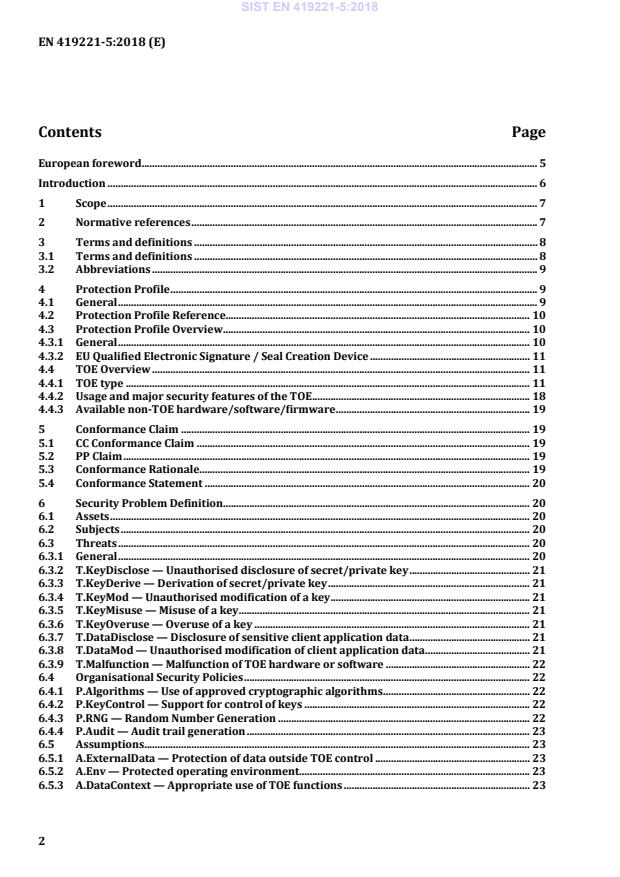
Mapping to Regulation (EU) 910/2014 . 74 Bibliography . 79
Tables Table 1 — Key Attributes Modification Table
................................................................................................. 56 Table 2 — Key Attributes Initialisation Table 82 ............................................................................................. 57 Table 3 — Security Assurance Requirements .................................................................................................. 61 Table 4 — Security Problem Definition mapping to Security Objectives ............................................... 66 Table 5 — TOE Security Objectives mapping to SFRs .................................................................................... 68 Table 6 — SFR Dependencies Rationale ............................................................................................................. 71 Table A.1— Mapping between [Regulation, Annex II] and this PP ........................................................... 74
Figures Figure 1 — Generic TOE Architecture . 12 Figure 2 — Generation of Random numbers - Component Levelling . 29 Figure 3 — Basic TSF Self Testing – Component Levelling . 30 Figure 4 — Architecture of Key Protection SFRs . 32 Figure 5 — Architecture of User, TSF Protection and Audit SFRs . 33 Figure 6 — Generic Key Lifecycle and Related SFRs . 34 SIST EN 419221-5:2018
1 As described in footnote 6, this Protection Profile includes a refinement to ADV_ARC.1 to consider support keys used in the implementation of the TOE and its protection measures. SIST EN 419221-5:2018
Figure 1 — Generic TOE Architecture The hardware appliance boundary in Figure 1 represents the enclosure of the computing appliance which hosts the TOE. This can be a server, a PC or equivalent. Local client applications reside in the same hardware appliance as the TOE, e.g. in the case of the TOE being a PCIe card inside a server, local client applications are the applications running within the same server boundary and using the TOE’s services through the PCIe bus. Another example of local client application is an embedded application running inside the physical boundary of the TOE. External client applications communicate remotely with the TOE through a network connection. In all cases, the Client Application is outside the scope of the TOE. A specific TOE will not necessarily include all of the elements shown in Figure 1. A TOE that comprises a PCIe card located in a server may have only local interfaces, e.g. for local client applications and storage of audit and TOE data within the server hardware boundary (which in this case is the hardware appliance boundary in Figure 1), but a dedicated cryptographic module might not include any such local storage and may use only external interfaces. The Security Target for each specific TOE is required to make clear what resources and channels are provided by that TOE. The TOE is intended to support the provision of cryptographic functions for use by trust service providers. SIST EN 419221-5:2018
2 In this document ‘authentication’ implies that the user is specifically identified, whereas ‘authorization’ implies that the authority of the user to use the key is established but the identity of the individual may not be known (e.g. where a single key is available to a number of individuals using a shared passphrase). As noted elsewhere, it is the responsibility of client applications to ensure that they use the correct mechanism for the context of the relevant keys and cryptographic functions. 3 More details of these requirements and the definitions of natural and legal persons can be found in [10]. 4 A TOE may provide some additional channels that provide only authentication and integrity protection, but it shall provide at least one channel that is also capable of protecting confidentiality. SIST EN 419221-5:2018
5 Some cryptographic operations, such as creating message digests, do not require keys. SIST EN 419221-5:2018
— Deletion of keys within the TOE. The TOE supports at least one of the following techniques for establishing keys7: 1) Generation of cryptographic keys using a random number generator and implementing the key generation algorithms depending on the intended use of the keys; 2) Import of cryptographic keys in encrypted form or cryptographic key components using split-knowledge procedures; 3) Key agreement protocols establishing common secrets with external entities; 4) Derivation of keys from shared knowledge. Secret keys are associated with attributes that determine their use, such that the correct association between the key and its attributes shall be protected against unauthorised modification. The specific key attributes maintained by a particular TOE are required to be specified in its Security Target. In generic terms these attributes include8: — The identifier of the key (this enables it to be linked by an application to a particular owner); — The type of the key (e.g. whether the key is a secret key of a symmetric cryptographic algorithm or the secret (commonly called private) key of an asymmetric cryptographic algorithm); — Authorization data that enables access to the key (required only for secret keys); — Re-authorization conditions such as determining a time period or number of uses of a key that are enabled by a single presentation of the correct authorization data for the key, after which the authorization will have to be re-presented in order to authorize any further uses of the key (re-authorization conditions are required only for secret keys, and may not be the same for all types of secret keys: the details of the re-authorization conditions for a specific TOE are described by completing the selections and assignments in FIA_UAU.6/KeyAuth in 9.4.3);
6 This Protection Profile distinguishes support keys from user keys, as described in the refinement to ADV_ARC.1 in 9.5.2. Requirements are placed by the Protection Profile on user keys, and support keys are considered an aspect of the TOE implementation that is therefore required to support the requirements for user keys, but where different structures and mechanisms (including aspects such as critical attributes) may be used. 7 SFRs are defined in Clause 9 only for random number generation and import; however a Security Target may add SFRs for additional techniques supported by the TOE. 8 In particular these attributes shall be sufficient to allow a secret key to be identified as one that is used to produce qualified electronic signatures and qualified electronic seals that meet the requirements of [Regulation], as interpreted for a specific TOE according to the definition in item 1 of the refinement to AGD_OPE.1 in 9.5.2. SIST EN 419221-5:2018
...
The standard EN 419221-5:2018 provides a comprehensive framework for the development and evaluation of cryptographic modules specifically designed for trust services. The scope of this standard is particularly relevant in light of the increasing reliance on digital signatures, electronic sealing, and certification processes, as mandated by the eIDAS regulation (EU) No 910/2014. By establishing a Protection Profile tailored for trust service providers, this document ensures that cryptographic modules meet stringent security requirements necessary for electronic transactions. One of the primary strengths of this standard is its alignment with the Common Criteria part 1 (CC1) guidelines, which promotes consistency and reliability in the assessment of security measures for cryptographic components. This adherence to established standards not only enhances confidence among stakeholders but also facilitates interoperability between different systems and services that utilize cryptographic technology. Additionally, EN 419221-5:2018 addresses key operational elements, including the issuance and revocation of certificates, time-stamping operations, and authentication services. This comprehensive approach reflects the diverse needs of trust service providers and supports a robust security framework essential for maintaining the integrity and authenticity of digital communications. The optional support for protected backup of keys is another noteworthy aspect, which adds a layer of resilience against data loss and unauthorized access. This feature is crucial for organizations that prioritize data integrity and availability, ensuring that cryptographic keys can be managed without compromising security. In summary, EN 419221-5:2018 stands out as a relevant and significant standard for cryptographic modules intended for trust services. Its structured approach to security evaluation and its alignment with European regulations fortify its position as a critical resource for organizations navigating the complexities of electronic transactions.
SIST EN 419221-5:2018は、信頼サービスプロバイダーによる電子署名や電子シーリング操作、証明書の発行と取り消し、タイムスタンプ操作、および認証サービスを支援するために使用できる暗号モジュールの保護プロファイルを規定しています。この標準は、EUのeIDAS規制(EU第910/2014号規則)に基づいており、内部市場における電子取引のための電子識別と信頼サービスの要件に準拠しています。 この標準の強みは、その包括性と適用範囲の広さにあります。具体的には、電子署名のための暗号化技術が要求される状況において、信頼性のある基準を提供しています。また、オプション機能としてキーの保護されたバックアップのサポートも含まれており、運用上の柔軟性を高めています。これにより、信頼サービスプロバイダーは、セキュリティの要件を満たしながら、顧客に対してより安心感を提供することが可能になります。 さらに、SIST EN 419221-5:2018は、Common Criteriaのルールと規約に従って設計されているため、その信頼性と整合性が保証されています。具体的には、保護プロファイルの仕様において明確な指針を提供することにより、暗号モジュールの設計と評価に和解をもたらします。これは、将来的な技術的進化に対しても遅れをとることなく、持続的な信頼性を確保するための基盤となります。 この標準は、信頼サービスの分野における暗号モジュールの設計、評価、運用において、重要な役割を果たすと考えられます。SIST EN 419221-5:2018は、電子取引の安全性向上に寄与し、国際的な基準にも対応可能な用途であることから、その重要性と関連性はますます高まっています。
Die Norm EN 419221-5:2018, auch als SIST EN 419221-5:2018 bekannt, definiert ein Schutzprofil für kryptographische Module, das speziell für Vertrauensdiensteanbieter entwickelt wurde. Der Geltungsbereich dieser Norm umfasst die Unterstützung von Verfahren wie elektronischer Signatur, elektronischer Siegelung, Zertifikatsausstellung und -widerruf, Zeitstempeloperationen sowie Authentifizierungsdiensten. Diese Aspekte sind im Einklang mit der EU-Verordnung Nr. 910/2014, die die Regelungen für elektronische Identifikation und Vertrauensdienste im Binnenmarkt festlegt. Ein wesentliches Merkmal der Norm ist ihre Fähigkeit, kryptographische Module zu standardisieren, die für die oben genannten Anwendungen geeignet sind. Dies stellt sicher, dass Vertrauensdiensteanbieter die benötigte Sicherheit und Zuverlässigkeit bieten, die in digitalen Transaktionen erforderlich sind. Die Norm erfüllt die Anforderungen, die aus der eIDAS-Verordnung resultieren, und ist somit besonders relevant für die Sicherstellung von Vertrauen in elektronische Dienstleistungen. Ein weiterer Vorteil dieser Norm ist die optionale Unterstützung für den geschützten Backup von Schlüsseln, was zusätzliche Sicherheit für die Kryptographie in diesen Anwendungen gewährleistet. Dies trägt zur Risikominimierung und zur Erhöhung der Widerstandsfähigkeit gegen Datenverlust oder -korruption bei, was in der heutigen digitalen Landschaft von entscheidender Bedeutung ist. Darüber hinaus orientiert sich das Dokument an den Regeln und Konventionen, die im Common Criteria Teil 1 (CC1) sowie im Anhang B „Spezifikation von Schutzprofilen“ festgelegt sind. Dies bedeutet, dass die Norm den internationalen Standards für IT-Sicherheit folgt und somit eine weitreichende Akzeptanz und Glaubwürdigkeit im globalen Kontext genießen kann. Insgesamt bietet die EN 419221-5:2018 ein umfassendes und robustes Rahmenwerk für die Entwicklung und Implementierung sicherer kryptographischer Lösungen für Vertrauensdiensteanbieter, die in der modernen digitalisierten Wirtschaft von großer Bedeutung sind.
Le document SIST EN 419221-5:2018 définit un Profil de Protection pour les modules cryptographiques, spécifiquement conçu pour les fournisseurs de services de confiance. Ce standard s'inscrit pleinement dans le cadre de la réglementation (UE) n° 910/2014 sur l'identification électronique et les services de confiance, répondant à un besoin croissant de sécurité dans les transactions électroniques. L'un des principaux atouts de ce standard est sa portée claire, qui englobe les opérations de signature électronique, de scellement électronique, d'émission et de révocation de certificats, ainsi que des services d'authentification. Ces éléments en font un outil essentiel pour garantir la conformité aux exigences de sécurité requises par la législation européenne. En outre, le standard prévoit un support optionnel pour la sauvegarde sécurisée des clés, renforçant ainsi la protection des données sensibles. Un autre point fort de ce document est son alignement avec les règles et conventions établies dans les Critères Communs, notamment la partie 1 [CC1], Annexe B, relative à la "Spécification des Profils de Protection". Cela assure une rigueur méthodologique et une reconnaissance internationale pour les entités qui adoptent cette norme. SIST EN 419221-5:2018 est également crucial pour aider les fournisseurs de services de confiance à établir des systèmes robustes et fiables, nécessaires à l'intégrité des transactions électroniques. En abordant de manière exhaustive les exigences techniques et opérationnelles des modules cryptographiques, ce standard renforce leur pertinence et leur adoption à travers l'Europe, en offrant une solution viable dans un paysage numérique de plus en plus complexe. En somme, le standard SIST EN 419221-5:2018 s'affirme comme une référence incontournable pour les fournisseurs de services de confiance, offrant un cadre solide pour la mise en œuvre de solutions cryptographiques sûres et conformes aux normes réglementaires établies.
SIST EN 419221-5:2018 표준은 신뢰 서비스 제공자가 전자 서명 및 전자 봉인 작업, 인증서 발급 및 해지, 타임스탬프 작업, 인증 서비스 등을 지원하는 데 적합한 암호 모듈에 대한 보호 프로필을 명확히 정의하고 있습니다. 이 표준은 유럽 의회 및 이사회의 전자 거래를 위한 전자 식별 및 신뢰 서비스에 관한 (EU) No 910/2014 규정(eIDAS)에 의해 요구되는 기준을 충족하도록 설계되었습니다. 특히, 이 표준의 강점은 신뢰 서비스 제공자가 직면할 수 있는 다양한 보안 요구조건에 적합하도록 암호 모듈의 보호 메커니즘을 체계적으로 규명하고 있다는 점입니다. 표준은 전자 서명 및 관련 인증 서비스를 위한 암호화된 데이터 보호를 강화하며, 이러한 요소는 전자 거래의 안전성을 확보하는 데 중요한 역할을 합니다. 또한, SIST EN 419221-5:2018 문서는 Common Criteria part 1 [CC1]의 규칙 및 관행에 따라 작성되어, 표준의 신뢰성과 투명성을 더욱 높이고 있습니다. 보안 요구사항의 명확한 규명과 함께, 키의 보호 백업을 위한 선택적 지원 기능도 포함되어 있어, 잠재적인 데이터 손실 위험에 대비하는 데 유용합니다. 종합적으로 볼 때, SIST EN 419221-5:2018 표준은 전자 거래의 보안성을 높이는 데 필수적인 암호 모듈을 위한 견고한 기반을 제공하며, 신뢰 서비스 제공자가 준수해야 할 필수 요건과 안전망을 명확하게 제시하고 있습니다. 이러한 점은 디지털 신뢰 환경의 발전에 중대한 기여를 할 것으로 기대됩니다.
Questions, Comments and Discussion
Ask us and Technical Secretary will try to provide an answer. You can facilitate discussion about the standard in here.
Loading comments...