

prEN 341
(Main)Personal fall protection equipment - Descender devices for rescue
General Information
- Abstract
This document specifies requirements, test methods, marking and manufacturer’s instructions and information for descender devices fitted with a built-in speed-regulating system, which include descent lines (hereinafter referred to as lines). These descender devices are intended to be used in a rescue system to provide protection against falling from a height when accessing/leaving positions at a height.
This document does not specify requirements for descender devices that are used for descending in mountaineering, rope access or work positioning systems.
- Status
- Not Published
- Publication Date
- 17-Jun-2026
- Technical Committee
- CEN/TC 160 - Protection against falls from height including working belts
- Current Stage
- 4599 - Dispatch of FV draft to CMC - Finalization for Vote
- Start Date
- 30-Jul-2026
- Due Date
- 08-May-2026
- Completion Date
- 30-Jul-2026

Overview
prEN 341 (CEN) - Personal fall protection equipment - Descender devices for rescue - specifies requirements, test methods, marking and manufacturer’s information for descender devices fitted with a built‑in speed‑regulating system (including the descent line). The standard covers devices intended for use in rescue systems to protect persons from falling when accessing or leaving positions at height. It does not cover descenders used for mountaineering, rope access or work‑positioning systems.
Key topics and technical requirements
- Device types
- Type 1 (automatic): built‑in speed regulation that requires no user intervention once descent starts.
- Type 2 (manually‑operated): speed regulation requires user input (includes descent control elements; panic locking also defined).
- Performance classes
- Devices are classified (A, B, C, D) by their descent energy capability and intended number of descents; class D is limited to a single descent. Exact energy thresholds and classification rules are defined in the standard.
- Lines (descent ropes/webbing)
- Permitted line materials: steel or stainless‑steel wire rope, textile kernmantel rope, or webbing. Terminations and end stops, protection against unintended slipping, and inspection requirements are specified.
- Loads
- Manufacturers must specify minimum rated load and maximum rated load (maximum shall be at least 100 kg when tested).
- Design, materials and user safety
- Materials in contact with skin must not cause harm. Edges must not damage ropes or users. Where a rescue lifting function exists, additional conformity to EN 1496:2017 (class A) is required.
- Tests and verification
- The standard defines dynamic strength, static strength, function tests (including conditioning), descent energy tests, line integrity, operating and blocking forces, and corrosion resistance (e.g., salt spray).
- Marking and documentation
- Required marking, user instructions, maintenance, inspection guidance and manufacturer information are specified.
Practical applications
- Use prEN 341 to design, evaluate, certify or procure rescue descender devices for emergency evacuation or rescue at height (e.g., emergency descent systems on industrial installations, cable cars, or building evacuation systems).
- Valuable for manufacturers, product designers, testing laboratories, conformity assessment bodies, health & safety managers and procurement teams responsible for fall protection equipment and rescue planning.
Who should use this standard
- Manufacturers of descender devices and descent lines
- Test laboratories and certification bodies
- Safety engineers, rescue teams and asset owners specifying rescue equipment
- Procurement officers ensuring compliance with CEN requirements
Related standards
- EN 363 (personal fall protection systems)
- EN 1496 (rescue lifting devices)
- EN 1891 (low‑stretch ropes)
- EN 362 (connectors)
- EN ISO 9227 (corrosion/salt spray tests)
Keywords: prEN 341, descender devices, personal fall protection, rescue descender, built‑in speed‑regulating system, descent lines, CEN standard, fall protection equipment.
Relations
- Effective Date
- 19-Jan-2023
Get Certified
Connect with accredited certification bodies for this standard

CIS Institut d.o.o.
Personal Protective Equipment (PPE) certification body. Notified Body NB-2890 for EU Regulation 2016/425 PPE.

Kiwa BDA Testing
Building and construction product certification.
Kmetijski inštitut Slovenije
Agricultural Institute of Slovenia. Soil testing, plant health, agricultural product analysis.
Sponsored listings
Frequently Asked Questions
prEN 341 is a draft published by the European Committee for Standardization (CEN). Its full title is "Personal fall protection equipment - Descender devices for rescue". This standard covers: This document specifies requirements, test methods, marking and manufacturer’s instructions and information for descender devices fitted with a built-in speed-regulating system, which include descent lines (hereinafter referred to as lines). These descender devices are intended to be used in a rescue system to provide protection against falling from a height when accessing/leaving positions at a height. This document does not specify requirements for descender devices that are used for descending in mountaineering, rope access or work positioning systems.
This document specifies requirements, test methods, marking and manufacturer’s instructions and information for descender devices fitted with a built-in speed-regulating system, which include descent lines (hereinafter referred to as lines). These descender devices are intended to be used in a rescue system to provide protection against falling from a height when accessing/leaving positions at a height. This document does not specify requirements for descender devices that are used for descending in mountaineering, rope access or work positioning systems.
prEN 341 is classified under the following ICS (International Classification for Standards) categories: 13.340.60 - Protection against falling and slipping; 13.340.99 - Other protective equipment. The ICS classification helps identify the subject area and facilitates finding related standards.
prEN 341 has the following relationships with other standards: It is inter standard links to EN 341:2011. Understanding these relationships helps ensure you are using the most current and applicable version of the standard.
prEN 341 is associated with the following European legislation: EU Directives/Regulations: 2016/425; Standardization Mandates: M/571, M/571 Amd 1. When a standard is cited in the Official Journal of the European Union, products manufactured in conformity with it benefit from a presumption of conformity with the essential requirements of the corresponding EU directive or regulation.
prEN 341 is available in PDF format for immediate download after purchase. The document can be added to your cart and obtained through the secure checkout process. Digital delivery ensures instant access to the complete standard document.
Standards Content (Sample)
SLOVENSKI STANDARD
01-april-2025
Osebna varovalna oprema za zaščito pred padci z višine - Naprave za spuščanje
ob reševanju
Personal fall protection equipment - Descender devices for rescue
Persönliche Absturzschutzausrüstung - Abseilgeräte zum Retten
Équipement de protection individuelle contre les chutes - Descendeurs pour sauvetage
Ta slovenski standard je istoveten z: prEN 341
ICS:
13.340.60 Zaščita pred padci in zdrsi Protection against falling and
slipping
2003-01.Slovenski inštitut za standardizacijo. Razmnoževanje celote ali delov tega standarda ni dovoljeno.
DRAFT
EUROPEAN STANDARD
NORME EUROPÉENNE
EUROPÄISCHE NORM
January 2025
ICS 13.340.99 Will supersede EN 341:2011
English Version
Personal fall protection equipment - Descender devices for
rescue
Persönliche Absturzschutzausrüstung - Abseilgeräte
zum Retten
This draft European Standard is submitted to CEN members for enquiry. It has been drawn up by the Technical Committee
CEN/TC 160.
If this draft becomes a European Standard, CEN members are bound to comply with the CEN/CENELEC Internal Regulations
which stipulate the conditions for giving this European Standard the status of a national standard without any alteration.
This draft European Standard was established by CEN in three official versions (English, French, German). A version in any other
language made by translation under the responsibility of a CEN member into its own language and notified to the CEN-CENELEC
Management Centre has the same status as the official versions.
CEN members are the national standards bodies of Austria, Belgium, Bulgaria, Croatia, Cyprus, Czech Republic, Denmark, Estonia,
Finland, France, Germany, Greece, Hungary, Iceland, Ireland, Italy, Latvia, Lithuania, Luxembourg, Malta, Netherlands, Norway,
Poland, Portugal, Republic of North Macedonia, Romania, Serbia, Slovakia, Slovenia, Spain, Sweden, Switzerland, Türkiye and
United Kingdom.
Recipients of this draft are invited to submit, with their comments, notification of any relevant patent rights of which they are
aware and to provide supporting documentation.
Warning : This document is not a European Standard. It is distributed for review and comments. It is subject to change without
notice and shall not be referred to as a European Standard.
EUROPEAN COMMITTEE FOR STANDARDIZATION
COMITÉ EUROPÉEN DE NORMALISATION
EUROPÄISCHES KOMITEE FÜR NORMUNG
CEN-CENELEC Management Centre: Rue de la Science 23, B-1040 Brussels
© 2025 CEN All rights of exploitation in any form and by any means reserved Ref. No. prEN 341:2025 E
worldwide for CEN national Members.
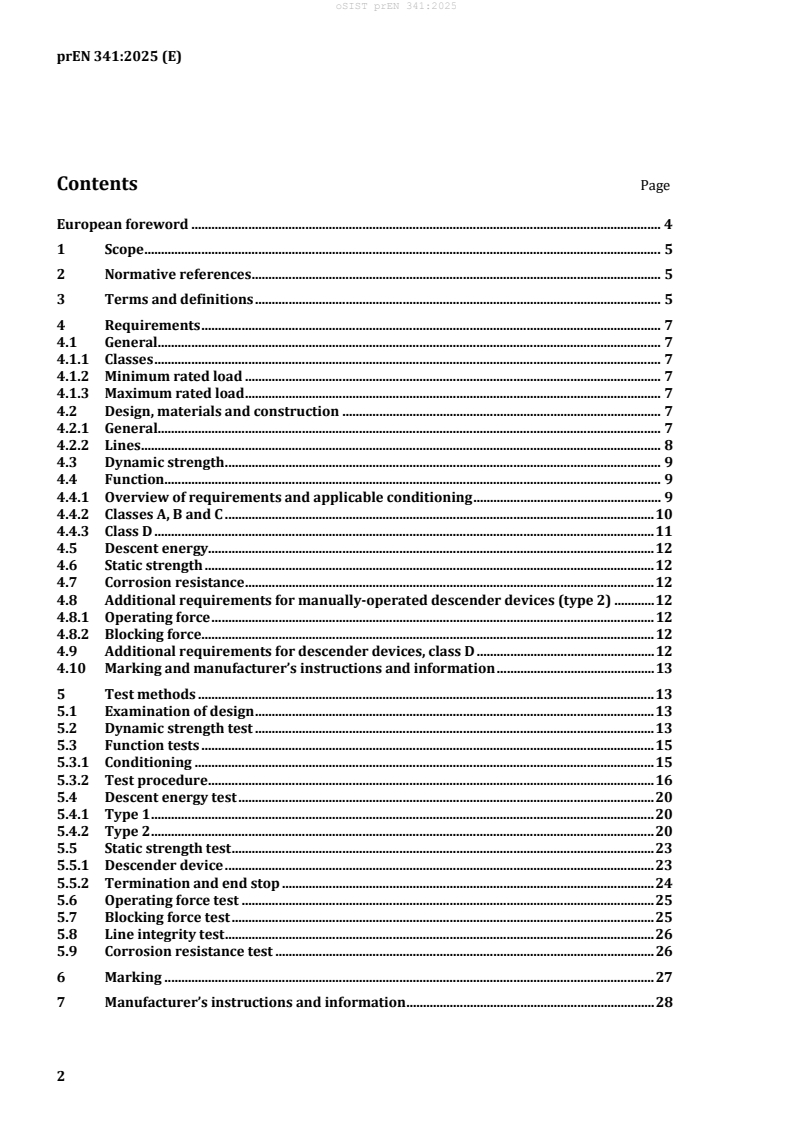
Contents Page
European foreword . 4
1 Scope . 5
2 Normative references . 5
3 Terms and definitions . 5
4 Requirements . 7
4.1 General. 7
4.1.1 Classes . 7
4.1.2 Minimum rated load . 7
4.1.3 Maximum rated load . 7
4.2 Design, materials and construction . 7
4.2.1 General. 7
4.2.2 Lines . 8
4.3 Dynamic strength . 9
4.4 Function . 9
4.4.1 Overview of requirements and applicable conditioning . 9
4.4.2 Classes A, B and C . 10
4.4.3 Class D . 11
4.5 Descent energy. 12
4.6 Static strength . 12
4.7 Corrosion resistance . 12
4.8 Additional requirements for manually-operated descender devices (type 2) . 12
4.8.1 Operating force . 12
4.8.2 Blocking force. 12
4.9 Additional requirements for descender devices, class D . 12
4.10 Marking and manufacturer’s instructions and information . 13
5 Test methods . 13
5.1 Examination of design . 13
5.2 Dynamic strength test . 13
5.3 Function tests . 15
5.3.1 Conditioning . 15
5.3.2 Test procedure . 16
5.4 Descent energy test . 20
5.4.1 Type 1 . 20
5.4.2 Type 2 . 20
5.5 Static strength test . 23
5.5.1 Descender device . 23
5.5.2 Termination and end stop . 24
5.6 Operating force test . 25
5.7 Blocking force test . 25
5.8 Line integrity test . 26
5.9 Corrosion resistance test . 26
6 Marking . 27
7 Manufacturer’s instructions and information . 28
Annex A (informative) Significant technical changes between this document and EN 341:2011
................................................................................................................................................................... 29
Annex B (informative) Background and rationale about the changes between this document
and EN 341:2011 . 31
Annex ZA (informative) Relationship between this European Standard and the essential
requirements of Regulation (EU) 2016/425 aimed to be covered . 33
Bibliography . 35
European foreword
This document (prEN 341:2025) has been prepared by Technical Committee CEN/TC 160 Protection
against falls from height including working belts”, the secretariat of which is held by DIN.
This document is currently submitted to the CEN Enquiry.
This document will supersede EN 341:2011.
A list of technical changes between this edition and EN 341:2011 is given in Annex A. Background and
rationale about the changes between this edition and EN 341:2011 is given in Annex B.
This document has been prepared under a standardization request addressed to CEN by the European
Commission. The Standing Committee of the EFTA States subsequently approves these requests for its
Member States.
For the relationship with EU Legislation, see informative Annex ZA, which is an integral part of this
document.
1 Scope
This document specifies requirements, test methods, marking and manufacturer’s instructions and
information for descender devices fitted with a built-in speed-regulating system, which include descent
lines (hereinafter referred to as lines). These descender devices are intended to be used in a rescue
system to provide protection against falling from a height when accessing/leaving positions at a height.
This document does not specify requirements for descender devices that are used for descending in
mountaineering, rope access or work positioning systems.
2 Normative references
The following documents are referred to in the text in such a way that some or all of their content
constitutes requirements of this document. For dated references, only the edition cited applies. For
undated references, the latest edition of the referenced document (including any amendments) applies.
EN 363:2018, Personal fall protection equipment — Personal fall protection systems
EN 364:1992, Personal protective equipment against falls from a height — Test methods
EN 365:2004, Personal protective equipment against falls from a height — General requirements for
instructions for use, maintenance, periodic examination, repair, marking and packaging
EN 1496:2017, Personal fall protection equipment — Rescue lifting devices
EN 1891:1998, Personal protective equipment for the prevention of falls from a height — Low stretch
kernmantel ropes
EN 12385-1:2002+A1:2008, Steel wire ropes — Safety — Part 1: General requirements
EN ISO 9227:2022, Corrosion tests in artificial atmospheres — Salt spray tests (ISO 9227:2022)
3 Terms and definitions
For the purposes of this document, the terms and definitions of EN 363:2018 and the following apply.
ISO and IEC maintain terminology databases for use in standardization at the following addresses:
— ISO Online browsing platform: available at https://www.iso.org/obp/
— IEC Electropedia: available at https://www.electropedia.org/
3.1
descender device
automatic (type 1) or manually-operated (type 2) device, including a line, by which persons can, at a
limited velocity, rescue themselves, themselves and others or solely others from a higher to a lower
position in such a way that a free fall is prevented
Note 1 to entry: In this document the term “device” is used to refer to the descender device without the line.
Note 2 to entry: The device can be designed for a line made from e.g. wire rope, textile rope, or webbing.
As impacted by EN 364:1992/AC:1993
As impacted by EN 365:2004/AC:2006
As impacted by EN ISO 9227:2022/A1:2024
3.1.1
automatic descender device (type 1)
descender device with a built-in speed-regulating system that does not require an intervention by the
user once the descent has commenced
3.1.2
manually-operated descender device (type 2)
descender device with a built-in speed-regulating system that requires an intervention by the user
3.1.3
built-in speed-regulating system
integral braking system of the descender device used to control the velocity of the descent for type 1 and
to stop the descent with hands-off for type 2
3.1.4
descent control element
integral element of the manually-operated descender device, used to control the built-in speed regulating
system
Note 1 to entry: A handle is an example for a descent control element.
3.1.5
panic locking element
integral part or function of the control device which stops the descent and thereby prevents an
uncontrolled descent or a fall if the user panics and operates the descender device beyond its intended
control parameters
3.1.6
attachment point
point at the descender device for connection of the user or to the anchor point
3.2
descent energy
energy measured in joules and expressed as W, which results from the product of the descent load, the
gravity, the descent height and the number of descents
Note 1 to entry: Descent energy W = m × g × h × n
where
W is the descent energy, expressed in joules (J);
m is the descent load, expressed in kilograms (kg);
g is the gravity 9,81 m/s ;
h is the descent height, expressed in metres (m);
n is the number of descents.
3.3
minimum rated load
minimum mass of the person(s), excluding tools and equipment, for the descender device, as specified by
the manufacturer
Note 1 to entry: Minimum rated load is expressed in kilograms.
3.4
maximum rated load
maximum mass of the person(s), including tools and equipment, for the descender device, as specified by
the manufacturer
Note 1 to entry: Maximum rated load is expressed in kilograms.
3.5
man-made fibre
fibre obtained by a manufacturing process
Note 1 to entry: For more information on man-made fibres, refer to ISO/TR 11827:2012.
4 Requirements
4.1 General
4.1.1 Classes
Descender devices are classified as follows:
a) class A: descent energy W ≥ 7,5 × 10 J;
b) class B: descent energy W ≥ 1,5 × 10 J;
c) class C: descent energy W ≥ 0,5 × 10 J;
d) class D: For only one descent. Descent energy depends on the maximum descent height and the
maximum rated load.
NOTE In practice, descender devices are subjected to different loads. A descender device for descending, e.g.
100 passengers from a cable car at a height of 100 m, has to meet more severe requirements than a descender device
used by a crane driver to descend by himself from a height of 20 m only once.
4.1.2 Minimum rated load
The minimum rated load shall be specified by the manufacturer when tested in accordance with 5.1.
4.1.3 Maximum rated load
The maximum rated load shall be specified by the manufacturer and shall be at least 100 kg when tested
in accordance with 5.1.
4.2 Design, materials and construction
4.2.1 General
Materials which can come into contact with the skin of a user shall not be known to, or suspected to,
adversely affect user hygiene or health, e.g. cause irritating or sensitization effects, during normal use of
the descender device.
Descender devices shall not have sharp or rough edges that can cut, abrade or otherwise damage rope or
webbing or cause injury to the user.
When descender devices in accordance with this standard have a rescue lifting function, they shall in
addition to this document conform to EN 1496:2017, class A.
Suitable connectors shall be used (e.g. a connector conforming to EN 362:2004).
These requirements shall be tested in accordance with 5.1.
4.2.2 Lines
4.2.2.1 General
Lines shall be made from steel or stainless steel wire rope, textile rope or webbing.
Lines shall have at least one termination. Line ends that do not have a termination shall have an end stop.
The ends of the lines shall be protected against slipping through the device unintentionally.
Lines including their termination(s) shall be of a type capable of visual inspection or else subject to
manufacturers’ guidance for appropriate examination.
These requirements shall be tested in accordance with 5.1.
4.2.2.2 Wire rope lines
Wire rope lines shall be made from one piece and shall be stress and torsion relieved.
Wire rope lines made from steel except stainless steel shall be galvanized according to
EN 12385-1:2002+A1:2008.
The nominal tensile strength of the wires of the steel or stainless steel wire rope shall not exceed
1960 N/mm .
NOTE A limit of the nominal tensile strength is necessary, because the wires become too brittle with a higher
nominal tensile strength.
Manufacturers of descender devices should be particularly careful when selecting lines made from
stainless steel as some types of stainless steel can have unpredictable fatigue and corrosion
characteristics.
These requirements shall be tested in accordance with 5.1.
4.2.2.3 Textile rope lines
When tested in accordance with 5.1 textile rope lines for descender devices, class A, B or C shall be of
kernmantel construction and shall conform to EN 1891:1998, 4.1 to 4.10, with the requirements of type A.
4.2.2.4 Webbing lines
Webbing lines shall meet the requirements of EN 1891:1998, 4.5, 4.6 and 4.10, with the requirements of
type A.
Webbing lines shall be made from man-made fibres suitable for the use intended. The breaking tenacity
of the man-made fibre shall be known to be at least 0,6 N/tex.
The materials used for the construction of the webbing line shall be known to have a melting point of
more than 195 °C. Webbing lines made from polypropylene or polyethylene shall not be used.
These requirements shall be tested in accordance with 5.1.
4.2.2.5 Line integrity
When tested in accordance with 5.8, lines made of stainless steel wire rope or made of textiles containing
aramid fibres shall withstand a test force as given in 4.6, applied for 3 min.
4.2.2.6 Terminations, end stops
Lines shall be terminated in such a manner that they can be connected, directly or by an appropriate
connector as specified by the manufacturer, to a body holding device, e.g. a rescue harness or a rescue
loop, or to an anchor device.
Reinforcement or another method shall be used to protect terminations from concentrated wear at all
webbing-to-metal fitting interfaces.
All splices shall be secured to prevent the splice from coming open in use.
Eye splices in laid fibre rope shall consist of at least four tucks using all the yarns in the strands. The
length of the splicing tails emerging after the last tuck shall be at least one rope diameter.
Threads used for sewing shall be physically compatible with the webbing/rope, and the quality shall be
compatible to that of the webbing/rope. They shall, however, be of a contrasting shade or colour in order
to facilitate visual inspection.
When using a knot for forming a termination or as an end stop, the knot shall be secured so that it cannot
be opened without the use of a tool. The tail end of the knot shall have a minimum length of 100 mm after
testing in accordance with 5.5.2.
Webbing ends shall be sealed or otherwise prevented from unravelling.
Eye terminations of wire ropes shall be made with thimbles and by splices or with thimbles and by
pressed ferrules.
4.3 Dynamic strength
When tested in accordance with 5.2, the descender device shall not release the test mass and no part of
the descender device shall show any signs of breaking or tearing.
4.4 Function
4.4.1 Overview of requirements and applicable conditioning
An overview for the conditionings and function requirements for the different Classes and Types is given
in Table 1.
Table 1 — Overview of conditioning and function requirements
Classes A, B, C Class D
Type 1 Type 2 Type 1 Type 2
Conditioning
Full Full Full Full
5 m 5 m 5 m 5 m
length length length length
Clause 4.4.2.1.1 4.4.2.1.2 4.4.2.2.1 4.4.2.2.2 4.4.3.1.1 4.4.3.1.2 4.4.3.2.1 4.4.3.2.2
Dry
5.3.1.2 No Yes Yes Yes No Yes No Yes
conditioning
Wet
5.3.1.3 No Yes Yes Yes No O No O
conditioning
Cold
5.3.1.4 Yes No Yes No O No O No
conditioning
Wet and cold
5.3.1.5 O No O No O No O No
conditioning
O = required, if claimed by the manufacturer.
4.4.2 Classes A, B and C
4.4.2.1 Type 1
4.4.2.1.1 Type 1 — 5 m
When tested in accordance with 5.3.2.1.1.1, after cold conditioning in accordance with 5.3.1.4, the descent
shall be continuous. If the manufacturer claims the use at temperatures lower than −4 °C, the lowest
claimed temperature shall be used.
If claimed by the manufacturer, for use at wet and cold conditions, the descent shall be continuous when
conditioned in accordance with 5.3.1.5 and tested in accordance with 5.3.2.1.1.1.
If the manufacturer claims the possibility to carry out alternating descents the descender device shall be
conditioned in accordance with 5.3.1.3 and the descent shall start when tested in accordance with
5.3.2.1.1.2.
NOTE For alternating descents the wet conditioning is the most severe configuration for the weight of the line.
4.4.2.1.2 Type 1 — Full length
When tested in accordance with 5.3.2.1.2, after dry conditioning in accordance with 5.3.1.2, the average
descent velocity shall be between 0,5 m/s and 2 m/s.
When tested in accordance with 5.3.2.1.2, after wet conditioning in accordance with 5.3.1.3, the average
descent velocity shall be between 0,5 m/s and 2 m/s.
4.4.2.2 Type 2
4.4.2.2.1 Type 2 — 5 m
When tested in accordance with 5.3.2.2.1.1, after dry conditioning in accordance with 5.3.1.2, the descent
shall be controllable, and the descender device shall stop in a hands-off or any panic-grab position.
When tested in accordance with 5.3.2.2.1.1, after wet conditioning in accordance with 5.3.1.3, the descent
shall be controllable, and the descender device shall stop in a hands-off or any panic-grab position.
When tested in accordance with 5.3.2.2.1.1, after cold conditioning in accordance with 5.3.1.4, the descent
shall be controllable, and the descender device shall stop in a hands-off or any panic-grab position. If the
manufacturer claims the use at temperatures lower than −4°C, the lowest claimed temperature shall be
used.
If claimed by the manufacturer, for use at wet and cold conditions, the descent shall be controllable, and
the descender device shall stop in a hands-off or any panic-grab position when conditioned in accordance
with 5.3.1.5 and tested in accordance with 5.3.2.2.1.1.
If the manufacturer claims the possibility to carry out alternating descents the descender device shall be
conditioned in accordance with 5.3.1.3 and the descent shall start when tested in accordance with
5.3.2.2.1.2.
NOTE For alternating descents the wet conditioning is the most severe configuration for the weight of the line.
4.4.2.2.2 Type 2 — Full length
When tested in accordance with 5.3.2.2.2, after dry conditioning in accordance with 5.3.1.2, the descent
shall be adjustable and controllable.
When tested in accordance with 5.3.2.2.2, after wet conditioning in accordance with 5.3.1.3, the descent
shall be adjustable and controllable.
The parts of the descender device that are touched to control the descent shall not develop a temperature
higher than 48 °C during the descent. The descent control element shall not break.
4.4.3 Class D
4.4.3.1 Type 1
4.4.3.1.1 Type 1 — 5 m
If claimed by the manufacturer for use at cold condition or for use at temperatures lower than −4 °C, the
descent shall be continuous, and the average velocity shall be between 0,5 m/s and 2 m/s when
conditioned in accordance with 5.3.1.4 and tested in accordance with 5.3.2.1.1.1.
If claimed by the manufacturer, for use at wet and cold conditions, the descent shall be continuous, and
the average velocity shall be between 0,5 m/s and 2 m/s when conditioned in accordance with 5.3.1.5
and tested in accordance with 5.3.2.1.1.1.
When checked in accordance with 5.3.2.1.1.1 the descender device shall indicate that it has been used.
4.4.3.1.2 Type 1 — Full length
When tested in accordance with 5.3.2.1.2, after dry conditioning in accordance with 5.3.1.2, the average
descent velocity shall be between 0,5 m/s and 2 m/s.
If claimed by the manufacturer for use at wet condition the average descent velocity shall be between
0,5 m/s and 2 m/s when conditioned in accordance with 5.3.1.3 and tested in accordance with 5.3.2.1.2.
When checked in accordance with 5.3.2.1.2 the descender device shall indicate that it has been used.
4.4.3.2 Type 2
4.4.3.2.1 Type 2 — 5 m
If claimed by the manufacturer for use at cold condition or for use at temperatures lower than −4 °C, the
descent shall be controllable, the descender device shall stop in a hands-off or any panic-grab position
and shall indicate that it has been used when conditioned in accordance with 5.3.1.4 and tested in
accordance with 5.3.2.2.1.1.
If claimed by the manufacturer, for use at wet and cold conditions, the descent shall be controllable, the
descender device shall stop in a hands-off or any panic-grab position and shall indicate that it has been
used when conditioned in accordance with 5.3.1.5 and tested in accordance with 5.3.2.2.1.1.
4.4.3.2.2 Type 2 — Full length
When tested in accordance with 5.3.2.2.2, after dry conditioning in accordance with 5.3.1.2 the descent
shall be controllable.
If claimed by the manufacturer for use at wet condition the descent shall be controllable when
conditioned in accordance with 5.3.1.3 and tested in accordance with 5.3.2.2.2.
The parts of the descender device that are touched to control the descent shall not develop a temperature
higher than 48 °C during the descent. The descent control element shall not break.
4.5 Descent energy
When tested in accordance with 5.4, with the descents being carried out in succession, descender devices,
class A, B and C shall meet the following requirements:
a) The descender devices shall withstand the descent energy determined for their class;
b) for type 1 the average descent velocity shall be between 0,5 m/s and 2 m/s;
c) for type 2 it shall be possible to maintain the mass within a range of ±1 m from its initial position.
NOTE This test is not required for Class D descender devices, as they are intended for a single use only.
4.6 Static strength
When tested in accordance with 5.5.1, descender devices, class A, B and C shall withstand a test force of
5 times the maximum rated load, but at least 15 kN.
When tested in accordance with 5.5.1, descender devices, class D shall withstand a test force of twice the
maximum impact force recorded in the dynamic test of 5.2, but at least 5 times the maximum rated load.
If manually-operated descender devices are tested in several locked positions, the highest of the
measured values shall be used as a basis for establishing the static strength test force.
When tested in accordance with 5.5.2, descender devices, classes A, B, C and D shall withstand a test force
of 6 kN.
4.7 Corrosion resistance
After testing in accordance with 5.9, metal parts of the descender device shall show no evidence of
corrosion of the base metal which could affect its function, e.g. the correct operation of moving elements
and locking function. White scaling or tarnishing is acceptable if the function is not impaired.
NOTE Conformity to this requirement does not imply suitability for use in highly corrosive environments, e.g.
offshore, chemical plants.
4.8 Additional requirements for manually-operated descender devices (type 2)
4.8.1 Operating force
When tested in accordance with 5.6, with a force equal to the maximum rated load, the force required to
start the descent shall not exceed 450 N.
4.8.2 Blocking force
Descender devices, with the descent control element in blocking mode, shall withstand a force of 3 kN or
1,4-times the maximum rated load, whichever is higher, for 3 min with a maximum slippage of 300 mm
when tested in accordance with 5.7.
No part of the device shall show any signs of permanent deformation that would affect its function, and
the line shall not show any signs of tearing or breaking.
For descender device that have more than one attachment point specified by the manufacturer, each
attachment point shall be tested to this requirement.
4.9 Additional requirements for descender devices, class D
After testing in accordance with 5.3, Class D descender devices shall indicate clearly that they have been
used.
4.10 Marking and manufacturer’s instructions and information
Marking of the descender device shall be in accordance with Clause 6.
Manufacturer’s instructions and information shall be supplied with the descender device in accordance
with Clause 7.
5 Test methods
5.1 Examination of design
Confirm by reference to appropriate documentation accompanying the descender device and by
measurement and by normal or corrected vision and/or tactile examination of the descender device that
it conforms to 4.1, 4.2.1, 4.2.2.1, 4.2.2.2, 4.2.2.3 and 4.2.2.4. If necessary to examine internal parts,
dismantle the device.
5.2 Dynamic strength test
The test apparatus shall conform to EN 364:1992, 4.4.1, 4.5, 4.6 and, if applicable, to EN 364:1992, 4.4.2.
Attach a new descender device by its attachment point or the termination of the line, as appropriate, to
the anchor point of the test apparatus, in accordance with the manufacturer’s instructions and
information, see Figure 1 or Figure 2. Manually-operated descender devices shall be tested in each locked
position intended by the manufacturer and described in the manufacturer’s instructions and information.
+50
Withdraw the line by (4 000 ) mm from the descender device and attach the rigid steel test mass in
accordance with the maximum rated load to the termination of the line or to the device, as appropriate.
In the case of descender devices with an automatic retraction function, prevent the line from retracting
by a clamp.
For descender devices, class D, attach a load cell between the device and the anchor point of the test
apparatus.
+50
Raise the test mass by (600 ) mm, with a maximum horizontal distance of 300 mm from the anchor
point.
Hold th
...