


EN 13015:2001
(Main)Maintenance for lifts and escalators - Rules for maintenance instructions
Maintenance for lifts and escalators - Rules for maintenance instructions
This European Standard specifies the elements necessary for the preparation of the instructions for the maintenance operations, as in 3.1, which are provided for new installed passenger lifts, goods passenger lifts, accessible goods only lifts, service lifts, escalators and passenger conveyors.
This European Standard does not cover:
a) instructions for the installation and the dismantling;
b) any legal examinations and tests based on national regulations.
Existing installations are not covered by this Standard, but it can be taken as a reference.
Instandhaltung von Aufzügen und Fahrtreppen - Regeln für Instandhaltungsanweisungen
Diese Norm legt alle Elemente für die Erstellung der Instandhaltungsanweisungen nach 3.1 fest, welche für neuinstallierte Personenaufzüge, Lastenaufzüge, betretbare Güteraufzüge, Kleingüteraufzüge, Fahrtreppen und Fahrsteige notwendig sind.
Diese Europäische Norm gilt nicht für:
a) Anweisungen für den Einbau und die Demontage;
b) gesetzliche Prüfungen und Untersuchungen auf Grund nationaler Bestimmungen.
Bestehende Anlagen werden von dieser Norm nicht abgedeckt; hierfür kann jedoch sachdienlich von dieser Norm ausgegangen werden.
Maintenance pour les ascenseurs et les escaliers mécaniques - Règles pour les instructions de maintenance
Domaine d'application
La présente Norme Européenne spécifie les éléments nécessaires à l'élaboration des instructions pour les opérations de maintenance, telle qu'elle est définie en 3.1, et qui sont fournies pour les ascenseurs, les ascenseurs de charge, les monte charge accessibles, les monte charge inaccessibles, les escaliers mécaniques et les trottoirs roulants nouvellement installés.
La présente Norme européenne ne couvre pas :
a) les instructions pour l'installation et le démantèlement ;
b) tous examens et essais réglementaires fondés sur des règlements nationaux.
Les installations existantes ne sont pas couvertes par la présente norme, mais celle-ci peut être prise en référence.
Vzdrževanje dvigal (liftov) in tekočih stopnic - Pravila za vzdrževalna navodila
General Information
- Status
- Withdrawn
- Publication Date
- 25-Sep-2001
- Withdrawal Date
- 29-Jul-2008
- Technical Committee
- CEN/TC 10 - Passenger, goods and service lifts
- Drafting Committee
- CEN/TC 10/WG 5 - Maintenance
- Current Stage
- 9960 - Withdrawal effective - Withdrawal
- Start Date
- 30-Jul-2008
- Completion Date
- 30-Jul-2008
- Directive
- 95/16/EC - Lifts
- Directive
- 98/37/EC - Machinery
Relations
- Merged Into
EN 13015:2001+A1:2008 - Maintenance for lifts and escalators - Rules for maintenance instructions - Effective Date
- 19-Jan-2023
- Effective Date
- 28-Jan-2026
- Effective Date
- 28-Jan-2026
- Effective Date
- 28-Jan-2026



Get Certified
Connect with accredited certification bodies for this standard

ICC Evaluation Service
Building products evaluation and certification.

QAI Laboratories
Building and construction product testing and certification.

Aboma Certification B.V.
Specialized in construction, metal, and transport sectors.
Sponsored listings
Frequently Asked Questions
EN 13015:2001 is a standard published by the European Committee for Standardization (CEN). Its full title is "Maintenance for lifts and escalators - Rules for maintenance instructions". This standard covers: This European Standard specifies the elements necessary for the preparation of the instructions for the maintenance operations, as in 3.1, which are provided for new installed passenger lifts, goods passenger lifts, accessible goods only lifts, service lifts, escalators and passenger conveyors. This European Standard does not cover: a) instructions for the installation and the dismantling; b) any legal examinations and tests based on national regulations. Existing installations are not covered by this Standard, but it can be taken as a reference.
This European Standard specifies the elements necessary for the preparation of the instructions for the maintenance operations, as in 3.1, which are provided for new installed passenger lifts, goods passenger lifts, accessible goods only lifts, service lifts, escalators and passenger conveyors. This European Standard does not cover: a) instructions for the installation and the dismantling; b) any legal examinations and tests based on national regulations. Existing installations are not covered by this Standard, but it can be taken as a reference.
EN 13015:2001 is classified under the following ICS (International Classification for Standards) categories: 91.140.90 - Lifts. Escalators. The ICS classification helps identify the subject area and facilitates finding related standards.
EN 13015:2001 has the following relationships with other standards: It is inter standard links to EN 13015:2001+A1:2008, EN 115-1:2008+A1:2010, EN 81-70:2003, EN 81-28:2003. Understanding these relationships helps ensure you are using the most current and applicable version of the standard.
EN 13015:2001 is associated with the following European legislation: EU Directives/Regulations: 95/16/EC, 98/37/EC; Standardization Mandates: M/079, M/BC/CEN/92/3. When a standard is cited in the Official Journal of the European Union, products manufactured in conformity with it benefit from a presumption of conformity with the essential requirements of the corresponding EU directive or regulation.
EN 13015:2001 is available in PDF format for immediate download after purchase. The document can be added to your cart and obtained through the secure checkout process. Digital delivery ensures instant access to the complete standard document.
Standards Content (Sample)
2003-01.Slovenski inštitut za standardizacijo. Razmnoževanje celote ali delov tega standarda ni dovoljeno.Maintenance for lifts and escalators - Rules for maintenance instructionsMaintenance pour les ascenseurs et les escaliers mécaniques - Regles pour les instructions de maintenanceInstandhaltung von Aufzügen und Fahrtreppen - Regeln für InstandhaltungsanweisungenTa slovenski standard je istoveten z:EN 13015:2001SIST EN 13015:2002en91.140.90Lifts. EscalatorsICS:SLOVENSKI
STANDARDSIST EN 13015:200201-maj-2002
EUROPEAN STANDARDNORME EUROPÉENNEEUROPÄISCHE NORMEN 13015September 2001ICS 91.140.90English versionMaintenance for lifts and escalators - Rules for maintenanceinstructionsMaintenance pour les ascenseurs et les escaliersmécaniques - Règles pour les instructions de maintenanceInstandhaltung von Aufzügen und Fahrtreppen - Regeln fürInstandhaltungsanweisungenThis European Standard was approved by CEN on 21 June 2001.CEN members are bound to comply with the CEN/CENELEC Internal Regulations which stipulate the conditions for giving this EuropeanStandard the status of a national standard without any alteration. Up-to-date lists and bibliographical references concerning such nationalstandards may be obtained on application to the Management Centre or to any CEN member.This European Standard exists in three official versions (English, French, German). A version in any other language made by translationunder the responsibility of a CEN member into its own language and notified to the Management Centre has the same status as the officialversions.CEN members are the national standards bodies of Austria, Belgium, Czech Republic, Denmark, Finland, France, Germany, Greece,Iceland, Ireland, Italy, Luxembourg, Netherlands, Norway, Portugal, Spain, Sweden, Switzerland and United Kingdom.EUROPEAN COMMITTEE FOR STANDARDIZATIONCOMITÉ EUROPÉEN DE NORMALISATIONEUROPÄISCHES KOMITEE FÜR NORMUNGManagement Centre: rue de Stassart, 36
B-1050 Brussels© 2001 CENAll rights of exploitation in any form and by any means reservedworldwide for CEN national Members.Ref. No. EN 13015:2001 E
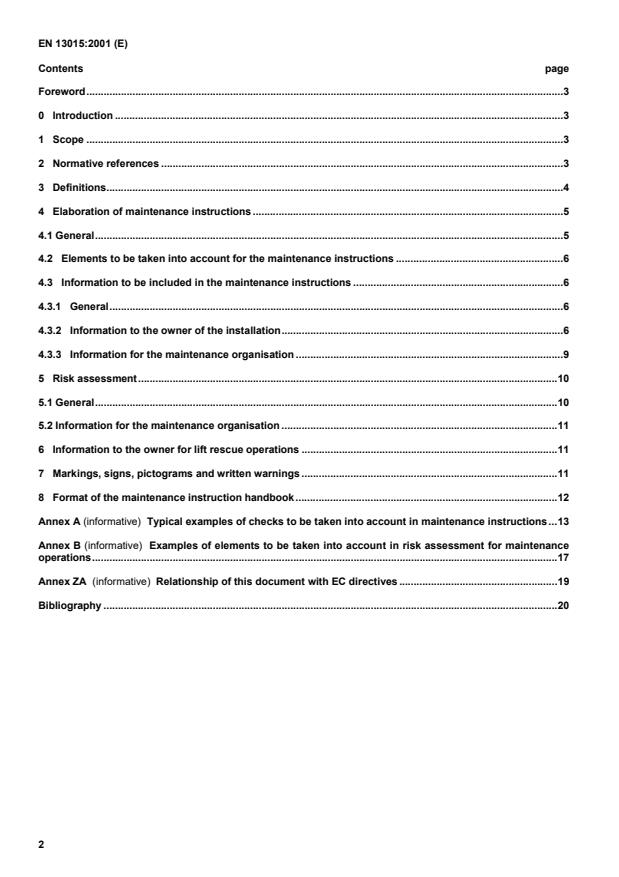
Introduction.31
Scope.32
Normative references.33
Definitions.44
Elaboration of maintenance instructions.54.1 General.54.2
Elements to be taken into account for the maintenance instructions.64.3
Information to be included in the maintenance instructions.64.3.1
General.64.3.2
Information to the owner of the installation.64.3.3
Information for the maintenance organisation.95
Risk assessment.105.1 General.105.2 Information for the maintenance organisation.116
Information to the owner for lift rescue operations.117
Markings, signs, pictograms and written warnings.118
Format of the maintenance instruction handbook.12Annex A (informative)
Typical examples of checks to be taken into account in maintenance instructions.13Annex B (informative)
Examples of elements to be taken into account in risk assessment for maintenanceoperations.17Annex ZA
(informative)
Relationship of this document with EC directives.19Bibliography.20
IntroductionThis European Standard is a type C standard as stated in EN 1070.Only correct and preventative maintenance performed by a competent maintenance person in conformity with themaintenance instructions can ensure the safe and intended functioning of an installation.In this Standard it is assumed that the installation to be maintained has been legally placed on the market.1
ScopeThis European Standard specifies the elements necessary for the preparation of the instructions for themaintenance operations, as in 3.1, which are provided for new installed passenger lifts, goods passenger lifts,accessible goods only lifts, service lifts, escalators and passenger conveyors.This European Standard does not cover:a) instructions for the installation and the dismantling;b) any legal examinations and tests based on national regulations.Existing installations are not covered by this Standard, but it can be taken as a reference.2
Normative referencesThis European Standard incorporates by dated or undated reference provisions from other publications. Thesenormative references are cited at the appropriate places in the text, and the publications are listed hereafter. Fordated references, subsequent amendments to or revisions of any of these publications apply to this EuropeanStandard only when incorporated in it by amendment or revision. For undated references, the latest edition of thepublication referred to applies (including amendments).EN 81-1, Safety rules for the construction and installation of lifts - Part 1: Electric liftsEN 81-2, Safety rules for the construction and installation of lifts - Part 2: Hydraulic liftsEN 81-3, Safety rules for the construction and installation of lifts - Part 3: Electric and hydraulic service liftsprEN 81-5, Safety rules for the construction and installation of lifts - Part 5: Screw lifts
DefinitionsFor the purposes of this Eurpean Standard, the definitions in EN 81-1, EN 81-2, EN 81-3, prEN 81-5, prEN 81-6,prEN 81-7, prEN 81-28, EN 115, EN 1050 and the following apply:3.1maintenanceall the necessary operations to ensure the safe and intended functioning of the installation and its components afterthe completion of the installation and throughout its life cycle.Maintenance includes:a)lubrication, cleaning, etc.;However, the following cleaning operations can be not considered as maintenance :1) cleaning of the external parts of the well;2) cleaning of the external parts of the escalator or passenger conveyor;3) cleaning of the inside of the car.b)checks;c)passenger rescue operations;d)the operations of setting and adjustment;e)repair or changing of components which may occur due to wear or tear and do not affect the characteristics ofthe installation.The following are not considered as maintenance operations:a)changing of a major component such as the machine, the car, the control panel, etc., or safety componentsuch as safety gear, etc., even if the characteristics of the new component are the same as the original;b)replacement of the installation;c) modernisation of the installation, including the changing of any characteristic of the installation (such as speed,load, etc.);d) rescue operations carried out by Fire Brigades3.2maintenance organisationcompany or part of company where competent maintenance person(s) carry out maintenance operations on behalfof the owner of the installation
Elaboration of maintenance instructions4.1 GeneralThe installations covered by this European Standard shall be maintained in good working order in accordance withthe installer's instructions. To this effect, regular maintenance of the installation shall be carried out, to ensure, inparticular, the safety of the installation. The safety of an installation shall take into account the ability to bemaintained without causing injury or damage to health.Regular maintenance of the installation shall be carried out to ensure the reliability of the installation.The access and the associated environment shall be maintained in good working order in accordance with theinstaller instructions.The instructions for maintenance of an installation according to the Lifts Directive shall be provided by the installer,as defined in 3.5, after completion of the installation, as a result of a risk assessment.The instructions for maintenance of the safety components of lifts shall be provided by the manufacturer to theinstaller as respectively defined in 3.4 and 3.5.The instructions for maintenance of an installation according to the Machinery Directive shall be provided by themanufacturer, as defined in 3.4, when placed on the market, and be the result of a risk assessment.In order that the aim of the maintenance instructions can be achieved, they shall be formulated so that they can beclearly and easily understood by competent maintenance persons.The competence of the maintenance person within the maintenance organisation shall be continuously updated.NOTE
The owner of the installation should be informed that the qualification of the maintenance organisation is in conformitywith the regulations applicable in the country in which the installation operates ; if no regulations exist, the qualification can be
Elements to be taken into account for the maintenance instructionsWhen preparing the content of the maintenance instructions (see 4.3, clauses 5 and 6) the following elements shallbe taken into account:a)the specifications and the intended use of the installation (type of installation, performance, type of goods to betransported, type of users, etc.);b)the environment in which the installation and its components are installed (weather conditions, vandalism,etc.);c)any restriction of use;d)the result of the risk assessment (see clause 5) for every working area and for every task to be undertaken;e)the specific maintenance instructions provided by the manufacturer of safety components;f)in case of components other than safety components, where maintenance is necessary, the maintenanceinstructions provided by the manufacturer of these components.4.3 Information to be included in the maintenance instructions4.3.1GeneralThe maintenance instructions shall contain information relating to the tasks of the owner and respectively themaintenance organisation.4.3.2
Information to the owner of the installationThe information relating to the tasks of the owner of the installation shall include the following:4.3.2.1 The need for the owner to keep the installation in a safe operating condition. To fulfil this the owner shalluse a maintenance organisation complying with the requirements of the Standard.NOTE
It is recommended to inform the owner of the installation about the need to use a maintenance organisation withadequate and proper insurance cover provided by an insurance company.4.3.2.2 The need for the owner to take care of any National regulations and other requirements, where relevant,and their implications on maintenance.4.3.2.3 The need for planned maintenance to be carried out by a maintenance organisation, at the latest when theinstallation is put into service or if the installation is to remain unused for a long period of time before first being putinto service.4.3.2.4 The importance for the owner of the installation
to have the same maintenance organisation in the case ofseveral installations having common well/spaces and/or machine room.4.3.2.5 The need for the owner of a passenger-/goods passenger lift to keep, as described in prEN 81-28, the two-way means of communication efficient and linked to a 24 h rescue service for the whole of the time that theinstallation can be used.4.3.2.6 The need for the owner to remove the passenger-/goods passenger lift from service when the two-waymeans of communication is out of order.4.3.2.7 The need for the owner to put the installation out of service in case of dangerous situations.4.3.2.8 The need for the owner of the installation to inform the maintenance organisation:
The owner of the installation should obtain from the company carrying out the relevant modification the maintenanceinstructions for the maintenance organisation.e)before any authorised third party inspection or works other than maintenance works are carried out on theinstallation;f)before taking the installation out of service for a prolonged period of time;g)before putting the installation back into service after a prolonged period of non operating time.4.3.2.9 The need for the owner of the installation to take into consideration the consequences of the riskassessment carried out by the maintenance organisation (see 4.3.3.4 and 5.1).4.3.2.10 The need for the owner of the installation to make sure that the risk assessment for maintenance is carriedout:a)if the maintenance organisation is replaced;b)if the use of the building and/or the installation changes;c)after a major modification of the installation or of the building;d)if it is the case, after an accident involving the installation.4.3.2.11 The need for the building owner to ensure, through a risk assessment, that :a)their premises are safe and free from risk to health as far as is practicable. This includes access to thepremises and installation equipment, and articles or substances used according to the regulation for the Use ofWork Equipment at the Workplace;b)the persons using the premises are informed about any remaining risks;c)any action to be done as a consequence of his risk assessment is carried out.Regarding the access ways to areas reserved to maintenance persons, the need for the owner of the installation toinform the maintenance organisation, in particular about:1) the access ways to be used and fire evacuating procedures from the building;2) the place where the keys of the reserved areas can be found;3) if necessary, the persons who shall accompany the maintenance persons to the installation;4) if necessary, personal protective equipment to be used in the access ways, and, possibly, where thisequipment can be found.The information shall be made available also on site to the maintenance organisation.4.3.2.12 The need for the owner of the installation to ensure that the name and the telephone number of themaintenance organisation are always available to the user of the installation, permanently affixed and clearlyvisible.4.3.2.13 The need for the owner of the installation to ensure that the keys of machine and pulley room doors (trapdoors) and of inspection and emergency doors (trap doors) are permanently available in the building and are usedonly by persons authorised to gain access.
...
Questions, Comments and Discussion
Ask us and Technical Secretary will try to provide an answer. You can facilitate discussion about the standard in here.
Loading comments...