


EN 12920:2006+A1:2008
(Main + Amendment)Characterization of waste - Methodology for the determination of the leaching behaviour of waste under specified conditions
General Information
- Abstract
This European Standard specifies a methodology for the determination of the leaching behaviour of a waste or a waste from the extractive industry under specified conditions (i.e. for a specified scenario including a specified time frame) in order to provide a solution to a defined problem. This applies to disposal and recovery scenarios.
NOTE 1 Recovery is the term defined in the European Waste Acts [1,3]. It includes re-use and recycling.
The external conditions which have a direct influence on the release of constituents from waste are considered. Migration of constituents leached from the disposal or the recovery site into the surrounding environment is not considered. Also the assessment of toxicity to humans or ecological impacts on flora and fauna as a secondary effect after release of constituents from the waste is not considered.
NOTE 2 Present knowledge of highly complex scenarios and wastes may limit the ability to provide a clear solution to a defined problem. An example may be the land filling of complex mixtures of wastes or the prediction of the acid generation behaviour waste from the extractive industry.
- Status
- Published
- Publication Date
- 09-Sep-2008
- Withdrawal Date
- 30-Mar-2009
- Technical Committee
- CEN/TC 444 - Environmental characterization
- Drafting Committee
- CEN/TC 444/WG 1 - Leaching tests
- Current Stage
- 9093 - Decision to confirm - Review Enquiry
- Start Date
- 11-Jul-2024
- Completion Date
- 17-Sep-2026



Overview
EN 12920:2006+A1:2008 (CEN) - "Characterization of waste - Methodology for the determination of the leaching behaviour of waste under specified conditions" - defines a stepwise methodology to determine how constituents are released (leaching behaviour) from wastes or extractive‑industry materials under a specified disposal or recovery scenario and time frame. The standard focuses on the waste‑specific release processes and modelling of leaching under defined external conditions. It does not cover migration into surrounding environments or secondary toxicity/ecological impact assessments.
Key topics and technical requirements
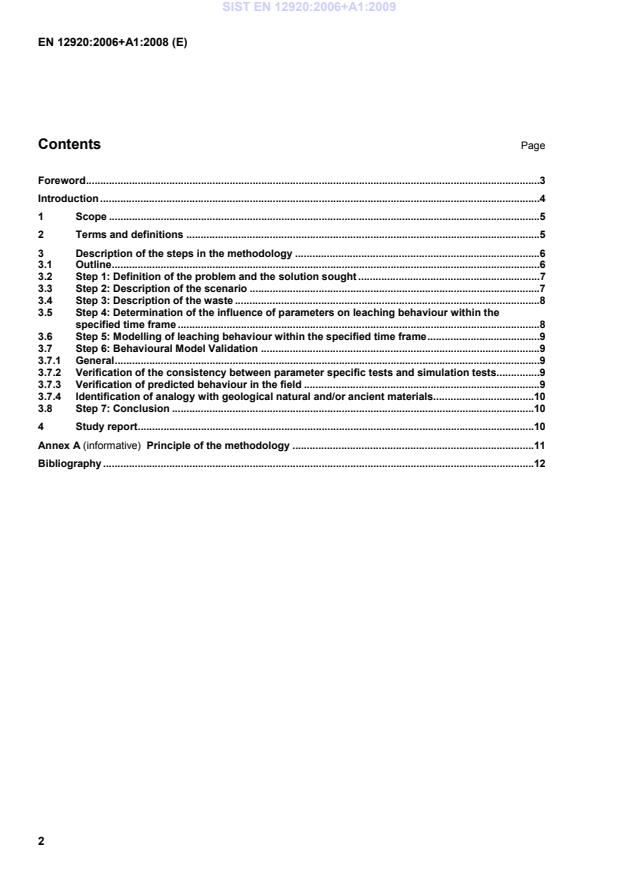
- Structured seven‑step methodology: definition of the problem and solution sought; scenario description; waste description; determination of parameter influence; modelling of leaching behaviour; behavioural model validation; conclusions and study report.
- Scenario‑driven approach: scenarios must describe mechanical/geotechnical, hydrogeological/climatic, biological, site‑use and exceptional conditions (e.g., flooding, fire).
- Waste characterisation: document origin, total chemistry, mineralogy, physical and geotechnical properties (density, porosity, particle size, permeability) relevant to leaching.
- Parameter identification and testing: select and justify parameter‑specific tests (intrinsic properties like diffusion coefficients, solubility) and simulation tests (combined effects; examples given: lysimeters, large‑scale columns). Accelerated tests are allowed but must be validated.
- Behavioural modelling and validation: build a model relating leaching to scenario conditions and waste properties; validate by consistency checks between parameter tests and simulation tests and, where possible, field verification or analogy with natural/ancient materials.
- Documentation: all assumptions, test selections and references to existing information must be recorded in a study report.
Practical applications
- Assessing long‑term release of contaminants from landfills, recycling/recovery operations and mining/aggregate wastes.
- Designing containment, leachate collection and treatment strategies for disposal and recovery sites.
- Comparing treatment or recovery options based on predicted release over specified time frames.
- Supporting permitting and regulatory compliance where scenario‑specific leaching behaviour is required.
Who uses this standard
- Environmental consultants and laboratory specialists conducting leaching tests and modelling.
- Waste and landfill designers, site operators and recovery facility planners.
- Mining and extractive industry professionals evaluating acid generation potential and ARD/AMD risk.
- Regulators and policy makers requiring documented, scenario‑based leaching assessments.
Related standards and references
- European Waste lists (Commission Decision 2000/532/EC) for waste categorisation.
- Waste management legislation such as Directive 91/156/EEC and national implementations of the European Waste Acts.
- CEN technical guidance and complementary test standards for leaching and materials characterisation (refer to national CEN bodies for up‑to‑date bibliographies).
Keywords: EN 12920 leaching behaviour, waste characterisation, leaching methodology, CEN standard, landfill leaching, extractive industry waste, behavioural model validation.
Relations
- Effective Date
- 19-Jan-2023
- Effective Date
- 19-Jan-2023
- Effective Date
- 28-Jan-2026
- Effective Date
- 28-Jan-2026
- Effective Date
- 28-Jan-2026
Get Certified
Connect with accredited certification bodies for this standard

CIS Institut d.o.o.
Personal Protective Equipment (PPE) certification body. Notified Body NB-2890 for EU Regulation 2016/425 PPE.

Kiwa BDA Testing
Building and construction product certification.
Kmetijski inštitut Slovenije
Agricultural Institute of Slovenia. Soil testing, plant health, agricultural product analysis.
Sponsored listings
Frequently Asked Questions
EN 12920:2006+A1:2008 is a standard published by the European Committee for Standardization (CEN). Its full title is "Characterization of waste - Methodology for the determination of the leaching behaviour of waste under specified conditions". This standard covers: This European Standard specifies a methodology for the determination of the leaching behaviour of a waste or a waste from the extractive industry under specified conditions (i.e. for a specified scenario including a specified time frame) in order to provide a solution to a defined problem. This applies to disposal and recovery scenarios. NOTE 1 Recovery is the term defined in the European Waste Acts [1,3]. It includes re-use and recycling. The external conditions which have a direct influence on the release of constituents from waste are considered. Migration of constituents leached from the disposal or the recovery site into the surrounding environment is not considered. Also the assessment of toxicity to humans or ecological impacts on flora and fauna as a secondary effect after release of constituents from the waste is not considered. NOTE 2 Present knowledge of highly complex scenarios and wastes may limit the ability to provide a clear solution to a defined problem. An example may be the land filling of complex mixtures of wastes or the prediction of the acid generation behaviour waste from the extractive industry.
This European Standard specifies a methodology for the determination of the leaching behaviour of a waste or a waste from the extractive industry under specified conditions (i.e. for a specified scenario including a specified time frame) in order to provide a solution to a defined problem. This applies to disposal and recovery scenarios. NOTE 1 Recovery is the term defined in the European Waste Acts [1,3]. It includes re-use and recycling. The external conditions which have a direct influence on the release of constituents from waste are considered. Migration of constituents leached from the disposal or the recovery site into the surrounding environment is not considered. Also the assessment of toxicity to humans or ecological impacts on flora and fauna as a secondary effect after release of constituents from the waste is not considered. NOTE 2 Present knowledge of highly complex scenarios and wastes may limit the ability to provide a clear solution to a defined problem. An example may be the land filling of complex mixtures of wastes or the prediction of the acid generation behaviour waste from the extractive industry.
EN 12920:2006+A1:2008 is classified under the following ICS (International Classification for Standards) categories: 13.030.01 - Wastes in general. The ICS classification helps identify the subject area and facilitates finding related standards.
EN 12920:2006+A1:2008 has the following relationships with other standards: It is inter standard links to EN 12920:2006, EN 12920:2006/prA1, CEN/TS 14429:2005, EN 14879-3:2006, EN ISO 18772:2014. Understanding these relationships helps ensure you are using the most current and applicable version of the standard.
EN 12920:2006+A1:2008 is available in PDF format for immediate download after purchase. The document can be added to your cart and obtained through the secure checkout process. Digital delivery ensures instant access to the complete standard document.
Standards Content (Sample)
2003-01.Slovenski inštitut za standardizacijo. Razmnoževanje celote ali delov tega standarda ni dovoljeno.Charakterisierung von Abfall - Vorgehensweise zur Bestimmung des Auslaugungsverhaltens von Abfall unter festgelegten BedingungenCaractérisation des déchets - Méthodologie pour la détermination du comportement à la lixiviation d'un déchet dans des conditions spécifiéesCharacterization of waste - Methodology for the determination of the leaching behaviour of waste under specified conditions13.030.01Odpadki na splošnoWastes in generalICS:Ta slovenski standard je istoveten z:EN 12920:2006+A1:2008SIST EN 12920:2006+A1:2009en,fr,de01-marec-2009SIST EN 12920:2006+A1:2009SLOVENSKI
STANDARD
EUROPEAN STANDARD NORME EUROPÉENNE EUROPÄISCHE NORM
EN 12920:2006+A1
September 2008 ICS 13.030.01 Supersedes EN 12920:2006English Version
Characterization of waste -Methodology for the determination of the leaching behaviour of waste under specified conditions
Caractérisation des déchets - Méthodologie pour la détermination du comportement à la lixiviation d'un déchet dans des conditions spécifiées
Charakterisierung von Abfall - Vorgehensweise zur Bestimmung des Auslaugungsverhaltens von Abfall unter festgelegten Bedingungen This European Standard was approved by CEN on 6 February 2006 and includes Amendment 1 approved by CEN on 30 July 2008.
CEN members are bound to comply with the CEN/CENELEC Internal Regulations which stipulate the conditions for giving this European Standard the status of a national standard without any alteration. Up-to-date lists and bibliographical references concerning such national standards may be obtained on application to the CEN Management Centre or to any CEN member.
This European Standard exists in three official versions (English, French, German). A version in any other language made by translation under the responsibility of a CEN member into its own language and notified to the CEN Management Centre has the same status as the official versions.
CEN members are the national standards bodies of Austria, Belgium, Bulgaria, Cyprus, Czech Republic, Denmark, Estonia, Finland, France, Germany, Greece, Hungary, Iceland, Ireland, Italy, Latvia, Lithuania, Luxembourg, Malta, Netherlands, Norway, Poland, Portugal, Romania, Slovakia, Slovenia, Spain, Sweden, Switzerland and United Kingdom.
EUROPEAN COMMITTEE FOR STANDARDIZATION
COMITÉ EUROPÉEN DE NORMALISATION EUROPÄISCHES KOMITEE FÜR NORMUNG
Management Centre: rue de Stassart, 36
B-1050 Brussels © 2008 CEN All rights of exploitation in any form and by any means reserved worldwide for CEN national Members. Ref. No. EN 12920:2006+A1:2008: ESIST EN 12920:2006+A1:2009
Principle of the methodology.11 Bibliography.12
NOTE To avoid unnecessary duplication of work, reference can be made to existing documented information on specific waste characteristics and on previous evaluations of scenarios.
In order to comply with this standard, reference to existing information shall be docu
...