

EN 15571:2014
(Main)Machines and plants for mining and tooling of natural stone - Safety - Requirements for surface finishing machines
- Abstract
This European Standard applies to stationary surface finishing machines, with stationary work piece (see 3.1) or with moving work piece (see 3.2), which are used to grind or polish horizontal surfaces of slabs, strips or tiles of natural stone and engineered stone (e.g. agglomerated stone) as defined by EN 14618:2009.
This European Standard deals with all significant hazards, hazardous situations and events relevant to surface finishing machines, when they are used as intended and under conditions of misuse which are reasonably foreseeable by the manufacturer (see Clause 4).
This European Standard specifies the appropriate technical measures to eliminate or reduce risks arising from the significant hazards.
This European Standard deals with the foreseeable lifetime of the machinery including the phases of transport, assembly, dismantling, disabling and scrapping.
This European Standard does not deal with:
- hand-held grinding machines;
- machines intended for operation in a potentially explosive atmosphere;
- operation in severe environmental conditions (e.g. extreme temperatures, corrosive environment);
- machines intended for outdoor operation.
This European Standard is not applicable to machinery which is manufactured before the date of publication of this document by CEN.
- Status
- Withdrawn
- Publication Date
- 25-Nov-2014
- Withdrawal Date
- 06-Oct-2026
- Technical Committee
- CEN/TC 151 - Construction equipment and building material machines - Safety
- Current Stage
- 9960 - Withdrawal effective - Withdrawal
- Start Date
- 18-Nov-2020
- Completion Date
- 07-Oct-2026

Relations
- Effective Date
- 08-Jun-2022
- Effective Date
- 25-Aug-2026
- Effective Date
- 25-Aug-2026
- Effective Date
- 09-Feb-2026
- Effective Date
- 09-Feb-2026
- Effective Date
- 09-Feb-2026
- Effective Date
- 09-Feb-2026
- Effective Date
- 09-Feb-2026
- Effective Date
- 28-Jan-2026
- Effective Date
- 28-Jan-2026
- Effective Date
- 28-Jan-2026
- Effective Date
- 28-Jan-2026
- Effective Date
- 28-Jan-2026
- Effective Date
- 28-Jan-2026
- Effective Date
- 28-Jan-2026
Get Certified
Connect with accredited certification bodies for this standard

DVS-ZERT GmbH
German welding certification society.

Bureau Veritas Chile
Bureau Veritas certification services in Chile.
Bureau Veritas Peru
Bureau Veritas certification services in Peru.
Sponsored listings
Frequently Asked Questions
EN 15571:2014 is a standard published by the European Committee for Standardization (CEN). Its full title is "Machines and plants for mining and tooling of natural stone - Safety - Requirements for surface finishing machines". This standard covers: This European Standard applies to stationary surface finishing machines, with stationary work piece (see 3.1) or with moving work piece (see 3.2), which are used to grind or polish horizontal surfaces of slabs, strips or tiles of natural stone and engineered stone (e.g. agglomerated stone) as defined by EN 14618:2009. This European Standard deals with all significant hazards, hazardous situations and events relevant to surface finishing machines, when they are used as intended and under conditions of misuse which are reasonably foreseeable by the manufacturer (see Clause 4). This European Standard specifies the appropriate technical measures to eliminate or reduce risks arising from the significant hazards. This European Standard deals with the foreseeable lifetime of the machinery including the phases of transport, assembly, dismantling, disabling and scrapping. This European Standard does not deal with: - hand-held grinding machines; - machines intended for operation in a potentially explosive atmosphere; - operation in severe environmental conditions (e.g. extreme temperatures, corrosive environment); - machines intended for outdoor operation. This European Standard is not applicable to machinery which is manufactured before the date of publication of this document by CEN.
This European Standard applies to stationary surface finishing machines, with stationary work piece (see 3.1) or with moving work piece (see 3.2), which are used to grind or polish horizontal surfaces of slabs, strips or tiles of natural stone and engineered stone (e.g. agglomerated stone) as defined by EN 14618:2009. This European Standard deals with all significant hazards, hazardous situations and events relevant to surface finishing machines, when they are used as intended and under conditions of misuse which are reasonably foreseeable by the manufacturer (see Clause 4). This European Standard specifies the appropriate technical measures to eliminate or reduce risks arising from the significant hazards. This European Standard deals with the foreseeable lifetime of the machinery including the phases of transport, assembly, dismantling, disabling and scrapping. This European Standard does not deal with: - hand-held grinding machines; - machines intended for operation in a potentially explosive atmosphere; - operation in severe environmental conditions (e.g. extreme temperatures, corrosive environment); - machines intended for outdoor operation. This European Standard is not applicable to machinery which is manufactured before the date of publication of this document by CEN.
EN 15571:2014 is classified under the following ICS (International Classification for Standards) categories: 25.080.50 - Grinding and polishing machines; 73.120 - Equipment for processing of minerals. The ICS classification helps identify the subject area and facilitates finding related standards.
EN 15571:2014 has the following relationships with other standards: It is inter standard links to EN 15571:2020, ISO 8598:1996, ISO 7490:1990, EN 61439-1:2011, EN 50370-1:2005, EN 60529:1991, EN 82079-1:2012, EN 61496-1:2013, EN ISO 4414:2010, EN ISO 11202:2010, EN ISO 3744:2010, EN 349:1993+A1:2008, EN ISO 3745:2012, EN ISO 13856-2:2013, EN 14618:2009. Understanding these relationships helps ensure you are using the most current and applicable version of the standard.
EN 15571:2014 is associated with the following European legislation: EU Directives/Regulations: 2006/42/EC; Standardization Mandates: M/396. When a standard is cited in the Official Journal of the European Union, products manufactured in conformity with it benefit from a presumption of conformity with the essential requirements of the corresponding EU directive or regulation.
EN 15571:2014 is available in PDF format for immediate download after purchase. The document can be added to your cart and obtained through the secure checkout process. Digital delivery ensures instant access to the complete standard document.
Standards Content (Sample)
2003-01.Slovenski inštitut za standardizacijo. Razmnoževanje celote ali delov tega standarda ni dovoljeno.Stroji in obrati za pridobivanje in obdelavo naravnega kamna - Varnost - Zahteve za stroje za dodelavo površineMaschinen und Anlagen zur Gewinnung und Bearbeitung von Naturstein - Sicherheit - Anforderungen an FlächenschleifmaschinenMachines et installations d'extraction et d'usinage des pierres naturelles - Sécurité - Prescriptions relatives aux machines de finition de surfaceMachines and plants for mining and tooling of natural stone - Safety - Requirements for surface finishing machines73.120Oprema za predelavo rudninEquipment for processing of minerals25.080.50Brusilni in polirni strojiGrinding and polishing machinesICS:Ta slovenski standard je istoveten z:EN 15571:2014SIST EN 15571:2015en,fr,de01-februar-2015SIST EN 15571:2015SLOVENSKI
STANDARD
EUROPEAN STANDARD NORME EUROPÉENNE EUROPÄISCHE NORM
EN 15571
November 2014 ICS 25.080.50; 73.120 English Version
Machines and plants for mining and tooling of natural stone - Safety - Requirements for surface finishing machines
Machines et installations d'extraction et d'usinage des pierres naturelles - Sécurité - Prescriptions relatives aux machines de finition de surface
Maschinen und Anlagen zur Gewinnung und Bearbeitung von Naturstein - Sicherheit - Anforderungen an Flächenschleifmaschinen This European Standard was approved by CEN on 13 September 2014.
CEN members are bound to comply with the CEN/CENELEC Internal Regulations which stipulate the conditions for giving this European Standard the status of a national standard without any alteration. Up-to-date lists and bibliographical references concerning such national standards may be obtained on application to the CEN-CENELEC Management Centre or to any CEN member.
This European Standard exists in three official versions (English, French, German). A version in any other language made by translation under the responsibility of a CEN member into its own language and notified to the CEN-CENELEC Management Centre has the same status as the official versions.
CEN members are the national standards bodies of Austria, Belgium, Bulgaria, Croatia, Cyprus, Czech Republic, Denmark, Estonia, Finland, Former Yugoslav Republic of Macedonia, France, Germany, Greece, Hungary, Iceland, Ireland, Italy, Latvia, Lithuania, Luxembourg, Malta, Netherlands, Norway, Poland, Portugal, Romania, Slovakia, Slovenia, Spain, Sweden, Switzerland, Turkey and United Kingdom.
EUROPEAN COMMITTEE FOR STANDARDIZATION
COMITÉ EUROPÉEN DE NORMALISATION EUROPÄISCHES KOMITEE FÜR NORMUNG
CEN-CENELEC Management Centre:
Avenue Marnix 17,
B-1000 Brussels © 2014 CEN All rights of exploitation in any form and by any means reserved worldwide for CEN national Members. Ref. No. EN 15571:2014 ESIST EN 15571:2015
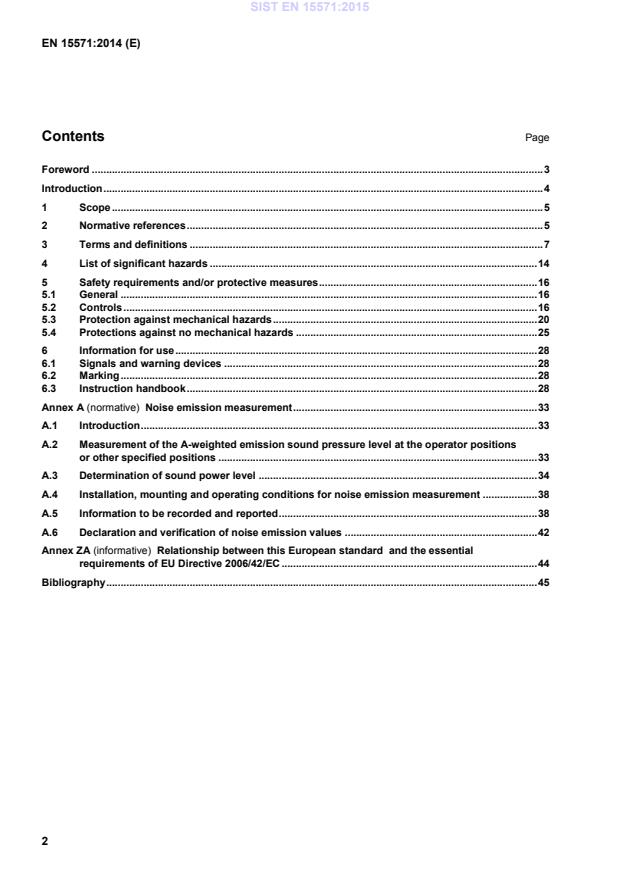
Noise emission measurement . 33 A.1 Introduction . 33 A.2 Measurement of the A-weighted emission sound pressure level at the operator positions or other specified positions . 33 A.3 Determination of sound power level . 34 A.4 Installation, mounting and operating conditions for noise emission measurement . 38 A.5 Information to be recorded and reported . 38 A.6 Declaration and verification of noise emission values . 42 Annex ZA (informative)
Relationship between this European standard
and the essential requirements of EU Directive 2006/42/EC . 44 Bibliography . 45
This European Standard deals with all significant hazards, hazardous situations and events relevant to surface finishing machines, when they are used as intended and under conditions of misuse which are reasonably foreseeable by the manufacturer (see Clause 4). This European Standard specifies the appropriate technical measures to eliminate or reduce risks arising from the significant hazards. This European Standard deals with the foreseeable lifetime of the machinery including the phases of transport, assembly, dismantling, disabling and scrapping. This European Standard does not deal with:
hand-held grinding machines;
machines intended for operation in a potentially explosive atmosphere;
operation in severe environmental conditions (e.g. extreme temperatures, corrosive environment);
machines intended for outdoor operation. This European Standard is not applicable to machinery which is manufactured before the date of publication of this document by CEN. 2 Normative references The following documents, in whole or in part, are normatively referenced in this document and are indispensable for its application. For dated references, only the edition cited applies. For undated references, the latest edition of the referenced document (including any amendments) applies. EN 166:2001, Personal eye-protection - Specifications EN 349:1993+A1:2008, Safety of machinery - Minimum gaps to avoid crushing of parts of the human body EN 953:1997+A1:2009, Safety of machinery - Guards - General requirements for the design and construction of fixed and movable guards EN 1005-2:2003+A1:2008, Safety of machinery - Human physical performance - Part 2: Manual handling of machinery and component parts of machinery EN 1005-4:2005+A1:2008 Safety of machinery - Human physical performance - Part 4: Evaluation of working postures and movements in relation to machinery EN 1037:1995+A1:2008, Safety of machinery - Prevention of unexpected start-up EN 1837:1999+A1:2009, Safety of machinery - Integral lighting of machines EN 14618:2009, Agglomerated stone - Terminology and classification EN 50370-1:2005, Electromagnetic compatibility (EMC) - Product family standard for machine tools - Part 1: Emission SIST EN 15571:2015
Safeguarding devices are not illustrated Key 1 spindle 5 material support plan 2 tool 6 track 3
bridge 7 control panel 4 workpiece 8 electric panel Figure 1 — Example of a surface finishing machine with fixed table and mobile transversal bridge “PORTAL”
Safeguarding devices are not illustrated Key 1 spindle 5 material support plan 2 tool 6 track 3 bridge 7 control panel 4 workpiece 8 electric panel Figure 2 — Example of a surface finishing machine with fixed table and mobile transversal bridge “SEMI-PORTAL” SIST EN 15571:2015
Safeguarding devices are not illustrated Key 1 spindle 5
workpiece 9 unloading roller track 2 grinding or polishing head 6 control panel 10 front cover (sliding door) 3
spindles-holding beam 7 electric board 11 work bench 4 belt Conveyor 8 loading roller track
Figure 3 — Example of a surface finishing machine with belt conveyor and fixed or mobile spindles-holding beam SIST EN 15571:2015
Key 1 grinding or polishing segment 2 holder saddle with dovetail Figure 4 — Grinding or polishing segment 3.7 grinding or polishing head different types of grinding or polishing heads are used to pick up the proper grinding or polishing segments Note 1 to entry: These heads can be designed for different additional movements between grinding or polishing segment and workpiece (swing, planetary, …).
Key 1 toothed wheel 4 grinding or polishing segment holder 2 grinding or polishing head carrier 5 grinding or polishing segment 3
housing of grinding or polishing head
Figure 5 — Swing grinding or polishing head
Key 1 toothed wheel 4 flange bearing 2 grinding or polishing head carrier 5 grinding or polishing segment holder 3
housing of grinding or polishing head 6 grinding or polishing segment Figure 6 — Planetary grinding or polishing head SIST EN 15571:2015
Key 1 toothed wheel 4 grinding or polishing segment holder 2 grinding or polishing disk carrier 5 grinding or polishing segment 3
grinding or polishing disk flange
Figure 7 — Disk grinding or polishing head 3.8 main drive generates the tool moving 3.9 feed drive drive of the adjusting axles (vertical adjustment, infeed, etc.) 3.10 spindle special shaft, powered by a motor, which holds the grinding or polishing head in rotation 3.11 spindles-holding beam beam that supports all the spindles and allows the alternative movement of translation 3.12 work bench bench on which the conveyor belt drives the workpiece (slabs or strips) 3.13 machine actuator power mechanism used to affect motion of the machine 3.14 machining mode of operation automatic, programmed, sequential mode of operation of the machine with the facility for manual or automatic loading/unloading of the workpiece 3.15 machine setting mode of operation setting, programming, fault finding, programme verification, testing mode of operation of the machine 3.16 operational stop stop for operational reasons without cutting off the energy supply to the actuator(s) where the stop condition is monitored and maintained SIST EN 15571:2015
Note 1 to entry: See EN 60204-1:2006, 3.44 and EN ISO 12100:2010, 6.2.12.4. 3.23 monitoring safety function which ensures that a safety measure is initiated if the ability of a component or an element to perform its function is diminished, or if the process conditions are changed in such a way that hazards are generated 3.24 unbraked run-down time time elapsed from the actuation of the stop control, but not the braking device (if fitted) up to spindle standstill 3.25 braked run-down time time elapsed from the actuation of the stop control and the brake device up to spindle standstill 3.26 information of the supplier statements, sales literature, leaflets or other documents where a manufacturer (supplier) declares either the compliance of the characteristics of e.g. a material or a product or the conformity of a material or a product to a relevant standard 3.27 safety function function of the machine whose failure can result in an immediate increase of the risk(s) [SOURCE: EN ISO 12100:2010, 3.30] SIST EN 15571:2015
SRP/CS part of a control system that responds to safety-related input signals and generates safety-related output signals [SOURCE: EN ISO 13849-1:2008, 3.1.1] Note 1 to entry: The combined safety-related parts of a control system start at the point where the safety-related input signals are initiated (including for example, the actuating cam and the roller of the position switch) and end at the output of the power control elements (including, for example, the main contacts of the contactor). Note 2 to entry: If monitoring systems are used for diagnostics, they are also considered as SRP/CS. 3.29 performance level
PL discrete level used to specify the ability of safety-related parts of control systems to perform a safety function under foreseeable conditions [SOURCE: EN ISO 13849-1:2008, 3.1.23, 4.5.1] 4 List of significant hazards This clause contains all the significant hazards, hazardous situations and events, as indicated in EN ISO 12100:2010, Annex B, identified by risk assessment as significant for this type of machinery and which require action to eliminate or reduce the risk. Table 1 — List of significant hazards Type or group Origin Potential consequences Subclause of this document Mechanical
hazards Approach of a moving element to a fixed part Crushing Impact 5.2.7, 5.2.8, 5.2.9, 5.3.3, 5.3.4, 5.3.5
Cutting parts Cutting and shearing 5.3.4, 5.3.5
Elastic elements Crushing Impact 5.4.10
Gravity Falling objects Impact 5.3.1, 5.3.2, 5.3.3, 5.4.8
Instability Crushing Impact Being run over 5.3.1, 5.3.2, 5.3.3, 5.4.8
High pressure Crushing Impact Being thrown 5.4.6
Moving elements Drawing-in Entanglement Being thrown 5.3.4, 5.3.5
Rotating elements Cutting, Abrasion Entanglement, Being thrown 5.3.4, 5.3.5 SIST EN 15571:2015
Live parts Electrical contact with live parts 5.2.8, 5.2.9, 5.4.3, 5.4.10
Not enough distance to live parts under high voltage Electrical contact with live parts 5.2.8, 5.2.9, 5.4.3, 5.4.10
Parts which have become live under fault conditions Electrical contact with live parts 5.2.8, 5.2.9, 5.4.3, 5.4.10
Short-circuit Electrical contact with live parts Shock Fire 5.2.8, 5.2.9, 5.4.1, 5.4.3, 5.4.10 Thermal hazards Objects or materials with a high or low temperature Scald or frostbite 5.4.1, 5.4.3 Noise Hazards Manufacturing process Interference with other acoustic signals Loss of awareness Stress Tinnitus 5.4.2 Material/ substance hazards Biological and microbiological agent (cooling water) Infection 5.4.9
Dust Respiratory diseases 5.4.9 Ergonomic hazards Access (worktable height) Discomfort Fatigue 5.4.4
Location of indicators and control devices Discomfort Fatigue Stress Impact 5.4.4 Hazards associated with the environment in which the machine is used Electromagnetic phenomena Unexpected Start/Stop Break Command failure Unexpected Start/Stop Break Command failure 5.2.1, 5.2.2, 5.2.3, 5.2.4, 5.2.5, 5.2.6, 5.2.7, 5.2.8, 5.2.9, 5.4.7 Hazards associated with unexpected start-up, unexpected overrun/ overspeed (or any similar malfunction) Failure/ disorder of the control system Unexpected Start/Stop Break Command failure Crushing Impact Cutting and shearing Being run over Being thrown Drawing-in Entanglement Abrasion 5.2.1, 5.2.2, 5.2.3, 5.2.4, 5.2.5, 5.2.6, 5.2.7, 5.2.8, 5.2.9, 5.3.1, 5.3.2, 5.3.3, 5.3.4, 5.3.5, 5.4.3, 5.4.6, 5.4.7, 5.4.8, 5.4.9
Uncontrolled restoration of energy supply after an interruption
Errors in the software
Impossibility of stopping the machine in the best possible conditions
Variations in the rotational speed of tools
Errors of fitting
Break-up during operation
Loss of stability/overturning of machinery
Slip, trip and fall of persons (related to machinery)
5 Safety requirements and/or protective measures 5.1 General Machinery shall comply with the safety requirements and/or protective measures of this clause. In addition, the machine shall be designed according to the principles of EN ISO 12100:2010 for relevant but not significant hazards, which are not dealt with by this document. 5.2 Controls 5.2.1 Safety and reliability of control systems For the purpose of this document, safety-related part of a control system means the system which implements safety functions from the initial device, e.g. actuator, position detector or sensor up to and including the power control element of the final machine actuator, e.g. motor or brake. Safety-related parts of the control system of this machine comprise parts concerning the following functions and they shall fulfil the requirements of the PL given below in accordance with the requirements of EN ISO 13849-1:2008:
for starting: PL = c (see 5.2.3);
for normal stop: PL = b (see 5.2.4);
for emergency stop: PL = c (see 5.2.5);
for operational stop: PL = c (see 5.2.6);
for standstill monitoring: PL = c (see 5.2.6 and 5.2.8);
for interlocking: PL = c (see 5.2.6 and 5.2.7);
for mode selection: PL = c (see 5.2.7). Verification: By checking the relevant drawings and/or circuit diagrams, calculation and inspection of the machine SIST EN 15571:2015
...