

EN 10288:2002
(Main)Steel tubes and fittings for onshore and offshore pipelines - External two layer extruded polyethylene based coatings
- Abstract
This European Standard defines the application of factory applied external two layer extruded polyethylene based coatings for the corrosion protection of tubes and pipeline components.
External extruded polyethylene coating can be used for the protection of buried or submerged tubes service at temperatures up to + 60 °C for type 1 and + 30 °C for type 2.
The coatings in this standard can be applied to longitudinally or spirally welded and to seamless steel tubes and components used for the construction of pipelines for conveying liquids or gases.
Tubes coated with this type of coating may be further protected by means of cathodic protection.
- Status
- Published
- Publication Date
- 16-Apr-2002
- Withdrawal Date
- 30-Oct-2002
- Technical Committee
- ECISS/TC 110 - Steel tubes, and iron and steel fittings
- Drafting Committee
- ECISS/TC 29/SC 4/WG 1 - Polyethylene based coatings
- Current Stage
- 9093 - Decision to confirm - Review Enquiry
- Start Date
- 05-Mar-2025
- Completion Date
- 30-Sep-2026


Overview
EN 10288:2002 (CEN) specifies factory-applied external two-layer extruded polyethylene (PE) based coatings for corrosion protection of steel tubes and fittings used in onshore and offshore pipelines. The standard covers coatings applied to longitudinally welded, spirally welded and seamless steel tubes and components for conveying liquids or gases. Coated tubes can be buried or submerged and may receive additional protection by cathodic protection.
Key temperature limits:
- Type 1: service temperatures up to +60 °C
- Type 2: service temperatures up to +30 °C
Key Topics and Requirements
EN 10288:2002 defines technical expectations and testing for external PE coatings, including (but not limited to):
- Surface preparation and coating application methods (factory extruded two-layer system)
- Coating composition and system characteristics for long-term corrosion protection
- Appearance and continuity (visual inspection criteria)
- Coating thickness measurement and acceptance
- Cut-back at pipe ends and end-preparation rules
- Holiday detection (electrical continuity/defect testing)
- Mechanical tests: impact resistance, indentation resistance, flexibility
- Adhesion/peel tests and peel force assessment
- Electrical insulation resistance and cathodic disbondment testing
- Elongation at break, UV resistance, and thermal stability
- Inspection, sampling, marking, repairs, handling, transport and storage requirements
The standard contains multiple normative annexes detailing test procedures (e.g., thickness inspection, holiday detection, impact, peel, indentation, electrical insulation, elongation, UV/thermal tests, cathodic disbondment).
Applications
EN 10288:2002 is intended for:
- Onshore and offshore pipelines (buried or submerged)
- Transmission and distribution lines for liquids and gases
- Situations requiring a robust external corrosion barrier with possible cathodic protection integration
Typical use-cases include oil & gas trunk lines, subsea export lines, water and product pipelines where PE extruded external coatings are specified.
Who Uses This Standard
- Pipeline engineers and designers specifying external coating systems
- Coating manufacturers and extruders producing two-layer PE systems
- Pipe fabricators and welders applying factory coatings
- Inspection and quality-control personnel performing tests listed in the standard
- Asset owners, procurement teams and regulatory bodies verifying compliance
Related Standards
EN 10288 references relevant standards for plastics and surface preparation, such as ISO 527-2, ISO 1133, ISO 1183, ISO 4287, ISO 4892-2, ISO 8501-1, and related pipeline tube standards (e.g., prEN 10224). These documents support specific test methods and material characterisation referenced by EN 10288.
Keywords: EN 10288:2002, two layer extruded polyethylene coating, external PE coating, pipeline corrosion protection, buried pipelines, offshore pipelines, cathodic protection, pipeline coating standard.
Relations
- Effective Date
- 25-Aug-2026
- Effective Date
- 25-Aug-2026
- Effective Date
- 25-Aug-2026
- Effective Date
- 25-Aug-2026
- Effective Date
- 25-Aug-2026
- Effective Date
- 25-Aug-2026
- Effective Date
- 09-Feb-2026
- Effective Date
- 28-Jan-2026
- Effective Date
- 28-Jan-2026
- Effective Date
- 28-Jan-2026
- Effective Date
- 28-Jan-2026
- Effective Date
- 28-Jan-2026
- Effective Date
- 28-Jan-2026
- Effective Date
- 28-Jan-2026
- Effective Date
- 28-Jan-2026
Get Certified
Connect with accredited certification bodies for this standard

DVS-ZERT GmbH
German welding certification society.
Institut za varilstvo d.o.o. (Welding Institute)
Slovenia's leading welding institute since 1952. ISO 3834, EN 1090, pressure equipment certification, NDT personnel, welder qualification. Only IIW Au
CARES (UK Certification Authority for Reinforcing Steels)
UK certification for reinforcing steels and construction.
Sponsored listings
Frequently Asked Questions
EN 10288:2002 is a standard published by the European Committee for Standardization (CEN). Its full title is "Steel tubes and fittings for onshore and offshore pipelines - External two layer extruded polyethylene based coatings". This standard covers: This European Standard defines the application of factory applied external two layer extruded polyethylene based coatings for the corrosion protection of tubes and pipeline components. External extruded polyethylene coating can be used for the protection of buried or submerged tubes service at temperatures up to + 60 °C for type 1 and + 30 °C for type 2. The coatings in this standard can be applied to longitudinally or spirally welded and to seamless steel tubes and components used for the construction of pipelines for conveying liquids or gases. Tubes coated with this type of coating may be further protected by means of cathodic protection.
This European Standard defines the application of factory applied external two layer extruded polyethylene based coatings for the corrosion protection of tubes and pipeline components. External extruded polyethylene coating can be used for the protection of buried or submerged tubes service at temperatures up to + 60 °C for type 1 and + 30 °C for type 2. The coatings in this standard can be applied to longitudinally or spirally welded and to seamless steel tubes and components used for the construction of pipelines for conveying liquids or gases. Tubes coated with this type of coating may be further protected by means of cathodic protection.
EN 10288:2002 is classified under the following ICS (International Classification for Standards) categories: 23.040.10 - Iron and steel pipes; 23.040.40 - Metal fittings; 25.220.60 - Organic coatings. The ICS classification helps identify the subject area and facilitates finding related standards.
EN 10288:2002 has the following relationships with other standards: It is inter standard links to ISO 8501-1:1988, ISO 1133:1997, ISO 527-2:1993, ISO 4287:1997, ISO 1183:1987, ISO 4892-2:1994, ISO 11420:1996, EN 10224:2002, EN 13055-2:2004, EN 2103-1:1991, EN ISO 22254:2005, EN 1594:2013, EN 10329:2006, EN 12007-3:2000, EN 1594:2009. Understanding these relationships helps ensure you are using the most current and applicable version of the standard.
EN 10288:2002 is associated with the following European legislation: Standardization Mandates: M/005. When a standard is cited in the Official Journal of the European Union, products manufactured in conformity with it benefit from a presumption of conformity with the essential requirements of the corresponding EU directive or regulation.
EN 10288:2002 is available in PDF format for immediate download after purchase. The document can be added to your cart and obtained through the secure checkout process. Digital delivery ensures instant access to the complete standard document.
Standards Content (Sample)
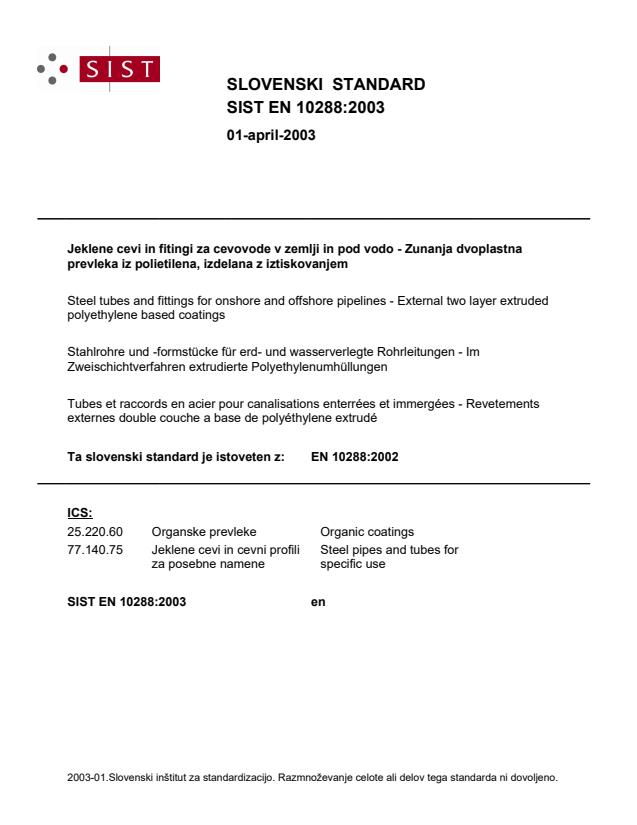
2003-01.Slovenski inštitut za standardizacijo. Razmnoževanje celote ali delov tega standarda ni dovoljeno.Jeklene cevi in fitingi za cevovode v zemlji in pod vodo - Zunanja dvoplastna prevleka iz polietilena, izdelana z iztiskovanjemStahlrohre und -formstücke für erd- und wasserverlegte Rohrleitungen - Im Zweischichtverfahren extrudierte PolyethylenumhüllungenTubes et raccords en acier pour canalisations enterrées et immergées - Revetements externes double couche a base de polyéthylene extrudéSteel tubes and fittings for onshore and offshore pipelines - External two layer extruded polyethylene based coatings77.140.75Jeklene cevi in cevni profili za posebne nameneSteel pipes and tubes for specific use25.220.60Organske prevlekeOrganic coatingsICS:Ta slovenski standard je istoveten z:EN 10288:2002SIST EN 10288:2003en01-april-2003SIST EN 10288:2003SLOVENSKI
STANDARD
EUROPEAN STANDARDNORME EUROPÉENNEEUROPÄISCHE NORMEN 10288April 2002ICS 23.040.10; 23.040.40; 25.220.60English versionSteel tubes and fittings for onshore and offshore pipelines -External two layer extruded polyethylene based coatingsTubes et raccords en acier pour canalisations enterrées etimmergées - Revêtements externes double couche à basede polyéthylène extrudéStahlrohre- und Formstücke für erd- und wasserverlegteRohrleitungen - Im Zweischicht-Verfahren extrudiertePolyethylenbeschichtungenThis European Standard was approved by CEN on 26 December 2001.CEN members are bound to comply with the CEN/CENELEC Internal Regulations which stipulate the conditions for giving this EuropeanStandard the status of a national standard without any alteration. Up-to-date lists and bibliographical references concerning such nationalstandards may be obtained on application to the Management Centre or to any CEN member.This European Standard exists in three official versions (English, French, German). A version in any other language made by translationunder the responsibility of a CEN member into its own language and notified to the Management Centre has the same status as the officialversions.CEN members are the national standards bodies of Austria, Belgium, Czech Republic, Denmark, Finland, France, Germany, Greece,Iceland, Ireland, Italy, Luxembourg, Malta, Netherlands, Norway, Portugal, Spain, Sweden, Switzerland and United Kingdom.EUROPEAN COMMITTEE FOR STANDARDIZATIONCOMITÉ EUROPÉEN DE NORMALISATIONEUROPÄISCHES KOMITEE FÜR NORMUNGManagement Centre: rue de Stassart, 36
B-1050 Brussels© 2002 CENAll rights of exploitation in any form and by any means reservedworldwide for CEN national Members.Ref. No. EN 10288:2002 ESIST EN 10288:2003
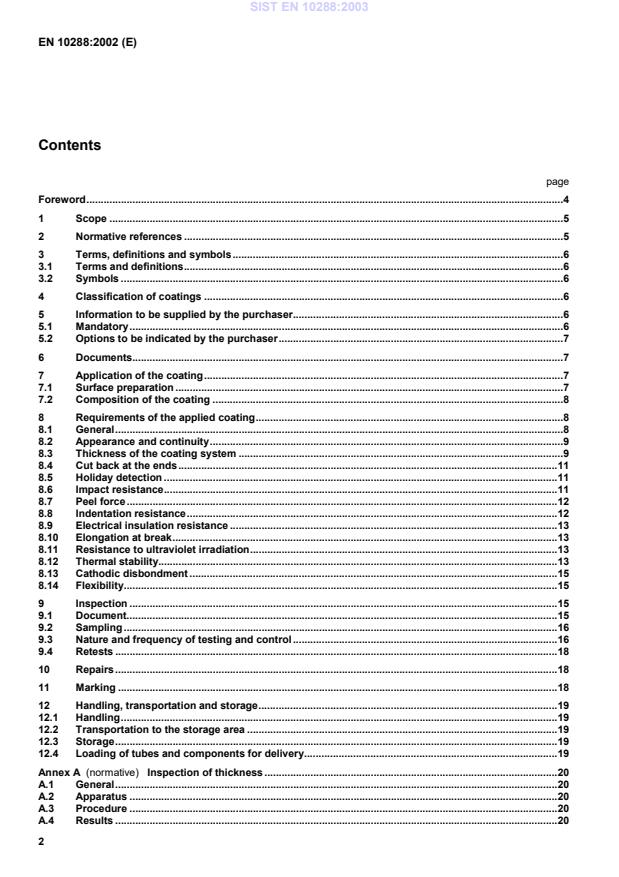
(normative)
Inspection of thickness.20A.1General.20A.2Apparatus.20A.3Procedure.20A.4Results.20SIST EN 10288:2003
Holiday detection test.21B.1General.21B.2Apparatus.21B.3Procedure.21B.4Results.21Annex C (normative)
Impact test.22C.1General.22C.2Apparatus.22C.3Procedure.22C.4Results.23Annex D (normative)
Peel force test.24D.1Measurement of the peeling force on a coated sample (type1).24D.2Measurement of the peel strength on large diameter tube (type 2).25Annex E (normative)
Indentation test.30E.1General.30E.2Apparatus.30E.3Procedure.30E.4Results.30Annex F (normative)
Specific electrical insulation resistance test.31F.1General.31F.2Apparatus.31F.3Procedure.31F.4Results.31Annex G (normative)
Elongation at break test.35G.1General.35G.2Apparatus.35G.3Sampling.35G.4Procedure.35G.5Results.36Annex H (normative)
Ultraviolet irradiation and thermal stability tests.37H.1Resistance to ultraviolet irradiation.37H.2Thermal stability.38Annex J
(normative)
Cathodic disbondment test.40J.1General.40J.2Apparatus.40J.3Sampling.41J.4.Procedure.42J.5Results.42Annex K
(normative)
Types of inspection documents.46Annex L (informative)
A-Deviation.47Bibliography.48SIST EN 10288:2003
114,31,51,82,5114,3 < D
2731,82,02,7273 < D
5082,02,22,9508 < D
7622,22,53,2762 < D2,53,03,7aThe thicknesses given in this Table can be reduced by 10 % for submerged arcwelded tubes, at the weld reinforcement.8.4 Cut back at the endsThe length of the cut back shall be (150 ± 20) mm and the coating shall be bevelled at the cut back forming a bevelangle of
30° unless otherwise specified by the purchaser.When removing the coating, the surface of the tube shall not be damaged.8.5 Holiday detectionHoliday detection shall be carried out in accordance with the method defined in annex B.The coating shall be free from holidays.8.6 Impact resistanceThe minimum impact energy, in joules, shall be determined in accordance with the method defined in annex C andshall correspond to 5 J
k for each millimetre of nominal coating thickness. The values of k are given in Table 3.Table 3 - Correction factorDiametermmkD > 219,176,1 < D
219,1D
76,11,000,850,70SIST EN 10288:2003
at room temperature (23
2) °CForce (in N/10 mm)at (60
2) °CMinimum averageAverageMinimum averageAverageA2030510B3040510C60801520NOTE 1If the top coat cannot be peeled from the tube, the measured tensile force at yield should be recorded andthe force of adhesion rated as greater than the tensile force at yield.NOTE 2Higher values may be agreed.8.7.2 Type 2Where the coating system is classified as type 2, the resistance to peeling shall be determined in accordance withthe method defined in D.2.The peeling resistance shall be such that the measured peel rate falls below the curve in D.2 - Figure D.5.8.8 Indentation resistanceIndentation resistance shall be assessed by testing in accordance with the method defined in annex E.The indentation shall not be more than the values given in Table 5.Table 5 - IndentationTypeIndentationat (23
2) °CmmIndentationat (60
2) °CmmIndentationat (30
2) °CmmType 10,30,5-Type 20,3-0,3SIST EN 10288:2003
2) °C. The value of theelongation at break shall be equal or greater than the value given in Table 6.Table 6 - Elongation at breakMinimum%3508.11 Resistance to ultraviolet irradiationThis test shall be carried out in accordance with the method defined in H.1. The value of elongation, after exposureto radiation from a xenon lamp, shall be greater than 50 % of the original value measured from the sameunexposed coating.Alternatively, the melt flow index after exposure to radiation from a xenon lamp shall not vary by more than 35 % relative to the melt flow index of the unexposed coating.8.12 Thermal stabilityThis test shall be carried out in accordance with the method defined in H.2. The melt flow rate after exposure toheat shall not vary by more than
35 % relative to the melt flow rate of the unexposed coating.SIST EN 10288:2003
k per mm coating thickness8.6Peel force(23
2) °C(60
2) °CForce N/10 mmminimumaverageaverageminimumaverageaverageSee FigureD.58.7A20 305 10CategoryB30 405 10C60 8015 20Indentation resistance(23
2) °C(60
2) °C(23
2) °C(30
2) °C 0,3 mm 0,5 mm 0,3 mm 0,3 mm8.8Electrical insulation resistance 28.10m8.9Elongation at break 350 %8.10Resistance to ultraviolet irradiation A
50 %0,65
MFR
1,358.11Thermal stability0,65
MFR
1,358.12Resistance to cathodic disbondmentaveragemaximumaveragemaximum 30 mm 40 mm 10 mm 15 mm8.13Flexibility 3 %8.14SIST EN 10288:2003
2) °Cat 28 days(40
2) °C at 7 days(60
2) °C at 2 daysType 23 tubes at (23
2) °Cat 28 days Flexibility8.14none3 tubesaAll tests detailed in the final column shall be undertaken at least every 3 years for the same system, material andsignificant technical process.The system and applicator approval may be combined with a coating production run.bAny tube from the beginning to the end of the production may be used for this test.cOther scheme of procedure qualification may be requested by the purchaser.dThe delivery of tubes can be undertaken prior to the completion of the test.eThe maximum impact energy in accordance with annex C shall be determined.SIST EN 10288:2003
...