

EN 13206:2017
(Main)Plastics - Thermoplastic covering films for use in agriculture and horticulture
- Abstract
See title
- Status
- Withdrawn
- Publication Date
- 24-Jan-2017
- Withdrawal Date
- 06-Oct-2026
- Technical Committee
- CEN/TC 249 - Plastics
- Drafting Committee
- CEN/TC 249/WG 7 - Thermoplastic films for use in agriculture
- Current Stage
- 9960 - Withdrawal effective - Withdrawal
- Start Date
- 22-Jan-2020
- Completion Date
- 07-Oct-2026


Relations
- Effective Date
- 14-Nov-2012
- Effective Date
- 19-Jan-2023
- Refers
ISO 4593:1993 - Plastics — Film and sheeting — Determination of thickness by mechanical scanning - Effective Date
- 25-Aug-2026
- Effective Date
- 25-Aug-2026
- Effective Date
- 25-Aug-2026
- Effective Date
- 28-Jan-2026
- Effective Date
- 28-Jan-2026
- Effective Date
- 28-Jan-2026
- Refers
EN 13031-1:2019 - Greenhouses - Design and construction - Part 1: Commercial production greenhouses - Effective Date
- 28-Jan-2026
- Effective Date
- 28-Jan-2026
- Effective Date
- 28-Jan-2026
- Effective Date
- 28-Jan-2026
- Effective Date
- 28-Jan-2026
- Effective Date
- 28-Jan-2026
- Effective Date
- 08-Nov-2017
Get Certified
Connect with accredited certification bodies for this standard

Control Union Certifications
Global certification for agriculture and sustainability.

DIN CERTCO
DIN Group product certification.

ECOCERT
Organic and sustainability certification.
Sponsored listings
Frequently Asked Questions
EN 13206:2017 is a standard published by the European Committee for Standardization (CEN). Its full title is "Plastics - Thermoplastic covering films for use in agriculture and horticulture". This standard covers: See title
See title
EN 13206:2017 is classified under the following ICS (International Classification for Standards) categories: 65.040.30 - Greenhouses and other installations; 83.140.10 - Films and sheets. The ICS classification helps identify the subject area and facilitates finding related standards.
EN 13206:2017 has the following relationships with other standards: It is inter standard links to EN 13206:2001, EN 13206:2017+A1:2020, ISO 4593:1993, ISO 4591:1992, ISO 4592:1992, EN ISO 4892-2:2013, EN ISO 4892-3:2016, EN ISO 527-3:2018, EN 13031-1:2019, EN 16472:2014, EN ISO 7765-1:2004, EN 4343:2002, EN ISO 527-1:2019, EN 10244-2:2023, EN 13206:2017/FprA1. Understanding these relationships helps ensure you are using the most current and applicable version of the standard.
EN 13206:2017 is available in PDF format for immediate download after purchase. The document can be added to your cart and obtained through the secure checkout process. Digital delivery ensures instant access to the complete standard document.
Standards Content (Sample)
2003-01.Slovenski inštitut za standardizacijo. Razmnoževanje celote ali delov tega standarda ni dovoljeno.Polimerni materiali - Prekrivne plastomerne folije za uporabo v kmetijstvu in vrtnarstvu - Zahteve in preskusne metode, pogoji za namestitev, uporabo in odstranjevanjeKunststoffe - Thermoplastische Abdeckfolien für den Einsatz in der Landwirtschaft und im Gartenbau - Anforderungen und Prüfverfahren, Bedingungen für den Einsatz, die Anwendung und das AblegenPlastiques - Films de couverture thermoplastiques pour utilisation en agriculture et horticulture - Exigences et méthodes d'essai, conditions de mise en œuvre, d'utilisation et de déposePlastics - Thermoplastic covering films for use in agriculture and horticulture - Requirements and test methods, conditions for installation, use and removal83.140.10Filmi in folijeFilms and sheets65.040.30Rastlinjaki in druge napraveGreenhouses and other installationsICS:Ta slovenski standard je istoveten z:EN 13206:2017SIST EN 13206:2017en,fr,de01-april-2017SIST EN 13206:2017SLOVENSKI
STANDARDSIST EN 13206:20021DGRPHãþD
EUROPEAN STANDARD NORME EUROPÉENNE EUROPÄISCHE NORM
EN 13206
January
t r s y ICS
x wä r v rä u râ
z uä s v rä s r Supersedes EN
s u t r xã t r r sEnglish Version
Plastics æ Thermoplastic covering films for use in agriculture and horticulture Plastiques æ Films de couverture thermoplastiques pour utilisation en agriculture et horticulture
Kunststoffe æ Thermoplastische Abdeckfolien für den Einsatz in der Landwirtschaft und im Gartenbau This European Standard was approved by CEN on
s v November
t r s xä
egulations which stipulate the conditions for giving this European Standard the status of a national standard without any alterationä Upætoædate lists and bibliographical references concerning such national standards may be obtained on application to the CENæCENELEC Management Centre or to any CEN memberä
translation under the responsibility of a CEN member into its own language and notified to the CENæCENELEC Management Centre has the same status as the official versionsä
CEN members are the national standards bodies of Austriaá Belgiumá Bulgariaá Croatiaá Cyprusá Czech Republicá Denmarká Estoniaá Finlandá Former Yugoslav Republic of Macedoniaá Franceá Germanyá Greeceá Hungaryá Icelandá Irelandá Italyá Latviaá Lithuaniaá Luxembourgá Maltaá Netherlandsá Norwayá Polandá Portugalá Romaniaá Serbiaá Slovakiaá Sloveniaá Spainá Swedená Switzerlandá Turkey and United Kingdomä
EUROPEAN COMMITTEE FOR STANDARDIZATION COMITÉ EUROPÉEN DE NORMALISATION EUROPÄISCHES KOMITEE FÜR NORMUNG
CEN-CENELEC Management Centre:
Avenue Marnix 17,
B-1000 Brussels
t r s y CEN All rights of exploitation in any form and by any means reserved worldwide for CEN national Membersä Refä Noä EN
s u t r xã t r s y ESIST EN 13206:2017
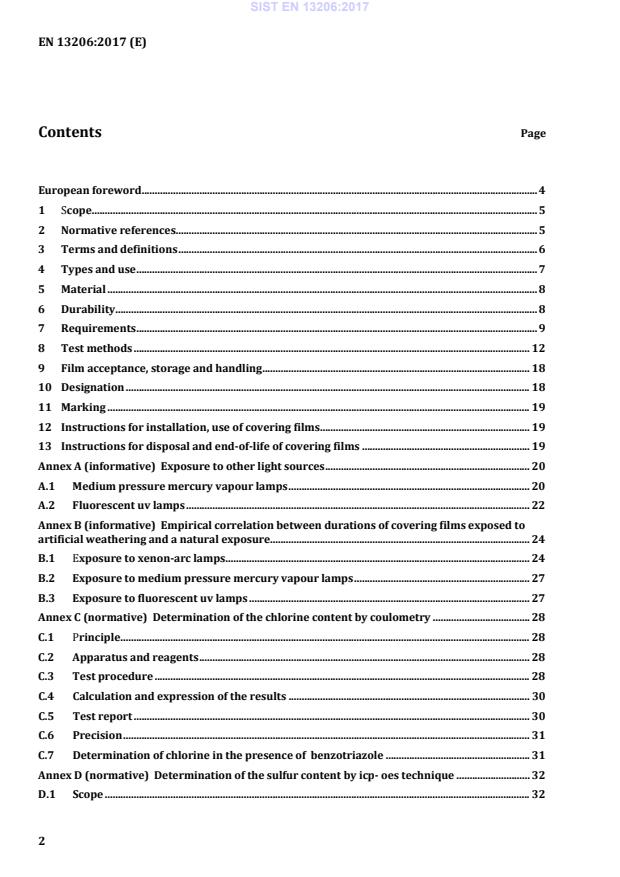
European foreword . 4 1 Scope . 5 2 Normative references. 5 3 Terms and definitions . 6 4 Types and use . 7 5 Material . 8 6 Durability . 8 7 Requirements . 9 8 Test methods . 12 9 Film acceptance, storage and handling . 18 10 Designation . 18 11 Marking . 19 12 Instructions for installation, use of covering films . 19 13 Instructions for disposal and end-of-life of covering films . 19 Annex A (informative)
Exposure to other light sources . 20 A.1 Medium pressure mercury vapour lamps . 20 A.2 Fluorescent uv lamps . 22 Annex B (informative)
Empirical correlation between durations of covering films exposed to artificial weathering and a natural exposure. 24 B.1 Exposure to xenon-arc lamps . 24 B.2 Exposure to medium pressure mercury vapour lamps . 27 B.3 Exposure to fluorescent uv lamps . 27 Annex C (normative)
Determination of the chlorine content by coulometry . 28 C.1 Principle . 28 C.2 Apparatus and reagents . 28 C.3 Test procedure . 28 C.4 Calculation and expression of the results . 30 C.5 Test report . 30 C.6 Precision . 31 C.7 Determination of chlorine in the presence of
benzotriazole . 31 Annex D (normative)
Determination of the sulfur content by icp- oes technique . 32 D.1 Scope . 32 SIST EN 13206:2017
preparation and calibration . 33 D.5 Sample preparation (digestion) . 34 D.6 Sulfur measurement . 34 D.7 Expression of results . 34 D.8 Sulfur determination in case of presence of ni quenchers . 34 D.9 Examples of conditions . 34 Annex E (informative)
Alternative method for the determination of chlorine and sulfur contents by x-ray fluorescence . 36 E.1 Principle . 36 E.2 Introduction . 36 E.3 Apparatus . 36 E.4 Test procedure . 36 E.5 Calculation and expression of the result . 36 E.6 Test report . 37 Annex F (informative)
Alternative methods for the determination of sulfur content by ultraviolet fluorescence method or by coulometry . 38 F.1 Principle . 38 F.2 Ultraviolet fluorescence method . 38 F.3 Coulometry . 40 Annex G (informative)
Guidance for installation, use and disposal of covering films . 43 G.1 Greenhouse covering films . 43 G.2 Low tunnel covering films. 49 G.3 Removal instructions . 50 Annex H (informative)
Industrial standard formats of films . 51 Bibliography . 52
— a minimum thickness of the film is fixed;
— the test methods have been updated as appropriate; — this revision specifies also test methods for the determination of the chlorine and sulfur contents of the films subjected to use and defines guidelines for installation, use and disposal; — the classification for the durability of the covering films is extended to a further class. Attention is drawn to the possibility that some of the elements of this document may be the subject of patent rights. CEN [and/or CENELEC] shall not be held responsible for identifying any or all such patent rights. According to the CEN/CENELEC Internal Regulations, the national standards organizations of the following countries are bound to implement this European Standard: Austria, Belgium, Bulgaria, Croatia, Cyprus, Czech Republic, Denmark, Estonia, Finland, Former Yugoslav Republic of Macedonia, France, Germany, Greece, Hungary, Iceland, Ireland, Italy, Latvia, Lithuania, Luxembourg, Malta, Netherlands, Norway, Poland, Portugal, Romania, Serbia, Slovakia, Slovenia, Spain, Sweden, Switzerland, Turkey and the United Kingdom. SIST EN 13206:2017
expected lifetime expected lifetime defined by agreement between the manufacturer/supplier and the customer or, by default, the minimum use duration that the film needs to satisfy Note 1 to entry: It is expressed in years, months or seasons. 3.10 actual useful lifetime time interval defined as beginning from the installation date of a film until its removal or an earlier date in case of its failure Note 1 to entry: It is expressed in months, years or seasons. 3.11 use ratio ratio of the actual useful lifetime of a film to its conventional expected lifetime Note 1 to entry: It is expressed as a dimensionless ratio or as a percentage (%). 3.12 remaining use potential difference between the conventional expected lifetime of a film and its actual useful lifetime Note 1 to entry: It is expressed in months. 3.13 radiant exposure H time integral of irradiance, measured in joules per square metre (J/m2) [SOURCE: ISO 9370:2009 [1], definition 3.27] 4 Types and use The different types of covering films, their optical and thermal characteristics and use are given in Table 1. Table 1 — Characteristics and use of covering films Type Optical and thermal characteristics Use Non-thermal (NTh) Low IR effectiveness Forcing and semi forcing crops Thermal clear (ThC) High transparency High IR effectiveness Same use as normal film, when higher IR effectiveness is requested Thermal diffusing (ThD) Diffusing light High IR effectiveness Same use as normal film, when higher IR effectiveness and diffusing light effect are requested SIST EN 13206:2017
· 20 a
· 60 b
· 100 c
· 150 d
· 200 Appearance - Shall conform to 7.2 7.2 Dimensional characteristics Tolerance of average thickness/nominal thickness % ±5 8.1 Tolerance of single point thickness/nominal thickness % - 15, +25 8.1 Width tolerance/nominal width Flat film Tubular film % % 0, +4 0, +2,4 8.2 Tolerance roll length/nominal length % 0, +4 8.12 Mechanical characteristics on unexposed film Tensile stress at break (MD, TD) MPa
· 19 8.3 Tensile strain at break (MD, TD) %
· 250
· 300
· 350
· 400
· 450 8.3 Impact resistance
Flat area g
· 100
· 150
· 300
· 350
· 450 8.4.2 Fold area g
· 75
· 100
· 150
· 200
· 250 8.4.3 Optical characteristic on unexposed film Visible light
transmission %
· 90
· 88
· 88
· 85
· 85 8.6 a 20
¶ nominal thickness < 60
b 60
¶ nominal thickness < 100
c 100
¶ nominal thickness < 150
d 150
¶ nominal thickness < 200
· 25 a
· 60 b
· 100 c
· 150 d
· 200 Appearance - Shall conform to 7.2 7.2 Dimensional characteristics Tolerance of average thickness/nominal thickness % ±5 8.1 Tolerance of single point thickness/nominal thickness % - 15, +25 8.1 Width tolerance/nominal width Flat film Tubular film % % 0, +4 0, +2,4 8.2 Tolerance roll length/nominal length % 0, +4 8.12 Mechanical characteristics on unexposed film Tensile stress at break (MD, TD) MPa
· 20 8.3 Tensile strain at break (MD, TD) %
· 300
· 350
· 400
· 450
· 550 8.3 Impact resistance
Flat area g
· 150
· 250
· 350
· 500
· 650 8.4.2 Fold area g
· 75
· 100
· 200
· 350
· 400 8.4.3 Elongation under a steady load (MD) %
¶ 30
¶ 30
¶ 30
¶ 30
¶ 30 8.5 Optical characteristic on unexposed film Visible light
transmission %
· 92
· 90
· 90
· 88
· 88 8.6 Haze %
¶ 20
¶ 25
¶ 25
¶ 30
¶ 30 8.7 IR effectiveness %
· 40
· 50
· 55
· 65
· 75 8.8 a 25
¶ nominal thickness < 60
b 60
¶ nominal thickness < 100
c 100
¶ nominal thickness < 150
d 150
¶ nominal thickness < 200
· 25 a
· 60 b
· 100 c
· 150 d
· 200 Appearance - Shall conform to 7.2 7.2 Dimensional characteristics Tolerance of average thickness/nominal thickness % ±5 8.1 Tolerance of single point thickness/nominal thickness % - 15, +25 8.1 Width tolerance/nominal width Flat film Tubular film % % 0, +4 0, +2,4 8.2 Tolerance roll length/nominal length % 0, +4 8.12 Mechanical characteristics on unexposed film Tensile stress at break (MD, TD) MPa
· 20 8.3 Tensile strain at break (MD, TD) %
· 200
· 220
· 350
· 400
· 500 8.3 Impact resistance
Flat area g
· 100
· 160
· 300
· 400
· 500 8.4.2 Fold area g
· 75
· 110
· 200
· 250
· 350 8.4.3 Elongation under a steady load (MD) %
¶ 30
¶ 30
¶ 30
¶ 30
¶ 30 8.5 Optical characteristic on unexposed film Visible light
transmission %
· 88
· 85
· 85
· 80
· 80 8.6 Haze %
· 30
· 30
· 30
· 35
· 35 8.7 IR effectiveness %
· 40
· 55
· 60
· 70
· 75 8.8 a 25
¶ nominal thickness < 60
b 60
¶ nominal thickness < 100
c 100
¶ nominal thickness < 150
d 150
¶ nominal thickness < 200
7.2 Requirement for appearance The free edges of the roll shall be sealed with adhesive tape or by some other similar means, in order to prevent its unwinding. The edges shall be properly in line and there shall be sufficient tension to prevent the layers of the roll from transverse slipping when it is handled. The film shall be homogeneous and free from visible defects which may affect the fitness for purpose of the film; check by unrolling at least 2 m of the film and examining it against the light holding it tight at arms length. SIST EN 13206:2017
Key 1 external fold 2 internal fold 3 film 4 vertical axle of the specimen clamps where: d = 13 mm Figure 1 — Position of impact on folds 8.5 Determination of elongation under a steady load (creep test) 8.5.1 Principle This test method is intended to measure the creep, expressed as the elongation of the film under a steady load in a vertical static position after a specified time period. 8.5.2 Apparatus A typical arrangement for testing is shown in Figure 2. The test piece is hold by two grips, the upper grip is clamped to a fixed support and a weight is hung to the lower grip to provide a steady load on the test piece. SIST EN 13206:2017
Key 1 Fixed support 2 Grips 3 test piece 4 Mass Figure 2 — Typical apparatus 8.5.3 Test pieces Cut three test pieces from the film in the longitudinal direction (MD), with the following dimensions: — width: 10 mm; — overall length: 140 mm; Gauge marks are defined on each test piece. The distance between the marks (L0) shall be 100 mm. 8.5.4 Test conditions a) Test temperature: 23 °C ± 2 °C. b) Stress to be applied: 4 MPa. c) Test period: 100 h. 8.5.5 Test procedure For each test piece, measure the thickness and the minimum width and calculate the value of the steady load referring to the measured values. Make two marks which defined the gauge length (L0) on the test piece. Set the test piece in the grips. Adjust the mass of the test stress
to the calculated value, e.g. by adding or removing lead shot. SIST EN 13206:2017
is the measured initial gauge length, in mm; L
is the arithmetic average value, in mm, of the three measurements of the distance between the two marks that define the gauge length at the end of testing. 8.6 Determination of visible light transmission The total visible light transmission is determined in accordance with ASTM D 1003-13 on five test pieces cut from the film. Calculate the arithmetic average value of the five measurements. The arithmetic average value shall fulfil the requirements of Table 3, 4 and 5, as applicable. 8.7 Determination of haze The haze shall be determined in accordance with ASTM D 1003-13 on five test pieces taken from the film. Calculate the arithmetic average value of the five measurements. The arithmetic average value shall fulfil the requirements of Table 4 and 5
as applicable. 8.8 Determination of IR effectiveness (ir) (thermal clear and thermal diffusing films) 8.8.1 Principle The method consists of measuring the IR transmission spectrum within wave numbers ranging from 1 430 cm «1 to 770 cm «1 (between 7
This range of wavelengths corresponds to the field of maximum emission of the energy irradiated by the earth's surface. 8.8.2 Apparatus 8.8.2.1 Infrared spectrophotometer allowing to measure and record continuously transmittance between 1 500 cm «1 and 700 cm «1; 8.8.2.2 Analytical balance with an accuracy of 0,1 mg or planimeter. NOTE The determination of IR effectiveness may also be made by using IR spectrophotometers equipped with software to integrate transmittance. SIST EN 13206:2017
the percentage of the measured area of the spectrum in respect to the total area is the value of the IR effectiveness (ir). According to the weighing method, the IR effectiveness (ir) in the range of wavelengths between 7 to 13
100100100×−=PPPtirη Calculate the arithmetic average value of the five measurements. The arithmetic average value shall fulfil the requirements of Table 4 and 5, as applicable. 8.9 Determination of resistance to weathering 8.9.1 Principle The variation of the tensile strain at break of specimens is determined before and after an exposure to xenon-arc lamps. 8.9.2 Exposure to xenon-arc lamps Carry out the artificial weathering according to EN ISO 4892-2:2013, Method A, using one of the test conditions given in Table 6. Table 6 — Exposure cycle and test conditions Exposure period Irradiance
Black-standard Temperature °C Chamber Temperature °C Relative humidity % Broadband (300 nm to 400 nm) W/m2 Narrowband (340 nm) W/(m2„nm) 102 min dry 18 min water spray 40 ± 2 40 ± 2 0,35 ± 0,02 0,35 ± 0,02 65 ± 3 — 38 ± 3 — 50 ± 5 — 102 min dry 18 min water spray 60 ± 2 60 ± 2 0,51 ± 0,02 0,51 ± 0,02 65 ± 3 — 38 ± 3 — 50 ± 5 — SIST EN 13206:2017
shall be used. 8.11 Determination of the sulfur content of used films The sulfur content of used films shall be determined in accordance with Annex D. Alternative methods may be used if there is an agreement between the manufacturer and the customer. For example, the sulfur content may be determined by ultraviolet fluorescence method or by coulometry according to Annex F, or by X-ray fluorescence method according to Annex E. In case of dispute, the method as specified in Annex D shall be used. 8.12 Determination of the roll/sheet length The roll or sheet length shall be greater or equal to the nominal length of the roll or the sheet. These control procedures are recommended in cases where there is uncertainty regarding the length of a roll or for survey testing. They are not recommended for goods acceptance inspections. The inspection shall be carried out on a film roll that is complete and in its original packaging. If the nominal length of the roll is 50 m or less, unwrap the roll and completely unroll it on a flat surface, then measure its length using a decametre. If the nominal length of the roll is over 50 m, follow the procedure below to check the length: a) unwrap the roll; b) determine the mass of the complete roll, PB, in kilograms, to the nearest 0,1 kg; c) at the beginning, middle and end of the roll, take three width samples, each measuring 100 cm ± 0,2 cm when flat; d) where appropriate, determine the mass of the core, PM, in grams. If there is no core: PM = 0 g; SIST EN 13206:2017
is the roll length, in metres; PB
is the mass of the complete roll, in kilograms; PM
is the core mass, in grams; P
is the total sample mass, in grams. 9 Film acceptance, storage and handling 9.1 Acceptance Carefully examine the rolls or sheets upon delivery in order to find any apparent damage or anomalies. If a defect is found, take the necessary actions for the case. Whenever possible, it is recommended to take a photograph of the damage. The rolls and sheets shall be carried, not dragged over the ground or any other surface. 9.2 Storage and handling of rolls Keep the rolls in their original packaging and store them protected from direct exposure to sunlight and temperature source and rain. For greenhouse covering films, the duration of storage by the end-user shall be contractually limited to less than three months. It is recommended that rolls delivered with a cardboard core be stored in a dry location. Handling should be performed horizontally. 10 Designation The designation of the film shall include the following information: a) use of the film: COVERING FILM with the type according to Table 1; b) reference to this European Standard: EN 13206; c) nominal width of the film, in millimetres (mm) ; d) nominal thickness of the film, in micrometres (µm) if required; e) class of durability according to Table 2. f) manufacturer's trade mark; g) manufacturer's information (the production period, year and month, in figures). All these information have to be put on the accompanying label. EXAMPLE
COVERING FILM NTh EN 13206 5000 150 A AnyCo 2016–06 SIST EN 13206:2017
AnyCo 2016-06 12 Instructions for installation, use of covering films The instructions of the film manufacturer for the conditions of installation and use, including durability aspects and maximum thresholds for residual sulfur and chlorine contents, shall be followed. In the absence of such instructions, guidance is given in G.1 for greenhouse covering films and in G.2 for low tunnel covering films. 13 Instructions for disposal and end-of-life of covering films For the removal instructions, the recommendations given by local authorities in charge of waste management of post-used agricultural films shall be followed. The minimum technical requirements issued by the companies/organizations that collect films are available on their websites. In the absence of such recommendations, see G.3, as guidance. Thermoplastic films are recyclable materials that can be re-processed in a material recovery process intended to save resources while minimizing harmful emissions into the air, water and soil, as well as their impacts on human health. EN 15347 [2] provides a framework for characterizing plastic waste. EN 15343 [3] provides the procedures necessary for ensuring the traceability of recycled plastics. EN 15344 [4] provide data for characterizing polyethylene and polypropylene recyclates respectively. ISO 15270 [6] provides guidelines for terminology and material recovery, through mechanical recycling in particular. SIST EN 13206:2017
Exposure to other light sources A.1 Medium pressure mercury vapour lamps A.1.1 Durability classification In the case of an exposure to medium pressure mercury vapour lamps, the class of durability of covering films is given in Table A.1, depending on the duration of exposure of the film according to A.1.2, which induces a decrease of the values of tensile strain at break equal or less than 50 % of the initial values. The class of durability shall be declared by the manufacturer. Table A.1 — Durability classification Class Minimum duration of exposure h N 100 A 450 B 750 C 1200 D 1 500 E 1 900 F 2 400 A.1.2 Exposure to medium pressure mercury vapour lamps A.1.2.1 Exposure method Carry out the exposure according to EN 16472 using the test conditions given in A.1.2.2 and A.1.2.3. The exposure may be carried out in the presence of moisture in the form of water spray, condensation or by immersion cycles with or without light. In this case, test parameters shall be agreed between parties and recorded in the test report. NOTE Information on the influence of water and additive migration can be found in ISO 10640 [7]. A.1.2.2 Irradiance The irradiance at the surface of the test specimens shall be (95 ± 15) W/m2 in the spectral passband 290 nm à 420 nm. SIST EN 13206:2017
is the absorbance ratio (carbonyl index); A1715
is the maximum absorbance at near 1 715 cm «1; A2020 is the maximum absorbance at near 2 020 cm «1. If the calculated absorbance ratio is out of the range as defined above, adjust the temperature set point and recalibrate until this condition is satisfied. NOTE For detailed information on the method to determine the absorbance ratio see ISO/TR 19032:2006 [8], 4.1. A.1.3 Procedure The specimen shall be exposed according to A.1.2, for the duration corresponding to the relevant class given in Table A.1. After the exposure, the tensile strain at break shall be determined according to EN ISO 527-1 and EN ISO 527-3, using five type 2 test pieces, 10 mm wide, 150 mm long, taken longitudinally in the film (MD), at a test speed of 500 mm/min. A.1.4 Calculation and expression of results Calculate the arithmetic mean value of the five measurements performed on the test pieces cut from the exposed specimens and the arithmetic mean value of the five measurements performed on the test pieces cut from the unexposed specimens in longitudinal direction (MD) (see 8.3). Compare these two values. SIST EN 13206:2017
...