

EN 13031-1:2019
(Main)Greenhouses - Design and construction - Part 1: Commercial production greenhouses
- Abstract
This document specifies principles and requirements for the mechanical resistance and stability, serviceability and durability for design and construction of commercial production greenhouse structures, including their foundations, irrespective of the material used, for the professional production of plants (crops).
Fire resistance-related aspects are not covered in this document.
- Status
- Published
- Publication Date
- 17-Dec-2019
- Withdrawal Date
- 29-Jun-2020
- Technical Committee
- CEN/TC 284 - Greenhouses
- Drafting Committee
- CEN/TC 284 - Greenhouses
- Current Stage
- 9093 - Decision to confirm - Review Enquiry
- Start Date
- 10-Jun-2025
- Completion Date
- 07-Oct-2026

Overview
EN 13031-1:2019 (identical to EN 13031-1:2019) sets out principles and requirements for the design and construction of commercial production greenhouses. It addresses mechanical resistance and stability, serviceability and durability of greenhouse structures - including foundations and cladding - regardless of construction material. Note: fire resistance is explicitly excluded from this standard. The standard was prepared by CEN/TC 284 “Greenhouses” and supersedes earlier national editions.
Key topics and technical requirements
The standard covers technical topics essential for structurally sound commercial greenhouses:
- Basis of design: classes of greenhouse structures, design working life, reliability and partial factors for structural design.
- Limit states: requirements for Ultimate Limit States (ULS) and Serviceability Limit States (SLS), including design calculations and testing.
- Actions on greenhouses: representative permanent, variable and accidental loads - detailed treatment of wind, snow, seismic and temperature effects (see normative annexes).
- Tolerances and displacements: permissible tolerances for members, displacements at connections, gutters and arches; SLS deflection limits.
- Durability, maintenance and repair: material durability, recommended maintenance schedules and repair guidance.
- Cladding and glazing: structural capacity and calculation methods for glass panels (Annex A) and verification methods for film-covered greenhouses (Annex I).
- Detailed annexes:
- Annex B: wind actions and aerodynamic coefficients
- Annex C: snow actions and thermal coefficients
- Annex E: earthquake/seismic actions
- Annex F: owner’s manual and identification plate
- Informative guidance on maintenance, structural details and calculation models
Practical applications - who uses this standard
SIST EN 13031-1 is intended for professionals involved in the lifecycle of commercial greenhouses:
- Structural and greenhouse engineers designing frames, foundations and cladding systems
- Manufacturers and fabricators specifying components and tolerances
- Contractors and installers ensuring construction complies with stability and serviceability requirements
- Greenhouse owners and operators using the owner’s manual and maintenance guidance
- Certifiers, inspectors and regulators assessing compliance with European structural practice
Typical applications include design checks for wind/snow loads, foundation detailing, glass or film cladding verification, tolerance control during assembly, and preparation of maintenance manuals.
Related information
- This document is the European standard EN 13031-1:2019 adopted as EN 13031-1:2019, and it supersedes earlier national editions. Relevant complementary standards cover specific topics such as materials, glazing products, and climate control systems that may be applied alongside this standard.
Relations
- Replaces
EN 13031-1:2001 - Greenhouses - Design and construction - Part 1: Commercial production greenhouses - Effective Date
- 08-Jun-2022
- Refers
EN 1998-1-2:2026 - Eurocode 8 - Design of structures for earthquake resistance - Part 1-2: Buildings - Effective Date
- 25-Mar-2026
- Effective Date
- 25-Mar-2026
- Effective Date
- 09-Feb-2026
- Effective Date
- 28-Jan-2026
- Effective Date
- 28-Jan-2026
- Effective Date
- 28-Jan-2026
- Refers
EN 1991-1-4:2005 - Eurocode 1: Actions on structures - Part 1-4: General actions - Wind actions - Effective Date
- 28-Jan-2026
- Effective Date
- 28-Jan-2026
- Effective Date
- 28-Jan-2026
- Effective Date
- 28-Jan-2026
- Effective Date
- 28-Jan-2026
- Effective Date
- 28-Jan-2026
- Effective Date
- 28-Jan-2026
- Effective Date
- 28-Jan-2026
Get Certified
Connect with accredited certification bodies for this standard

Control Union Certifications
Global certification for agriculture and sustainability.

ECOCERT
Organic and sustainability certification.

FSC International
Forest Stewardship Council certification.
Sponsored listings
Frequently Asked Questions
EN 13031-1:2019 is a standard published by the European Committee for Standardization (CEN). Its full title is "Greenhouses - Design and construction - Part 1: Commercial production greenhouses". This standard covers: This document specifies principles and requirements for the mechanical resistance and stability, serviceability and durability for design and construction of commercial production greenhouse structures, including their foundations, irrespective of the material used, for the professional production of plants (crops). Fire resistance-related aspects are not covered in this document.
This document specifies principles and requirements for the mechanical resistance and stability, serviceability and durability for design and construction of commercial production greenhouse structures, including their foundations, irrespective of the material used, for the professional production of plants (crops). Fire resistance-related aspects are not covered in this document.
EN 13031-1:2019 is classified under the following ICS (International Classification for Standards) categories: 65.040.30 - Greenhouses and other installations. The ICS classification helps identify the subject area and facilitates finding related standards.
EN 13031-1:2019 has the following relationships with other standards: It is inter standard links to EN 13031-1:2001, EN 1998-1-2:2026, EN 1991-1-4:2026, ISO 4355:2013, EN 673:2024, EN ISO 6946:2017, EN ISO 10077-2:2017, EN 1991-1-4:2005, EN ISO 12543-5:2021, EN 1090-1:2009+A1:2011, EN 1998-1-1:2024, EN 1279-1:2018, EN 572-1:2012+A1:2016, EN 1096-1:2012, EN 12150-1:2015+A1:2019. Understanding these relationships helps ensure you are using the most current and applicable version of the standard.
EN 13031-1:2019 is available in PDF format for immediate download after purchase. The document can be added to your cart and obtained through the secure checkout process. Digital delivery ensures instant access to the complete standard document.
Standards Content (Sample)
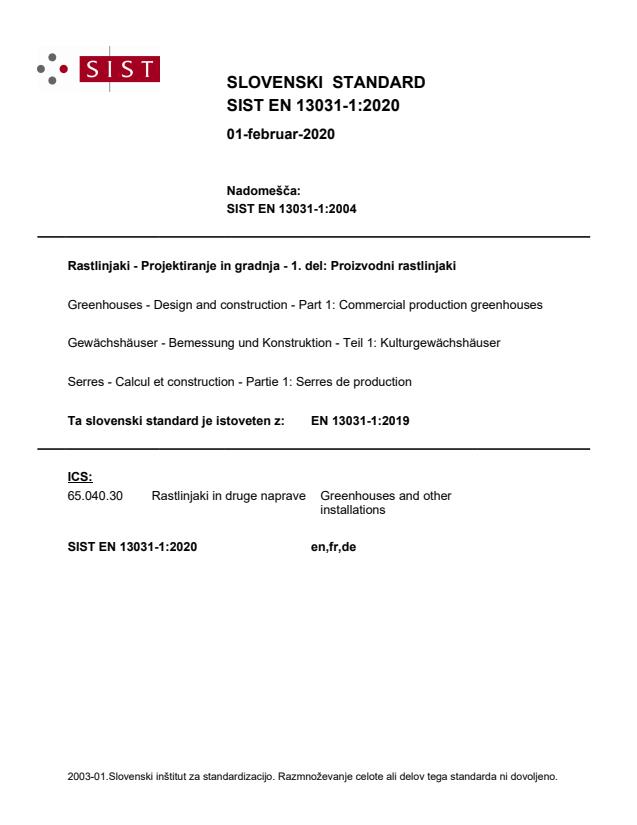
SLOVENSKI STANDARD
01-februar-2020
Nadomešča:
SIST EN 13031-1:2004
Rastlinjaki - Projektiranje in gradnja - 1. del: Proizvodni rastlinjaki
Greenhouses - Design and construction - Part 1: Commercial production greenhouses
Gewächshäuser - Bemessung und Konstruktion - Teil 1: Kulturgewächshäuser
Serres - Calcul et construction - Partie 1: Serres de production
Ta slovenski standard je istoveten z: EN 13031-1:2019
ICS:
65.040.30 Rastlinjaki in druge naprave Greenhouses and other
installations
2003-01.Slovenski inštitut za standardizacijo. Razmnoževanje celote ali delov tega standarda ni dovoljeno.
EN 13031-1
EUROPEAN STANDARD
NORME EUROPÉENNE
December 2019
EUROPÄISCHE NORM
ICS 65.040.30 Supersedes EN 13031-1:2001
English Version
Greenhouses - Design and construction - Part 1:
Commercial production greenhouses
Serres - Calcul et construction - Partie 1 : Serres de Gewächshäuser - Bemessung und Konstruktion - Teil 1:
production Produktionsgewächshäuser
This European Standard was approved by CEN on 19 May 2019.
CEN members are bound to comply with the CEN/CENELEC Internal Regulations which stipulate the conditions for giving this
European Standard the status of a national standard without any alteration. Up-to-date lists and bibliographical references
concerning such national standards may be obtained on application to the CEN-CENELEC Management Centre or to any CEN
member.
This European Standard exists in three official versions (English, French, German). A version in any other language made by
translation under the responsibility of a CEN member into its own language and notified to the CEN-CENELEC Management
Centre has the same status as the official versions.
CEN members are the national standards bodies of Austria, Belgium, Bulgaria, Croatia, Cyprus, Czech Republic, Denmark, Estonia,
Finland, France, Germany, Greece, Hungary, Iceland, Ireland, Italy, Latvia, Lithuania, Luxembourg, Malta, Netherlands, Norway,
Poland, Portugal, Republic of North Macedonia, Romania, Serbia, Slovakia, Slovenia, Spain, Sweden, Switzerland, Turkey and
United Kingdom.
EUROPEAN COMMITTEE FOR STANDARDIZATION
COMITÉ EUROPÉEN DE NORMALISATION
EUROPÄISCHES KOMITEE FÜR NORMUNG
CEN-CENELEC Management Centre: Rue de la Science 23, B-1040 Brussels
© 2019 CEN All rights of exploitation in any form and by any means reserved Ref. No. EN 13031-1:2019 E
worldwide for CEN national Members.
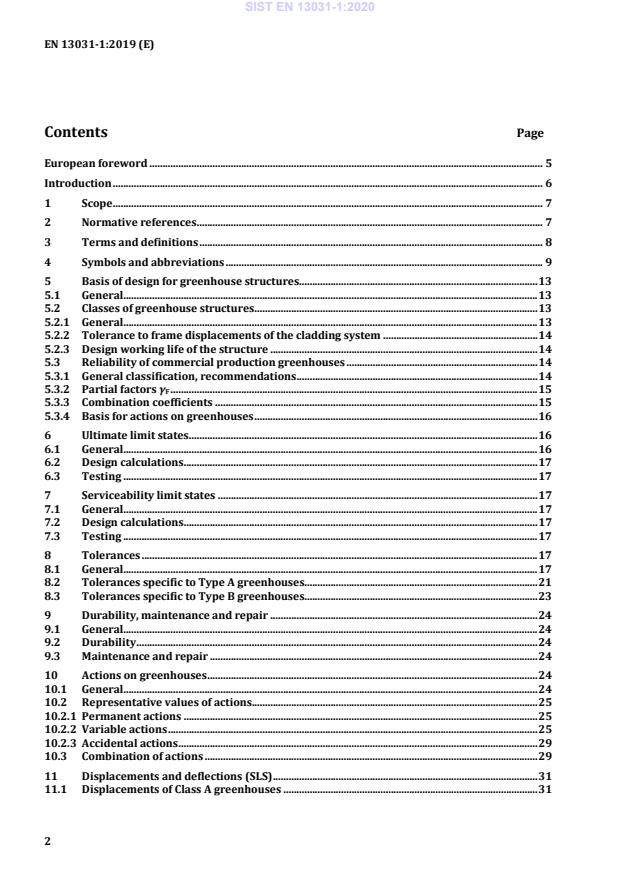
Contents Page
European foreword . 5
Introduction . 6
1 Scope . 7
2 Normative references . 7
3 Terms and definitions . 8
4 Symbols and abbreviations . 9
5 Basis of design for greenhouse structures. 13
5.1 General. 13
5.2 Classes of greenhouse structures . 13
5.2.1 General. 13
5.2.2 Tolerance to frame displacements of the cladding system . 14
5.2.3 Design working life of the structure . 14
5.3 Reliability of commercial production greenhouses . 14
5.3.1 General classification, recommendations . 14
5.3.2 Partial factors γ . 15
F
5.3.3 Combination coefficients . 15
5.3.4 Basis for actions on greenhouses . 16
6 Ultimate limit states . 16
6.1 General. 16
6.2 Design calculations. 17
6.3 Testing . 17
7 Serviceability limit states . 17
7.1 General. 17
7.2 Design calculations. 17
7.3 Testing . 17
8 Tolerances . 17
8.1 General. 17
8.2 Tolerances specific to Type A greenhouses. 21
8.3 Tolerances specific to Type B greenhouses. 23
9 Durability, maintenance and repair . 24
9.1 General. 24
9.2 Durability . 24
9.3 Maintenance and repair . 24
10 Actions on greenhouses . 24
10.1 General. 24
10.2 Representative values of actions. 25
10.2.1 Permanent actions . 25
10.2.2 Variable actions . 25
10.2.3 Accidental actions . 29
10.3 Combination of actions . 29
11 Displacements and deflections (SLS) . 31
11.1 Displacements of Class A greenhouses . 31
11.1.1 Displacements of connecting points of columns with foundations . 31
11.1.2 Displacements at gutter level . 31
11.1.3 Displacements of arches . 35
11.2 Deflections of Type A greenhouses . 36
11.2.1 General . 36
11.2.2 Deflections of components of a greenhouse . 36
Annex A (normative) Structural capacity of glass panels . 38
A.1 General . 38
A.2 Calculation method for glass panels . 38
A.3 Materials . 41
Annex B (normative) Wind actions . 44
B.1 General . 44
B.2 Aerodynamic coefficients . 44
B.2.1 General . 44
B.2.2 Greenhouses with pitched roofs . 45
B.2.3 Greenhouses with arched roofs . 51
B.2.4 Internal pressures . 62
B.2.5 Surface friction . 63
B.2.6 Ventilators . 63
B.2.7 Permeable cladding . 63
B.3 Dynamic coefficients for gust wind response . 64
Annex C (normative) Snow actions . 65
C.1 General . 65
C.2 Thermal coefficient C . 67
t
C.2.1 Requirements for heated greenhouses with controlled heating . 67
C.2.2 Special heat transmittance (U value according to ISO 4355) . 67
o
C.2.3 Calculation of the thermal coefficient C . 69
t
C.3 Special snow load shape coefficients for greenhouses . 71
C.3.1 General . 71
C.3.2 Pitched roofs of greenhouses . 72
C.3.3 Arched roofs of greenhouses . 76
Annex D (informative) Ultimate limit states for arches . 78
D.1 General . 78
D.2 Equivalent imperfections . 78
D.3 First order elastic and linear buckling (Euler buckling) . 78
D.4 Second order elastic . 79
D.5 Second order elastic-plastic . 79
D.6 Equivalent model for the behaviour of cross-sections of thin walled tubes . 79
Annex E (normative) Earthquake . 81
E.1 Classification . 81
E.2 Importance factors . 81
E.3 Earthquake return periods . 82
E.4 Seismic actions . 82
Annex F (normative) Owner's manual and identification plate . 83
F.1 General . 83
F.2 Owner’s manual . 83
F.3 Identification plate . 84
Annex G (informative) Instructions for maintenance and repair . 85
G.1 General . 85
G.2 Access to the roof . 85
G.3 Glass stock and emergency repair kits . 85
Annex H (informative) Structural details . 86
H.1 General. 86
H.2 Forces due to temperature effects . 86
H.3 Contact forces between glass panels and cladding bars . 86
H.4 Rainwater capacities of gutters, gutter outlets and downpipes . 87
H.5 Aperture ratio . 87
H.6 Light interception ratio . 89
Annex I (informative) Calculation method for film covered greenhouses . 91
I.1 General. 91
I.2 Actions on film covered greenhouses . 91
I.3 Transmission of forces from the film to the supporting structure . 91
I.4 Verification of the film . 94
Bibliography . 95
European foreword
This document (EN 13031-1:2019) has been prepared by Technical Committee CEN/TC 284
“Greenhouses”, the secretariat of which is held by NEN.
This European Standard shall be given the status of a national standard, either by publication of an
identical text or by endorsement, at the latest by June 2020, and conflicting national standards shall be
withdrawn at the latest by June 2020.
Attention is drawn to the possibility that some of the elements of this document may be the subject of
patent rights. CEN shall not be held responsible for identifying any or all such patent rights.
This document will supersede EN 13031-1:2001.
National document: National choices are allowed in EN 13031-1 through:
• 5.2.3 for Design working life of the structure;
• 5.3.1 for Classification of Consequence Classes CC;
• 5.3.2 for Differentiation of Partial Factors;
• 5.3.3 and 10.3 for Combinations of actions and related ψ-coefficients;
• 5.3.4 for Reference Periods for related Probabilities of Exceedance;
• 10.2.2 and 10.2.3 for Adjustment Factors for Reference Periods according to 5.3.4;
• 10.2.2.6 for Temperature ranges for gutters and other structural components;
• 10.3 Combination of actions;
• Annex A for Glass design calculation;
• Annex B for Wind: Size Factors, Correlation Coefficients, Aerodynamic Coefficients;
• Annex C for Snow: Surface Material Coefficients, Thermal Coefficients, Shape Coefficients;
• Annex E for Earthquake: Classification of Importance Categories IC, Importance Factors γ , Return
I
Periods, probabilities of Exceedance and Adjustment Factors;
• Annex F for Owner's manual and identification plate.
As a guidance, the recommended values in tables are shown in grey fields.
According to the CEN-CENELEC Internal Regulations, the national standards organisations of the
following countries are bound to implement this European Standard: Austria, Belgium, Bulgaria,
Croatia, Cyprus, Czech Republic, Denmark, Estonia, Finland, Former Yugoslav Republic of Macedonia,
France, Germany, Greece, Hungary, Iceland, Ireland, Italy, Latvia, Lithuania, Luxembourg, Malta,
Netherlands, Norway, Poland, Portugal, Romania, Serbia, Slovakia, Slovenia, Spain, Sweden, Switzerland,
Turkey and the United Kingdom.
Introduction
Part 1 of this document relates specifically to commercial production greenhouses used for the
professional production of plants (crops) where human occupancy is restricted to authorized
personnel, concerning low levels in number and duration. Other parts of this European standard are to
be prepared that relate to greenhouses where general access by the public is permitted (such as those
in garden centres or expositions).
This document gives specific rules and information, such as load distributions, deformation criteria and
limitations to tolerances, for structural design and construction of greenhouses to enable adequate
structural safety.
The structural design is based on EN 1990 and the relevant parts of EN 1991 to EN 1999 (Eurocodes 1
to 9) regarding the general principles and basic requirements for actions, mechanical resistance and
stability, serviceability and durability. National Application Documents (NAD) are considered.
Recommended values for structural design in this document are given in accordance with the
classification of greenhouses in EN 1990. This takes into account, that for commercial production
greenhouses the consequences and nature of failure and the importance for public safety are lower than
for normal buildings. The design working life is small. The potential economic loss is limited to the
owner and the impact on the environment is low.
Non-contradictory, complementary information is provided to account for the particular requirements,
functions and forms of commercial production greenhouses that distinguish them from ordinary
buildings. A distinguishing functional requirement is the optimization of solar radiation transmission to
create and maintain an optimal environment for the growth of plants (crops). This has implications on
the form and structural design of commercial greenhouses.
As rules and requirements of this standard may become adopted by other European standards, for
example the Structural Eurocodes or codes for Glass in Building – Design of glass panes, these will be
replaced by a reference to this document.
1 Scope
This document specifies principles and requirements for the mechanical resistance and stability,
serviceability and durability for design and construction of commercial production greenhouse
structures, including their foundations, irrespective of the material used, for the professional
production of plants (crops).
Fire resistance-related aspects are not covered in this document.
2 Normative references
The following documents are referred to in the text in such a way that some or all of their content
constitutes requirements of this document. For dated references, only the edition cited applies. For
undated references, the latest edition of the referenced document (including any amendments) applies.
EN 572-1, Glass in building — Basic soda lime silicate glass products — Part 1: Definitions and general
physical and mechanical properties
EN 572-6, Glass in building — Basic soda lime silicate glass products — Part 6: Wired patterned glass
EN 673, Glass in building — Determination of thermal transmittance (U value) — Calculation method
EN 1090-1, Execution of steel structures and aluminium structures — Part 1: Requirements for conformity
assessment of structural components
EN 1096-1, Glass in building — Coated glass — Part 1: Definitions and classification
EN 1279-1, Glass in Building — Insulating glass units — Part 1: Generalities, system description, rules for
substitution, tolerances and visual quality
EN 1990, Eurocode — Basis of structural design
EN 1991-1-1, Eurocode 1: Actions on structures — Part 1-1: General actions — Densities, self-weight,
imposed loads for buildings
EN 1991-1-3, Eurocode 1 – Actions on structures — Part 1-3: General actions — Snow loads
EN 1991-1-4, Eurocode 1: Actions on structures — Part 1-4: General actions — Wind actions
EN 1993-1-1, Eurocode 3: Design of steel structures — Part 1-1: General rules and rules for buildings
EN 1998-1, Eurocode 8: Design of structures for earthquake resistance — Part 1: General rules, seismic
actions and rules for buildings
EN 12150-1, Glass in building — Thermally toughened soda lime silicate safety glass — Part 1: Definition
and description
prEN 16612:2017, Glass in building — Determination of the lateral load resistance of glass panes by
calculation
ISO 4355, Bases for design of structures — Determination of snow loads on roofs
EN ISO 6946, Building components and building elements — Thermal resistance and thermal
transmittance — Calculation methods (ISO 6946)
EN ISO 10077-1, Thermal performance of windows, doors and shutters — Calculation of thermal
transmittance – Part 1: General (ISO 10077-1)
EN ISO 10077-2, Thermal performance of windows, doors and shutters — Calculation of thermal
transmittance — Part 2: Numerical method for frames (ISO 10077-2)
EN ISO 12543-5, Glass in building — Laminated glass and laminated safety glass — Part 5: Dimensions
and edge finishing (ISO 12543-5)
3 Terms and definitions
For the purposes of this document, the terms and definitions given in EN 1990, EN 1090-1 and the
following apply.
ISO and IEC maintain terminological databases for use in standardization at the following addresses:
• IEC Electropedia: available at http://www.electropedia.org/
• ISO Online browsing platform: available at http://www.iso.org/obp
3.1
greenhouse
building structure that optimizes solar radiation transmission used for plants requiring regulated
climatic conditions
3.2
commercial production greenhouse
greenhouse (3.1) for professional production and/-or protection of plants (crops), where human
occupancy is restricted to authorized personnel, concerning low levels in number and duration
Note 1 to entry: Other persons shall be accompanied by authorized personnel.
3.3
clearance
free space in the rabbet, between the cut-size of a cladding panel and two opposite cladding bars
3.4
permanent opening
opening which cannot be closed under extreme wind conditions and which has a significant influence
on the internal pressure
3.5
cladding
outer skin of roof and wall attached to the structural framework of the greenhouse
Note 1 to entry: It is made of panels of glass or plastic sheets or of plastic film and may include further metal
components, such as cladding bars, ridge bar and gutter. The gutter can also be as well a component of the
structural framework.
4 Symbols and abbreviations
Abbreviations:
NAD National Application Documents, e.g. National Annex to Eurocode or Euronorm, also
National Code or National Regulation by the Authority
SLS serviceability limit states
ULS ultimate limit states
NCR non collapse requirements
DLS damage limitation states
CC consequence class
IC earthquake importance category
Luv windward side of the structure
Lee leeward side of the structure
0°-Wind wind direction perpendicular to ridge and gutter, side walls, inclined windward and
leeward roof surface
90°-Wind wind direction parallel to ridge and gutter, perpendicular to the gable walls
Symbols:
NOTE The following symbols used in this document are based on EN 1990, EN 1991 and EN 1998.
Latin upper-case letters:
A altitude of the building site above sea level in m
A accidental action
i
A characteristic value of accidental action
k
A ground area of the greenhouse
gr
A aperture area of the greenhouse
ap
A light interception area of the greenhouse
li
B width
B width of the greenhouse
gh
C exceptional snow load coefficient
esl
Ce exposure coefficient
C surface material coefficient
m
C thermal coefficient
t
D cross sectional dimension of the foundation hole
E modulus of elasticity
F horizontal force per wire
wire
G shear modulus
G ; g permanent action
i i
G ; g characteristic value of a permanent action
k k
H height of the greenhouse ridge above ground level
K shape parameter dependent on the coefficient or variation of the maximum annual
wind data (speed or pressure)
K consequence factor dependent on the consequence class
FI
L length; span
L length of the greenhouse
gh
M moment
N normal or membrane force
P annual probability of exceedance of variable or of earthquake actions
P probability of exceedance of variable or of earthquake actions with reference to n years
n
P target value of the probability of exceedance of the earthquake action with reference to
T,50
n = 50 years and the associated return period T (50)
NCR
Q ,; q variable action
i i
Q ; q characteristic value of a variable action
k k
R thermal resistance of a component
T
R internal surface resistance (surface to internal air)
si
R internal surface resistance for heat flow sideways
si,sw
R internal surface resistance for heat flow upwards
si,up
R external surface resistance (surface to external air)
se
R thermal resistance of the material layer j
λ,j
R thermal resistance of the frame, e.g. gladding bars and gutter
f
R thermal resistance of the gas space k
g,k
R thermal resistance of the (thermal) screen m
ts,m
T (n) target value for the earthquake return period in years for NCR in reference to n years
NCR
T (50) target value for the earthquake return period in years for NCR in reference to 50 years
NCR
U overall heat transmittance in W/(m K)
U special heat transmittance in W/(m K) for snowmelt conditions excluding the external
o
heat transfer into the air
V coefficient of variation of the annual maximum snow load
Latin lower-case letters:
a largest span of a glass panel, distance between wires
a reference peak ground acceleration for earthquake
gR
a design ground acceleration for earthquake
g
b smallest span of a glass panel; distance in width direction
b distance between the column bases
cb
c clearance; coefficient
c coefficient of friction
fr
c aerodynamic coefficient for global external pressure
pe
c aerodynamic coefficient for local external pressure
pe,L
c aerodynamic coefficient for internal pressure
pi
c probability factor the adjustment of the wind speed dependent on the return period n
prob
c size factor
s
c correlation factor
cor
d distance; diameter; depth
f characteristic yield strength of steel
y
fgl;d design value of the ultimate bending strength of a glass pane
f characteristic value of the ultimate bending strength of a glass pane
gl;u
f(α) roof angle function for the thermal coefficient C
t
f(θ ) influence of the heating (internal air temperature) on the thermal coefficient C
i t
f(U ) influence of the thermal transmittance of the gladding on the thermal coefficient C
o t
f(s ) influence of the snowfall rate (snow load) on the thermal coefficient C
k,n t
f (n) adjustment factor for the characteristic value of the snow load dependent on the
s
reference period n
f (n) adjustment factor for the characteristic value of the wind load dependent on the
w
reference period n
fE(n) adjustment factor for the earthquake ground acceleration dependent on the reference
period n
h length of column (between foundation and gutter); height (usually above ground level)
h eaves height above ground level
e
h gutter height above ground level
g
h roof height; for multi-span roofs also depth of the inner troughs
r
h heat transfer coefficient of the gas space k
s,k
k seismic coefficient
k quantile of the negative inverse standard normal distribution for the annual probability
n
P (n) for a reference period of n years
k modification factor for the load duration for glass
mod
k strength reduction factor dependent on the edge finish of glass panes
ed
k strength reduction factor dependent on the surface profile of glass panes
sp
l span; distance in longitudinal direction
l distance between the column bases
cb
n number
n return period in years
n design working life in years
d
p target value of the annual probability of failure
T,1
p target value of the failure probability accumulated to a reference period of n = 50 years
T,50
s section length; roof span
s characteristic ground snow load for the reference period n
k,n
s characteristic roof snow load for the location i, the shape coefficient μ , the reference
i,n,t i
period n, the exposure coefficient C and the thermal coefficient C
e t
(Note: for C < 1; C = 1)
t e
min s minimum roof snow load with reference to the ground area in kN/m
1,n,t
t thickness
t load duration
t nominal thickness of the glass panel
nom
t design value of thickness of the glass panel
pl
u displacement or deflection
v intended fall of the gutter
int
v mean wind velocity
m
v fundamental value of the basic wind velocity
b,0
v basic wind velocity
b
w width; overall width of multi-span roof; wind pressure
z , z reference height of a greenhouse above ground for external or internal wind pressure
e i
z reference height for the gust wind response of the greenhouse structure
s
z minimum height (onset of the wind profile)
min
Greek upper-case letters:
Φ cumulative distribution function of the standard normal distribution
Δ deviation from the intended position
Δφ deviation from intended inclination
Greek lower-case letters:
α angle of roof pitch; measured from the horizontal; coefficient of thermal expansion
α second-order elastic critical load factor
cr
α second-order elastic-plastic critical load factor
u
α intended angle between the foundations of side wall and gable wall
H
β angle between the horizontal and the tangent of arched roofs (β = 0° = horizontal
tangent; β = 90° = vertical tangent)
β target value of the reliability index of the annual failure probability
T,1
β target value of the failure probability accumulated to a reference period of n = 50 years
T,50
γ partial factor for actions (including variations and model uncertainties)
F
γ partial factor for resistance (general)
M
γG; γQ; γA partial factor for actions: permanent, variable and accidental action
γ importance factor for earthquake actions dependent on the importance category
I
γ equivalent mean snow density by weight in kN/m
s,equ
λ thermal conductivity in W/(mK) for a material layer j; (λ - upper value; λ - lower
j j,sup j,inf
value)
μ shape coefficient at the location i for roof snow load distributions
i
θ radial angle of an arched roof
θ internal air temperature in °C
i
θ external air temperature in °C
e
ρ density
ν Poisson ratio
φ intended inclination
ϕ rotation angle of the cladding bar
x
ψ combination value, frequent value and quasi-permanent value of variable actions in
0;1;2
load combinations
5 Basis of design for greenhouse structures
5.1 General
(1) Greenhouses shall be designed to have adequate structural resistance, serviceability and durability.
Types and classes of greenhouses are specified in 5.2. Recommendations for the reliability of
commercial production greenhouses are specified in 5.3.
(2) Ultimate limit states shall be verified in accordance with Clause 6, and serviceability limit states in
accordance with Clause 7.
(3) The greenhouse design shall meet the requirements for tolerance, durability, maintenance and
repair given in Clause 8 and Clause 9.
5.2 Classes of greenhouse structures
5.2.1 General
Commercial production greenhouses are classified dependent on the tolerance to frame displacement
of the cladding system as given in 5.2.2 and the design working life for the structure as given in 5.2.3.
NOTE The recommended classes, categories, values and procedures in 5.2, 5.3 and Clause 10 of
EN 13031-1.
5.2.2 Tolerance to frame displacements of the cladding system
(1) Greenhouses shall be designated as Type A or Type B depending upon the tolerance to frame
displacements of the cladding system, as described in 5.2.2(2) to (4).
(2) Greenhouses in which the cladding system is not tolerant to frame displacements, resulting from the
design actions, shall be designated as Type A. Type A greenhouses shall be designed by considering
serviceability limit states (SLS) as well as ultimate limit states (ULS).
(3) Greenhouses in which the cladding system is tolerant to frame displacements, resulting from the
design actions, may be designated as Type B. Type B greenhouses may be designed by considering
ultimate limit states (ULS) only.
(4) In cases where only a part of the greenhouse cladding system is not tolerant to frame displacements,
the greenhouse structure shall be designated as Type A. The local displacements of structural
components directly carrying only parts of the cladding system, that are tolerant to frame
displacements, need not be checked against serviceability limit state (SLS) criteria.
5.2.3 Design working life of the structure
(1) As indicated in EN 1990, commercial production greenhouses shall have a design working life
dependent on the greenhouse type and use.
The life span of cladding (e.g. plastic film) may differ from the design working life, provided that the
cladding can be exchanged in accordance with Clause 9.
(2) Greenhouses should be classified dependent on the design working life as shown in Table 1, where
minimum values are given.
Table 1 — Recommendations for the classification of greenhouses (minimum values)
Type Commercial Production Greenhouse Class
see 5.2.2
c
Design working life n in years
d
15 years 10 years 5 years
Type A A15 – –
a b B15 B10 B5
Type B
a
A design working life of 5 years may only be used for structures with limited service life, such as tunnels.
b
Where expensive plants (crops) and /or equipment are present in the greenhouse, the design working life should
be not less than 10 years.
c
A design working life of at least 15 years shall be used for structures dedicated to technical areas (such as electric
generator rooms, boiler rooms, storage areas, cold rooms, ferti-irrigation areas, water storage, packing areas, plants
(crops) preparation areas, etc.) with low level of authorized personnel.
5.3 Reliability of commercial production greenhouses
5.3.1 General classification, recommendations
(1) According to EN 1990, commercial production greenhouses specified in 5.2.3 as Class A15 or Class
B15, should be classified as structures of Consequence Class CC1.
(2) Commercial production greenhouses, specified in 5.2.3 as Class B10 and B5, should be classified as
structures of Consequence Class CC0.
NOTE For commercial production greenhouses the consequences and nature of failure and the importance
for public safety are lower than for normal buildings. There is no public access. Human access is restricted to
authorized personnel, concerning low levels in number and duration. The potential economic loss is limited to the
owner; the impact on the environment is low. The design working life is small. The statistical basis for the
reliability differentiation in accordance with EN 1990 is given in Table 2.
5.3.2 Partial factors γ
F
(1) As indicated in EN 1990 the partial factors of actions γF may be modified using the recommended
consequence factors K for actions in persistent and transient design situations:
FI
γγF, i= K
FI,i F,i,CC2
where
K is the consequence factor for the consequence class according to Table 2;
FI,i
γ is the partial factor for the action i;
F,i
γ is the partial factor for the action i for the reference consequence class CC2, taken from
F,i,CC2
EN 1990 and NAD.
(2) For the commercial production greenhouses classified in 5.3.1, the consequence factors based on
EN 1990, should be taken as shown in Table 2.
Table 2 — Consequence factors for commercial production greenhouses
Persistent, transient and accidental design situations Consequence Class
ULS (reference period 50 years) a CC1 CC0
CC2
−5 −4 −3
Target value of probability of failure for n = 50 years p 5 · 10 5 · 10 5 · 10
T,50
(3,8) (3,3) (2,6)
(Target value of reliability index β )
T,50
1/50 −6 −5 −4
Target value of annual failure probability p = 1 - (1-p ) 10 10 10
T,1 T,50
(4,7) (4,2) (3,7)
(Target value of reliability index β )
T,1
K and K for permanent and variable actions 1 0,9 0,8
Fi,G Fi,Q
KFi,A for accidental actions (without earthquake) 1 0,8 0,6
a
Basic reference values for n = 50 years, consequence class CC2 according to EN 1990.
5.3.3 Combination coefficients
(1) In addition to general combinations of actions in ULS and SLS and the related combination
coefficients that should be taken from EN 1990 and NAD, all design values of actions on greenhouses
that may occur simultaneously shall be considered in combination. In verifying the serviceability and
ultimate limit states, the effects of the most onerous combinations of design values of actions shall be
considered.
(2) Values of ψ factors for wind and snow can be taken from EN 1990 + NAD. In case crop load is the
leading variable action, the ψ factor for snow load may be taken as ψ = 0 in case the thermal
i,Qk2
coefficient for the roof cladding can be taken as C < 1 (see Annex C, Table C.1). The recommended ψ
t
factor for crop load is ψ = 1 in all load combinations.
i,Qk3
NOTE See Clause 10 of this standard for representative values of actions on greenhouses including
recommendations for the definition of combinations of actions.
(3) Actions on greenhouses, which cannot occur simultaneously, for example, due to physical or
functional reasons, should not be considered together in combinations.
(4) When wind action Q and snow action Q are to be considered in combination, from the wind
k1 k2
action on the external surfaces, only the wall pressures and positive wind pressures on the roof should
be taken into account.
(5) Combination coefficients for crop action Q depend on the type of plants (crops) and the production
k3
method. If not otherwise specified, they can be classified as long-term variable loads.
...