

EN 1329-1:2014+A1:2018
(Main + Amendment)Plastics piping systems for soil and waste discharge (low and high temperature) within the building structure - Unplasticized poly(vinyl chloride) (PVC-U) - Part 1: Specifications for pipes, fittings and the systems
- Abstract
This document specifies the requirements for solid wall pipes with smooth internal and external surfaces, extruded from the same formulation throughout the wall, fittings and the system of unplasticized poly(vinyl chloride) (PVC U) piping systems in the field of non-pressure underground drainage and sewerage:
- buried in ground outside the building structure (application area code "U"), and
- both buried in ground, within the building structure and outside the building (application area code "UD").
NOTE 1 The intended use is reflected in the marking of products by "U" or "UD".
It also specifies the test parameters for the test methods referred to in this document.
NOTE 2 Multilayer pipes with different formulations throughout the wall and foamed core pipes are covered by EN 13476-2 [1].
This document covers a range of nominal sizes, a range of pipes and fittings series and a range of stiffness classes and gives recommendations concerning colours.
NOTE 3 It is the responsibility of the purchaser or specifier to make the appropriate selection from these aspects, taking into account their particular requirements and any relevant national regulations and installation practices or codes.
It is applicable to PVC U pipes and fittings, their joints and to joints with components of other plastics and non-plastics materials intended to be used for buried piping systems for non-pressure underground drainage and sewerage.
NOTE 4 Pipes, fittings and other components conforming to any of the plastics product standards listed in Annex C can be used with pipes and fittings conforming to this document, provided they conform to the requirements for joint dimensions given in Clause 7 and to the requirements of Table 16.
- Status
- Withdrawn
- Publication Date
- 27-Mar-2018
- Withdrawal Date
- 06-Oct-2026
- Technical Committee
- CEN/TC 155 - Plastics piping systems and ducting systems
- Drafting Committee
- CEN/TC 155/WG 6 - Systems for soil and waste discharge - PVC-U
- Current Stage
- 9960 - Withdrawal effective - Withdrawal
- Start Date
- 02-Dec-2020
- Completion Date
- 07-Oct-2026

Relations
- Effective Date
- 19-Jan-2023
- Effective Date
- 19-Jan-2023
- Effective Date
- 08-Jun-2022
- Effective Date
- 25-Aug-2026
- Effective Date
- 25-Aug-2026
- Effective Date
- 25-Aug-2026
- Effective Date
- 25-Aug-2026
- Effective Date
- 09-Feb-2026
- Effective Date
- 09-Feb-2026
- Effective Date
- 09-Feb-2026
- Effective Date
- 09-Feb-2026
- Effective Date
- 09-Feb-2026
- Effective Date
- 09-Feb-2026
- Effective Date
- 28-Jan-2026
- Effective Date
- 28-Jan-2026
Get Certified
Connect with accredited certification bodies for this standard

Institut za varilstvo d.o.o. (Welding Institute)
Slovenia's leading welding institute since 1952. ISO 3834, EN 1090, pressure equipment certification, NDT personnel, welder qualification. Only IIW Au
Sponsored listings
Frequently Asked Questions
EN 1329-1:2014+A1:2018 is a standard published by the European Committee for Standardization (CEN). Its full title is "Plastics piping systems for soil and waste discharge (low and high temperature) within the building structure - Unplasticized poly(vinyl chloride) (PVC-U) - Part 1: Specifications for pipes, fittings and the systems". This standard covers: This document specifies the requirements for solid wall pipes with smooth internal and external surfaces, extruded from the same formulation throughout the wall, fittings and the system of unplasticized poly(vinyl chloride) (PVC U) piping systems in the field of non-pressure underground drainage and sewerage: - buried in ground outside the building structure (application area code "U"), and - both buried in ground, within the building structure and outside the building (application area code "UD"). NOTE 1 The intended use is reflected in the marking of products by "U" or "UD". It also specifies the test parameters for the test methods referred to in this document. NOTE 2 Multilayer pipes with different formulations throughout the wall and foamed core pipes are covered by EN 13476-2 [1]. This document covers a range of nominal sizes, a range of pipes and fittings series and a range of stiffness classes and gives recommendations concerning colours. NOTE 3 It is the responsibility of the purchaser or specifier to make the appropriate selection from these aspects, taking into account their particular requirements and any relevant national regulations and installation practices or codes. It is applicable to PVC U pipes and fittings, their joints and to joints with components of other plastics and non-plastics materials intended to be used for buried piping systems for non-pressure underground drainage and sewerage. NOTE 4 Pipes, fittings and other components conforming to any of the plastics product standards listed in Annex C can be used with pipes and fittings conforming to this document, provided they conform to the requirements for joint dimensions given in Clause 7 and to the requirements of Table 16.
This document specifies the requirements for solid wall pipes with smooth internal and external surfaces, extruded from the same formulation throughout the wall, fittings and the system of unplasticized poly(vinyl chloride) (PVC U) piping systems in the field of non-pressure underground drainage and sewerage: - buried in ground outside the building structure (application area code "U"), and - both buried in ground, within the building structure and outside the building (application area code "UD"). NOTE 1 The intended use is reflected in the marking of products by "U" or "UD". It also specifies the test parameters for the test methods referred to in this document. NOTE 2 Multilayer pipes with different formulations throughout the wall and foamed core pipes are covered by EN 13476-2 [1]. This document covers a range of nominal sizes, a range of pipes and fittings series and a range of stiffness classes and gives recommendations concerning colours. NOTE 3 It is the responsibility of the purchaser or specifier to make the appropriate selection from these aspects, taking into account their particular requirements and any relevant national regulations and installation practices or codes. It is applicable to PVC U pipes and fittings, their joints and to joints with components of other plastics and non-plastics materials intended to be used for buried piping systems for non-pressure underground drainage and sewerage. NOTE 4 Pipes, fittings and other components conforming to any of the plastics product standards listed in Annex C can be used with pipes and fittings conforming to this document, provided they conform to the requirements for joint dimensions given in Clause 7 and to the requirements of Table 16.
EN 1329-1:2014+A1:2018 is classified under the following ICS (International Classification for Standards) categories: 23.040.01 - Pipeline components and pipelines in general. The ICS classification helps identify the subject area and facilitates finding related standards.
EN 1329-1:2014+A1:2018 has the following relationships with other standards: It is inter standard links to EN 1329-1:2014/FprA1, EN 1329-1:2014, EN 1329-1:2020, ISO 11173:1994, ISO 6259-2:1997, ISO 3127:1994, ISO 2507-1:1995, ISO 13257:2010, ISO 13255:2010, ISO 13254:2010, ISO 18373-1:2007, ISO 13259:2010, ISO 9852:2007, EN ISO 1183-1:2025, EN 10204:2004. Understanding these relationships helps ensure you are using the most current and applicable version of the standard.
EN 1329-1:2014+A1:2018 is available in PDF format for immediate download after purchase. The document can be added to your cart and obtained through the secure checkout process. Digital delivery ensures instant access to the complete standard document.
Standards Content (Sample)
2003-01.Slovenski inštitut za standardizacijo. Razmnoževanje celote ali delov tega standarda ni dovoljeno.Kunststoff-Rohrleitungssysteme zum Ableiten von Abwasser (niedriger und hoher Temperatur) innerhalb der Gebäudestruktur - Weichmacherfreies Polyvinylchlorid (PVC-U) - Teil 1: Anforderungen an Rohre, Formstücke und das RohrleitungssystemSystèmes de canalisations en plastique pour l'évacuation des eaux-vannes et des eaux usées (à basse et à haute température) à l'intérieur de la structure des bâtiments - Poly(chlorure de vinyle) non plastifié (PVC-U) - Partie 1 : Spécifications pour tubes, raccords et le systèmePlastics piping systems for soil and waste discharge (low and high temperature) within the building structure - Unplasticized poly(vinyl chloride) (PVC-U) - Part 1: Specifications for pipes, fittings and the systems91.140.80Drenažni sistemiDrainage systems23.040.20Cevi iz polimernih materialovPlastics pipesICS:Ta slovenski standard je istoveten z:EN 1329-1:2014+A1:2018SIST EN 1329-1:2014+A1:2018en,fr,de01-maj-2018SIST EN 1329-1:2014+A1:2018SLOVENSKI
STANDARDSIST EN 1329-1:20141DGRPHãþD
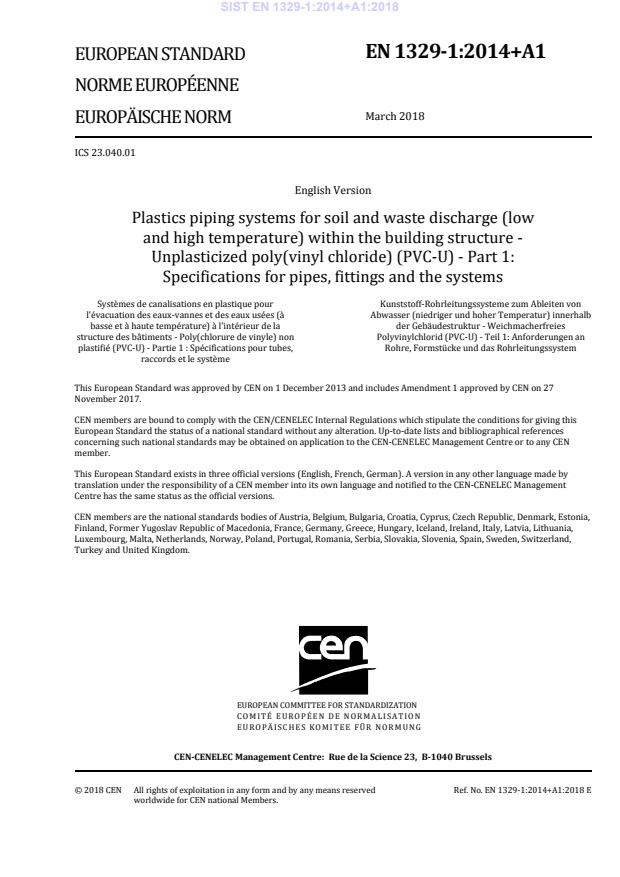
EUROPEAN STANDARD NORME EUROPÉENNE EUROPÄISCHE NORM
EN 1329-1:2014+A1
March
t r s z ICS
t uä r v rä r s English Version
Specifications for pipesá fittings and the systems Systèmes de canalisations en plastique pour raccords et le système
KunststoffæRohrleitungssysteme zum Ableiten von der Gebäudestruktur æ Weichmacherfreies Rohreá Formstücke und das Rohrleitungssystem This European Standard was approved by CEN on
s December
t r s u and includes Amendment
s approved by CEN on
t y November
t r s yä
egulations which stipulate the conditions for giving this European Standard the status of a national standard without any alterationä Upætoædate lists and bibliographical references concerning such national standards may be obtained on application to the CENæCENELEC Management Centre or to any CEN memberä
translation under the responsibility of a CEN member into its own language and notified to the CENæCENELEC Management Centre has the same status as the official versionsä
CEN members are the national standards bodies of Austriaá Belgiumá Bulgariaá Croatiaá Cyprusá Czech Republicá Denmarká Estoniaá Finlandá Former Yugoslav Republic of Macedoniaá Franceá Germanyá Greeceá Hungaryá Icelandá Irelandá Italyá Latviaá Lithuaniaá Luxembourgá Maltaá Netherlandsá Norwayá Polandá Portugalá Romaniaá Serbiaá Slovakiaá Sloveniaá Spainá Swedená Switzerlandá Turkey and United Kingdomä
EUROPEAN COMMITTEE FOR STANDARDIZATION COMITÉ EUROPÉEN DE NORMALISATION EUROPÄISCHES KOMITEE FÜR NORMUNG
CEN-CENELEC Management Centre:
Rue de la Science 23,
B-1040 Brussels
t r s z CEN All rights of exploitation in any form and by any means reserved worldwide for CEN national Membersä Refä Noä EN
s u t {æ sã t r s v ªA sã t r s z ESIST EN 1329-1:2014+A1:2018
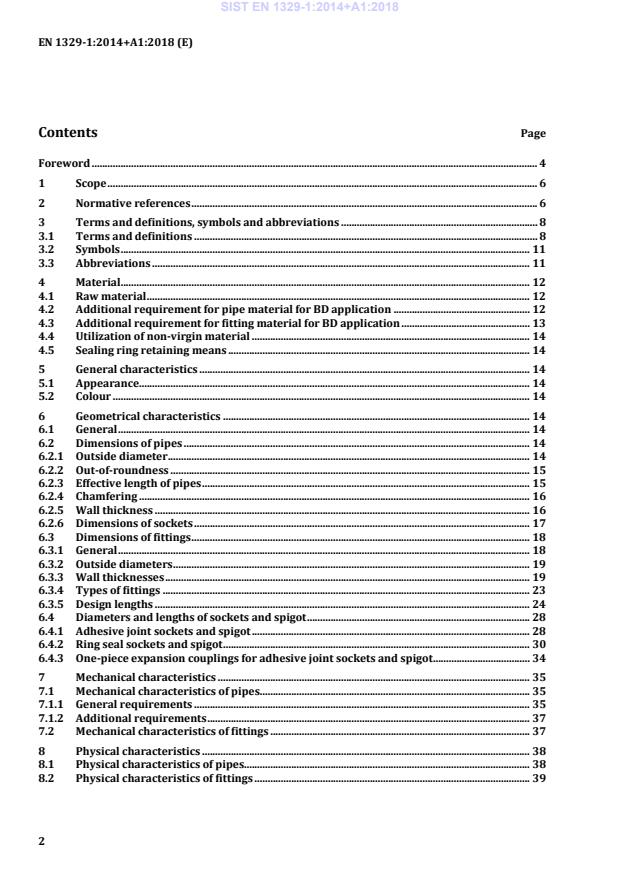
Utilization of non-virgin material . 44 A.1 Own reprocessed material . 44 A.2 External reprocessed and recycled materials with agreed specifications . 44 A.3 External reprocessed and recycled material not covered by an agreed specification . 46 A.4 Summary of use of non-virgin material . 47 Annex B (informative)
Product standards . 48 Annex C (informative)
Correspondence between ISO test methods and CEN test methods . 49 Bibliography . 50
· 110 mm; — introduction of alternative test methods to DCMT for the evaluation of the gelation of PVC; — explicit integration of designs of fittings. System Standards are based on the results of the work undertaken in ISO/TC 138 “Plastics pipes, fittings and valves for the transport of fluids”, which is a Technical Committee of the International Organization for Standardization (ISO). They are supported by separate standards on test method to which references are made throughout the System Standard. The System Standards are consistent with general standards on functional requirements and on recommended practice for installation. SIST EN 1329-1:2014+A1:2018
3,142), rounded to the next greater 0,1 mm 3.1.6 inside diameter ds value of the measurement of the inside diameter through its cross section at any point of a socket, rounded to the next greater 0,1 mm 3.1.7 mean inside diameter of a socket dsm arithmetical mean of a number of measurements of the inside diameter of a socket in the same cross section 3.1.8 out-of-roundness ovality difference between the measured maximum and the measured minimum outside diameter in the same cross section of a component 3.1.9 wall thickness e value of measurement of the wall thickness at any point around the circumference of a component 3.1.10 mean wall thickness em arithmetical mean of a number of measurements of the wall thickness, regularly spaced around the circumference and in the same cross section of a component, including the measured minimum and the measured maximum values of the wall thickness in that cross section 3.1.11 standard dimension ratio SDR nominal ratio of the outside diameter, dn, to the minimum wall thickness, emin SIST EN 1329-1:2014+A1:2018
: nominal angle of a fitting 3.3 Abbreviations DN : nominal size DN/OD : nominal size, outside diameter related PVC-U : Unplasticised poly(vinyl chloride) SDR : Standard dimension ratio SN : Nominal ring stiffness TIR : True impact rate SIST EN 1329-1:2014+A1:2018
· 110 mm and intended for BD applications, a further reduction of the PVC-U content to
· 75 % by mass for pipes only is permitted provided the PVC-U is substituted by coated or uncoated CaCO3 conforming to the following: a) The composition of the CaCO3, before coating if any, shall conform to the following: 1) content of CaCO3
· 96 % by mass; 2) content of MgCO3
¶ 4 % by mass; 3) content of CaCO3 and MgCO3 in total
· 98 % by mass. b) The physical properties of the material shall conform to the following: 1) mean particle size D50
¶ 2,5 m; 2) top cut D98
¶ 20
4.2 Additional requirement for pipe material for BD application The material of pipes intended to be used in application area BD shall comply with the additional requirement given in Table 1, when tested in accordance with the methods and the parameters indicated in Table 1. The pipe material shall be tested in the form of a pipe. SIST EN 1329-1:2014+A1:2018
EN ISO 1167-2
Test temperature 60 °C
Orientation Free
Number of test pieces 3
Circumferential (hoop) stress 10,0 MPa
Conditioning period 1 h
Type of test Water-in-water
Test period 1 000 h
4.3 Additional requirement for fitting material for BD application The material of fittings intended to be used in application area BD shall comply with the additional requirement given in Table 2, when tested in accordance with the methods and the parameters indicated in Table 2. The fitting material shall be tested in the form of an extruded or injection-moulded pipe. Table 2 — Material characteristics of fittings intended for BD application Characteristic Requirements Test parameters Test method Resistance to internal pressure No failure during the test period End caps Type A or B EN ISO 1167-1
and
EN ISO 1167-2
Dimensions 50 mm
¶ dn
¶ 110 mm
Test temperature 60 °C
Orientation Free
Free length for injection-moulded pipe
· 140 mm
Number of test pieces 3
Circumferential (hoop) stress 6,3 MPa
Conditioning period 1 h
Type of test Water-in-water
Test period 1 000 h
dn dem,min dem,max 32 40 50 63
75 80 82 90
100 110 125 140
160 180 200 250 315 32 40 50 63
75 80 82 90
100 110 125 140
160 180 200 250 315 32,0 40,0 50,0 63,0
75,0 80,0 82,0 90,0
100,0 110,0 125,0 140,0
160,0 180,0 200,0 250,0 315,0 32,2 40,2 50,2 63,2
75,3 80,3 82,3 90,3
100,3 110,3 125,3 140,4
160,4 180,4 200,5 250,5 315,6 Table 4 — Mean outside diameters (series based on inch dimensions) Dimensions in millimetres Nominal size DN/OD Nominal outside diameter Mean outside diameter
dn dem,min dem,max 36 43 56 36 43 56 36,2 42,8 55,8 36,5 43,1 56,1
6.2.2 Out-of-roundness The out-of-roundness, measured directly after production shall be less than or equal to 0,024 dn. 6.2.3 Effective length of pipes The effective length (useful length) of a pipe, l, shall be not less than that specified by the manufacturer when measured as shown in Figure 1. SIST EN 1329-1:2014+A1:2018
Figure 1 — Effective length of pipes 6.2.4 Chamfering If a chamfer is applied, the angle of chamfering shall be between 15° and 45° to the axis of the pipe. The remaining wall thickness of the end of the pipe shall be at least 1/3 of emin. 6.2.5 Wall thickness The wall thickness shall conform to Table 5 or Table 6 respectively, where for metric series a wall thickness at any point up to 1,2emin is permitted provided that the mean value, em, is less than or equal to the specified em,max. SIST EN 1329-1:2014+A1:2018
B a BD b
dn emin em,max emin em,max 32 40 50 63
75 80 82 90
100 110 125 140
160 180 200 250 315 32 40 50 63
75 80 82 90
100 110 125 140
160 180 200 250 315 3,0 3,0 3,0 3,0
3,0 3,0 3,0 3,0
3,0 3,2 3,2 3,2
3,2 3,6 3,9 4,9 6,2 3,5 3,5 3,5 3,5
3,5 3,5 3,5 3,5
3,5 3,8 3,8 3,8
3,8 4,2 4,5 5,6 7,1
3,0 3,0 3,0 3,0
3,0 3,2 3,2 3,5
4,0 4,4 4,9 6,2 7,7
3,5 3,5 3,5 3,5
3,5 3,8 3,8 4,1
4,6 5,0 5,6 7,1 8,7 a This serie results from a SDR 51. b This serie results from a SDR 41, which is classified SN4. Table 6 — Wall thickness (series based on inch dimensions) Dimensions in millimetres Nominal size DN/OD Nominal outside diameter Wall thickness Application area B
dn emin em,max 36 43 56 36 43 56 3,0 3,0 3,0 3,5 3,5 3,5
6.2.6 Dimensions of sockets When applicable, the dimensions of pipes sockets shall comply with the relevant requirements of sockets as specified in 6.4. SIST EN 1329-1:2014+A1:2018
Key A length of engagement C depth of sealing zone de outside diameter of a spigot ds inside diameter of a socket e wall thickness e2 wall thickness of socket e3 wall thickness at the groove L1 length of spigot Figure 2 — General dimensions of sockets and spigots for elastomeric sealing joints SIST EN 1329-1:2014+A1:2018
Key de outside diameter of a spigot ds inside diameter of a socket e wall thickness e2 wall thickness of socket L1 length of spigot L2 length of socket Figure 3 — Basic dimensions of sockets and spigots for adhesive joints 6.3.2 Outside diameters The mean outside diameter, dem, of the spigot shall conform to Table 3 or Table 4, as applicable. 6.3.3 Wall thicknesses 6.3.3.1 General Fittings and those parts of fittings not intended to come into contact with the fluid being conveyed are not required to conform to the wall thickness given in Table 5, Table 6 or Table 7, as applicable. 6.3.3.2 Adhesive joint fittings For adhesive joint fittings the wall thicknesses, e and e2 (see Figure 3) shall comply with the requirements given in Table 7 or Table 8, as applicable. For adhesive joint fittings a reduction of 5 % of the wall thickness resulting from core shifting is permitted. In such case the average of two opposite wall thicknesses shall be equal to, or exceed, the values given in Table 7 or Table 8, as applicable. SIST EN 1329-1:2014+A1:2018
Application area Application area
B BD B BD
dn emin emin e2,min e2,min 32 32 3,0
2,0 b
40 40 3,0
2,0 b
50 50 3,0
2,0 b
63 63 3,0
2,0 b
75 75 3,0 3,0 2,0 b 2,0 b 80 80 3,0 3,0 2,3 2,3 82 82 3,0 3,0 2,3 2,3 90 90 3,0 3,0 2,3 2,3
100 100 3,0 3,0 2,3 2,3 110 110 3,2 3,2 2,4 2,4 125 125 3,2 3,2 2,4 2,4 140 140 3,2 3,5 2,4 2,6
160 160 3,2 4,0 2,4 3,0 180 180 3,6 4,4 2,7 3,3 200 200 3,9 4,9 2,9 3,7 250 250 4,9 6,2 3,7 4,7 315 315 6,2 7,7 4,7 5,8 a This requirement is also applicable to the wall thickness of the spigot. b e2 = 0,65e. This kind of fittings may only be used in an adhesive joint system and shall be marked accordingly. SIST EN 1329-1:2014+A1:2018
= 0,75e)
Application area Application area
B B
dn emin e2,min 36 43 56 36 43 56 3,0 3,0 3,0 2,3 2,3 2,3 a For existing tools the following values for the wall thickness are allowed, provided that the deviating value for the wall thickness, e, is marked on the fitting:
dn emin e2,min
36 43 56 2,7 2,7 2,7 2,0 2,0 2,0 b This requirement is also applicable to the wall thickness of the spigot.
6.3.3.3 Ring seal fittings For ring seal fittings the wall thicknesses e, e2 and e3 (see Figure 2), shall comply with the requirements given in Table 9 or Table 10, as applicable. For ring seal fittings a reduction of 5 % of the wall thickness resulting from core shifting is permitted. In such case the average of two opposite wall thicknesses shall be equal to, or exceed, the values given in Table 9 or Table 10, as applicable. Where a sealing ring is located by means of a retaining cap or ring (see Figure 4) the wall thickness in this area shall be calculated by addition of the wall thickness of the socket and the wall thickness of the retaining cap or ring at the corresponding places in the same cross section.
Figure 4 — Example for calculation of the wall thickness of sockets with retaining cap SIST EN 1329-1:2014+A1:2018
Application area Application area Application area
dn B emin BD emin B e2,min BD e2,min B e3,min BD e3,min 32 40 50 63
75 80 82 90
100 110 125 140
160 180 200 250 315 32 40 50 63
75 80 82 90
100 110 125 140
160 180 200 250 315 3,0 3,0 3,0 3,0
3,0 3,0 3,0 3,0
3,0 3,2 3,2 3,2
3,2 3,6 3,9 4,9 6,2
3,0 3,0 3,0 3,0
3,0 3,2 3,2 3,5
4,0 4,4 4,9 6,2 7,7 2,7 2,7 2,7 2,7
2,7 2,7 2,7 2,7
2,7 2,9 2,9 2,9
2,9 3,2 3,5 4,5 5,6
2,7 2,7 2,7 2,7
2,7 2,9 2,9 3,1
3,6 4,0 4,4 5,6 6,9 2,3 2,3 2,3 2,3
2,3 2,3 2,3 2,3
2,3 2,4 2,4 2,4
2,4 2,7 2,9 3,7 4,7
2,3 2,3 2,3 2,3
2,3 2,4 2,4 2,6
3,0 3,3 3,7 4,7 5,8 SIST EN 1329-1:2014+A1:2018
Application area Application area Application area
dn B emin B e2,min B e3,min 36 43 56 36 43 56 3,0 3,0 3,0 2,7 2,7 2,7 2,2 2,2 2,2 a For existing tools the following values for the wall thickness are allowed, provided that the deviating value for the wall thickness, e, is marked on the fitting:
dn emin e2,min e3,min
36 43 56 2,7 2,7 2,7 2,4 2,4 2,4 2,0 2,0 2,0
6.3.4 Types of fittings This standard is applicable to the following types of fittings. Other types and/or designs of fittings (e.g. plugs, access fittings, etc.) are permitted. a) bends (see Figures 5, 6, 7 or 8) 1) unswept or swept angle (see ISO 265-1 [18]); 2) spigot/socket and socket/socket; the nominal angle, á shall be selected from the followingã
s w ¹á
t t ¹ u r"á
u r ¹á
v w ¹á
x y ¹ u r"á
z r ¹á or
z y ¹ u r" to
{ r ¹â b) couplers (see Figure 9). c) reducers (see Figure 10). d) branches and reducing branches (single or multiple) (see for example Figures 11, 12, 13, or 14): 1) unswept or swept angle (see ISO 265-1 [18]); 2) spigot/socket and socket/socket; the nominal angle, á shall be selected from the followingã
v w ¹á
x y ¹ u r"á
z y ¹ u r" to
{ r ¹ä If other nominal angles are required they shall be agreed between manufacturer and purchaser and be identified accordingly. SIST EN 1329-1:2014+A1:2018
Figure 5 — Bend with single socket (unswept)
Figure 6 — Bend with all sockets (unswept) SIST EN 1329-1:2014+A1:2018
Figure 7 — Bend with single socket (swept)
Figure 8 — Bend with all sockets (swept)
Figure 9 — Coupler SIST EN 1329-1:2014+A1:2018
Figure 10 — Reducer
Figure 11 — Branch with single socket (unswept) SIST EN 1329-1:2014+A1:2018
Figure 12 — Branch with all sockets (unswept)
Figure 13 — Reducing branch with single socket (swept) SIST EN 1329-1:2014+A1:2018
Figure 14 — Reducing branch with all sockets (swept) 6.4 Diameters and lengths of sockets and spigot 6.4.1 Adhesive joint sockets and spigot The diameters and lengths of adhesive joint sockets and spigot shall conform to Table 11 or Table 12, as applicable (see Figure 3). SIST EN 1329-1:2014+A1:2018
dn dem,min dem,max dsm,min dsm,max L2,min and L1,min 32 40 50 63
75 80 82 90
100 110 125 140
160 180 200 250 315 32 40 50 63
75 80 82 90
100 110 125 140
160 180 200 250 315 32,0 40,0 50,0 63,0
75,0 80,0 82,0 90,0
100,0 110,0 125,0 140,0
160,0 180,0 200,0 250,0 315,0 32,2 40,2 50,2 63,2
75,3 80,3 82,3 90,3
100,3 110,3 125,3 140,4
160,4 180,4 200,5 250,5 315,6 32,1 40,1 50,1 63,1
75,2 80,2 82,2 90,2
100,2 110,2 125,2 140,3
160,3 180,3 200,4 250,4 315,5 32,4 40,4 50,4 63,4
75,5 80,5 82,5 90,5
100,5 110,6 125,7 140,8
160,8 180,8 200,9 250,9 316,0 22 26 30 36
40 42 43 46
46 48 51 54
58 60 60 60 60 a The manufacturer shall state whether the fittings are designed with a tapered or parallel socket. If they are tapered, then the minimum and maximum values given for dsm shall apply at the mid mean point of the socket with a maximum taper angle of
r ¹ u r" per sideä Otherwise these values for dsm shall apply over the entire length of the socket b For joints intended for fabrication within a workshop L2-values may be reduced to the Cmax values (see Table 13). SIST EN 1329-1:2014+A1:2018
(series based on inch dimensions) Dimensions in millimetres Nominal size DN/OD Nominal outside diameter Mean outside diameter of spigot Mean inside diameter of socket Length of socket and spigot
dn dem,min dem,max dsm,min dsm,max L2,min and L1,min 36 43 56 36 43 56 36,1 42,7 55,7 36,5 43,1 56,1 36,1 42,7 55,7 36,7 43,3 56,3 18 21 27 Tolerances apply to the complete length of the socket. If a taper is incorporated, it shall not exceed
r ¹ u r"ä
6.4.2 Ring seal sockets and spigot The diameters and lengths of ring seal sockets and spigots type S I (short type system I), type S II (short type system II) and type M (medium type) shall conform to Tables 13 to 15, as applicable (see Figure 2). An example of designs for grooves for elastomeric ring seal sockets is given in Figure 15. Other designs are permitted. SIST EN 1329-1:2014+A1:2018
Figure 15 — Typical groove designs for elastomeric ring seal sockets Where sealing rings are firmly retained, the minimum value for A and the maximum value for C (see Figure 15) shall be measured to the effective sealing point (see Figure 16) as specified by the manufacturer and, if applicable, in agreement with a certification body.
Figure 16 — Example for measuring the effective sealing point SIST EN 1329-1:2014+A1:2018
...