

CEN/TS 15223:2025
(Main)Plastic piping systems - Structural design of buried thermoplastics piping systems - Procedure and guidance under various conditions of loading
- Abstract
This document specifies the procedure and gives guidance for structural design of buried thermoplastics piping systems under various conditions of loading for non-pressure application. This document can be used for pressure piping systems before applying operating pressure.
This document is applicable to all solid and structured wall thermoplastics piping systems covered by an EN standard developed by CEN/TC 155.
NOTE 1 PE piping systems for gas infrastructure are covered in EN 12007-2 [1].
This document gives guidance for structural design by either validated field experience or calculation, and contents of EN 476 [2], EN1295-1 [3] and EN 1610 [4] have been considered.
At the design stage, precise details of types of soil and installation conditions are not always available. The choice of design assumptions is left to the judgement of the designer/specifier. In this respect, this technical specification provides general indications and advice.
NOTE 2 It is the responsibility of the designer/specifier to make the appropriate selection of the design aspects, taking into account any relevant National regulation and installation practices or codes.
- Status
- Published
- Publication Date
- 21-Oct-2025
- Technical Committee
- CEN/TC 155 - Plastics piping systems and ducting systems
- Current Stage
- 6060 - Definitive text made available (DAV) - Publishing
- Start Date
- 22-Oct-2025
- Due Date
- 14-Aug-2023
- Completion Date
- 22-Oct-2025

Overview
CEN/TS 15223:2025 specifies the procedures and offers detailed guidance for the structural design of buried thermoplastics piping systems under various loading conditions. Developed by CEN/TC 155, this technical specification addresses both solid and structured wall thermoplastics systems for non-pressure applications, with limited application for pressure systems before they are commissioned. The standard helps designers ensure long-term performance and reliability of plastic pipeline infrastructure in a range of environments, considering factors such as soil conditions, installation practices, and varying load types.
Key Topics
Structural Design Procedures:
- Provides validated field experience and calculation methods for structural assessment.
- Outlines the use of graphical and analytical approaches depending on project parameters such as pipe diameter and depth of installation.
Load Considerations:
- Addresses different types of loads including soil, traffic (primarily road), and groundwater.
- Specifies procedures to calculate the effects of these loads on pipe deflection, buckling, and ring stiffness.
Deflection and Settlement:
- Defines target values and calculation approaches for short-term and long-term deflection of buried pipes.
- Considers both well-compacted and moderately compacted backfill scenarios.
Material Types and Pipe Stiffness:
- Applies to polyethylene (PE), polypropylene (PP), mineral modified PP (PP-MD), and both oriented and unplasticized PVC (PVC-O, PVC-U).
- References appropriate EN standards for pipe products.
Installation Conditions:
- Provides general advice where specific details (e.g., soil type, exact installation method) may be unavailable at the design stage.
- Leaves selection of design assumptions to the professional judgment of the designer/specifier, emphasizing alignment with national regulations and codes.
Applications
Buried Non-Pressure Pipelines:
- Suited for drainage, sewerage, and other utility installations where pipes are buried and exposed to varied soil and surface loads.
Pre-Commissioning Pressure Pipelines:
- The design principles may be used for pressure pipelines before operating pressure is applied, ensuring safety during installation and early operation.
Large and Small Diameters:
- Small diameter pipes (≤ DN 1100) can be designed using the provided graphics.
- Larger diameters (DN 1100 to DN 3000) require analytical calculation as specified.
Infrastructure Projects:
- Widely applicable in municipal and industrial projects for constructing or upgrading underground water conveyance and distribution systems.
Related Standards
For comprehensive design and installation guidance, CEN/TS 15223:2025 should be used alongside related European and international standards:
- EN 476: Covers general requirements for components used in gravity systems and sewers.
- EN 1295-1: Provides guidelines for structural design of buried pipelines under various loading conditions.
- EN 1610: Sets out construction and testing methods for drains and sewers.
- EN 12007-2: Specifically addresses PE piping for gas infrastructure (not covered in CEN/TS 15223).
- Standards for pipe products including EN 1401-1, EN 1852-1, EN 12666-1, EN 12201-2 (PE piping), EN 17176-2 (PVC-O), and EN 1452-2 (PVC-U).
Practical Value
Implementing CEN/TS 15223:2025 ensures robust structural design of buried thermoplastic pipes tailored to real-world installation environments and loading scenarios. By following its procedures, infrastructure projects can:
- Enhance pipeline durability and minimize maintenance related to structural failures.
- Meet regulatory requirements and align with best practices in European pipeline engineering.
- Adapt design approaches to variable site conditions and optimize materials selection.
- Use validated experience and calculation methods to support reliable utility services.
Keywords: CEN/TS 15223:2025, plastic piping systems, structural design, buried thermoplastics pipes, soil load, traffic load, non-pressure applications, European standards, pipeline infrastructure, pipe deflection, EN 1295-1, EN 1610.
Relations
- Effective Date
- 19-Jan-2023
- Effective Date
- 28-Jan-2026
Get Certified
Connect with accredited certification bodies for this standard

Institut za varilstvo d.o.o. (Welding Institute)
Slovenia's leading welding institute since 1952. ISO 3834, EN 1090, pressure equipment certification, NDT personnel, welder qualification. Only IIW Au
Sponsored listings
Frequently Asked Questions
CEN/TS 15223:2025 is a technical specification published by the European Committee for Standardization (CEN). Its full title is "Plastic piping systems - Structural design of buried thermoplastics piping systems - Procedure and guidance under various conditions of loading". This standard covers: This document specifies the procedure and gives guidance for structural design of buried thermoplastics piping systems under various conditions of loading for non-pressure application. This document can be used for pressure piping systems before applying operating pressure. This document is applicable to all solid and structured wall thermoplastics piping systems covered by an EN standard developed by CEN/TC 155. NOTE 1 PE piping systems for gas infrastructure are covered in EN 12007-2 [1]. This document gives guidance for structural design by either validated field experience or calculation, and contents of EN 476 [2], EN1295-1 [3] and EN 1610 [4] have been considered. At the design stage, precise details of types of soil and installation conditions are not always available. The choice of design assumptions is left to the judgement of the designer/specifier. In this respect, this technical specification provides general indications and advice. NOTE 2 It is the responsibility of the designer/specifier to make the appropriate selection of the design aspects, taking into account any relevant National regulation and installation practices or codes.
This document specifies the procedure and gives guidance for structural design of buried thermoplastics piping systems under various conditions of loading for non-pressure application. This document can be used for pressure piping systems before applying operating pressure. This document is applicable to all solid and structured wall thermoplastics piping systems covered by an EN standard developed by CEN/TC 155. NOTE 1 PE piping systems for gas infrastructure are covered in EN 12007-2 [1]. This document gives guidance for structural design by either validated field experience or calculation, and contents of EN 476 [2], EN1295-1 [3] and EN 1610 [4] have been considered. At the design stage, precise details of types of soil and installation conditions are not always available. The choice of design assumptions is left to the judgement of the designer/specifier. In this respect, this technical specification provides general indications and advice. NOTE 2 It is the responsibility of the designer/specifier to make the appropriate selection of the design aspects, taking into account any relevant National regulation and installation practices or codes.
CEN/TS 15223:2025 is classified under the following ICS (International Classification for Standards) categories: 23.040.01 - Pipeline components and pipelines in general. The ICS classification helps identify the subject area and facilitates finding related standards.
CEN/TS 15223:2025 has the following relationships with other standards: It is inter standard links to CEN/TS 15223:2017, EN 17415-3:2021. Understanding these relationships helps ensure you are using the most current and applicable version of the standard.
CEN/TS 15223:2025 is available in PDF format for immediate download after purchase. The document can be added to your cart and obtained through the secure checkout process. Digital delivery ensures instant access to the complete standard document.
Standards Content (Sample)
SLOVENSKI STANDARD
01-december-2025
Nadomešča:
SIST-TS CEN/TS 15223:2018
Cevni sistemi iz polimernih materialov - Konstrukcijsko načrtovanje vkopanih
cevovodnih sistemov iz termoplastov - Postopek in smernice pri različnih pogojih
obremenitve
Plastic piping systems - Structural design of buried thermoplastics piping systems -
Procedure and guidance under various conditions of loading
Kunststoff-Rohrleitungssysteme - Gültige Berechnungsparameter von erdverlegten
thermoplastischen Rohrleitungssystemen
Systèmes de canalisations en matières plastiques - Paramètres de calcul validés pour
les systèmes enterrés de canalisations en matières thermoplastiques
Ta slovenski standard je istoveten z: CEN/TS 15223:2025
ICS:
23.040.01 Deli cevovodov in cevovodi Pipeline components and
na splošno pipelines in general
2003-01.Slovenski inštitut za standardizacijo. Razmnoževanje celote ali delov tega standarda ni dovoljeno.
CEN/TS 15223
TECHNICAL SPECIFICATION
SPÉCIFICATION TECHNIQUE
October 2025
TECHNISCHE SPEZIFIKATION
ICS 23.040.01 Supersedes CEN/TS 15223:2017
English Version
Plastic piping systems - Structural design of buried
thermoplastics piping systems - Procedure and guidance
under various conditions of loading
Systèmes de canalisations en plastique - Conception Kunststoff-Rohrleitungssysteme - Statische Bemessung
structurelle des systèmes enterrés de canalisations en erdverlegter Rohrleitungssysteme aus Thermoplasten -
thermoplastique - Procédure et recommandations dans Verfahren und Empfehlungen unter verschiedenen
diverses conditions de charge Belastungsbedingungen
This Technical Specification (CEN/TS) was approved by CEN on 11 August 2025 for provisional application.
The period of validity of this CEN/TS is limited initially to three years. After two years the members of CEN will be requested to
submit their comments, particularly on the question whether the CEN/TS can be converted into a European Standard.
CEN members are required to announce the existence of this CEN/TS in the same way as for an EN and to make the CEN/TS
available promptly at national level in an appropriate form. It is permissible to keep conflicting national standards in force (in
parallel to the CEN/TS) until the final decision about the possible conversion of the CEN/TS into an EN is reached.
CEN members are the national standards bodies of Austria, Belgium, Bulgaria, Croatia, Cyprus, Czech Republic, Denmark, Estonia,
Finland, France, Germany, Greece, Hungary, Iceland, Ireland, Italy, Latvia, Lithuania, Luxembourg, Malta, Netherlands, Norway,
Poland, Portugal, Republic of North Macedonia, Romania, Serbia, Slovakia, Slovenia, Spain, Sweden, Switzerland, Türkiye and
United Kingdom.
EUROPEAN COMMITTEE FOR STANDARDIZATION
COMITÉ EUROPÉEN DE NORMALISATION
EUROPÄISCHES KOMITEE FÜR NORMUNG
CEN-CENELEC Management Centre: Rue de la Science 23, B-1040 Brussels
© 2025 CEN All rights of exploitation in any form and by any means reserved Ref. No. CEN/TS 15223:2025 E
worldwide for CEN national Members.
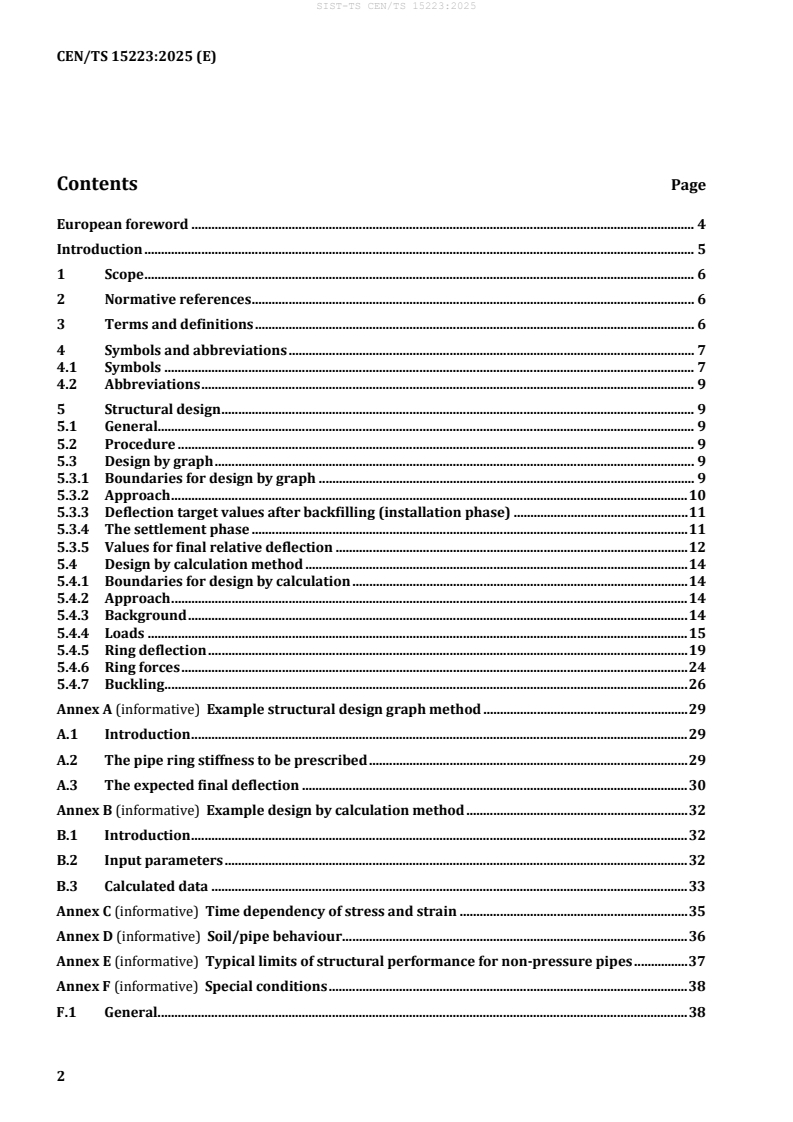
Contents Page
European foreword . 4
Introduction . 5
1 Scope . 6
2 Normative references . 6
3 Terms and definitions . 6
4 Symbols and abbreviations . 7
4.1 Symbols . 7
4.2 Abbreviations . 9
5 Structural design . 9
5.1 General. 9
5.2 Procedure . 9
5.3 Design by graph . 9
5.3.1 Boundaries for design by graph . 9
5.3.2 Approach . 10
5.3.3 Deflection target values after backfilling (installation phase) . 11
5.3.4 The settlement phase . 11
5.3.5 Values for final relative deflection . 12
5.4 Design by calculation method . 14
5.4.1 Boundaries for design by calculation . 14
5.4.2 Approach . 14
5.4.3 Background . 14
5.4.4 Loads . 15
5.4.5 Ring deflection . 19
5.4.6 Ring forces . 24
5.4.7 Buckling . 26
Annex A (informative) Example structural design graph method . 29
A.1 Introduction . 29
A.2 The pipe ring stiffness to be prescribed . 29
A.3 The expected final deflection . 30
Annex B (informative) Example design by calculation method . 32
B.1 Introduction . 32
B.2 Input parameters . 32
B.3 Calculated data . 33
Annex C (informative) Time dependency of stress and strain . 35
Annex D (informative) Soil/pipe behaviour . 36
Annex E (informative) Typical limits of structural performance for non-pressure pipes . 37
Annex F (informative) Special conditions . 38
F.1 General. 38
F.2 Installation at depths shallower than the expected frost penetration . 38
Bibliography . 39
European foreword
This document (CEN/TS 15223:2025) has been prepared by Technical Committee CEN/TC 155 “Plastics
piping systems and ducting systems”, the secretariat of which is held by NEN.
Attention is drawn to the possibility that some of the elements of this document may be the subject of
patent rights. CEN shall not be held responsible for identifying any or all such patent rights.
This document supersedes CEN/TS 15223:2017.
CEN/TS 15223:2017:
— the title and scope have been changed;
— content related to functional design has been taken out. A separate document with guidance for
functional design aspects for buried thermoplastics piping systems is under development;
— a calculation method has been introduced in 5.4;
— examples on how to use the structural design graph and calculation method have been introduced in
Annex A and Annex B;
— guidance for design in special conditions has been introduced in Annex F.
Any feedback and questions on this document should be directed to the users’ national standards body.
A complete listing of these bodies can be found on the CEN website.
According to the CEN/CENELEC Internal Regulations, the national standards organisations of the
following countries are bound to announce this Technical Specification: Austria, Belgium, Bulgaria,
Croatia, Cyprus, Czech Republic, Denmark, Estonia, Finland, France, Germany, Greece, Hungary, Iceland,
Ireland, Italy, Latvia, Lithuania, Luxembourg, Malta, Netherlands, Norway, Poland, Portugal, Republic of
North Macedonia, Romania, Serbia, Slovakia, Slovenia, Spain, Sweden, Switzerland, Türkiye and the
United Kingdom.
Introduction
This document covers structural design of pressure and non-pressure thermoplastics piping systems.
Pressure and non-pressure thermoplastics piping system behave in the same way during installation and
during the time the system is without pressure but behave differently when pressurized. This behaviour
is explained in this document.
This document includes a structural design graph for small diameter pipes and a calculation method for
large diameter pipes. The basis for this is research carried out by The European Plastic Pipe and Fitting
Association, TEPPFA on structural performance with full-scale trials. This is described in the TEPPFA
studies “Design of buried plastics pipe systems” [5], and “Design of large diameter buried PE and PP pipes
without internal pressure” [18].
1 Scope
This document specifies the procedure and gives guidance for structural design of buried thermoplastics
piping systems under various conditions of loading for non-pressure application. This document can be
used for pressure piping systems before applying operating pressure.
This document is applicable to all solid and structured wall thermoplastics piping systems covered by an
EN standard developed by CEN/TC 155.
NOTE 1 PE piping systems for gas infrastructure are covered in EN 12007-2 [1].
This document gives guidance for structural design by either validated field experience or calculation,
and contents of EN 476 [2], EN 1295-1 [3] and EN 1610 [4] have been considered.
At the design stage, precise details of types of soil and installation conditions are not always available.
The choice of design assumptions is left to the judgement of the designer/specifier. In this respect, this
technical specification provides general indications and advice.
NOTE 2 It is the responsibility of the designer/specifier to make the appropriate selection of the design aspects,
taking into account any relevant National regulation and installation practices or codes.
2 Normative references
There are no normative references in this document.
3 Terms and definitions
For the purposes of this document, the following terms and definitions apply.
ISO and IEC maintain terminology databases for use in standardization at the following addresses:
— ISO Online browsing platform: available at https://www.iso.org/obp/
— IEC Electropedia: available at https://www.electropedia.org/
3.1
nominal ring stiffness
SN
numerical designation of the ring stiffness of a pipe or fitting, which is a convenient round number,
relative to the determined stiffness in kilonewtons per square metre (kN/m ), indicating the minimum
required ring stiffness of the pipe or fitting
Note 1 to entry: It is designated by the letters “SN” followed by the appropriate number and are normally expressed
in classes
[SOURCE: ISO 13966:1998, 3.1]
3.2
standard dimension ratio
SDR
numerical designation of a pipe series, which is a convenient round number, approximately equal to the
dimension ratio of the nominal outside diameter, d , and the nominal wall thickness, e
n n
[SOURCE: ISO 4065:2018, 3.5]
3.3
deflection
vertical change in diameter of a pipe in a horizontal position in response to a vertical compressive force
Note 1 to entry: deflection (δ) is expressed in [mm] or as relative deflection δ/D in [%]
m
3.4
depth of cover
vertical distance from the top of the pipe barrel to the surface
[SOURCE: EN 1610:2015, 3.3]
3.5
maximum allowable deflection
value given by the design engineer considering the functional performance of the pipeline
4 Symbols and abbreviations
4.1 Symbols
For the purposes of this document, the following symbols apply.
A pipe wall area, in m /m
α support angle
a reduction factor for traffic load
N2
Bf bedding factor, in %
b coefficient for soil support angle and load distribution angle
β load angle
β buckling reduction factor
d
C horizontal factor for traffic load
i
C increase of the deflection during the settlement phase, in %
f
C factor for correction of the horizontal soil pressure at rest
D mean diameter, in m
m
D pipe outside diameter, in m
o
DL time-lag factor
d nominal outside diameter of the pipe, in mm
n
DN nominal diameter
δ deflection of the pipe, in mm
δ vertical diameter change due to soil load, in m
s
δ change of vertical diameter length due to traffic load, in m
tr
δ/D relative deflection, in %
m
δ /D relative deflection due to traffic load, in %
tr m
E elastic modulus, in MPa
2 2
E´ soil modulus, in kN/m or in MN/m
sd
e thickness of the pipe wall for a solid wall pipe, in m
e nominal wall thickness of the pipe, in mm
n
ε tangential strain, in %
ε long-term bending strain, in %
M
ε combined compressive strain, in %
CC
εCT combined tensile strain, in %
ε limit value for tensile strain, in %
max,t
ε limit value for compressive strain, in %
max,c
γ density of the fill, in kN/m
γ safety coefficient for buckling
b
Η depth of cover, in m
H distance between top of the fill and the ground water level, in m
w
I moment of inertia, in m /m
I installation factor, in %
f
K horizontal soil pressure coefficient
LM1 load model
M bending moment, in kNm/m
M constrained soil modulus, in MN/m
S
N ring normal force, in kN/m
r
ν Poisson`s ratio
q calculated buckling pressure, in kN/m
q Load case a
a
q buckling pressure, in kN/m
b
q buckling pressure short-term, in kN/m
ba
q buckling pressure long term, in kN/m
bb
q design ring load, in kN/m
d
q vertical soil load, in kN/m
s
q design pressure from traffic loads, in kN/m
tr
q traffic load, in kN/m
trm
q average ground water ring pressure on the pipe, in kN/m
w
s profile layer offset
4.2 Abbreviations
For the purposes of this document, the following abbreviations apply.
PE Polyethylene
PP Polypropylene
PP-MD Polypropylene mineral modified
PVC-O Poly(vinyl chloride) oriented unplasticized
PVC-U Poly(vinyl chloride) unplasticized
5 Structural design
5.1 General
Structural design for non-pressure applications is presented as procedure (5.2) and design by graph or
calculation method (5.3 or 5.4).
The maximum allowable deflection is given in the project design documentation, taking into account
functional piping system requirements.
The performance of the jointing system influences the maximum allowable deflection as it is stated in the
product standards.
5.2 Procedure
At the start of a project, the procedure, considering the project characteristics, needs to be determined
taking the intended use into account.
Structural design can be done either using a design graph or a calculation method. The choice of which
method to use is described in 5.3 and 5.4.
5.3 Design by graph
5.3.1 Boundaries for design by graph
When the parameters of the project are within the boundaries as given in Table 1, the structural design
can be based on validated field experience as presented in [5] and Annex D. The structural design graph
in 5.3.3 can be used.
When the parameters of the project are outside the boundaries as given in Table 1, the structural design
can be calculated, according to 5.4.
This method is suitable for non-pressure applications as well as for pressure applications until the time
when internal pressure is introduced.
Table 1 — Boundaries for structural design parameters, design graph
Parameter Value (range) Remark
Diameter For diameters ≤ DN 1100 –
a
Installation depth 0,80 m to 6,0 m As defined in CEN/TS 1046
Depth of cover above the ≥ 0,60 m As defined in CEN/TS 1046
pipe crown
Native soil Granular (Type 1–3), See CEN/TS 1046:2021,
Table A.1
Cohesive (Type 4)
b
Installation type Compaction: well or moderate Combination of backfill,
compaction, and degree of care
Pipe stiffness For non-pressure pipes ≥ SN 2 –
For pressure pipes with SDR classes When the pipe is not
c
corresponding to ≥ SN 2 pressurized
Pipe types Solid wall pipes according to EN EN 1401-1, EN 1852–1,
standards EN 12666-1, EN 14758-1,
EN 12201-2, EN 17176-2,
EN 1452-2
Structured wall pipes according to EN 13476-2, EN 13476-3
EN Standards with a ring
flexibility ≥ 30 %
Traffic load All classes according to national Railways are excluded
classifications
Ground water table No limitation for structural design –
a
In special conditions, shallower installation depths (until 0,6 m) are allowed, but only in combination with
installation type 'well compaction”.
b
See 5.3.5.
I × E
c
Formula to calculate SN, SN = ; I = moment of inertia, E = elastic modulus, ν = Poisson ratio.
2 3
1 −ν × D
( )
e
5.3.2 Approach
For the use of the design graphs the following characteristics are needed: Pipe ring stiffness [SN] and
backfill compaction level.
The design graphs are used with pipe ring stiffness and backfill compaction level to identify the initial
and final pipe relative deflection. The results can be compared against maximum allowable deflection.
The target values for the relative deflection during the installation phase, the settlement phase, and the
final deflection are given in 5.3.3, 5.3.4 and 5.3.5, respectively.
In addition, the results can be compared against the typical relative deflection limits as given in Annex E
for pipes made from different types of thermoplastic materials.
An example is given in Annex A.
NOTE The structural design graphs are validated by the calculation method given in 5.4.
5.3.3 Deflection target values after backfilling (installation phase)
The relation between ring stiffness and initial pipe relative deflection is given in Figure 1.
Key
A initial pipe relative deflection δ/D , in %
m
B nominal ring stiffness, in kN/m
I well compacted
II moderate compacted
Figure 1— Structural design graph –Initial relative pipe deflection after trench backfilling
Figure 1 shows two compaction levels. For each compaction level, the average initial relative deflection
is shown at the bottom (bold line) and the maximum initial relative deflection is shown at the top.
NOTE A negative initial deflection is possible for low stiffness pipe in well compacted installation [5].
EXAMPLE When using compaction level 'well compacted' for an SN 8 pipe, the average initial relative
deflection is 0 %, and the maximum initial relative deflection will be less than 1 %.
5.3.4 The settlement phase
The pipes will have an initial deflection which depends on the quality of the backfill workmanship.
After a settlement phase of approximately 2 years the final deflection is reached. This final deflection can
be reached earlier when traffic load is applied. See Figure 2.
The final deflection will be, with or without traffic load, at the end the same. See Figures 2 and 3.
Key
A pipe deflection
B time, years
I installation phase
II settlement phase
III settled phase, without any further deflection
IV traffic effect
Figure 2 — Structural design graph – Development of deflection during settlement phase
5.3.5 Values for final relative deflection
The final relative deflection can be calculated with Formula (1):
δδ
+ C
f
DD
mm
final initial
(1)
where
is the ratio between the deflection of the pipe and the mean diameter of the pipe,
δ
expressed as percentage. See Figure 3 for initial and final pipe deflection;
D
m
C is the increase of the relative deflection during the settlement phase expressed as
f
percentage, which is depending on the backfill type and the embedment type.
=
Key
A pipe deflection
A2 final deflection
Cf increase in deflection during settlement phase
A1 initial pipe deflection
B time, years
I installation phase
II settlement phase
III settled phase, without any further deflection
Figure 3 — Structural design graph — Long-term pipe deflection
Correction “C ” factors to be used for the different installation types:
f
1) “Well” compaction, C = 1,0
f
The embedment soil of a granular type is placed carefully in the haunching zone and compacted,
followed by placing the backfill in shifts of maximum 300 mm, after which each layer is compacted
carefully. Typical values of standard Proctor are above 94 %. The pipe shall at least be covered by a
layer of 150 mm.
The trench is further filled with backfill material of any type and compacted.
2) “Moderate” compaction, C = 2,0
f
The embedment backfill of a granular type is placed in shifts of maximum 500 mm, after which each
layer is compacted carefully. Typical values for the standard Proctor density are in the range of 87 %
to 94 %. The pipe shall at least be covered by a layer of 150 mm.
The trench is further filled with backfill material of any type and compacted.
5.4 Design by calculation method
5.4.1 Boundaries for design by calculation
When the parameters of the project are outside the boundaries as given in Table 1, the structural design
based on calculation can be used according to 5.4.2.
This method is suitable for non-pressure applications as well as for pressure applications until the time
when internal pressure is introduced.
5.4.2 Approach
The designer can use the calculation method to finalise the structural design of large diameter flexible
thermoplastic piping systems, see Table 2.
The calculation method is used to determine the initial pipe relative deflection, final pipe relative
deflection and buckling resistance [18].
The results can be compared against maximum allowable deflection, see 5.1.
The results can be compared against typical relative deflection limits as given in Annex E for pipes made
from different types of thermoplastic materials.
A worked example is given in Annex B.
NOTE The calculation method for large diameter plastic piping systems is based on investigations done by
TEPPFA, see 5.4.3 and [18].
5.4.3 Background
This calculation method has been developed as part of the TEPPFA project “Buried pipes 2“ [6] and [18]
which is a follow up of an earlier TEPPFA project concerning ”Design of buried thermoplastics pipes” [5].
The behaviour of buried flexible piping systems is summarized in Annex C “Time dependency of stress
and strain” and Annex D “Soil / pipe behaviour”.
Some years later, a report called P92 [7], was published. That report was based on laboratory tests, soil-
box tests and full-scale field tests in the Nordic countries during the period 1965 to 2000. Investigations
were made on sewer pipes of different plastics materials, normally with diameters from DN 200 to DN
700.
Technology to produce large diameter plastics pipes has been further developed and thermoplastic pipes
with a diameter up to at least DN 3000 are now available on the market (2021). Long-term experience
from such pipes has also been published [8].
The present calculation method for large diameter PE- and PP- pipes is derived from [7]. The
requirements in Table 2 are the basis for the calculation method.
Large-diameter structured-wall pipes are often design specific and therefore it is not possible to give
general formulas for the profile area and distance from the neutral axis for the inertia momentum
calculation. These values can be provided by the manufacturer of a given pipe.
Table 2 — Boundaries for structural design parameters, calculation
Value (range) Remark
Diameter For diameters 1100 ≤ DN ≤ 3000 –
Installation depth 2,1 m to 6,0 m As defined in CEN/TS 1046
Depth of cover above the SN 8: ≥ 1,00 m As defined in CEN/TS 1046
pipe crown.
SN 2, SN 4: ≥ DN/2 (m) but at least
1,00 m
Native soil Granular (Type 1–3), See CEN/TS 1046:2021,
Table A.1
Cohesive (Type 4)
a
Installation type Compaction: well, see 5.3.5 Combination of backfill,
compaction, and degree of care
Pipe ring stiffness For non-pressure pipes ≥ SN 2 –
For pressure pipes with SDR classes Required during installation
corresponding to ≥ SN 2 and commissioning
Pipe types Structured wall pipes according to EN 13476-2, EN 13476-3
EN standards, with a ring
flexibility ≥ 30 %
Solid wall pipes according to EN EN 12201-2, EN 12666-1,
standards EN 1852-1, EN 17176-2
Traffic load Load model 1 (LM1) as specified in Railways are excluded
EN 1991-2:2003
Ground water table No limitation for structural design –
a
See 5.3.4.
5.4.4 Loads
5.4.4.1 General
Concentrated loads on the soil surface, normally traffic loads, are important when designing piping
systems made of large diameter pipes. These loads are assumed to spread out with increasing depth
below the surface according to the Boussinesq theory [10]. At small depths, the effect of traffic loads is
concentrated to areas below the individual wheels and axles. With increasing depth, the loads will spread
out to larger areas and the pressure intensity will decrease rapidly, and the loads will be more evenly
distributed over a larger area.
5.4.4.2 Soil load
For the calculation of the soil load on the pipe the methods in [7] may be used.
However, to take account also of the load from the backfill at the upper haunches of the pipe, the vertical
soil pressure on large diameter pipes shall be calculated as follows:
qH=γ⋅+ 0,11⋅ D
( )
so
(2)
where
q is the soil load, in kN/m ;
s
γ 3
is the density of the backfill, in kN/m ;
H is the depth of cover, in m;
D is the pipe outside diameter, in m.
o
For a gravel fill according to EN ISO 14688-1, a density range of 19 to 20 kN/m can be used above ground
water level, and 11 kN/m below ground water level, if the designer does not prescribe other values.
The maximum soil load occurs with the ground water level as low as possible, while the maximum total
load on the pipe occurs at the highest possible level of the ground water.
5.4.4.3 Traffic loads
In this document, the impact of traffic loads on buried pipes is based on the EN 1991-2:2003. Load model
1 (LM1) is valid for road traffic. The details of the loading case are shown in Figure 4. The dynamic
amplification is included in the loads. Table 3 gives the characteristic values or Load Model 1.
Table 3 — Load Model 1: Characteristic values
a
Location Tandem system TS
Axle loads (kN)
Lane number 1 300
Lane number 2 200
Lane number 3 100
Other lanes 0
Remaining area 0
a
Refer to Figure 4 for definition.
Key
(1) lane number 1: Q1k = 300 kN; q1k = 9 kN/m
(2) lane number 2: Q = 200 kN; q = 2,5 kN/m
2k 2k
(3) lane number 3: Q = 100 kN; q = 2,5 kN/m
3k 3k
Figure 4 — Load model LM1 for road traffic, from EN 1991-2:2003
Adjustment factors α , α and α in EN 1991-2:2003, 4.3.2 are locally given for LM1 and not used in this
Qi qi qr
document. As the soil pressure according to Figure 5 is used for structural design of pipes and not for
bridges as intended in EN 1991-2:2003, the area load q of LM1 is not applied.
ik
In Figure 5, the mean pressure caused by the traffic loads is shown as a function of installation depth for
different pipe diameters. The calculation is made in accordance with the Boussinesq theory [10].
A reduction factor a is applied to LM1, giving a 20 % reduction according to 4.3.2 of EN 1991-2:2003.
N2
Key
A characteristic traffic load q , in kN/m
tr
B depth of cover, in m
C pipe diameter 1,0 m
D pipe diameter 1,5 m
E pipe diameter 2,0 m
F pipe diameter 3,0 m
Figure 5 — Mean value of traffic load, load case LM1
The pressure curves per pipe diameter shown in Figure 5 are including the load distribution of a stiff road
pavement with a thickness of 200 mm and a load-spreading twice as large as in the native soil below [10].
5.4.4.4 Railway traffic
The impact of railway loads on a buried pipe is not included in this document. The loading requirements
for some of the different load models for railway systems can be found in EN 1991-2:2003.
5.4.4.5 Ground water load
The ground water will give the following average ring pressure on the pipe:
D
o
q = 10·(HH- + ) (3)
ww
where
q is the average ground water ring pressure on the pipe, in kN/m ;
w
H is the depth of cover, in m;
H is the distance between top of the fill and the ground water level, in m;
w
D is the outside diameter of pipe, in m.
o
If the ground water surface is below the ground level but above the bottom of the pipe, the validity
condition for Formula (3) can be written as:
D
o
0 ≤≤HH( + )
w
in Formula (3) shall be given as a negative value.
If the ground water surface is above the ground level, 𝐻𝐻w
5.4.5 Ring deflection
5.4.5.1 Load distribution model
A buried flexible pipe is subjected to vertical forces caused by the weight of soil fill and traffic loads and
reacting horizontal forces including soil reactions partly caused by movements of the pipe wall as
illustrated in Figure 6. The load model divides the two parts.
Key
qs soil load
k q lateral load
o s
Ci horizontal factor for traffic load
Ko horizontal soil pressure coefficient
q traffic load
trm
Q total traffic load
tr
D pipe diameter
qtr design pressure from traffic loads
α support angle
β load angle
Figure 6 — General load distribution model
The result from the two calculation models shall be added together for the combined result.
5.4.5.2 Soil modulus
Values for the soil modulus E´ based on sand tests in a large diameter (0,5 m) oedometer with a wall of
sd
floating rings are presented in [7]. The values chosen for the modulus include an extra margin for the risk
of insufficient compaction quality in ordinary sewer pipe construction work.
For large diameter pipes (see Table 2), execution of the installation work is expected to be more qualified
than for small diameter pipes (see Table 1). Values for the constrained soil modulus M , are given in
s
Table 4. These values are expected to be representative for the fill around the large diameter pipes dealt
with in this document.
Table 4 — Constrained soil modulus, M
s
Bedding and side fill Compaction Compaction M
s
materials modified Proctor standard Proctor
(%) (%) MN/m
Gravel (normally processed 85 90 9
material)
90 95 15
Sand and coarse-grained soil 85 90 5
with less than 12 % fines
90 95 10
NOTE Values taken from BS 9295:2020, 7.3.5, Table 17 [9].
The following relation is suggested as design value for calculation of the deflection and buckling of large
diameter plastic pipes at depths of cover 1 to 6 m including the effect of a high ground water level:
E´ = 0,7 × M (4)
sd s
The values given in Table 4 are valid for cases where the native soil has the same or higher soil modulus
than the backfilling material. Otherwise, the values shall be corrected as advised in BS 9295:2020, 7.3.5.
[9].
EXAMPLE The pipe trench has a width of 2⋅D and the native soil has a modulus of half the modulus for the fill
o
around the pipe. The combined modulus for E´ for calculation of the deflection will, according to BS 9295:2020,
sd
7.3.5 [9], then be 0,5⋅Ms.
The materials for the bed and the side fill given in Table 4 are in accordance with the installation category
“well”as defined in 5.3.4 and in [13]. The backfill surrounding the pipe shall be a granular soil placed
carefully in the haunching zone and compacted to 90 % modified Proctor. More detailed information on
the soil modulus can be found in [11].
5.4.5.3 Deflection caused by soil fill
The relative deflection caused by soil fill can be calculated with Formula (5) [18]:
δ C ⋅−b 0,083 ⋅ K
s i 1 0
q⋅
s
´
D
8 ⋅ SN + 0,061 ⋅ E
m
sd
(5)
where
δ is the vertical diameter change due to soil load, in m;
s
D is the mean diameter of pipe, in m;
m
q is the soil load, in 𝑘𝑘𝑘𝑘/𝑚𝑚 ;
s
=
C is the horizontal factor for traffic load, chosen value 1,0;
i
b is the coefficient for soil support angle and load distribution angle;
K is the horizontal soil pressure coefficient, chosen value 0,5;
SN is the ring stiffness, in 𝑘𝑘𝑘𝑘/𝑚𝑚 ;
E` is the soil modulus, in 𝑘𝑘𝑘𝑘/𝑚𝑚 .
sd
Values for the coefficient b are given in Table 5 for different support angles α and load angles β, see [12].
The ring stiffness SN for calculation of ring deflection and buckling is defined with Formula (6):
EI
SN =
1 −⋅υ D
( )
m
(6)
where
SN is the ring stiffness, in kN/m ;
I is the moment of inertia of the pipe per meter length of pipe, in 𝑚𝑚 /m;
E is the modulus of the pipe material, in kN/m ;
ν is the Poisson`s ratio;
is the mean diameter of pipe, in m.
Dm
The value of SN can be calculated with (6). The short-term value can also be directly established by ring
testing according to EN ISO 9969.
Table 5 — Coefficient b as function of the support angle at the bottom of the pipe α, and the load
distribution angle at the top of the pipe, β
β
α
0° 30° 60° 90° 120° 180°
0° 0,148 0,145 0,138 0,130 0,122 0,116
30° 0,145 0,143 0,134 0,126 0,118 0,113
60° 0,138 0,134 0,128 0,117 0,113 0,106
90° 0,130 0,126 0,117 0,109 0,102 0,096
120° 0,122 0,118 0,113 0,102 0,097 0,089
180° 0,116 0,113 0,106 0,096 0,089 0,083
The bottom angle α can normally be set to minimum 90°. A higher value, e.g. 120°, can be chosen if that
can be justified by the specifications for the compaction of the fill under the pipe, also including a
thorough inspection during the execution of that work.
For soil load, the top angle β can be chosen as 180° for all cases.
For estimation of the local maximum relative deflection due to effects of unforeseen installation measures
and other irregularities along the pipeline, additions shall be made to the calculated mean value caused
by soil and traffic loads, see 5.4.5.4.
5.4.5.4 Deflection caused by traffic load
The deflection caused by traffic loads is assumed to follow almost the same pattern as the deflection
caused by the soil load. However, at small depths of cover the traffic load is more concentrated over the
top part of the pipe than the soil load. This can be considered by assuming the total traffic load to be
distributed over only a part of the pipe diameter as indicated in Figure 6.
The relative deflection caused by traffic load can be estimated by Formula (7) [18]:
δ C ⋅−b 0,083 ⋅ K ⋅ C
tr i 1 0 1
q ⋅
trm
´
D
8 ⋅ SN + 0,061 ⋅ E
m
sd
(7)
where
δ is the change of vertical diameter length due to traffic load, in m;
tr
Dm is the mean diameter of pipe, in m;
δ /D is the relative deflection due to traffic load, in %;
tr m
q is the traffic load, mean value over 1 m length of pipe, in 𝑘𝑘𝑘𝑘/𝑚𝑚 ;
trm
C is the factor for correction of the horizontal soil pressure at rest;
C is the horizontal factor for traffic load, chosen value 1,0;
i
E´ is the soil modulus, in 𝑘𝑘𝑘𝑘/𝑚𝑚 ;
sd
K is the horizontal soil pressure coefficient, chosen value 0,5.
For traffic loads as well as for soil loads, the bottom angle α can normally be set to minimum 90°. A higher
value might be possible as indicated for the deflection caused by the soil fill, see 5.4.5.3.
The value of the top angle β for traffic loads depends on the pipe diameter Dm and the depth of cover H. A
rough estimation based on the pressure curves caused by the load LM1 in Figure 5 indicates top angles β
between 45° and almost 180°. This means that the value of the coefficient b varies between roughly 0,12
and 0,10 at a support angle of 90°.The value b = 0,12 can normally be used as design value for the
calculation of pipe relative deflection caused by traffic loads for all pipe diameters and depths of cover
treated in this document.
The horizontal correction factor C for the soil pressure at rest is related to the part of the vertical traffic
pressure acting on the fill at the sides of the pipe. An estimation of the factor C has been based on the
load case LM1. A conservative value of the factor C has then been obtained by dividing the vertical
pressure at the distance 0,5⋅D beside the pipe wall with the maximum vertical pressure at top of the pipe.
o
Estimated values for the coefficient C are shown in Table 6.
=
Table 6 — Estimated values for the coefficient C
Pipe diameter depth of cover Coefficient C
(m) (m)
1 1 0,3
2 0,8
3 0,9
4 0,9
6 0,9
2 1 0,1
2 0,4
3 0,6
4 0,7
6 0,8
3 1 0,0
2 0,2
3 0,3
4 0,5
6 0,7
Intermediate values of C for pipe diameter and depth of cover can be interpolated.
For calculation of the pipe relative deflection caused by traffic loads, the short-term value of the ring
stiffness SN shall normally be used also for the long-term relative deflection of the pipe as the traffic load
has a short duration. The effect of load repetitions is considered by the time-lag factor, see 5.4.5.5.
5.4.5.5 Long term deflection
Many field observations have shown that the pipe deflection varies along the pipeline. Some of these
variations occur during the installation work and are not related to soil or traffic loads. They can be
considered by two additional terms, the Installation factor I and the Bedding factor B , see [7].
f f
The long-term effect on the deflection related to loads from soil fill and traffic is represented by a time-
lag factor, DL. The total value for the long-term relative deflection can then be expressed with
Formula (8):
δδ
δ
S tr
= DL⋅ + ++I B
f f
D DD
m mm
(8)
where
is the total long-term relative deflection, in %;
δ
D
m
𝐼𝐼 is the installation factor, in %;
f
𝐵𝐵f is the bedding factor, in %;
DL is the time-lag factor;
is the short-term relative deflection caused by soil load, in %;
δ
S
D
m
is the short-term relative deflection caused by traffic loads, in %.
δ
tr
D
m
Suggested values for the terms I , B and DL valid for large diameter pipes as defined in Table 2 are given
f f
in Table 7.
Table 7 — Suggested values for I , B and DL
f f
Ring stiffness class, SN Installation factor, I , Bedding factor, B , Time lag factor, DL
f f
(kN/m ) (%) (%) (%)
2 0,5 2,0 2,0
4 0,5 1,0 2,0
8 0,5 0,75 2,0
The values for I and B are chosen as half the values given for small diameter pipes in [7]. For pipes
f f
installed on the shelf in a multi-pipe trench, additional load and deflection of the pipe may occur due to
settlements in the trench below the level of the pipe foundation. For PE and PP pipes, the deflection is
normally not critical for the stress or strain in the material as long as the pipe is surrounded by well
compacted soil fill. However, the deflection might be critical due to operational reasons or jointing
difficulties.
The maximum allowable deflection shall be given by the design engineer (see 5.1) or the pipe producer.
The relative deflection is suggested to not exceed 15 % of the diameter, but local regulations shall always
be observed.
5.4.6 Ring forces
5.4.6.1 Bending strain and bending moment
The estimation of the long-term bending strain in the pipe wall ε as a function of relative deflection [7],
M
is given in Formula (9):
δ
e
s
ε =6⋅⋅
M
DD
mm
(9)
where
ε long-term bending strain in the pipe wall as a function of relative deflection, in %;
M
e thickness of the pipe wall for a solid wall pipe. In case of a pipe with an asymmetric
...