

CEN/TS 17152-4:2025
(Main)Plastics piping systems for non-pressure underground conveyance and storage of non-potable water - Boxes used for infiltration, attenuation and storage systems - Part 4: Guidance for structural design of modular systems
- Abstract
This document gives guidance on the structural design of underground modular systems for infiltration, attenuation and storage of surface water under various conditions of loading. The procedures are explained, with the appropriate variables in the design formulae, and provides graphical information on vehicle surcharge loadings.
These modular systems are constructed from multiple cuboid shaped thermoplastic boxes generally with ancillary components such as inlet/outlet connectors, vents, and access/inspection provision. This guidance is for the design of modular systems conforming to EN 17152 1.
The boxes, including integral components, are injection moulded, extruded or thermoformed thermoplastics, manufactured from polypropylene (PP) or unplasticized poly(vinyl chloride) (PVC-U), and are intended to be used as elements in a modular system where the manufacturer has clearly stated in the documentation how the components are assembled to create a complete infiltration, attenuation or storage system.
Outside the scope of this document are the following conditions:
- seismic loads;
- lateral loads from adjacent structures and embankments;
- influence of trees;
- backfill materials not according to CEN/TR 17179 [1].
Geotextile and/or geomembrane used with modular systems are outside the scope of this document.
NOTE If reference is made in this document to Eurocode standards, the conditions in a national foreword or national annex are normally stated.
- Status
- Published
- Publication Date
- 01-Jul-2025
- Technical Committee
- CEN/TC 155 - Plastics piping systems and ducting systems
- Drafting Committee
- CEN/TC 155/WG 26 - Storm Water Management
- Current Stage
- 6060 - Definitive text made available (DAV) - Publishing
- Start Date
- 02-Jul-2025
- Due Date
- 23-Mar-2026
- Completion Date
- 02-Jul-2025
Overview - CEN/TS 17152-4:2025 (structural design guidance)
CEN/TS 17152-4:2025 is a Technical Specification from CEN that provides guidance for the structural design of underground modular plastics systems used for infiltration, attenuation and storage of surface (non-potable) water. It covers modular geocellular systems made from repeating cuboid thermoplastic boxes (PP or PVC‑U) - injection moulded, extruded or thermoformed - and explains the procedures, design formulae, variables and graphical information (including vehicle surcharge loading) required to assess structural performance under various load conditions.
This CEN/TS is intended for modular systems conforming to EN 17152‑1 and is provisionally adopted for three years (approved May 2025). It clarifies design practice for thermoplastic stormwater boxes where behaviour differs from conventional rigid structures.
Key topics and technical requirements
- Scope and limits: Guidance applies to underground infiltration/attenuation/storage systems; excludes seismic loads, lateral loads from adjacent structures/embankments, tree influences, and backfill not complying with CEN/TR 17179. Geotextile/geomembrane design is outside scope.
- Materials and construction: Boxes and integral components made from polypropylene (PP) or unplasticized PVC (PVC‑U); assembled per manufacturer documentation.
- Design principles: Use of Limit States - Ultimate Limit State (ULS) and Serviceability Limit State (SLS) - with characteristic and design pressures and strengths.
- Loads and pressures: Definitions of permanent vs variable pressures, characteristic pressures, design pressures, soil and vehicle surcharge modelling; includes graphical vehicle surcharge data and load models.
- Strength and factors: Manufacturer-declared characteristic strengths (per EN 17152‑1) converted to design strength via partial factors; guidance on temperature-in-use and cyclic loads.
- Analysis methods: Vertical and lateral direction checks, flotation considerations, deflection/compliance limits and stepwise design/analysis procedure.
- Symbols and notation: Comprehensive list of symbols (e.g., compliance C, soil coefficient K) and normative references.
Practical applications and users
- Civil and geotechnical engineers designing stormwater management systems
- Manufacturers and product engineers of modular stormwater boxes (PP, PVC‑U)
- Specifiers, consultants and contractors preparing structural designs and installation documents
- Test laboratories and conformity assessors referencing EN 17152‑1 data
- Asset owners assessing retrofit or new infiltration/attenuation tanks
This guidance helps ensure safe, serviceable designs for plastic geocellular tanks under traffic and soil loading, improving durability and fit-for-purpose performance.
Related standards
- EN 17152‑1:2019 - Specifications for storm water boxes (PP, PVC‑U)
- EN 1997‑1:2024 - Eurocode 7: Geotechnical design - General rules
- CEN/TR 17179 - Recommended installation practices
- EN ISO 472 / EN ISO 1043‑1 - Plastics terminology and symbols
Keywords: CEN/TS 17152-4:2025, plastics piping systems, modular stormwater boxes, structural design, geocellular systems, infiltration attenuation storage, PP, PVC‑U, vehicle surcharge.
Relations
- Effective Date
- 07-Aug-2024
- Effective Date
- 28-Jan-2026
- Effective Date
- 28-Jan-2026
- Effective Date
- 28-Jan-2026
- Effective Date
- 28-Jan-2026
Get Certified
Connect with accredited certification bodies for this standard

Institut za varilstvo d.o.o. (Welding Institute)
Slovenia's leading welding institute since 1952. ISO 3834, EN 1090, pressure equipment certification, NDT personnel, welder qualification. Only IIW Au
Sponsored listings
Frequently Asked Questions
CEN/TS 17152-4:2025 is a technical specification published by the European Committee for Standardization (CEN). Its full title is "Plastics piping systems for non-pressure underground conveyance and storage of non-potable water - Boxes used for infiltration, attenuation and storage systems - Part 4: Guidance for structural design of modular systems". This standard covers: This document gives guidance on the structural design of underground modular systems for infiltration, attenuation and storage of surface water under various conditions of loading. The procedures are explained, with the appropriate variables in the design formulae, and provides graphical information on vehicle surcharge loadings. These modular systems are constructed from multiple cuboid shaped thermoplastic boxes generally with ancillary components such as inlet/outlet connectors, vents, and access/inspection provision. This guidance is for the design of modular systems conforming to EN 17152 1. The boxes, including integral components, are injection moulded, extruded or thermoformed thermoplastics, manufactured from polypropylene (PP) or unplasticized poly(vinyl chloride) (PVC-U), and are intended to be used as elements in a modular system where the manufacturer has clearly stated in the documentation how the components are assembled to create a complete infiltration, attenuation or storage system. Outside the scope of this document are the following conditions: - seismic loads; - lateral loads from adjacent structures and embankments; - influence of trees; - backfill materials not according to CEN/TR 17179 [1]. Geotextile and/or geomembrane used with modular systems are outside the scope of this document. NOTE If reference is made in this document to Eurocode standards, the conditions in a national foreword or national annex are normally stated.
This document gives guidance on the structural design of underground modular systems for infiltration, attenuation and storage of surface water under various conditions of loading. The procedures are explained, with the appropriate variables in the design formulae, and provides graphical information on vehicle surcharge loadings. These modular systems are constructed from multiple cuboid shaped thermoplastic boxes generally with ancillary components such as inlet/outlet connectors, vents, and access/inspection provision. This guidance is for the design of modular systems conforming to EN 17152 1. The boxes, including integral components, are injection moulded, extruded or thermoformed thermoplastics, manufactured from polypropylene (PP) or unplasticized poly(vinyl chloride) (PVC-U), and are intended to be used as elements in a modular system where the manufacturer has clearly stated in the documentation how the components are assembled to create a complete infiltration, attenuation or storage system. Outside the scope of this document are the following conditions: - seismic loads; - lateral loads from adjacent structures and embankments; - influence of trees; - backfill materials not according to CEN/TR 17179 [1]. Geotextile and/or geomembrane used with modular systems are outside the scope of this document. NOTE If reference is made in this document to Eurocode standards, the conditions in a national foreword or national annex are normally stated.
CEN/TS 17152-4:2025 is classified under the following ICS (International Classification for Standards) categories: 23.040.01 - Pipeline components and pipelines in general. The ICS classification helps identify the subject area and facilitates finding related standards.
CEN/TS 17152-4:2025 has the following relationships with other standards: It is inter standard links to CEN/TS 17152-4:2024, EN 1997-1:2024, EN ISO 1043-1:2011, EN 17152-1:2019, EN ISO 472:2013. Understanding these relationships helps ensure you are using the most current and applicable version of the standard.
CEN/TS 17152-4:2025 is available in PDF format for immediate download after purchase. The document can be added to your cart and obtained through the secure checkout process. Digital delivery ensures instant access to the complete standard document.
Standards Content (Sample)
SLOVENSKI STANDARD
01-september-2025
Cevni sistemi iz polimernih materialov, ki delujejo po težnostnem principu in so
položeni v zemljo, za transport in shranjevanje površinske nepitne vode - Zaboji za
sisteme infiltriranja, reduciranja in hrambe - 4. del: Navodilo za konstrukcijsko
načrtovanje modularnih sistemov
Plastics piping systems for non-pressure underground conveyance and storage of non-
potable water - Boxes used for infiltration, attenuation and storage systems - Part 4:
Guidance for structural design of modular systems
Kunststoff-Rohrleitungssysteme für die drucklose unterirdische Entwässerung für Nicht-
Trinkwasser - Versickerungsblöcke zur Verwendung in Infiltrations-, Zwischenspeicher-
und Speichersystemen - Teil 4: Leitfaden für die statische Berechnung von Systemen
Systèmes de canalisations en plastique pour le transport et le stockage souterrains sans
pression de l’eau non potable - Structures alvéolaires ultra-légères pour les systèmes
d’infiltration, de rétention et de stockage - Partie 4: Guide pour la conception structurelle
des systèmes modulaires
Ta slovenski standard je istoveten z: CEN/TS 17152-4:2025
ICS:
23.040.03 Cevovodi za zunanje sisteme Pipeline and its parts for
transporta vode in njihovi deli external water conveyance
systems
2003-01.Slovenski inštitut za standardizacijo. Razmnoževanje celote ali delov tega standarda ni dovoljeno.
CEN/TS 17152-4
TECHNICAL SPECIFICATION
SPÉCIFICATION TECHNIQUE
July 2025
TECHNISCHE SPEZIFIKATION
ICS 23.040.01 Supersedes CEN/TS 17152-4:2024
English Version
Plastics piping systems for non-pressure underground
conveyance and storage of non-potable water - Boxes used
for infiltration, attenuation and storage systems - Part 4:
Guidance for structural design of modular systems
Systèmes de canalisations en plastique pour le Kunststoff-Rohrleitungssysteme für die drucklose
transport et le stockage souterrains sans pression de unterirdische Entwässerung für Nicht-Trinkwasser -
l'eau non potable - Structures alvéolaires ultra-légères Versickerungsblöcke zur Verwendung in Infiltrations-,
pour les systèmes d'infiltration, de rétention et de Zwischenspeicher- und Speichersystemen - Teil 4:
stockage - Partie 4: Guide pour la conception Leitfaden für die statische Berechnung von Systemen
structurelle des systèmes modulaires
This Technical Specification (CEN/TS) was approved by CEN on 25 May 2025 for provisional application.
The period of validity of this CEN/TS is limited initially to three years. After two years the members of CEN will be requested to
submit their comments, particularly on the question whether the CEN/TS can be converted into a European Standard.
CEN members are required to announce the existence of this CEN/TS in the same way as for an EN and to make the CEN/TS
available promptly at national level in an appropriate form. It is permissible to keep conflicting national standards in force (in
parallel to the CEN/TS) until the final decision about the possible conversion of the CEN/TS into an EN is reached.
CEN members are the national standards bodies of Austria, Belgium, Bulgaria, Croatia, Cyprus, Czech Republic, Denmark, Estonia,
Finland, France, Germany, Greece, Hungary, Iceland, Ireland, Italy, Latvia, Lithuania, Luxembourg, Malta, Netherlands, Norway,
Poland, Portugal, Republic of North Macedonia, Romania, Serbia, Slovakia, Slovenia, Spain, Sweden, Switzerland, Türkiye and
United Kingdom.
EUROPEAN COMMITTEE FOR STANDARDIZATION
COMITÉ EUROPÉEN DE NORMALISATION
EUROPÄISCHES KOMITEE FÜR NORMUNG
CEN-CENELEC Management Centre: Rue de la Science 23, B-1040 Brussels
© 2025 CEN All rights of exploitation in any form and by any means reserved Ref. No. CEN/TS 17152-4:2025 E
worldwide for CEN national Members.
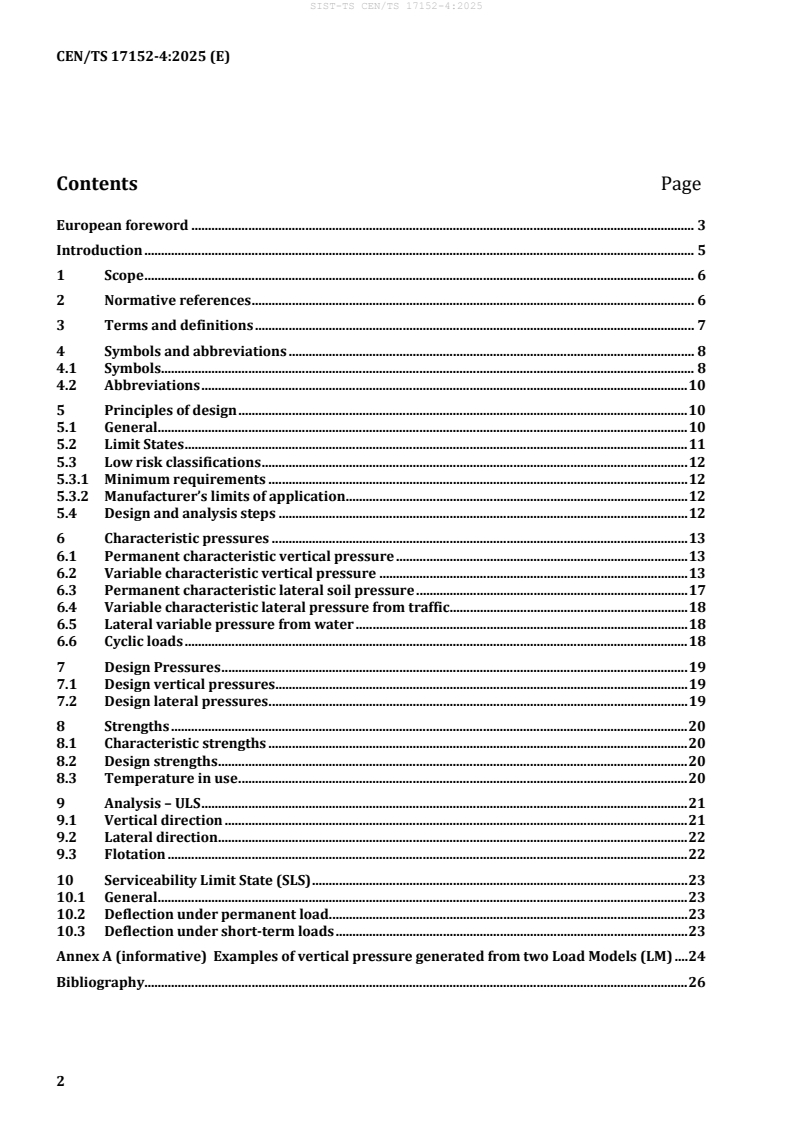
Contents Page
European foreword . 3
Introduction . 5
1 Scope . 6
2 Normative references . 6
3 Terms and definitions . 7
4 Symbols and abbreviations . 8
4.1 Symbols. 8
4.2 Abbreviations . 10
5 Principles of design . 10
5.1 General . 10
5.2 Limit States . 11
5.3 Low risk classifications . 12
5.3.1 Minimum requirements . 12
5.3.2 Manufacturer’s limits of application . 12
5.4 Design and analysis steps . 12
6 Characteristic pressures . 13
6.1 Permanent characteristic vertical pressure . 13
6.2 Variable characteristic vertical pressure . 13
6.3 Permanent characteristic lateral soil pressure . 17
6.4 Variable characteristic lateral pressure from traffic . 18
6.5 Lateral variable pressure from water . 18
6.6 Cyclic loads . 18
7 Design Pressures . 19
7.1 Design vertical pressures. 19
7.2 Design lateral pressures . 19
8 Strengths . 20
8.1 Characteristic strengths . 20
8.2 Design strengths . 20
8.3 Temperature in use . 20
9 Analysis – ULS . 21
9.1 Vertical direction . 21
9.2 Lateral direction . 22
9.3 Flotation . 22
10 Serviceability Limit State (SLS) . 23
10.1 General . 23
10.2 Deflection under permanent load . 23
10.3 Deflection under short-term loads . 23
Annex A (informative) Examples of vertical pressure generated from two Load Models (LM) . 24
Bibliography. 26
European foreword
This document (CEN/TS 17152-4:2025) has been prepared by Technical Committee CEN/TC 155
“Plastics piping systems and ducting systems”, the secretariat of which is held by NEN.
This European Standard shall be given the status of a national standard, either by publication of an
identical text or by endorsement, at the latest by January 2026, and conflicting national standards shall
be withdrawn at the latest by January 2026.
Attention is drawn to the possibility that some of the elements of this document may be the subject of
patent rights. CEN shall not be held responsible for identifying any or all such patent rights.
This document supersedes CEN/TS 17152-4:2024.
The early revision of CEN/TS 17152-4:2024 is proposed by CEN TC 155 WG 26 to change some clauses
which could result in unsafe design. In addition several editorial mistakes are corrected.
The main changes compared to the previous version are:
a) amended Figure 1 (5.1);
b) amended Figure 3 (6.2);
c) revised text 6.3 (limitation height of the system and installation depth) and improved text calculation
of K;
d) revised text 6.4 (limitation height of the system and installation depth) and improved text calculation
of K;
e) γ changed to 1,35 in 7.1 and 7.2.
Q
This document is supported by separate standards on test methods to which normative references are
made.
EN 17152 consists of the following parts under the general title Plastics piping systems for non-pressure
underground conveyance and storage of non-potable water — Boxes used for infiltration, attenuation and
storage systems:
— Part 1: Specifications for storm water boxes made of PP and PVC;
— Part 3: Assessment of conformity (CEN/TS);
— Part 4: Guidance for the structural design of modular systems (CEN/TS).
Recommended practices for installation are described in CEN/TR 17179 [1].
National standards for pipes and fittings for the transport of surface water are not considered to be
conflicting with this document and can thus be allowed to coexist.
Any feedback and questions on this document should be directed to the users’ national standards body.
A complete listing of these bodies can be found on the CEN website.
According to the CEN-CENELEC Internal Regulations, the national standards organisations of the
following countries are bound to implement this European Standard: Austria, Belgium, Bulgaria, Croatia,
Cyprus, Czech Republic, Denmark, Estonia, Finland, France, Germany, Greece, Hungary, Iceland, Ireland,
Italy, Latvia, Lithuania, Luxembourg, Malta, Netherlands, Norway, Poland, Portugal, Republic of North
Macedonia, Romania, Serbia, Slovakia, Slovenia, Spain, Sweden, Switzerland, Türkiye and the United
Kingdom.
Introduction
The products covered by this document are part of surface water (previously referred to as stormwater)
management systems.
Geocellular systems are an assemblage of boxes, in one or more layers, for which the material and the
material characteristics are according to EN 17152-1. The assemblage is considered as a modular system
for the purposes of this design guidance.
The general principles of designing structures to withstand long-term loads are well established.
However, their application is generally for rigid structures such as concrete bridges, e.g. Eurocode 2
series: Design of concrete structures (EN 1992).
The behaviour of thermoplastics is more complex and the design loads which may be experienced may
be different in magnitude and action. This guidance is intended to aid the designer in determining realistic
loadings in the design of thermoplastic geocellular modular systems.
NOTE In this guidance, the terms pressure(s) and strength will be used, corresponding to actions and
resistances in Eurocodes.
1 Scope
This document gives guidance on the structural design of underground modular systems for infiltration,
attenuation and storage of surface water under various conditions of loading. The procedures are
explained, with the appropriate variables in the design formulae, and provides graphical information on
vehicle surcharge loadings.
These modular systems are constructed from multiple cuboid shaped thermoplastic boxes generally with
ancillary components such as inlet/outlet connectors, vents, and access/inspection provision. This
guidance is for the design of modular systems conforming to EN 17152-1.
The boxes, including integral components, are injection moulded, extruded or thermoformed
thermoplastics, manufactured from polypropylene (PP) or unplasticized poly(vinyl chloride) (PVC-U),
and are intended to be used as elements in a modular system where the manufacturer has clearly stated
in the documentation how the components are assembled to create a complete infiltration, attenuation
or storage system.
Outside the scope of this document are the following conditions:
— seismic loads;
— lateral loads from adjacent structures and embankments;
— influence of trees;
— backfill materials not according to CEN/TR 17179 [1].
Geotextile and/or geomembrane used with modular systems are outside the scope of this document.
NOTE If reference is made in this document to Eurocode standards, the conditions in a national foreword or
national annex are normally stated.
2 Normative references
The following documents are referred to in the text in such a way that some or all of their content
constitutes requirements of this document. For dated references, only the edition cited applies. For
undated references, the latest edition of the referenced document (including any amendments) applies.
EN 1997-1:2024, Eurocode 7 - Geotechnical design - Part 1: General rules
EN 17152-1:2019, Plastics piping systems for non-pressure underground conveyance and storage of non-
potable water - Boxes used for infiltration, attenuation and storage systems - Part 1: Specifications for storm
water boxes made of PP and PVC-U
EN ISO 472:2013, Plastics - Vocabulary (ISO 472:2013)
EN ISO 1043-1:2011, Plastics - Symbols and abbreviated terms - Part 1: Basic polymers and their special
characteristics (ISO 1043-1:2011)
3 Terms and definitions
For the purposes of this document, the terms and definitions given in EN ISO 472:2013,
EN ISO 1043-1:2011, EN 17152-1:2019 and the following apply.
3.1
limit state
state beyond which the structure no longer satisfies the relevant design criteria
[SOURCE: EN 1990:2023 3.1.2.14]
3.2
ultimate limit state
ULS
state associated with collapse or other similar forms of structural failure
Note 1 to entry: Generally corresponds to the maximum load-carrying resistance of a structure or structural
member
[SOURCE: EN 1990:2023 3.1.2.15; modified – note to entry added]
3.3
serviceability limit state
SLS
state that correspond to conditions beyond which specified service requirements for a structure or
structural member are no longer met
[SOURCE: EN 1990:2023 3.1.2.16]
3.4
characteristic pressure
principal representative pressure exerted on a structure by an imposed load
3.5
design pressure
conversion of characteristic pressure to design pressure by applying load factors relevant to the site
and/or application
3.6
load factor
factor modifying characteristic loads to reflect the site classification and/or risk
3.7
characteristic strength
short and long-term compression strength of boxes declared by the manufacturer according to
EN 17152-1
3.8
design strength
conversion of characteristic strengths to design strength by applying partial factors relevant to the site
and/or application
3.9
partial factor
PF
factor modifying characteristic strength to reflect the application and available data
3.10
variable pressure
pressure resulting from a load that is relevant during a period much shorter than the design life of the
modular system and which has a high probability of occurrence
3.11
permanent pressure
pressure that is relevant during a period of the same order as the design life of the modular system
3.12
compliance
deflection per unit of pressure (reciprocal of stiffness)
3.13
modular system
geocellular system made of repeating boxes to function as a tank or reservoir
3.14
submerged unit weight
weight of the solids in air minus the weight of water displaced by the solids per unit of volume of solid
mass
4 Symbols and abbreviations
4.1 Symbols
For the purposes of this document, the following symbols and units apply.
A
time dependent reduction factor for temporary surcharges
t
A
reduction factor for a load duration of 50 years
50a
C
lateral compliance of a box mm/kPa
BL
C
lateral compliance of a system mm/kPa
SL
d minimum horizontal dimension of the system m
F
single wheel load according to applied load model kN
A
F
sum of adjacent wheel loads kN
E
h equivalent depth of backfill (cover) over modular system m
K soil coefficient –
p
permanent design vertical pressure kPa
Gd
p
permanent characteristic vertical pressure kPa
Gk
p
variable design vertical pressure kPa
Qd
p
variable vertical characteristic pressure kPa
Qk
p
variable characteristic vertical pressure due to a single load kPa
0k
p
variable vertical characteristic pressure kPa
Qk
r
radius of the wheel load area m
A
the average distance between the first wheel and all adjacent wheel loads ((r
E1
r
m
E
+ r + r )/3), in m.
E2 E3
R
design lateral short-term compression strength kPa
0ld
R
design vertical short-term compression strength kPa
0vd
R
characteristic lateral short-term compression strength kPa
0lk
R
characteristic vertical short-term compression strength kPa
0vk
R
50al
design lateral long-term compression strength kPa
d
R
50al
characteristic lateral long-term compression strength at 50 years kPa
k
R
50av
design vertical long-term compression strength kPa
d
R
50av
characteristic vertical long term compression strength at 50 years kPa
k
Z depth to the point where the lateral soil pressure is to be calculated m
α
reduction factor for shallow depth of cover –
F
γ
partial factor (permanent) –
G
γ
partial factor (variable) –
Q
γ
partial factor, destabilising –
dstb
γ
load factor (permanent, lateral) –
LP
γ
load factor (variable, lateral) –
LT
γ
partial safety factor of the material –
M
γ 3
unit weight of backfill
s kN/m
γ
partial factor, stabilizing –
stb
γ 3
unit weight of water
W kN/m
δ
design ultimate lateral deflection m
d.lim
δ
permanent lateral deflection m
G
δ
ultimate deflection from short-term compression testing m
max
δ
variable lateral deflection m
Q
σ
permanent characteristic lateral pressure kPa
Gk
σ
permanent design lateral pressure kPa
Gd
σ
variable characteristic lateral pressure kPa
Qk
σ
variable design lateral pressure kPa
Qd
4.2 Abbreviations
LM Load Model
SLS Serviceability Limit State
ULS Ultimate Limit State
5 Principles of design
5.1 General
This guidance includes three possible design routes depending on the risk classification of the site and/or
the application. The three routes are shown in Figure 1 and detailed further in this clause.
Key
* revise design could be, for example, amend ground model, improve soil properties, change other
parameters.
Figure 1 — Flow chart of design steps with relevant clauses
5.2 Limit States
For geocellular modular systems, the Ultimate Limit State (ULS) i.e. the performance requirement
without failure over the design life, considers the characteristic long-term and short-term compression
strength of the modular system in the vertical direction (see 9.1) and a strain capacity of the boxes in the
lateral direction (see 9.2). Flotation is also considered if a watertight modular system is below
groundwater level (see 9.3).
It is assumed (see Clause 10) that excessive vertical deflection at the ground surface is the most likely
cause of exceeding the Serviceability Limit State (SLS).
5.3 Low risk classifications
5.3.1 Minimum requirements
Boxes that meet the minimum requirements of EN 17152-1 and are installed according to CEN/TR 17179
[1] are deemed not to require project specific design calculations when all the following conditions are
met:
— cover depth greater than 0,5 m and less than 1,25 m;
— modular system height less than 2,0 m;
— installed in landscape areas where maximum axle load is 20 kN;
— water table below the base of the modular system at all times.
NOTE The aforementioned maximum cover depth in combination with the given wheel load of 10 kN results
in a vertical soil pressure of 28,7 kPa on the surface of the system (soil unit weight 20 kN/m , wheel area 0,4 m by
0,4 m, load spread angle 1:2). Calculated with the minimum long-term compression strength (50 kPa) the global
safety level is 1,74, which is greater than the product of partial factors as defined in Clauses 8 and 9 (1,35 ·
1,25 = 1,69).
5.3.2 Manufacturer’s limits of application
All installations should have the design calculations carried out to determine that the modular system
will perform as required under the particular load conditions. In practice, the manufacturer should have
carried out sample calculations in accordance with this design guidance to demonstrate the limits of
application, specifically maximum depth of installation and minimum depth of cover and predetermined
ground conditions and loadings.
5.4 Design and analysis steps
It is recommended that the designer follows the steps below.
First summarize the critical factors relevant to the design. This should be a diagrammatic cross-section
of:
— ground level profile over and adjacent to modular system;
— depth of cover over top of modular system;
— depth to base of modular system;
— extern
...