


EN ISO 12217-2:2025
(Main)Small craft - Stability and buoyancy assessment and categorization - Part 2: Sailing boats of hull length greater than or equal to 6 m (ISO 12217-2:2022)
Small craft - Stability and buoyancy assessment and categorization - Part 2: Sailing boats of hull length greater than or equal to 6 m (ISO 12217-2:2022)
This document specifies methods for evaluating the stability and buoyancy of intact (i.e. undamaged) boats. The flotation characteristics of boats susceptible to swamping are also encompassed.
The evaluation of stability and buoyancy properties using this document will enable the boat to be assigned to a design category (A, B, C or D) appropriate to its design and maximum load.
This document is principally applicable to boats propelled primarily by sail (even if fitted with an auxiliary engine) of 6 m up to and including 24 m hull length. However, it can also be applied to boats less than 6 m if they are habitable multihulls or can be applied if they do not attain the desired design category specified in ISO 12217‑3 and they are decked and have quick-draining recesses which comply with ISO 11812.
In relation to habitable multihulls, this document includes assessment of susceptibility to inversion, definition of viable means of escape and requirements for inverted flotation.
This document excludes:
— inflatable and rigid-inflatable boats covered by the ISO 6185 series, except for references made in the ISO 6185 series to specific clauses of the ISO 12217 series;
— gondolas and pedalos;
— surfboards including sailing surfboards; and
— hydrofoils and foil stabilized boats when not operating in the displacement mode.
NOTE Displacement mode means that the boat is only supported by hydrostatic forces.
It does not include or evaluate the effects on stability of towing, fishing, dredging or lifting operations, which need to be separately considered if appropriate.
Kleine Wasserfahrzeuge - Festlegung und Kategorisierung von Querstabilität und Auftrieb - Teil 2: Segelboote ab 6 m Rumpflänge (ISO 12217-2:2022)
Dieses Dokument legt Verfahren für die Beurteilung von Stabilität und Auftrieb von intakten (d. h. unbeschädigten) Booten fest. Ebenfalls sind darin die Auftriebseigenschaften solcher Boote erfasst, die anfällig gegen Vollschlagen sind.
Die Beurteilung der Stabilitäts- und Auftriebseigenschaften nach diesem Dokuemnt erlaubt es, dem Boot eine Entwurfskategorie (A, B, C oder D) zuzuordnen, die seiner Auslegung und seiner maximalen Beladung entspricht.
Dieses Dokument ist grundsätzlich für Boote anwendbar, die in erster Linie durch Segel angetrieben werden (auch wenn das Boot über einen Hilfsmotor verfügt) mit einer Rumpflänge von 6 m bis einschließlich 24 m. Er kann jedoch auch auf Boote von weniger als 6 m Rumpflänge angewendet werden, wenn sie bewohnbare Mehrrumpfboote sind oder sie bei Anwendung von ISO 12217-3 nicht die gewünschte Entwurfskategorie erreichen, jedoch voll gedeckt sind und schnell-lenzende Rezesse entsprechend ISO 11812:2020 besitzen.
In Bezug auf bewohnbare Mehrrumpfboote beinhaltet dieses Dokument die Bewertung der Anfälligkeit gegen Kenterung, die Definition funktionsfähiger Fluchtmöglichkeiten und Anforderungen an die Schwimmfähigkeit im gekenterten Zustand (kieloben).
Ausgeschlossen von der Anwendung dieses Dokuments sind:
- Schlauchboote und Schlauchboote mit festem Rumpf (RIB) nach ISO 6185 mit Ausnahme der Verweisungen, die sich in jener Norm auf bestimmte Abschnitte in ISO 12217 beziehen;
- Gondeln und Tretboote;
- Surfbretter einschließlich Segel-Surfbretter;
- Tragflügelboote, motor- oder segelbetrieben, sofern sie nicht im Verdrängermodus betrieben werden.
ANMERKUNG Verdrängermodus bedeutet, dass das Boot nur durch hydrostatische Kräfte getragen wird.
Es enthält keine Angaben oder Beurteilungen zu den die Stabilität betreffenden Auswirkungen von Schleppen, Fischen, Baggern oder Kranarbeiten; diese müssen, falls erforderlich, gesondert berücksichtigt werden.
ACHTUNG - Die Übereinstimmung mit diesem Dokument stellt keine absolute Sicherheit oder Risikofreiheit bezüglich Kentern oder Sinken sicher.
WICHTIG - Die elektronische Datei dieses Dokuments enthält Farben, die als nützlich für das korrekte Verständnis dieses Dokuments erachtet werden. Anwender sollten daher erwägen, dieses Dokument farbig auszudrucken.
Petits navires - Évaluation et catégorisation de la stabilité et de la flottabilité - Partie 2: Bateaux à voiles d'une longueur de coque supérieure ou égale à 6 m (ISO 12217-2:2022)
Le présent document spécifie les méthodes d'évaluation de la stabilité et de la flottabilité des bateaux à l'état intact (c'est-à-dire non endommagés). Les caractéristiques de flottabilité des bateaux susceptibles d'envahissement sont également prises en compte.
L'évaluation des propriétés de stabilité et de flottabilité effectuée en utilisant le présent document permettra d'attribuer à un bateau une catégorie de conception (A, B, C ou D) appropriée à sa conception et à sa charge maximale.
Le présent document est principalement applicable aux bateaux propulsés principalement par des voiles (même s'ils sont équipés d'un moteur auxiliaire), d'une longueur de coque de 6 m à 24 m inclus. Elle peut cependant être appliquée aux bateaux de moins de 6 m, s’il s’agit des multicoques habitables ou s'ils n'atteignent pas la catégorie de conception désirée spécifiée par l’ISO 12217-3 et s’ils sont pontés et munis de cavités rapidement autovideuses conformes à l'ISO 11812.
Pour ce qui concerne les multicoques habitables, la présente document comprend l'évaluation de la susceptibilité à l'inversion, la définition d'un moyen d'échappée viable et des exigences de flottabilité à l'état inversé.
La présente document exclut:
— les bateaux pneumatiques et semi-rigides couverts par la série ISO 6185, excepté lorsque la série ISO 6185 fait référence à des paragraphes spécifiques de la série ISO 12217;
— les gondoles et pédalos;
— les planches de surf, y compris les planches de surf à voiles;
— les hydrofoils et les bateaux stabilisés par des foils lorsqu'ils ne fonctionnent pas en mode à déplacement.
NOTE Le mode à déplacement signifie que le bateau est uniquement supporté par des forces hydrostatiques.
Elle n'inclut ni n'évalue les effets sur la stabilité provenant du remorquage, de la pêche, du dragage ou d'opérations de levage, qui doivent être, si nécessaire, considérés séparément.
Mala plovila - Stabilnost in ocena vzgona ter kategorizacija - 2. del: Jadrnice s trupom, večjim ali enakim 6 m (ISO 12217-2:2022)
General Information
Relations
Standards Content (Sample)
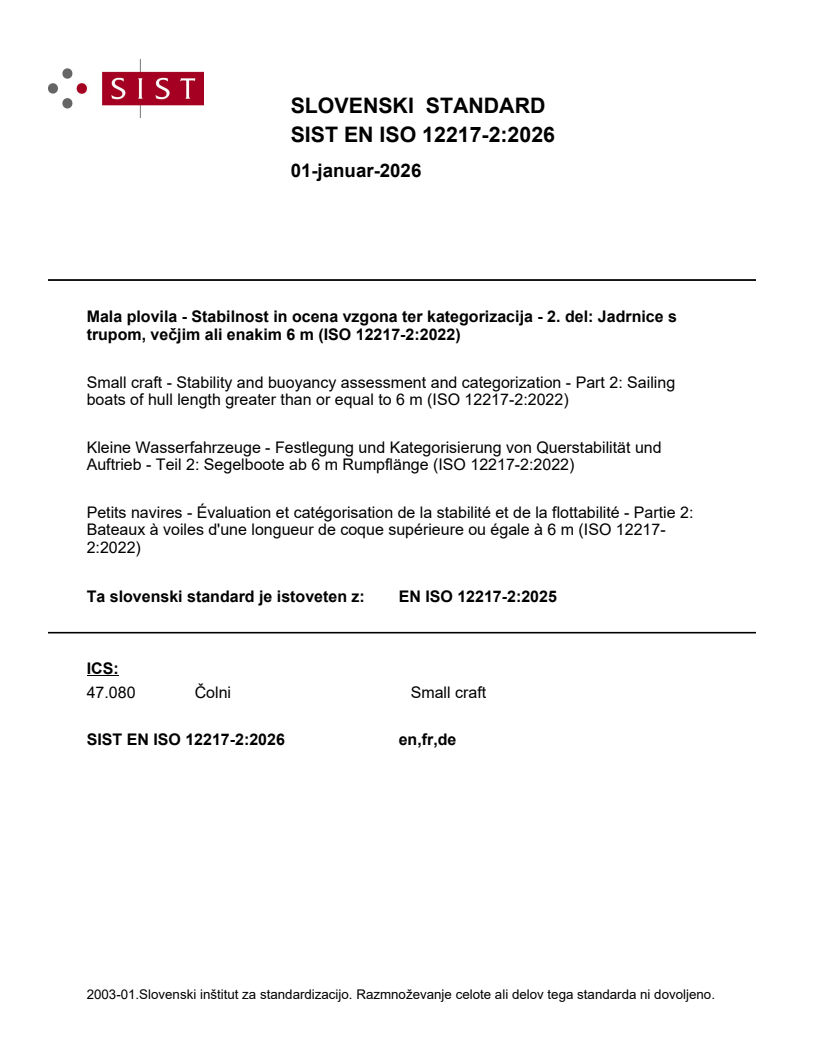
SLOVENSKI STANDARD
01-januar-2026
Mala plovila - Stabilnost in ocena vzgona ter kategorizacija - 2. del: Jadrnice s
trupom, večjim ali enakim 6 m (ISO 12217-2:2022)
Small craft - Stability and buoyancy assessment and categorization - Part 2: Sailing
boats of hull length greater than or equal to 6 m (ISO 12217-2:2022)
Kleine Wasserfahrzeuge - Festlegung und Kategorisierung von Querstabilität und
Auftrieb - Teil 2: Segelboote ab 6 m Rumpflänge (ISO 12217-2:2022)
Petits navires - Évaluation et catégorisation de la stabilité et de la flottabilité - Partie 2:
Bateaux à voiles d'une longueur de coque supérieure ou égale à 6 m (ISO 12217-
2:2022)
Ta slovenski standard je istoveten z: EN ISO 12217-2:2025
ICS:
47.080 Čolni Small craft
2003-01.Slovenski inštitut za standardizacijo. Razmnoževanje celote ali delov tega standarda ni dovoljeno.
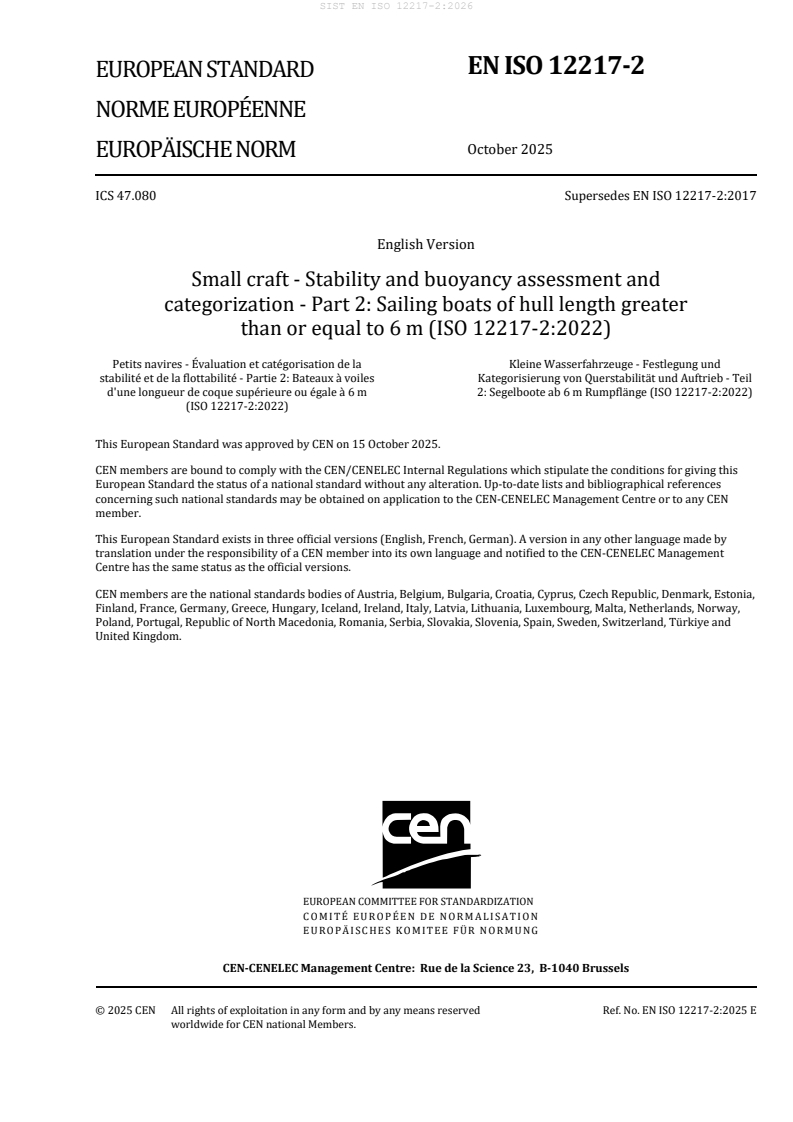
EN ISO 12217-2
EUROPEAN STANDARD
NORME EUROPÉENNE
October 2025
EUROPÄISCHE NORM
ICS 47.080 Supersedes EN ISO 12217-2:2017
English Version
Small craft - Stability and buoyancy assessment and
categorization - Part 2: Sailing boats of hull length greater
than or equal to 6 m (ISO 12217-2:2022)
Petits navires - Évaluation et catégorisation de la Kleine Wasserfahrzeuge - Festlegung und
stabilité et de la flottabilité - Partie 2: Bateaux à voiles Kategorisierung von Querstabilität und Auftrieb - Teil
d'une longueur de coque supérieure ou égale à 6 m 2: Segelboote ab 6 m Rumpflänge (ISO 12217-2:2022)
(ISO 12217-2:2022)
This European Standard was approved by CEN on 15 October 2025.
CEN members are bound to comply with the CEN/CENELEC Internal Regulations which stipulate the conditions for giving this
European Standard the status of a national standard without any alteration. Up-to-date lists and bibliographical references
concerning such national standards may be obtained on application to the CEN-CENELEC Management Centre or to any CEN
member.
This European Standard exists in three official versions (English, French, German). A version in any other language made by
translation under the responsibility of a CEN member into its own language and notified to the CEN-CENELEC Management
Centre has the same status as the official versions.
CEN members are the national standards bodies of Austria, Belgium, Bulgaria, Croatia, Cyprus, Czech Republic, Denmark, Estonia,
Finland, France, Germany, Greece, Hungary, Iceland, Ireland, Italy, Latvia, Lithuania, Luxembourg, Malta, Netherlands, Norway,
Poland, Portugal, Republic of North Macedonia, Romania, Serbia, Slovakia, Slovenia, Spain, Sweden, Switzerland, Türkiye and
United Kingdom.
EUROPEAN COMMITTEE FOR STANDARDIZATION
COMITÉ EUROPÉEN DE NORMALISATION
EUROPÄISCHES KOMITEE FÜR NORMUNG
CEN-CENELEC Management Centre: Rue de la Science 23, B-1040 Brussels
© 2025 CEN All rights of exploitation in any form and by any means reserved Ref. No. EN ISO 12217-2:2025 E
worldwide for CEN national Members.
Contents Page
European foreword . 3
European foreword
This document (EN ISO 12217-2:2025) has been prepared by Technical Committee ISO/TC 188 "Small
craft" in collaboration with Technical Committee CEN/TC 464 “Small Craft” the secretariat of which is
held by SIS.
This European Standard shall be given the status of a national standard, either by publication of an
identical text or by endorsement, at the latest by April 2026, and conflicting national standards shall be
withdrawn at the latest by April 2026.
Attention is drawn to the possibility that some of the elements of this document may be the subject of
patent rights. CEN shall not be held responsible for identifying any or all such patent rights.
This document supersedes EN ISO 12217-2:2017.
Any feedback and questions on this document should be directed to the users’ national standards
body/national committee. A complete listing of these bodies can be found on the CEN website.
According to the CEN-CENELEC Internal Regulations, the national standards organizations of the
following countries are bound to implement this European Standard: Austria, Belgium, Bulgaria,
Croatia, Cyprus, Czech Republic, Denmark, Estonia, Finland, France, Germany, Greece, Hungary, Iceland,
Ireland, Italy, Latvia, Lithuania, Luxembourg, Malta, Netherlands, Norway, Poland, Portugal, Republic of
North Macedonia, Romania, Serbia, Slovakia, Slovenia, Spain, Sweden, Switzerland, Türkiye and the
United Kingdom.
Endorsement notice
The text of ISO 12217-2:2022 has been approved by CEN as EN ISO 12217-2:2025 without any
modification.
INTERNATIONAL ISO
STANDARD 12217-2
Fourth edition
2022-12
Small craft — Stability and buoyancy
assessment and categorization —
Part 2:
Sailing boats of hull length greater
than or equal to 6 m
Petits navires — Évaluation et catégorisation de la stabilité et de la
flottabilité —
Partie 2: Bateaux à voiles d'une longueur de coque supérieure ou
égale à 6 m
Reference number
ISO 12217-2:2022(E)
ISO 12217-2:2022(E)
© ISO 2022
All rights reserved. Unless otherwise specified, or required in the context of its implementation, no part of this publication may
be reproduced or utilized otherwise in any form or by any means, electronic or mechanical, including photocopying, or posting on
the internet or an intranet, without prior written permission. Permission can be requested from either ISO at the address below
or ISO’s member body in the country of the requester.
ISO copyright office
CP 401 • Ch. de Blandonnet 8
CH-1214 Vernier, Geneva
Phone: +41 22 749 01 11
Email: copyright@iso.org
Website: www.iso.org
Published in Switzerland
ii
ISO 12217-2:2022(E)
Contents Page
Foreword .v
Introduction . vi
1 Scope . 1
2 Normative references . 1
3 Terms and definitions . 2
3.1 Primary . 2
3.2 Hazards . 4
3.3 Downflooding . 4
3.4 Dimensions, areas and angles . 5
3.5 Condition, mass and volume . 6
3.6 Other terms and definitions . 9
4 Symbols .12
5 Procedure .13
5.1 Maximum load .13
5.2 Sailing or non-sailing .13
5.3 Tests, calculations and requirements to be applied . 13
5.4 Variation in input parameters . 14
6 Requirements for monohull boats .14
6.1 Requirements to be applied . 14
6.2 Downflooding . 15
6.2.1 Downflooding openings .15
6.2.2 Downflooding height . 18
6.2.3 Downflooding angle . 19
6.3 Recess size . 19
6.3.1 Application . 19
6.3.2 Simplified methods . 20
6.3.3 Direct calculation method . 22
6.4 Minimum righting energy . 22
6.5 Angle of vanishing stability .23
6.5.1 General .23
6.5.2 Normal requirement .23
6.5.3 Alternative requirement for design category B .23
6.6 Stability index (STIX) . 24
6.6.1 Method . . 24
6.6.2 Dynamic stability factor (FDS) . 25
6.6.3 Inversion recovery factor (FIR) . 25
6.6.4 Knockdown recovery factor (FKR) . 25
6.6.5 Displacement-length factor (FDL) . 26
6.6.6 Beam-displacement factor (FBD) . 26
6.6.7 Wind moment factor (FWM) . 26
6.6.8 Downflooding factor (FDF) . 27
6.6.9 Calculation of the stability index (STIX) . 27
6.7 Knockdown-recovery test . 27
6.8 Wind stiffness test .28
6.8.1 General .28
6.8.2 Practical test .28
6.8.3 Compliance by calculation .30
6.8.4 Requirements . 31
6.9 Flotation requirements . 32
6.10 Capsize-recovery test . 32
6.11 Detection and removal of water .34
7 Requirements for catamarans, trimarans and form-stable monohulls .35
iii
ISO 12217-2:2022(E)
7.1 Requirements to be applied . 35
7.2 Downflooding openings . 35
7.3 Downflooding height . 35
7.4 Recess size . 35
7.5 Stability information . 35
7.6 Safety signs . 36
7.7 Bare poles factor . 37
7.8 Rolling in breaking waves . 37
7.9 Pitchpoling .38
7.10 Diagonal stability .38
7.11 Habitable multihull boats .38
7.12 Buoyancy when inverted .40
7.13 Escape after inversion. 41
8 Safety signs .42
9 Application .42
9.1 Deciding the design category . 42
9.2 Meaning of the design categories . 42
Annex A (normative) Full method for required downflooding height . 44
Annex B (normative) Methods for calculating downflooding angle .46
Annex C (normative) Determining the curve of righting moments .48
Annex D (normative) Method for calculating reserve of buoyancy after inversion or
swamping .51
Annex E (normative) Flotation material and elements .53
Annex F (normative) Information for the craft’s owner’s manual .55
Annex G (normative) Determination of safe wind speed information .59
Annex H (normative) Determination of longitudinal righting characteristics .62
Annex I (informative) Summary of requirements .65
Annex J (informative) Worksheets .68
Annex K (informative) Illustration of recess retention level .87
Bibliography .88
iv
ISO 12217-2:2022(E)
Foreword
ISO (the International Organization for Standardization) is a worldwide federation of national standards
bodies (ISO member bodies). The work of preparing International Standards is normally carried out
through ISO technical committees. Each member body interested in a subject for which a technical
committee has been established has the right to be represented on that committee. International
organizations, governmental and non-governmental, in liaison with ISO, also take part in the work.
ISO collaborates closely with the International Electrotechnical Commission (IEC) on all matters of
electrotechnical standardization.
The procedures used to develop this document and those intended for its further maintenance are
described in the ISO/IEC Directives, Part 1. In particular, the different approval criteria needed for the
different types of ISO documents should be noted. This document was drafted in accordance with the
editorial rules of the ISO/IEC Directives, Part 2 (see www.iso.org/directives).
Attention is drawn to the possibility that some of the elements of this document may be the subject of
patent rights. ISO shall not be held responsible for identifying any or all such patent rights. Details of
any patent rights identified during the development of the document will be in the Introduction and/or
on the ISO list of patent declarations received (see www.iso.org/patents).
Any trade name used in this document is information given for the convenience of users and does not
constitute an endorsement.
For an explanation of the voluntary nature of standards, the meaning of ISO specific terms and
expressions related to conformity assessment, as well as information about ISO’s adherence to
the World Trade Organization (WTO) principles in the Technical Barriers to Trade (TBT), see
www.iso.org/iso/foreword.html.
This document was prepared by Technical Committee ISO/TC 188, Small craft, in collaboration with
the European Committee for Standardization (CEN) Technical Committee CEN/TC 464, Small Craft, in
accordance with the Agreement on technical cooperation between ISO and CEN (Vienna Agreement).
This fourth edition cancels and replaces the third edition (ISO 12217-2:2015), of which it constitutes a
minor revision. The main changes are as follows:
— the Normative references have been updated;
— the “allowance for the maximum mass of optional equipment and fittings not included in the
manufacturer’s basic outfit” has been moved from 3.5.4 (maximum load) to 3.5.5 (maximum load
condition);
— in Clause F.1, the first paragraph has been slightly reworded as a Note, so as to clearly make an
informative reference to ISO 10240, which has been moved from Clause 2 to the Bibliography;
— in Annex J, the calculation worksheet No. 1 has been corrected to reflect the changes in 3.5.4 and
3.5.5;
— minor editorial changes throughout the document.
A list of all parts in the ISO 12217 series can be found on the ISO website.
Any feedback or questions on this document should be directed to the user’s national standards body. A
complete listing of these bodies can be found at www.iso.org/members.html.
v
ISO 12217-2:2022(E)
Introduction
This document enables the determination of limiting environmental conditions for which an individual
boat has been designed.
It enables the boat to be assigned to a design category appropriate to its design and maximum load. The
design categories used align with those in the Recreational Craft Directive of the European Union, EU
Directive 2013/53/EU.
Annex J provides worksheets to assist in the systematic assessment of a boat according to this document.
vi
INTERNATIONAL STANDARD ISO 12217-2:2022(E)
Small craft — Stability and buoyancy assessment and
categorization —
Part 2:
Sailing boats of hull length greater than or equal to 6 m
CAUTION — Compliance with this document does not guarantee total safety or total freedom of
risk from capsize or sinking.
IMPORTANT — The electronic file of this document contains colours which are considered to be
useful for the correct understanding of the document. Users should therefore consider printing
this document using a colour printer.
1 Scope
This document specifies methods for evaluating the stability and buoyancy of intact (i.e. undamaged)
boats. The flotation characteristics of boats susceptible to swamping are also encompassed.
The evaluation of stability and buoyancy properties using this document will enable the boat to be
assigned to a design category (A, B, C or D) appropriate to its design and maximum load.
This document is principally applicable to boats propelled primarily by sail (even if fitted with an
auxiliary engine) of 6 m up to and including 24 m hull length. However, it can also be applied to boats
less than 6 m if they are habitable multihulls or can be applied if they do not attain the desired design
category specified in ISO 12217-3 and they are decked and have quick-draining recesses which comply
with ISO 11812.
In relation to habitable multihulls, this document includes assessment of susceptibility to inversion,
definition of viable means of escape and requirements for inverted flotation.
This document excludes:
— inflatable and rigid-inflatable boats covered by the ISO 6185 series, except for references made in
the ISO 6185 series to specific clauses of the ISO 12217 series;
— gondolas and pedalos;
— surfboards including sailing surfboards; and
— hydrofoils and foil stabilized boats when not operating in the displacement mode.
NOTE Displacement mode means that the boat is only supported by hydrostatic forces.
It does not include or evaluate the effects on stability of towing, fishing, dredging or lifting operations,
which need to be separately considered if appropriate.
2 Normative references
The following documents are referred to in the text in such a way that some or all of their content
constitutes requirements of this document. For dated references, only the edition cited applies. For
undated references, the latest edition of the referenced document (including any amendments) applies.
ISO 2896:2001, Rigid cellular plastics — Determination of water absorption
ISO 12217-2:2022(E)
ISO 3864-1:2011, Graphical symbols — Safety colours and safety signs — Part 1: Design principles for
safety signs and safety markings
ISO 8666:2020, Small craft — Principal data
ISO 9093, Small craft — Seacocks and through-hull fittings
ISO 9094, Small craft — Fire protection
ISO 11812, Small craft — Watertight or quick-draining recesses and cockpits
ISO 12216, Small craft — Windows, portlights, hatches, deadlights and doors — Strength and watertightness
requirements
ISO 12217-1:2022, Small craft — Stability and buoyancy assessment and categorization — Part 1: Non-
sailing boats of hull length greater than or equal to 6 m
ISO 14946:2021, Small craft — Maximum load capacity
ISO 15083, Small craft — Bilge-pumping systems
3 Terms and definitions
For the purposes of this document, the following terms and definitions apply.
ISO and IEC maintain terminology databases for use in standardization at the following addresses:
— ISO Online browsing platform: available at https:// www .iso .org/ obp
— IEC Electropedia: available at https:// www .electropedia .org/
NOTE The meanings of certain symbols used in the definitions are given in Clause 4.
3.1 Primary
3.1.1
design category
description of the sea and wind conditions for which a boat is assessed to be suitable
Note 1 to entry: See also 9.2.
3.1.2
sailing boat
boat for which the primary means of propulsion is by wind power, having reference sail area (3.4.8)
2/3
A ≥ 0,07(m )
S LDC
Note 1 to entry: m is the mass of the boat in the maximum load condition, expressed in kilograms.
LDC
3.1.3
catamaran
boat with two main load-bearing hulls
EXAMPLE Boats with a centreline or bridge-deck nacelle which supports less than 30 % of the mass in the
maximum load condition are considered to be catamarans. Proas are asymmetric catamarans.
3.1.4
trimaran
boat with a centre main hull and two sidehulls in which the centre hull, when the boat is upright,
supports 30 % or more of the mass in the maximum load condition
ISO 12217-2:2022(E)
3.1.5
recess
volume open to the air that might retain water within the range of loading conditions and corresponding
trims
EXAMPLE Cockpits, wells, open volumes or areas bounded by bulwarks or coamings.
Note 1 to entry: Cabins, shelters or lockers provided with closures according to the requirements of ISO 12216
are not recesses.
Note 2 to entry: Cockpits that are open aft to the sea are considered to be recesses. Flush decks without bulwarks
or coamings are not recesses.
3.1.6
quick-draining recess
recess fulfilling all the requirements of ISO 11812 for “quick-draining cockpits and recesses”
Note 1 to entry: According to its characteristics, a cockpit may be considered to be quick-draining for one design
category, but not for a higher category.
Note 2 to entry: ISO 11812 contains requirements with which most sailing dinghies cannot comply.
3.1.7
watertight recess
recess fulfilling all the requirements of ISO 11812 for “watertight cockpits and recesses”
Note 1 to entry: This term only implies requirements in respect of watertightness and sill heights, but not those
for drainage.
3.1.8
fully enclosed boat
boat in which the horizontal projection of the sheerline area comprises any combination of
— watertight deck and superstructure, and/or
— quick-draining recesses which comply with ISO 11812, and/or
— watertight recesses complying with ISO 11812 with a combined volume of less than (L B F )/40,
H H M
and
all closing appliances have their degree of watertightness in accordance with ISO 12216
Note 1 to entry: The size of recesses permitted for boats of design category A, B or some boats of design category
C is restricted by the requirements of 6.3.
3.1.9
habitable boat
boat having a fully enclosed cabin with rigid roof fitted with one or more bunks, benches,
pipecots, hammocks or similar locations that can be used for sleeping when the boat is under way
Note 1 to entry: A boat is considered to be “habitable” if a fabric closure is used instead of a rigid door, or the
cabin has fabric sides.
Note 2 to entry: The following are not considered to render a boat “habitable”:
— a cockpit tent, or
— an open-sided cuddy intended to provide limited protection from spray, provided it is not fitted with fabric
closures all round.
Note 3 to entry: Locations used for sleeping have minimum dimensions of 1,5 m diagonal length, 0,4 m width
at the widest point, and with a minimum headroom of 0,4 m over the length. The cabin sole and compartments
designated by the builder to be used exclusively for storage and referenced in the owner’s manual are not
included.
ISO 12217-2:2022(E)
3.1.10
habitable part of a boat
spaces within a habitable boat with rigid roof that are fitted with a toilet or in which there is provision
for any of the following activities: sitting, sleeping, cooking, eating, washing, navigation, steering
Note 1 to entry: Compartments designated by the builder to be used exclusively for storage and referenced in the
owner’s manual are not included.
3.2 Hazards
3.2.1
capsize
event when a boat reaches any heel angle from which it is unable to recover to equilibrium near the
upright without intervention
3.2.2
knockdown
event when a boat reaches a heel angle sufficient to immerse the masthead, and from which it may or
may not recover without intervention
3.2.3
inversion
event when a boat becomes upside down
3.3 Downflooding
3.3.1
downflooding opening
opening in the hull or deck (including the edge of a recess) that might admit water into the interior or
bilge of a boat, or a recess, apart from those excluded in 6.2.1.6
3.3.2
downflooding angle
ϕ
D
angle of heel at which downflooding openings (apart from those excluded in 6.2.1.6) become immersed,
when the boat is in calm water and in the appropriate loading condition at design trim
Note 1 to entry: Where openings are not symmetrical about the centreline of the boat, the case resulting in the
smallest angle is used.
Note 2 to entry: The following are specifically considered:
— ϕ is the downflooding angle to any downflooding opening;
D
— ϕ is the angle of heel at which openings which are not marked “KEEP SHUT WHEN UNDER WAY” having
DA
a combined total area, expressed in square centimetres (cm ), greater than the number represented by
1,2L B F first become immersed;
H H M
— ϕ is the downflooding angle at which recesses which are not quick-draining begin to fill with water;
DC
— ϕ is the downflooding angle at which any main access hatch (i.e. having an opening area greater than
DH
0,18 m each) giving direct access to the main open air helm position first begins to become immersed.
Note 3 to entry: Downflooding angle is expressed in degrees.
ISO 12217-2:2022(E)
3.3.3
downflooding height
h
D
smallest height above the waterline to any downflooding opening, apart from those excluded in 6.2.1.6,
when the boat is upright in calm water and in the maximum load condition, measured to the critical
downflooding point which might be within pipes or ducts inside the hull
Note 1 to entry: Downflooding height is expressed in metres.
Note 2 to entry: See Figure B.1.
3.4 Dimensions, areas and angles
3.4.1
length of hull
L
H
length of the hull measured according to ISO 8666
Note 1 to entry: Length of hull is expressed in metres.
3.4.2
length waterline
L
WL
waterline length measured according to ISO 8666 when the boat is upright in calm water, in the
appropriate loading condition and at design trim
Note 1 to entry: For multihull boats, L relates to that of the longest individual hull.
WL
Note 2 to entry: Length waterline is expressed in metres.
3.4.3
beam of hull
B
H
maximum beam of the hull using the method of ISO 8666; for catamaran and trimaran boats, maximum
beam across the outer hulls
Note 1 to entry: Beam of hull is expressed in metres.
3.4.4
beam waterline
B
WL
greatest beam measured according to ISO 8666 at the waterline in calm water which, for multihull
boats, is the sum of the maximum waterline beams of each of the hulls, the boat being upright, in the
appropriate loading condition and at design trim
Note 1 to entry: Beam waterline is expressed in metres.
3.4.5
beam between hull centres
B
CB
on catamaran and trimaran boats, the transverse distance between the centres of buoyancy of the
outer hulls
Note 1 to entry: Beam between hull centres is expressed in metres.
ISO 12217-2:2022(E)
3.4.6
freeboard amidships
F
M
distance of the sheerline or deck above the waterline at L /2 measured according to ISO 8666, the
WL
boat being upright, in the appropriate loading condition and at design trim
Note 1 to entry: Freeboard amidships is expressed in metres.
Note 2 to entry: Where no loading condition is specified, maximum load condition should be assumed.
3.4.7
draught of canoe body
T
C
draught of the main buoyant part of the hull(s) below the waterline, as defined in ISO 8666, the boat
being upright in the appropriate loading condition and at design trim
Note 1 to entry: Draught of canoe body excludes appendages such as rudders or skegs, and is expressed in metres.
3.4.8
reference sail area
A
S
actual profile area of sails set abaft a mast, plus the maximum profile areas of all masts, plus reference
triangle area(s) forward of each mast as defined in ISO 8666
Note 1 to entry: Sail area is expressed in square metres.
3.4.9
standard sail area
A′
S
actual profile area of the largest sail plan suitable for windward sailing in true winds of 10–12 kn (5,1–
6,2 m/s), including overlaps, and supplied or recommended by the builder as standard
Note 1 to entry: Sail area is expressed in square metres.
3.4.10
angle of vanishing stability
ϕ
V
angle of heel nearest the upright (other than upright) in the appropriate loading condition at which the
transverse stability righting moment is zero
Note 1 to entry: This is determined assuming that there is no offset load, and that all potential downflooding
openings are considered to be watertight.
Note 2 to entry: Where a boat has recesses which are not quick-draining, ϕ is to be taken as the downflooding
V
angle to these recesses, unless the loss of buoyancy due to such recesses is fully accounted for in determining ϕ .
V
Note 3 to entry: Angle of vanishing stability is expressed in degrees.
3.5 Condition, mass and volume
3.5.1
empty craft condition
empty boat including fittings and equipment as listed below but excluding all optional equipment and
fittings not included in the manufacturer’s basic outfit:
a) structure: comprising all the structural parts, including any fixed ballast keel and/or drop keel/
centreboard/daggerboard(s) and rudder(s);
b) ballast: any fixed ballast installed;
ISO 12217-2:2022(E)
c) internal structure and accommodation: bulkheads and partitions, insulation, lining, built-in
furniture, flotation material, windows, hatches and doors, permanently installed mattresses and
upholstery materials;
d) permanently installed engine(s) and fuel system: comprising inboard engine(s), including all
supplies and controls as needed for their operation, permanently installed fuel systems, including
tanks;
e) fluids in permanently installed systems: residual working fluids as needed for their operation (see
examples below), but excluding contents of fluid ballast systems and tanks, and main storage tanks
(which are included in maximum load);
EXAMPLE Fluids in hot or cold water, fuel, lubricating or hydraulic oil systems.
f) internal equipment, including:
— all items of equipment permanently attached to the craft, e.g. tanks, toilet system(s), water
transfer equipment;
— bilge pumping system(s), cooking and heating devices, cooling equipment, ventilation system(s);
— electrical installation and equipment, including permanently installed batteries mounted in the
position intended by the builder;
— fixed navigational and electronic equipment;
— fixed firefighting equipment, where fitted;
g) external equipment, including:
— all permanently attached standard or specified deck fittings, e.g. guardrails, pulpits and
pushpits, bowsprits and their attachments, bathing platforms, boarding ladders, steering
equipment, winches, sprayhood(s);
— awning(s), cockpit tables, gratings, signal mast(s), where fitted;
— mast(s), boom(s), spinnaker poles and other pole(s), standing and running rigging, in the stowed
position ready for use; all standing and running rigging in place
Note 1 to entry: The mass in the empty craft condition is denoted by m and is expressed in kilograms.
EC
3.5.2
light craft condition
empty craft condition plus standard equipment (3.6.12) plus removable ballast (whether solid or
liquid) when supplied and/or intended by the manufacturer to be carried when the boat is afloat, with
elements positioned as follows:
a) where provision is made for propulsion by outboard engine(s) of more than 3 kW, the heaviest
engine(s) recommended for the boat by the manufacturer is(are) mounted in the working
position(s);
b) where batteries are fitted, they are mounted in the position intended by the builder, and if there
is no specific stowage provided for batteries, the mass of one battery for each engine over 7 kW is
allowed for, and located within 1,0 m of the engine location;
c) all upwind sails supplied or recommended by the builder as standard, onboard and rigged ready
for use, but not hoisted, e.g. mainsail on boom, roller furling sails furled, hanked foresails on stay
stowed on foredeck
Note 1 to entry: For the minimum mass of outboard engines and batteries, refer to ISO 12217-3:2022, Tables C.1
and C.2.
Note 2 to entry: The mass in the light craft condition is denoted by m and is expressed in kilograms.
LC
ISO 12217-2:2022(E)
3.5.3
minimum operating condition
boat in the light craft condition with the following additions:
a) mass to represent the crew, positioned on the centreline near the main control position of
— 75 kg where L ≤ 8 m,
H
— 150 kg where 8 m < L ≤ 16 m,
H
— 225 kg where 16 m < L ≤ 24 m;
H
b) non-edible stores and equipment normally carried on the boat and not included in the
manufacturer’s list of standard equipment
EXAMPLE Loose internal equipment and tools, spare parts, dishes, kitchenware and cutlery, additional
anchors or sails, dinghy and outboard if carried aboard.
Note 1 to entry: Liquids in main storage tanks (e.g. fuel, drinking water, black and grey water, live wells, bait
tanks, etc.) are excluded.
Note 2 to entry: Water ballast in tanks which are symmetrical about the centreline and which are intended by the
builder to be used for variable asymmetric ballasting while under way is excluded.
Note 3 to entry: Elements with transversally variable position (e.g. canting keels, movable solid ballast, tilting
masts) are positioned symmetrically about the centreline of the boat. Elements with longitudinally variable
position (e.g. tilting masts or keels) are positioned so that the VCG is maximized.
Note 4 to entry: Any centreboard or keel is in the raised position unless it can be fixed in the lowered position
and an appropriate instruction is given in the owner’s manual.
Note 5 to entry: The mass in the minimum operating condition is denoted by m and is expressed in kilograms.
MO
3.5.4
maximum load
load which the boat is designed to carry in addition to the light craft condition, comprising:
— the crew limit at 75 kg each;
— the personal effects of the crew;
— stores and cargo (if any), dry provisions, consumable liquids;
— contents of all permanently installed storage tanks filled to 95 % of their maximum capacity,
including fuel, drinking water, black water, grey wat
...
Questions, Comments and Discussion
Ask us and Technical Secretary will try to provide an answer. You can facilitate discussion about the standard in here.
Loading comments...