

EN 1917:2002
(Main)Concrete manholes and inspection chambers, unreinforced, steel fibre and reinforced
- Abstract
This European Standard specifies performance requirements as defined in table 1 and describes test methods for precast concrete units, including joints (elastomeric, plastomeric or other sealing materials, either integrated in the unit or supplied separately), for inspection chambers designed to be used for inverts not exceeding 2 metres deep and manholes, of circular, rectangular (with or without chamfered or rounded corners) or elliptical internal shape, unreinforced, steel fibre and reinforced, with nominal sizes not exceeding DN 1250 for units with a circular bore or LN 1250 for units with a rectangular or elliptical shape.
- Status
- Published
- Publication Date
- 22-Oct-2002
- Technical Committee
- CEN/TC 165 - Waste water engineering
- Drafting Committee
- CEN/TC 165/WG 9 - Concrete pipes
- Current Stage
- 9093 - Decision to confirm - Review Enquiry
- Start Date
- 09-Jun-2022
- Completion Date
- 07-Oct-2026
- Directive
- 305/2011 - Regulation (eu) No 305/2011 of the European Parliament and of the Council of 9 march 2011 laying down harmonised conditions for the marketing of construction products and repealing council directive 89/106/eecOJ Ref: C, C 259 OJ Date: 08-Aug-2014
89/106/EEC - Construction productsOJ Ref: C, C 139, C 319, C 320 OJ Date: 20-Dec-2002

Overview
EN 1917:2002 (CEN) covers performance requirements and test methods for precast concrete manholes and inspection chambers - unreinforced, steel fibre and reinforced - intended for external sewage systems. It applies to circular, rectangular or elliptical internal shapes with nominal sizes up to DN 1250 (circular) or LN 1250 (rectangular/elliptical) and for inverts not exceeding 2 metres deep. The standard includes requirements for units and their joints (elastomeric, plastomeric or other seal materials), either integrated or supplied separately.
Key Topics
- Scope & definitions: Terms, symbols and applicability for precast concrete units used in sewer networks.
- Materials & concrete quality: Requirements for concrete constituents, strength, water and chloride content, and water absorption.
- Jointing & seals: Specifications for joint profiles and sealing materials (elastomeric, plastomeric, others).
- Structural requirements:
- Crushing strength of chamber and shaft units (horizontal and vertical arrangements).
- Vertical strength of reducing units, capping units and cover slabs.
- Requirements for steel fibre and reinforced concrete units (reinforcement, concrete cover).
- Durability & serviceability: Finish, geometrical characteristics, durability of joints to pipes/adaptors, watertightness and serviceability criteria.
- Testing methods: Normative annexes provide detailed tests:
- Annex A: Crushing strength
- Annex B: Vertical strength
- Annex C: Watertightness (hydrostatic tests, joint assembly, shear/deflection)
- Annex D: Water absorption
- Annex E: Installed steps (load & pull-out tests)
- Annex F: Manufacturer quality assurance system
- Conformity & marking: Procedures for initial type testing, factory production control, further testing and marking of compliant products.
Applications / Who uses it
- Precast concrete manufacturers specifying production and factory quality control
- Civil and structural engineers designing wastewater and stormwater access structures
- Contractors and utilities installing manholes, inspection chambers and access shafts
- Certification bodies and testing laboratories performing conformity assessment
- Specifiers preparing procurement documents and product standards for external sewage systems
Practical applications include maintenance access and inspection points in sewer networks, stormwater systems, and underground utilities where standardized performance, watertightness and structural integrity are critical.
Related standards
EN 1917 is published by CEN and references other European standards for concrete, jointing, and sewer components. Users should consider complementary EN standards on concrete materials, joint seals and drainage infrastructure when specifying or testing products to ensure full compliance and compatibility.
Relations
- Effective Date
- 03-Jun-2026
- Effective Date
- 09-Feb-2026
- Effective Date
- 28-Jan-2026
- Effective Date
- 28-Jan-2026
- Effective Date
- 28-Jan-2026
- Effective Date
- 28-Jan-2026
- Effective Date
- 28-Jan-2026
- Effective Date
- 28-Jan-2026
- Referred By
EN 588-2:2001 - Fibre cement pipes for drains and sewers - Part 2: Manholes and inspection chambers - Effective Date
- 28-Jan-2026
- Corrected By
EN 1917:2002/AC:2003 - Concrete manholes and inspection chambers, unreinforced, steel fibre and reinforced - Effective Date
- 22-Dec-2008
- Corrected By
EN 1917:2002/AC:2006 - Concrete manholes and inspection chambers, unreinforced, steel fibre and reinforced - Effective Date
- 22-Dec-2008
- Corrected By
EN 1917:2002/AC:2008 - Concrete manholes and inspection chambers, unreinforced, steel fibre and reinforced - Effective Date
- 22-Dec-2008
Get Certified
Connect with accredited certification bodies for this standard

Zavod za gradbeništvo Slovenije (ZAG) - Inšpekcija
ZAG inspection body for construction products, structures, and materials.
Sponsored listings
Frequently Asked Questions
EN 1917:2002 is a standard published by the European Committee for Standardization (CEN). Its full title is "Concrete manholes and inspection chambers, unreinforced, steel fibre and reinforced". This standard covers: This European Standard specifies performance requirements as defined in table 1 and describes test methods for precast concrete units, including joints (elastomeric, plastomeric or other sealing materials, either integrated in the unit or supplied separately), for inspection chambers designed to be used for inverts not exceeding 2 metres deep and manholes, of circular, rectangular (with or without chamfered or rounded corners) or elliptical internal shape, unreinforced, steel fibre and reinforced, with nominal sizes not exceeding DN 1250 for units with a circular bore or LN 1250 for units with a rectangular or elliptical shape.
This European Standard specifies performance requirements as defined in table 1 and describes test methods for precast concrete units, including joints (elastomeric, plastomeric or other sealing materials, either integrated in the unit or supplied separately), for inspection chambers designed to be used for inverts not exceeding 2 metres deep and manholes, of circular, rectangular (with or without chamfered or rounded corners) or elliptical internal shape, unreinforced, steel fibre and reinforced, with nominal sizes not exceeding DN 1250 for units with a circular bore or LN 1250 for units with a rectangular or elliptical shape.
EN 1917:2002 is classified under the following ICS (International Classification for Standards) categories: 93.030 - External sewage systems. The ICS classification helps identify the subject area and facilitates finding related standards.
EN 1917:2002 has the following relationships with other standards: It is inter standard links to ISO 4012:1978, ISO 10544:1992, EN ISO 6892-1:2019, EN 12441-6:2003, EN 681-1:1996, EN 1916:2002, EN 15383:2012, EN 15383:2012+A1:2013, EN 588-2:2001, EN 1917:2002/AC:2003, EN 1917:2002/AC:2006, EN 1917:2002/AC:2008. Understanding these relationships helps ensure you are using the most current and applicable version of the standard.
EN 1917:2002 is associated with the following European legislation: EU Directives/Regulations: 305/2011, 89/106/EEC, 93/38/EEC; Standardization Mandates: M/118, M/BC/CEN/88/15. When a standard is cited in the Official Journal of the European Union, products manufactured in conformity with it benefit from a presumption of conformity with the essential requirements of the corresponding EU directive or regulation.
EN 1917:2002 is available in PDF format for immediate download after purchase. The document can be added to your cart and obtained through the secure checkout process. Digital delivery ensures instant access to the complete standard document.
Standards Content (Sample)
2003-01.Slovenski inštitut za standardizacijo. Razmnoževanje celote ali delov tega standarda ni dovoljeno.Betonski vstopni in revizijski jaški, nearmirani, z jeklenimi vlakni in armiraniEinsteig- und Kontrollschächte aus Beton, Stahlfaserbeton und StahlbetonRegards de visite et boîtes de branchement ou d'inspection en béton non armé, béton fibré acier et béton arméConcrete manholes and inspection chambers, unreinforced, steel fibre and reinforced93.030Zunanji sistemi za odpadno vodoExternal sewage systemsICS:Ta slovenski standard je istoveten z:EN 1917:2002SIST EN 1917:2003en01-marec-2003SIST EN 1917:2003SLOVENSKI
STANDARD
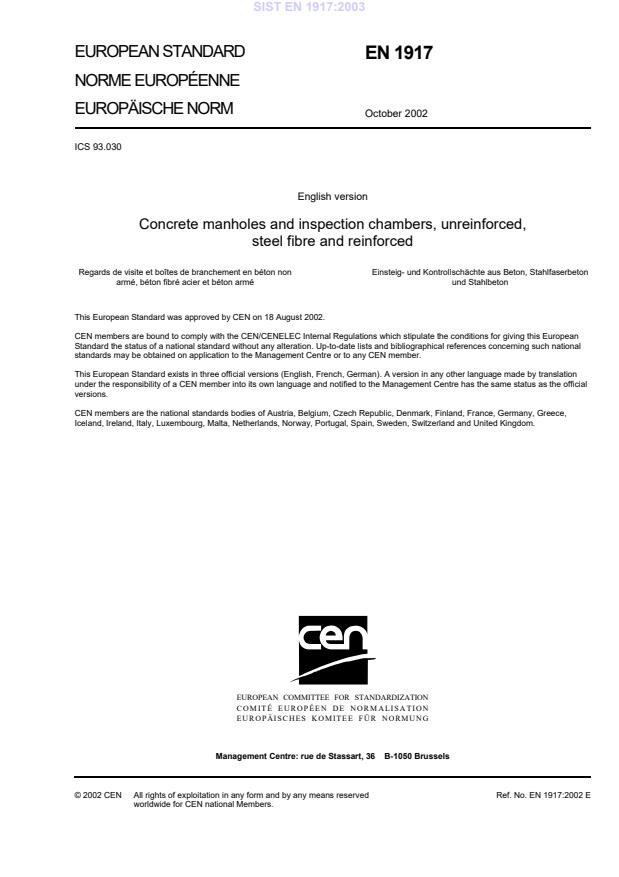
EUROPEAN STANDARDNORME EUROPÉENNEEUROPÄISCHE NORMEN 1917October 2002ICS 93.030English versionConcrete manholes and inspection chambers, unreinforced,steel fibre and reinforcedRegards de visite et boîtes de branchement en béton nonarmé, béton fibré acier et béton arméEinsteig- und Kontrollschächte aus Beton, Stahlfaserbetonund StahlbetonThis European Standard was approved by CEN on 18 August 2002.CEN members are bound to comply with the CEN/CENELEC Internal Regulations which stipulate the conditions for giving this EuropeanStandard the status of a national standard without any alteration. Up-to-date lists and bibliographical references concerning such nationalstandards may be obtained on application to the Management Centre or to any CEN member.This European Standard exists in three official versions (English, French, German). A version in any other language made by translationunder the responsibility of a CEN member into its own language and notified to the Management Centre has the same status as the officialversions.CEN members are the national standards bodies of Austria, Belgium, Czech Republic, Denmark, Finland, France, Germany, Greece,Iceland, Ireland, Italy, Luxembourg, Malta, Netherlands, Norway, Portugal, Spain, Sweden, Switzerland and United Kingdom.EUROPEAN COMMITTEE FOR STANDARDIZATIONCOMITÉ EUROPÉEN DE NORMALISATIONEUROPÄISCHES KOMITEE FÜR NORMUNGManagement Centre: rue de Stassart, 36
B-1050 Brussels© 2002 CENAll rights of exploitation in any form and by any means reservedworldwide for CEN national Members.Ref. No. EN 1917:2002 ESIST EN 1917:2003
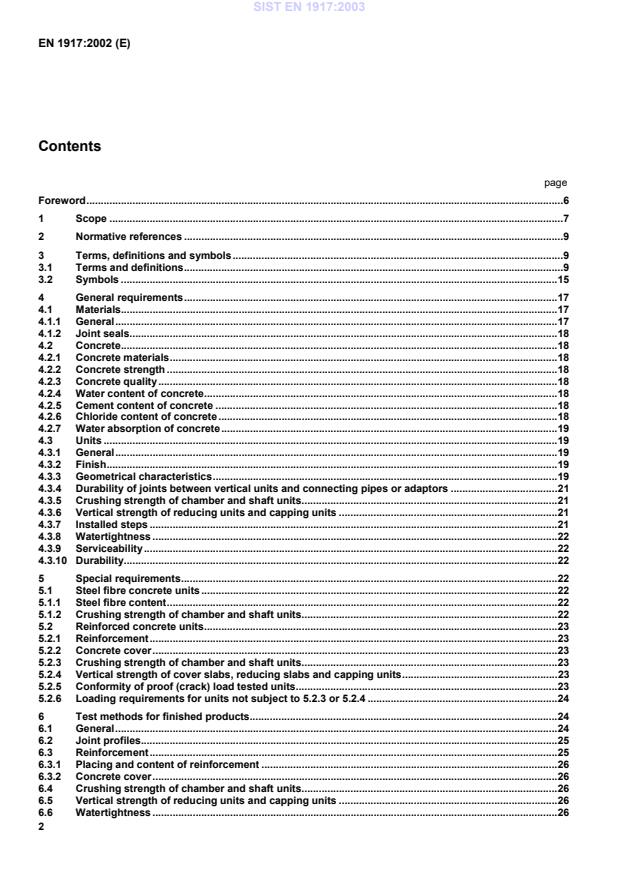
Test method for crushing strength of chamber and shaft units.29A.1Principle.29A.2Apparatus.29A.3Preparation.29A.4Procedure.29A.4.1Horizontal arrangement.29A.4.2Vertical arrangement.30A.4.3General.32A.5Expression of results.32Annex B (normative)
Test methods for vertical strength of reducing units and capping units.33B.1Principle.33B.2Apparatus.33B.3Preparation.33B.4Procedure.33B.4.1Unreinforced and steel fibre concrete units.33B.4.2Reinforced concrete units.33B.5Expression of results.36B.5.1Vertical crushing load tests.36B.5.2Vertical proof load tests.36Annex C (normative)
Test methods for watertightness.37C.1Principle.37C.2Apparatus.37C.3Preparation.37C.4Procedure (vertical unit hydrostatic test - routine and initial type tests).37C.5Procedure (joint assembly test).37C.6Alternative procedure for assembled structures.38C.7Procedure (joint between a vertical unit and a connecting pipe or adaptor).38C.7.1General.38C.7.2Watertightness during angular deflection.38C.7.3Watertightness under shear load.39C.7.4Watertightness during angular deflection under shear load.39C.8Expression of results.40Annex D (normative)
Test method for water absorption.41D.1Principle.41D.2Sample.41D.3Apparatus.41D.4Procedure.41D.4.1Determination of mass of immersed sample m1.41D.4.2Determination of mass of dried sample m2.41D.5Expression of results.42Annex E (normative)
Test methods for installed steps.43E.1Principle.43E.2Apparatus.43E.2.1Vertical loading test.43E.2.2Horizontal pull-out test.43SIST EN 1917:2003
Manufacturer's quality assurance system.45F.1Organization.45F.1.1Responsibility and authority.45F.1.2Management representative for factory production control.45F.1.3Management review.45F.1.4Factory documents.45F.2Factory production control system.46F.3Inspection and testing.46F.3.1General.46F.3.2Inspection and test status.46F.3.3Testing.46F.3.4Inspection and test records.46F.3.5Complaints.46F.4Action required in the case of defectives.47F.4.1Unsatisfactory results.47F.4.2Defectives.47F.4.3Purchaser information.47F.5Handling, storage, packing and delivery of units.47F.5.1General.47F.5.2Handling.47F.5.3Storage.47F.5.4Packing and marking.47F.5.5Traceability.47F.6Training and personnel.47F.7Materials control.48F.8Equipment control.50F.9Process control.51F.10Control of laboratory equipment.52Annex G (normative)
Sampling procedures for inspection of finished products.53Annex H (normative)
Sampling procedures for continuous inspection of crushing strength, verticalstrength and watertightness (vertical unit hydrostatic).55H.1Inspection rates and interpretation of results.55H.1.1Inspection rates.55H.1.2Interpretation of results.55H.2Operating of switching rules.55H.2.1Tightened to normal inspection.55H.2.2Discontinuation of inspection.55H.2.3Normal to reduced inspection.56H.2.4Reduced to normal inspection.56H.2.5Normal to tightened inspection.56H.3Tightened, normal and reduced inspection.56H.3.1Tightened inspection.56H.3.2Normal inspection.56H.3.3Reduced inspection.58Reduced inspection corresponds to half the sampling rate of normal inspection.58H.3.4Examples.58H.4Acceptability determination.60H.4.1Inspection on the basis of individual assessments.60H.4.2Inspection of crushing strength on the basis of statistical assessment.63Annex I (normative)
Tasks for a product certification body.66I.1Initial inspection of factory and factory production control.66I.2Evaluation and approval of initial type testing of units.66SIST EN 1917:2003
Procedure for unreinforced concrete chamber and shaft units where routine(continuous) inspection of crushing strength is primarily to minimum crushing load.68Annex ZA (informative)
Clauses of this European Standard addressing essential requirements orother provisions of EU Directives.70ZA.1Scope and relevant characteristics.70ZA.2Procedure(s) for the attestation of conformity of concrete manholes and inspection chambers.71ZA.2.1System of attestation of conformity.71ZA.2.2Declaration of conformity.72ZA.3 CE marking.72Bibliography.75SIST EN 1917:2003
...