


EN 14385:2024
(Main)Stationary source emissions - Determination of the total emission of As, Cd, Cr, Co, Cu, Mn, Ni, Pb, Sb, Tl and V
Stationary source emissions - Determination of the total emission of As, Cd, Cr, Co, Cu, Mn, Ni, Pb, Sb, Tl and V
This document specifies a manual reference method for the determination of the mass concentration of specific elements in stationary source emissions. The method is applicable to each of the specific elements in the concentration range of 0,005 mg/m3 to 5 mg/m3.
This document has been validated for the determination of the mass concentration of metals in incineration exhaust gases - applying the performance criteria stated in Clause 9 - for the following elements:
- arsenic (As), cadmium (Cd), chromium (Cr), cobalt (Co), copper (Cu), manganese (Mn), nickel (Ni), lead (Pb), antimony (Sb), thallium (Tl), and vanadium (V) and their compounds.
The document can be used to determine metals other than those listed above (for example, selenium (Se) (ISO 17211), tellurium (Te), beryllium (Be), tin (Sn) and zinc (Zn)).
NOTE 1 These other metals mentioned above are commonly required by National Regulations, but this document currently has not yet been validated for these metals.
The document was validated for waste incinerators, but it is also applicable to other industrial processes, the practical experience shows that it can be applied over wide concentration ranges and various emission sources.
If mercury is intended to be determined as well, this can be sampled in a side stream arrangement of the sampling train (EN 13211) [5].
NOTE 2 This document has been validated with the described materials, equipment, sampling, and digestion performances etc., followed by analyses with atomic absorption spectroscopy (AAS) and inductively coupled plasma optical emission spectroscopy (ICP-OES,) or inductively coupled mass spectrometry (ICP-MS). This does not exclude the use of other types of equipment or analyses that meet the requirements and have been proven to be equivalent to the described European Standard.
Emissionen aus stationären Quellen - Bestimmung der Gesamtemission von As, Cd, Cr, Co, Cu, Mn, Ni, Pb, Sb, Tl und V
Dieses Dokument legt ein manuelles Referenzmessverfahren zur Bestimmung der Massenkonzentration bestimmter Elemente in den Emissionen aus stationären Quellen fest. Das Verfahren ist für jedes der zu bestimmenden Elemente im Konzentrationsbereich von 0,005 mg/m3 bis 5 mg/m3 anwendbar.
Dieses Dokument wurde zur Bestimmung der Massenkonzentrationen von Metallen in Abgasen von Verbrennungsanlagen unter Anwendung der in Abschnitt 9 festgelegten Leistungskriterien für die folgenden Elemente validiert:
Arsen (As), Cadmium (Cd), Chrom (Cr), Kobalt (Co), Kupfer (Cu), Mangan (Mn), Nickel (Ni), Blei (Pb), Antimon (Sb), Thallium (Tl), Vanadium (V) und deren Verbindungen.
Dieses Dokument kann zur Bestimmung anderer als der oben genannten Metalle verwendet werden (z. B. Selen (Se) (ISO 17211), Tellur (Te), Beryllium (Be), Zinn (Sn) und Zink (Zn)).
ANMERKUNG 1 Diese anderen oben aufgeführten Metalle werden in der Regel von nationalen Vorschriften vorgeschrieben, allerdings wurde dieses Dokument derzeit noch nicht für diese Metalle validiert.
Dieses Dokument wurde für Müllverbrennungsanlagen validiert, ist aber auch auf andere industrielle Prozesse anwendbar. Die praktische Erfahrung zeigt, dass es auf eine Vielzahl von Konzentrationsbereichen und verschiedene Emissionsquellen angewendet werden kann.
Falls es beabsichtigt ist, Quecksilber ebenfalls mitzubestimmen, so kann dies durch die Probenahme im Teilstromverfahren erfolgen (EN 13211) [5].
ANMERKUNG 2 Dieses Dokument wurde mit den beschriebenen Materialien, Ausrüstungen, Probenahme- und Aufschlussverfahren usw. und den anschließend durchgeführten Analysen mit Atomabsorptionsspektroskopie (AAS) und induktiv gekoppelter Plasma-Emissionsspektroskopie (ICP OES) oder induktiv gekoppelter Massenspektrometrie (ICP MS) validiert. Dies schließt nicht die Verwendung anderer Geräte, Analysen, Materialien und Vorgehensweisen aus, die die Anforderungen erfüllen und deren Äquivalenz zu den beschriebenen Vorgehensweisen in dieser Europäischen Norm nachgewiesen ist.
Émissions de sources fixes - Détermination de l'émission totale de As, Cd, Cr, Co, Cu, Mn, Ni, Pb, Sb, TI et V
Le présent document décrit une méthode de référence manuelle de détermination de la concentration massique d’éléments spécifiques dans les émissions de sources fixes. Cette méthode est applicable à chacun de ces éléments dans la plage de concentration comprise entre 0,005 mg/m3 et 5 mg/m3.
Le présent document a été validé pour la détermination de la concentration massique des métaux dans les effluents gazeux d’incinération, en appliquant les critères de performance énoncés à l’Article 9, pour les éléments suivants :
— arsenic (As), cadmium (Cd), chrome (Cr), cobalt (Co), cuivre (Cu), manganèse (Mn), nickel (Ni), plomb (Pb), antimoine (Sb), thallium (Tl) et vanadium (V) et leurs composés.
Le document peut être utilisé pour doser des métaux autres que ceux listés ci-dessus (par exemple, sélénium (Se) (ISO 17211), tellure (Te), béryllium (Be), étain (Sn) et zinc (Zn)).
NOTE 1 Ces autres métaux susmentionnés sont couramment exigés par les réglementations nationales,
mais à l’heure actuelle, le présent document n’a pas encore été validé pour ces métaux.
Le document a été validé pour les incinérateurs de déchets, mais il est aussi applicable à d’autres procédés industriels. L’expérience pratique révèle qu’il peut être appliqué sur de larges plages de concentration et diverses sources d’émission.
S’il est prévu de déterminer également le mercure, il est possible d’effectuer le prélèvement avec une ligne secondaire du système de prélèvement (EN 13211) [5].
NOTE 2 Le présent document a été validé sur la base des performances des matériels, de l’équipement, du prélèvement et de la minéralisation décrits, etc. suivis des analyses par spectroscopie d’absorption atomique (AAS) et spectroscopie d’émission optique à plasma à couplage inductif (ICP-OES,) ou spectrométrie de masse à couplage inductif (ICP-MS). Ceci n’exclut pas l’utilisation d’autres types d’équipements ou d’analyses qui répondent aux exigences fixées dans la présente Norme européenne et dont l’équivalence a été prouvée.
Emisije nepremičnih virov - Določanje celotne emisije As, Cd, Cr, Co, Cu, Mn, Ni, Pb, Sb, TI in V
Ta dokument določa ročno referenčno metodo za določanje masne koncentracije določenih elementov v emisijah nepremičnih virov. Metoda se uporablja za vsakega od določenih elementov v območju koncentracij od 0,005 mg/m3 do 5 mg/m3.
Ta dokument je bil potrjen za določanje masne koncentracije kovin v odpadnih plinih iz sežigalnic – z uporabo meril zmogljivosti, navedenih v točki 9 – za naslednje elemente:
– arzen (As), kadmij (Cd), krom (Cr), kobalt (Co), baker (Cu), mangan (Mn), nikelj (Ni), svinec (Pb), antimon (Sb), talij (Tl) in vanadij (V) ter njihove spojine.
Dokument je mogoče uporabljati za določanje kovin, ki niso navedene zgoraj (npr. selen (Se) (ISO 17211), telur (Te), berilij (Be), kositer (Sn) in cink (Zn)).
OPOMBA 1: Zgoraj omenjene kovine pogosto zahtevajo nacionalni predpisi, vendar ta dokument trenutno še ni potrjen za te kovine.
Dokument je bil potrjen za sežigalnice odpadkov, vendar ga je mogoče uporabljati tudi v drugih industrijskih procesih; izkušnje v praksi kažejo, da ga je mogoče uporabljati v širokem območju koncentracij in za različne vire emisij.
Če je načrtovana tudi določitev živega srebra, je mogoče vzorčenje izvesti v okviru običajnega vzorčnega niza (EN 13211) [5].
OPOMBA 2: Ta dokument je bil potrjen z opisanimi materiali, opremo, vzorčenjem in zmogljivostmi razklopa itd. ter z naknadnimi analizami z atomsko absorpcijsko spektroskopijo (AAS) in optično emisijsko spektroskopijo z induktivno sklopljeno plazmo (ICP-OES) ali masno spektrometrijo z induktivno sklopljeno plazmo (ICP-MS). To ne izključuje uporabe drugih vrst opreme ali analiz, ki izpolnjujejo zahteve in so dokazano enakovredne opisanemu evropskemu standardu.
General Information
- Status
- Published
- Publication Date
- 17-Dec-2024
- Technical Committee
- CEN/TC 264 - Air quality
- Drafting Committee
- CEN/TC 264/WG 8 - Measurement of total mercury emissions
- Current Stage
- 6060 - Definitive text made available (DAV) - Publishing
- Start Date
- 18-Dec-2024
- Due Date
- 23-Jan-2025
- Completion Date
- 18-Dec-2024
- Directive
- 2001/997 - Incineration of waste
Relations
- Effective Date
- 28-Jan-2023
Overview
EN 14385:2024 - Stationary source emissions - Determination of the total emission of As, Cd, Cr, Co, Cu, Mn, Ni, Pb, Sb, Tl and V - is a CEN manual reference method for measuring the mass concentration of selected metals in stationary source (stack) emissions. The method covers measurements across the concentration range 0.005 mg/m3 to 5 mg/m3 and has been validated specifically for waste incineration exhaust gases, although it is applicable to other industrial processes and a wide range of emission sources.
Key topics and requirements
- Target metals: arsenic (As), cadmium (Cd), chromium (Cr), cobalt (Co), copper (Cu), manganese (Mn), nickel (Ni), lead (Pb), antimony (Sb), thallium (Tl), vanadium (V). The method can be applied to other metals (e.g., Se, Te, Be, Sn, Zn) but these have not been validated in this standard.
- Sampling method: manual, isokinetic sampling train with absorbers and filter collection. Guidance on equipment, leak testing, cleaning and pre-treatment is included.
- Analytical techniques: validated with AAS, ICP-OES, and ICP-MS; other analytical equipment may be used if proven equivalent to the standard’s performance criteria.
- Quality assurance: performance criteria, field blanks, sample storage, pre-tests, digestion options (including HF-free alternative), and criteria for absorption efficiency.
- Uncertainty and detection limits: Annex F provides example uncertainty budgets; Annex G defines procedures for determining and reporting limit of detection (LoD) and limit of quantification (LoQ).
- Reporting: standardized expression of results, handling of data when using wet gas meters or side-stream sampling, and required contents for test reports.
Applications and users
EN 14385:2024 is intended for:
- Environmental laboratories performing stack testing for metals determination.
- Regulatory agencies and inspectors enforcing air quality and emissions limits.
- Waste incinerator operators and industrial facilities performing compliance monitoring or permit testing.
- Third‑party emissions testing contractors and consultants conducting stack sampling, trend analysis, and performance verification.
Typical uses include regulatory compliance testing, permit applications, emissions inventories, and long‑term monitoring of metal pollutant releases.
Related standards
- EN 13211 - sampling for mercury (recommended side‑stream arrangement if mercury is also required).
- ISO 17211 - methods for selenium (Se) determination referenced for related metals.
- Refer to Annex H in EN 14385 for an HF‑free filter digestion alternative and Annex B for isokinetic equipment/leak tests.
EN 14385:2024 provides a robust, validated reference method for accurate measurement of trace metals in stationary source emissions, supporting compliance, reporting, and environmental protection objectives.

Frequently Asked Questions
EN 14385:2024 is a standard published by the European Committee for Standardization (CEN). Its full title is "Stationary source emissions - Determination of the total emission of As, Cd, Cr, Co, Cu, Mn, Ni, Pb, Sb, Tl and V". This standard covers: This document specifies a manual reference method for the determination of the mass concentration of specific elements in stationary source emissions. The method is applicable to each of the specific elements in the concentration range of 0,005 mg/m3 to 5 mg/m3. This document has been validated for the determination of the mass concentration of metals in incineration exhaust gases - applying the performance criteria stated in Clause 9 - for the following elements: - arsenic (As), cadmium (Cd), chromium (Cr), cobalt (Co), copper (Cu), manganese (Mn), nickel (Ni), lead (Pb), antimony (Sb), thallium (Tl), and vanadium (V) and their compounds. The document can be used to determine metals other than those listed above (for example, selenium (Se) (ISO 17211), tellurium (Te), beryllium (Be), tin (Sn) and zinc (Zn)). NOTE 1 These other metals mentioned above are commonly required by National Regulations, but this document currently has not yet been validated for these metals. The document was validated for waste incinerators, but it is also applicable to other industrial processes, the practical experience shows that it can be applied over wide concentration ranges and various emission sources. If mercury is intended to be determined as well, this can be sampled in a side stream arrangement of the sampling train (EN 13211) [5]. NOTE 2 This document has been validated with the described materials, equipment, sampling, and digestion performances etc., followed by analyses with atomic absorption spectroscopy (AAS) and inductively coupled plasma optical emission spectroscopy (ICP-OES,) or inductively coupled mass spectrometry (ICP-MS). This does not exclude the use of other types of equipment or analyses that meet the requirements and have been proven to be equivalent to the described European Standard.
This document specifies a manual reference method for the determination of the mass concentration of specific elements in stationary source emissions. The method is applicable to each of the specific elements in the concentration range of 0,005 mg/m3 to 5 mg/m3. This document has been validated for the determination of the mass concentration of metals in incineration exhaust gases - applying the performance criteria stated in Clause 9 - for the following elements: - arsenic (As), cadmium (Cd), chromium (Cr), cobalt (Co), copper (Cu), manganese (Mn), nickel (Ni), lead (Pb), antimony (Sb), thallium (Tl), and vanadium (V) and their compounds. The document can be used to determine metals other than those listed above (for example, selenium (Se) (ISO 17211), tellurium (Te), beryllium (Be), tin (Sn) and zinc (Zn)). NOTE 1 These other metals mentioned above are commonly required by National Regulations, but this document currently has not yet been validated for these metals. The document was validated for waste incinerators, but it is also applicable to other industrial processes, the practical experience shows that it can be applied over wide concentration ranges and various emission sources. If mercury is intended to be determined as well, this can be sampled in a side stream arrangement of the sampling train (EN 13211) [5]. NOTE 2 This document has been validated with the described materials, equipment, sampling, and digestion performances etc., followed by analyses with atomic absorption spectroscopy (AAS) and inductively coupled plasma optical emission spectroscopy (ICP-OES,) or inductively coupled mass spectrometry (ICP-MS). This does not exclude the use of other types of equipment or analyses that meet the requirements and have been proven to be equivalent to the described European Standard.
EN 14385:2024 is classified under the following ICS (International Classification for Standards) categories: 13.040.40 - Stationary source emissions. The ICS classification helps identify the subject area and facilitates finding related standards.
EN 14385:2024 has the following relationships with other standards: It is inter standard links to EN 14385:2004. Understanding these relationships helps ensure you are using the most current and applicable version of the standard.
EN 14385:2024 is associated with the following European legislation: EU Directives/Regulations: 2001/997, 89/369/EEC, 89/429/EEC, 94/67/EC; Standardization Mandates: M/232. When a standard is cited in the Official Journal of the European Union, products manufactured in conformity with it benefit from a presumption of conformity with the essential requirements of the corresponding EU directive or regulation.
You can purchase EN 14385:2024 directly from iTeh Standards. The document is available in PDF format and is delivered instantly after payment. Add the standard to your cart and complete the secure checkout process. iTeh Standards is an authorized distributor of CEN standards.
Standards Content (Sample)
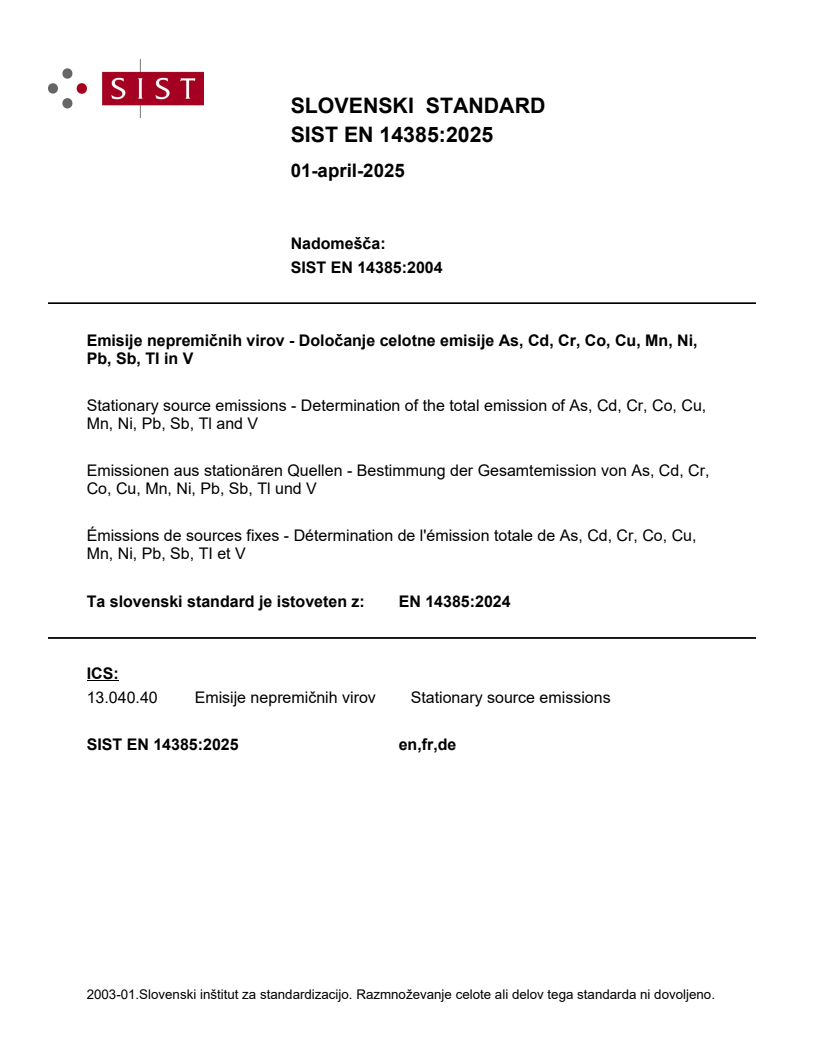
SLOVENSKI STANDARD
01-april-2025
Nadomešča:
SIST EN 14385:2004
Emisije nepremičnih virov - Določanje celotne emisije As, Cd, Cr, Co, Cu, Mn, Ni,
Pb, Sb, TI in V
Stationary source emissions - Determination of the total emission of As, Cd, Cr, Co, Cu,
Mn, Ni, Pb, Sb, Tl and V
Emissionen aus stationären Quellen - Bestimmung der Gesamtemission von As, Cd, Cr,
Co, Cu, Mn, Ni, Pb, Sb, Tl und V
Émissions de sources fixes - Détermination de l'émission totale de As, Cd, Cr, Co, Cu,
Mn, Ni, Pb, Sb, TI et V
Ta slovenski standard je istoveten z: EN 14385:2024
ICS:
13.040.40 Emisije nepremičnih virov Stationary source emissions
2003-01.Slovenski inštitut za standardizacijo. Razmnoževanje celote ali delov tega standarda ni dovoljeno.
EN 14385
EUROPEAN STANDARD
NORME EUROPÉENNE
December 2024
EUROPÄISCHE NORM
ICS 13.040.40 Supersedes EN 14385:2004
English Version
Stationary source emissions - Determination of the total
emission of As, Cd, Cr, Co, Cu, Mn, Ni, Pb, Sb, Tl and V
Émissions de sources fixes - Détermination de Emissionen aus stationären Quellen - Bestimmung der
l'émission totale de As, Cd, Cr, Co, Cu, Mn, Ni, Pb, Sb, TI Gesamtemission von As, Cd, Cr, Co, Cu, Mn, Ni, Pb, Sb, Tl
et V und V
This European Standard was approved by CEN on 25 November 2024.
CEN members are bound to comply with the CEN/CENELEC Internal Regulations which stipulate the conditions for giving this
European Standard the status of a national standard without any alteration. Up-to-date lists and bibliographical references
concerning such national standards may be obtained on application to the CEN-CENELEC Management Centre or to any CEN
member.
This European Standard exists in three official versions (English, French, German). A version in any other language made by
translation under the responsibility of a CEN member into its own language and notified to the CEN-CENELEC Management
Centre has the same status as the official versions.
CEN members are the national standards bodies of Austria, Belgium, Bulgaria, Croatia, Cyprus, Czech Republic, Denmark, Estonia,
Finland, France, Germany, Greece, Hungary, Iceland, Ireland, Italy, Latvia, Lithuania, Luxembourg, Malta, Netherlands, Norway,
Poland, Portugal, Republic of North Macedonia, Romania, Serbia, Slovakia, Slovenia, Spain, Sweden, Switzerland, Türkiye and
United Kingdom.
EUROPEAN COMMITTEE FOR STANDARDIZATION
COMITÉ EUROPÉEN DE NORMALISATION
EUROPÄISCHES KOMITEE FÜR NORMUNG
CEN-CENELEC Management Centre: Rue de la Science 23, B-1040 Brussels
© 2024 CEN All rights of exploitation in any form and by any means reserved Ref. No. EN 14385:2024 E
worldwide for CEN national Members.
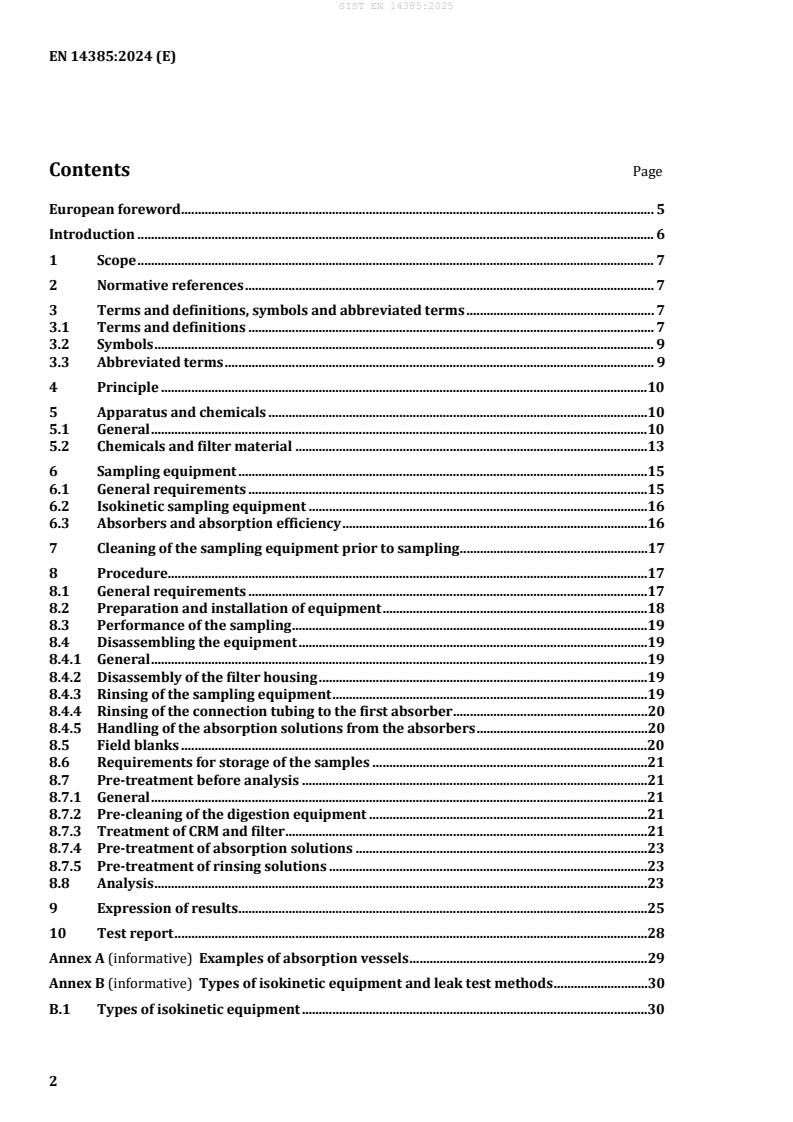
Contents Page
European foreword . 5
Introduction . 6
1 Scope . 7
2 Normative references . 7
3 Terms and definitions, symbols and abbreviated terms . 7
3.1 Terms and definitions . 7
3.2 Symbols . 9
3.3 Abbreviated terms . 9
4 Principle .10
5 Apparatus and chemicals .10
5.1 General .10
5.2 Chemicals and filter material .13
6 Sampling equipment .15
6.1 General requirements .15
6.2 Isokinetic sampling equipment .16
6.3 Absorbers and absorption efficiency .16
7 Cleaning of the sampling equipment prior to sampling .17
8 Procedure.17
8.1 General requirements .17
8.2 Preparation and installation of equipment .18
8.3 Performance of the sampling .19
8.4 Disassembling the equipment .19
8.4.1 General .19
8.4.2 Disassembly of the filter housing .19
8.4.3 Rinsing of the sampling equipment .19
8.4.4 Rinsing of the connection tubing to the first absorber .20
8.4.5 Handling of the absorption solutions from the absorbers .20
8.5 Field blanks .20
8.6 Requirements for storage of the samples .21
8.7 Pre-treatment before analysis .21
8.7.1 General .21
8.7.2 Pre-cleaning of the digestion equipment .21
8.7.3 Treatment of CRM and filter .21
8.7.4 Pre-treatment of absorption solutions .23
8.7.5 Pre-treatment of rinsing solutions .23
8.8 Analysis .23
9 Expression of results .25
10 Test report .28
Annex A (informative) Examples of absorption vessels .29
Annex B (informative) Types of isokinetic equipment and leak test methods .30
B.1 Types of isokinetic equipment .30
B.2 Leak test methods. 31
Annex C (informative) Pre-cleaning procedures of the sampling equipment at the laboratory
and determination of the absorption efficiency . 34
C.1 General . 34
C.2 Chemicals . 34
C.2.1 General . 34
C.2.2 Rinsing solution . 34
C.2.3 Diluted aqua regia . 34
C.2.4 Laboratory cleaning solution . 34
C.2.5 Dilute hydrogen peroxide . 34
C.2.6 Rinsing acid . 34
C.3 Equipment . 34
C.3.1 Procedure A . 34
C.3.2 Procedure B . 35
C.3.3 Procedure C. 35
C.4 Absorption and storage bottles . 35
C.4.1 Procedure A . 35
C.4.2 Procedure B . 35
C.4.3 Procedure C. 35
C.4.4 Procedure D . 35
Annex D (informative) Measurement results of two field tests . 36
D.1 General . 36
D.2 Absorption efficiency . 36
D.3 Repeatability . 36
D.4 Reproducibility . 38
Annex E (informative) Pre-tests for the determination of the efficiency, of the digestion
and of the performance of the analytical procedures . 40
E.1 Analytical efficiencies of reference materials . 40
E.2 Comments of field study data . 42
E.2.1 General . 42
E.2.2 Pre-treatment and analysis . 43
E.2.3 Absorption efficiency . 43
E.2.4 Detection limit . 43
E.2.5 Repeatability and reproducibility . 43
Annex F (informative) Example of assessment of compliance of the standard reference
method . 44
F.1 Introduction . 44
F.2 Elements required for the uncertainty determinations - Model equation .44
F.3 Example of an uncertainty calculation in case of side-stream sampling system .44
F.3.1 General .44
F.3.2 Determination of the model equations .45
F.3.3 Equations for calculating combined uncertainties of gas volumes sampled in
standardized conditions .47
F.3.4 Equations for calculating combined uncertainties of concentrations .48
F.3.5 Quantification of standard uncertainty components .51
F.4 Estimation of measurement uncertainty in case of main-stream sampling system .64
F.4.1 General .64
F.4.2 Determination of the model equations .64
F.4.3 Equations for calculating combined uncertainties of gas volumes sampled in
standardized conditions .65
F.4.4 Equations for calculating combined uncertainties of concentrations .65
Annex G (normative) Determination and reporting of limits of detection and quantification
....................................................................................................................................................................68
G.1 Introduction to Limit of Detection and Quantification .68
G.2 Limit of detection (LoD) .69
G.3 Limit of quantification (LoQ) .69
G.4 Rules to be adopted when summing the various parts of a metals sample train where
the levels are at LoQ or below .69
Annex H (informative) Alternative digestion method for the filters by use of an HF-free
digestion Mixture [3],[4].73
H.1 Background to alternative method .73
H.2 Reagents .73
H.3 Digestion of filter .73
H.4 Analysis .73
Bibliography .74
European foreword
This document (EN 14385:2024) has been prepared by Technical Committee CEN/TC 264 “Air quality”,
the secretariat of which is held by DIN.
This European Standard shall be given the status of a national standard, either by publication of an
identical text or by endorsement, at the latest by June 2025, and conflicting national standards shall be
withdrawn at the latest by June 2025.
Attention is drawn to the possibility that some of the elements of this document may be the subject of
patent rights. CEN shall not be held responsible for identifying any or all such patent rights.
This document supersedes EN 14385:2004.
The main changes compared to the previous edition are listed below:
3 3
— in the Scope: Range of specific elements widened from 0,5 mg/m to 5 mg/m ;
— in the Scope: Table 1 Exhaust Gas matrix composition deleted;
— in Clause 3: Definitions clarified and widened;
— in Clause 3: Elements split into Groups A and B for clarity;
— in 5.1.2.7.2: Correction using a wet gas meter has been clarified;
— in Clause 5: Definitions of Chemicals and Quality have been clarified;
— in Clause 5: Leak check methods has been moved to Annex B;
— in Clause 8: Treatment of Data from field blanks has been clarified and made explicit;
— in Clause 9: Expression of results has been clarified and treatment of data where a wet gas meter has
been used has been expanded;
— in Annex F: Example of an Uncertainty Budget Assessment of the Standard has been added;
— in Annex G: Determination and reporting of limits of detection and quantification added and
information on how to deal with elements below the level of quantification;
— in Annex H: Alternative digestion method for filters by use of an HF-free digestion Mixture.
This document has been prepared under a standardization request addressed to CEN by the European
Commission. The Standing Committee of the EFTA States subsequently approves these requests for its
Member States.
Any feedback and questions on this document should be directed to the users’ national standards body.
A complete listing of these bodies can be found on the CEN website.
According to the CEN-CENELEC Internal Regulations, the national standards organisations of the
following countries are bound to implement this European Standard: Austria, Belgium, Bulgaria, Croatia,
Cyprus, Czech Republic, Denmark, Estonia, Finland, France, Germany, Greece, Hungary, Iceland, Ireland,
Italy, Latvia, Lithuania, Luxembourg, Malta, Netherlands, Norway, Poland, Portugal, Republic of North
Macedonia, Romania, Serbia, Slovakia, Slovenia, Spain, Sweden, Switzerland, Türkiye and the United
Kingdom.
Introduction
This document specifies a method for the determination of the total mass concentration of specific
elements in waste flue gases. The document was validated for waste incinerators but is also applicable to
other industrial processes. During the establishment of this document, field tests were performed in
order to determine some performance characteristics. These tests showed that in the “gaseous” phase
most of the elements cannot be determined quantitatively in the absorption solutions. Therefore, the
results of this method are expressed as the total element mass concentrations (i.e. sum of gaseous,
dissolved in droplets, solid and adsorbed on particles). This means that when the specific elements are
mainly in the solid phase no significant losses (biases) should occur due to the poor absorption efficiency
for the elements in the gaseous phase. The quality check requirement for approval of the results is the
mass in the last absorber expressed as a minimum percentage of the total mass; this minimum is set at a
high level, based on the experiences of the absorption efficiencies in the field tests.
1 Scope
This document specifies a manual reference method for the determination of the mass concentration of
specific elements in stationary source emissions. The method is applicable to each of the specific elements
3 3
in the concentration range of 0,005 mg/m to 5 mg/m .
This document has been validated for the determination of the mass concentration of metals in
incineration exhaust gases – applying the performance criteria stated in Clause 9 – for the following
elements:
— arsenic (As), cadmium (Cd), chromium (Cr), cobalt (Co), copper (Cu), manganese (Mn), nickel (Ni),
lead (Pb), antimony (Sb), thallium (Tl), and vanadium (V) and their compounds.
The document can be used to determine metals other than those listed above (for example, selenium (Se)
(ISO 17211), tellurium (Te), beryllium (Be), tin (Sn) and zinc (Zn)).
NOTE 1 These other metals mentioned above are commonly required by National Regulations, but this
document currently has not yet been validated for these metals.
The document was validated for waste incinerators, but it is also applicable to other industrial processes,
the practical experience shows that it can be applied over wide concentration ranges and various
emission sources.
If mercury is intended to be determined as well, this can be sampled in a side stream arrangement of the
sampling train (EN 13211) [5].
NOTE 2 This document has been validated with the described materials, equipment, sampling, and digestion
performances etc., followed by analyses with atomic absorption spectroscopy (AAS) and inductively coupled plasma
optical emission spectroscopy (ICP-OES,) or inductively coupled mass spectrometry (ICP-MS). This does not exclude
the use of other types of equipment or analyses that meet the requirements and have been proven to be equivalent
to the described European Standard.
2 Normative references
The following documents are referred to in the text in such a way that some or all of their content
constitutes requirements of this document. For dated references, only the edition cited applies. For
undated references, the latest edition of the referenced document (including any amendments) applies.
EN 13284-1:2017, Stationary source emissions - Determination of low range mass concentration of dust -
Part 1: Manual gravimetric method
EN 15259, Air quality - Measurement of stationary source emissions - Requirements for measurement
sections and sites and for the measurement objective, plan and report
3 Terms and definitions, symbols and abbreviated terms
3.1 Terms and definitions
For the purposes of this document, the following terms and definitions apply.
3.1.1
absorber
device in which specific elements are absorbed into an absorption liquid
3.1.2
chemical blank
solution used to check the purity of the chemicals employed by the laboratory
Note 1 to entry: The chemical blank value is determined by analysing the solution (5.2.8) used for the absorption
of the specific metal elements, plus any reagents that are added to the solution before analysis including the rinsing
solution (5.2.11) if this is used at any stage in the sampling and analysis procedure. This chemical blank is to be used
as a blank for all digestions using reagents all from the same batch. Furthermore, this chemical blank should be the
same as the solutions used for dilution of laboratory standards, etc. It represents the potential background elements
arising from the chemicals used in the analysis. This chemical blank can be subtracted if required from the analysis,
if necessary, by the analytical laboratory. However, where it is subtracted this should be identified in the analytical
report.
3.1.3
filter blank
value determined for each specific element by treatment and analysis of an unused filter which has been
taken from the same batch as the sample filters
Note 1 to entry: Chemical blanks and filter blanks may be subtracted from the analysis and if the level is then below
zero the level will be reported as the level of quantification. If chemical or filter blanks are repeatedly high requiring
subtraction, then an investigation as to the quality of the reagents or filters should be conducted to ensure that
subtraction of the chemical or filter blank is not masking the use of poor quality of reagents or filters.
3.1.4
field blank
sample of filter, absorption and rinsing solutions taken at site without sampling gas and analysed as a
normal sample
Note 1 to entry: The field blank is not to be subtracted from the samples and shall be reported separately.
Note 2 to entry: An explanation is provided in 8.5.
3.1.5
filtered material
material collected on the filter
3.1.6
filter passing material
component passing through the filter and recovered in the rest of the absorption system
3.1.7
fritted gas distributor
part of the absorber where the gas stream is distributed into the absorption liquid
3.1.8
Group A elements
arsenic (As), chromium (Cr), cobalt (Co), copper (Cu), manganese (Mn), nickel (Ni), lead (Pb), antimony
(Sb), vanadium (V) and their compounds
3.1.9
Group B elements
cadmium (Cd) and thallium (Tl) and their compounds
3.1.10
sampling
process consisting of the collection of gas pollutants from process gases or the withdrawal
or isolation of a fractional part of a larger volume of process gases
Note 1 to entry: To ensure sampling is representative the isokinetic sampling procedural requirements specified
within EN 13284-1 and EN 15259 should be adopted.
3.1.11
sampling campaign
sampling at one duct or location during one site visit
3.2 Symbols
For the purposes of this document, the following symbols apply.
A Cross section area, in square metres (m )
Q Flow rate of the sampled gas, in cubic metres per hour or litres per minute (m /h or l/min)
T Temperature, in Kelvin (K)
V Gas volume dry at standard conditions, in cubic metres or litres (m or l)
L Leakage rate (volume ratio)
O Oxygen volume content of the flue gas, in percentage (%)
m Mass, in milligrams (mg)
n Number of absorption vessels
p Pressure, in kilopascals (kPa)
P Partial vapour pressure, in kilopascals (kPa)
v
C Mass concentration, e.g. in milligrams per cubic metre (mg/m ); grams per litre (g/l)
ε Absorption efficiency
w Mass fraction in percent (%)
Density, in kilograms per litre (kg/l) at 20 °C related to that of water at 4 °C
ρ
−1
ρ Specific conductivity, in micro-Siemens per metre (µSm )
κ Specific resistance, in mega-Ohm-metre (MΩm)
H Humidity, in percentage volume of gases at wet gas meter inlet
m
H Humidity, in percentage volume of gases at required reporting conditions
a
3.3 Abbreviated terms
For the purposes of this document, the following abbreviated terms apply.
CRM Certified reference material
El Specific element
ELV Emission limit value
FEP Polyperfluoroethene/polyperfluopropene
PE Polyethene
PFA Perfluoroalkoxy compounds
PP Polypropene
PTFE Polytetrafluoroethene
amb Ambient; index
ave Average
gas Gaseous; index
main Mainstream; index
side Side stream; index
mes Temperature, pressure at measuring conditions; index
b Humidity, pressure, temperature at measuring conditions; index
f Wet at standard conditions; index
sol Particle bound; index
norm Normalized to a reference dry oxygen content of x % (volume fraction); index
per Permitted; index
obs Observed; index
int Internal; index
0 Temperature at standard condition of 273 K, pressure at standard condition of 101,3 kPa,
dry volume at 273 K and 101,3 kPa; index
4 Principle
A known volume of flue gas is extracted isokinetically and representatively from a duct during a certain
period of time at a controlled flow rate following EN 13284-1. The dust in the sampled gas volume is
collected on a filter. Thereafter, the gas stream is passed through a series of absorbers containing
absorption solutions and the filter passing fractions of the specific elements are collected within these
solutions.
The filter, absorption solution and rinsing solutions are recovered for analysis.
The filter sample is digested in a closed PTFE vessel.
The absorption liquids and the rinsing solutions are prepared for analysis.
The samples are analysed and the final result is expressed as the total mass concentration for each
specific element and no distinction is made between filtered and filter passing fractions.
5 Apparatus and chemicals
5.1 General
All parts coming into contact with the sample are to be made of corrosion resistant and inert material, i.e.
borosilicate glass, quartz glass, PTFE, or titanium. As commercial titanium can contain some of the
specific elements to be determined care shall be taken to avoid contamination.
All materials should be suitable for the temperature and flue gas composition they are likely to encounter
during the sampling period and remain inert under these conditions and during recovery of the sample.
There have been reports that titanium can undergo thermal oxidation under some conditions and at
temperatures above 300 °C and where fluoride levels are > 20 ppm and hence lead to contamination
issues.
5.1.2 Apparatus for sampling
5.1.2.1 Nozzle, (see a) 1 of Figure B.1)
The diameter shall be chosen to be compatible with the required gas sampling volume flow rate; the
choice of the nozzle shall be in accordance with EN 13284-1.
5.1.2.2 Filter housing and filter support, (see a) 3 of Figure B.1)
The filter housing and filter support shall be in accordance with EN 13284-1.
5.1.2.3 Sampling probe, (see a) 2 of Figure B.1)
5.1.2.4 Absorbers
Fritted gas bubblers or impingers are to be used; for examples see Annex A. The absorbers shall be cooled
to a temperature less than or equal to 30°C to avoid excessive evaporation from the first absorption bottle
and to aid absorption efficiency. A cooling/ice bath could be used to limit the temperature of the absorber
which will improve the absorption efficiency and improve the drying of the gas stream prior to it reaching
the dryer.
5.1.2.5 Connection fittings and tubing
Ball joints and other connectors made of the materials stated in 5.1.1 are allowed. PTFE lined seals are
also allowed.
For the main-stream arrangement of the sampling equipment, the material requirements specified in
5.1.1 shall be applied from the nozzle to the last absorber; for the side-stream arrangement these
materials shall be applied from the nozzle to the T-piece and from the T-piece to the last absorber in the
side-stream sampling train.
The length of connections (such as tubing) from the sampling probe to the absorbers shall be minimized
and less than 1 m.
5.1.2.6 Suction unit
Depending on the arrangement of the equipment (see Annex B) two suction units can be required for one
sampling line.
The suction unit(s) shall be gas-tight, corrosion-proof, and capable of extracting at least the desired gas
flow rate(s) at the pressure conditions present in the flue gas duct. Wide adjustments of the sample flow
rate(s) shall be facilitated using regulating and/or by-pass valves. Shut-off valve(s) for stopping the gas
flow or back flow, due to potentially low pressures in the duct, should also be available.
If a variant of the sampling train with flow division is chosen, the volume flow rate in the secondary line
shall be taken into account in order to calculate the required volume flow rate in the main line.
NOTE Measures for the protection of the suction unit(s) such as filters, water traps, etc. can be useful.
Flow meters which are gas-tight and corrosion-proof (variable area meters, orifice plates, etc.) are
strongly recommended to check the sampling flow rate.
5.1.2.7 Gas volume metering
5.1.2.7.1 General
In accordance with EN 13284-1 two kinds of systems may be used to measure the gas volume:
— volume measurements on a dry basis;
— volume measurements on a wet basis.
5.1.2.7.2 Gas volume meter
The requirements for the flow rate measurements on a dry basis are:
— atmospheric pressure measuring device;
— condenser and/or gas drying tower providing a residual humidity less than 10 g/m at the maximum
flow rate;
— gas-tight suction device (such as compressed air ejector, pump, etc.);
NOTE 1 Gas-tightness is not necessary if the pump is positioned downstream of the metering device.
— flowmeter, in order to facilitate the flow rate adjustment, calibrated against the dry gas volume
meter;
— dry gas volume meter providing gas volume measurement shall have a maximum expanded
uncertainty of 5 % at the anticipated flow rate, incorporating the associated absolute pressure and
absolute temperature measurement uncertainties (maximum expanded uncertainty of 2,0 % each);
The requirements for the flow rate measurements on a wet basis are:
— heated tubing, in order to prevent upstream condensation of the sample gas;
— heated orifice plate or equivalent device (flow meter), shall be calibrated within 10 % maximum
expanded uncertainty of the anticipated flow rate; the uncertainty of temperature, pressure
(absolute and differential) measurement shall be less than 2 %;
— gas-tight suction device (such as compressed air ejector, pump, etc.);
NOTE 2 Gas-tightness is not necessary if the pump is positioned downstream of the metering device.
— atmospheric pressure measuring device;
— when using a wet gas volume measurement system (gas volume meter, critical orifice, etc.),
measurement of the flue gas water vapour content at the gas volume meter is required to allow the
gas wet volume to be corrected to a dry basis, see Formula (1):
𝑃𝑃−𝑃𝑃 100−𝐻𝐻
𝑣𝑣 𝑚𝑚
( )
𝑉𝑉 𝑑𝑑𝑑𝑑𝑑𝑑 =𝑉𝑉 . =𝑉𝑉 . (1)
𝑚𝑚𝑚𝑚𝑚𝑚 𝑚𝑚𝑚𝑚𝑚𝑚 𝑚𝑚𝑚𝑚𝑚𝑚
𝑃𝑃 100−𝐻𝐻
𝑎𝑎
See symbols 3.2 and abbreviations 3.3.
P is the partial vapour pressure of water in the gas meter;
v
P is the absolute pressure in the gas meter;
H is the water content of gases entering wet gas meter;
m
H is the water content at the reporting conditions.
a
In the particular case of a wet gas volume meter, it can be assumed that the gas is saturated at the gas
volume meter temperature (T). The partial vapour pressure P is then equal to the saturation vapour
v
pressure P of the water at the gas volume meter temperature, see Formula (2):
sat(T)
𝑃𝑃−𝑃𝑃
𝑚𝑚𝑠𝑠𝑤𝑤(𝑇𝑇)
𝑉𝑉 =𝑉𝑉 . (2)
𝑚𝑚𝑚𝑚𝑚𝑚(𝑑𝑑𝑑𝑑𝑑𝑑) 𝑚𝑚𝑚𝑚𝑚𝑚(𝑤𝑤𝑚𝑚𝑤𝑤)
𝑃𝑃
5.1.2.8 Storage bottles
The bottles for the storage of the unused absorption solutions (before sampling) as well as the exposed
absorption solutions containing the absorbed elements (samples) shall be made of PE. The caps shall be
made of PTFE, PFA, FEP, PP, or uncoloured PE.
WARNING Using the storage bottles with absorption solution see warning of 8.2.3.
5.1.3 Apparatus for analysis
5.1.3.1 Digestion device
Heating plate or microwave oven for digestion in a closed PTFE vessel at increased temperature and
pressure.
5.1.3.2 Digestion PTFE vessels
Pressure tight PTFE vessels with lids to be used for sample digestion at increased temperature and
pressure, matching the digestion device, capacity e.g. 100 ml to 200 ml.
5.1.3.3 Measuring cylinders
For the unused and exposed absorption solutions, the capacity will depend on their application, e.g. 50 ml,
100 ml, and 1 000 ml. The flasks are to be made of borosilicate glass, quartz glass, or PE.
5.1.3.4 Volumetric flasks
For the preparation of solutions, the capacity will depend on their application, e.g. 20 ml, 50 ml, 100 ml
and 1 000 ml. They are to be made of borosilicate glass, quartz glass, or PE.
5.1.3.5 Storage flasks
For the digestion solutions, the capacity will depend on their application, e.g. 50 ml, 100 ml and 1 000 ml.
Again, they are to be made of borosilicate glass, quartz glass, or PE.
5.1.3.6 Pipettes and dispensers
These are to be made of borosilicate glass, quartz glass, or PE.
5.2 Chemicals and filter material
5.2.1 General
Only reagents of recognized analytical grades are to be used. All these materials are to have a suitable
content of the elements to be determined to enable the field blank criteria to be met (8.5).
WARNING The user should ensure that all reagents are used in accordance with the appropriate
health and safety regulations. Risk assessment on the overall analytical protocol is required which will
include COSHH (Control of Substances Hazardous to Health) assessments for all the reagents used.
Particular attention should be made to the use of hydrofluoric acid (HF) and the need to develop a specific
“safe working” protocol to address the unique safety issues relating to HF in the laboratory.
5.2.2 Filter
For any series of tests, use only filters from one batch, these should have a low and constant metal content.
The filter material shall have a blank value for each of the elements (per cubic metre of sampled flue gas
anticipated) of less than 1 µg/m or such that the field blank criteria (8.5) can be met. Only plane filters
made of quartz fibre or PTFE shall be used. For the filter efficiency, the same specifications as in
EN 13284-1 are required. This efficiency shall be certified by the supplier. The filter material shall be
suitable for application up to the maximum temperature anticipated.
When using filters with organic binders, precautions shall be taken to ensure that during digestion all
sampled elements attached to the filter material will be digested. The organic binders or the reaction
products from these binders after digestion shall not influence the analysis.
NOTE 1 Generally, the use of filters with organic binders is not recommended.
NOTE 2 For long-term sampling (greater than 24 h) other filters could be considered as long as they allow the
field blank criteria (8.5) to be met.
5.2.3 Hydrofluoric acid
HF; mass concentration w ≈ 40 % (w/w), ρ = 1,16 kg/l, for filter digestion.
5.2.4 Hydrogen peroxide
H O ; mass concentration w ≈ 30 % (w/w), ρ = 1,11 kg/l.
2 2
5.2.5 Nitric acid
HNO ; mass concentration w ≈ 65 % (w/w), ρ = 1,40 kg/l, for filter digestion.
5.2.6 Hydrochloric acid
HCl; mass concentration w ≈ 35 % (w/w), ρ = 1,18 kg/l.
5.2.7 Water
−1
H O; doubly distilled or of the same quality, specific conductivity ρ < 10 µSm (i.e. specific resistance
κ > 0,1 MWm).
5.2.8 Absorption solution
Prepare a mixture of equal volumes of nitric acid (5.2.5) and hydrogen peroxide (5.2.4), pour one volume
of this mixture into nine volume parts of water (5.2.7). This results in mass contents w(HNO ) ≈ 4,4 %
and w(H O ) ≈ 1,6 %. As hydrogen peroxide tends to decompose with time this solution should be
2 2
prepared freshly on site. Keep a portion of the solution for analysis as a blank which is equivalent to the
absorption solution used at site.
NOTE Alternatively, the nitric acid solution can be prepared in advance and the hydrogen peroxide added
on site so avoiding the decomposition issue.
5.2.9 Boric acid solution (H3BO3)
To obtain a cold saturated boric acid solution with a mass content w ≈ 5 % (m/v), dissolve an excess of
boric acid (≈ 50-55 g) in 1 000 ml warm water (5.2.7) and let the solution cool to room temperature.
The supernatant liquid needs to be filtered or decanted for use.
5.2.10 Digestion Solution
To be obtained as follows: Add 200 ml of saturated H BO (5.2.9), 30 ml of HNO (5.2.5) and 20 ml HF
3 3 3
(5.2.3) to a volumetric flask with approximately 700 ml of water (5.2.7). Make up to 1 000 ml with water
(5.2.7) and mix well. Transfer the mixture to a 1 000 ml storage bottle. Label it “digestion solution” and
add any other relevant information (date, etc.). Take approx. 50-100 ml of this solution into a further
storage bottle and label it “digestion blank” along with any other relevant information (date, etc.)
The digestion solution shall be used as blank for all digestions by using acids from one batch.
Furthermore, this chemical digestion solution shall be used for dilution of laboratory standards (3.1.3
and 8.7.3).
5.2.11 Rinsing acid
HNO , mass content w ≈ 5 %, for rinsing the digestion equipment. Add 80 ml of HNO (5.2.5) carefully
3 3
to 300 ml of water (5.2.7) and make up to 1 000 ml with water (5.2.7).
NOTE Alternatively the absorption solution can be used for rinsing the sampling train.
5.2.12 Standard solutions
These are to contain the specific elements to be determined with C(element) = 1 g/l; pH ≤ 1.
Use commercially available standard solutions and dilute them to the appropriate concentrations.
5.2.13 Certified reference material
Commercially available certified reference material (CRM), e.g. pulverized fly ash (BCR 038), shall be
used.
5.2.14 Acetone
If acetone is used for pre-washing the nozzle and probe it shall be chosen such that it does not contribute
to the overall analysis and such that the field blank criteria (8.5) can be met. This requires that high
analytical grade acetone is used with low suspended and low residues on evaporation. The content of
specific metals of Groups A and B metals (6.3) will need to be as low as possible. However, the specific
levels will be dependent on the expected sample gas volume in a campaign.
The highest grade of analytical reagent is recommended with respect to metal content and will need
verifying to ensure that the field blank criteria (8.5) can be met.
6 Sampling equipment
6.1 General requirements
The sampling equipment consists of:
— sampling probe with an entry nozzle suitable for isokinetic sampling conforming to the requirements
specified in EN 13284-1;
— a filter housing with filter support and filter;
— the filter housing may be located either:
— in the duct, mounted directly behind the entry nozzle (in-stack filtration); or
— outside the duct, mounted directly behind the suction tube (out-stack filtration).
In the latter case (out-stack filtration) the filter housing shall be temperature controlled.
--------------
...
La norme EN 14385:2024 présente un cadre robuste pour la détermination des émissions des sources stationnaires, spécifiquement en matière de concentration massique d'éléments tels que l'arsenic (As), le cadmium (Cd), le chrome (Cr), le cobalt (Co), le cuivre (Cu), le manganèse (Mn), le nickel (Ni), le plomb (Pb), l'antimoine (Sb), le thallium (Tl) et le vanadium (V). Avec une concentration applicable allant de 0,005 mg/m3 à 5 mg/m3, cette norme permet une identification précise des métaux dans les gaz d'échappement des incinérateurs, ce qui en fait un outil précieux pour le contrôle environnemental et la conformité réglementaire. Les points forts de cette norme résident dans sa validation pour les incinérateurs de déchets, tout en étant également pertinente pour d'autres processus industriels. La flexibilité de la méthode, qui a démontré son efficacité sur une large gamme de concentrations et diverses sources d'émissions, renforce son applicabilité dans des contextes variés. Ceci indique que la norme EN 14385:2024 peut être un atout non seulement pour le secteur de l'incinération mais également pour une multitude d'industries susceptibles d'émissions de métaux lourds. En outre, la norme précise que d'autres métaux, bien que non encore validés par ce document, peuvent également être étudiés. Cela offre aux utilisateurs la possibilité d’adapter leur approche analytique selon les exigences des réglementations nationales. Cela dit, pour des éléments comme le mercure, des dispositions spécifiques de prélèvement dans le train d'échantillonnage sont également mentionnées, ce qui témoigne de l'attention portée sur l'exhaustivité de l'analyse des substances dangereuses. Les méthodes d'analyse, telles que la spectroscopie d'absorption atomique (AAS) et la spectroscopie d'émission par plasma à couplage inductif (ICP-OES), sont en ligne avec des pratiques modernes, garantissant ainsi que la norme répond aux standards contemporains d'analyse environnementale. De plus, la possibilité d'utiliser d'autres équipements validés qui répondent aux critères de performance nécessaires augmente la pertinence de la norme pour un large éventail d'applications. En somme, la norme EN 14385:2024 est une référence essentielle pour les professionnels œuvrant dans le domaine des émissions industrielles, soulignant son importance pour la réglementation et la surveillance de la pollution atmosphérique. Sa capacité à traiter des éléments spécifiques et à s'adapter à divers contextes industriels en fait une norme d'une grande valeur dans le cadre des enjeux environnementaux contemporains.
Die Norm EN 14385:2024 bietet eine umfassende und detaillierte Methode zur Bestimmung der Gesamtemissionen bestimmter Elemente aus stationären Quellen, insbesondere in Bezug auf As (Arsen), Cd (Cadmium), Cr (Chrom), Co (Kobalt), Cu (Kupfer), Mn (Mangan), Ni (Nickel), Pb (Blei), Sb (Antimon), Tl (Thallium) und V (Vanadium). Der Anwendungsbereich dieser Norm ist sowohl auf die Einhaltung nationaler Vorschriften als auch auf die Überwachung industrieller Prozesse ausgelegt. Ein herausragendes Merkmal der EN 14385:2024 ist die Validierung der Methodik für die Bestimmung der Metallkonzentrationen in Abgasen von Müllverbrennungsanlagen. Dies stellt sicher, dass die Norm praxisnah und anwendbar ist, was durch zahlreiche konkrete Erfahrungen und deren Anwendung über verschiedene Emissionsquellen und Konzentrationsbereiche belegt wird. Die spezifischen Konzentrationsbereiche von 0,005 mg/m³ bis 5 mg/m³ bieten eine angemessene Grundlage für vielfältige Anwendungen innerhalb der Emissionsüberwachung, was die Flexibilität und Relevanz der Norm in zahlreichen Industriezweigen unterstreicht. Darüber hinaus bietet die Norm auch die Möglichkeit, andere Metalle wie Se (Selen), Te (Tellur), Be (Beryllium), Sn (Zinn) und Zn (Zink) zu bestimmen, auch wenn diese derzeit nicht validiert sind. Dies verdeutlicht die Adaptierbarkeit und die Perspektiven der Norm für zukünftige Erweiterungen. Zusätzlich ermöglicht EN 14385:2024 Methoden wie die atomare Absorptionsspektroskopie (AAS) sowie die induktiv gekoppelte Plasma-Emission (ICP-OES) und Massenspektrometrie (ICP-MS) zur Analyse, was die technische Tragfähigkeit und Genauigkeit der Ergebnisse erhöht. Diese Flexibilität hinsichtlich der eingesetzten Technologien stellt sicher, dass Anwender die für ihre spezifischen Anforderungen am besten geeignete Methodik wählen können. Insgesamt stellt die EN 14385:2024 eine bedeutende Ressource im Bereich der Emissionsmessung dar und ist ein wichtiger Standard für die Überwachung und Regulierung von Schadstoffen in industriellen Anwendungen.
EN 14385:2024は、定常的な発生源からのアスコピウム(As)、カドミウム(Cd)、クロム(Cr)、コバルト(Co)、銅(Cu)、マンガン(Mn)、ニッケル(Ni)、鉛(Pb)、アンチモン(Sb)、タリウム(Tl)、バナジウム(V)およびその化合物の質量濃度を標準的に判定するための手法を示しています。この文書は、0.005 mg/m3から5 mg/m3の濃度範囲における特定の元素の計測のために適用できるため、広範な用途を持っています。 この標準化文書の大きな強みは、廃棄物焼却炉における金属の質量濃度の検出が確認されている点です。また、他の工業プロセスにも適用可能であり、さまざまな排出源からの広範な濃度範囲で実績があるため、実務的な適用可能性が高いことが確認されています。特に、コードに記されているように、重金属のより広範な調査が求められる現在の環境規制において、この標準は重要な役割を果たします。 さらに、文書では水銀の測定も考慮されており、これに関してはサンプリングトレインのサイドストリーム配置を用いることで対応可能であると示されています。この柔軟性は、複雑な環境中での多様な発生源からの排出測定に対する対応力を格段に高めています。 EN 14385:2024では、原材料、機器、およびサンプリングと消化性能についての詳細な検証が行われており、原子吸光光度法(AAS)や誘導結合プラズマ光学放射分光法(ICP-OES)、または誘導結合質量分析法(ICP-MS)を用いた分析がなされています。当標準は、他の機器や分析方法の使用も認められており、欧州標準と同等であることが証明されている手法であれば適用可能です。この点も、幅広い技術的選択肢を持つ意味で、その利便性を高めます。 全体として、EN 14385:2024は、現代の環境保護規制における要求を満たすための洗練された指針を提供するものであり、質量濃度の確実な測定を可能にすることで、持続可能な工業活動を支援しています。この標準の遵守は、金属類の排出管理と環境への配慮の両方を実現する鍵となるでしょう。
SIST EN 14385:2025 문서는 고정 소스 배출가스에서 비소(As), 카드뮴(Cd), 크롬(Cr), 코발트(Co), 구리(Cu), 망간(Mn), 니켈(Ni), 납(Pb), 안티모니(Sb), 탈륨(Tl), 바나듐(V) 및 이들의 화합물과 같은 특정 원소의 질량 농도를 측정하기 위한 수기 참조 방법을 명시하고 있습니다. 이 표준은 0.005 mg/m³에서 5 mg/m³의 농도 범위 내에서 적용 가능하며, 특히 쓰레기 소각가스의 금속 측정에 대한 유효성을 입증했습니다. 이 표준의 주요 강점 중 하나는 다양한 산업 프로세스에 적용 가능하다는 점입니다. 폐기물 소각로뿐만 아니라 다른 배출원에서도 넓은 농도 범위에서의 적용 경험이 입증되어 있어, 여러 가지 산업 환경에서의 활용도가 높습니다. 또한, 수은(Hg)과 같은 추가 금属을 측정할 필요가 있는 경우 샘플링 트레인에서 사이드 스트림 배치 방법을 통해 가능하다는 점도 주목할 만합니다. SIST EN 14385:2025 문서는 유럽 표준에 명시된 분석 장비와 방법론을 통해 구현된 원칙을 따르며, 원자 흡광 광도법(AAS), 유도 결합 플라즈마 광 방출분광법(ICP-OES) 및 유도 결합 질량 분석기(ICP-MS)와 같은 분석 방법을 활용합니다. 이러한 방법론은 유럽 표준에서 요구하는 검증 기준을 만족하며, 다른 유형의 장비나 분석들이 동등하게 입증된 경우에도 사용할 수 있음을 명시하고 있습니다. 이 문서는 비소, 카드뮴 및 기타 금속을 포함한 복잡한 배출가스 성분의 관리 및 평가를 위한 필수적인 지침을 제시하고 있으며, 국내 규정에서 요구되는 다양한 금속의 측정을 위해 필요한 표준화된 방법론을 제공합니다. 이 표준의 적용을 통해 환경 규제를 준수하고, 고정 배출원에서 발생하는 오염 물질을 효과적으로 관리할 수 있습니다.
The EN 14385:2024 standard offers a comprehensive framework for the determination of total emissions of specific metals, namely arsenic (As), cadmium (Cd), chromium (Cr), cobalt (Co), copper (Cu), manganese (Mn), nickel (Ni), lead (Pb), antimony (Sb), thallium (Tl), and vanadium (V), within stationary source emissions. Its scope is notably potent, enabling users to gauge mass concentrations in a range from 0.005 mg/m³ to 5 mg/m³, thus addressing essential compliance requirements for various industrial processes and waste incineration applications effectively. One of the standout strengths of this standard is its rigorous validation for the specified elements in incineration exhaust gases, ensuring high reliability in emissions monitoring. Additionally, the performance criteria set forth in Clause 9 bolster the standard's applicability across different emission sources, showcasing flexibility and adaptability in various industrial contexts. Another advantageous aspect of EN 14385:2024 is its potential for application beyond the validated list of metals. The document acknowledges the capacity to apply the method for determining other elements, such as selenium (Se), tellurium (Te), beryllium (Be), tin (Sn), and zinc (Zn), although it notes that these metals have not been validated within the scope of this standard. This opens up possibilities for industries requiring broader metal analysis, while also aligning with national regulations typically focused on a wider set of contaminants. Furthermore, the document outlines methodologies for detection using advanced analytical techniques like atomic absorption spectroscopy (AAS) and inductively coupled plasma methods (ICP-OES, ICP-MS). The flexibility to integrate other equipment that meets or exceeds the standard's requirements enhances its relevance and utility in evolving technological contexts. In summary, EN 14385:2024 represents a robust standard for the determination of total emissions of specific heavy metals from stationary sources, facilitating enhanced compliance and monitoring capabilities across various sectors. Its practical applicability, alongside its rigorous validation for targeted elements, positions it as a vital reference in environmental quality assurance and emissions control efforts.
Questions, Comments and Discussion
Ask us and Technical Secretary will try to provide an answer. You can facilitate discussion about the standard in here.
Loading comments...