

EN 13501-2:2023/FprA1
(Amendment)Fire classification of construction products and building elements - Part 2: Classification using data from fire resistance and/or smoke control tests, excluding ventilation services
- Abstract
This document specifies the procedure for classification of construction products and building elements using data from fire resistance and/or smoke leakage/control tests and/or mechanical tests which are within the direct field of application of the relevant test method. Classification on the basis of extended application of test results is also included in the scope of this document.
This document deals with:
a) loadbearing elements without a fire separating function:
- walls;
- floors;
- roofs;
- beams;
- columns;
- balconies;
- walkways;
- stairs.
b) loadbearing elements with a fire separating function, with or without glazing, services and fixtures:
- walls;
- floors;
- roofs;
- raised floors.
c) products and systems for protecting elements or parts of the works:
- ceilings with no independent fire resistance;
- fire protective coatings, claddings and screens;
d) non-loadbearing elements or parts of works, with or without glazing, services and fixtures:
- partitions;
- facades (curtain walls) and external walls;
- ceilings with independent fire resistance;
- raised floors;
- fire resisting doorsets, shutter assemblies and openable windows and their closing devices;
- smoke control doorsets and shutter assemblies and their closing devices;
- conveyor systems and their closures;
- penetration seals;
- linear joint seals;
- combined penetration seals;
- service ducts and shafts;
- air transfer grilles.
- chimneys.
e) wall and ceiling coverings with fire protection ability.
f) lift landing doors which are tested according to EN 81-58 are excluded from this document. Lift landing doors which are tested in accordance with EN 1634-1 are classified in accordance with 7.5.5.
Relevant test methods which have been prepared for these construction products are listed in Clauses 2 and 7.
- Status
- Not Published
- Publication Date
- 09-Dec-2026
- Technical Committee
- CEN/TC 127 - Fire safety in buildings
- Drafting Committee
- CEN/TC 127/WG 7 - Classification
- Current Stage
- 5020 - Submission to Vote - Formal Approval
- Start Date
- 20-Aug-2026
- Due Date
- 02-Aug-2027
- Completion Date
- 20-Aug-2026
EN 13501-2:2023/prA1 is a CEN draft amendment to EN 13501-2:2023, the European standard for fire classification of construction products and building elements using data from fire resistance and smoke control tests. It updates the way classifications are assigned for items such as loadbearing and non-loadbearing elements, fire doorsets, shutters, windows, seals, ducts, chimneys and fire-protective coverings. This draft is under CEN enquiry and, if approved, will modify the 2023 edition.
What does EN 13501-2:2023/prA1 specify?
EN 13501-2:2023/prA1 specifies changes to the procedure for classifying construction products and building elements from fire resistance and/or smoke control test data, including extended application. The base standard covers a wide range of building elements and protection products, while excluding lift landing doors tested to EN 81-58 and products used in ventilation services.
The draft amendment is organized as a foreword and nine modification items covering the introduction, normative references, fire scenarios, resistance characteristics, fire-resistance classification, the classification procedure, Annex A, and Table B.2. In practice, that means the document changes both the wording and the technical rules used to turn test reports into classifications.
What are the key requirements of EN 13501-2:2023/prA1?
EN 13501-2:2023/prA1 mainly refines how fire resistance and smoke control results are translated into classification designations. The most important changes affect doorsets, smoke control classes, external fire exposure notation, and the way supporting test evidence is recorded.
Fire resistance and smoke control classification
- Clause 5.1 now links smoke leakage with smoke leakage/control. This matters because the classification text has to match the test purpose more closely.
- Clause 6.6.2 allows smoke control to be added to a fire-resistance class, such as EI 60-S, or used on its own as S. In practice, reports must show whether smoke control is combined with fire resistance or stated separately.
- Clause 7.5.10.5 updates direction markings to (i→o), (o→i) or (i↔o). This tells users which side of the element was tested or whether both directions were covered.
Doorsets, shutters and smoke control
- Clause 7.5.5.1 ties fire doorsets, shutter assemblies and openable windows to EN 1634-1 and/or EN 1634-3, with extended application by EN 15269 and EN 17020 series, and closing-device testing in conjunction with EN 16034. That means the tested specimen can be extended only through the relevant EXAP rules.
- Clause 7.5.5.3.4 rewrites smoke control classes S, S200, Sa3 and Sa4 around air flow rate. The practical effect is that the bottom gap condition, pressure steps and temperature points have to be reported clearly, because they change the class.
- The same clause states that the Sa3 or Sa4 label depends on whether the threshold or bottom gap was taped over during the test. This matters when comparing test reports or extending a result to similar designs.
Classification procedure and reporting
- Clause 7.3.4.4 removes the 10-minute column for RE and REI in Table 4. Users should expect shorter classification tables, not a 10-minute fire-resistance class in that location.
- Annex A now requires supporting test reports to identify the laboratory, sponsor, test type, report number, test standards and detailed results. This is the traceability needed for audits, certification and classification decisions.
- Table B.2 updates the example design-temperature values. That affects worked examples and tabulated presentation, not the underlying classification principle.
What terms does EN 13501-2:2023/prA1 define?
- Doorset - The amendment uses this term for the complete door assembly, including cases where the text previously said only door.
- Extended field of application (EXAP) - The rules used to extend a classification from the tested specimen to related designs.
- Smoke control S - The smoke-control classification used for elements that reduce smoke passage.
- S200 - A smoke-control classification for large industrial doorsets, based on air flow rate at ambient temperature and 200°C.
- Sa3 - A smoke-control classification that shows the test result was based on 3-sided sealing or a bottom gap condition described in the standard.
- Sa4 - A smoke-control classification that shows the test result was based on 4-sided sealing, including the threshold or bottom gap condition.
- Fire resistance classification - The designation built from fire-resistance letters and time, with added suffixes such as S and direction marks where applicable.
Who uses EN 13501-2:2023/prA1?
Manufacturers of construction products use EN 13501-2:2023/prA1 to classify fire doorsets, shutters, windows, seals, ducts, chimneys, coatings and other building elements from test evidence. Fire test laboratories use it when preparing reports that support classification. Certification bodies, notified bodies, specifiers, technical purchasers and fire safety engineers use it to check which test standards apply, how results may be extended, and how the final classification should be written.
What changed in EN 13501-2:2023/prA1 from the previous edition?
EN 13501-2:2023/prA1 is a draft amendment to EN 13501-2:2023. It updates terminology, revises several cross-references, changes smoke control classification wording, clarifies door and doorset language, adjusts external fire exposure notation, revises reporting text in Annex A, and updates the example temperature table in Annex B.
Which standards are used with EN 13501-2:2023/prA1?
- EN 12605 - Mechanical test methods for industrial, commercial and garage doors and gates, used in the revised references for doorset-related assessment.
- EN 1634-1 - Fire resistance test method for doorsets and related closures.
- EN 1634-3 - Smoke control test method used for smoke control doorsets and shutter assemblies.
- EN 16034 - Used with EN 1634-1 and EN 1634-3 for closing device and self-closing assessment.
- EN 15269 series - Extended application rules for fire resistance and smoke control test results.
- EN 17020 series - Extended application rules, including durability of self-closing.
- EN 1191 - Durability of self-closing test method used with doorsets.
- EN 15254 series - Cited for external fire exposure-related classification procedures.
- EN 81-58 - Lift landing doors tested to this standard are excluded from this document.
What does the EN 13501-2:2023/prA1 document contain?
The draft amendment contains revised wording for the introduction, norm references, fire scenarios and the main fire-resistance classification clauses. It also updates specific tables and examples, including the smoke-control classification wording, the combined classification examples in Table 7, and the temperature example data in Table B.2. Annex A is tightened so that supporting test reports and their evidence are identified more clearly.
Relations
- Effective Date
- 27-Dec-2023
Get Certified
Connect with accredited certification bodies for this standard

CIS Institut d.o.o.
Personal Protective Equipment (PPE) certification body. Notified Body NB-2890 for EU Regulation 2016/425 PPE.

Kiwa BDA Testing
Building and construction product certification.
Kmetijski inštitut Slovenije
Agricultural Institute of Slovenia. Soil testing, plant health, agricultural product analysis.
Sponsored listings
Frequently Asked Questions
EN 13501-2:2023/FprA1 is a draft published by the European Committee for Standardization (CEN). Its full title is "Fire classification of construction products and building elements - Part 2: Classification using data from fire resistance and/or smoke control tests, excluding ventilation services". This standard covers: This document specifies the procedure for classification of construction products and building elements using data from fire resistance and/or smoke leakage/control tests and/or mechanical tests which are within the direct field of application of the relevant test method. Classification on the basis of extended application of test results is also included in the scope of this document. This document deals with: a) loadbearing elements without a fire separating function: - walls; - floors; - roofs; - beams; - columns; - balconies; - walkways; - stairs. b) loadbearing elements with a fire separating function, with or without glazing, services and fixtures: - walls; - floors; - roofs; - raised floors. c) products and systems for protecting elements or parts of the works: - ceilings with no independent fire resistance; - fire protective coatings, claddings and screens; d) non-loadbearing elements or parts of works, with or without glazing, services and fixtures: - partitions; - facades (curtain walls) and external walls; - ceilings with independent fire resistance; - raised floors; - fire resisting doorsets, shutter assemblies and openable windows and their closing devices; - smoke control doorsets and shutter assemblies and their closing devices; - conveyor systems and their closures; - penetration seals; - linear joint seals; - combined penetration seals; - service ducts and shafts; - air transfer grilles. - chimneys. e) wall and ceiling coverings with fire protection ability. f) lift landing doors which are tested according to EN 81-58 are excluded from this document. Lift landing doors which are tested in accordance with EN 1634-1 are classified in accordance with 7.5.5. Relevant test methods which have been prepared for these construction products are listed in Clauses 2 and 7.
This document specifies the procedure for classification of construction products and building elements using data from fire resistance and/or smoke leakage/control tests and/or mechanical tests which are within the direct field of application of the relevant test method. Classification on the basis of extended application of test results is also included in the scope of this document. This document deals with: a) loadbearing elements without a fire separating function: - walls; - floors; - roofs; - beams; - columns; - balconies; - walkways; - stairs. b) loadbearing elements with a fire separating function, with or without glazing, services and fixtures: - walls; - floors; - roofs; - raised floors. c) products and systems for protecting elements or parts of the works: - ceilings with no independent fire resistance; - fire protective coatings, claddings and screens; d) non-loadbearing elements or parts of works, with or without glazing, services and fixtures: - partitions; - facades (curtain walls) and external walls; - ceilings with independent fire resistance; - raised floors; - fire resisting doorsets, shutter assemblies and openable windows and their closing devices; - smoke control doorsets and shutter assemblies and their closing devices; - conveyor systems and their closures; - penetration seals; - linear joint seals; - combined penetration seals; - service ducts and shafts; - air transfer grilles. - chimneys. e) wall and ceiling coverings with fire protection ability. f) lift landing doors which are tested according to EN 81-58 are excluded from this document. Lift landing doors which are tested in accordance with EN 1634-1 are classified in accordance with 7.5.5. Relevant test methods which have been prepared for these construction products are listed in Clauses 2 and 7.
EN 13501-2:2023/FprA1 is classified under the following ICS (International Classification for Standards) categories: 13.220.50 - Fire-resistance of building materials and elements. The ICS classification helps identify the subject area and facilitates finding related standards.
EN 13501-2:2023/FprA1 has the following relationships with other standards: It is inter standard links to EN 13501-2:2023. Understanding these relationships helps ensure you are using the most current and applicable version of the standard.
EN 13501-2:2023/FprA1 is associated with the following European legislation: EU Directives/Regulations: 305/2011; Standardization Mandates: M/117. When a standard is cited in the Official Journal of the European Union, products manufactured in conformity with it benefit from a presumption of conformity with the essential requirements of the corresponding EU directive or regulation.
EN 13501-2:2023/FprA1 is available in PDF format for immediate download after purchase. The document can be added to your cart and obtained through the secure checkout process. Digital delivery ensures instant access to the complete standard document.
Standards Content (Sample)
SLOVENSKI STANDARD
SIST EN 13501-2:2023/oprA1:2026
01-januar-2026
Požarna klasifikacija gradbenih proizvodov in elementov stavb - 2. del:
Klasifikacija na podlagi podatkov iz preskusov požarne odpornosti in/ali
dimotesnosti, izvzete so prezračevalne naprave - Dopolnilo A1
Fire classification of construction products and building elements - Part 2: Classification
using data from fire resistance and/or smoke control tests, excluding ventilation services
Klassifizierung von Bauprodukten und Bauteilen zu ihrem Brandverhalten - Teil 2:
Klassifizierung mit den Ergebnissen aus den Feuerwiderstandsprüfungen und/oder
Rauchschutzprüfungen, mit Ausnahme von Lüftungsanlagen
Classement au feu des produits et éléments de construction - Partie 2 : Classement à
partir des données d’essais de résistance au feu et/ou de contrôle des fumées à
l’exclusion des produits utilisés dans les systèmes de ventilation
Ta slovenski standard je istoveten z: EN 13501-2:2023/prA1
ICS:
13.220.50 Požarna odpornost Fire-resistance of building
gradbenih materialov in materials and elements
elementov
SIST EN 13501-2:2023/oprA1:2026 en,fr,de
2003-01.Slovenski inštitut za standardizacijo. Razmnoževanje celote ali delov tega standarda ni dovoljeno.
SIST EN 13501-2:2023/oprA1:2026
SIST EN 13501-2:2023/oprA1:2026
DRAFT
EUROPEAN STANDARD
EN 13501-2:2023
NORME EUROPÉENNE
EUROPÄISCHE NORM
prA1
November 2025
ICS
English Version
Fire classification of construction products and building
elements - Part 2: Classification using data from fire
resistance and/or smoke control tests, excluding
ventilation services
Classement au feu des produits et éléments de Klassifizierung von Bauprodukten und Bauteilen zu
construction - Partie 2 : Classement à partir des ihrem Brandverhalten - Teil 2: Klassifizierung mit den
données d'essais de résistance au feu et/ou de contrôle Ergebnissen aus den Feuerwiderstandsprüfungen
des fumées à l'exclusion des produits utilisés dans les und/oder Rauchschutzprüfungen, mit Ausnahme von
systèmes de ventilation Lüftungsanlagen
This draft amendment is submitted to CEN members for enquiry. It has been drawn up by the Technical Committee CEN/TC 127.
This draft amendment A1, if approved, will modify the European Standard EN 13501-2:2023. If this draft becomes an
amendment, CEN members are bound to comply with the CEN/CENELEC Internal Regulations which stipulate the conditions for
inclusion of this amendment into the relevant national standard without any alteration.
This draft amendment was established by CEN in three official versions (English, French, German). A version in any other
language made by translation under the responsibility of a CEN member into its own language and notified to the CEN-CENELEC
Management Centre has the same status as the official versions.
CEN members are the national standards bodies of Austria, Belgium, Bulgaria, Croatia, Cyprus, Czech Republic, Denmark, Estonia,
Finland, France, Germany, Greece, Hungary, Iceland, Ireland, Italy, Latvia, Lithuania, Luxembourg, Malta, Netherlands, Norway,
Poland, Portugal, Republic of North Macedonia, Romania, Serbia, Slovakia, Slovenia, Spain, Sweden, Switzerland, Türkiye and
United Kingdom.
Recipients of this draft are invited to submit, with their comments, notification of any relevant patent rights of which they are
aware and to provide supporting documentation.
Warning : This document is not a European Standard. It is distributed for review and comments. It is subject to change without
notice and shall not be referred to as a European Standard.
EUROPEAN COMMITTEE FOR STANDARDIZATION
COMITÉ EUROPÉEN DE NORMALISATION
EUROPÄISCHES KOMITEE FÜR NORMUNG
CEN-CENELEC Management Centre: Rue de la Science 23, B-1040 Brussels
© 2025 CEN All rights of exploitation in any form and by any means reserved Ref. No. EN 13501-2:2023/prA1:2025 E
worldwide for CEN national Members.
SIST EN 13501-2:2023/oprA1:2026
EN 13501-2:2023/prA1:2025 (E)
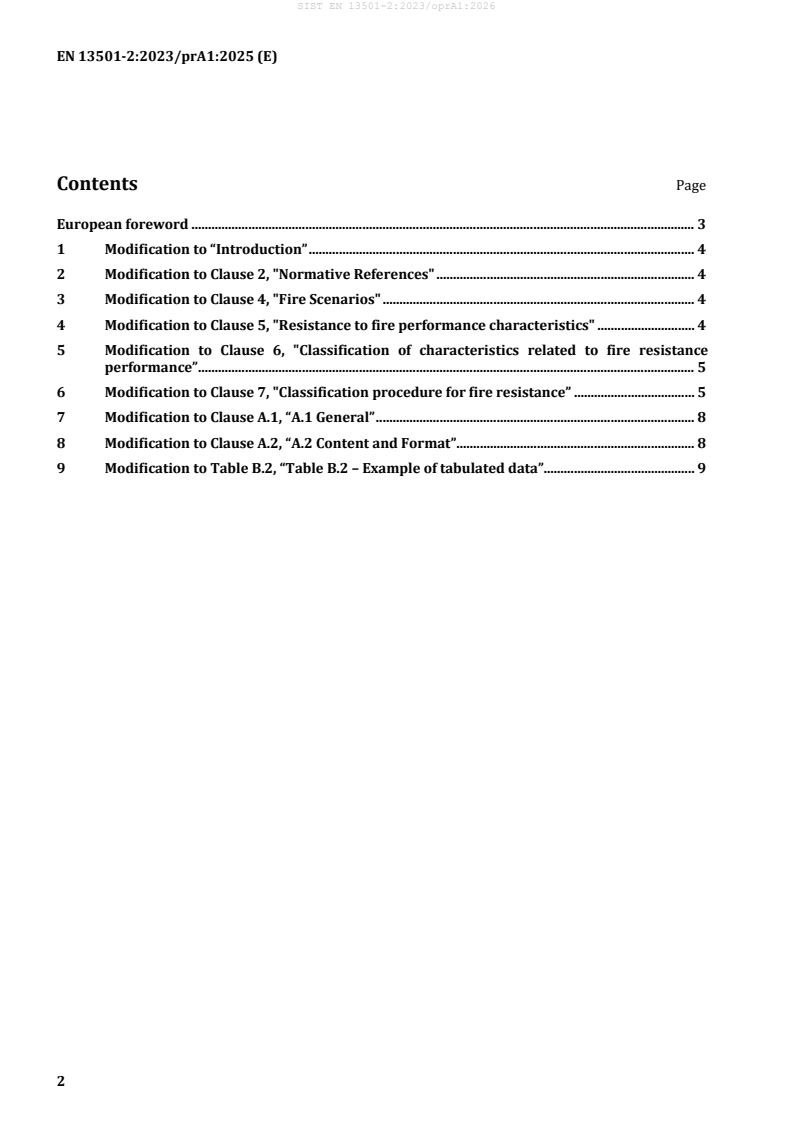
Contents Page
European foreword . 3
1 Modification to “Introduction” . 4
2 Modification to Clause 2, "Normative References" . 4
3 Modification to Clause 4, "Fire Scenarios" . 4
4 Modification to Clause 5, "Resistance to fire performance characteristics" . 4
5 Modification to Clause 6, "Classification of characteristics related to fire resistance
performance”. 5
6 Modification to Clause 7, "Classification procedure for fire resistance” . 5
7 Modification to Clause A.1, “A.1 General” . 8
8 Modification to Clause A.2, “A.2 Content and Format”. 8
9 Modification to Table B.2, “Table B.2 – Example of tabulated data”. 9
SIST EN 13501-2:2023/oprA1:2026
EN 13501-2:2023/prA1:2025 (E)
European foreword
This document (EN 13501-2:2023/prA1:2025) has been prepared by Technical Committee CEN/TC 127
“Fire safety in buildings”, the secretariat of which is held by BSI.
This document is currently submitted to the CEN Enquiry.
SIST EN 13501-2:2023/oprA1:2026
EN 13501-2:2023/prA1:2025 (E)
1 Modification to “Introduction”
Replace
“CEN, CENELEC and EOTA committees preparing technical specifications which contain performance
requirements against fire resistance tests are expected to refer to the fire resistance classification given
in this document and not refer directly to any specific fire test method.”
with
“Commission delegated regulation (EU) 2024/1681 of 6 March 2024 specifies performance and classes
regarding fire resistance. These classes are identified by designation letters, each of which refers to an
important characteristic of fire resistance behaviour.”
2 Modification to Clause 2, "Normative References"
Replace
“EN 12604, Industrial, commercial and garage doors and gates — Mechanical aspects — Requirements and
test methods”
with
“EN 12605: 2000, Industrial, commercial and garage doors and gates —Mechanical aspects — Test
methods”
3 Modification to Clause 4, "Fire Scenarios"
Replace the word “doors” with “doorsets” throughout Clause 4.
In clause 4.6 bullet point 1 replace “leakage” with “air flow”.
In clause 4.6 bullet point 2 replace “leakage” with “air flow”.
At end of section 4.6 add the following note:
“NOTE Instead of air flow rate, the term leakage rate was used to describe the evaluation of ambient and medium
temperature for smoke control doorsets in former versions of this document.”
4 Modification to Clause 5, "Resistance to fire performance characteristics"
In clause 5.1, at end of second sentence, add “/control” after “smoke leakage”.
In clause 5.2.2.1 in second sentence of first paragraph replace “may” with “can”
In clause 5.2.3.3 replace the word “doorsests” with “doorsets”.
In clause 5.2.4 in the last sentence replace “thermal insulation” with “radiation”
In clause 5.2.7, after the first sentence, delete all text and replace with the following:
“S is the classification related to the air flow rate at ambient temperature and in the case the doorset
a3
was tested with the bottom gap taped over.
S is the classification related to the air flow rate at ambient temperature and in the case the doorset was
a4
tested without the bottom gap taped over.
S is the classification for the air flow rate at both ambient temperature and at 200°C.
S is the classification for the air flow rate at both ambient temperature and at 200°C and may be used
200L
for large industrial doorsets only. Large industrial doorsets have an overall door leaf area of more than
9m .
SIST EN 13501-2:2023/oprA1:2026
EN 13501-2:2023/prA1:2025 (E)
NOTE 1 The classification S is defined in previous versions of this document.
a
NOTE 2 The classification S is defined in previous versions of this document.”
m
5 Modification to Clause 6, "Classification of characteristics related to fire
resistance performance”
In clause 6.6.2 replace the text for S definition with the following:
“for elements with particular limitations on smoke leakage/control;
For fire resistant elements the S shall be added to the fire resistance classification (e.g. EI 60-
S ). Where no fire resistance classification is relevant, the element shall simply be classified S
as defined in this document for the particular product and classification;”
6 Modification to Clause 7, "Classification procedure for fire resistance”
In clause 7.1.1 a) “load level (see 3.26)” is to be a separate bullet point
In clause 7.1.1 c) replace the word “doorsests” with “doorsets”.
In clause 7.1.1 d) add “/control” after “smoke leakage” and “/air flow” after “limiting leakage” and before
“rate”.
In clause 7.2.2.3 replace the word “both” with “one”.
In section 7.3.2.4 move “With external fire exposure, the classification shall be given as REI 30-ef, or
REI 60-ef (o→i).” to the end of the paragraph above.
nd
In table 4 in clause 7.3.4.4 delete the 10-minute classification column (2 column) for both RE and REI.
In clause 7.5.2.1 delete “EN 15254-6 and”.
In clause 7.5.2.2 delete “and EN 15254- 6” and insert “EN 15254-3” between “EN 15254-2” and “EN 15254-
4”, and insert “and” between “EN 15254-4” and “EN 15254
...