

EN 1279-5:2005
(Main)Glass in building - Insulating glass units - Part 5: Evaluation of conformity
- Abstract
This document specifies requirements, the evaluation of conformity and the factory production control of insulating glass units for use in buildings.
NOTE 1 For glass products with electrical wiring or connections for e.g. alarm or heating purposes, other directives, e.g. Low Voltage Directive, may apply.
The main intended uses of the insulating glass units are installations in windows, doors, curtain walling, roofs and partitions where there exists protection against direct ultraviolet radiation at the edges.
NOTE 2 In cases where there is no protection against direct ultra-violet radiation at the edges, such as structural sealant glazing systems, additional European technical specifications should be followed (e.g. prEN XXX, prEN 13022-1).
NOTE 3 Units for which the intended use is only 'artistic' and therefore no essential requirement is required, are not subject to CE marking and are not part of this document.
- Status
- Withdrawn
- Publication Date
- 17-May-2005
- Withdrawal Date
- 11-Nov-2008
- Technical Committee
- CEN/TC 129 - Glass in building
- Drafting Committee
- CEN/TC 129 - Glass in building
- Current Stage
- 9960 - Withdrawal effective - Withdrawal
- Start Date
- 12-Nov-2008
- Completion Date
- 12-Nov-2008
89/106/EEC - Construction productsOJ Ref: C, C 319 OJ Date: 14-Dec-2005

Relations
- Effective Date
- 22-Dec-2008
- Effective Date
- 28-Jan-2026
- Amended By
EN 1279-5:2005/FprA2 - Glass in building - Insulating glass units - Part 5: Evaluation of conformity - Effective Date
- 26-Sep-2009
Frequently Asked Questions
EN 1279-5:2005 is a standard published by the European Committee for Standardization (CEN). Its full title is "Glass in building - Insulating glass units - Part 5: Evaluation of conformity". This standard covers: This document specifies requirements, the evaluation of conformity and the factory production control of insulating glass units for use in buildings. NOTE 1 For glass products with electrical wiring or connections for e.g. alarm or heating purposes, other directives, e.g. Low Voltage Directive, may apply. The main intended uses of the insulating glass units are installations in windows, doors, curtain walling, roofs and partitions where there exists protection against direct ultraviolet radiation at the edges. NOTE 2 In cases where there is no protection against direct ultra-violet radiation at the edges, such as structural sealant glazing systems, additional European technical specifications should be followed (e.g. prEN XXX, prEN 13022-1). NOTE 3 Units for which the intended use is only 'artistic' and therefore no essential requirement is required, are not subject to CE marking and are not part of this document.
This document specifies requirements, the evaluation of conformity and the factory production control of insulating glass units for use in buildings. NOTE 1 For glass products with electrical wiring or connections for e.g. alarm or heating purposes, other directives, e.g. Low Voltage Directive, may apply. The main intended uses of the insulating glass units are installations in windows, doors, curtain walling, roofs and partitions where there exists protection against direct ultraviolet radiation at the edges. NOTE 2 In cases where there is no protection against direct ultra-violet radiation at the edges, such as structural sealant glazing systems, additional European technical specifications should be followed (e.g. prEN XXX, prEN 13022-1). NOTE 3 Units for which the intended use is only 'artistic' and therefore no essential requirement is required, are not subject to CE marking and are not part of this document.
EN 1279-5:2005 is classified under the following ICS (International Classification for Standards) categories: 81.040.20 - Glass in building. The ICS classification helps identify the subject area and facilitates finding related standards.
EN 1279-5:2005 has the following relationships with other standards: It is inter standard links to EN 1279-5:2005+A1:2008, EN 14600:2005, EN 1279-5:2005/FprA2. Understanding these relationships helps ensure you are using the most current and applicable version of the standard.
EN 1279-5:2005 is associated with the following European legislation: EU Directives/Regulations: 305/2011, 89/106/EEC; Standardization Mandates: M/135. When a standard is cited in the Official Journal of the European Union, products manufactured in conformity with it benefit from a presumption of conformity with the essential requirements of the corresponding EU directive or regulation.
EN 1279-5:2005 is available in PDF format for immediate download after purchase. The document can be added to your cart and obtained through the secure checkout process. Digital delivery ensures instant access to the complete standard document.
Standards Content (Sample)
2003-01.Slovenski inštitut za standardizacijo. Razmnoževanje celote ali delov tega standarda ni dovoljeno.Glass in building - Insulating glass units - Part 5: Evaluation of conformitySteklo v gradbeništvu – Izolacijsko steklo – 5. del: Ovrednotenje skladnostiVerre dans la construction - Vitrage isolant - Partie 5: Evaluation de la conformitéGlas im Bauwesen - Mehrscheiben-Isolierglas - Teil 5: Konformitätsbewertung81.040.20Steklo v gradbeništvuGlass in buildingICS:SIST EN 1279-5:2005enTa slovenski standard je istoveten z:EN 1279-5:200501-september-2005SIST EN 1279-5:2005SLOVENSKI
STANDARD
EUROPEAN STANDARDNORME EUROPÉENNEEUROPÄISCHE NORMEN 1279-5May 2005ICS 81.040.20English versionGlass in building - Insulating glass units - Part 5: Evaluation ofconformityVerre dans la construction - Vitrage isolant préfabriquéscellé - Partie 5: Evaluation de la conformitéGlas im Bauwesen - Mehrscheiben-Isolierglas - Teil 5:KonformitätsbewertungThis European Standard was approved by CEN on 24 March 2005.CEN members are bound to comply with the CEN/CENELEC Internal Regulations which stipulate the conditions for giving this EuropeanStandard the status of a national standard without any alteration. Up-to-date lists and bibliographical references concerning such nationalstandards may be obtained on application to the Central Secretariat or to any CEN member.This European Standard exists in three official versions (English, French, German). A version in any other language made by translationunder the responsibility of a CEN member into its own language and notified to the Central Secretariat has the same status as the officialversions.CEN members are the national standards bodies of Austria, Belgium, Cyprus, Czech Republic, Denmark, Estonia, Finland, France,Germany, Greece, Hungary, Iceland, Ireland, Italy, Latvia, Lithuania, Luxembourg, Malta, Netherlands, Norway, Poland, Portugal, Slovakia,Slovenia, Spain, Sweden, Switzerland and United Kingdom.EUROPEAN COMMITTEE FOR STANDARDIZATIONCOMITÉ EUROPÉEN DE NORMALISATIONEUROPÄISCHES KOMITEE FÜR NORMUNGManagement Centre: rue de Stassart, 36
B-1050 Brussels© 2005 CENAll rights of exploitation in any form and by any means reservedworldwide for CEN national Members.Ref. No. EN 1279-5:2005: E
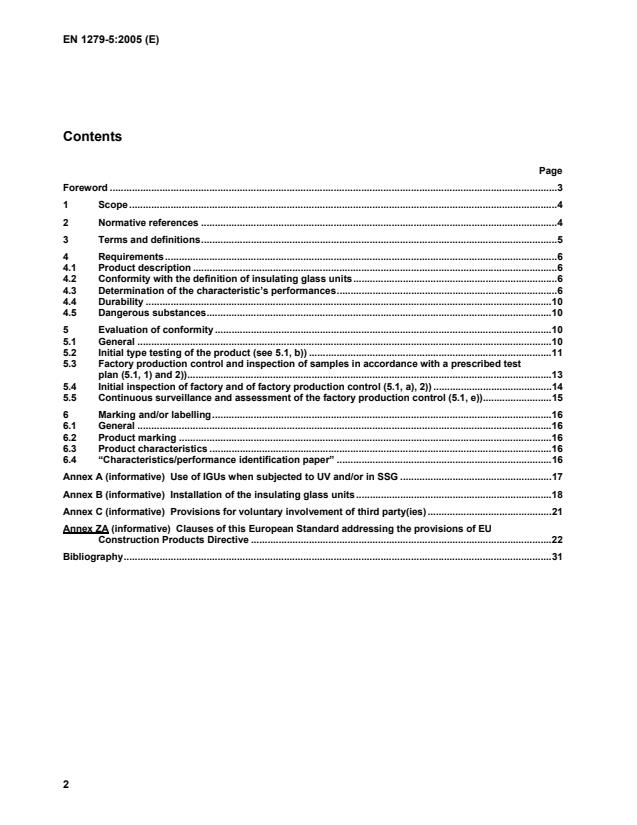
Use of IGUs when subjected to UV and/or in SSG.17 Annex B (informative)
Installation of the insulating glass units.18 Annex C (informative)
Provisions for voluntary involvement of third party(ies).21 Annex ZA (informative)
Clauses of this European Standard addressing the provisions of EU Construction Products Directive.22 Bibliography.31
fire resistance tests, excluding ventilation services prEN 13501-5, Fire classification of construction products and building elements – Part 5: Classification using data from external fire exposure to roof tests EN 13541, Glass in building – Security glazing – Testing and classification of resistance against explosion pressure EN 14178-1, Glass in building – Basic alkaline earth silicate glass products – Part 1: Float glass EN ISO 12543-1, Glass in building – Laminated and laminated safety glass - Part 1: Definition and description of component parts (ISO 12543-1:1998)
3 Terms and definitions For the purposes of this European Standard, the terms and definitions given in EN 1279-1:2004, EN 1279-2:2002, EN 1279-3:2002, EN 1279-4:2002 and EN 1279-6:2002 and the following apply. 3.1 initial type testing determination of the performance of a product (characteristic, durability), on the basis of either actual tests or other procedures (such as conventional, standardised, tabulated or general accepted values, standardised or recognised calculation methods, test reports when made available,), in accordance with this European Standard that demonstrates compliance with this European Standard 3.2 test report document that covers the results of tests undertaken on a representative sample of the product from production or on a prototype design of the product 3.3 product description document that details the relevant parameters, e.g. process conditions, structure, etc, for defining a product that complies with the standard. It includes specific references to characteristics that are modified by the production process
Characteristic
Symbol
Unit - density - hardness - Young's modulus - Poisson's ratio - characteristic bending strength - specific heat capacity - coefficient of linear expansion - thermal conductivity - mean refractive index to visible radiation - emissivity - light transmittance - solar direct transmittance - total solar energy transmittance ρ HK 0,1/20 E µ fk c α λ n ε τv τe g kg/m³ GPa Pa Dimensionless Pa J/(kg·K) K-1 W/(m·K) Dimensionless Dimensionless Dimensionless Dimensionless Dimensionless
4.3.2 Determination of characteristics of insulating glass units 4.3.2.1 General If the insulating glass manufacturer wishes to claim that any performance characteristic is independent of the production equipment used then the factory production control system shall be in accordance with this European Standard including his specific process control conditions. 4.3.2.2 Safety in the case of fire - Resistance to fire Fire resistance shall be determined and classified in accordance with EN 13501-2. NOTE EN 357 may be used as a classification reference specific to fire resistant glazed elements. 4.3.2.3 Safety in the case of fire - Reaction to fire Reaction to fire shall be determined and classified in accordance with EN 13501-1. For classification, consideration shall be given to: a) the following product changes require new type testing on reaction to fire: reduction of the reaction to fire classification of the glass components in the insulating glass unit; reduction of the reaction to fire performance of the organic sealant in the edge seal; b) however when not tested, the insulating glass unit shall be classified either: by the reaction to fire classification of the glass component used in the insulating glass unit, or by the classification of an insulating glass units using the same organic sealant in the edge seal,
1 The terms ‘manufacturer’ and ‘producer’ are understood as being synonyms (see CPD working document NB-CPD/02/019-issued 24 April 2002 – page1).
Applicable to:
Seal performance: Validation method: (Demonstration by means of available test report or by testing)
Requirement:
All systems of IGU Moisture vapour penetration EN 1279-2 refer to EN 1279-2
Adhesion sealant-glassEN 1279-4 refer to EN 1279-4 NOTE Tests can be carried out by different test laboratories.
Applicable to:
Seal performance: Validation method: (Demonstration by means of available test report or by testing)
Requirement: Gas-filled IGU: Type of gas Gas leakage rate EN 1279-3 refer to EN 1279-3 Gas filled units: gas concentration
Subject of factory production control in accordance with EN 1279-6 refer to EN 1279-6:2002, Annex A.3 Seal bonding to glass coating Adhesion: - sealant/coating - interlayers of coating EN 1279-4:2002, Annex D refer to EN 1279-4 NOTE Tests can be performed by different test laboratories.
Substitution of materials and of components shall maintain the conformity of the system with the definition of insulating glass units. The relevant seal properties, components and the related derived requirements are summarized in EN 1279-1:2004, Tables B.1 and B.2, together with the validation methods. The component manufacturer test reports may be used to validate the substitution. During factory production control the short climate test value of the test report shall be confirmed by the outcome value of the periodic test of the factory production control. Only one substitution shall be made at any one time. When a relevant material changes the short climate test shall be repeated (EN 1279-6:2002, B.4.2). When meeting the requirements, the substituting materials and components shall be added to the system description. In case of system description (processed edge seal description) change, test report on prototype can be used. During factory production control the short climate test value of the test report shall be confirmed by the outcome value of the periodic test of the factory production control. If glass panes are used which are not covered by European specifications, it shall be demonstrated that those glasses have a chemical and mechanical stability over time comparable with: soda lime silicate glass according to EN 572-1; or borosilicate glass according to EN 1748-1-1; or glass ceramics according to EN 1748-2-1; or alkaline earth silicate glass according to EN 14178-1. 5.2.5 Initial type testing of performances of characteristics (5.1, 2)) All characteri
...