


EN 16603-50-01:2014
(Main)Space engineering - Space data links - Telemetry synchronization and channel coding
Space engineering - Space data links - Telemetry synchronization and channel coding
This Standard establishes a common implementation of space telemetry channel coding systems.
Several space telemetry channel coding schemes are specified in this Standard. The specification does not attempt to quantify the relative coding gain or the merits of each scheme, nor the design requirements for encoders or decoders. However, some application profiles are discussed in Annex D. Performance data for the coding schemes specified in this Standard can be found in CCSDS 130.1 G 1. Annex G describes the related mission configuration parameters.
Further provisions and guidance on the application of this standard can be found in the following publications:
- ECSS-E-ST-50, Communications, which defines the principle characteristics of communication protocols and related services for all communication layers relevant for space communication (physical- to application-layer), and their basic relationship to each other.
- The handbook ECSS-E-HB-50, Communications guidelines, which provides information about specific implementation characteristics of these protocols in order to support the choice of a certain communications profile for the specific requirements of a space mission.
Users of this present standard are invited to consult these documents before taking decisions on the implementation of the present one.
This standard may be tailored for the specific characteristics and constraints of a space project in conformance with ECSS-S-ST-00.
Raumfahrttechnik - Raumfahrt-Datenübertragung - Telemetriesynchronisation und Kanalkodierung
Ingénierie spatiale - Liaison de données spatiales - Synchronisation et codage canal de la télémesure
La présente norme établit une implémentation courante des systèmes de codage utilisés dans les canaux de télémesure spatiaux.
Elle décrit plusieurs schémas de codage applicables aux canaux de télémesure spatiaux. Cette norme ne prétend quantifier ni le gain de codage relatif ou les avantages de chaque schéma, ni les exigences de conception applicables aux codeurs ou décodeurs. Certains profils d'application sont toutefois présentés à l'Annexe D. Les données relatives aux performances des schémas de codage spécifiés dans la présente norme sont définies dans la spécification CCSDS 130.1 G 1. L'Annexe G décrit les paramètres de configuration de mission associés.
Les publications suivantes contiennent des dispositions et des préconisations supplémentaires concernant l'application de la présente norme :
• l'ECSS-E-ST-50, « Communications », qui définit les principes des protocoles de communication et des services connexes pour toutes les couches de communication spatiale (de la couche physique à la couche applicative), et décrit leurs relations de base ;
• le manuel ECSS-E-HB-50, « Communications guidelines », qui fournit des informations sur les caractéristiques de mise en œuvre de ces protocoles afin d'orienter le choix d'un profil de communication donné compte tenu des exigences particulières d'une mission spatiale.
Les utilisateurs de la présente norme sont invités à consulter ces documents avant de prendre toute décision quant à sa mise en œuvre.
La présente norme peut être adaptée aux caractéristiques et contraintes spécifiques d'un projet spatial, conformément à la norme ECSS-S-ST-00.
Vesoljska tehnika - Vesoljske podatkovne povezave - Telemetrijska sinhronizacija in kodiranje kanalov
Ta standard določa skupno izvedbo vesoljskih telemetričnih sistemov za kodiranje kanalov.
V tem standardu je določenih več vesoljskih telemetričnih shem za kodiranje kanalov. Specifikacija ne poskuša količinsko opredeliti relativnega dobička kodiranja ali prednosti vsake sheme ali zahtev za zasnovo kodirnikov ali dekodirnikov. Vendar so nekateri profili uporabe predstavljeni v dodatku D. Podatki o delovanju za kodirne sheme, določene v tem standardu, je mogoče najti v standardu CCSDS 130.1 G 1. V dodatku G so opisani povezani konfiguracijski parametri misije.
Dodatne določbe in smernice o uporabi tega standarda je mogoče najti v naslednjih publikacijah:
– v standardu ECSS-E-ST-50 (Komunikacije), ki določa glavne značilnosti komunikacijskih protokolov in z njimi povezanih storitev za vse ravni komunikacije, pomembne za vesoljsko komunikacijo (od fizične do aplikacijske ravni), in njihove osnovne medsebojne povezave,
– v priročniku ECSS-E-HB-50 (Komunikacijske smernice), ki zagotavlja informacije o posebnih značilnostih vpeljave teh protokolov za podporo pri izbiri določenega komunikacijskega profila za posebne zahteve vesoljske misije.
Uporabniki obstoječega standarda so vabljeni k ogledu teh dokumentov, preden sprejmejo odločitve o izvajanju trenutnega standarda.
Ta standard se lahko prilagodi posameznim lastnostim in omejitvam vesoljskega projekta v skladu s standardom ECSS-S-ST-00.
General Information
- Status
- Withdrawn
- Publication Date
- 23-Sep-2014
- Withdrawal Date
- 10-Feb-2026
- Technical Committee
- CEN/CLC/TC 5 - Space
- Drafting Committee
- CEN/CLC/TC 5 - Space
- Current Stage
- 9960 - Withdrawal effective - Withdrawal
- Start Date
- 06-Jul-2022
- Completion Date
- 11-Feb-2026
Relations
- Effective Date
- 15-Dec-2021


Get Certified
Connect with accredited certification bodies for this standard

DEKRA North America
DEKRA certification services in North America.

Eagle Registrations Inc.
American certification body for aerospace and defense.

Element Materials Technology
Materials testing and product certification.
Sponsored listings
Frequently Asked Questions
EN 16603-50-01:2014 is a standard published by the European Committee for Standardization (CEN). Its full title is "Space engineering - Space data links - Telemetry synchronization and channel coding". This standard covers: This Standard establishes a common implementation of space telemetry channel coding systems. Several space telemetry channel coding schemes are specified in this Standard. The specification does not attempt to quantify the relative coding gain or the merits of each scheme, nor the design requirements for encoders or decoders. However, some application profiles are discussed in Annex D. Performance data for the coding schemes specified in this Standard can be found in CCSDS 130.1 G 1. Annex G describes the related mission configuration parameters. Further provisions and guidance on the application of this standard can be found in the following publications: - ECSS-E-ST-50, Communications, which defines the principle characteristics of communication protocols and related services for all communication layers relevant for space communication (physical- to application-layer), and their basic relationship to each other. - The handbook ECSS-E-HB-50, Communications guidelines, which provides information about specific implementation characteristics of these protocols in order to support the choice of a certain communications profile for the specific requirements of a space mission. Users of this present standard are invited to consult these documents before taking decisions on the implementation of the present one. This standard may be tailored for the specific characteristics and constraints of a space project in conformance with ECSS-S-ST-00.
This Standard establishes a common implementation of space telemetry channel coding systems. Several space telemetry channel coding schemes are specified in this Standard. The specification does not attempt to quantify the relative coding gain or the merits of each scheme, nor the design requirements for encoders or decoders. However, some application profiles are discussed in Annex D. Performance data for the coding schemes specified in this Standard can be found in CCSDS 130.1 G 1. Annex G describes the related mission configuration parameters. Further provisions and guidance on the application of this standard can be found in the following publications: - ECSS-E-ST-50, Communications, which defines the principle characteristics of communication protocols and related services for all communication layers relevant for space communication (physical- to application-layer), and their basic relationship to each other. - The handbook ECSS-E-HB-50, Communications guidelines, which provides information about specific implementation characteristics of these protocols in order to support the choice of a certain communications profile for the specific requirements of a space mission. Users of this present standard are invited to consult these documents before taking decisions on the implementation of the present one. This standard may be tailored for the specific characteristics and constraints of a space project in conformance with ECSS-S-ST-00.
EN 16603-50-01:2014 is classified under the following ICS (International Classification for Standards) categories: 49.140 - Space systems and operations. The ICS classification helps identify the subject area and facilitates finding related standards.
EN 16603-50-01:2014 has the following relationships with other standards: It is inter standard links to EN 16603-50-21:2022. Understanding these relationships helps ensure you are using the most current and applicable version of the standard.
EN 16603-50-01:2014 is associated with the following European legislation: Standardization Mandates: M/496. When a standard is cited in the Official Journal of the European Union, products manufactured in conformity with it benefit from a presumption of conformity with the essential requirements of the corresponding EU directive or regulation.
EN 16603-50-01:2014 is available in PDF format for immediate download after purchase. The document can be added to your cart and obtained through the secure checkout process. Digital delivery ensures instant access to the complete standard document.
Standards Content (Sample)
2003-01.Slovenski inštitut za standardizacijo. Razmnoževanje celote ali delov tega standarda ni dovoljeno.Vesoljska tehnika - Vesoljske podatkovne povezave - Telemetrijska sinhronizacija in kodiranje kanalovRaumfahrttechnik - Raumfahrt-Datenübertragung - Telemetriesynchronisation und -kanalkodierungIngénierie spatiale - Liaison de données spatiales - Synchronisation et codage canal de la télémesureSpace engineering - Space data links - Telemetry synchronization and channel coding49.140Vesoljski sistemi in operacijeSpace systems and operations33.200Daljinsko krmiljenje, daljinske meritve (telemetrija)Telecontrol. TelemeteringICS:Ta slovenski standard je istoveten z:EN 16603-50-01:2014SIST EN 16603-50-01:2015en01-januar-2015SIST EN 16603-50-01:2015SLOVENSKI
STANDARD
EUROPEAN STANDARD NORME EUROPÉENNE EUROPÄISCHE NORM
EN 16603-50-01
September 2014 ICS 49.140
English version
Space engineering - Space data links - Telemetry synchronization and channel coding
Ingénierie spatiale - Liaison de données spatiales - Synchronisation et codage canal de la télémesure
Raumfahrtproduktsicherung - Raumfahrt-Datenübertragung - Telemetriesynchronisation und
kanalkodierung This European Standard was approved by CEN on 11 April 2014.
CEN and CENELEC members are bound to comply with the CEN/CENELEC Internal Regulations which stipulate the conditions for giving this European Standard the status of a national standard without any alteration. Up-to-date lists and bibliographical references concerning such national standards may be obtained on application to the CEN-CENELEC Management Centre or to any CEN and CENELEC member.
This European Standard exists in three official versions (English, French, German). A version in any other language made by translation under the responsibility of a CEN and CENELEC member into its own language and notified to the CEN-CENELEC Management Centre has the same status as the official versions.
CEN and CENELEC members are the national standards bodies and national electrotechnical committees of Austria, Belgium, Bulgaria, Croatia, Cyprus, Czech Republic, Denmark, Estonia, Finland, Former Yugoslav Republic of Macedonia, France, Germany, Greece, Hungary, Iceland, Ireland, Italy, Latvia, Lithuania, Luxembourg, Malta, Netherlands, Norway, Poland, Portugal, Romania, Slovakia, Slovenia, Spain, Sweden, Switzerland, Turkey and United Kingdom.
CEN-CENELEC Management Centre: Avenue Marnix 17, B-1000 Brussels © 2014 CEN/CENELEC All rights of exploitation in any form and by any means reserved worldwide for CEN national Members and for CENELEC Members. Ref. No. EN 16603-50-01:2014 E SIST EN 16603-50-01:2015
Figures Figure 3-1: Bit numbering convention . 10 Figure 4-1: Coding, randomization and synchronization (1) . 14 Figure 4-2: Coding, randomization and synchronization (2) . 15 Figure 5-1: Convolutional encoder block diagram . 18 Figure 5-2: Punctured encoder block diagram . 19 Figure 6-1: Functional representation of R-S interleaving . 23 Figure 6-2: Reed-Solomon codeblock partitioning . 24 Figure 7-1: Interpretation of permutation . 31 Figure 7-2: Turbo encoder block diagram . 32 Figure 7-3: Turbo codeblocks for code rates 1/2 and 1/4 . 34 Figure 7-4: Turbo codeblock with attached sync marker . 34 Figure 8-1: Format of channel access data unit (CADU) . 35 Figure 8-2 ASM bit pattern for non-turbo-coded data . 36 Figure 8-3: ASM bit pattern for rate 1/2 turbo-coded data . 36 Figure 8-4: ASM bit pattern for rate 1/4 turbo-coded data . 37 Figure 8-5: Embedded ASM bit pattern . 38 SIST EN 16603-50-01:2015
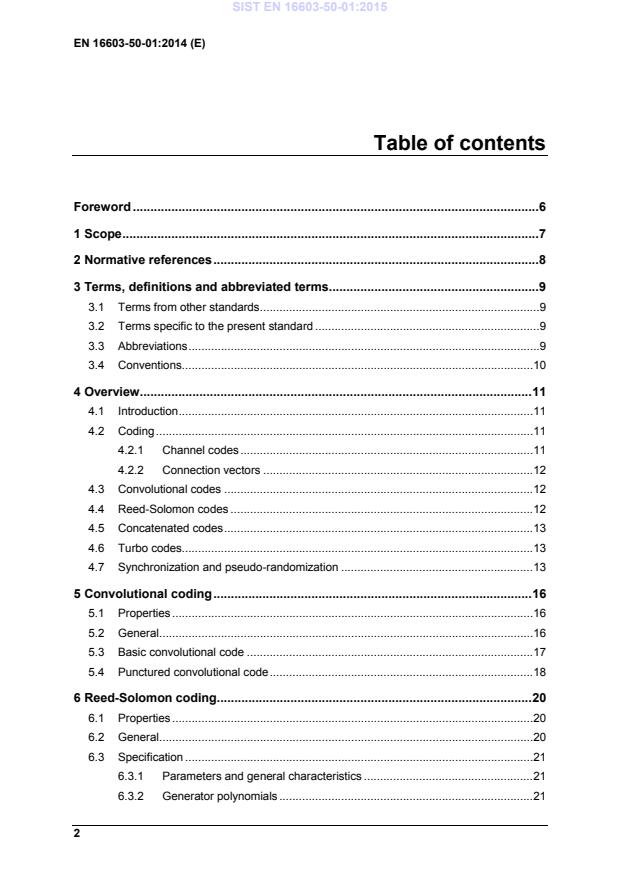
Tables Table 5-1: Basic convolutional code characteristics . 17 Table 5-2: Punctured convolutional code characteristics . 19 Table 5-3: Puncture code patterns for convolutional codes . 19 Table 7-1: Specified information block lengths . 30 Table 7-2: Codeblock lengths (measured in bits) . 30 Table 7-3: Parameters k1 and k2 for specified information block lengths . 31 Table 7-4: Forward connection vectors . 32 Table 8-1: ASM bit patterns in hexadecimal notation . 37 Table A-1 : Equivalence of representations (Part 1 of 4) . 46 Table B-1 : Expansion for E=16 . 50 Table B-2 : Expansion for E=8 . 51 Table C-1 : Maximum frame lengths for E=16 . 53 Table C-2 : Maximum frame lengths for E=8 . 53 Table D-1 : Preferred coding schemes . 56 Table D-2 : Coding gains and bandwidth expansions . 58 Table D-3 : Coding gains for R-S(255, 239) and 4D-8PSK-TCM . 59
• The handbook ECSS-E-HB-50, Communications guidelines, which provides information about specific implementation characteristics of these protocols in order to support the choice of a certain communications profile for the specific requirements of a space mission. Users of this present standard are invited to consult these documents before taking decisions on the implementation of the present one. This standard may be tailored for the specific characteristics and constraints of a space project in conformance with ECSS-S-ST-00. SIST EN 16603-50-01:2015
EN reference Reference in text Title EN 16601-00-01 ECSS-S-ST-00-01 ECSS system - Glossary of terms SIST EN 16603-50-01:2015
3.4 Conventions 3.4.1 bit 0, bit 1, bit N−1 To identify each bit in an N-bit field, the first bit in the field to be transferred (i.e. the most left justified in a graphical representation) is defined as bit 0; the following bit is defined as bit 1 and so on up to bit N−1.
Figure 3-1: Bit numbering convention 3.4.2 most significant bit When an N-bit field is used to express a binary value (such as a counter), the most significant bit is the first bit of the field, i.e. bit 0 (see Figure 3-1). SIST EN 16603-50-01:2015
Depending on the code, the symbols can consist of one or more bits. The source symbols are also called information symbols. The code symbols are called channel symbols when they are the output of the last or only code applied during the encoding process. Block encoding is a one-to-one transformation of sequences of length k source symbols to sequences of length n code symbols. The length of the encoded sequence is greater than the source sequence, so n> k.
The ratio k/n is the code rate, which can be defined more generally as the average ratio of the number of binary digits at the input of an encoder to the number of binary digits at its output. A codeword of an (n,k) block code is one of the sequences of n code symbols in the range of the one-to-one transformation. A codeblock of an (n,k) block code is a sequence of n channel symbols which are produced as a unit by encoding a sequence of k information symbols. The codeblock is decoded as a unit and, if successful, delivers a sequence of k information symbols. A systematic code is one in which the input information sequence appears in unaltered form as part of the output codeword. A transparent code has the property that complementing the input of the encoder or decoder results in complementing the output. SIST EN 16603-50-01:2015
A forward connection vector is a vector which specifies one of the parity checks computed by the shift register(s) in the encoder. For a shift register with s stages, a connection vector is an s-bit binary number. A bit equal to "1" in position i (counted from the left) indicates that the output of the ith stage of the shift register is used in computing that parity check. In turbo coding, a backward connection vector is a vector which specifies the feedback to the shift registers in the encoder. For a shift register with s stages, a backward connection vector is an s-bit binary number. A bit equal to "1" in position i (counted from the left) indicates that the output of the ith stage of the shift register is used in computing the feedback value, except for the leftmost bit which is ignored. 4.3 Convolutional codes A convolutional code is a code in which a number of output symbols are produced for each input information bit. Each output symbol is a linear combination of the current input bit as well as some or all of the previous k−1 bits, where k is the constraint length of the code. The constraint length is the number of consecutive input bits that are used to determine the value of the output symbols at any time. The rate 1/2 convolutional code is specified in clause 5. Depending on performance requirements, this code can be used alone.
For telecommunication channels that are constrained by bandwidth and cannot accommodate the increase in bandwidth caused by the basic convolutional code, clause 5 also specifies a punctured convolutional code which has the advantage of a smaller bandwidth expansion.
A punctured code is a code obtained by deleting some of the parity symbols generated by the convolutional encoder before transmission. There is an increase in the bandwidth efficiency due to puncturing compared to the original code, however the minimum weight (and therefore its error-correcting performance) is less than that of the original code. 4.4 Reed-Solomon codes The Reed-Solomon (R-S) code specified in clause 6 is a powerful burst error correcting code. In addition, the code has the capability of indicating the presence of uncorrectable errors, with an extremely low undetected error rate. The Reed-Solomon code has the advantage of smaller bandwidth expansion than the convolutional code. The Reed-Solomon symbol is a set of J bits that represents an element in the Galois field GF(2J), the code alphabet of a J-bit Reed-Solomon code. For the code specified in clause 6, J = 8 bits per R-S symbol. SIST EN 16603-50-01:2015
At the sending end, the order of convolutional encoding and modulation is dependent on the implementation. At the receiving end, the order of SIST EN 16603-50-01:2015
The figures do not imply any hardware or software configuration in a real system. When designing a communications system, the system designer usually takes into account radio regulations and modulation standardization requirements from other standards, such as ECSS-E-ST-50-05.
Figure 4-1: Coding, randomization and synchronization (1) SIST EN 16603-50-01:2015
Figure 4-2: Coding, randomization and synchronization (2) SIST EN 16603-50-01:2015
a. Soft bit decisions with at least 3-bit quantization shall be used for the decoder. b. The frame synchronization defined in clause 8 shall be used. c. If differential encoding (i.e. conversion from NRZ-L to NRZ-M) is used at the sending end, the conversions should be as follows: the conversion is performed at the input to the convolutional encoder; the corresponding conversion at the receiving end from NRZ-M to NRZ-L is performed at the output of the convolutional decoder. SIST EN 16603-50-01:2015
modulo 2 s2(t) = i(t) + i(t−2) + i(t−3) + i(t−5) + i(t−6) + 1 modulo 2 where the equations use modulo 2 addition, and s1 is the first output symbol, s2 is the second output symbol and i(t) is the input information at time t. NOTE 2 An encoder block diagram is shown in Figure 5-1. NOTE 3 The output symbol sequence is: C1(1), ____,C2(1), C1(2), ____,C2(2). . . . Table 5-1: Basic convolutional code characteristics Characteristic Value Nomenclature Convolutional code with maximum-likelihood (Viterbi) decoding Code rate 1/2 bit per symbol Constraint length 7 bits Connection vectors G1 = 1111001 (171 octal); G2 = 1011011 (133 octal) Symbol inversion On output path of G2
Figure 5-1: Convolutional encoder block diagram 5.4 Punctured convolutional code a. The punctured convolutional code shall have the characteristics shown in Table 5-2.
NOTE 1 A single code rate of 2/3, 3/4, 5/6 or 7/8 is selected when it provides the appropriate level of error correction and symbol rate for a given service or data rate. NOTE 2 Figure 5-2 depicts the punctured encoding scheme. NOTE 3 The punctured convolutional code does not include the symbol inverter associated with G2 in the rate 1/2 code defined above. b. The puncturing patterns for each of the punctured convolutional code rates shall be the patterns defined in Table 5-3. SIST EN 16603-50-01:2015
Figure 5-2: Punctured encoder block diagram Table 5-3: Puncture code patterns for convolutional codes Puncturing pattern (a) Code rate Output sequence (b) C1: 1 0 C2: 1 1 2/3 C1(1) C2(1) C2(2) . C1: 1 0 1 C2: 1 1 0 3/4 C1(1) C2(1) C2(2) C1(3) . C1: 1 0 1 0 1 C2: 1 1 0 1 0 5/6 C1(1) C2(1) C2(2) C1(3) C2(4) C1(5) . C1: 1 0 0 0 1 0 1 C2: 1 1 1 1 0 1 0 7/8 C1(1) C2(1) C2(2) C2(3) C2(4) C1(5) C2(6) C1(7) . (a)
1 = transmitted symbol 0 = non-transmitted symbol (b)
C1(t), C2(t) denote values at bit time t
forward error correction capability in a burst-noise channel with an extremely low undetected error rate. This means that the decoder can reliably indicate whether it can make the proper corrections or not. For this reason, when telemetry transfer frames are used, ECSS-E-ST-50-03 does not specify the use of a cyclic redundancy check (CRC) field to validate the frame when this Reed-Solomon Code is used. The Reed-Solomon error correction and detection presupposes correct frame synchronization. The Reed-Solomon frame validation can only deliver a valid frame if the frame is correctly synchronized. If a frame is not correctly synchronized, then the Reed-Solomon decoder can perform a meaningless error correction of the frame and deliver it as valid. The reliability of the Reed-Solomon error correction and detection depends on the correct operation of the pseudo-randomization defined in clause 9. If frames are
• randomized and then not derandomized, or • not randomized and then derandomized, then the Reed-Solomon decoder can perform meaningless error correction of a frame and deliver it as valid. In particular, this can happen when the Reed-Solomon interleaving depth, I, is 5. The Reed-Solomon coding, by itself, cannot guarantee sufficient channel symbol transitions to keep receiver symbol synchronizers in lock. The pseudo-randomizer defined in clause 9 can be used to increase the symbol transition density. 6.2 General a. For Reed-Solomon coding, the frame synchronization defined in clause 8 shall be used. NOTE
The reliability of the Reed-Solomon code depends on proper codeblock synchronization b. To provide additional coding gain, the Reed-Solomon code may be concatenated with one of the convolutional codes defined in clause 5.
Used this way, the Reed-Solomon code is the outer code, while the convolutional code is the inner code. Figure 4-2 shows the order of the codes at the sending and receiving ends. 6.3 Specification 6.3.1 Parameters and general characteristics The Reed-Solomon code shall have the following parameters and general characteristics: • J = 8, where J is the number of bits per R-S symbol. • E = 16, where E is the Reed-Solomon error correction capability, in symbols, within an R-S codeword. • J, E, and I (the depth of interleaving) are independent parameters. • n = 2J−1 = 255, where n is the number of symbols per R-S codeword. • 2E is the number of parity check symbols in each codeword. Therefore there are 32 parity check R-S symbols in each 255-symbol codeword. • k = n−2E, where k is the number of information symbols in each codeword. Therefore there are 223 information R-S symbols in each 255-symbol codeword. NOTE
The specified Reed-Solomon code is a systematic code and results in a systematic codeblock. 6.3.2 Generator polynomials a. The Reed-Solomon code shall have the following field generator polynomial over GF(2): F(x) = x8 + x7 + x2 + x + 1 b. The Reed-Solomon code shall have the following code generator polynomial over GF(28), where F(α) = 0: ∏∑+−===−=EEjEiiijxGxxg1271282011)()(α
NOTE 1 α11 is a primitive element in GF(28). NOTE 2 For E=16, F(x) and g(x) characterize a (255,223) Reed-Solomon code. NOTE 3 Each coefficient of the code generator polynomial can be represented as a power of α or as a binary polynomial in α of degree less than 8, where F(α) = 0 (i.e. α is one of the roots of the field generator polynomial F(x)). The two representations are given in Annex B. SIST EN 16603-50-01:2015
d 5,1d1,2
. . .
d 5,2 . . .
d1,k
. . .
d 5,k
[2E ×
5 ] then the output is the same sequence with the [2E ×
5] filled by the [2E × 5] check symbols as shown below: p1,1
. . .
p 5,1 . . .
p1,2E
. . .
p
5,2Ewhere d i,1 d
i,2 . . .
d i,k
p i,1Error! Bookmark not defined. . . .
p
i,2Eis the R-S codeword produced by the ith encoder. If q virtual fill symbols (see clause 6.3.6) are used in each codeword, then replace k by (k−q) in this functional description. SIST EN 16603-50-01:2015
Figure 6-1: Functional representation of R-S interleaving 6.3.5 Reed-Solomon codeblock partitioning The R-S codeblock is partitioned as shown in Figure 6-2. The attached sync marker used with R-S coding is a 32-bit pattern specified in clause 8 as an aid to synchronization. It precedes the transmitted codeblock. Frame synchronizers are therefore set to expect a marker at every transmitted codeblock + 32 bits. The telemetry transfer frame is defined in ECSS-E-ST-50-03. When used with R-S coding, only specified lengths can be contained within the codeblock’s data space. See Annex C for the maximum lengths, not including the 32-bit attached sync marker. The Reed-Solomon check symbols consist of the trailing 2EI symbols (2EIJ bits) of the codeblock. For example, when E=16 and I=5, then the length occupied by the check symbols is always 1280 bits. The transmitted codeblock consists of the telemetry transfer frame (without the 32-bit sync marker) and R-S check symbols, which is the received data entity physically fed into the R-S decoder. For example, when E=16, k=223 and I=5, the length of the transmitted codeblock is 10 200 bits, unless virtual fill is used. If virtual fill is used, the length of the transmitted codeblock is reduced by the length of the virtual fill. A description of the use of virtual fill is provided in clause 6.3.6. The logical codeblock is the logical data entity operated upon by the R-S decoder. It can have a different length than the transmitted codeblock because it accounts for the amount of virtual fill that was introduced. For example, when E=16, k=223 and I=5, the logical codeblock always appears to be exactly 10 200 bits in length. SIST EN 16603-50-01:2015
Figure 6-2: Reed-Solomon codeblock partitioning 6.3.6 Shortened codeblock length 6.3.6.1 Overview In a systematic block code, a codeword can be divided into an information part and a parity (check) part. If the information part is k symbols long, a shortened code is created by taking only s (s < k) information symbols as input, appending a fixed string of length k−s and then encoding in the normal way. This fixed string is called virtual fill. Since the fill is a predetermined sequence of symbols, it is not transmitted over the channel, resulting in a shortened codeblock length. Thus the length of the transmitted codeblock is reduced by the length of the virtual fill. At the receiving end, the decoder appends the same fill sequence before decoding. The transmitted codeblock together with the virtual fill forms the logical codeblock. Figure 6-2 illustrates the transmitted codeblock and the logical codeblock. Shortening the transmitted codeblock length in this way changes the overall performance to a degree dependent on the amount of virtual fill used. Since it incorporates no virtual fill, the maximum codeblock length provides full performance. 6.3.6.2 General a. A shortened codeblock length may be used to accommodate frame lengths smaller than the maximum. b. Virtual fill shall be inserted only in integer multiples of 8I bits. c. The virtual fill shall not change in length during a mission phase. d. Virtual fill shall be inserted only at the beginning of the codeblock (i.e. after the attached sync marker but before the beginning of the transmitted codeblock). e. Virtual fill shall not be transmitted. NOTE
Virtual fill is used to logically complete the codeblock. SIST EN 16603-50-01:2015
As virtual fill in a codeblock is increased (at a specific bit rate), the number of codeblocks per unit time increases. 6.3.6.3 Use of virtual fill Since
...
Questions, Comments and Discussion
Ask us and Technical Secretary will try to provide an answer. You can facilitate discussion about the standard in here.
Loading comments...