

EN 12697-18:2017
(Main)Bituminous mixtures - Test methods - Part 18: Binder drainage
- Abstract
This draft European Standard describes two test methods:
- basket method (see Clause 4),
- beaker method (see Clause 5).
The basket method describes a method for determining binder drainage of bituminous mixtures. This method directly measures binder drainage, but when carried out on bituminous mixtures with fibres or mixtures whose mortar content is higher than in porous asphalt some clogging of the holes in the drainage baskets can occur, limiting the drainage of the binder. The basket method can be used either for determining the binder drainage for different binder content, or with a single binder content, eliminating the successive repetitions. It also enables the effects of varying fine aggregate types or including any anti-draining additive to be quantified.
The beaker method describes a method for determining binder drainage of bituminous mixtures. It is applicable to asphalt materials that are not porous asphalt or for porous asphalt incorporating fibres. It can be used either for determining the binder drainage for different binder content, or with a single binder content, eliminating the successive repetitions. It also enables the effects of varying fine aggregate types or including any anti-draining additive to be quantified.
- Status
- Published
- Publication Date
- 27-Jun-2017
- Withdrawal Date
- 30-Dec-2017
- Technical Committee
- CEN/TC 227 - Road materials
- Drafting Committee
- CEN/TC 227/WG 1 - Bituminous mixtures
- Current Stage
- 9092 - Decision on results of review/2YR ENQ - revise - Review Enquiry
- Start Date
- 19-Feb-2024
- Completion Date
- 07-Oct-2026


Overview
EN 12697-18:2017 - Bituminous mixtures: Test methods - Part 18: Binder drainage (CEN) defines two laboratory test methods for measuring binder drainage from asphalt mixtures: the basket method and the beaker method. Both methods quantify binder, fine particles and additives that separate from a mixture during mixing or transport, enabling evaluation of drainability for mix design, production control and specification of porous and non-porous asphalt mixtures.
Key Topics
- Test methods
- Basket method: Direct measurement using perforated metal baskets (100 ± 2 mm cubes) made from 3.15 mm perforated plate (ISO 3310-2). Intended primarily for porous asphalt; can measure binder drainage for varying binder contents or single-content tests. Note: mixtures with fibres or high mortar content may clog basket perforations, limiting drainage.
- Beaker method: Applicable to non-porous asphalt or porous asphalt incorporating fibres. Also used for single or multiple binder-content assessments.
- Temperature control
- For paving-grade bitumen: test at reference compaction temperature (EN 12697-35) + 25 °C.
- For modified bitumen (EN 14023) or other additives: use supplier’s installation temperature + 15 °C.
- Materials and apparatus
- Specified aggregate batches, balances to 0.1 g, thermostatic oven (80–200 °C range), trays, boxes and aluminium foil.
- Purpose and outputs
- Measures drained material (BD) after a defined period (e.g., 3 h at test temperature) and permits assessment of anti-drain additives and effects of fine aggregate type.
- Reporting and precision
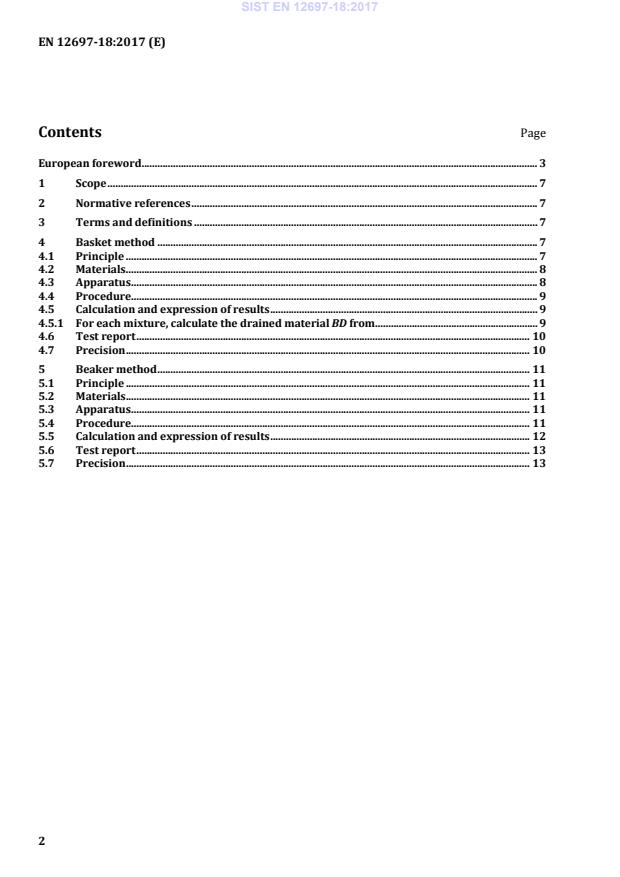
- Test report and precision requirements are specified (see Clauses 4.6–4.7 and 5.6–5.7).
Applications
- Quality control (QC) and factory production control for asphalt producers and contractors.
- Porous asphalt mix design, to prevent binder loss during transport/laying.
- Evaluation of anti-draining additives, fibres and fine aggregate choices to reduce binder separation.
- Specification development for highways, pavements and surface courses where drainability affects performance.
- Used by materials laboratories, pavement engineers, road authorities and consultants for verifying compliance and optimizing mix composition.
Who should use this standard
- Road material testing laboratories
- Asphalt mix designers and quality managers
- Highway agencies and pavement specifiers
- Additive and binder manufacturers seeking standardized drainability data
Related standards
- EN 12697 series (test methods for bituminous mixtures)
- EN 12697-35 (Laboratory mixing - reference compaction temperature)
- EN 12697-27 (Sampling)
- EN 14023 (Polymer-modified bitumen specification framework)
- ISO 3310 (Test sieves)
Keywords: EN 12697-18:2017, binder drainage, bituminous mixtures, basket method, beaker method, porous asphalt, asphalt testing, drainability, CEN standard.
Relations
- Replaces
EN 12697-18:2004 - Bituminous mixtures - Test methods for hot mix asphalt - Part 18: Binder drainage - Effective Date
- 08-Jun-2022
- Effective Date
- 25-Aug-2026
- Effective Date
- 09-Feb-2026
- Effective Date
- 28-Jan-2026
- Effective Date
- 28-Jan-2026
- Effective Date
- 28-Jan-2026
- Effective Date
- 28-Jan-2026
- Effective Date
- 28-Jan-2026
- Effective Date
- 28-Jan-2026
- Effective Date
- 28-Jan-2026
- Effective Date
- 28-Jan-2026
- Effective Date
- 28-Jan-2026
- Referred By
EN 13108-5:2016 - Bituminous mixtures - Material specifications - Part 5: Stone Mastic Asphalt - Effective Date
- 28-Jan-2026
- Effective Date
- 21-Feb-2024
Get Certified
Connect with accredited certification bodies for this standard

Zavod za gradbeništvo Slovenije (ZAG) - Inšpekcija
ZAG inspection body for construction products, structures, and materials.
Sponsored listings
Frequently Asked Questions
EN 12697-18:2017 is a standard published by the European Committee for Standardization (CEN). Its full title is "Bituminous mixtures - Test methods - Part 18: Binder drainage". This standard covers: This draft European Standard describes two test methods: - basket method (see Clause 4), - beaker method (see Clause 5). The basket method describes a method for determining binder drainage of bituminous mixtures. This method directly measures binder drainage, but when carried out on bituminous mixtures with fibres or mixtures whose mortar content is higher than in porous asphalt some clogging of the holes in the drainage baskets can occur, limiting the drainage of the binder. The basket method can be used either for determining the binder drainage for different binder content, or with a single binder content, eliminating the successive repetitions. It also enables the effects of varying fine aggregate types or including any anti-draining additive to be quantified. The beaker method describes a method for determining binder drainage of bituminous mixtures. It is applicable to asphalt materials that are not porous asphalt or for porous asphalt incorporating fibres. It can be used either for determining the binder drainage for different binder content, or with a single binder content, eliminating the successive repetitions. It also enables the effects of varying fine aggregate types or including any anti-draining additive to be quantified.
This draft European Standard describes two test methods: - basket method (see Clause 4), - beaker method (see Clause 5). The basket method describes a method for determining binder drainage of bituminous mixtures. This method directly measures binder drainage, but when carried out on bituminous mixtures with fibres or mixtures whose mortar content is higher than in porous asphalt some clogging of the holes in the drainage baskets can occur, limiting the drainage of the binder. The basket method can be used either for determining the binder drainage for different binder content, or with a single binder content, eliminating the successive repetitions. It also enables the effects of varying fine aggregate types or including any anti-draining additive to be quantified. The beaker method describes a method for determining binder drainage of bituminous mixtures. It is applicable to asphalt materials that are not porous asphalt or for porous asphalt incorporating fibres. It can be used either for determining the binder drainage for different binder content, or with a single binder content, eliminating the successive repetitions. It also enables the effects of varying fine aggregate types or including any anti-draining additive to be quantified.
EN 12697-18:2017 is classified under the following ICS (International Classification for Standards) categories: 93.080.20 - Road construction materials. The ICS classification helps identify the subject area and facilitates finding related standards.
EN 12697-18:2017 has the following relationships with other standards: It is inter standard links to EN 12697-18:2004, ISO 3310-2:2013, ISO 3310-1:2016, EN 12697-27:2017, EN 14023:2010, CEN ISO/TR 18486:2017, EN 12697-35:2025, EN 13108-7:2016, EN 13108-20:2006, EN 13108-9:2016, EN 13108-20:2016, CEN/TS 12697-52:2017, EN 13108-5:2016, FprEN 12697-18. Understanding these relationships helps ensure you are using the most current and applicable version of the standard.
EN 12697-18:2017 is associated with the following European legislation: EU Directives/Regulations: 305/2011; Standardization Mandates: M/124. When a standard is cited in the Official Journal of the European Union, products manufactured in conformity with it benefit from a presumption of conformity with the essential requirements of the corresponding EU directive or regulation.
EN 12697-18:2017 is available in PDF format for immediate download after purchase. The document can be added to your cart and obtained through the secure checkout process. Digital delivery ensures instant access to the complete standard document.
Standards Content (Sample)
2003-01.Slovenski inštitut za standardizacijo. Razmnoževanje celote ali delov tega standarda ni dovoljeno.Bitumenske zmesi - Preskusne metode - 18. del: Odtekanje vezivaAsphalt - Prüfverfahren - Teil 18: Bestimmung des AblaufensMélanges bitumineux - Méthodes d'essai - Partie 18: Egouttage du liantBituminous mixtures - Test methods - Part 18: Binder drainage93.080.20Materiali za gradnjo cestRoad construction materials91.100.50Veziva. Tesnilni materialiBinders. Sealing materialsICS:Ta slovenski standard je istoveten z:EN 12697-18:2017SIST EN 12697-18:2017en,fr,de01-september-2017SIST EN 12697-18:2017SLOVENSKI
STANDARDSIST EN 12697-18:20051DGRPHãþD
EUROPEAN STANDARD NORME EUROPÉENNE EUROPÄISCHE NORM
EN 12697-18
June
t r s y ICS
{ uä r z rä t r Supersedes EN
s t x { yæ s zã t r r vEnglish Version
Bituminous mixtures æ Test methods æ Part
s zã Binder drainage Mélanges bitumineux æ Méthodes d 5essai æ Partie
s zã Egouttage du liant
Asphalt æ Prüfverfahren æ Teil
s zã Bestimmung des Ablaufens This European Standard was approved by CEN on
t v April
t r s yä
egulations which stipulate the conditions for giving this European Standard the status of a national standard without any alterationä Upætoædate lists and bibliographical references concerning such national standards may be obtained on application to the CENæCENELEC Management Centre or to any CEN memberä
translation under the responsibility of a CEN member into its own language and notified to the CENæCENELEC Management Centre has the same status as the official versionsä
CEN members are the national standards bodies of Austriaá Belgiumá Bulgariaá Croatiaá Cyprusá Czech Republicá Denmarká Estoniaá Finlandá Former Yugoslav Republic of Macedoniaá Franceá Germanyá Greeceá Hungaryá Icelandá Irelandá Italyá Latviaá Lithuaniaá Luxembourgá Maltaá Netherlandsá Norwayá Polandá Portugalá Romaniaá Serbiaá Slovakiaá Sloveniaá Spainá Swedená Switzerlandá Turkey and United Kingdomä
EUROPEAN COMMITTEE FOR STANDARDIZATION COMITÉ EUROPÉEN DE NORMALISATION EUROPÄISCHES KOMITEE FÜR NORMUNG
CEN-CENELEC Management Centre:
Avenue Marnix 17,
B-1000 Brussels
t r s y CEN All rights of exploitation in any form and by any means reserved worldwide for CEN national Membersä Refä Noä EN
s t x { yæ s zã t r s y ESIST EN 12697-18:2017
...