

EN 14023:2010
(Main)Bitumen and bituminous binders - Specification framework for polymer modified bitumens
- Abstract
This European Standard provides a framework for specifying the characteristics and relevant test methods for polymer modified bitumens which are suitable for use in the construction and maintenance of roads, airfields and other paved areas.
This framework covers the following characteristics:
- "consistency at intermediate service temperature";
- "consistency at elevated service temperature";
- "cohesion";
- "durability" of consistency;
- "brittleness at low service temperature";
- "strain recovery".
The cohesion property has been included as a means of discriminating between polymer modified bitumens and other bituminous binders. The other essential requirements, "adhesion" and "setting ability" are indicated by tests carried out on the finished asphalt mixtures.
The introduction of classes of convenience in Table 1, Table 2 and Table 3 enables the selection of the most suitable specification for the bitumen taking account of local conditions of climate and use. The nomenclature of polymer modified bitumens comprises the penetration range and the minimum softening point (see example in Annex A).
- Status
- Published
- Publication Date
- 06-Apr-2010
- Withdrawal Date
- 30-Oct-2010
- Technical Committee
- CEN/TC 336 - Bituminous binders
- Drafting Committee
- CEN/TC 336/WG 1 - Bituminous binders for paving
- Current Stage
- 9093 - Decision to confirm - Review Enquiry
- Start Date
- 28-Oct-2024
- Completion Date
- 07-Oct-2026
- Directive
- 305/2011 - Regulation (eu) No 305/2011 of the European Parliament and of the Council of 9 march 2011 laying down harmonised conditions for the marketing of construction products and repealing council directive 89/106/eecOJ Ref: C, C 259 OJ Date: 08-Aug-2014
89/106/EEC - Construction productsOJ Ref: C, C 344 OJ Date: 17-Dec-2010
Buy Documents


Overview
EN 14023:2010 is the CEN European standard that establishes a specification framework for polymer modified bitumens (PMB) used in the construction and maintenance of roads, airfields and other paved areas. Published in April 2010 (superseding EN 14023:2005), the document defines which material characteristics should be specified, the relevant test methods, and a practical grading/nomenclature system for PMB products.
Key topics and technical requirements
- Core characteristics covered:
- Consistency at intermediate service temperature (penetration at 25 °C)
- Consistency at elevated service temperature (softening point)
- Cohesion (to distinguish PMBs from unmodified binders)
- Durability / resistance to hardening (RTFOT conditioning)
- Brittleness at low temperature (Fraass breaking point)
- Strain recovery / elastic recovery
- Tables and classes: The standard provides Tables 1–3:
- Table 1 properties are mandatory for all PMBs (regulatory/HSE related).
- Table 2 properties address regional or climatic requirements.
- Table 3 lists additional, non-mandated properties useful for specification.
Classes of convenience in these tables support selection for local climate and use.
- Test methods and sampling: Referenced EN methods include EN 1426 (penetration), EN 1427 (softening point), EN 12607‑1 (RTFOT), EN 13398 (elastic recovery), EN 13399 (storage stability), EN 13587/13588 (tensile/cohesion methods), EN ISO 2592 (flash point), EN 15326 (density), and EN 58/EN 12594 for sampling and lab sample preparation.
- Cohesion and other notes: Cohesion may be measured by several methods (force ductility, tensile test, Vialit pendulum); the manufacturer must state the method used. Adhesion and setting ability are evaluated on finished asphalt mixtures rather than the binder alone.
- Nomenclature: PMB grades are designated by penetration range and minimum softening point (example provided in Annex A). Annex B lists informative properties producers are encouraged to report.
Applications and practical use
- Use EN 14023:2010 to specify PMB materials for:
- Road and highway pavements
- Airport runways and taxiways
- Parking areas and other paved surfaces requiring enhanced binder performance
- Practical benefits: helps engineers, specifiers and contractors choose PMB grades suited to local climate, traffic loading and performance goals (rutting resistance, low-temperature cracking, elasticity).
Who should use this standard
- Bitumen and PMB manufacturers
- Pavement designers and road authorities
- Testing laboratories and quality control teams
- Procurement/specification authors and consulting engineers
Related standards
- EN 12591 (paving grade bitumens)
- EN 12607‑1 (RTFOT conditioning)
- EN 13398 / EN 13399 (elastic recovery, storage stability)
- EN 1426 / EN 1427 / EN 13587–13589 (key test methods)
EN 14023:2010 is a practical reference for writing PMB specifications, aligning test methods and selecting grades that meet regional climatic and performance requirements.
Relations
- Effective Date
- 08-Jun-2022
- Effective Date
- 17-Sep-2026
- Effective Date
- 24-Jun-2026
- Effective Date
- 24-Jun-2026
- Effective Date
- 27-May-2026
- Effective Date
- 28-Jan-2026
- Effective Date
- 28-Jan-2026
- Effective Date
- 28-Jan-2026
- Effective Date
- 28-Jan-2026
- Effective Date
- 28-Jan-2026
- Effective Date
- 28-Jan-2026
- Effective Date
- 28-Jan-2026
- Effective Date
- 28-Jan-2026
- Effective Date
- 28-Jan-2026
- Effective Date
- 28-Jan-2026
Buy Documents
Get Certified
Connect with accredited certification bodies for this standard

Zavod za gradbeništvo Slovenije (ZAG) - Inšpekcija
ZAG inspection body for construction products, structures, and materials.
Sponsored listings
Frequently Asked Questions
EN 14023:2010 is a standard published by the European Committee for Standardization (CEN). Its full title is "Bitumen and bituminous binders - Specification framework for polymer modified bitumens". This standard covers: This European Standard provides a framework for specifying the characteristics and relevant test methods for polymer modified bitumens which are suitable for use in the construction and maintenance of roads, airfields and other paved areas. This framework covers the following characteristics: - "consistency at intermediate service temperature"; - "consistency at elevated service temperature"; - "cohesion"; - "durability" of consistency; - "brittleness at low service temperature"; - "strain recovery". The cohesion property has been included as a means of discriminating between polymer modified bitumens and other bituminous binders. The other essential requirements, "adhesion" and "setting ability" are indicated by tests carried out on the finished asphalt mixtures. The introduction of classes of convenience in Table 1, Table 2 and Table 3 enables the selection of the most suitable specification for the bitumen taking account of local conditions of climate and use. The nomenclature of polymer modified bitumens comprises the penetration range and the minimum softening point (see example in Annex A).
This European Standard provides a framework for specifying the characteristics and relevant test methods for polymer modified bitumens which are suitable for use in the construction and maintenance of roads, airfields and other paved areas. This framework covers the following characteristics: - "consistency at intermediate service temperature"; - "consistency at elevated service temperature"; - "cohesion"; - "durability" of consistency; - "brittleness at low service temperature"; - "strain recovery". The cohesion property has been included as a means of discriminating between polymer modified bitumens and other bituminous binders. The other essential requirements, "adhesion" and "setting ability" are indicated by tests carried out on the finished asphalt mixtures. The introduction of classes of convenience in Table 1, Table 2 and Table 3 enables the selection of the most suitable specification for the bitumen taking account of local conditions of climate and use. The nomenclature of polymer modified bitumens comprises the penetration range and the minimum softening point (see example in Annex A).
EN 14023:2010 is classified under the following ICS (International Classification for Standards) categories: 93.080.20 - Road construction materials. The ICS classification helps identify the subject area and facilitates finding related standards.
EN 14023:2010 has the following relationships with other standards: It is inter standard links to EN 14023:2005, EN ISO 9001:2026, EN ISO 4259-2:2026, EN ISO 4259-1:2026, EN 1427:2026, EN ISO 2592:2017, EN 13399:2017, EN 15326:2007+A1:2009, EN 1427:2015, EN 1426:2024, EN 12597:2000, EN 13398:2017, EN 12593:2015, EN 12596:2023, EN 58:2012. Understanding these relationships helps ensure you are using the most current and applicable version of the standard.
EN 14023:2010 is associated with the following European legislation: EU Directives/Regulations: 305/2011, 89/106/EEC; Standardization Mandates: M/124. When a standard is cited in the Official Journal of the European Union, products manufactured in conformity with it benefit from a presumption of conformity with the essential requirements of the corresponding EU directive or regulation.
EN 14023:2010 is available in PDF format for immediate download after purchase. The document can be added to your cart and obtained through the secure checkout process. Digital delivery ensures instant access to the complete standard document.
Standards Content (Sample)
2003-01.Slovenski inštitut za standardizacijo. Razmnoževanje celote ali delov tega standarda ni dovoljeno.Bitumen in bitumenska veziva - Okvirna specifikacija za bitumne, modificirane s polimeriBitumen und bitumenhaltige Bindemittel - Rahmenwerk für die Spezifikation von polymermodifizierten BitumenBitumes et liants bitumineux - Cadre de spécifications des bitumes modifiés par des polymèresBitumen and bituminous binders - Specification framework for polymer modified bitumens91.100.50Veziva. Tesnilni materialiBinders. Sealing materials75.140Voski, bitumni in drugi naftni proizvodiWaxes, bituminous materials and other petroleum productsICS:Ta slovenski standard je istoveten z:EN 14023:2010SIST EN 14023:2010en,fr,de01-junij-2010SIST EN 14023:2010SLOVENSKI
STANDARDSIST EN 14023:20051DGRPHãþD
EUROPEAN STANDARD NORME EUROPÉENNE EUROPÄISCHE NORM
EN 14023
April 2010 ICS 93.080.20 Supersedes EN 14023:2005English Version
Bitumen and bituminous binders - Specification framework for polymer modified bitumens
Bitumes et liants bitumineux - Cadre de spécifications des bitumes modifiés par des polymères
Bitumen und bitumenhaltige Bindemittel - Rahmenwerk für die Spezifikation von polymermodifizierten Bitumen This European Standard was approved by CEN on 6 March 2010.
CEN members are bound to comply with the CEN/CENELEC Internal Regulations which stipulate the conditions for giving this European Standard the status of a national standard without any alteration. Up-to-date lists and bibliographical references concerning such national standards may be obtained on application to the CEN Management Centre or to any CEN member.
This European Standard exists in three official versions (English, French, German). A version in any other language made by translation under the responsibility of a CEN member into its own language and notified to the CEN Management Centre has the same status as the official versions.
CEN members are the national standards bodies of Austria, Belgium, Bulgaria, Croatia, Cyprus, Czech Republic, Denmark, Estonia, Finland, France, Germany, Greece, Hungary, Iceland, Ireland, Italy, Latvia, Lithuania, Luxembourg, Malta, Netherlands, Norway, Poland, Portugal, Romania, Slovakia, Slovenia, Spain, Sweden, Switzerland and United Kingdom.
EUROPEAN COMMITTEE FOR STANDARDIZATION
COMITÉ EUROPÉEN DE NORMALISATION EUROPÄISCHES KOMITEE FÜR NORMUNG
Management Centre:
Avenue Marnix 17,
B-1000 Brussels © 2010 CEN All rights of exploitation in any form and by any means reserved worldwide for CEN national Members. Ref. No. EN 14023:2010: ESIST EN 14023:2010
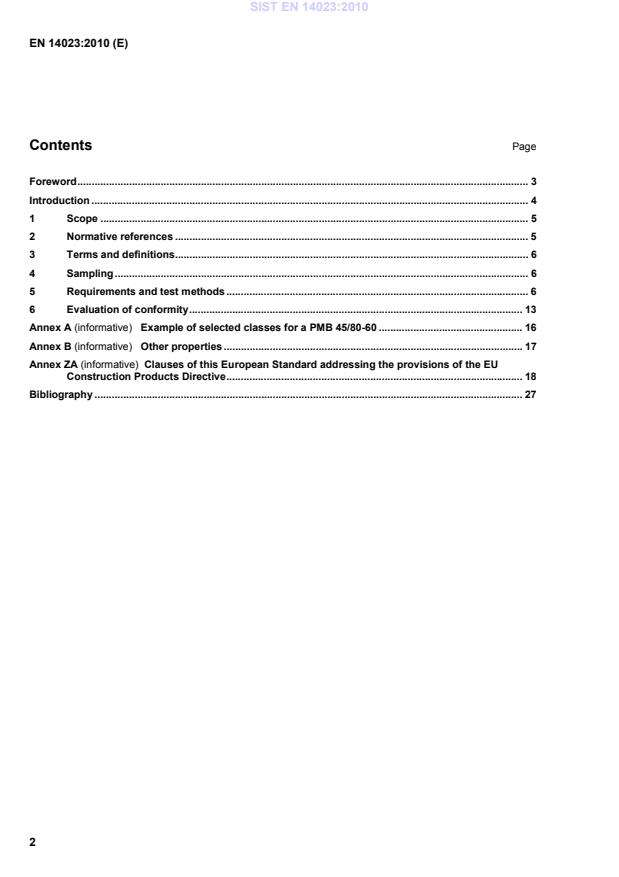
Example of selected classes for a PMB 45/80-60 . 16Annex B (informative)
Other properties . 17Annex ZA (informative)
Clauses of this European Standard addressing the provisions of the EU Construction Products Directive . 18Bibliography . 27 SIST EN 14023:2010
NOTE Industrial applications are not covered by mandate M/124. According to the CEN/CENELEC Internal Regulations, the national standards organizations of the following countries are bound to implement this European Standard: Austria, Belgium, Bulgaria, Croatia, Cyprus, Czech Republic, Denmark, Estonia, Finland, France, Germany, Greece, Hungary, Iceland, Ireland, Italy, Latvia, Lithuania, Luxembourg, Malta, Netherlands, Norway, Poland, Portugal, Romania, Slovakia, Slovenia, Spain, Sweden, Switzerland and the United Kingdom.
Bituminous binders Paving grade bitumens EN 12591 Oxidized bitumens (industrial applications) EN 13304 Hard Gradeindustrialbitumens (industrial applications)EN 13924 Hard paving grade bitumens Polymer modified bitumens EN 14023 EN 13305Cut-back &fluxed bituminous binders EN 15322 CationicbituminousemulsionsEN 13808 SIST EN 14023:2010
Sampling bituminous binders EN 1426, Bitumen and bituminous binders
Determination of needle penetration EN 1427, Bitumen and bituminous binders
Determination of the softening point
Ring and Ball method EN 12593, Bitumen and bituminous binders
Determination of the Fraass breaking point EN 12594, Bitumen and bituminous binders
Preparation of test samples EN 12595, Bitumen and bituminous binders
Determination of kinematic viscosity EN 12596, Bitumen and bituminous binders
Determination of dynamic viscosity by vacuum capillary EN 12597:2000, Bitumen and bituminous binders
Terminology EN 12607-1, Bitumen and bituminous binders
Determination of the resistance to hardening under the influence of heat and air
Part 1: RTFOT method EN 13302, Bitumen and bituminous binders
Determination of dynamic viscosity of bituminous binder using a rotating spindle apparatus EN 13398, Bitumen and bituminous binders
Determination of the elastic recovery of modified bitumen SIST EN 14023:2010
Determination of storage stability of modified bitumen EN 13587, Bitumen and bituminous binders
Determination of the tensile properties of bituminous binders by the tensile test method EN 13588, Bitumen and bituminous binders
Determination of cohesion of bituminous binders with pendulum test EN 13589, Bitumen and bituminous binders
Determination of the tensile properties of modified bitumen by the force ductility method EN 13702-1, Bitumen and bituminous binders
Determination of dynamic viscosity of modified bitumen
Part 1: Cone and plate method EN 13703, Bitumen and bituminous binders
Determination of deformation energy EN 15326, Bitumen and bituminous binders
Measurement of density and specific gravity
Capilliary-stoppered pyknometer method (including EN 15326:2007/A1:2009) EN ISO 2592, Determination of flash and fire points
Cleveland open cup method (ISO 2592:2000) EN ISO 4259, Petroleum products
Determination and application of precision data in relation to methods of test (ISO 4259:2006) EN ISO 9001:2008, Quality management systems
Requirements (ISO 9001:2008) 3 Terms and definitions For the purposes of this document, the terms and definitions given in EN 12597:2000 apply. The following abbreviation term is used in the specification tables of this document (see Table 1, Table 2 and Table 3): TBR for "To Be Reported": this class shall mean that the manufacturer is invited, but not required, to provide information, regarding performance characteristics, with the product. NOTE The reported values (TBR) are intended to be used for future development of specifications. NR for "No Requirement" may be used when there are no regulations or other regional requirements for the property in the territory of intended use. 4 Sampling Samples of bulk products shall be taken as described in EN 58. Test samples shall be taken from the laboratory samples, and prepared for testing, as described in EN 12594. 5 Requirements and test methods 5.1 General European product standards cover a large variety of road materials for different applications, to accommodate local traffic loads and climatic conditions. This European Standard therefore also covers a large range of bitumens to facilitate the production and application of the designed paving. This European Standard is a framework of specifications and classes for properties of polymer modified bitumens which are chosen from Table 1, Table 2 and Table 3. SIST EN 14023:2010
In Table 3 further properties that have been considered useful for specifications are described. NOTE 1 Each country will then have a particular selection of specifications, which, if regulated, are covered in Tables 1 and 2 and which, if commonly used by industry, are covered in Table 3. It is useful for each country to publish in a national guidance document for each application, their requirements for polymer modified bitumens from Table 1, Table 2 and Table 3. The appropriate class for each technical requirement or application is selected in turn and the selection of classes should be made from past experience of successful use, on a regional basis, in order to avoid unworkable combinations. NOTE 2 In order to assist in using the tables, an example has been provided in Annex A. 5.2.2 Consistency at intermediate service temperatures Consistency at intermediate service temperature for polymer modified bitumens shall comply with the requirements for penetration at 25 °C in Table 1. The grades are designated by the nominal penetration range at 25 °C. 5.2.3 Consistency at elevated service temperatures Consistency at elevated service temperature for polymer modified bitumens shall comply with the requirements for softening point as indicated in Table 1. Polymer modified bitumens are supplied for a variety of end uses in various climatic conditions; consequently the specifications include a wide range of softening point values. NOTE The various softening point limits are included so as not to prevent some traditional methods used to evaluate the suitability of modified bitumens in the different European climatic conditions (for more information refer to national guidance documents). As the grading system is based on the consistency at intermediate and elevated service temperatures, values shall be given for these characteristics. 5.2.4 Brittleness at low service temperature Brittleness at low service temperature may be required to meet specific regional conditions. Where required, polymer modified bitumens shall conform to the requirements for Fraass breaking point in Table 2. For some highly modified polymer modified bitumens, Fraass breaking point is not a suitable low temperature method and, in that case, low temperature elastic recovery at 10 °C shall be used. 5.2.5 Cohesion The property of cohesion is included as a means of differentiating polymer modified bitumens from paving grade bitumens. Three different test methods are included in Table 1: force ductility, tensile test and Vialit pendulum. These reflect the different characteristics that can occur with polymer modified bitumens and are not considered to be equivalent. It is intended that the most appropriate cohesion test method shall be used in each case, at the discretion of the supplier. The manufacturer shall state the test method used. SIST EN 14023:2010
In order to assist in controlling rutting deformation and cracking of asphalt mixes, optional tests and classes, for measurements on material after the hardening procedure, are given in Table 3. The choice will depend upon climatic conditions, traffic and local use. Resistance to hardening is not appropriate for surface dressing bitumens. 5.2.7 Strain recovery Strain recovery may be required to meet specific regional conditions. Where required, polymer modified bitumens shall conform to the requirements for elastic recovery at 25 °C or 10 °C in Table 2. 5.2.8 Other properties 5.2.8.1 Informative characteristics The framework specifications include a table of informative characteristics (see Annex B) based on new test methods that are under validation. Producers of polymer modified bitumens are invited to supply data from these measurements to the client on a voluntary basis. It is hoped that the data so gathered will be of assistance in developing performance-related specifications in the future. 5.2.8.2 Flash point The flash point shall be determined by the Cleveland open cup method in EN ISO 2592 for normal specification purposes. NOTE The Pensky-Martens closed cup method (see EN ISO 2719 [6]) can be used to investigate possible contamination but is likely to give lower values. 5.2.8.3 Density Where required, density shall be determined in accordance with EN 15326. 5.2.8.4 Plasticity range The plasticity range is the numerical difference between the softening point and Fraass breaking point.
EXAMPLE Polymer modified bitumen with a softening point of 75 °C and a Fraass breaking point of - 18 °C would have a plasticity range of 93 °C. 5.2.8.5 Storage conditions Storage conditions of the polymer modified bitumen shall be given by the supplier. 5.2.8.6 Homogeneity and storage stability Homogeneity is necessary for polymer modified bitumens. The tendency of polymer modified bitumens to separate during storage may be assessed by the storage stability test (see EN 13399). If the product does not fulfil the SIST EN 14023:2010
45-80
40-100
65-105
75-130
90-150
120-200 200-300
Softening Point EN 1427 °C ≥ 80
≥ 75
≥ 70
≥ 65 ≥ 60 ≥ 55
≥ 50
≥ 45
≥ 40
Cohesion a Force ductility a
(50 mm/min traction)
or EN 13589 followed by EN 13703 J/cm2 ≥ 3 at 5 °C ≥ 2 at 5 °C ≥ 1 at 5 °C ≥ 2
at 0 °C ≥ 2 at 10 °C ≥ 3 at 10 °C ≥ 0,5 at 15 °C ≥ 2 at 15 °C ≥ 0,5 at 20 °C ≥ 0,5 at 25 °C
Tensile test
a (100 mm/min traction) or EN 13587 followed by EN 13703 J/cm2 ≥ 3 at 5°C ≥ 2
at 5 °C ≥ 1
at 5 °C ≥ 3 at 0 °C ≥ 3 at 10 °C
Vialit pendulum a
(Impact test) EN 13588 J/cm2 ≥ 0,7
Resistance to hardening b Retained Penetration EN 12607-1 % ≥ 35 ≥ 40 ≥ 45 ≥ 50 ≥ 55 ≥ 60
Increase in
Softening point °C ≤ 8 ≤ 10 ≤ 12
Change of mass c % ≤ 0,3 ≤ 0,5 ≤ 0,8 ≤ 1,0
Flash Point
EN ISO 2592 °C ≥ 250 ≥ 235 ≥ 220
a One cohesion method shall be chosen based on end application. Vialit cohesion (EN 13588) shall only be used for surface dressing binders. b The main test is the RTFOT at 163 °C. For some highly viscous polymer modified bitumens where the viscosity is too high to provide a moving film it is not possible to carry out the RTFOT at the reference temperature of 163 °C. In such cases the procedure shall be carried out at 180 °C in accordance with EN 12607-1. c Change of mass can be positive or negative.
The properties in Table 1 shall be specified for all polymer modified bitumens listed in this table. They are associated with regulatory or HSE requirements and shall be included in all specifications. SIST EN 14023:2010
2 3 4 5 6 7 8 9 10 Fraass Breaking Point EN 12593 °C NR a TBR b ≤ 0 ≤ - 5 ≤ - 7 ≤ - 10 ≤ - 12 ≤ - 15 ≤ - 18 ≤ - 20 ≤ - 22 Elastic recovery
25 °C or c EN 13398 % NR a TBR b ≥ 80 ≥ 70 ≥ 60 ≥ 50
10 °C EN 13398 % NR a TBR b ≥ 75 ≥ 50
a NR. No Requirement may be used when there are no regulations or other regional requirements for the property in the territory of intended use.
b TBR. To Be Reported may be used when there are no regulations or other regional requirements for the property in the territory of intended use, but the property has been found useful to describe polymer modified bitumens. c Where required, polymer modified bitumens shall conform to the requirements for elastic recovery at 25 °C or 10 °C.
The properties in Table 2 are required to meet specific regional conditions. They are associated with regulatory or other regional requirements.
Elastic recovery at 25 °C after EN 12607-1 EN 13398 % NR a TBR ≥ 70 ≥ 60 ≥ 50
Elastic recovery at 10 °C after EN 12607-1 EN 13398 % NR a TBR ≥ 50
Storage stability b
Difference in softening point EN 13399
EN 1427
°C
NR a
TBR b
≤ 5
Storage stability b
Difference in penetration EN 13399
EN 1426
0,1 mm
NR a
TBR b
≤ 9
≤ 13
≤ 19
≤ 26
a NR. No Requirement may be used when there are no requirements for the property in the territory of intended use. b Storage conditions of the polymer modified binder shall be given by the supplier. Homogeneity is necessary for polymer modified bitumens. The tendency of polymer modified bitumens to separate during storage may be assessed by the storage stability test (see EN 13399). If the product does not fulfil the properties in Table 3 Classes 2 to 5, information shall be given by the supplier regarding storage conditions for the polymer modified bitumen to avoid separation of the components and to ensure the homogeneity of the product.
NOTE The following data may be given by the supplier o
...
SLOVENSKI SIST EN 14023
STANDARD
junij 2010
Bitumen in bitumenska veziva – Okvirna specifikacija za bitumne, modificirane
s polimeri
Bitumen and bituminous binders – Specification framework for polymer modified
bitumens
Bitumes et liants bitumineux – Cadre de spécifications des bitumes modifiés par
des polymères
Bitumen und bitumenhaltige Bindemittel – Rahmenwerk für die Spezifikation von
polymermodifizierten Bitumen
Referenčna oznaka
ICS 91.100.50; 93.080.20 SIST EN 14023:2010 (sl)
Nadaljevanje na straneh II in III ter od 1 do 25
© 2012-01. Standard je založil in izdal Slovenski inštitut za standardizacijo. Razmnoževanje celote ali delov tega standarda ni dovoljeno.
SIST EN 14023 : 2010
NACIONALNI UVOD
Standard SIST EN 14023 (sl), Bitumen in bitumenska veziva – Okvirna specifikacija za bitumne,
modificirane s polimeri, 2010, ima status slovenskega standarda in je enakovreden evropskemu
standardu EN 14023 (en, de, fr), Bitumen and bituminous binders – Specification framework for
polymer modified bitumens, 2010.
NACIONALNI PREDGOVOR
Evropski standard EN 14023:2010 je pripravil tehnični odbor Evropskega komiteja za standardizacijo
CEN/TC 336 Bitumenska veziva. Slovenski standard SIST EN 14023:2010 je prevod evropskega
standarda EN 14023:2010. V primeru spora glede besedila slovenskega prevoda v tem standardu je
odločilen izvirni evropski standard v enem izmed treh uradnih jezikov CEN. Slovensko izdajo
standarda je pripravil tehnični odbor SIST/TC VLA Vlaga.
Odločitev za izdajo tega standarda je dne 11. maja 2010 sprejel SIST/TC VLA Vlaga.
Ta dokument nadomešča SIST EN 14023:2005.
UPORABLJENE KRATICE:
CPD Construction Product Directive Direktiva o gradbenih proizvodih
EGP European Economic Area (EEA) Evropski gospodarski prostor
FPC Factory Production Control kontrola proizvodnje v obratu
HSE Health, Safety & Environment sistem varovanja zdravja, varnosti in okolja
ITT Initial Type Testing začetno tipsko preskušanje
NR No Requirement ni zahteve
NPD No Performance Determined lastnost ni določena
TBR To Be Reported navesti
ZVEZA S STANDARDI
S privzemom tega evropskega standarda veljajo za omenjeni namen referenčnih standardov vsi
standardi, navedeni v izvirniku, razen tistih, ki so že sprejeti v nacionalno standardizacijo:
SIST EN 58 Bitumen in bitumenska veziva – Vzorčenje bitumenskih veziv
SIST EN 1426 Bitumen in bitumenska veziva – Določanje penetracije z iglo
SIST EN 1427 Bitumen in bitumenska veziva – Določanje zmehčišča – Metoda prstana in
kroglice
SIST EN 12593 Bitumen in bitumenska veziva – Določanje pretrgališča po Fraassu
SIST EN 12594 Bitumen in bitumenska veziva – Priprava preskusnih vzorcev
SIST EN 12595 Bitumen in bitumenska veziva – Določanje kinematične viskoznosti
SIST EN 12596 Bitumen in bitumenska veziva – Določanje dinamične viskoznosti z metodo
kapilare z vakuumom
SIST EN 12597:2003 Bitumen in bitumenska veziva – Terminologija
SIST EN 12607-1 Bitumen in bitumenska veziva – Določanje odpornosti proti otrjevanju pod
vplivom toplote in zraka – 1. del: Metoda RTFOT
SIST EN 13302 Bitumen in bitumenska veziva – Določanje dinamične viskoznosti
bitumenskih veziv z uporabo rotacijskega viskozimetra
SIST EN 13398 Bitumen in bitumenska veziva – Določevanje elastičnega povratka
modificiranih bitumnov
II
SIST EN 14023 : 2010
SIST EN 13399 Bitumen in bitumenska veziva – Določevanje stabilnosti modificiranih
bitumnov pri skladiščenju
SIST EN 13587 Bitumen in bitumenska veziva – Določevanje nateznih lastnosti
bitumenskih veziv z natezno preskusno metodo
SIST EN 13588 Bitumen in bitumenska veziva – Določevanje kohezijskih lastnosti
bitumenskih veziv – Preskus z nihalom
SIST EN 13589 Bitumen in bitumenska veziva – Določevanje nateznih lastnosti
modificiranih bitumnov – Metoda določanja sile pri merjenju duktilnosti
SIST EN 13702-1 Bitumen in bitumenska veziva – Določevanje dinamične viskoznosti
modificiranih bitumnov – 1. del: Metoda s konusom in ploščo
SIST EN 13703 Bitumen in bitumenska veziva – Določevanje deformacijske energije
SIST EN 15326 Bitumen in bitumenska veziva – Merjenje gostote in specifične teže –
Metoda s kapilarnim piknometrom z zamaškom
SIST EN ISO 2592 Določevanje plamenišča in točke gorenja – Metoda z odprto posodo po
Clevelandu (ISO 2592:2000)
SIST EN ISO 4259 Naftni proizvodi – Določanje in uporaba stopenj natančnosti pri preskusnih
metodah (ISO 4259:2006)
SIST EN ISO 9001:2008 Sistemi vodenja kakovosti – Zahteve (ISO 9001:2008)
OSNOVA ZA IZDAJO STANDARDA
– privzem standarda EN 14023:2010
PREDHODNA IZDAJA
– SIST EN 14023:2005, Bitumen in bitumenska veziva – Okvirna specifikacija za bitumne,
modificirane s polimeri
OPOMBE
– Povsod, kjer se v besedilu standarda uporablja izraz “evropski standard”, v SIST EN 14023:2010
to pomeni “slovenski standard”.
– Uvod in nacionalni predgovor nista sestavni del standarda.
– Ta nacionalni dokument je istoveten EN 14023:2010 in je objavljen z dovoljenjem
CEN
Management Centre
Avenue Marnix 17
B-1000 Bruselj
– This national document is identical with EN 14023:2010 and is published with the permission of
CEN
Management Centre
Avenue Marnix 17
B-1000 Brussels
III
SIST EN 14023 : 2010
IV
EVROPSKI STANDARD EN 14023
EUROPEAN STANDARD
NORME EUROPÉENNE
EUROPÄISCHE NORM april 2010
ICS 93.080.20 Nadomešča EN 14023:2005
Slovenska izdaja
Bitumen in bitumenska veziva – Okvirna specifikacija za bitumne, modificirane s
polimeri
Bitumen and bituminous binders Bitumes et liants bitumineux – Cadre Bitumen und bitumenhaltige
– Specification framework for de spécifications des bitumes Bindemittel – Rahmenwerk für die
polymer modified bitumens modifiés par des polymères Spezifikation von
polymermodifizierten Bitumen
Ta evropski standard je CEN sprejel 6. marca 2010.
Člani CEN morajo izpolnjevati notranje predpise CEN/CENELEC, s katerimi je predpisano, da mora
biti ta standard brez kakršnih koli sprememb sprejet kot nacionalni standard, Seznami najnovejših
izdaj teh nacionalnih standardov in njihovi bibliografski podatki so na voljo pri Upravnem centru CEN
in članicah CEN.
Ta evropski standard obstaja v treh izvirnih izdajah (angleški, francoski, nemški). Izdaje v drugih
jezikih, ki jih članice CEN na lastno odgovornost prevedejo in izdajo ter prijavijo pri Upravnem centru
CEN, veljajo kot uradne izdaje.
Člani CEN so nacionalne organi za standardizacijo Avstrije, Belgije, Bolgarije, Hrvaške, Cipra, Češke
republike, Danske, Estonije, Finske, Francije, Grčije, Islandije, Irske, Italije, Latvije, Litve,
Luksemburga, Madžarske, Malte, Nemčije, Nizozemske, Norveške, Poljske, Portugalske, Romunije,
Slovaške, Slovenije, Španije, Švedske, Švice in Združenega kraljestva.
CEN
Evropski komite za standardizacijo
European Committee for Standardisation
Comité Européen de Normalisation
Europäisches Komitee für Normung
Upravni center: Avenue Marnix 17, B-1000 Brussels
© 2010 CEN Lastnice avtorskih pravic so vse države članice CEN. Ref. oznaka EN 14023:2010 E
SIST EN 14023 : 2010
VSEBINA Stran
Predgovor .3
Uvod .4
1 Področje uporabe .5
2 Zveza s standardi .5
3 Izrazi in definicije .6
4 Vzorčenje.6
5 Zahteve in preskusne metode .6
6 Vrednotenje skladnosti .13
Dodatek A (informativni): Primer izbire razredov za PMB 45/80-60 .16
Dodatek B (informativni): Druge lastnosti.17
Dodatek ZA (informativni): Točke tega evropskega standarda, ki se nanašajo na določila
Direktive EU o gradbenih proizvodih .18
Literatura.25
SIST EN 14023 : 2010
Predgovor
Ta dokument (EN 14023:2010) je pripravil tehnični odbor CEN/TC 336 Bitumenska veziva, katerega
sekretariat vodi AFNOR.
Ta evropski standard mora dobiti status nacionalnega standarda bodisi z objavo istovetnega besedila
ali z razglasitvijo najpozneje oktobra 2010, nasprotujoče nacionalne standarde pa je treba razveljaviti
najpozneje oktobra 2010.
Opozoriti velja, da so nekateri elementi tega dokumenta lahko predmet patentnih pravic. CEN (in/ali
CENELEC) ni odgovoren za ugotavljanje katere koli ali vseh takšnih patentnih pravic.
Ta dokument nadomešča EN 14023:2005.
Ta dokument je pripravljen v okviru mandata, ki sta ga Evropska komisija in Evropsko združenje za
prosto trgovino dala CEN, in podpira bistvene zahteve evropske Direktive o gradbenih proizvodih.
Za zvezo z evropsko direktivo(-ami) glej informativni dodatek ZA, ki je sestavni del tega dokumenta.
Ta evropski standard je del naslednje družine evropskih standardov za bitumne:
Bitumenska veziva
Trši
Rezana in
Oksidirani
Trši Bitumni, Kationske
Cestogradbeni industrijski
fluksirana
bitumni
cestogradbeni modificirani s
bitumenske
bitumni
bitumni
bitumenska
(industrijska
bitumni polimeri emulzije
(industrijska
veziva uporaba)
uporaba)
EN 12591 EN 13808
EN EN 13924 EN 14023
EN 15322
EN 13304
EN 13305
OPOMBA: Industrijska uporaba ni predmet mandata M/124.
V skladu z notranjimi predpisi CEN/CENELEC so dolžne ta evropski standard privzeti nacionalne
organizacije za standardizacijo naslednjih držav: Avstrije, Belgije, Bolgarije, Hrvaške, Cipra, Češke
republike, Danske, Estonije, Finske, Francije, Grčije, Islandije, Irske, Italije, Latvije, Litve,
Luksemburga, Madžarske, Malte, Nemčije, Nizozemske, Norveške, Poljske, Portugalske, Romunije,
Slovaške, Slovenije, Španije, Švedske, Švice in Združenega kraljestva.
SIST EN 14023 : 2010
Uvod
Ta evropski standard je tesno povezan s standardom EN 12591, Bitumen in bitumenska veziva –
Specifikacije za cestogradbene bitumne [1]. V tem uvodu so podane informacije o podlagi za izbiro
tipov bitumnov, opredeljenih v tem evropskem standardu, statusu nekaterih lastnosti in o preskusnih
metodah ter predlaganem razvoju tega evropskega standarda.
Za razvoj EN 12591[1] je bilo sprejeto splošno načelo, da se zagotovi širok izbor tipov bitumnov za
izdelavo materialov za gradnjo in vzdrževanje cest z upoštevanjem podnebnih in prometnih razmer v
vseh državah članicah. Ta evropski standard širi izbor tipov bitumnov, specificiranih v EN 12591 [1],
saj imajo modificirana veziva za gradnjo in vzdrževanje cest izboljšane lastnosti.
Enako kot velja za EN 12591 [1], je obvezno objaviti celotne specifikacije v vseh državah EU in EFTA,
pri čemer je dopuščeno vsaki članici, da sama zase opredeli najustreznejše tipe in razrede.
Dodatek B navaja informativne lastnosti in poziva proizvajalce bitumnov, modificiranih s polimeri, da jih
neobvezno upoštevajo. Pričakovati je, da bodo tako zbrani podatki v pomoč pri prihodnjem razvoju
lastnosti, bolj neposredno povezanih s končnim namenom uporabe.
SIST EN 14023 : 2010
1 Področje uporabe
Ta evropski standard določa okvirne specifikacije za lastnosti in ustrezne preskusne metode za
bitumne, modificirane s polimeri, ki so primerni za gradnjo in vzdrževanje cest, letališč in drugih
asfaltnih površin.
Okvir sestavljajo naslednje lastnosti:
– "konsistenca pri srednji temperaturi uporabe",
– "konsistenca pri povišani temperaturi uporabe",
– "kohezija",
– "trajnost" konsistence,
– "krhkost pri nižji temperaturi uporabe",
– "povratek deformacije".
Kohezijske lastnosti so bile vključene kot sredstvo razlikovanja med bitumni, modificiranimi s polimeri,
in drugimi bitumenskimi vezivi. Drugi bistveni zahtevi, to sta "obstojnost" in "odpornost proti
posedanju", se pokažeta šele s preskusi končnih bitumenskih zmesi.
Uvedba razredov ustreznosti v preglednicah 1, 2 in 3 omogoča izbiro najustreznejše specifikacije za
bitumen z upoštevanjem lokalnih podnebnih razmer in izkušenj. Oznaka bitumnov, modificiranih s
polimeri, je sestavljena iz mejnih vrednosti za penetracijo in vrednosti najmanjšega dopustnega
zmehčišča (glej primer v dodatku A).
2 Zveze s standardi
Za uporabo tega standarda so nujno potrebni spodaj navedeni dokumenti. Pri datiranih dokumentih
velja samo navedena izdaja. Pri nedatiranih dokumentih velja najnovejša izdaja dokumenta (vključno z
morebitnimi spremembami).
EN 58 Bitumen in bitumenska veziva – Vzorčenje bitumenskih veziv
EN 1426 Bitumen in bitumenska veziva – Določanje penetracije z iglo
EN 1427 Bitumen in bitumenska veziva – Določanje zmehčišča – Metoda prstana in
kroglice
EN 12593 Bitumen in bitumenska veziva – Določanje pretrgališča po Fraassu
EN 12594 Bitumen in bitumenska veziva – Priprava preskusnih vzorcev
EN 12595 Bitumen in bitumenska veziva – Določevanje kinematične viskoznosti
EN 12596 Bitumen in bitumenska veziva – Določevanje dinamične viskoznosti z
metodo kapilare z vakuumom
EN 12597:2000 Bitumen in bitumenska veziva – Terminologija
EN 12607-1 Bitumen in bitumenska veziva – Določanje odpornosti proti otrjevanju pod
vplivom toplote in zraka – 1. del: Metoda RTFOT
EN 13302 Bitumen in bitumenska veziva – Določanje dinamične viskoznosti
bitumenskih veziv z uporabo rotacijskega viskozimetra
EN 13398 Bitumen in bitumenska veziva – Določevanje elastičnega povratka
modificiranih bitumnov
EN 13399 Bitumen in bitumenska veziva – Določevanje stabilnosti modificiranih
bitumnov pri skladiščenju
EN 13587 Bitumen in bitumenska veziva – Določevanje nateznih lastnosti bitumenskih
veziv z natezno preskusno metodo
SIST EN 14023 : 2010
EN 13588 Bitumen in bitumenska veziva – Določevanje kohezijskih lastnosti
bitumenskih veziv – Preskus z nihalom
EN 13589 Bitumen in bitumenska veziva – Določevanje nateznih lastnosti modificiranih
bitumnov – Metoda določanja sile pri merjenju duktilnosti
EN 13702-1 Bitumen in bitumenska veziva – Določevanje dinamične viskoznosti
modificiranih bitumnov – 1. del: Metoda s konusom in ploščo
EN 13703 Bitumen in bitumenska veziva – Določevanje deformacijske energije
EN 15326 Bitumen in bitumenska veziva – Merjenje gostote in specifične teže –
Metoda s kapilarnim piknometrom z zamaškom (skupaj z EN
15326:2007/A1:2009)
EN ISO 2592 Določevanje plamenišča in točke gorenja – Metoda z odprto posodo po
Clevelandu (ISO 2592:2000)
EN ISO 4259 Naftni proizvodi – Določanje in uporaba stopenj natančnosti pri preskusnih
metodah (ISO 4259:2006)
EN ISO 9001:2008 Sistemi vodenja kakovosti – Zahteve (ISO 9001:2008)
3 Izrazi in definicije
V tem evropskem standardu se uporabljajo izrazi in definicije, navedeni v standardu EN 12597:2000.
V specifikacijskih preglednicah tega dokumenta sta uporabljeni naslednji kratici (glej preglednice 1, 2 in 3):
TBR ("To Be Reported") za "navesti": ta razred pomeni, da je zaželeno, da proizvajalec navede
informacijo o proizvodu, ni pa to obvezno.
OPOMBA: Navedene vrednosti (TBR) bodo služile za potrebe bodočega razvoja specifikacij.
NR ("No Requirement") za "ni zahteve" se lahko uporabi, kadar ni zakonodajnih ali drugih nacionalnih
zahtev za lastnost na območju predvidene uporabe.
4 Vzorčenje
Vzorec iz celotne pošiljke je treba odvzeti v skladu z EN 58.
Preskusne vzorce je treba odvzeti iz laboratorijskih vzorcev in jih pripraviti za preskušanje, kot je
opisano v EN 12594.
5 Zahteve in preskusne metode
5.1 Splošno
Evropski standardi za proizvode zajemajo zelo različne cestogradbene materiale za različne namene
uporabe, da bi se ti prilagodili lokalnim prometnim obremenitvam in podnebnim razmeram. Ta evropski
standard zato zajema širok spekter bitumnov, da bi olajšal proizvodnjo in uporabo načrtovanih asfaltnih
plasti.
Ta evropski standard je okvir za specifikacije in razrede za lastnosti bitumnov, modificiranih s polimeri,
izbranih iz preglednic 1, 2 in 3.
V preglednicah so lastnosti razdeljene na tri skupine. Lastnosti v preglednici 1 morajo biti določene za vse
bitumne, modificirane s polimeri. Povezane so z zakonodajo ali zahtevami HSE. Lastnosti v preglednici 2
so zahtevane, kadar morajo biti izpolnjeni posebni regionalni pogoji. Povezane so z zakonodajo ali
drugimi regionalnimi zahtevami. Lastnosti v preglednici 3 so dodatne lastnosti, ki niso obvezne, so se pa v
SIST EN 14023 : 2010
preteklosti izkazale za koristne v nekaterih državah, ker dobro opišejo lastnosti bitumnov, modificiranih s
polimeri.
5.2 Lastnosti in z njimi povezane preskusne metode
5.2.1 Splošno
Lastnosti bitumnov, modificiranih s polimeri, in z njimi povezane preskusne metode morajo biti izbrane
v skladu s preglednicama 1 in 2. Različni tipi bitumnov, preskušeni po predpisanih metodah, morajo
ustrezati mejnim vrednostim, postavljenim v preglednici.
V preglednici 3 so opisane dodatne lastnosti, ki so se v preteklosti izkazale za koristne.
OPOMBA 1: Vsaka država bo nato izdelala poseben izbor specifikacij, ki jih bo, če so regulirane, izbrala iz preglednic 1 in 2,
oziroma kadar so splošno uporabljene v industriji, iz preglednice 3. Za vsako državo je priporočljivo, da v svojih
nacionalnih navodilih objavi za vsako vrsto uporabe bitumnov, modificiranih s polimeri, poseben dokument s svojimi
zahtevami iz preglednic 1, 2 in 3. Po vrsti izbere ustrezni razred za vsako tehnično zahtevo ali vrsto uporabe. Izbira
ustreznih razredov naj temelji na preteklih izkušnjah in dobri praksi na regionalni podlagi, da se preprečijo
neuporabne kombinacije.
OPOMBA 2: Za pomoč pri uporabi preglednic je podan vzorec v dodatku A.
5.2.2 Konsistenca pri srednji temperaturi uporabe
Konsistenca bitumnov, modificiranih s polimeri, pri srednji temperaturi uporabe mora ustrezati
vrednostim za penetracijo pri 25 °C iz preglednice 1. Tipi bitumnov so označeni glede na nazivno
vrednost penetracije pri 25 °C.
5.2.3 Konsistenca pri povišani temperaturi uporabe
Konsistenca bitumnov, modificiranih s polimeri, pri povišani temperaturi uporabe mora ustrezati
vrednostim za zmehčišče, kot je navedeno v preglednici 1.
Bitumni, modificirani s polimeri, se dobavljajo za različne končne namene uporabe v različnih
podnebnih razmerah, zato specifikacije dopuščajo širok izbor vrednosti za zmehčišče.
OPOMBA: Navedene so različne mejne vrednosti zmehčišč, da bi omogočile vrednotenje ustreznosti modificiranih
bitumnov v različnih evropskih podnebnih razmerah tudi na podlagi nekaterih starih metod preskušanja (več
informacij je v nacionalnih navodilih).
Ker razvrstitev v tipe temelji na konsistenci pri srednji in povišani temperaturi uporabe, morajo biti
navedene vrednosti za te lastnosti.
5.2.4 Krhkost pri nizki temperaturi uporabe
Krhkost pri nizki temperaturi uporabe je lahko zahtevana za posebne regionalne razmere. Kjer je to
zahtevano, morajo bitumni, modificirani s polimeri, izpolnjevati zahteve za pretrgališče po Fraassu,
podane v preglednici 2.
Za nekatere visoko polimerizirane bitumne vrednost pretrgališča po Fraassu ni primerna metoda za
določanje odpornosti pri nizki temperaturi, zato je v takih primerih treba izvesti meritev elastičnega
povratka pri 10 °C.
5.2.5 Kohezija
Kohezijske lastnosti so vključene kot sredstvo razločevanja bitumnov, modificiranih s polimeri, od
standardnih cestogradbenih bitumnov. V preglednici 1 so navedene tri različne metode preskušanja:
merjenje sile pri duktilnosti, preskus natezne trdnosti in z nihalom Vialit. Te odražajo različne lastnosti,
ki jih lahko imajo bitumni, modificirani s polimeri, in med seboj niso enakovredne. Osnovni namen je,
SIST EN 14023 : 2010
da se v vsakem posameznem primeru glede na izkušnje dobavitelja uporabi najustreznejša metoda za
preskus kohezijskih lastnosti. Proizvajalec mora določiti metodo preskušanja.
Izbere se ena metoda preskušanja kohezije, ki je odvisna od končne uporabe. Preskus z nihalom
Vialit (EN 13588) se uporablja le za veziva za površinske prevleke.
5.2.6 Trajnost – odpornost proti otrjevanju
Odpornost proti otrjevanju je treba preskušati po kondicioniranju po metodi RTFOT (glej EN 12607-1).
Osnovni preskus RTFOT se izvede pri 163 °C. Nekateri visoko viskozni bitumni, modificirani s
polimeri, imajo previsoko viskoznost, da bi tvorili ustrezen film pri referenčni temperaturi 163 °C, zato
se v teh primerih metoda RTFOT po EN 12607-1 izvede pri 180 °C.
OPOMBA: Za pomoč pri pregledovanju nastanka kolesnic in razpok v bitumenskih zmeseh so v preglednici 3 navedene
neobvezne metode in razredi za merjenje materialov po otrjevanju. Izbira bo odvisna od podnebnih razmer,
prometa in lokalnih izkušenj.
Odpornost proti otrjevanju ni merodajna za bitumne za površinske prevleke.
5.2.7 Povratek deformacije
Povratek deformacije je lahko zahtevan za posebne regionalne razmere. Kjer je to zahtevano, morajo
bitumni, modificirani s polimeri, izpolnjevati zahteve za elastični povratek pri 25 °C ali pri 10 °C,
podane v preglednici 2.
5.2.8 Druge lastnosti
5.2.8.1 Informativne lastnosti
Okvirne specifikacije vsebujejo tudi preglednico z informativnimi lastnostmi (glej dodatek B) na podlagi
novih preskusnih metod, ki so še v postopku validacije. Proizvajalci bitumnov, modificiranih s polimeri,
naj podatke teh meritev prostovoljno dajo na voljo kupcem. Pričakovati je, da bodo tako zbrani podatki
v pomoč pri prihodnjem razvoju lastnosti, bolj neposredno povezanih s končnim namenom uporabe.
5.2.8.2 Plamenišče
Ponavadi se plamenišče ugotavlja po metodi z odprto posodo po Clevelandu skladno s standardom
EN ISO 2592.
OPOMBA: Metoda po Pensky-Martensu z zaprto posodo (EN ISO 2719) se lahko uporabi, kadar se preiskujejo morebitna
onesnaženja, vendar ponavadi daje ta metoda nižje vrednosti.
5.2.8.3 Gostota
Kadar se zahteva, se gostota ugotavlja v skladu z EN 15326.
5.2.8.4 Območje plastičnosti
Območje plastičnosti je številčna razlika med vrednostma zmehčišča in pretrgališča po Fraassu.
PRIMER: Bitumen, modificiran s polimeri, ki ima zmehčišče pri 75 °C in pretrgališče po Fraassu pri
–18 °C, ima območje plastičnosti 93 °C.
5.2.8.5 Pogoji skladiščenja
Pogoje skladiščenja bitumnov, modificiranih s polimeri, določi dobavitelj.
SIST EN 14023 : 2010
5.2.8.6 Homogenost in stabilnost pri skladiščenju
Bitumni, modificirani s polimeri, morajo biti homogeni. Težnja teh bitumnov po razslojevanju med
skladiščenjem se lahko oceni s preskusom stabilnosti pri skladiščenju po EN 13399. Če proizvod ne
izpolnjuje zahtevanih lastnosti razreda 2 do razreda 5 iz preglednice 3, mora dobavitelj določiti pogoje
skladiščenja, da se prepreči razslojevanje komponent in zagotovi homogenost proizvoda.
5.3 Izpust nevarnih snovi
Materiali, ki se uporabljajo v proizvodih, ne smejo oddajati nobenih nevarnih snovi v količinah, ki so
večje od največjih predpisanih količin v ustreznih evropskih standardih za materiale ali v nacionalni
zakonodaji države članice.
5.4 Stopnja natančnosti
Preskusne metode, navedene v tem standardu,
...