

EN 13477-2:2021
(Main)Non-destructive testing - Acoustic emission testing - Equipment characterisation - Part 2: Verification of operating characteristics
- Abstract
This document specifies test routines for the periodic verification of the performance of acoustic emission (AE) test equipment, i.e. sensors, pre-amplifiers, signal processors, external parametric inputs.
It is intended for use by qualified personnel to implement an automated verification process.
Verification of the measurement characteristics is advised after purchase of equipment, in order to obtain reference data for later verifications. Verification is also advised after repair, modifications, use under extraordinary conditions, or if one suspects a malfunction.
The procedures specified in this document do not exclude other qualified methods, e.g. verification in the frequency domain. These procedures apply in general unless the manufacturer specifies alternative equivalent procedures.
Safety aspects of equipment for use in potentially explosive zones are not considered in this document.
- Status
- Published
- Publication Date
- 12-Oct-2021
- Withdrawal Date
- 29-Apr-2022
- Technical Committee
- CEN/TC 138 - Non-destructive testing
- Drafting Committee
- CEN/TC 138/WG 7 - Acoustic emission testing
- Current Stage
- 6060 - Definitive text made available (DAV) - Publishing
- Start Date
- 13-Oct-2021
- Due Date
- 17-Feb-2021
- Completion Date
- 13-Oct-2021


Overview
EN 13477-2:2021 - "Non-destructive testing - Acoustic emission testing - Equipment characterisation - Part 2: Verification of operating characteristics" specifies test routines for the periodic verification of acoustic emission (AE) test equipment. It applies to sensors, pre-amplifiers, signal processors and external parametric inputs, and is intended for use by qualified personnel to implement automated verification workflows. Verification is recommended after purchase, repair, modification, unusual operating conditions or when a malfunction is suspected. Safety for explosive atmospheres is not covered.
Key technical topics and requirements
This standard defines procedures and measurements used to verify AE equipment operating characteristics. Major technical topics include:
- Required test equipment and standard test signals (e.g., continuous sine, triangular‑modulated sine burst, sin‑modulated burst, rectangular‑modulated burst, rectangular pulse, repetitive and DC signals).
- Sensor verification
- Sensitivity checks
- Electrical shield crosstalk assessment
- Use of test blocks and shielding test plates
- Pre-amplifier verification
- DC consumption
- Gain and bandwidth
- Electronic noise and dynamic range
- Common‑mode rejection and pulsing tests
- Acoustic emission signal processor verification
- Noise floor and RMS measurement checks
- Floating and fixed threshold functionality
- Bandwidth and filter roll‑off verification
- Burst parameter verification: amplitude, duration, rise‑time, ring‑down counts, energy/signal strength
- System performance checks
- External parametric input verification and formulas
- Pulser and acquisition rate verification
- Delta‑t (Δt) timing accuracy
- Software verification and reporting requirements
- Reporting
- Informative annexes provide report forms for sensors, pre‑amps, signal processors and parametric inputs.
The procedures do not preclude other qualified verification methods (for example, frequency‑domain verification) and may be replaced by manufacturer‑specified equivalent procedures.
Practical applications - who uses it and why
EN 13477-2:2021 is useful for:
- NDT/AE technicians and inspectors performing routine equipment maintenance and calibration
- Quality assurance teams and laboratories conducting acceptance testing of AE systems
- AE equipment manufacturers and service centers performing post‑repair verification
- Asset managers implementing condition monitoring programs that rely on AE data
Benefits include establishing baseline reference data at purchase, ensuring consistent detection performance, reducing false alarms, and supporting reliable condition monitoring and structural health assessments.
Related standards and references
- Part of the EN 13477 series (equipment characterisation for AE testing)
- Normative references such as EN 1330‑1 are cited within the document
Keywords: acoustic emission testing, non‑destructive testing, AE equipment verification, sensor verification, pre‑amplifier testing, signal processor, EN 13477‑2:2021, SIST.
Relations
- Effective Date
- 06-Dec-2017
- Effective Date
- 28-Jan-2026
- Effective Date
- 28-Jan-2026
- Effective Date
- 28-Jan-2026
- Effective Date
- 28-Jan-2026
- Effective Date
- 28-Jan-2026
- Effective Date
- 28-Jan-2026
- Effective Date
- 28-Jan-2026
- Effective Date
- 28-Jan-2026
- Effective Date
- 28-Jan-2026
- Effective Date
- 28-Jan-2026
- Effective Date
- 28-Jan-2026
- Effective Date
- 28-Jan-2026
- Effective Date
- 28-Jan-2026
- Effective Date
- 28-Jan-2026
Get Certified
Connect with accredited certification bodies for this standard

IMP NDT d.o.o.
Non-destructive testing services. Radiography, ultrasonic, magnetic particle, penetrant, visual inspection.
Inštitut za kovinske materiale in tehnologije
Institute of Metals and Technology. Materials testing, metallurgical analysis, NDT.
Q Techna d.o.o.
NDT and quality assurance specialist. 30+ years experience. NDT personnel certification per ISO 9712, nuclear and thermal power plant inspections, QA/
Sponsored listings
Frequently Asked Questions
EN 13477-2:2021 is a standard published by the European Committee for Standardization (CEN). Its full title is "Non-destructive testing - Acoustic emission testing - Equipment characterisation - Part 2: Verification of operating characteristics". This standard covers: This document specifies test routines for the periodic verification of the performance of acoustic emission (AE) test equipment, i.e. sensors, pre-amplifiers, signal processors, external parametric inputs. It is intended for use by qualified personnel to implement an automated verification process. Verification of the measurement characteristics is advised after purchase of equipment, in order to obtain reference data for later verifications. Verification is also advised after repair, modifications, use under extraordinary conditions, or if one suspects a malfunction. The procedures specified in this document do not exclude other qualified methods, e.g. verification in the frequency domain. These procedures apply in general unless the manufacturer specifies alternative equivalent procedures. Safety aspects of equipment for use in potentially explosive zones are not considered in this document.
This document specifies test routines for the periodic verification of the performance of acoustic emission (AE) test equipment, i.e. sensors, pre-amplifiers, signal processors, external parametric inputs. It is intended for use by qualified personnel to implement an automated verification process. Verification of the measurement characteristics is advised after purchase of equipment, in order to obtain reference data for later verifications. Verification is also advised after repair, modifications, use under extraordinary conditions, or if one suspects a malfunction. The procedures specified in this document do not exclude other qualified methods, e.g. verification in the frequency domain. These procedures apply in general unless the manufacturer specifies alternative equivalent procedures. Safety aspects of equipment for use in potentially explosive zones are not considered in this document.
EN 13477-2:2021 is classified under the following ICS (International Classification for Standards) categories: 19.100 - Non-destructive testing. The ICS classification helps identify the subject area and facilitates finding related standards.
EN 13477-2:2021 has the following relationships with other standards: It is inter standard links to EN 13477-2:2010, EN 13477-1:2001, EN 1330-1:2014, EN 1330-2:1998, EN 1330-9:2017, EN 13554:2011, EN ISO 18081:2024, EN ISO 16148:2016, EN 15857:2010, EN 15495:2007, EN 14584:2005, EN 15856:2010, EN ISO 18081:2016, EN 12819:2019, EN 12819:2009. Understanding these relationships helps ensure you are using the most current and applicable version of the standard.
EN 13477-2:2021 is available in PDF format for immediate download after purchase. The document can be added to your cart and obtained through the secure checkout process. Digital delivery ensures instant access to the complete standard document.
Standards Content (Sample)
SLOVENSKI STANDARD
01-december-2021
Nadomešča:
SIST EN 13477-2:2011
Neporušitvene preiskave - Akustična emisija - Določanje značilnosti opreme - 2.
del: Preverjanje lastnosti delovanja
Non-destructive testing - Acoustic emission testing - Equipment characterisation - Part 2:
Verification of operating characteristics
Zerstörungsfreie Prüfung - Schallemissionsprüfung - Charakterisierung der
Prüfausrüstung - Teil 2: Überprüfung der Betriebskenngrössen
Essais non destructifs - Essais d'émission acoustique - Caractérisation de l'équipement -
Partie 2 : Vérifications des caractéristiques de fonctionnement
Ta slovenski standard je istoveten z: EN 13477-2:2021
ICS:
19.100 Neporušitveno preskušanje Non-destructive testing
2003-01.Slovenski inštitut za standardizacijo. Razmnoževanje celote ali delov tega standarda ni dovoljeno.
EN 13477-2
EUROPEAN STANDARD
NORME EUROPÉENNE
October 2021
EUROPÄISCHE NORM
ICS 19.100 Supersedes EN 13477-2:2010
English Version
Non-destructive testing - Acoustic emission testing -
Equipment characterisation - Part 2: Verification of
operating characteristics
Essais non destructifs - Essais d'émission acoustique - Zerstörungsfreie Prüfung - Schallemissionsprüfung -
Caractérisation de l'équipement - Partie 2 : Charakterisierung der Prüfausrüstung - Teil 2:
Vérifications des caractéristiques de fonctionnement Überprüfung der Betriebskenngrössen
This European Standard was approved by CEN on 30 May 2021.
CEN members are bound to comply with the CEN/CENELEC Internal Regulations which stipulate the conditions for giving this
European Standard the status of a national standard without any alteration. Up-to-date lists and bibliographical references
concerning such national standards may be obtained on application to the CEN-CENELEC Management Centre or to any CEN
member.
This European Standard exists in three official versions (English, French, German). A version in any other language made by
translation under the responsibility of a CEN member into its own language and notified to the CEN-CENELEC Management
Centre has the same status as the official versions.
CEN members are the national standards bodies of Austria, Belgium, Bulgaria, Croatia, Cyprus, Czech Republic, Denmark, Estonia,
Finland, France, Germany, Greece, Hungary, Iceland, Ireland, Italy, Latvia, Lithuania, Luxembourg, Malta, Netherlands, Norway,
Poland, Portugal, Republic of North Macedonia, Romania, Serbia, Slovakia, Slovenia, Spain, Sweden, Switzerland, Turkey and
United Kingdom.
EUROPEAN COMMITTEE FOR STANDARDIZATION
COMITÉ EUROPÉEN DE NORMALISATION
EUROPÄISCHES KOMITEE FÜR NORMUNG
CEN-CENELEC Management Centre: Rue de la Science 23, B-1040 Brussels
© 2021 CEN All rights of exploitation in any form and by any means reserved Ref. No. EN 13477-2:2021 E
worldwide for CEN national Members.
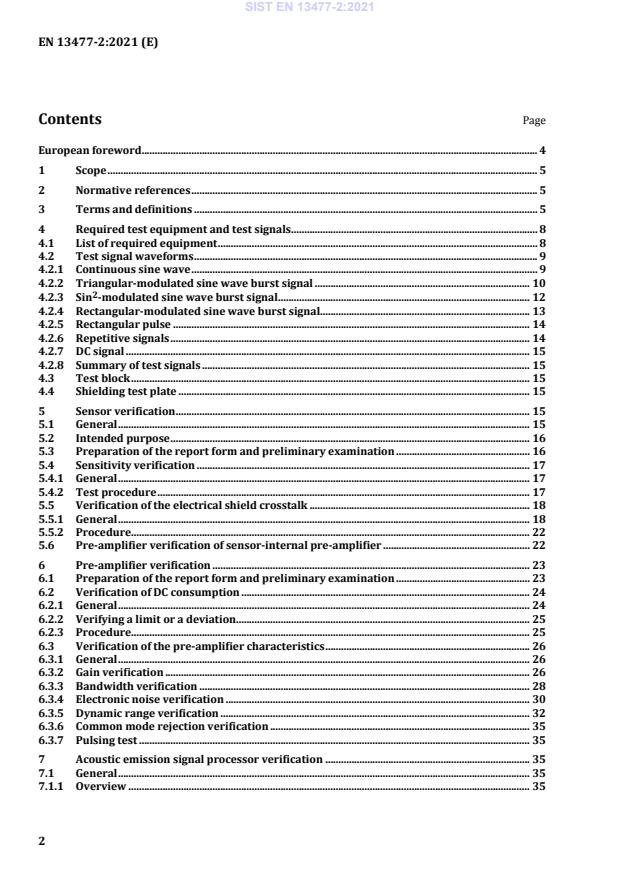
Contents Page
European foreword . 4
1 Scope . 5
2 Normative references . 5
3 Terms and definitions . 5
4 Required test equipment and test signals . 8
4.1 List of required equipment . 8
4.2 Test signal waveforms . 9
4.2.1 Continuous sine wave . 9
4.2.2 Triangular-modulated sine wave burst signal . 10
4.2.3 Sin -modulated sine wave burst signal . 12
4.2.4 Rectangular-modulated sine wave burst signal . 13
4.2.5 Rectangular pulse . 14
4.2.6 Repetitive signals . 14
4.2.7 DC signal . 15
4.2.8 Summary of test signals . 15
4.3 Test block . 15
4.4 Shielding test plate . 15
5 Sensor verification . 15
5.1 General . 15
5.2 Intended purpose . 16
5.3 Preparation of the report form and preliminary examination . 16
5.4 Sensitivity verification . 17
5.4.1 General . 17
5.4.2 Test procedure . 17
5.5 Verification of the electrical shield crosstalk . 18
5.5.1 General . 18
5.5.2 Procedure. 22
5.6 Pre-amplifier verification of sensor-internal pre-amplifier . 22
6 Pre-amplifier verification . 23
6.1 Preparation of the report form and preliminary examination . 23
6.2 Verification of DC consumption . 24
6.2.1 General . 24
6.2.2 Verifying a limit or a deviation . 25
6.2.3 Procedure. 25
6.3 Verification of the pre-amplifier characteristics . 26
6.3.1 General . 26
6.3.2 Gain verification . 26
6.3.3 Bandwidth verification . 28
6.3.4 Electronic noise verification . 30
6.3.5 Dynamic range verification . 32
6.3.6 Common mode rejection verification . 35
6.3.7 Pulsing test . 35
7 Acoustic emission signal processor verification . 35
7.1 General . 35
7.1.1 Overview . 35
7.1.2 Preparation of the report form . 38
7.2 Signal processor noise verification . 39
7.2.1 General . 39
7.2.2 Test procedure . 40
7.3 Verification of RMS measurement and floating threshold functionality . 41
7.3.1 General . 41
7.3.2 Test procedure . 43
7.4 Verification of the fixed detection threshold . 43
7.4.1 General . 43
7.4.2 Procedure for signal stimulation and data acquisition . 45
7.4.3 Procedure for the data verification . 45
7.5 Bandwidth and filter roll-off verification . 45
7.5.1 General . 45
7.5.2 Data needed for verification of bandwidth and roll-off verification. 46
7.5.3 Procedure for signal stimulation and storage . 46
7.5.4 Test procedure for bandwidth verification based on stored AE data. 46
7.6 Burst signal parameter verification. 47
7.6.1 General . 47
7.6.2 Maximum amplitude verification . 47
7.6.3 Duration verification . 50
7.6.4 Rise-time verification . 52
7.6.5 Ring-down count verification . 54
7.6.6 Energy and signal strength verification . 55
8 Verification of the system performance . 58
8.1 External parametric input verification . 58
8.1.1 General . 58
8.1.2 Formulae for parametric input verification . 59
8.1.3 Avoiding the use of a high-accuracy digital voltmeter (HADVM) . 60
8.1.4 Report form preparation . 60
8.1.5 Test procedure for signal stimulation and measurement for parametric input
verification . 61
8.1.6 Test procedure for parametric input data verification . 62
8.2 Pulser verification . 62
8.3 System acquisition rate verification . 62
8.4 Delta t (Δt) measurement verification . 63
8.5 Software verification . 63
9 Test report . 64
Annex A (informative) Report form for the sensor performance verification . 65
Annex B (informative) Report form for the pre-amplifier performance verification . 67
Annex C (informative) Report form for the acoustic emission signal processor verification . 70
Annex D (informative) Report form for the external parametric input verification . 75
Annex E (informative) List of designations . 77
Bibliography . 79
European foreword
This document (EN 13477-2:2021) has been prepared by Technical Committee CEN/TC 138 “Non-
destructive testing”, the secretariat of which is held by AFNOR.
This European Standard shall be given the status of a national standard, either by publication of an
identical text or by endorsement, at the latest by April 2022, and conflicting national standards shall be
withdrawn at the latest by April 2022.
Attention is drawn to the possibility that some of the elements of this document may be the subject of
patent rights. CEN shall not be held responsible for identifying any or all such patent rights.
This document supersedes EN 13477-2:2010.
In comparison with the previous edition, the following technical modifications have been made:
— Improvement of Clause 3 “Terms & Definitions”;
— Improvement of Clause 5 “Sensor verification”;
— Improvement of Clause 6 “Pre-amplifier verification”;
— Improvement of Clause 7 “Acoustic emission signal processor verification”;
— Improvement of Clause 8 “Verification of the system performance”.
Any feedback and questions on this document should be directed to the users’ national standards body.
A complete listing of these bodies can be found on the CEN website.
According to the CEN-CENELEC Internal Regulations, the national standards organisations of the
following countries are bound to implement this European Standard: Austria, Belgium, Bulgaria, Croatia,
Cyprus, Czech Republic, Denmark, Estonia, Finland, France, Germany, Greece, Hungary, Iceland, Ireland,
Italy, Latvia, Lithuania, Luxembourg, Malta, Netherlands, Norway, Poland, Portugal, Republic of North
Macedonia, Romania, Serbia, Slovakia, Slovenia, Spain, Sweden, Switzerland, Turkey and the United
Kingdom.
1 Scope
This document specifies test routines for the periodic verification of the performance of acoustic emission
(AE) test equipment, i.e. sensors, pre-amplifiers, signal processors, external parametric inputs.
It is intended for use by qualified personnel to implement an automated verification process.
Verification of the measurement characteristics is advised after purchase of equipment, in order to obtain
reference data for later verifications. Verification is also advised after repair, modifications, use under
extraordinary conditions, or if one suspects a malfunction.
The procedures specified in this document do not exclude other qualified methods, e.g. verification in the
frequency domain. These procedures apply in general unless the manufacturer specifies alternative
equivalent procedures.
Safety aspects of equipment for use in potentially explosive zones are not considered in this document.
2 Normative references
The following documents are referred to in the text in such a way that some or all of their content
constitutes requirements of this document. For dated references, only the edition cited applies. For
undated references, the latest edition of the referenced document (including any amendments) applies.
EN 1330-1:2014, Non destructive testing - Terminology - Part 1: List of general terms
EN 1330-2:1998, Non destructive testing - Terminology - Part 2: Terms common to the non-destructive
testing methods
EN 1330-9:2017, Non-destructive testing - Terminology - Part 9: Terms used in acoustic emission testing
EN 13477-1:2001, Non-destructive testing - Acoustic emission - Equipment characterisation - Part 1:
Equipment description
3 Terms and definitions
For the purposes of this document, the terms and definitions given in EN 1330-1:2014,
EN 1330-2:1998 and EN 1330-9:2017, and the following apply.
ISO and IEC maintain terminological databases for use in standardization at the following addresses:
— ISO Online browsing platform: available at https://www.iso.org/obp
— IEC Electropedia: available at https://www.electropedia.org/
3.1
acoustic emission signal processor
ASP
part of an AE channel for the conversion of the output of the pre-amplifier to digital signal parameters
Note 1 to entry: An AE signal processor can include additional support functions, e.g. pre-amplifier power supply,
test pulse control, transient recorder and more.
3.2
arbitrary function generator
AFG
electronic device for generating programmable test signals, various waveforms and direct current (DC)
3.3
high-accuracy digital voltmeter
HADVM
electronic device for precise measurement of the DC voltages used for stimulation of external parametric
inputs
3.4
current measurement adapter
CMA1
electrical device for the convenient measurement of DC consumption of a pre-amplifier, supplied by an
AE signal processor
3.5
50 Ω terminator
coaxial plug (BNC style) with an internal 50 Ω resistor between inner wire and shielding
3.6
high impedance
HiZ
high impedance condition of an electrical connection, which is usually terminated by 50 Ω
3.7
DC blocker
BNC male to BNC female connector piece with a capacitor, 10 µF/50 V, non-polarized, between the inner
wires of both connectors, feeding an alternating current (AC) signal through but blocking off its DC
component from an arbitrary function generator (AFG) or a 50 Ω terminator
3.8
distinction of designations from text
distinction in which normal text is reproduced in standard font (Cambria 11 Pt.) and designations in bold
italic font, when it indicates a variable and in bold non-italic font, when it indicates a constant
Note 1 to entry: For optimized legibility, superscripts are avoided with the exemption of “ ” (for “square”,
e.g. “sin ”), and subscripts are avoided with the exemption of “dB ”, “V ”, “V ”, and “V ”.
AE P PP RMS
3.9
item under verification
IUV
general term and placeholder for any designation code
Note 1 to entry: Lists of items under verification, differently sorted, can be found in Annex E, Tables E.1 and E.2.
3.10
designation code
abbreviation of an item under verification, consisting of one or two characters (sometimes more in order
to identify further information) and, for certain items, a one or two-digit number, either a setpoint
number, or the character “s” as placeholder for the setpoint number, or the number of an external
parametric input, or the character “x” as placeholder for the input number
Note 1 to entry: If no extension is appended to a designation code, the measurement value of that code is meant.
EXAMPLE 1 Rs identifies the measured rise-time of setpoint s, see 7.6.4.
EXAMPLE 2 EA1 identifies the measured energy value of the first setpoint of the maximum amplitude-varied
energy verification, see 7.6.6.
EXAMPLE 3 BGRMSs identifies a measured RMS value of the continuous background noise using the maximum
amplitude setpoint As'T of the continuous sine wave test signal C-Sw'T with a nominal frequency F'N, see 7.3.2.
3.11
'N
designation code extension for a nominal value of an IUV for a certain setpoint, defined by the
manufacturer or a procedure or calculated by a formula
EXAMPLE 1 A1’N defines the first nominal maximum amplitude setpoint of a series to be stimulated, measured
and verified against well-defined acceptance criteria, see 7.6.2.
EXAMPLE 2 EAs’N defines a series of nominal signal energies, calculated by using a given formula, to be
stimulated, measured and verified against well-defined acceptance criteria, see 7.6.6.
3.12
‘S
designation code extension for an AE system setpoint
EXAMPLE BPN’S defines the narrow bandpass to be used in the AE signal processor, for measurements as
defined in the procedure.
3.13
’T
designation code extension for a test signal setpoint
EXAMPLE 1 A’T defines the calculated maximum amplitude setpoint for the test signal of the arbitrary function
generator (AFG) output.
EXAMPLE 2 S2-Sw’T defines the setpoint for the AFG to generate a sin -modulated sine wave burst.
3.14
.MA
designation code extension for a manufacturer-specified acceptable deviation of a measured maximum
amplitude from the nominal value, in dB
3.15
.MP
designation code extension for an acceptance factor, which, when multiplied with the nominal value of a
linear setpoint, results in the acceptable deviation of a measured value from the nominal value, specified
by the manufacturer
Note 1 to entry: For verification of the maximum amplitude, A.MP shall be converted from A.MA by Formula (33).
3.16
.MB
designation code extension for an acceptable deviation, which is independent of the nominal value,
specified by the manufacturer, see Table C.3
3.17
.U
designation code extension for an upper acceptance limit, specified by the manufacturer for certain items
EXAMPLE NSWP.U defines an upper limit for the internally generated AE signal processor noise in µV .
P
3.18
.L
designation code extension for a lower acceptance limit, specified by the manufacturer for certain items
EXAMPLE DR.L defines the lower acceptance limit for the dynamic range of a pre-amplifier, see 6.3.5.
3.19
.DP
deviation percentage, i.e. the ratio of an absolute measurement deviation to the acceptable deviation, a
number in %; the acceptance criterion is met if IUV.DP is lower than or equal to 100 %
Note 1 to entry: IUV.DP lets one simply recognize by one number, whether an IUV passed or failed the
verification, independent of the complexity of the acceptance criterion.
Note 2 to entry: Selecting the maximum IUV.DP value of all verification steps performed indicates in one number
whether all verification steps of an IUV succeeded.
3.20
ABS(X)
mathematical function that returns the absolute value of argument X
Note 1 to entry: If X is negative, ABS(X) returns a positive value.
3.21
MAX(X1; X2; …; XN)
mathematical function that returns the greatest value of arguments X1 to XN
3.22
MIN(X1; X2; …; XN)
mathematical function that returns the least value of arguments X1 to XN
4 Required test equipment and test signals
4.1 List of required equipment
The following minimum test equipment is required:
a) test block;
b) shielding test plate;
c) Hsu-Nielsen source, for sensor sensitivity verification;
d) multimeter for voltage and current measurements of DC during pre-amplifier verification (the model
given in f) can be used for this purpose);
e) test signal generator, an arbitrary function generator (AFG) with the capability to deliver loadable
arbitrary signals, sine waves, rectangle waves, pulses, and also DC for manual or automated
verification of external parametric inputs. The output socket shall be isolated from protective earth,
which is the usual case with standard AFGs, e.g. Keysight model 33511B . Key specifications for
accuracy: AC amplitude in mV ± (1 % of setting +1,0) at 1 kHz, frequency ± 0,01 % of setting, DC
PP
voltage in mV ± (1 % of setting + 2,0);
f) high-accuracy digital voltmeter (HADVM) to measure the DC test signal from AFG in sufficient
accuracy for the verification of the external parametric inputs e.g. AGILENT Model 34401A . Key
specifications for accuracy: DC voltage in µV ± (0,003 5 % of reading + 100);
g) variable attenuator, graduated in decibels, matching 50 Ω impedance on input and output,
accuracy: ± 0,15 dB;
h) DC power supply, for pre-amplifier supply, with a proper circuit to decouple and terminate the AE
signal, if power is fed in via the signal wire. Can be substituted by a verified AE signal processor, see
also k) and n);
i) RMS voltmeter, with known or settable time constant or time window. Can be substituted by a
verified AE signal processor and appropriate software; key specification: AC accuracy 20 kHz to
1 MHz: ± 0,2 dB;
j) dual-channel storage oscilloscope, for detecting any artefact or non-plausibility in various setups;
k) current measurement adapter (CMA1), if h) is substituted by a verified AE signal processor. Resistor
accuracy: ± 1 %;
l) DC blocker;
m) 50 Ω BNC terminator;
n) verified AE signal processor (two units), can be substituted by h) and i).
All electric/electronic test items shall be subject to the quality management system.
4.2 Test signal waveforms
4.2.1 Continuous sine wave
This type of test signal may be used to verify the frequency response and gain of the pre-amplifier and it
shall be used to verify the accuracy of the continuous signal level of the AE signal processor. The
designation of this signal is C-Sw’T. It is defined by amplitude A and frequency F.
This information is given for the convenience of users of this document and does not constitute an endorsement
by CEN of the product named. Equivalent products may be used if they can be shown to lead to the same results.
4.2.2 Triangular-modulated sine wave burst signal
This type of waveform simulates an AE burst signal, see Figure 1. The designation is Tri-Sw’T. It is defined
by the following parameters:
— maximum amplitude A;
— rise-time R;
— decay-time DEC;
— carrier frequency FC.
Figure 1 a) shows a voltage signal in time domain, horizontally scaled in µs, vertically in mV. Figure 1 b)
shows the FFT of the voltage signal in a), horizontally scaled in kHz, vertically in dB. The magnitude in dB
corresponds to dB , if a continuous sine wave occupies the FFT input buffer. For burst signals in a zero-
AE
padded FFT input buffer the scaling is influenced by the duration and the waveform of the signal.
Example: A single-cycle sine wave of 100 kHz in a zero-padded FFT buffer produces a 6,02 dB higher FFT
result than a single-cycle sine wave of 200 kHz, since the 100 kHz cycle lasts twice the time of the 200 kHz
cycle.
a) Time domain b) Frequency domain (FFT)
Key
1 voltage in mV
2 time in µs
3 magnitude in dB
4 frequency in kHz
Figure 1 — Triangular-modulated sine wave burst signal
The signal shown in Figure 1 a) results from Formula (1):
U(t) = UP × sin(2 × π × F’N × t) × MIN(1; t / R’N) × (1 - MAX(0; (t - R’N) / DEC’N)) (1)
F‘T = 1 / (R’N + DEC’N) (2)
where
U(t) voltage in mV at time t;
t time of the stimulated burst signal in µs taking values from t = 0 till to t = R'N + DEC'N;
maximum amplitude (98 mV in Figure 1) of the simulated burst signal;
UP
P
F’N nominal carrier frequency in MHz (0,2 MHz in Figure 1);
R’N nominal rise-time in µs (100 µs in Figure 1);
DEC’N nominal decay-time in µs (100 µs in Figure 1);
F’T frequency setting at the AFG.
This wave shall be generated by an arbitrary function generator (AFG). The waveform shall be defined as
a sequence of voltage samples, according to Formula (1), with UP = 1 mV , and loaded into the AFG. The
P
maximum amplitude setpoint A'T (98 mV for 98 mV in Figure 1) and the frequency setpoint F’T, see
PP P
Formula (2), shall be entered at the AFG.
The measured rise-time can be shorter than the visible rise-time of the test signal because rise-time
measurement starts at the time of the first threshold crossing. Table 1 shows the theoretical first
threshold-crossing delay for five different thresholds in relation the maximum amplitude A. In practice,
the used bandpass filter can further modify the exact value of the first threshold-crossing delay.
Table 1 — First threshold-crossing delay versus threshold to maximum amplitude relation for a
triangular-modulated test signal
Threshold in relation to the Triangular-modulated first threshold-crossing
maximum amplitude in dB delay in % of rise-time
A – 20 10,0
A – 25 5,6
A – 30 3,2
A – 35 1,8
A – 40 1,0
See also additional information in rise-time verification under 7.6.4.
4.2.3 Sin -modulated sine wave burst signal
a) Time domain b) Frequency domain (FFT)
Key
1 voltage in mV
2 time in µs
3 magnitude in dB
4 frequency in kHz
Figure 2 — Sin -modulated sine wave burst signal
A sin -modulated signal (see Figure 2), designated S2-Sw’T, provides a purer frequency spectrum due to
its smooth begin, maximum and end of the burst signal. Compared to the other types of test signals this
wave type avoids influences of the bandpass filter on the waveform of the signal, such as overshoots at
the beginning and reverberations at the end. Therefore, this type of signal shall be used for the
verification of burst signal maximum amplitude related parameters (maximum amplitude, detection
threshold, energy and signal strength). This type of signal may also be used to obtain the frequency
response of the bandpass of a pre-amplifier or of an AE signal processor based on burst signal maximum
amplitude measurement at varied frequency, see 7.5.
Similar to the triangular modulated sine wave, the rise-time measured by an AE signal processor is
shorter than the visible rise-time of the test signal, since rise-time measurement starts at the time of the
first threshold crossing.
The signal shown in Figure 2 results from Formula (3):
U(t) = UP × sin(2 × π × F'N × t) × sin (π × F'T × t) (3)
F’T = F'N/ SWpB (4)
where
U(t) voltage in mV at time t;
t time of the stimulated burst signal in µs taking values from t = 0 till to t = 1 / F'T;
UP maximum amplitude (98 mV in Figure 2) of the simulated burst signal;
P
F'N nominal carrier frequency in MHz;
SWpB sine waves per burst signal (41 in Figure 2);
F’T frequency setting at the AFG.
Formula (4) defines the frequency setpoint F’T of the arbitrary function generator (AFG) for obtaining
the nominal carrier frequency F'N at a given number of programmed sine waves per burst signal SWpB.
This wave shall be generated by an arbitrary function generator (AFG). The waveform shall be defined as
a sequence of voltage samples, according to Formula (3), with UP = 1 mV , and loaded into the AFG. The
P
maximum amplitude setpoint A'T (98 mV for 98 mV in Figure 2) and the frequency setpoint F’T, see
PP P
Formula (4), shall be entered at the AFG.
Similar with the triangular-modulated sine wave, the rise-time measured by an AE signal processor is
shorter than the visible rise-time of the test signal, since rise-time measurement starts at the time of the
first threshold crossing.
4.2.4 Rectangular-modulated sine wave burst signal
a) Time domain b) Frequency domain (FFT)
Key
1 voltage in mV
2 time in µs
3 magnitude in dB
4 frequency in kHz
Figure 3 — Rectangular-modulated sine wave burst signal
This test signal is designated R-Sw’T. It is defined by the characteristics A (amplitude), D (duration) and
FC (carrier frequency), see Figure 3. It is mainly used for duration-varied verifications.
When using an arbitrary function generator (AFG), the duration in µs (100 µs in Figure 3) results from
the setpoint of the number of sine waves per burst signal (10 in Figure 3) divided by the setpoint of
frequency in MHz (0,1 MHz in Figure 3).
4.2.5 Rectangular pulse
Key
1 voltage in mV
2 time in µs
Figure 4 — Pulse signal
This test signal, designated R-P’T is used to check the measurement of the time difference Δt. It is defined
by the characteristics A (amplitude) and D (duration). Figure 4 shows a pulse of 18 V amplitude and
PP
200 ns duration at the output of an arbitrary function generator (AFG). The amplitude setpoint was 9 V .
PP
At unterminated output the amplitude is twice the setpoint.
Such a pulse, fed into a piezoelectric sensor, converts the sensor into a transmitter. This generates an
acoustic pulse which can be used to stimulate reproducible AE events into a test block (see 4.3).
4.2.6 Repetitive signals
Key
1 voltage in mV
2 time in µs
Figure 5 — A series of transient signals (pulses) behind the bandpass, 160 µs apart
This signal can be used to verify the signal processing rate. It is a series of rectangular pulses as described
in 4.2.5. It is defined by A (maximum amplitude), D (duration) and f (repetition frequency), typically 1 Hz
to 100 kHz. Figure 5 shows a signal example with 1 / f = 160 µs, taken after the bandpass filter of an AE
signal processor. The maximum reasonable repetition frequency is limited by the ring-down effect of the
bandpass filter. Above 10 kHz each bandpass in the measurement chains should be bypassed, when using
this signal.
4.2.7 DC signal
This signal, designated DC_HiZ’T is used for the verification of the external parametric inputs. It can be
generated by the arbitrary function generator (AFG) in DC HiZ mode, in which the voltage generated
corresponds to the setpoint of the AFG.
4.2.8 Summary of test signals
Table 2 lists the designations of all test signals used in this document.
Table 2 — Test signal designations
Designation Test signal
C-Sw'T Continuous sine wave
Tri-Sw'T Triangular-modulated sine wave burst signal
S2-Sw’T
Sin -modulated sine wave burst signal
R-Sw'T Rectangular-modulated sine wave burst signal
R-P’T Rectangular pulse
DC_HiZ'T DC signal with HiZ setpoints
The designations are to identify the used test signals for setting the arbitrary function generator (AFG)
for the required verifications, see Table 5.
4.3 Test block
The test block can take different forms, e.g. a metallic block, a plate, or an acrylic rod. Once chosen, the
dimensions, construction material, source position (Hsu-Nielsen source or piezoelectric transmitter, see
also 4.2.5), sensor mounting position and usage shall be controlled to ensure reproducibility of results.
The surface in contact with the sensor shall be flat and smooth. The test block shall be isolated
acoustically from the work bench to avoid interference from external noise sources.
4.4 Shielding test plate
This is a small flat metallic plate sufficient in size to cover the sensor’s sensitive area. The plate shall be
connected to a sine wave signal; therefore, it shall be electrically isolated from earth. The sensor side shall
be covered by a thin non-conductive layer. The dimension of the plate and the thickness of the non-
conductive layer shall be controlled. The test plate shall be given an identifier for use in the verification
report, see Figure 6 for the setup.
5 Sensor verification
5.1 General
The following procedure allows for comparison of some characteristics of sensors of same type. The
deterioration of a sensor can result from e.g. mechanical shock, exposure to high temperature, high
ionizing radiation, a corrosive environment, water ingress, or a damaged connector or cable.
5.2 Intended purpose
The purposes of the sensor verification are:
a) warning of degrading of sensitivity or damaged internal shielding;
b) determining when a sensor is no longer suitable for use;
c) verifying sensors that are known to have been exposed to high-risk conditions;
d) creating matched sets of sensors to achieve uniform performance;
e) verifying sensors quickly and reliably and assisting trouble shooting, when a channel shows a fault.
5.3 Preparation of the report form and preliminary examination
The report form given in Annex A may be used to document the sensor verification.
The exact report format for the items to be reported as shown in Annex A may be determined or
influenced by the software used for verification data evaluation.
The general data in Table A.1 comprises:
a) name of operator and the identification of the verification job;
b) date and time (start as well as end) of the verification;
c) temperature and humidity at the verification location.
The following information regarding measurement equipment used for the sensor sensitivity verification
shall be reported. Table A.2 shows an example for an acceptable format:
d) identification of the test block, the couplant used and the source-to-sensor distance;
e) Hsu-Nielsen source diameter (0,5 mm or 0,3 mm) and hardness grade (usually 2H).
If a piezoelectric transmitter is used instead of a Hsu-Nielsen source, the following shall be filled in:
f) type and serial number of the transmitter;
g) excitation (in units of V ) of the transmitter and, if the AE system offers such option, the main
PP
frequency content of the pulse (e.g. normal or low);
h) AE system used (model and serial number);
i) AE signal processor (model, serial number, high-pass and low-pass corner frequencies of the
bandpass filter as well as the date of last performed verification);
j) pre-amplifier (type, serial number, gain, high-pass and low-pass corner frequencies of the bandpass
filter as well as the date of last performed verification);
k) sensor-to-pre-amplifier cable and its length.
The key parameters of the shield crosstalk (SC) verification shall be filled in into Table A.3:
l) test plate identification, test plate voltage and frequency setpoint;
m) isolation thickness;
n) manufacturer’s specification of the acceptance limit.
Perform a preliminary examination of the sensor under verification (SUV) to identify any obvious
mechanical damage, paying particular attention to connector and cable, if any. If a damage has been
discovered make a corresponding remark in the report form below the title.
Table A.4 of Annex A shows an acceptable format to be used to report the measurement results linked to
the specific sensors and for the assessment of the sensors under verification.
5.4 Sensitivity verification
5.4.1 General
a) For the sensitivity verification of a sensor a verified AE signal processor shall be used.
b) If the sensor does not employ a pre-amplifier, a verified reference pre-amplifier and sensor cable of
specified type and length shall be used.
c) The frequency filters in the pre-amplifier and AE signal processor shall properly cover the bandwidth
of the sensor.
d) For good reproducibility, the positions of the Hsu-Nielsen source or the piezoelectric transmitter, as
applicable, and the sensor under verification shall be marked on the test block. The chosen distance
between source and sensor shall safely prevent saturation of the measurement chain.
e) Particular attention shall be spent for the selection of the couplant between sensor and test block.
The chosen couplant shall reach the final coupling quality within a properly short waiting time.
Several couplant products need hours until the final coupling quality is reached. Those are not
suitable for sensor verification.
f) Conditions and results of the sensor verification shall be reported, e.g. using the report format shown
in Annex A.
5.4.2 Test procedure
a) Allow the test block, sensors and couplant to adopt the ambient temperature.
b) Mount the sensor under verification on the test block at the marked position using an appropriate
couplant. Be sparing with the couplant, e.g. approximately 0,1 cm of silicone grease is adequate for
most types of sensors under verification.
c) Press the sensor firmly down onto the test block to ensure a good coupling. Ensure that the sensor’s
position at the test block cannot displace during the test. The use of a constant force device, e.g. a
spring-loaded sensor holder, is re
...