

EN 13554:2011
(Main)Non-destructive testing - Acoustic emission testing - General principles
- Abstract
This European Standard specifies the general principles required for the acoustic emission testing (AT) of industrial structures, components, and different materials under stress and for harsh environment, in order to provide a defined and repeatable performance. It includes guidelines for the preparation of application documents, which describe the specific requirements for the application of the AE method.
Unless otherwise specified in the referencing documents, the minimum requirements of this European Standard are applicable.
- Status
- Published
- Publication Date
- 25-Jan-2011
- Withdrawal Date
- 30-Jul-2011
- Technical Committee
- CEN/TC 138 - Non-destructive testing
- Drafting Committee
- CEN/TC 138/WG 7 - Acoustic emission testing
- Current Stage
- 9092 - Decision on results of review/2YR ENQ - revise - Review Enquiry
- Start Date
- 15-Jan-2024
- Completion Date
- 07-Oct-2026

Overview
EN 13554:2011 - Non‑destructive testing - Acoustic emission testing - General principles (CEN) defines the general principles and minimum requirements for performing acoustic emission (AE) testing on industrial structures, components and materials subjected to stress or harsh environments. The standard establishes repeatable performance criteria and provides guidelines for preparing application documents that specify how the AE method is to be applied. EN 13554:2011 supersedes the 2002 edition and is intended for use unless a referencing document specifies otherwise.
Key topics and technical requirements
- Scope & purpose: Applies to AE testing of metallics, composites, ceramics, concrete, rock, etc., for stages from manufacturing and acceptance to in‑service monitoring and leak detection.
- Personnel qualification: Assumes qualified personnel; certification in accordance with EN 473 (or equivalent) is recommended. Special approval requirements apply for certain pressure equipment categories.
- AE principle & features: Describes the AE phenomenon (transient elastic waves generated by crack growth, corrosion, leakage, cavitation, impact, electrical discharge, etc.), and highlights AE strengths - passive monitoring, volumetric coverage, real‑time detection, source location.
- Limitations: Notes AE is sensitive to growing (active) discontinuities and to environmental/extraneous noise; non‑growing defects may not emit AE.
- Instrumentation: Requirements for sensors, preamplifiers, signal conditioning, filtering, feature extraction and waveform acquisition. Sensor selection/installation, acoustic couplants, and verification (e.g., Hsu‑Nielsen checks) are covered.
- Settings & parametric inputs: Guidance on thresholds, gain, attenuation and the use of external parametric channels (pressure, strain, temperature, etc.) with appropriate accuracy and sampling rates.
- Testing process: Defines testing phases - preliminary information, preparation, on‑site setup, data acquisition (on‑line and post‑test analysis), presentation of results, subsequent operations.
- Documentation: Test instruction preparation, test documentation and reporting requirements to ensure repeatability and traceability.
Practical applications and users
EN 13554:2011 is intended for:
- NDT and AE engineers performing inspections and health monitoring
- Asset owners/operators (pressure vessels, piping systems, storage tanks, bridges, dams, power transformers, mines)
- Inspection bodies and third‑party certifiers ensuring compliance with regulatory and safety requirements
- Design and quality teams using AE for materials/design optimization and manufacturing quality assurance
Typical applications: in‑service monitoring, acceptance and proof testing, requalification, leak detection, cavitation/erosion assessment, and detection of crack activity in concrete or rock.
Related standards
- EN 1330‑1, EN 1330‑2, EN 1330‑9 (NDT terminology, including AE terms)
- EN 13477‑2 (AE equipment characterisation / verification of operating characteristics)
- EN 473 (personnel certification) and applicable regulatory directives for pressure equipment
Keywords: EN 13554:2011 acoustic emission testing, AE testing standard, non‑destructive testing AE, acoustic emission sensors, AE instrumentation, in‑service monitoring, CEN standard.
Relations
- Effective Date
- 29-Jan-2011
- Effective Date
- 22-Dec-2008
- Effective Date
- 28-Jan-2026
- Effective Date
- 28-Jan-2026
- Effective Date
- 28-Jan-2026
- Effective Date
- 28-Jan-2026
- Effective Date
- 28-Jan-2026
- Effective Date
- 28-Jan-2026
- Effective Date
- 28-Jan-2026
- Effective Date
- 28-Jan-2026
- Effective Date
- 28-Jan-2026
- Effective Date
- 28-Jan-2026
- Effective Date
- 28-Jan-2026
- Effective Date
- 28-Jan-2026
- Effective Date
- 28-Jan-2026
Get Certified
Connect with accredited certification bodies for this standard

IMP NDT d.o.o.
Non-destructive testing services. Radiography, ultrasonic, magnetic particle, penetrant, visual inspection.
Inštitut za kovinske materiale in tehnologije
Institute of Metals and Technology. Materials testing, metallurgical analysis, NDT.
Q Techna d.o.o.
NDT and quality assurance specialist. 30+ years experience. NDT personnel certification per ISO 9712, nuclear and thermal power plant inspections, QA/
Sponsored listings
Frequently Asked Questions
EN 13554:2011 is a standard published by the European Committee for Standardization (CEN). Its full title is "Non-destructive testing - Acoustic emission testing - General principles". This standard covers: This European Standard specifies the general principles required for the acoustic emission testing (AT) of industrial structures, components, and different materials under stress and for harsh environment, in order to provide a defined and repeatable performance. It includes guidelines for the preparation of application documents, which describe the specific requirements for the application of the AE method. Unless otherwise specified in the referencing documents, the minimum requirements of this European Standard are applicable.
This European Standard specifies the general principles required for the acoustic emission testing (AT) of industrial structures, components, and different materials under stress and for harsh environment, in order to provide a defined and repeatable performance. It includes guidelines for the preparation of application documents, which describe the specific requirements for the application of the AE method. Unless otherwise specified in the referencing documents, the minimum requirements of this European Standard are applicable.
EN 13554:2011 is classified under the following ICS (International Classification for Standards) categories: 19.100 - Non-destructive testing. The ICS classification helps identify the subject area and facilitates finding related standards.
EN 13554:2011 has the following relationships with other standards: It is inter standard links to EN 13554:2002/A1:2003, EN 13554:2002, EN 1330-2:1998, EN 1330-9:2009, EN 1330-1:1998, EN 13477-2:2021, EN 14584:2013, EN 12817:2010, EN ISO 5135:2020, EN 12817:2019, EN ISO 18081:2024, EN ISO 27509:2020, EN 15856:2010, CEN ISO/TS 21083-2:2019, EN ISO 18081:2016. Understanding these relationships helps ensure you are using the most current and applicable version of the standard.
EN 13554:2011 is available in PDF format for immediate download after purchase. The document can be added to your cart and obtained through the secure checkout process. Digital delivery ensures instant access to the complete standard document.
Standards Content (Sample)
2003-01.Slovenski inštitut za standardizacijo. Razmnoževanje celote ali delov tega standarda ni dovoljeno.Zertörungsfreie Prüfung - Schallemission - Allgemeine GrundsätzeEssais non destructifs - Émission acoustique - Principes générauxNon destructive testing - Acoustic emission - General principles19.100Neporušitveno preskušanjeNon-destructive testingICS:Ta slovenski standard je istoveten z:EN 13554:2011SIST EN 13554:2011en,fr,de01-april-2011SIST EN 13554:2011SLOVENSKI
STANDARDSIST EN 13554:2004/A1:2004SIST EN 13554:20041DGRPHãþD
EUROPEAN STANDARD NORME EUROPÉENNE EUROPÄISCHE NORM
EN 13554
January 2011 ICS 19.100 Supersedes EN 13554:2002English Version
Non-destructive testing - Acoustic emission testing - General principles
Essais non destructifs - Émission acoustique - Principes généraux
Zerstörungsfreie Prüfung - Schallemissionsprüfung - Allgemeine Grundsätze This European Standard was approved by CEN on 17 December 2010.
CEN members are bound to comply with the CEN/CENELEC Internal Regulations which stipulate the conditions for giving this European Standard the status of a national standard without any alteration. Up-to-date lists and bibliographical references concerning such national standards may be obtained on application to the CEN-CENELEC Management Centre or to any CEN member.
This European Standard exists in three official versions (English, French, German). A version in any other language made by translation under the responsibility of a CEN member into its own language and notified to the CEN-CENELEC Management Centre has the same status as the official versions.
CEN members are the national standards bodies of Austria, Belgium, Bulgaria, Croatia, Cyprus, Czech Republic, Denmark, Estonia, Finland, France, Germany, Greece, Hungary, Iceland, Ireland, Italy, Latvia, Lithuania, Luxembourg, Malta, Netherlands, Norway, Poland, Portugal, Romania, Slovakia, Slovenia, Spain, Sweden, Switzerland and United Kingdom.
EUROPEAN COMMITTEE FOR STANDARDIZATION
COMITÉ EUROPÉEN DE NORMALISATION EUROPÄISCHES KOMITEE FÜR NORMUNG
Management Centre:
Avenue Marnix 17,
B-1000 Brussels © 2011 CEN All rights of exploitation in any form and by any means reserved worldwide for CEN national Members. Ref. No. EN 13554:2011: ESIST EN 13554:2011
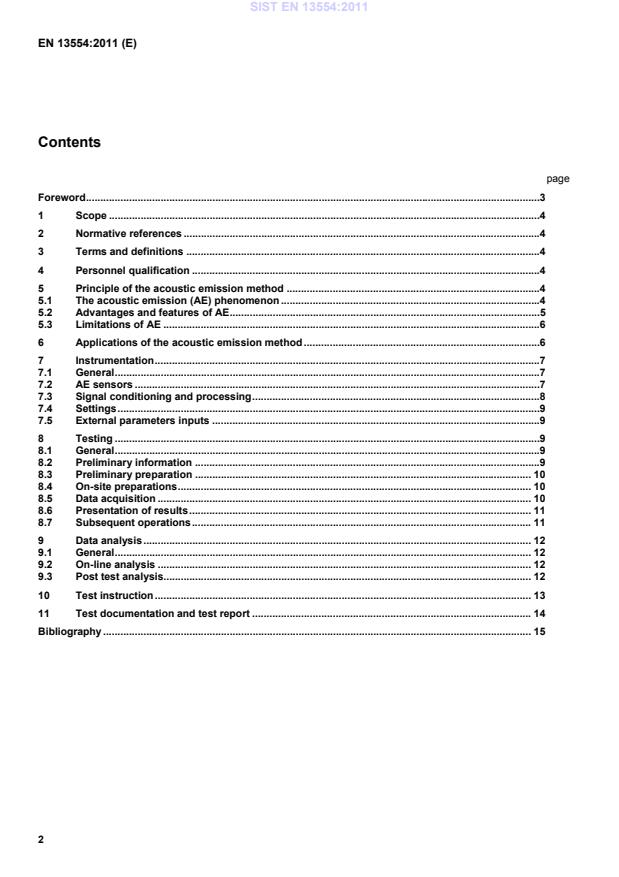
page Foreword .31Scope .42Normative references .43Terms and definitions .44Personnel qualification .45Principle of the acoustic emission method .45.1The acoustic emission (AE) phenomenon .45.2Advantages and features of AE .55.3Limitations of AE .66Applications of the acoustic emission method .67Instrumentation .77.1General .77.2AE sensors .77.3Signal conditioning and processing .87.4Settings .97.5External parameters inputs .98Testing .98.1General .98.2Preliminary information .98.3Preliminary preparation . 108.4On-site preparations . 108.5Data acquisition . 108.6Presentation of results . 118.7Subsequent operations . 119Data analysis . 129.1General . 129.2On-line analysis . 129.3Post test analysis. 1210Test instruction . 1311Test documentation and test report . 14Bibliography . 15 SIST EN 13554:2011
Key 1 growing discontinuity 5 signal out 2 surface waves 6 section view of the component material 3 preamplifier 7 wave packet 4 AE sensor 8 applied load inducing stress Figure 1 — Schematic principle of Acoustic Emission and its detection 5.2 Advantages and features of AE The AE method has the following features: a) it is a passive detection method that monitors the dynamic response of the material to the applied load or environment; b) it allows detection of sources, depending on the materials properties, up to several meters distance; c) it allows a 100 % volumetric monitoring of the test object; d) it is sensitive to growth of discontinuities and changes in the material structure rather than to the presence of static discontinuities; e) it is non invasive; f) it offers a dynamic real time monitoring of any discontinuity that grows under the applied stress; g) it can be applied to monitor the structures during operation; h) it can be used to detect the effects of the application of load in order to prevent catastrophic failure of structures; i) it is capable of locating a growing discontinuity in the structure under test by the use of a sufficient number of sensors; j) its measurement frequency range extends from about 20 kHz to 2 MHz depending on the application. SIST EN 13554:2011
crack activity of rocks and concrete; etc. It is applied to: pressure equipment; pipe systems; SIST EN 13554:2011
...