

EN 13477-2:2010
(Main)Non-destructive testing - Acoustic emission - Equipment characterisation - Part 2: Verification of operating characteristic
- Abstract
This part of the standard specifies methods for routine verification of the performance of AE equipment comprising one or more sensing channels. It is intended for use by operators of the equipment under laboratory conditions. Verification of the measurement characteristics is recommended after purchase of equipment, modifications, use under extraordinary conditions, or if one suspects a malfunction. The procedures described in this European Standard do not exclude other qualified methods, e.g. verification in the frequency domain.
- Status
- Withdrawn
- Publication Date
- 14-Sep-2010
- Withdrawal Date
- 29-Sep-2026
- Technical Committee
- CEN/TC 138 - Non-destructive testing
- Drafting Committee
- CEN/TC 138/WG 7 - Acoustic emission testing
- Current Stage
- 9960 - Withdrawal effective - Withdrawal
- Start Date
- 13-Oct-2021
- Completion Date
- 30-Sep-2026

Relations
- Effective Date
- 22-Dec-2008
- Effective Date
- 06-Dec-2017
- Effective Date
- 25-Aug-2026
- Effective Date
- 25-Aug-2026
- Effective Date
- 25-Aug-2026
- Effective Date
- 25-Aug-2026
- Effective Date
- 25-Aug-2026
- Effective Date
- 25-Aug-2026
- Refers
IEC 60050-531:1974 - International Electrotechnical Vocabulary (IEV) - Part 531: Electronic tubes - Effective Date
- 25-Aug-2026
- Refers
IEC 60050-851:2008 - International Electrotechnical Vocabulary (IEV) - Part 851: Electric welding - Effective Date
- 25-Aug-2026
- Refers
IEC 60050-461:2008 - International Electrotechnical Vocabulary (IEV) - Part 461: Electric cables - Effective Date
- 25-Aug-2026
- Effective Date
- 25-Aug-2026
- Effective Date
- 25-Aug-2026
- Effective Date
- 25-Aug-2026
- Refers
IEC 60050-891:1998 - International Electrotechnical Vocabulary (IEV) - Part 891: Electrobiology - Effective Date
- 25-Aug-2026
Get Certified
Connect with accredited certification bodies for this standard

IMP NDT d.o.o.
Non-destructive testing services. Radiography, ultrasonic, magnetic particle, penetrant, visual inspection.
Inštitut za kovinske materiale in tehnologije
Institute of Metals and Technology. Materials testing, metallurgical analysis, NDT.
Q Techna d.o.o.
NDT and quality assurance specialist. 30+ years experience. NDT personnel certification per ISO 9712, nuclear and thermal power plant inspections, QA/
Sponsored listings
Frequently Asked Questions
EN 13477-2:2010 is a standard published by the European Committee for Standardization (CEN). Its full title is "Non-destructive testing - Acoustic emission - Equipment characterisation - Part 2: Verification of operating characteristic". This standard covers: This part of the standard specifies methods for routine verification of the performance of AE equipment comprising one or more sensing channels. It is intended for use by operators of the equipment under laboratory conditions. Verification of the measurement characteristics is recommended after purchase of equipment, modifications, use under extraordinary conditions, or if one suspects a malfunction. The procedures described in this European Standard do not exclude other qualified methods, e.g. verification in the frequency domain.
This part of the standard specifies methods for routine verification of the performance of AE equipment comprising one or more sensing channels. It is intended for use by operators of the equipment under laboratory conditions. Verification of the measurement characteristics is recommended after purchase of equipment, modifications, use under extraordinary conditions, or if one suspects a malfunction. The procedures described in this European Standard do not exclude other qualified methods, e.g. verification in the frequency domain.
EN 13477-2:2010 is classified under the following ICS (International Classification for Standards) categories: 19.100 - Non-destructive testing. The ICS classification helps identify the subject area and facilitates finding related standards.
EN 13477-2:2010 has the following relationships with other standards: It is inter standard links to EN 13477-2:2001, EN 13477-2:2021, IEC 60050-112:2010, IEC 60050-617:2009, IEC 60050-300:2001, IEC 60050-826:2004, IEC 60050-441:1984, IEC 60050-841:2004, IEC 60050-531:1974, IEC 60050-851:2008, IEC 60050-461:2008, IEC 60050-445:2002, IEC 60050-482:2004, IEC 60050-442:1998, IEC 60050-891:1998. Understanding these relationships helps ensure you are using the most current and applicable version of the standard.
EN 13477-2:2010 is available in PDF format for immediate download after purchase. The document can be added to your cart and obtained through the secure checkout process. Digital delivery ensures instant access to the complete standard document.
Standards Content (Sample)
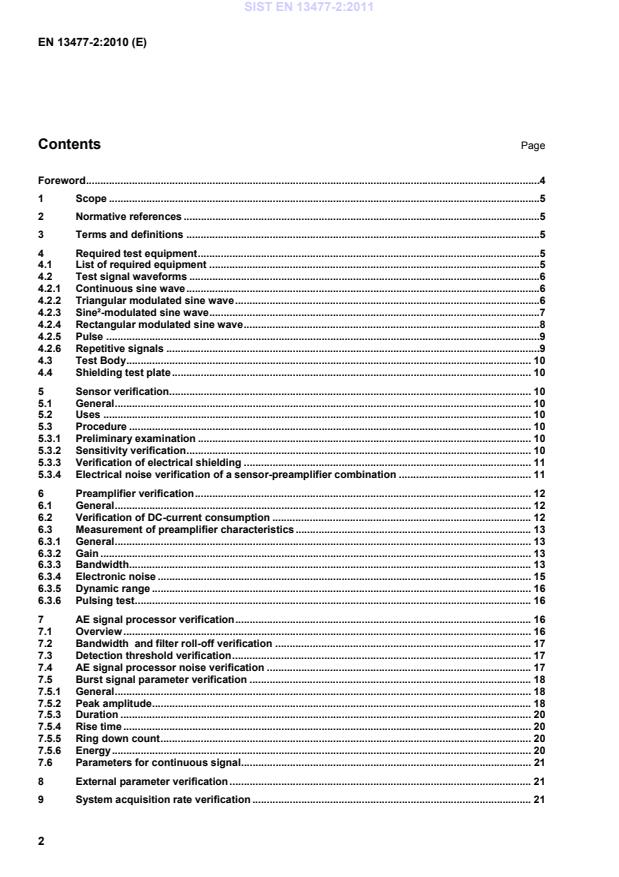
2003-01.Slovenski inštitut za standardizacijo. Razmnoževanje celote ali delov tega standarda ni dovoljeno.Zerstörungsfreie Prüfung - Schallemissionsprüfung - Gerätecharakterisierung - Teil 2: Überprüfung der BetriebskenngrößenEssais non destructifs, émission acoustique - Caractérisation de l’équipement - Partie 2: Vérifications des caractéristiques de fonctionnementNon destructive testing acoustic emission - Equipment Characterisation - Part 2: Verification of operating characteristic19.100Neporušitveno preskušanjeNon-destructive testingICS:Ta slovenski standard je istoveten z:EN 13477-2:2010SIST EN 13477-2:2011en,fr,de01-februar-2011SIST EN 13477-2:2011SLOVENSKI
STANDARDSIST EN 13477-2:20011DGRPHãþD
EUROPEAN STANDARD NORME EUROPÉENNE EUROPÄISCHE NORM
EN 13477-2
September 2010 ICS 19.100 Supersedes EN 13477-2:2001English Version
Non-destructive testing - Acoustic emission - Equipment characterisation - Part 2: Verification of operating characteristic Essais non destructifs, émission acoustique - Caractérisation de l'équipement - Partie 2: Vérifications des caractéristiques de fonctionnement
Zerstörungsfreie Prüfung - Schallemissionsprüfung - Gerätecharakterisierung - Teil 2: Überprüfung der Betriebskenngrößen This European Standard was approved by CEN on 30 July 2010.
CEN members are bound to comply with the CEN/CENELEC Internal Regulations which stipulate the conditions for giving this European Standard the status of a national standard without any alteration. Up-to-date lists and bibliographical references concerning such national standards may be obtained on application to the CEN Management Centre or to any CEN member.
This European Standard exists in three official versions (English, French, German). A version in any other language made by translation under the responsibility of a CEN member into its own language and notified to the CEN Management Centre has the same status as the official versions.
CEN members are the national standards bodies of Austria, Belgium, Bulgaria, Croatia, Cyprus, Czech Republic, Denmark, Estonia, Finland, France, Germany, Greece, Hungary, Iceland, Ireland, Italy, Latvia, Lithuania, Luxembourg, Malta, Netherlands, Norway, Poland, Portugal, Romania, Slovakia, Slovenia, Spain, Sweden, Switzerland and United Kingdom.
EUROPEAN COMMITTEE FOR STANDARDIZATION
COMITÉ EUROPÉEN DE NORMALISATION EUROPÄISCHES KOMITEE FÜR NORMUNG
Management Centre:
Avenue Marnix 17,
B-1000 Brussels © 2010 CEN All rights of exploitation in any form and by any means reserved worldwide for CEN national Members. Ref. No. EN 13477-2:2010: ESIST EN 13477-2:2011
and filter roll-off verification . 177.3 Detection threshold verification . 177.4 AE signal processor noise verification . 177.5 Burst signal parameter verification . 187.5.1 General . 187.5.2 Peak amplitude . 187.5.3 Duration . 207.5.4 Rise time . 207.5.5 Ring down count . 207.5.6 Energy . 207.6 Parameters for continuous signal . 218 External parameter verification . 219 System acquisition rate verification . 21SIST EN 13477-2:2011
∆∆∆∆t measurement verification . 2211 Documentation . 22Annex A (informative)
Sensor performance check form . 25Annex B (informative)
Preamplifier performance check form . 27Annex C (informative)
AE signal processor - bandwidth & noise verification form (one per channel) . 29 SIST EN 13477-2:2011
Key [mV] amplitude Figure 1 — Triangular modulated sine wave in time (left) and frequency (right) domain The measured rise time may be shorter than the visible rise time of the test signal because rise time measurement starts at the time of the first threshold crossing. Table 1 shows the dependency of this threshold crossing delay on the difference between maximum amplitude and threshold setting in an AE channel. 4.2.3 Sine²-modulated sine wave A sine²-modulated signal (see Figure 2) can be used as an alternative to a triangular modulated sine wave. Due to its smooth begin, peak and end, its spectrum is very pure and the influence of filter overshoot and filter ring down behaviour is reduced. This signal can be used to obtain the frequency response of the bandpass of a preamplifier or AE signal processor by burst peak amplitude measurement.
Key [mV] amplitude Figure 2 — Sine²-modulated sine wave in time (left) and frequency domain (right) NOTE The shown signal corresponds to the following function: ))/(²(sin)/2sin(][SWpBSpSWNSpSWNUNUP××××××=ππ (1) 0=N to )SWpB(SpSW×, in integer steps (2) where N = number of each sample in time order; SpSW = Samples per sine wave (48 in Figure 2); SWpB = Sine waves per burst (41 in Figure 2); U[N] = Voltage of sample N; SIST EN 13477-2:2011
()SpSWft×=cs1 (4) Example in Figure 2: ts = 1/(200 kHz x 48) = 104.167 ns Similar to the triangular modulated sine wave, the rise time measured by an AE signal processor is shorter than the visible rise time of the test signal, because rise time measurement starts at the time of the first threshold crossing. This so-called “first threshold crossing delay” depends on the difference of maximum amplitude and detection threshold in dB and is listed for the two modulated test signals in Table 1. Table 1 First threshold crossing delay versus amplitude to threshold ratio
for a sin2 and triangular modulated test signal Threshold Sin² modulated first threshold crossing delay % of signal rise time Triangular modulated
first threshold crossing delay % of signal rise time A – 20 dB 19,7 11,0 A – 25 dB 15,0 6,0 A – 30 dB 12,3 3,5 A – 35 dB 8,3 3,0 A – 40 dB 7,6 1,0
4.2.4 Rectangular modulated sine wave This type of signal is defined by the characteristics A, D and f, see
4.2.2 and Figure 3.
Key [mV] amplitude Figure 3 — Rectangular modulated sine wave in time (left) and frequency domain (right) SIST EN 13477-2:2011
Figure 4 — Pulse 4.2.6 Repetitive signals This signal is used to verify the signal processing rate. It is a series of pulses as described in 4.2.5. It is defined by A (amplitude), D (pulse duration) and f (repetition frequency), typically 1 Hz – 10 kHz. Figure 5 shows an example with 1/f = 160 µs, taken after the band pass filter of an AE signal processor. The maximum reasonable repetition frequency is limited by the ring down effect of the band pass filter, if a pulse causes multiple threshold crossings.
Key [mV] amplitude Figure 5 — A series of transient signals (pulses) 160 µs apart behind the band pass SIST EN 13477-2:2011
Figure 6 — Shielding verification set-up 5.3.4 Electrical noise verification of a sensor-preamplifier combination The electrical noise level of a sensor and preamplifier combination shall be measured in acoustically quiet environment with the sensor dismounted from a structure. The measurement set-up is according to 6.3.4. The noise level is measured in specified units and shall not exceed the noise specification of the manufacturer. The measured value shall be reported on the test record (see Annex A). SIST EN 13477-2:2011
With no input from the sine wave generator measure and record the stand by current,ISB
in mA.
Use a sine wave of a frequency within the pass band of the preamplifier and set the preamplifier AC output to full scale. Measure and record the full scale current IFS
in mA. Standby current ISB and full scale current IFS shall not exceed the manufacturer’s specifications.
Figure 7 — Set-up for measurement of DC current consumption SIST EN 13477-2:2011
Figure 8 — Test set-up for the verification of preamplifier gain and bandwidth 6.3.3 Bandwidth Figure 8 shows the test set-up for the verification of preamplifier bandwid
...