

EN 514:2025
(Main)Plastics - Poly(vinyl chloride) (PVC) based profiles - Determination of the strength of welded corners and T-joints
- Abstract
This document specifies a tensile bending method and a compression bending method for determining the failure stress of welded corners and welded T-joints made from unplasticized poly(vinyl chloride) (PVC-U) profiles.
It is applicable to PVC based profiles used for the fabrication of windows and doors.
- Status
- Published
- Publication Date
- 13-May-2025
- Technical Committee
- CEN/TC 249 - Plastics
- Drafting Committee
- CEN/TC 249/WG 21 - Profiles for windows and doors
- Current Stage
- 6060 - Definitive text made available (DAV) - Publishing
- Start Date
- 14-May-2025
- Due Date
- 20-Apr-2026
- Completion Date
- 14-May-2025

Overview
EN 514:2025 - Plastics: Poly(vinyl chloride) (PVC) based profiles - specifies standardized test methods for determining the strength of welded corners and welded T‑joints in unplasticized PVC (PVC‑U) profiles. Published by CEN and approved in May 2025, this standard defines tensile bending and compression bending procedures to record the failure load and calculate failure stress for PVC profiles used in the fabrication of windows and doors.
Key topics and technical requirements
- Scope: Applies to PVC‑based profiles (PVC‑U) for windows and doors; replaces EN 514:2018.
- Test methods:
- Tensile bending test (clamped specimen with load applied at a specified distance).
- Compression bending test (specimen supported on carriages with centrally applied load).
- Apparatus and settings:
- Tensile/compression testing machine with measuring range 0.2 kN to 20 kN, peak recording and ±3% accuracy.
- Test speed 50 ± 5 mm/min.
- Test temperature (23 ± 5) °C; specimens conditioned at this temperature for at least 2 hours prior to testing.
- Specimen preparation:
- Welded corners and T‑joints made by heat welding to form (90 ± 1)° joints.
- Minimum dimensions for bending specimens (e.g., inside leg lengths ≥ 400 mm).
- Minimum of three specimens per profile type from the same welder head to obtain a mean value.
- Calculation: Failure stress is calculated from measured failure load, geometry, and loading arrangement using formulae in Annex A (moment of resistance W = I/e, etc.).
- Reporting: Test reports must reference EN 514:2025 and include profile identification, joint type, welding conditions, test method and results (individual and average failure stress), temperature and any deviations.
Applications
- Verifying mechanical integrity of welded corners and T‑joints in PVC‑U window and door systems.
- Quality control for profile manufacturers, fabricators and window/door assemblers to ensure joint strength meets design expectations.
- Benchmarking welding processes (welding head selection, weld parameters) and validating production changes.
Who should use this standard
- PVC profile manufacturers and extrusion suppliers
- Window, door and façade fabricators and installers
- Test laboratories and certification bodies performing mechanical tests on PVC‑U assemblies
- R&D and quality assurance teams responsible for joint design and welding process validation
Related standards
- Supersedes EN 514:2018.
- Published by CEN/TC 249 (Plastics); users should consult other CEN standards for complementary test methods and product requirements for PVC profiles and fenestration products.
Keywords: EN 514:2025, PVC‑U, welded corners, T‑joints, tensile bending, compression bending, failure stress, windows and doors, CEN testing.
Relations
- Effective Date
- 17-Jan-2024
- Effective Date
- 28-Jan-2026
- Effective Date
- 28-Jan-2026
- Effective Date
- 28-Jan-2026
- Effective Date
- 28-Jan-2026
- Referred By
EN 17410:2021 - Plastics - Controlled loop recycling of PVC-U profiles from windows and doors - Effective Date
- 28-Jan-2026
Get Certified
Connect with accredited certification bodies for this standard

DIN CERTCO
DIN Group product certification.

Smithers Quality Assessments
US management systems and product certification.
Sponsored listings
Frequently Asked Questions
EN 514:2025 is a standard published by the European Committee for Standardization (CEN). Its full title is "Plastics - Poly(vinyl chloride) (PVC) based profiles - Determination of the strength of welded corners and T-joints". This standard covers: This document specifies a tensile bending method and a compression bending method for determining the failure stress of welded corners and welded T-joints made from unplasticized poly(vinyl chloride) (PVC-U) profiles. It is applicable to PVC based profiles used for the fabrication of windows and doors.
This document specifies a tensile bending method and a compression bending method for determining the failure stress of welded corners and welded T-joints made from unplasticized poly(vinyl chloride) (PVC-U) profiles. It is applicable to PVC based profiles used for the fabrication of windows and doors.
EN 514:2025 is classified under the following ICS (International Classification for Standards) categories: 83.140.99 - Other rubber and plastics products. The ICS classification helps identify the subject area and facilitates finding related standards.
EN 514:2025 has the following relationships with other standards: It is inter standard links to EN 514:2018, EN 12608-1:2016, EN 12608-1:2016+A1:2020, EN 12608:2003, EN 12608-2:2023, EN 17410:2021. Understanding these relationships helps ensure you are using the most current and applicable version of the standard.
EN 514:2025 is available in PDF format for immediate download after purchase. The document can be added to your cart and obtained through the secure checkout process. Digital delivery ensures instant access to the complete standard document.
Standards Content (Sample)
SLOVENSKI STANDARD
01-julij-2025
Polimerni materiali - Profili na osnovi polivinilklorida (PVC) - Ugotavljanje trdnosti
kotnih varov in varov T
Plastics - Poly(vinyl chloride) (PVC) based profiles - Determination of the strength of
welded corners and T-joints
Kunststoffe - Profile auf Basis von Polyvinylchlorid (PVC) - Bestimmung der Festigkeit
verschweißter Ecken und T-Verbindungen
Plastiques - Profilés à base de poly(chlorure de vinyle) (PVC) - Détermination de la
résistance des assemblages soudés en angle et en T
Ta slovenski standard je istoveten z: EN 514:2025
ICS:
83.140.99 Drugi izdelki iz gume in Other rubber and plastics
polimernih materialov products
91.060.50 Vrata in okna Doors and windows
2003-01.Slovenski inštitut za standardizacijo. Razmnoževanje celote ali delov tega standarda ni dovoljeno.
EN 514
EUROPEAN STANDARD
NORME EUROPÉENNE
May 2025
EUROPÄISCHE NORM
ICS 83.140.99 Supersedes EN 514:2018
English Version
Plastics - Poly(vinyl chloride) (PVC) based profiles -
Determination of the strength of welded corners and T-
joints
Plastiques - Profilés à base de poly(chlorure de vinyle) Kunststoffe - Profile auf Basis von Polyvinylchlorid
(PVC) - Détermination de la résistance des (PVC) - Bestimmung der Festigkeit verschweißter
assemblages soudés en angle et en T Ecken und T-Verbindungen
This European Standard was approved by CEN on 7 April 2025.
CEN members are bound to comply with the CEN/CENELEC Internal Regulations which stipulate the conditions for giving this
European Standard the status of a national standard without any alteration. Up-to-date lists and bibliographical references
concerning such national standards may be obtained on application to the CEN-CENELEC Management Centre or to any CEN
member.
This European Standard exists in three official versions (English, French, German). A version in any other language made by
translation under the responsibility of a CEN member into its own language and notified to the CEN-CENELEC Management
Centre has the same status as the official versions.
CEN members are the national standards bodies of Austria, Belgium, Bulgaria, Croatia, Cyprus, Czech Republic, Denmark, Estonia,
Finland, France, Germany, Greece, Hungary, Iceland, Ireland, Italy, Latvia, Lithuania, Luxembourg, Malta, Netherlands, Norway,
Poland, Portugal, Republic of North Macedonia, Romania, Serbia, Slovakia, Slovenia, Spain, Sweden, Switzerland, Türkiye and
United Kingdom.
EUROPEAN COMMITTEE FOR STANDARDIZATION
COMITÉ EUROPÉEN DE NORMALISATION
EUROPÄISCHES KOMITEE FÜR NORMUNG
CEN-CENELEC Management Centre: Rue de la Science 23, B-1040 Brussels
© 2025 CEN All rights of exploitation in any form and by any means reserved Ref. No. EN 514:2025 E
worldwide for CEN national Members.
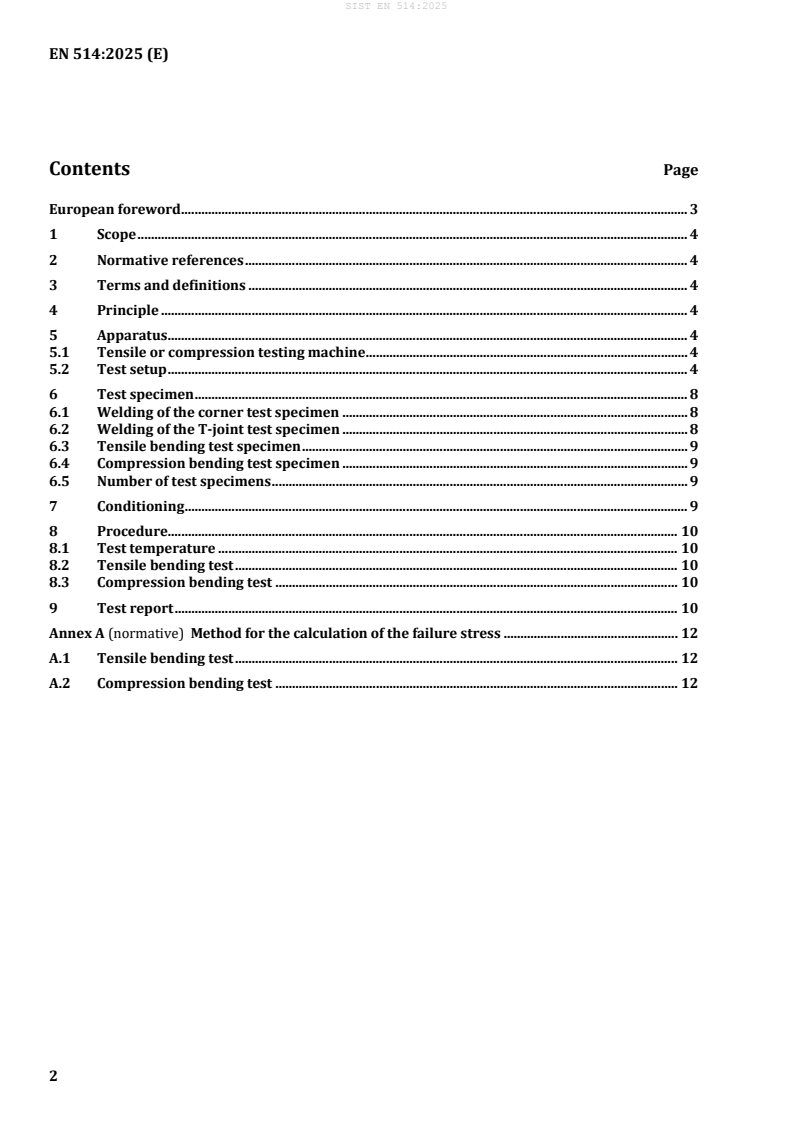
Contents Page
European foreword . 3
1 Scope . 4
2 Normative references . 4
3 Terms and definitions . 4
4 Principle . 4
5 Apparatus . 4
5.1 Tensile or compression testing machine . 4
5.2 Test setup . 4
6 Test specimen . 8
6.1 Welding of the corner test specimen . 8
6.2 Welding of the T-joint test specimen . 8
6.3 Tensile bending test specimen . 9
6.4 Compression bending test specimen . 9
6.5 Number of test specimens . 9
7 Conditioning . 9
8 Procedure. 10
8.1 Test temperature . 10
8.2 Tensile bending test . 10
8.3 Compression bending test . 10
9 Test report . 10
Annex A (normative) Method for the calculation of the failure stress . 12
A.1 Tensile bending test . 12
A.2 Compression bending test . 12
European foreword
This document (EN 514:2025) has been prepared by Technical Committee CEN/TC 249 “Plastics”, the
secretariat of which is held by SIS.
This European Standard shall be given the status of a national standard, either by publication of an
identical text or by endorsement, at the latest by November 2025, and conflicting national standards shall
be withdrawn at the latest by November 2025.
Attention is drawn to the possibility that some of the elements of this document may be the subject of
patent rights. CEN shall not be held responsible for identifying any or all such patent rights.
This document supersedes EN 514:2018.
— term 3.1 "failure load" has been revised;
— in 5.1 the measuring range of load for the tensile or compression testing machine has been expanded.
Any feedback and questions on this document should be directed to the users’ national standards body.
A complete listing of these bodies can be found on the CEN website.
According to the CEN-CENELEC Internal Regulations, the national standards organisations of the
following countries are bound to implement this European Standard: Austria, Belgium, Bulgaria, Croatia,
Cyprus, Czech Republic, Denmark, Estonia, Finland, France, Germany, Greece, Hungary, Iceland, Ireland,
Italy, Latvia, Lithuania, Luxembourg, Malta, Netherlands, Norway, Poland, Portugal, Republic of North
Macedonia, Romania, Serbia, Slovakia, Slovenia, Spain, Sweden, Switzerland, Türkiye and the United
Kingdom.
1 Scope
This document specifies a tensile bending method and a compression bending method for determining
the failure stress of welded corners and welded T-joints made from unplasticized poly(vinyl chloride)
(PVC-U) profiles.
It is applicable to PVC based profiles used for the fabrication of windows and doors.
2 Normative references
There are no normative references in this document.
3 Terms and definitions
For the purposes of this document, the following terms and definitions apply.
ISO and IEC maintain terminology databases for use in standardization at the following addresses:
— ISO Online browsing platform: available at https://www.iso.org/obp
— IEC Electropedia: available at https://www.electropedia.org/
3.1
failure load
load at which the test specimen breaks corresponding with the maximum load during test
4 Principle
Welded corners or T-joints made from PVC-U profiles are subjected to a tensile bending or compression
bending test at specified temperature and test speed.
The failure load is recorded and the failure stress is calculated.
5 Apparatus
5.1 Tensile or
...