

EN 13245-1:2025
(Main)Plastics - Unplasticized poly(vinyl chloride) (PVC-U) profiles for building applications - Part 1: Designation of PVC-U profiles
- Abstract
This document establishes a system of designation for profiles made of unplasticized poly(vinyl chloride) (PVC-U) intended to be used for building applications. This system is intended to be used in product specification after the application is specified.
NOTE It is intended to use this system for the designation of PVC-U profiles for information related to technical literature of the manufacturer, not for the marking of the products.
This part is applicable to PVC-U profiles of any colour, obtained by a mono-extrusion or a co-extrusion process, with or without surface finishing (e.g. foil, paint or print).
This document defines minimum requirements for the surface finishing of PVC-U profiles.
Profiles for the management of electrical power cables, communication cables and power track systems used for the distribution of electrical power, profiles for windows or doors and profiles for guttering are not covered by this document.
- Status
- Published
- Publication Date
- 09-Dec-2025
- Technical Committee
- CEN/TC 249 - Plastics
- Drafting Committee
- CEN/TC 249/WG 5 - Thermoplastic profiles for building applications
- Current Stage
- 6060 - Definitive text made available (DAV) - Publishing
- Start Date
- 10-Dec-2025
- Due Date
- 23-Oct-2025
- Completion Date
- 10-Dec-2025

Overview
EN 13245-1:2025 - Plastics: Unplasticized poly(vinyl chloride) (PVC‑U) profiles for building applications - Part 1: Designation of PVC‑U profiles (CEN) defines a standardized designation system for PVC‑U profiles used in building applications. The standard applies to mono‑extruded or co‑extruded PVC‑U profiles of any colour, with or without surface finishing (laminated foil, paint, print). It is intended for use in product specification and manufacturer technical literature - not for product marking. Certain profile types (windows/doors, guttering, cable management/power distribution systems) are excluded.
Key topics and technical requirements
- Designation structure: A profile designation comprises a description block plus five data blocks:
- Data block 1 - Material and profile type (Type 1: mono‑extruded; Type 2: co‑extruded; Type 3: laminated foil; Type 4: paint; Type 5: printing).
- Data block 2 - Intended application code (e.g., outside = E, inside = I).
- Data block 3 - Material properties (Vicat softening temperature, modulus of elasticity in flexure).
- Data block 4 - Profile properties (nominal linear mass, heat reversion at 100 °C, impact resistance).
- Data block 5 - Durability (ageing test methods and property assessment after ageing).
- Surface finishing: Minimum requirements for laminated foils, paints and prints are defined; appearance, gloss and adhesion assessment methods are referenced.
- Test methods referenced: The standard references established tests (e.g., EN ISO 306 for Vicat, EN ISO 178 for flexural modulus, EN 477/479/513 series for impact, heat reversion and weathering, peel/adhesion tests).
- Durability and ageing: Specifies test regimes and codification for post‑ageing properties to support lifetime performance claims.
- Recycling and materials: Notes on use of recycled PVC‑U (rPVC‑U or IRM) and guidance for design for recycling.
Practical applications and users
Who uses EN 13245-1:2025:
- Profile manufacturers - to provide consistent product data sheets and classify profile types.
- Specifiers, architects and engineers - to compare and select PVC‑U profiles by standardized properties (VST, flexural modulus, impact resistance, durability).
- Procurement and quality teams - to set purchase specifications and acceptance criteria.
- Technical authors and marketing - to prepare clear technical literature compliant with CEN designation practice.
- Recycling and sustainability teams - to address material declarations and design‑for‑recycling recommendations.
Related standards
EN 13245 consists of multiple parts; Part 1 covers designation. Normative references include EN ISO 306, EN ISO 178, EN 477, EN 479, EN 513, EN 17271, EN 17410 and other ISO/CEN test methods for colour, gloss and adhesion - useful cross‑references when specifying or testing PVC‑U profiles.
Keywords: EN 13245-1:2025, PVC‑U profiles, unplasticized poly(vinyl chloride), profile designation, surface finishing, Vicat softening temperature, modulus of elasticity, impact resistance, durability, co‑extrusion, laminated foil, building applications.
Relations
- Effective Date
- 28-Jan-2023
- Effective Date
- 25-Aug-2026
- Effective Date
- 12-Aug-2026
- Effective Date
- 09-Feb-2026
- Effective Date
- 09-Feb-2026
- Effective Date
- 28-Jan-2026
- Effective Date
- 28-Jan-2026
- Effective Date
- 28-Jan-2026
- Effective Date
- 28-Jan-2026
- Effective Date
- 28-Jan-2026
- Effective Date
- 28-Jan-2026
- Effective Date
- 28-Jan-2026
- Effective Date
- 28-Jan-2026
- Effective Date
- 28-Jan-2026
- Effective Date
- 28-Jan-2026
Get Certified
Connect with accredited certification bodies for this standard

DIN CERTCO
DIN Group product certification.

Smithers Quality Assessments
US management systems and product certification.
Sponsored listings
Frequently Asked Questions
EN 13245-1:2025 is a standard published by the European Committee for Standardization (CEN). Its full title is "Plastics - Unplasticized poly(vinyl chloride) (PVC-U) profiles for building applications - Part 1: Designation of PVC-U profiles". This standard covers: This document establishes a system of designation for profiles made of unplasticized poly(vinyl chloride) (PVC-U) intended to be used for building applications. This system is intended to be used in product specification after the application is specified. NOTE It is intended to use this system for the designation of PVC-U profiles for information related to technical literature of the manufacturer, not for the marking of the products. This part is applicable to PVC-U profiles of any colour, obtained by a mono-extrusion or a co-extrusion process, with or without surface finishing (e.g. foil, paint or print). This document defines minimum requirements for the surface finishing of PVC-U profiles. Profiles for the management of electrical power cables, communication cables and power track systems used for the distribution of electrical power, profiles for windows or doors and profiles for guttering are not covered by this document.
This document establishes a system of designation for profiles made of unplasticized poly(vinyl chloride) (PVC-U) intended to be used for building applications. This system is intended to be used in product specification after the application is specified. NOTE It is intended to use this system for the designation of PVC-U profiles for information related to technical literature of the manufacturer, not for the marking of the products. This part is applicable to PVC-U profiles of any colour, obtained by a mono-extrusion or a co-extrusion process, with or without surface finishing (e.g. foil, paint or print). This document defines minimum requirements for the surface finishing of PVC-U profiles. Profiles for the management of electrical power cables, communication cables and power track systems used for the distribution of electrical power, profiles for windows or doors and profiles for guttering are not covered by this document.
EN 13245-1:2025 is classified under the following ICS (International Classification for Standards) categories: 83.140.99 - Other rubber and plastics products. The ICS classification helps identify the subject area and facilitates finding related standards.
EN 13245-1:2025 has the following relationships with other standards: It is inter standard links to EN 13245-1:2010, ISO/CIE 11664-2:2022, EN 513:2026, ISO/CIE 11664-4:2019, ISO/CIE 11664-1:2019, EN 17508:2021, EN 477:2018, EN ISO 2409:2020, EN ISO 18314-1:2018, EN ISO 4624:2023, EN 513:2018, EN ISO 23547:2023, EN 17615:2022, EN ISO 1043-1:2011, EN ISO 105-A01:2010. Understanding these relationships helps ensure you are using the most current and applicable version of the standard.
EN 13245-1:2025 is associated with the following European legislation: EU Directives/Regulations: 305/2011. When a standard is cited in the Official Journal of the European Union, products manufactured in conformity with it benefit from a presumption of conformity with the essential requirements of the corresponding EU directive or regulation.
EN 13245-1:2025 is available in PDF format for immediate download after purchase. The document can be added to your cart and obtained through the secure checkout process. Digital delivery ensures instant access to the complete standard document.
Standards Content (Sample)
SLOVENSKI STANDARD
01-februar-2026
Polimerni materiali - Profili iz trdega polivinilklorida (PVC-U) za uporabo v
gradbeništvu - 1. del: Označevanje profilov PVC-U
Plastics - Unplasticized poly(vinyl chloride) (PVC-U) profiles for building applications -
Part 1: Designation of PVC-U profiles
Kunststoffe - Profile aus weichmacherfreiem Polyvinylchlorid (PVC-U) für die
Anwendung im Bauwesen - Teil 1: Bezeichnung von Profilen aus PVC-U
Plastiques - Profilés en poly(chlorure de vinyle) non plastifié (PVC-U) pour applications
dans le bâtiment - Partie 1: Désignation des profilés en PVC-U
Ta slovenski standard je istoveten z: EN 13245-1:2025
ICS:
83.140.99 Drugi izdelki iz gume in Other rubber and plastics
polimernih materialov products
2003-01.Slovenski inštitut za standardizacijo. Razmnoževanje celote ali delov tega standarda ni dovoljeno.
EN 13245-1
EUROPEAN STANDARD
NORME EUROPÉENNE
December 2025
EUROPÄISCHE NORM
ICS 83.140.99 Supersedes EN 13245-1:2010
English Version
Plastics - Unplasticized poly(vinyl chloride) (PVC-U)
profiles for building applications - Part 1: Designation of
PVC-U profiles
Plastiques - Profilés en poly(chlorure de vinyle) non Kunststoffe - Profile aus weichmacherfreiem
plastifié (PVC-U) pour applications dans le bâtiment - Polyvinylchlorid (PVC-U) für die Anwendung im
Partie 1 : Désignation des profilés en PVC-U Bauwesen - Teil 1: Bezeichnung von Profilen aus PVC-U
This European Standard was approved by CEN on 26 October 2025.
CEN members are bound to comply with the CEN/CENELEC Internal Regulations which stipulate the conditions for giving this
European Standard the status of a national standard without any alteration. Up-to-date lists and bibliographical references
concerning such national standards may be obtained on application to the CEN-CENELEC Management Centre or to any CEN
member.
This European Standard exists in three official versions (English, French, German). A version in any other language made by
translation under the responsibility of a CEN member into its own language and notified to the CEN-CENELEC Management
Centre has the same status as the official versions.
CEN members are the national standards bodies of Austria, Belgium, Bulgaria, Croatia, Cyprus, Czech Republic, Denmark, Estonia,
Finland, France, Germany, Greece, Hungary, Iceland, Ireland, Italy, Latvia, Lithuania, Luxembourg, Malta, Netherlands, Norway,
Poland, Portugal, Republic of North Macedonia, Romania, Serbia, Slovakia, Slovenia, Spain, Sweden, Switzerland, Türkiye and
United Kingdom.
EUROPEAN COMMITTEE FOR STANDARDIZATION
COMITÉ EUROPÉEN DE NORMALISATION
EUROPÄISCHES KOMITEE FÜR NORMUNG
CEN-CENELEC Management Centre: Rue de la Science 23, B-1040 Brussels
© 2025 CEN All rights of exploitation in any form and by any means reserved Ref. No. EN 13245-1:2025 E
worldwide for CEN national Members.
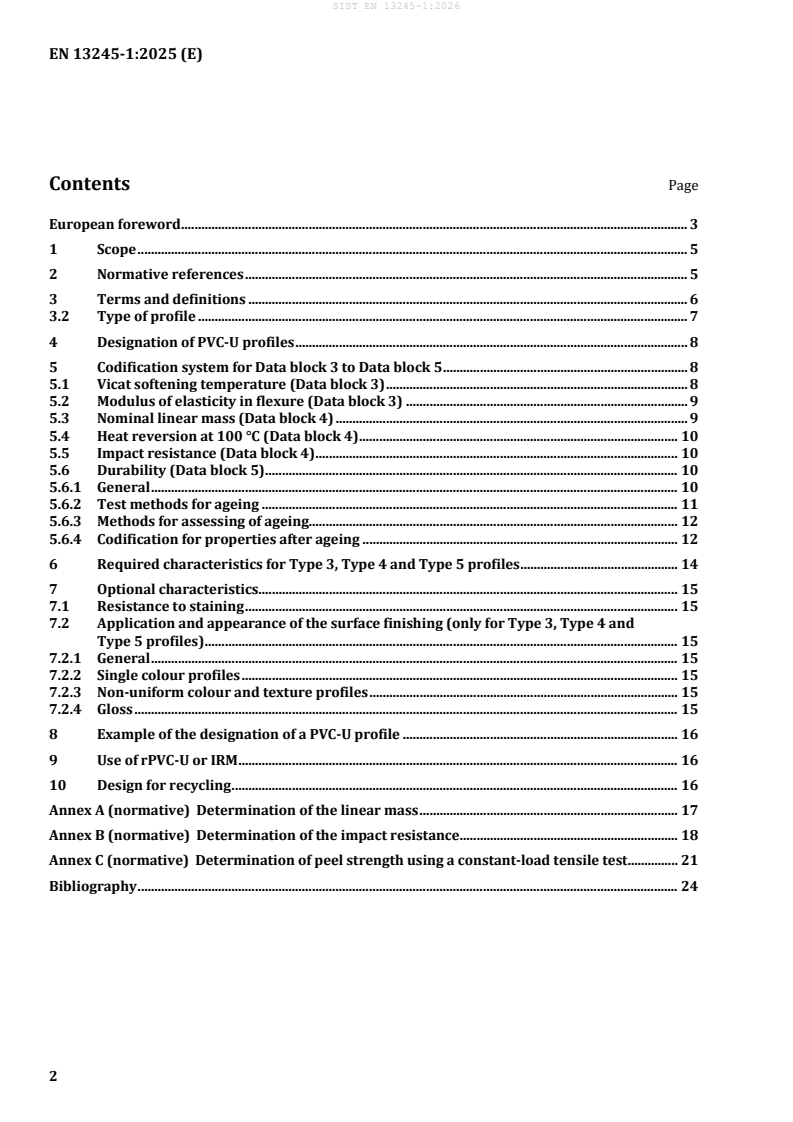
Contents Page
European foreword . 3
1 Scope . 5
2 Normative references . 5
3 Terms and definitions . 6
3.2 Type of profile . 7
4 Designation of PVC-U profiles . 8
5 Codification system for Data block 3 to Data block 5 . 8
5.1 Vicat softening temperature (Data block 3) . 8
5.2 Modulus of elasticity in flexure (Data block 3) . 9
5.3 Nominal linear mass (Data block 4) . 9
5.4 Heat reversion at 100 °C (Data block 4) . 10
5.5 Impact resistance (Data block 4) . 10
5.6 Durability (Data block 5) . 10
5.6.1 General . 10
5.6.2 Test methods for ageing . 11
5.6.3 Methods for assessing of ageing. 12
5.6.4 Codification for properties after ageing . 12
6 Required characteristics for Type 3, Type 4 and Type 5 profiles . 14
7 Optional characteristics. 15
7.1 Resistance to staining . 15
7.2 Application and appearance of the surface finishing (only for Type 3, Type 4 and
Type 5 profiles) . 15
7.2.1 General . 15
7.2.2 Single colour profiles . 15
7.2.3 Non-uniform colour and texture profiles . 15
7.2.4 Gloss . 15
8 Example of the designation of a PVC-U profile . 16
9 Use of rPVC-U or IRM . 16
10 Design for recycling . 16
Annex A (normative) Determination of the linear mass . 17
Annex B (normative) Determination of the impact resistance . 18
Annex C (normative) Determination of peel strength using a constant-load tensile test . 21
Bibliography . 24
European foreword
This document (EN 13245-1:2025) has been prepared by Technical Committee CEN/TC 249 “Plastics”,
the secretariat of which is held by SIS.
This European Standard shall be given the status of a national standard, either by publication of an
identical text or by endorsement, at the latest by June 2026, and conflicting national standards shall be
withdrawn at the latest by June 2026.
Attention is drawn to the possibility that some of the elements of this document may be the subject of
patent rights. CEN shall not be held responsible for identifying any or all such patent rights.
This document supersedes EN 13245-1:2010.
— Scope has been clarified;
— Normative references have been updated;
— Terms and definitions have been updated and reference to EN 17410, EN 17508 and EN 17615
has been added;
— Printing process and Type 5 profile, “profile as Type 1 or Type 2 covered with print”, have been
added and the whole document has been updated accordingly;
— Peel test method according to EN 17271 for Type 3 profiles has been added and the whole
document has been updated accordingly;
— Clause 9 has been modified to introduce new terms from EN 17508 and its title has been changed
accordingly;
— New Clause 10, “Design for recycling” has been added;
— Annex C was modified with a new peel strength apparatus;
— Bibliography has been updated.
The EN 13245 series, under the general title Plastics ― Unplasticized poly(vinyl chloride) (PVC-U) profiles
for building applications, consists of the following parts:
— Part 1: Designation of PVC-U profiles
— Part 2: PVC-U profiles and PVC-UE profiles for internal and external wall and ceiling finishes
— Part 3: Designation of PVC-UE profiles
Any feedback and questions on this document should be directed to the users’ national standards body.
A complete listing of these bodies can be found on the CEN website.
According to the CEN-CENELEC Internal Regulations, the national standards organisations of the
following countries are bound to implement this European Standard: Austria, Belgium, Bulgaria, Croatia,
Cyprus, Czech Republic, Denmark, Estonia, Finland, France, Germany, Greece, Hungary, Iceland, Ireland,
Italy, Latvia, Lithuania, Luxembourg, Malta, Netherlands, Norway, Poland, Portugal, Republic of North
Macedonia, Romania, Serbia, Slovakia, Slovenia, Spain, Sweden, Switzerland, Türkiye and the United
Kingdom.
1 Scope
This document establishes a system of designation for profiles made of unplasticized poly(vinyl chloride)
(PVC-U) intended to be used for building applications. This system is intended to be used in product
specification after the application is specified.
NOTE It is intended to use this system for the designation of PVC-U profiles for information related to technical
literature of the manufacturer, not for the marking of the products.
This part is applicable to PVC-U profiles of any colour, obtained by a mono-extrusion or a co-extrusion
process, with or without surface finishing (e.g. foil, paint or print).
This document defines minimum requirements for the surface finishing of PVC-U profiles.
Profiles for the management of electrical power cables, communication cables and power track systems
used for the distribution of electrical power, profiles for windows or doors and profiles for guttering are
not covered by this document .
2 Normative references
The following documents are referred to in the text in such a way that some or all of their content
constitutes requirements of this document. For dated references, only the edition cited applies. For
undated references, the latest edition of the referenced document (including any amendments) applies.
EN 438-2:2016+A1:2018, High-pressure decorative laminates (HPL) — Sheets based on thermosetting
resins (usually called Laminates) — Part 2: Determination of properties
EN 477, Plastics — Poly(vinyl chloride) (PVC) based profiles — Determination of the resistance to impact of
profiles by falling mass
EN 478, Plastics — Poly(vinyl chloride) (PVC) based profiles — Determination of the appearance after
exposure at 150 °C
EN 479, Plastics — Poly(vinyl chloride) (PVC) based profiles — Determination of heat reversion
EN 513, Plastics — Poly(vinyl chloride) (PVC) based profiles — Determination of the resistance to artificial
weathering
EN 12720, Furniture — Assessment of surface resistance to cold liquids
EN 17271, Plastics — Poly(vinyl chloride) (PVC) based profiles — Determination of the peel strength of
profiles laminated with foils
EN 17410, Plastics — Controlled loop recycling of PVC-U profiles from windows and doors
EN 17508, Plastics — Unplasticized poly(vinyl chloride) (PVC-U) profiles for the fabrication of windows and
doors — Terminology of PVC based materials
EN 17615, Plastics — Environmental Aspects — Vocabulary
Profiles that are excluded are in the scopes of standards prepared by CEN/TC 249/WG 21, CENELEC/TC 213 or
CEN/TC 128.
EN 20105-A02, Textiles — Tests for colour fastness — Part A02: Grey scale for assessing change in colour
(ISO 105-A02)
EN ISO 105-A01:2010, Textiles — Tests for colour fastness — Part A01: General principles of testing
(ISO 105-A01:2010)
EN ISO 178, Plastics — Determination of flexural properties (ISO 178)
EN ISO 306, Plastics — Thermoplastic materials — Determination of Vicat softening temperature (VST)
(ISO 306)
EN ISO 472, Plastics — Vocabulary (ISO 472)
EN ISO 877-2, Plastics — Methods of exposure to solar radiation — Part 2: Direct weathering and exposure
behind window glass (ISO 877-2)
EN ISO 1043-1, Plastics — Symbols and abbreviated terms — Part 1: Basic polymers and their special
characteristics (ISO 1043-1)
EN ISO 2409, Paints and varnishes — Cross-cut test (ISO 2409)
EN ISO 2813, Paints and varnishes — Determination of gloss value at 20°, 60° and 85° (ISO 2813)
EN ISO 4624, Paints and varnishes — Pull-off test for adhesion (ISO 4624)
EN ISO 4892-2:2013, Plastics — Methods of exposure to laboratory light sources — Part 2: Xenon-arc
lamps (ISO 4892-2:2013)
EN ISO 8256, Plastics — Determination of tensile-impact strength (ISO 8256)
EN ISO 18314-1, Analytical colorimetry — Part 1: Practical colour measurement (ISO 18314-1)
EN ISO/CIE 11664-1, Colorimetry — Part 1: CIE standard colorimetric observers (ISO/CIE 11664-1)
EN ISO/CIE 11664-2, Colorimetry — Part 2: CIE standard illuminants (ISO/CIE 11664-2)
EN ISO/CIE 11664-4, Colorimetry — Part 4: CIE 1976 L*a*b* Colour space (ISO/CIE 11664-4)
3 Terms and definitions
For the purposes of this document, the terms and definitions given in EN 17410, EN 17508, EN 17615,
EN ISO 472, EN ISO 1043-1 and the following apply.
ISO and IEC maintain terminology databases for use in standardization at the following addresses:
— ISO Online browsing platform: available at https://www.iso.org/obp
— IEC Electropedia: available at https://www.electropedia.org/
3.1
PVC-U profile
profile made of non-cellular unplasticized poly(vinyl chloride) (PVC-U) material
3.2 Type of profile
3.2.1
Type 1 profile
non-covered profile coloured in the mass obtained by a mono-extrusion process
3.2.2
Type 2 profile
non-covered profile obtained by a co-extrusion process with a surface coloured in the mass
3.2.3
Type 3 profile
profile as Type 1 or Type 2 covered with foil
Note 1 to entry: Foil can be painted, printed or not.
3.2.4
Type 4 profile
profile as Type 1 or Type 2 covered with paint
3.2.5
Type 5 profile
profile as Type 1 or Type 2 covered with print
3.3
sight surface
surface of a profile that is exposed to view, when the profile is installed
3.4
surface finishing
covering layer on the sight surface of a profile, e.g. a co-extruded layer, a foil, a paint, a print
3.5
foil
plastics layer for external uses intended to cover surfaces of a base profile
Note 1 to entry: Foil can be painted, printed or not.
3.6
print
result of a printing process in which ink or a combination of ink and surface finishing is applied
3.7
paint
one or several layer(s) of lacquer (e.g. acrylic or polyurethane resin) and/or varnish (clear coating
material) that cover(s) a base profile
3.8
co-extrusion
durable bonding of two or more thermoplastics [e.g. unplasticized poly(vinyl chloride) (PVC-U) and
poly(methyl methacrylate) (PMMA)] that are melted in separated extruders and fused together in the
profile tool
3.9
radiant exposure
H
time integral of irradiance
Note 1 to entry: It is measured in joules per square metre (J/m ).
[SOURCE: ISO 9370:2017 [1], 3.27]
4 Designation of PVC-U profiles
The PVC-U profiles are designated in accordance with a classification system of their characteristics.
The designation consists of a description block and five data blocks as given in Table 1.
Table 1 — Designation of PVC-U profiles
Data block Description Profile EN 13245-1 Additional
information
a b
Data block 1 Material and PVC-U – Type 1, Type 2, Type 3 , Type 4 See 3.2
b
profile type or Type 5
identification
Data block 2 Intended Codes depending on the intended
application application:
For outside building applications: E
For inside building applications: I
Data block 3 Material properties Vicat softening temperature (VST) See 5.1
Modulus of elasticity in flexure See 5.2
Data block 4 Profile properties Nominal linear mass See 5.3
Heat reversion at 100 °C See 5.4
Impact resistance See 5.5
Data block 5 Durability See 5.6
a
For Type 3 profiles, the requirements given in 6.1 to 6.4 shall be fulfilled.
b
For Type 4 or 5 profiles, the requirements given in 6.1 to 6.3 shall be fulfilled.
5 Codification system for Data block 3 to Data block 5
5.1 Vicat softening temperature (Data block 3)
The Vicat softening temperature (VST) shall be measured in accordance with EN ISO 306, Method B50,
as indicated in Table 2.
Testing shall be carried out on profiles, however where geometry or thickness is prohibitive samples can
be made of pressed plates prepared according to EN ISO 21306-2 [4]. Where these are used, the test
result shall be designated with the letter “Q” after the value.
Table 2 — Preparation of test specimens
Type of profile Compound to be tested
Type 1 PVC-U compound
Type 2, Type 3, Type 4 and Type 5 Each of the extruded compounds, as applicable
The type of sample tested shall be recorded and the value of VST shall be coded according to Table 3.
For Type 2, Type 3, Type 4 and Type 5 profiles, as applicable, the values of the VST of each compound
shall be coded from the internal layer to the external layer, with a separation by “/”.
5.2 Modulus of elasticity in flexure (Data block 3)
The modulus of elasticity in flexure, E, shall be measured in accordance with EN ISO 178, as indicated in
Table 2.
Testing shall be carried out on profiles, however where geometry or thickness is prohibitive samples can
be made of pressed plates prepared according to EN ISO 21306-2. Where these are used, the test result
shall be designated with the letter “Q” after the value.
For Type 2, Type 3, Type 4 and Type 5 profiles, as applicable, the values of the modulus of elasticity in
flexure of each compound shall be coded from the internal layer to the external layer, with a separation
by “/”.
The value of the modulus of elasticity in flexure shall be coded according to Table 3.
Table 3 — Codification for Data block 3
a b
Vicat softening temperature (VST) Modulus of elasticity in flexure, E
a
Range of values Code
MPa
The VST is represented by three figures giving E < 1 700 00
the softening temperature.
1 700 ≤ E < 2 000 17
E.g. code 082 for a nominal VST value of 2 000 ≤ E < 2 300 20
82,3 °C.
2 300 ≤ E < 2 600 23
E.g. code 083Q for a nominal VST value of 2 600 ≤ E < 2 900 26
82,6 °C from a pressed plate.
2 900 ≤ E < 3 200 29
3 200 ≤ E < 3 500 32
3 500 ≤ E 35
a
The letter “Q” is added when pressed plates are tested.
b
According to EN ISO 306, the VST value is reported with one decimal Celsius that may affect the
code.
5.3 Nominal linear mass (Data block 4)
The nominal linear mass of the PVC-U profile shall be measured in accordance with Annex A.
The value of the nominal linear mass shall be coded according to Table 4.
5.4 Heat reversion at 100 °C (Data block 4)
The heat reversion at 100 °C of the PVC-U profile, R, shall be measured in accordance with EN 479.
The value of the heat reversion at 100 °C shall be coded according to Table 4.
5.5 Impact resistance (Data block 4)
The impact resistance of the PVC-U profile at 23 °C or, if required, at a low temperature (- 10 °C, - 20 °C
or -T °C), shall be measured in accordance with Annex B.
The value of the impact resistance shall be coded according to Table 4.
Table 4 — Codification for Data block 4
Nominal linear mass, P Heat reversion at 100 °C Impact resistance at T °C
M
R Code Energy level Code
% J
The nominal linear mass is R ≤ 2 2 1 (T,01)
represented by four figures giving
R ≤ 3 3 2 (T,02)
the nominal linear mass.
a
R ≤ n n 3 (T,03)
4 (T,04)
E.g. code 1483 for a nominal linear 5 (T,05)
mass of 1 483 g/m.
6 (T,06)
10 (T,10)
15 (T,15)
20 (T,20)
b
“(5 × m)” “[T,(5 × m)]”
a
n is an integer.
b
m is an integer.
EXAMPLES
— Code (23,10) for a PVC-U profile with an impact resistance at 23 °C of 10 J;
— Code (−20,05) for a PVC-U profile with an impact resistance at - 20 °C of 5 J.
5.6 Durability (Data block 5)
5.6.1 General
To test durability, the profile is subjected to either natural or artificial ageing. Assessment of the
durability is based on the following criteria:
a) the colour differences between unexposed and exposed PVC-U profiles;
b) the tensile-impact strength of the PVC-U profiles after ageing;
c) the visual inspection of the PVC-U profiles after ageing;
d) the adhesion of the surface finishing of the PVC-U profiles after ageing (for Type 3, Type 4 and Type 5
profiles, only).
5.6.2 Test methods for ageing
5.6.2.1 Outside building applications
Ageing shall be carried out according to either an artificial ageing test method or a natural ageing test
method.
a) Artificial ageing test method according to EN 513, Method 1.
The conditions shall be specified in accordance with the codes “A.n”, “A.n.T” or “A.0”, where
A means “artificial ageing”;
n is the radiant exposure receive
...