

EN 12449:2016+A1:2019
(Main + Amendment)Copper and copper alloys - Seamless, round tubes for general purposes
General Information
- Abstract
This European Standard specifies the composition, property requirements and tolerances on dimensions and form for seamless round drawn copper and copper alloy tubes for general purposes supplied in the size range from 3 mm up to and including 450 mm outside diameter and from 0,3 mm up to and including 20 mm wall thickness.
The sampling procedures and the methods of test for verification of conformity to the requirements of this European Standard are also specified.
NOTE Tubes having an outside diameter less than 80 mm and/or a wall thickness greater than 2 mm in certain alloys are most frequently used for free machining purposes which are specified in EN 12168.
- Status
- Withdrawn
- Publication Date
- 08-Oct-2019
- Withdrawal Date
- 29-Sep-2026
- Technical Committee
- CEN/TC 133 - Copper and copper alloys
- Drafting Committee
- CEN/TC 133/WG 3 - Copper tubes (installation and industrial)
- Current Stage
- 9960 - Withdrawal effective - Withdrawal
- Start Date
- 28-Jun-2023
- Completion Date
- 30-Sep-2026

Relations
- Merged From
EN 12449:2016/prA1 - Copper and copper alloys - Seamless, round tubes for general purposes - Effective Date
- 19-Jan-2023
- Effective Date
- 31-Jul-2019
- Effective Date
- 18-Jan-2023
- Effective Date
- 25-Aug-2026
- Effective Date
- 28-Jan-2026
- Effective Date
- 28-Jan-2026
- Effective Date
- 28-Jan-2026
- Effective Date
- 28-Jan-2026
- Effective Date
- 28-Jan-2026
- Effective Date
- 28-Jan-2026
- Effective Date
- 28-Jan-2026
- Effective Date
- 28-Jan-2026
- Effective Date
- 28-Jan-2026
- Refers
EN ISO 2624:1995 - Copper and copper alloys - Estimation of average grain size (ISO 2624:1990) - Effective Date
- 28-Jan-2026
- Effective Date
- 28-Jan-2026
Get Certified
Connect with accredited certification bodies for this standard

Element Materials Technology
Materials testing and product certification.

Inštitut za kovinske materiale in tehnologije
Institute of Metals and Technology. Materials testing, metallurgical analysis, NDT.
Institut za varilstvo d.o.o. (Welding Institute)
Slovenia's leading welding institute since 1952. ISO 3834, EN 1090, pressure equipment certification, NDT personnel, welder qualification. Only IIW Au
Sponsored listings
Frequently Asked Questions
EN 12449:2016+A1:2019 is a standard published by the European Committee for Standardization (CEN). Its full title is "Copper and copper alloys - Seamless, round tubes for general purposes". This standard covers: This European Standard specifies the composition, property requirements and tolerances on dimensions and form for seamless round drawn copper and copper alloy tubes for general purposes supplied in the size range from 3 mm up to and including 450 mm outside diameter and from 0,3 mm up to and including 20 mm wall thickness. The sampling procedures and the methods of test for verification of conformity to the requirements of this European Standard are also specified. NOTE Tubes having an outside diameter less than 80 mm and/or a wall thickness greater than 2 mm in certain alloys are most frequently used for free machining purposes which are specified in EN 12168.
This European Standard specifies the composition, property requirements and tolerances on dimensions and form for seamless round drawn copper and copper alloy tubes for general purposes supplied in the size range from 3 mm up to and including 450 mm outside diameter and from 0,3 mm up to and including 20 mm wall thickness. The sampling procedures and the methods of test for verification of conformity to the requirements of this European Standard are also specified. NOTE Tubes having an outside diameter less than 80 mm and/or a wall thickness greater than 2 mm in certain alloys are most frequently used for free machining purposes which are specified in EN 12168.
EN 12449:2016+A1:2019 is classified under the following ICS (International Classification for Standards) categories: 23.040.15 - Non-ferrous metal pipes; 77.120.30 - Copper and copper alloys. The ICS classification helps identify the subject area and facilitates finding related standards.
EN 12449:2016+A1:2019 has the following relationships with other standards: It is inter standard links to EN 12449:2016/prA1, EN 12449:2016, EN 12449:2023, ISO 6957:1988, EN ISO 6892-1:2019, EN 10204:2004, EN ISO 196:1995, EN ISO 6507-1:2023, EN 16090:2019, EN 1971-1:2019, EN 1976:2012, EN ISO 8493:2004, EN ISO 6506-1:2014, EN ISO 2624:1995, EN 1971-2:2019. Understanding these relationships helps ensure you are using the most current and applicable version of the standard.
EN 12449:2016+A1:2019 is available in PDF format for immediate download after purchase. The document can be added to your cart and obtained through the secure checkout process. Digital delivery ensures instant access to the complete standard document.
Standards Content (Sample)
SLOVENSKI STANDARD
01-december-2019
Nadomešča:
SIST EN 12449:2016
Baker in bakrove zlitine - Nevarjene cevi z okroglim prerezom za splošno uporabo
Copper and copper alloys - Seamless, round tubes for general purposes
Kupfer und Kupferlegierungen - Nahtlose Rundrohre zur allgemeinen Verwendung
Cuivre et alliages de cuivre - Tubes ronds sans soudure pour usages généraux
Ta slovenski standard je istoveten z: EN 12449:2016+A1:2019
ICS:
23.040.15 Cevi iz neželeznih kovin Non-ferrous metal pipes
77.150.30 Bakreni izdelki Copper products
2003-01.Slovenski inštitut za standardizacijo. Razmnoževanje celote ali delov tega standarda ni dovoljeno.
EN 12449:2016+A1
EUROPEAN STANDARD
NORME EUROPÉENNE
October 2019
EUROPÄISCHE NORM
ICS 23.040.15; 77.120.30 Supersedes EN 12449:2016
English Version
Copper and copper alloys - Seamless, round tubes for
general purposes
Cuivre et alliages de cuivre - Tubes ronds sans soudure Kupfer und Kupferlegierungen - Nahtlose Rundrohre
pour usages généraux zur allgemeinen Verwendung
This European Standard was approved by CEN on 28 February 2016 and includes Amendment 1 approved by CEN on 7 August
2019.
CEN members are bound to comply with the CEN/CENELEC Internal Regulations which stipulate the conditions for giving this
European Standard the status of a national standard without any alteration. Up-to-date lists and bibliographical references
concerning such national standards may be obtained on application to the CEN-CENELEC Management Centre or to any CEN
member.
This European Standard exists in three official versions (English, French, German). A version in any other language made by
translation under the responsibility of a CEN member into its own language and notified to the CEN-CENELEC Management
Centre has the same status as the official versions.
CEN members are the national standards bodies of Austria, Belgium, Bulgaria, Croatia, Cyprus, Czech Republic, Denmark, Estonia,
Finland, France, Germany, Greece, Hungary, Iceland, Ireland, Italy, Latvia, Lithuania, Luxembourg, Malta, Netherlands, Norway,
Poland, Portugal, Republic of North Macedonia, Romania, Serbia, Slovakia, Slovenia, Spain, Sweden, Switzerland, Turkey and
United Kingdom.
EUROPEAN COMMITTEE FOR STANDARDIZATION
COMITÉ EUROPÉEN DE NORMALISATION
EUROPÄISCHES KOMITEE FÜR NORMUNG
CEN-CENELEC Management Centre: Rue de la Science 23, B-1040 Brussels
© 2019 CEN All rights of exploitation in any form and by any means reserved Ref. No. EN 12449:2016+A1:2019 E
worldwide for CEN national Members.
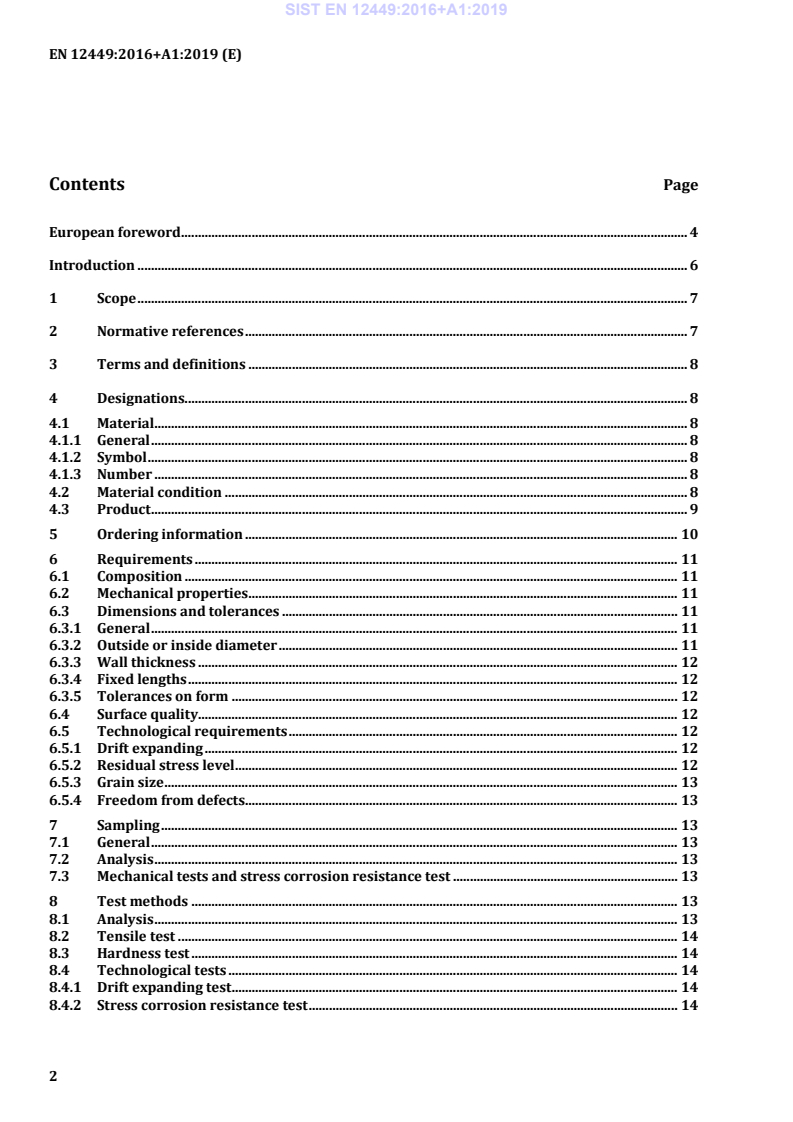
Contents Page
European foreword . 4
Introduction . 6
1 Scope . 7
2 Normative references . 7
3 Terms and definitions . 8
4 Designations. 8
4.1 Material . 8
4.1.1 General . 8
4.1.2 Symbol . 8
4.1.3 Number . 8
4.2 Material condition . 8
4.3 Product . 9
5 Ordering information . 10
6 Requirements . 11
6.1 Composition . 11
6.2 Mechanical properties . 11
6.3 Dimensions and tolerances . 11
6.3.1 General . 11
6.3.2 Outside or inside diameter . 11
6.3.3 Wall thickness . 12
6.3.4 Fixed lengths . 12
6.3.5 Tolerances on form . 12
6.4 Surface quality. 12
6.5 Technological requirements . 12
6.5.1 Drift expanding . 12
6.5.2 Residual stress level . 12
6.5.3 Grain size . 13
6.5.4 Freedom from defects . 13
7 Sampling . 13
7.1 General . 13
7.2 Analysis . 13
7.3 Mechanical tests and stress corrosion resistance test . 13
8 Test methods . 13
8.1 Analysis . 13
8.2 Tensile test . 14
8.3 Hardness test . 14
8.4 Technological tests . 14
8.4.1 Drift expanding test . 14
8.4.2 Stress corrosion resistance test . 14
8.4.3 Average grain size determination . 14
8.5 Freedom from defects tests . 14
8.6 Retests . 14
8.6.1 Analysis, tensile, hardness, drift expanding and grain size tests . 14
8.6.2 Stress corrosion resistance test . 15
8.7 Rounding of results . 15
9 Declaration of conformity and inspection documentation . 15
9.1 Declaration of conformity . 15
9.2 Inspection documentation . 15
10 Marking, packaging, labelling . 15
Bibliography . 49
Figures
Figure 1 — Measurement of straightness . 47
Tables
Table 1 — Composition of copper . 16
Table 2 — Composition of low alloyed copper alloys . 17
Table 3 — Composition of copper-nickel alloys . 17
Table 4 — Composition of copper-nickel-zinc alloys . 18
Table 5 — Composition of copper-tin alloys . 18
Table 6 — Composition of binary copper-zinc alloys . 19
Table 7 — Composition of copper-zinc-lead alloys . 20
Table 8 — Composition of complex copper-zinc alloys. 21
Table 9 — Mechanical properties of copper and low alloyed copper alloys . 22
Table 10 — Mechanical properties of copper-nickel alloys . 26
Table 11 — Mechanical properties of copper-nickel-zinc alloys . 27
Table 12 — Mechanical properties of copper-tin alloys . 28
Table 13 — Mechanical properties of binary copper-zinc alloys . 31
Table 14 — Mechanical properties of copper-zinc-lead alloys . 36
Table 15 — Mechanical properties of complex copper-zinc alloys . 40
Table 16 — Minimal elongation values for R250 (half hard) material condition tubes . 45
Table 17 — Tolerances on diameter . 45
Table 18 — Tolerances on wall thickness . 46
Table 19 — Tolerances on fixed lengths, tubes in straight lengths . 46
Table 20 — Tolerances on fixed lengths, tube in coils (not level wound) . 46
Table 21 — Tolerances on diameter including deviation from circular form, tube in coils . 47
Table 22 — Tolerances on straightness. 47
Table 23 — Sampling rate . 48
European foreword
This document (EN 12449:2016+A1:2019) has been prepared by Technical Committee CEN/TC 133
“Copper and copper alloys”, the secretariat of which is held by DIN.
This European Standard shall be given the status of a national standard, either by publication of an
identical text or by endorsement, at the latest by April 2020 and conflicting national standards shall be
withdrawn at the latest by April 2020.
Attention is drawn to the possibility that some of the elements of this document may be the subject of
patent rights. CEN shall not be held responsible for identifying any or all such patent rights.
This document includes Amendment 1 approved by CEN on 7 August 2019.
This document supersedes !EN 12449:2016".
The start and finish of text introduced or altered by amendment is indicated in the text by tags !".
In comparison with EN 12449:2012, the following significant technical changes were made:
a) Addition of the new material CuFe0,1Sn0,1P (CW125C);
b) Modification of the elongation values for Cu-DHP (CW024A) in material condition R250 including
new Table 16;
c) Modification of iron and tin content for CuZn37Pb1 (CW605N) from 0,2 % to 0,3 % in Table 7;
d) Replacement of the material number CW121C by CW124C for CuSi3Zn2P.
Within its programme of work, Technical Committee CEN/TC 133 requested CEN/TC 133/WG 3
"Copper tubes (installation and industrial)" to revise the following standard:
— EN 12449:2012, Copper and copper alloys — Seamless, round copper tubes for general purposes.
This is one of a series of European Standards for copper and copper alloy tubes. Other products are
specified as follows:
— EN 1057, Copper and copper alloys — Seamless, round copper tubes for water and gas in sanitary and
heating applications;
— EN 12450, Copper and copper alloys — Seamless, round copper capillary tubes;
— EN 12451, Copper and copper alloys — Seamless, round tubes for heat exchangers;
— EN 12452, Copper and copper alloys — Rolled, finned, seamless tubes for heat exchangers;
— EN 12735-1, Copper and copper alloys — Seamless, round tubes for air conditioning and refrigeration
— Part 1: Tubes for piping systems;
— EN 12735-2, Copper and copper alloys — Seamless, round tubes for air conditioning and refrigeration
— Part 2: Tubes for equipment;
— EN 13348, Copper and copper alloys — Seamless, round copper tubes for medical gases or vacuum;
— EN 13349, Copper and copper alloys — Pre-insulated copper tubes with solid covering;
— EN 13600, Copper and copper alloys — Seamless copper tubes for electrical purposes.
According to the CEN-CENELEC Internal Regulations, the national standards organisations of the
following countries are bound to implement this European Standard: Austria, Belgium, Bulgaria,
Croatia, Cyprus, Czech Republic, Denmark, Estonia, Finland, France, Germany, Greece, Hungary, Iceland,
Ireland, Italy, Latvia, Lithuania, Luxembourg, Malta, Netherlands, Norway, Poland, Portugal, Republic of
North Macedonia, Romania, Serbia, Slovakia, Slovenia, Spain, Sweden, Switzerland, Turkey and the
United Kingdom.
Introduction
The European Committee for Standardization (CEN) draws attention to the fact that it is claimed that
compliance with this document may involve the use of a patent concerning the alloy
CuSi3Zn2P (CW124C) and CuZn21Si3P (CW724R) given in 6.1.
CEN takes no position concerning the evidence, validity and scope of this patent right.
The holder of this patent right has assured the CEN that he is willing to negotiate licenses under
reasonable and not-discriminatory terms and conditions with applicants throughout the world. In this
respect, the statement of the holder of this patent right is registered with CEN.
— For CuSi3Zn2P (CW124C) information may be obtained from:
VIEGA GmbH & Co. KG
Ennester Weg 9
57439 Attendorn
GERMANY
— For CuZn21Si3P (CW724R) information may be obtained from:
Wieland-Werke AG
Graf-Arco-Straße 36
89079 Ulm
GERMANY
Attention is drawn to the possibility that some of the elements of this document may be the subject of
patent rights other than those identified above. CEN shall not be held responsible for identifying any or
all such patent rights.
)
CEN and CENELEC (http://www.cencenelec.eu/ipr/Patents/PatentDeclaration/Pages/default.aspx
maintain on-line lists of patents relevant to their standards. Users are encouraged to consult the lists for
the most up to date information concerning patents.
1 Scope
This European Standard specifies the composition, property requirements and tolerances on
dimensions and form for seamless round drawn copper and copper alloy tubes for general purposes
supplied in the size range from 3 mm up to and including 450 mm outside diameter and from 0,3 mm
up to and including 20 mm wall thickness.
The sampling procedures and the methods of test for verification of conformity to the requirements of
this European Standard are also specified.
NOTE Tubes having an outside diameter less than 80 mm and/or a wall thickness greater than 2 mm in
certain alloys are most frequently used for free machining purposes which are specified in EN 12168.
2 Normative references
The following documents, in whole or in part, are normatively referenced in this document and are
indispensable for its application. For dated references, only the edition cited applies. For undated
references, the latest edition of the referenced document (including any amendments) applies.
EN 1655, Copper and copper alloys - Declarations of conformity
EN 1971-1, Copper and copper alloys - Eddy current test for measuring defects on seamless round copper
and copper alloy tubes - Part 1: Test with an encircling test coil on the outer surface
EN 1971-2, Copper and copper alloys - Eddy current test for measuring defects on seamless round copper
and copper alloy tubes - Part 2: Test with an internal probe on the inner surface
EN 1976, Copper and copper alloys - Cast unwrought copper products
EN 10204, Metallic products - Types of inspection documents
EN 16090, Copper and copper alloys - Estimation of average grain size by ultrasound
EN ISO 196, Wrought copper and copper alloys - Detection of residual stress - Mercury(I) nitrate test
(ISO 196)
EN ISO 2624, Copper and copper alloys - Estimation of average grain size (ISO 2624)
EN ISO 6506-1, Metallic materials - Brinell hardness test - Part 1: Test method (ISO 6506-1)
EN ISO 6507-1, Metallic materials - Vickers hardness test - Part 1: Test method (ISO 6507-1)
EN ISO 6892-1, Metallic materials - Tensile testing - Part 1: Method of test at room temperature
(ISO 6892-1)
EN ISO 8493, Metallic materials - Tube - Drift-expanding test (ISO 8493)
ISO 6957, Copper alloys - Ammonia test for stress corrosion resistance
3 Terms and definitions
For the purposes of this document, the following terms and definitions apply.
3.1
seamless round tube
hollow semi-finished product, circular in cross-section, having a uniform wall thickness, which at all
stages of production has a continuous periphery
3.2
mean diameter
arithmetical mean of the maximum and minimum outside diameters through the same cross-section of
the tube
[SOURCE: EN 1057:2006+A1:2010, 3.5]
3.3
deviation from circular form
difference between the maximum and minimum outside diameters measured at any one cross-section
of the tube
[SOURCE: EN 1057:2006+A1:2010, 3.6]
4 Designations
4.1 Material
4.1.1 General
The material is designated either by symbol or number (see Tables 1 to 8).
4.1.2 Symbol
The material symbol designation is based on the designation system given in ISO 1190-1.
NOTE Although material symbol designations used in this standard might be the same as those in other
standards using the designation system given in ISO 1190-1, the detailed composition requirements are not
necessarily the same.
4.1.3 Number
The material number designation is in accordance with the system given in EN 1412.
4.2 Material condition
For the purposes of this standard, the following designations, which are in accordance with the system
given in EN 1173, apply for the material condition:
M material condition for the product as manufactured without specified mechanical properties;
R. material condition designated by the minimum value of tensile strength requirement for the
product with mandatory tensile property requirements;
H. material condition designated by the minimum value of hardness requirement for the product
with mandatory hardness requirements.
NOTE 1 Products in the H. condition can be specified to Vickers or Brinell hardness. The material condition
designation H. is the same for both hardness test methods.
S (suffix) material condition for a product which is stress relieved.
NOTE 2 Products in the M, R. or H. condition can be specially processed (i.e. mechanically or thermally stress
relieved) in order to lower the residual stress level to improve the resistance to stress corrosion (see 6.5.2).
Exact conversion between the material conditions designated R. and H. is not possible.
Except when the suffix S is used, material condition is designated by only one of the above designations.
4.3 Product
The product designation provides a standardized pattern of designation from which a rapid and
unequivocal description of a product is conveyed in communication. It provides mutual comprehension
at the international level with regard to products which meet the requirements of the relevant
European Standard.
The product designation is no substitute for the full content of the standard.
The product designation for products to this standard shall consist of:
— denomination (Tube);
— number of this European Standard (EN 12449);
— material designation, either symbol or number (see Tables 1 to 8);
— material condition designation (see Tables 9 to 15);
— nominal cross-sectional dimensions, either outside diameter (OD) and wall thickness or inside
diameter (ID) and wall thickness (see 6.3).
The derivation of a product designation is shown in Example 1.
EXAMPLE 1 Tube conforming to this standard, in material designated either CuNi10Fe1Mn or CW352H, in
material condition H075, nominal outside diameter 22 mm, nominal wall thickness 2,0 mm, will be designated as
follows:
Tube EN 12449 — CuNi10Fe1Mn — H075 — OD22 × 2,0
or
Tube EN 12449 — CW352H — H075 — OD22 × 2,0
Denomination
Number of this European Standard
Material designation
Material condition designation
Nominal cross-sectional dimensions in millimetres
EXAMPLE 2 Tube conforming to this standard, in material designated either CuZn37 or CW508L, in material
condition M, stress relieved, nominal inside diameter 30 mm, nominal wall thickness 2,5 mm, will be designated
as follows:
Tube EN 12449 — CuZn37 — MS — ID30 × 2,5
or
Tube EN 12449 — CW508L — MS — ID30 × 2,5
5 Ordering information
In order to facilitate the enquiry, order and confirmation of order procedures between the purchaser
and the supplier, the purchaser shall state on his enquiry and order the following information:
a) quantity of product required (number of pieces, length or mass);
b) denomination (Tube);
c) number of this European Standard (EN 12449);
d) material designation (see Tables 1 to 8);
e) material condition designation (see 4.2 and Tables 9 to 15) if it is other than M;
f) nominal cross-sectional dimensions [either outside diameter (OD) and wall thickness or inside
diameter (ID) and wall thickness] (see 6.3);
g) length, either nominal together with tolerance required, or fixed length (see 6.3.4).
NOTE 1 It is advised that the product designation, as described in 4.3, is used for items b) to f).
In addition, the purchaser shall also state on the enquiry and order any of the following, if required:
h) whether the tubes are for sea water application (see Table 3). If so, the composition limits required;
i) test method to be used for the measurement of hardness, i.e. Vickers or Brinell (see 8.3);
j) where dimensional tolerances are to be applied, if not on the outside diameter and wall thickness
(see 6.3.1);
k) whether the tubes are required to pass a drift expanding test (see 6.5.1);
l) whether the tubes are required to pass a stress corrosion resistance test (see 6.5.2);
m) whether the tubes are required to meet a grain size requirement (see 6.5.3); if so, the grain size
limits required;
NOTE 2 It is advised to agree the grain size limits between the purchaser and the supplier.
n) whether the tubes are required to pass freedom from defects tests (see 6.5.4); if so, which test
method is to be used (see 8.5), if the choice is not to be left to the discretion of the supplier, and the
acceptance criteria if they are not to be left to the discretion of the supplier;
o) whether deburring is required (see 6.4);
p) whether special surface quality is required (see 6.4);
q) whether a declaration of conformity is required (see 9.1);
r) whether an inspection document is required, and if so, which type (see 9.2);
s) whether there are any special requirements for marking, packaging or labelling (see Clause 10).
EXAMPLE Ordering details for 1 000 m tube conforming to EN 12449, in material designated either
CuNi10Fe1Mn or CW352H, in material condition H075, nominal outside diameter 22 mm, nominal wall thickness
2,0 mm, in 3 000 mm fixed lengths:
1 000 m Tube EN 12449 — CuNi10Fe1Mn — H075 — OD22 × 2,0
— fixed length 3 000 mm
or
1 000 m Tube EN 12449 — CW352H — H075 — OD22 × 2,0
— fixed length 3 000 mm
6 Requirements
6.1 Composition
The composition shall conform to the requirements for the appropriate material given in Tables 1 to 8.
6.2 Mechanical properties
The properties shall conform to the appropriate requirements given in Tables 9 to 15. The tests shall be
carried out in accordance with either 8.2 (tensile test) or 8.3 (hardness test).
Products in stress relieved condition shall conform to the same mechanical property requirements as
for non stress relieved material.
6.3 Dimensions and tolerances
6.3.1 General
The geometrical properties of the tubes are defined by outside diameter or inside diameter, wall
thickness and length.
Normally, tolerances for cross-sectional dimensions are applied on the outside diameter (see 6.3.2) and
wall thickness (see 6.3.3) but other possibilities may be agreed between the purchaser and the supplier
at the time of the enquiry and order [see Clause 5, list entry j)].
Normally, tubes are supplied in lengths with tolerances agreed between the purchaser and the supplier
at the time of the enquiry and order [see Clause 5, list entry g)] but tubes may be ordered as "fixed
lengths" (see 6.3.4).
6.3.2 Outside or inside diameter
The diameter of the tubes shall conform to the tolerances given in Table 17.
6.3.3 Wall thickness
The wall thickness, measured at any point, shall conform to the tolerances given in Table 18.
6.3.4 Fixed lengths
Tubes in straight lengths ordered as "fixed lengths" shall conform to the tolerances given in Table 19.
Tubes in coiled form ordered as "fixed lengths" shall conform to the tolerances given in Table 20.
6.3.5 Tolerances on form
6.3.5.1 Deviation from circular form
For tubes in straight lengths the deviation from circular form is included in the tolerances on diameter
given in Table 17.
For coiled tubes with wall thicknesses up to and including 2 mm, except for tubes with ratios of outside
diameter to wall thickness greater than 20, the deviation from circular form is included in the
tolerances on diameter given in Table 21.
6.3.5.2 Straightness
Tubes in straight lengths, except for those in the annealed condition (see Tables 9 to 15) or with outside
diameter equal to or less than 10 mm, shall conform to the tolerances given in Table 22.
6.4 Surface quality
The external and internal surfaces shall be clean and smooth.
The tubes may have a superficial film of drawing lubricant or, if annealed or thermally stress relieved, a
superficial, dull, iridescent oxide film, securely adherent on both the internal and external surfaces.
Discontinuous irregularities on the external and internal surfaces of the tubes are permitted if they are
within the dimensional tolerances.
Special requirements (e.g. pickling, degreasing, etc.) relating to the surface quality shall be agreed
between the purchaser and the supplier [see Clause 5, list entry p)].
If deburring of the cut ends of the tubes is required it shall be agreed between the purchaser and the
supplier [see Clause 5, list entry o)].
6.5 Technological requirements
6.5.1 Drift expanding
No crack shall be visible to the unaided eye, corrected for normal vision if necessary, when tubes in the
annealed condition and outside diameter up to and including 100 mm and when agreed between the
purchaser and the supplier [see Clause 5, list entry k)] are tested in accordance with 8.4.1.
6.5.2 Residual stress level
No crack shall be visible to the unaided eye, corrected for normal vision if necessary, when tubes in the
stress relieved condition and when requested by the purchaser [see Clause 5, list entry l)] are tested in
accordance with 8.4.2.
6.5.3 Grain size
The average grain size of tubes in the annealed condition, when requested by the purchaser, [see
Clause 5, list entry m)] shall conform to the limits agreed between the purchaser and the supplier. The
test shall be carried out in accordance with 8.4.3.
6.5.4 Freedom from defects
When requested by the purchaser [see Clause 5, list entry n)] tubes shall be tested in accordance with
8.5 and the acceptance criteria, unless otherwise agreed between the purchaser and the supplier, shall
be at the discretion of the supplier.
7 Sampling
7.1 General
When required (e.g. if necessary in accordance with specified procedures of a supplier's quality system,
or when the purchaser requests inspection documents with test results, or for use in cases of dispute),
an inspection lot shall be sampled in accordance with 7.2 and 7.3.
7.2 Analysis
The sampling rate shall be in accordance with Table 23. A test sample, depending on the analytical
technique to be employed, shall be prepared from each sampling unit and used for the determination of
the composition.
When preparing the test sample, care should be taken to avoid contaminating or overheating the test
sample. Carbide tipped tools are recommended; steel tools, if used, should be made of magnetic
material to assist in the subsequent removal of extraneous iron. If the test samples are in finely divided
form (e.g. drillings, millings), they should be treated carefully with a strong magnet to remove any
particles of iron introduced during preparation.
In cases of dispute concerning the results of analysis, the full procedure given in ISO 1811-2 should be
followed.
Results may be used from analyses carried out at an earlier stage of manufacturing the product, e.g. at
the casting stage, if the material identity is maintained and if the quality management system of the
manufacturer is certified, e.g. as conforming to EN ISO 9001.
7.3 Mechanical tests and stress corrosion resistance test
The sampling rate shall be in accordance with Table 23. Sampling units shall be selected from the
finished products. The test samples shall be cut from the sampling units. Test samples, and test pieces
prepared from them, shall not be subjected to any further treatment, other than any machining
operations necessary in the preparation of the test pieces.
8 Test methods
8.1 Analysis
Analysis shall be carried out on the test pieces, or test portions, prepared from the test samples
obtained in accordance with 7.2. Except in cases of dispute, the analytical methods used shall be
chemical or spectrographic according to EN or ISO standards in force. For expression of results, the
rounding rules given in 8.7 shall be used.
In cases of dispute concerning the results of analysis, the method of analysis to be used should be
chemical.
8.2 Tensile test
The tensile properties shall be determined in accordance with EN ISO 6892-1 on the test pieces
obtained in accordance with 7.3.
8.3 Hardness test
Hardness shall be determined on test pieces prepared from the test samples obtained in accordance
with 7.3. The test shall be carried out in accordance with either EN ISO 6506-1 or EN ISO 6507-1 and
the impression/indentation made on the outside surface, unless otherwise agreed. For the Brinell test
according to EN ISO 6506-1, a 0,102 F/D ratio of 10 shall be used.
8.4 Technological tests
8.4.1 Drift expanding test
When required, the drift expanding test shall be carried out in accordance with EN ISO 8493. The
outside diameter of the tube end shall be expanded by 30 % using a conical mandrel with an angle of
45°.
8.4.2 Stress corrosion resistance test
When required, the test method given in either EN ISO 196 or ISO 6957 shall be used on the test pieces
prepared from the test samples obtained in accordance with 7.3. The choice of which of these tests is
used shall be at the discretion of the supplier.
8.4.3 Average grain size determination
When required, the estimation of average grain size shall be carried out in accordance with
EN ISO 2624 or EN 16090.
8.5 Freedom from defects tests
When required, each tube shall be subjected to one of the following tests:
— Eddy current test for detection of local defects, in accordance with EN 1971-1 or EN 1971-2;
— Hydrostatic test;
— Pneumatic test.
If not otherwise agreed between the purchaser and the supplier, which of the test methods to be used
and the method of testing shall be at the discretion of the manufacturer.
8.6 Retests
8.6.1 Analysis, tensile, hardness, drift expanding and grain size tests
If there is a failure of one, or more than one, of the tests in 8.1, 8.2, 8.3, 8.4.1 or 8.4.3, two test samples
from the same inspection lot shall be permitted to be selected for retesting the failed property
(properties). One of these test samples shall be taken from the same sampling unit as that from which
the original failed test piece was taken, unless that sampling unit is no longer available, or has been
withdrawn by the manufacturer.
If the test pieces from both test samples pass the appropriate test(s), then the inspection lot
represented shall be deemed to conform to the particular requirement(s) of this standard. If a test piece
fails a test, the inspection lot represented shall be deemed not to conform to this standard.
8.6.2 Stress corrosion resistance test
If a test piece fails the test, the inspection lot represented by the failed test piece shall be permitted to
be subjected to a stress relieving treatment. A further test sample shall then be selected in accordance
with 7.3.
If a test piece from the further test sample passes the test, the stress relieved material shall be deemed
to conform to the requirements of this standard for residual stress level and shall then be subjected to
all the other tests called for on the purchase order, except for analysis. If the test piece from the further
test sample fails the test, the stress relieved material shall be deemed not to conform to this standard.
8.7 Rounding of results
For the purpose of determining conformity to the limits specified in this standard, an observed or a
calculated value obtained from a test shall be rounded in accordance with the following procedure,
which is based upon the guidance given in Annex B of ISO 80000-1:2009. It shall be rounded in one step
to the same number of figures used to express the specified limit in this standard, except that for tensile
)
2 1
strength and 0,2 % proof strength the rounding interval shall be 10 N/mm and for elongation the
value shall be rounded to the nearest 1 %.
The following rules shall be used for rounding:
— if the figure immediately after the last figure to be retained is less than 5, the last figure to be
retained shall be kept unchanged;
— if the figure immediately after the last figure to be retained is equal to or greater than 5, the last
figure to be retained shall be increased by one.
9 Declaration of conformity and inspection documentation
9.1 Declaration of conformity
When requested by the purchaser [see Clause 5, list entry q)] and agreed with the supplier, the supplier
shall issue for the products the appropriate declaration of conformity in accordance with EN 1655.
9.2 Inspection documentation
When requested by the purchaser [see Clause 5, list entry r)] and agreed with the supplier, the supplier
shall issue for the products the appropriate inspection document in accordance with EN 10204.
10 Marking, packaging, labelling
Unless otherwise specified by the purchaser and agreed by the supplier, the marking, packaging and
labelling shall be left to the discretion of the supplier [see Clause 5, list entry s)].
1) 1 N/mm is equivalent to 1 MPa.
Table 1 — Composition of copper
Composition
% (mass fraction)
e
Density
Material designation
g/cm
other elements
a
Element Cu Bi O P Pb
(see NOTE)
Symbol Number total excluding approx.
min. 99,90 — — — — —
Cu-ETP CW004A Ag, O 8,9
b
max. — 0,000 5 0,040 — 0,005 0,03
min. 99,90 — — — — —
Cu-FRHC CW005A Ag, O 8,9
b f
max. — — 0,040 — — 0,06
min. 99,95 — — — — —
Cu-OF CW008A Ag 8,9
c
max. — 0,000 5 — — 0,005 0,03
min. 99,95 — — 0,001 — —
Cu-PHC CW020A Ag, P 8,9
c
max. — 0,000 5 — 0,006 0,005 0,03
min. 99,95 — — 0,002 — —–
Cu-HCP CW021A Ag, P 8,9
c
max. — 0,000 5 — 0,007 0,005 0,03
min. 99,90 — — 0,015 — —
Cu-DHP CW024A — 8,9
c d
max. — — — 0,040 — —
NOTE The total of other elements (than copper) is defined as the sum of Ag, As, Bi, Cd, Co, Cr, Fe, Mn, Ni, O, P, Pb, S, Sb,
Se, Si, Sn, Te and Zn, subject to the exclusion of any individual elements indicated.
a
Including silver, up to a maximum of 0,015 %.
b
Oxygen content up to 0,060 % is permitted, subject to agreement between the purchaser and the supplier.
c
The oxygen content shall be such that the material conforms to the hydrogen embrittlement requirements of EN 1976.
d
If required, the permitted total of elements, other than silver and phosphorus, should be agreed between the purchaser
and the supplier.
e
For information only.
f
Higher total impurities content is permitted, subject to agreement between the purchaser and the supplier.
Table 2 — Composition of low alloyed copper alloys
a
Composition Density
Material designation
% (mass fraction) g/cm
others
Symbol Number Element Cu Al As Fe Mn Ni P Pb Si Sn Zn
total
approx.
min. Rem. — — 2,1 — — 0,015 — — — 0,05 —
CuFe2P CW107C 8,8
max. — — — 2,6 — — 0,15 0,03 — — 0,20 0,2
min. Rem. — — — — 1,6 — — 0,4 — — —
CuNi2Si CW111C 8,8
max. — — — 0,2 0,1 2,5 — 0,02 0,8 — — 0,3
min. Rem. — — — — — 0,01 — 2,5 — 1,0 —
CuSi3Zn2P CW124C 8,6
max. — — — — 0,20 0,20 0,20 0,10 3,5 — 3,0 0,2
min. Rem. — — 0,05 — — 0,015 — — 0,05 — —
CuFe0,1Sn0,1P CW125C 8,6
max. — — — 0,20 — — 0,055 — — 0,25 — 0,2
a
For information only.
Table 3 — Composition of copper-nickel alloys
Composition
a
Material designation
Density
% (mass fraction)
g/cm
others
Symbol Number Element Cu C Co Fe Mn Ni P Pb S Sn Zn
total
approx.
c
min. Rem. — — 1,0 0,5 9,0 — — — — — —
CuNi10Fe1Mn CW352H 8,9
b c
max. — 0,05 0,1 2,0 1,0 11,0 0,02 0,02 0,05 0,03 0,5 0,2
min. Rem. — — 0,4 0,5 30,0 — — — — — —
CuNi30Mn1Fe CW354H 8,9
b
max. — 0,05 0,1 1,0 1,5 32,0 0,02 0,02 0,05 0,05 0,5 0,2
a
For information only.
b
Co max. 0,1 % is counted as Ni.
c
For sea water applications, the composition limits shall be agreed between the purchaser and the supplier [see Clause 5,
list entry h)].
Table 4 — Composition of copper-nickel-zinc alloys
a
Composition Density
Material designation
% (mass fraction) g/cm
others
Symbol Number Element Cu Fe Mn Ni Pb Sn Zn approx.
total
min. 63,0 — — 11,0 — — Rem. —
CuNi12Zn24 CW403J 8,7
max. 66,0 0,3 0,5 13,0 0,03 0,03 — 0,2
min. 60,0 — — 17,0 — — Rem. —
CuNi18Zn20 CW409J 8,7
max. 63,0 0,3 0,5 19,0 0,03 0,03 — 0,2
a
For information only.
Table 5 — Composition of copper-tin alloys
a
Composition Density
Material designation
% (mass fraction) g/cm
others
Symbol Number Element Cu Fe Ni P Pb Sn Zn approx.
total
min. Rem. — — 0,01 — 5,5 — —
CuSn6 CW452K 8,8
max. — 0,1 0,2 0,4 0,02 7,0 0,2 0,2
min. Rem. — — 0,01 — 7,5 — —
CuSn8 CW453K 8,8
max. — 0,1 0,2 0,4 0,02 8,5 0,2 0,2
min. Rem. — — 0,2 1,5 3,5 — —
CuSn4Pb2P CW455K 8,9
max. — 0,1 0,2 0,4 2,5 4,5 0,3 0,2
min. Rem. — — 0,2 — 7,5 — —
...