

EN 1361:2004
(Main)Rubber hoses and hose assemblies for aviation fuel handling - Specification
- Abstract
This European Standard specifies the dimensions, construction and requirements for four types of hoses and hose assemblies for use in all operations associated with the ground fuelling and de fuelling of aircraft.
All four types of hose are designed for:
a) use with petroleum fuels, having an aromatic hydrocarbon content not exceeding 30 % by volume;
b) operation within the temperature range of -30 °C to +65 °C and are to be undamaged by climatic conditions of -40 °C to +70 °C when stored in static conditions;
c) operating up to 20 bar maximum working pressure, including surges of pressure which the hose can be subjected to in service.
NOTE 1 Type C hoses are intended for general pressure application on all vehicles used for into - plane fuelling. It can also be used for vehicle/rail car loading and discharge where excessive vacuum does not occur.
NOTE 2 Type F hoses can be used for into-plane delivery applications on vehicles that are also used for de-fuelling at high flow rates, where Type C hoses are not suitable.
NOTE 3 Types E & F hoses can also be used for vehicle/rail, car loading and discharge, for trailer to fueller transfer and for elevation platform supply (riser) to provide greater kink resistance.
- Status
- Withdrawn
- Publication Date
- 27-Jul-2004
- Withdrawal Date
- 10-May-2011
- Technical Committee
- CEN/TC 218 - Rubber and plastics hoses and hose assemblies
- Current Stage
- 9960 - Withdrawal effective - Withdrawal
- Start Date
- 11-May-2011
- Completion Date
- 11-May-2011



Relations
- Effective Date
- 22-Dec-2008
- Effective Date
- 14-May-2011
- Referred By
CLC/TR 60079-32-1:2015 - Explosive atmospheres - Part 32-1: Electrostatic Hazards - Guidance - Effective Date
- 09-Feb-2026
- Referred By
CLC/TR 60079-32-1:2018 - Explosive atmospheres - Part 32-1: Electrostatic hazards, guidance - Effective Date
- 09-Feb-2026
Get Certified
Connect with accredited certification bodies for this standard

BUREAU VERITAS Certification Germany
Bureau Veritas certification in Germany.

Element Materials Technology
Materials testing and product certification.

AQMS Ltd.
AQMS provides ISO certification to SMEs across the UK.
Sponsored listings
Frequently Asked Questions
EN 1361:2004 is a standard published by the European Committee for Standardization (CEN). Its full title is "Rubber hoses and hose assemblies for aviation fuel handling - Specification". This standard covers: This European Standard specifies the dimensions, construction and requirements for four types of hoses and hose assemblies for use in all operations associated with the ground fuelling and de fuelling of aircraft. All four types of hose are designed for: a) use with petroleum fuels, having an aromatic hydrocarbon content not exceeding 30 % by volume; b) operation within the temperature range of -30 °C to +65 °C and are to be undamaged by climatic conditions of -40 °C to +70 °C when stored in static conditions; c) operating up to 20 bar maximum working pressure, including surges of pressure which the hose can be subjected to in service. NOTE 1 Type C hoses are intended for general pressure application on all vehicles used for into - plane fuelling. It can also be used for vehicle/rail car loading and discharge where excessive vacuum does not occur. NOTE 2 Type F hoses can be used for into-plane delivery applications on vehicles that are also used for de-fuelling at high flow rates, where Type C hoses are not suitable. NOTE 3 Types E & F hoses can also be used for vehicle/rail, car loading and discharge, for trailer to fueller transfer and for elevation platform supply (riser) to provide greater kink resistance.
This European Standard specifies the dimensions, construction and requirements for four types of hoses and hose assemblies for use in all operations associated with the ground fuelling and de fuelling of aircraft. All four types of hose are designed for: a) use with petroleum fuels, having an aromatic hydrocarbon content not exceeding 30 % by volume; b) operation within the temperature range of -30 °C to +65 °C and are to be undamaged by climatic conditions of -40 °C to +70 °C when stored in static conditions; c) operating up to 20 bar maximum working pressure, including surges of pressure which the hose can be subjected to in service. NOTE 1 Type C hoses are intended for general pressure application on all vehicles used for into - plane fuelling. It can also be used for vehicle/rail car loading and discharge where excessive vacuum does not occur. NOTE 2 Type F hoses can be used for into-plane delivery applications on vehicles that are also used for de-fuelling at high flow rates, where Type C hoses are not suitable. NOTE 3 Types E & F hoses can also be used for vehicle/rail, car loading and discharge, for trailer to fueller transfer and for elevation platform supply (riser) to provide greater kink resistance.
EN 1361:2004 is classified under the following ICS (International Classification for Standards) categories: 49.100 - Ground service and maintenance equipment. The ICS classification helps identify the subject area and facilitates finding related standards.
EN 1361:2004 has the following relationships with other standards: It is inter standard links to EN 1361:1997, EN ISO 1825:2011, CLC/TR 60079-32-1:2015, CLC/TR 60079-32-1:2018. Understanding these relationships helps ensure you are using the most current and applicable version of the standard.
EN 1361:2004 is available in PDF format for immediate download after purchase. The document can be added to your cart and obtained through the secure checkout process. Digital delivery ensures instant access to the complete standard document.
Standards Content (Sample)
2003-01.Slovenski inštitut za standardizacijo. Razmnoževanje celote ali delov tega standarda ni dovoljeno.SHFLILNDFLMDGummischläuche und -schlauchleitungen für die Flugzeugbetankung - AnforderungenTuyaux et flexibles en caoutchouc pour transfert de carburant pour aviation - SpécificationRubber hoses and hose assemblies for aviation fuel handling - Specification83.140.40Gumene ceviHoses49.100Oprema za servis in vzdrževanje na tlehGround service and maintenance equipmentICS:Ta slovenski standard je istoveten z:EN 1361:2004SIST EN 1361:2004en,fr,de01-oktober-2004SIST EN 1361:2004SLOVENSKI
STANDARDSIST EN 1361:20001DGRPHãþD
EUROPEAN STANDARDNORME EUROPÉENNEEUROPÄISCHE NORMEN 1361July 2004ICS 49.100Supersedes EN 1361:1997
English versionRubber hoses and hose assemblies for aviation fuel handling -SpecificationTuyaux et flexibles en caoutchouc pour transfert decarburant pour aviation - SpécificationGummischläuche und -schlauchleitungen für dieFlugzeugbetankung - AnforderungenThis European Standard was approved by CEN on 1 April 2004.CEN members are bound to comply with the CEN/CENELEC Internal Regulations which stipulate the conditions for giving this EuropeanStandard the status of a national standard without any alteration. Up-to-date lists and bibliographical references concerning such nationalstandards may be obtained on application to the Central Secretariat or to any CEN member.This European Standard exists in three official versions (English, French, German). A version in any other language made by translationunder the responsibility of a CEN member into its own language and notified to the Central Secretariat has the same status as the officialversions.CEN members are the national standards bodies of Austria, Belgium, Cyprus, Czech Republic, Denmark, Estonia, Finland, France,Germany, Greece, Hungary, Iceland, Ireland, Italy, Latvia, Lithuania, Luxembourg, Malta, Netherlands, Norway, Poland, Portugal, Slovakia,Slovenia, Spain, Sweden, Switzerland and United Kingdom.EUROPEAN COMMITTEE FOR STANDARDIZATIONCOMITÉ EUROPÉEN DE NORMALISATIONEUROPÄISCHES KOMITEE FÜR NORMUNGManagement Centre: rue de Stassart, 36
B-1050 Brussels© 2004 CENAll rights of exploitation in any form and by any means reservedworldwide for CEN national Members.Ref. No. EN 1361:2004: ESIST EN 1361:2004
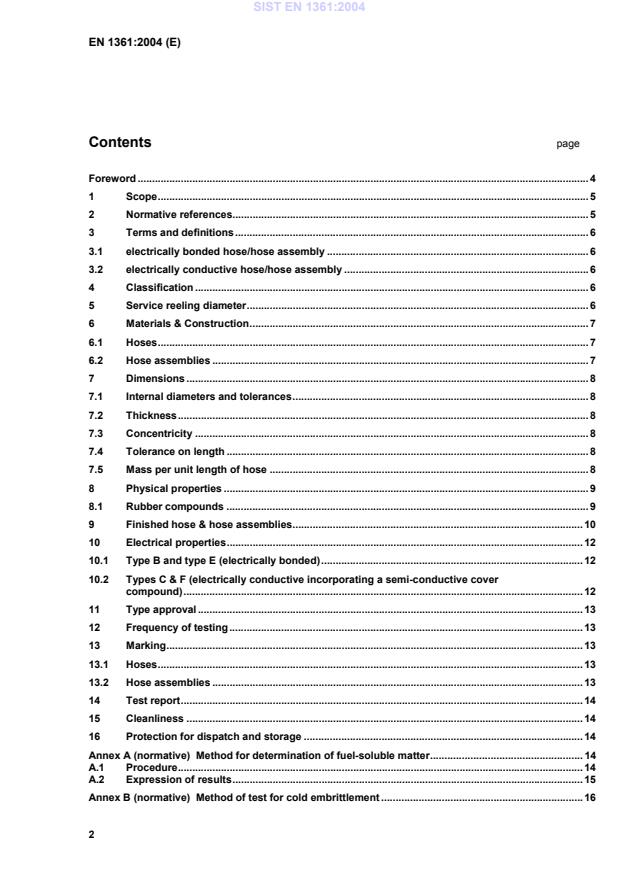
Method for determination of fuel-soluble matter.14 A.1 Procedure.14 A.2 Expression of results.15 Annex B (normative)
Method of test for cold embrittlement.16 SIST EN 1361:2004
Method for determination of adhesion between components.17 C.1 Dry adhesion.17 C.2 Adhesion after contact with fuel.17 Annex D (normative)
Method for determination of resistance to fuel contamination.18 D.1 Principle.18 D.2 Procedure.18 D.3 Expression of results.18 Annex E (normative)
Method of test for flexibility at 20 °C.19 Annex F (normative)
Method of test for flexibility at -30 °C.20 Annex G (normative)
Method of test for crush recovery.21 G.1 Apparatus.21 G.1.1 Apparatus 1.21 G.1.2 Apparatus 2.21 G.2 Test piece.21 G.3 Conditioning of test pieces.21 G.4 Procedure.21 Annex H (normative)
Method for determination of cyclic kinking resistance.22 Annex I (normative)
Flammability test.23 I.1 Method.23 I.2 Assessment.23 Annex J (normative)
Hydrostatic tests.25 J.1 Pressure tests on hose lengths and/or hose assemblies.25 J.1.1 Working pressure test.25 J.1.2 Proof pressure test.25 J.2 Bursting pressure test on hose lengths.25 Annex K (normative)
Method of test for vacuum resistance.26 K.1 General.26 K.2 Types B & C only.26 K.3 Types B & C only.26 K.4 Type E only.26 K.5 Type F only.26 Annex L (normative)
Method of test for security of coupling attachment.28 L.1 Apparatus.28 L.2 Procedure.28 L.3 Hose couplings.28 Annex M (normative)
Frequency of testing.29 Annex N (informative)
Production acceptance tests.31 Annex O (informative)
Recommended practice for hose flushing and handling.32 O.1 Flushing.32 O.2 Handling.32 O.3 Inspection.32 O.4 Replacement.33 O.5 Hose re-coupling recommended practice.33 Annex P (informative)
Method of determining torque value.34
Scope This document specifies the dimensions, construction and requirements for four types of hoses and hose assemblies for use in all operations associated with the ground fuelling and de-fuelling of aircraft. All four types of hose are designed for: a) use with petroleum fuels, having an aromatic hydrocarbon content not exceeding 30 % by volume; b) operation within the temperature range of –30 °C to +65 °C and are to be undamaged by climatic conditions of -40 °C to +70 °C when stored in static conditions; c) operating up to 20 bar maximum working pressure, including surges of pressure which the hose can be subjected to in service. NOTE 1 Type C hoses are intended for general pressure application on all vehicles used for into – plane fuelling. It can also be used for vehicle/rail car loading and discharge where excessive vacuum does not occur. NOTE 2 Type F hoses can be used for into-plane delivery applications on vehicles that are also used for de-fuelling at high flow rates, where Type C hoses are not suitable. NOTE 3 Types E & F hoses can also be used for vehicle/rail, car loading and discharge, for trailer to fueller transfer and for elevation platform supply (riser) to provide greater kink resistance. 2 Normative references
The following referenced documents are indispensable for theapplication of this document. For dated references, only the edition cited applies. For undated references, the latest editionof the referenced document (including any amendments) applies.
EN 27326 Rubber and plastics hoses — Assessment of ozone resistance under static conditions (ISO 7326:1991) EN 28033, Rubber and plastics hose — Determination of adhesion between components (ISO 8033:1991) EN ISO 1402, Rubber and plastics hoses and hose assemblies - Hydrostatic testing (ISO 1402:1994) EN ISO 4671, Rubber and plastics hose and hose assemblies - Methods of measurement of dimensions (ISO 4671:1999) EN ISO 4672, Rubber and plastics hoses - Sub-ambient temperature flexibility tests (ISO 4672:1997) EN ISO 6246, Petroleum products - Gum content of light and middle distillate fuels - Jet evaporation method (ISO 6246:1995) EN ISO 8031, Rubber and plastics hoses and hose assemblies — Determination of electrical resistance (ISO 8031:1993) EN ISO 8330, Rubber and plastics hoses and hose assemblies - Vocabulary (ISO 8330:1998) ISO 37, Rubber, vulcanized or thermoplastic — Determination of tensile stress-strain properties ISO 188, Rubber, vulcanized or thermoplastic - Accelerated ageing and heat resistance tests ISO 1817:1999, Rubber, vulcanized — Determination of the effect of liquids ISO 4649, Rubber, vulcanized or thermoplastic - Determination of abrasion resistance using a rotating cylindrical drum device SIST EN 1361:2004
3 Terms and definitions For the purposes of this document, the terms and definitions given in EN ISO 8330 and the following apply. 3.1
electrically bonded hose/hose assembly
hose/hose assembly that uses a metallic wire connection to conduct static electricity 3.2
electrically conductive hose/hose assembly hose/hose assembly that is capable of conducting static electrical charges, using a conductive rubber layer, without the use of a metallic wire 4 Classification Hoses for this application are classified into four types and two grades according to their construction and electrical properties. Type Grade Construction B M Electrically bonded, incorporating at least two low resistance electrically bonding wires and a conductive cover compound C Ω Electrically conductive, incorporating a conductive cover compound E M Electrically bonded, incorporating at least one metallic wire helix, with enhanced de-fuelling capability, at least two low-resistance electrically conductive wires and a conductive cover compound F Ω Electrically conductive, incorporating at least one non-electrically conductive non-metallic helix and conductive cover compound
5 Service reeling diameter Hoses shall be designed for operation on equipment fitted with hose reels of the diameters given in Table 1. NOTE These hoses remain substantially circular in cross section when reeled on drums (see Table 1) and should not be confused with hoses of the collapsible type that are intended to be reeled flat. SIST EN 1361:2004
Table 1 — Service reeling diameters
Nominal bore Minimum external diameter of reeling drum used in service
mm 19 225 25 300 32 375 38 450 50 550 63 600 75 600 76 600 100 900 101 900
6 Materials & Construction 6.1 Hoses If a hose is built and vulcanized on a mandrel, particulate type release agents shall not be used. A hose shall be uniform in quality, free from porosity, air holes, foreign inclusions and other defects. A hose shall comprise: A lining of synthetic rubber resistant to petroleum fuel. A reinforcement of layers of woven, braided or spiral wound textile material. Type E shall incorporate one or more metallic wire helix or helices. Type F shall incorporate one or more non-metallic helix or helices. A cover of synthetic rubber shall be conductive, resistant to abrasion, outdoor exposure and petroleum fuel. Types B & E shall also incorporate low resistance electrically conductive wires to enable the hoses to be electrically bonded to the couplings when manufacturing a hose assembly.
NOTE A hose cover may have a shallow cloth marked finish. 6.2 Hose assemblies In order to produce the required electrical properties, the method of attachment of the couplings shall be in accordance with Clause 10. SIST EN 1361:2004
Nominal bore Internal diametermm Tolerance mm 19 19,0 ± 0,8 25 25,0
32 32,0
38 38,0
50 50,0 ± 1,2 63 63,0
75 75,0
76 76,0
100 100,0 ± 1,6 101 101,5
7.2 Thickness When measured in accordance with EN ISO 4671 the thickness of the lining for hoses of all internal diameters shall not be less than 1,6 mm. For hoses of nominal bore less than 50, the thickness of the cover shall not be less than 1,6 mm. For hoses of nominal bore 50 and above, the thickness of the cover shall not be less than 2,0 mm. 7.3 Concentricity When determined in accordance with EN ISO 4671, the concentricity, based on a total indicator reading between the internal diameter and the outside surface of the cover, shall not exceed 1 mm. 7.4 Tolerance on length The tolerance on the measured length of hose or hose assembly shall be ± 1 %. 7.5 Mass per unit length of hose The maximum mass per unit length shall comply with the values given in Table 3. SIST EN 1361:2004
Table 3 — Mass per unit length of hoses Nominal bore Type B and type C Kg/m Type E and type F
Kg/m 19 0,9 1,1 25 1,1 1,5 32 1,4 1,9 38 1,7 2,2 50 2,7 3,0 63 3,5 4,0 75 4,0 4,7 76 4,0 4,7 100 6,5 7,5 101 6,5 7,5 8 Physical properties 8.1 Rubber compounds The physical properties of the rubber compounds used for the lining and cover shall comply with the values given in Table 4, when tested by the methods listed in Table 4. Tests shall be carried out either on samples taken from the hose or from separately vulcanized sheets, except for cold embrittlement and abrasion resistance tests which shall be carried out on moulded test pieces vulcanized to the same state as the hose. Table 4 — Physical properties of rubber compounds Property Unit Requirement Method of test
Lining Cover
Tensile strength, min. MPa 7,0 7,0 ISO 37
(dumb-bell test pieces) Elongation at break, min. % 250 300 ISO 37
(dumb-bell test pieces) Swelling in fuel, max. % 50 75 8.2 of ISO 1817:1999
(48 h at 40 °C in liquid B) Fuel-soluble matter, max. % 4,0 Not Annex A Cold embrittlement
No No cracking Annex B
cracking
Abrasion resistance, max mm3 Not 140 Method A of ISO 4649
applicable
Ageing %
ISO 188 (7 days at 70 °C) (air-
oven method) Tensile strength change, max.
± 30 ± 30
Elongation at break change, max.
± 30 ± 30
Unit Requirement Method of Hose dimensions
Internal diameter mm See Table 2 EN ISO 4671Lining thickness (min.) mm 1.6 EN ISO 4671Cover thickness (min.) mm 1,6 (inside diameter < 50 mm) EN ISO 4671
2,0 (inside diameter ≥ 50 mm)
Concentricity (max.) mm 1,0 EN ISO 4671Length tolerance % ± 1,0 EN ISO 4671Mass (max.) Kg/m See Table 3
Hose tests
Adhesion between components N/mm 3,0 Annex C (dry) min.
After contact with fuel (min.) N/mm 2,0
Fuel contamination Re (max.) mg/100 ml10 Annex D Ozone resistance — No cracking observed under x2 magnification Method 2 or 3 of EN 27326
(40 ºC) Flexibility at ambient & low temperature — No permanent deformation or visible structural damage, no increase in electrical resistance outside the specified limits, no impairment of electrical continuity and shall comply with the proof pressure requirements in Annex J (20 ± 5) °C.
Annex E (20 ºC) Annex F (-30 ºC) Crush recovery (type F only) —
After 1 min
Regain 90 % of original diameter
After 10 min
Regain 95 % of original diameter Annex G
Shall comply with the proof pressure requirement in Annex J (20 ± 5) ºC
Cyclic kinking — No leakage at proof pressure at (20 ± 5) °C
(types B & C only)
No increase in electrical resistance or
impairment of electrical continuity, Annex H
No adhesion between components to be
less than 2,0 N/mm
Annex I Flammability — Hose shall cease to burn immediately on removal of flame and there shall be no glowing visible after 2 min
Change in length at working % Types B & C: +7 pressure (max.)
Types E & F: +12 Annex J Proof pressure 40 bar No leakage or damage
No increase in electrical continuity or Annex J
Resistance, outside the specified limits Annex J Burst pressure (min.) bar 80 Annex J SIST EN 1361:2004
Vacuum test bar Types B & C at 0,15 bar absolute, no visible Annex K
structural damage
Types B & C: at 0,85 bar absolute, loss of
circularity not to exceed 20 % of internal
diameter Annex K
Type E only: at 0,15 bar absolute,
In accordance with Annex K
Type F only: at 0,35 bar absolute, in
accordance with Annex K
Electrical properties ohms 10.1, 10.2
The electrical properties of the hose shall be such that the electrical requirement for the hose assemblies are met
Hose assembly tests
40 bar No leakage or damage
No increase in electrical continuity or
...