

EN 13035-6:2006+A1:2009
(Main + Amendment)Machines and plants for the manufacture, treatment and processing of flat glass - Safety requirements - Part 6: Machines for break-out
- Abstract
This European Standard applies for machines for break-out of flat glass including the following steps: transport and positioning, break-out, transport of the cut sizes to the unloading position, leading away of waste flat glass.
1.2 This European Standard deals with the significant hazards, hazardous situations and events relevant to machines for the break-out of flat glass when they are used as intended and under the conditions of misuse which are reasonably foreseeable by the manufacturer (see Clause 4). Those hazards which are dealt with in EN 619 for conveyors are excepted. This European Standard specifies the appropriate technical measures to eliminate or reduce risks arising from the significant hazards during commissioning, operation and maintenance. Hazards from noise are not considered to be significant.
1.3 This European Standard is not applicable to the break-out operation (opening the cut) of cutting ma-chines for laminated glass (see EN 13035-7).
1.4 This European Standard is not applicable to the treatment of waste flat glass such as crushing and/or charging of waste flat glass into bins, containers.
1.5 This European Standard does not apply to the significant hazards of conveyors. If there are specific hazards which arise by the co-operation of conveyors with machines for break-out of flat glass, appropriate measures are specified.
1.6 This European Standard is not applicable to machines for break-out of flat glass which are manufac-tured before the date of publication of this European Standard by CEN.
- Status
- Published
- Publication Date
- 15-Dec-2009
- Technical Committee
- CEN/TC 151 - Construction equipment and building material machines - Safety
- Current Stage
- 9020 - Submission to 2 Year Review Enquiry - Review Enquiry
- Start Date
- 15-Jul-2026
- Completion Date
- 15-Jul-2026
- Directive
- 2006/42/EC - Directive 2006/42/EC of the European Parliament and of the Council of 17 May 2006 on machinery, and amending Directive 95/16/EC (recast)OJ Ref: C, C 136 OJ Date: 26-May-2010

Overview
EN 13035-6:2006+A1:2009 is a CEN European Standard specifying safety requirements for machines and plants used for break-out of flat glass. It covers the complete break-out sequence: transport and positioning, opening the cut (break-out), transport of cut sizes to unloading, and removal/leading away of waste flat glass. The standard addresses significant hazards that occur during commissioning, operation and maintenance and provides technical measures to eliminate or reduce risk. It is a type C standard intended to be used alongside general machinery safety standards and is not applicable to certain operations (see exclusions).
Key topics and technical requirements
- Scope and exclusions
- Applies to break-out machines for flat glass; excludes laminated glass break-out (see EN 13035-7), waste treatment (crushing/charging), and hazards already covered by conveyor standards (EN 619).
- Does not apply to machines manufactured before the date of publication.
- Hazard identification
- Lists significant hazards such as crushing (break-out bars, clamps, plungers), drawing-in by top rollers, electrical contact, burns from gas burners, unexpected start-up/overrun, falling/ejected glass and slips from glass fragments.
- Noise is explicitly not considered a significant hazard in this part, though acoustic test codes are included as informative annexes.
- Safeguarding and design rules
- Break-out bars must not create openings beneath them during lifting.
- Clamps and plungers must prevent finger crushing by specific design measures (e.g., maximum 6 mm closing movement or low-pressure approach with closing force ≤150 N and associated control requirements).
- Requirements for guards, emergency stop, prevention of unexpected start-up and control-system reliability.
- Verification and information for use
- Specifies individual testing, verification of protective measures and required operator/maintenance information as part of the machine documentation.
Applications and practical value
- Use this standard when designing, manufacturing, installing or assessing break-out machines for flat glass in glass processing shops and production plants.
- Practical for:
- Machine manufacturers and designers to achieve compliant safety design.
- Safety engineers and CE-marking specialists for risk assessment and conformity.
- Plant managers and maintenance teams for safe commissioning, operation and servicing.
- Inspectors and certification bodies verifying compliance with EU Machinery Directive requirements.
Related standards
- EN ISO 12100 (general machinery risk assessment)
- EN 619 (conveyors - exclusions and interfaces)
- EN 13035-7 (laminated glass break-out)
- EN ISO 13849-1 (control-system safety performance)
- EN 60204-1 (electrical equipment of machines)
- EN 953, EN 999, EN 1760-2, EN 61496-1 and acoustic standards (EN ISO 11201 / 11202 / 11204) - referenced for specific protective devices and verification methods.
Keywords: EN 13035-6:2006+A1:2009, flat glass break-out machines, safety requirements, CEN standard, machinery safety, risk assessment, break-out bar, clamps, conveyor interfaces.
Relations
- Effective Date
- 17-Oct-2009
- Effective Date
- 17-Oct-2009
- Effective Date
- 25-Feb-2026
- Effective Date
- 09-Feb-2026
- Effective Date
- 09-Feb-2026
- Effective Date
- 09-Feb-2026
- Effective Date
- 28-Jan-2026
- Effective Date
- 28-Jan-2026
- Effective Date
- 28-Jan-2026
- Effective Date
- 28-Jan-2026
- Effective Date
- 28-Jan-2026
- Effective Date
- 28-Jan-2026
- Effective Date
- 28-Jan-2026
- Effective Date
- 28-Jan-2026
- Effective Date
- 28-Jan-2026
Frequently Asked Questions
EN 13035-6:2006+A1:2009 is a standard published by the European Committee for Standardization (CEN). Its full title is "Machines and plants for the manufacture, treatment and processing of flat glass - Safety requirements - Part 6: Machines for break-out". This standard covers: This European Standard applies for machines for break-out of flat glass including the following steps: transport and positioning, break-out, transport of the cut sizes to the unloading position, leading away of waste flat glass. 1.2 This European Standard deals with the significant hazards, hazardous situations and events relevant to machines for the break-out of flat glass when they are used as intended and under the conditions of misuse which are reasonably foreseeable by the manufacturer (see Clause 4). Those hazards which are dealt with in EN 619 for conveyors are excepted. This European Standard specifies the appropriate technical measures to eliminate or reduce risks arising from the significant hazards during commissioning, operation and maintenance. Hazards from noise are not considered to be significant. 1.3 This European Standard is not applicable to the break-out operation (opening the cut) of cutting ma-chines for laminated glass (see EN 13035-7). 1.4 This European Standard is not applicable to the treatment of waste flat glass such as crushing and/or charging of waste flat glass into bins, containers. 1.5 This European Standard does not apply to the significant hazards of conveyors. If there are specific hazards which arise by the co-operation of conveyors with machines for break-out of flat glass, appropriate measures are specified. 1.6 This European Standard is not applicable to machines for break-out of flat glass which are manufac-tured before the date of publication of this European Standard by CEN.
This European Standard applies for machines for break-out of flat glass including the following steps: transport and positioning, break-out, transport of the cut sizes to the unloading position, leading away of waste flat glass. 1.2 This European Standard deals with the significant hazards, hazardous situations and events relevant to machines for the break-out of flat glass when they are used as intended and under the conditions of misuse which are reasonably foreseeable by the manufacturer (see Clause 4). Those hazards which are dealt with in EN 619 for conveyors are excepted. This European Standard specifies the appropriate technical measures to eliminate or reduce risks arising from the significant hazards during commissioning, operation and maintenance. Hazards from noise are not considered to be significant. 1.3 This European Standard is not applicable to the break-out operation (opening the cut) of cutting ma-chines for laminated glass (see EN 13035-7). 1.4 This European Standard is not applicable to the treatment of waste flat glass such as crushing and/or charging of waste flat glass into bins, containers. 1.5 This European Standard does not apply to the significant hazards of conveyors. If there are specific hazards which arise by the co-operation of conveyors with machines for break-out of flat glass, appropriate measures are specified. 1.6 This European Standard is not applicable to machines for break-out of flat glass which are manufac-tured before the date of publication of this European Standard by CEN.
EN 13035-6:2006+A1:2009 is classified under the following ICS (International Classification for Standards) categories: 81.100 - Equipment for the glass and ceramics industries. The ICS classification helps identify the subject area and facilitates finding related standards.
EN 13035-6:2006+A1:2009 has the following relationships with other standards: It is inter standard links to EN 13035-6:2006, EN 13035-6:2006/prA1, ISO 8598:1996, CLC/TS 61496-2:2006, EN 61496-1:2004, EN 61310-1:2008, EN ISO 13849-1:2008, EN 999:1998, EN ISO 12100-2:2003, EN 983:1996, EN ISO 11201:2010, EN ISO 13857:2008, EN ISO 12100-1:2003, EN ISO 11204:2010, EN 953:1997. Understanding these relationships helps ensure you are using the most current and applicable version of the standard.
EN 13035-6:2006+A1:2009 is associated with the following European legislation: EU Directives/Regulations: 2006/42/EC, 98/37/EC; Standardization Mandates: M/079, M/396. When a standard is cited in the Official Journal of the European Union, products manufactured in conformity with it benefit from a presumption of conformity with the essential requirements of the corresponding EU directive or regulation.
EN 13035-6:2006+A1:2009 is available in PDF format for immediate download after purchase. The document can be added to your cart and obtained through the secure checkout process. Digital delivery ensures instant access to the complete standard document.
Standards Content (Sample)
2003-01.Slovenski inštitut za standardizacijo. Razmnoževanje celote ali delov tega standarda ni dovoljeno.Stroji in obrati za proizvodnjo, obdelavo in predelavo ravnega stekla - Varnostne zahteve - 6. del: Stroji za lomljenjeMaschinen und Anlagen für die Herstellung, Be- und Verarbeitung von Flachglas - Sicherheitsanforderungen - Teil 6: BrechmaschinenMachines et installations pour la production, le façonnage et la transformation du verre plat - Exigences de sécurité - Partie 6: Machines à rompreMachines and plants for the manufacture, treatment and processing of flat glass - Safety requirements - Part 6: Machines for break-out81.100Equipment for the glass and ceramics industriesICS:Ta slovenski standard je istoveten z:EN 13035-6:2006+A1:2009SIST EN 13035-6:2007+A1:2010en,fr01-februar-2010SIST EN 13035-6:2007+A1:2010SLOVENSKI
STANDARD
EUROPEAN STANDARD NORME EUROPÉENNE EUROPÄISCHE NORM
EN 13035-6:2006+A1
December 2009 ICS 81.100 Supersedes EN 13035-6:2006English Version
Machines and plants for the manufacture, treatment and processing of flat glass - Safety requirements - Part 6: Machines for break-out
Machines et installations pour la production, le façonnage et la transformation du verre plat - Exigences de sécurité - Partie 6: Machines à rompre
Maschinen und Anlagen für die Herstellung, Be- und Verarbeitung von Flachglas - Sicherheitsanforderungen - Teil 6: Brechmaschinen This European Standard was approved by CEN on 24 May 2006 and includes Amendment 1 approved by CEN on 8 November 2009.
CEN members are bound to comply with the CEN/CENELEC Internal Regulations which stipulate the conditions for giving this European Standard the status of a national standard without any alteration. Up-to-date lists and bibliographical references concerning such national standards may be obtained on application to the CEN Management Centre or to any CEN member.
This European Standard exists in three official versions (English, French, German). A version in any other language made by translation under the responsibility of a CEN member into its own language and notified to the CEN Management Centre has the same status as the official versions.
CEN members are the national standards bodies of Austria, Belgium, Bulgaria, Cyprus, Czech Republic, Denmark, Estonia, Finland, France, Germany, Greece, Hungary, Iceland, Ireland, Italy, Latvia, Lithuania, Luxembourg, Malta, Netherlands, Norway, Poland, Portugal, Romania, Slovakia, Slovenia, Spain, Sweden, Switzerland and United Kingdom.
EUROPEAN COMMITTEE FOR STANDARDIZATION
COMITÉ EUROPÉEN DE NORMALISATION EUROPÄISCHES KOMITEE FÜR NORMUNG
Management Centre:
Avenue Marnix 17,
B-1000 Brussels © 2009 CEN All rights of exploitation in any form and by any means reserved worldwide for CEN national Members. Ref. No. EN 13035-6:2006+A1:2009: ESIST EN 13035-6:2007+A1:2010
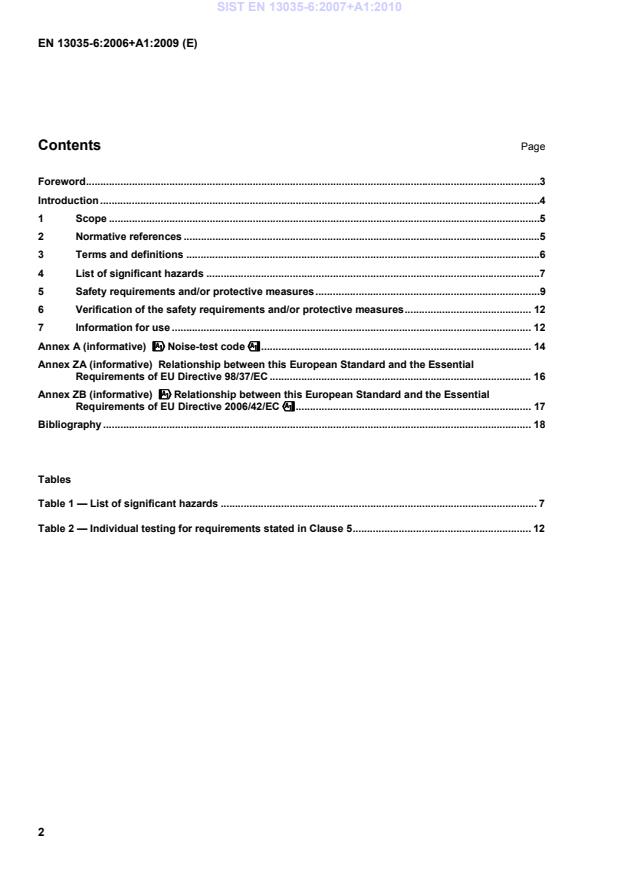
!!!!Noise-test code"""" . 14Annex ZA (informative)
Relationship between this European Standard and the Essential Requirements of EU Directive 98/37/EC . 16Annex ZB (informative)
!!!!Relationship between this European Standard and the Essential
Requirements of EU Directive 2006/42/EC"""" . 17Bibliography . 18
Tables Table 1 — List of significant hazards . 7 Table 2 — Individual testing for requirements stated in Clause 5 . 12
1 Scope 1.1 This European Standard applies for machines for break-out of flat glass including the following steps: transport and positioning, break-out, transport of the cut sizes to the unloading position, leading away of waste flat glass. 1.2 !This European Standard deals with the significant hazards, hazardous situations and events rele-vant to machines for the break-out of flat glass when they are used as intended and under the conditions of misuse which are reasonably foreseeable by the manufacturer (see Clause 4)." Those hazards which are dealt with in EN 619 for conveyors are excepted. !This European Standard specifies the appropriate techni-cal measures to eliminate or reduce risks arising from the significant hazards during commissioning, operation and maintenance." Hazards from noise are not considered to be significant. 1.3 This European Standard is not applicable to the break-out operation (opening the cut) of cutting ma-chines for laminated glass (see EN 13035-7). 1.4 This European Standard is not applicable to the treatment of waste flat glass such as crushing and/or charging of waste flat glass into bins, containers. 1.5 This European Standard does not apply to the significant hazards of conveyors. If there are specific hazards which arise by the co-operation of conveyors with machines for break-out of flat glass, appropriate measures are specified. 1.6 This European Standard is not applicable to machines for break-out of flat glass which are manufac-tured before the date of publication of this European Standard by CEN. 2 Normative references The following referenced documents are indispensable for the application of this document. For dated refer-ences, only the edition cited applies. For undated references, the latest edition of the referenced document (including any amendments) applies. !deleted text" EN 953:1997, Safety of machinery Guards General requirements for the design and construction of fixed and movable guards !deleted text" EN 982:1996, Safety of machinery — Safety requirements for fluid power systems and their components — Hydraulics EN 983:1996, Safety of machinery Safety requirements for fluid power systems and their components Pneumatics EN 999:1998, Safety of machinery The positioning of protective equipment in respect of approach speeds of parts of the human body EN 1037:1995, Safety of machinery Prevention of unexpected start-up !deleted text" SIST EN 13035-6:2007+A1:2010
3 Terms and definitions For the purposes of this document, the terms and definitions given in EN ISO 12100-1:2003 and the following apply. 3.1 break-out method to open a cut (score) by generating strain e.g. by mechanical devices, by local heating with gas burn-ers SIST EN 13035-6:2007+A1:2010
Danger zone/dangerous item Preventive measures: see clause 4.1
Static break-out
4.1.1 Crushing of the fingers upwards and downwards moving break-out bar/supporting surface, e.g. table 5.2.1 SIST EN 13035-6:2007+A1:2010
Danger zone/dangerous item Preventive measures: see clause 4.1.2 Crushing of hand or fingers clamping device/supporting surface, e.g. table 5.2.2 4.1.3 Crushing of hand (fingers) downwards moving plunger/glass to be bro-ken 5.2.2 4.2 Dynamic break-out
4.2.1 Drawing-in of hand or fingers top roller/glass surface 5.3.1 4.3 General requirements
4.3.1 Electrical direct or indirect contact 5.4.4; 5.4.5; 7.2.7 4.3.2 Burns naked flames 5.4.1; 7.2.6 4.3.3 Neglecting ergonomic princi-ples; human behaviour all dangerous movements and items, fixed guards fixing systems 7.2.4; 5.7 4.3.4 Unexpected overrun by failure of the control system flat glass falling from the supporting surface by non stopping of conveyors delivering glass to manual unloading stations 5.4.2 4.3.5 Unexpected start-up from dis-order of the control system, error of the operator, restoration of energy supply after interrup-tion all dangerous movements 5.4.4 to 5.4.6; 7.2.7; 7.2.8 4.3.6 Impossibility of stopping in the best possible conditions all dangerous movements, naked flames 5.4.7; 7.2.9 4.3.7 Falling or ejected objects collision of sheets of glass and pushing off sheets from supporting surface 5.4.3 4.3.8 Slip glass bits 7.2.5 4.4 Conveyor
4.4.1 Crushing flap/fixed parts of conveyors 5.5.2 4.4.2 Cutting flat glass e.g. projecting the outline of the conveyor 5.5.1; 7.2.3
"
provided, including training, and to any limiting value of the requirement and if appropriate to the
...