

CEN/TR 17862:2022
(Main)Guideline for the implementation of the Cinema Preservation Package (CPP) in EN 17650
General Information
- Abstract
This Technical Report defines guidelines and gives implementation advice how to organize and structure the Cinema Preservation Packageas (CPP) as defined in the European standard EN 17650. It facilitates the digital preservation of cinematographic works. It explains the methods to describe the relationship of components of the cinematographic work and demonstrates the syntax to describe the package content. While EN 17650 defines the structure of the package and specifies the constraints that are necessary to enable compliance and interoperability, this document explains its usage.
This documetn demonstrates examples for the structure of the Cinema Preservation Package and the usage of metadata schemes for structural, descriptive, provenance and technical metadata. Examples for METS, EBUCore and playlist files are given in the technical report.
- Status
- Published
- Publication Date
- 30-Aug-2022
- Technical Committee
- CEN/TC 457 - Preservation of digital cinema movies
- Drafting Committee
- CEN/TC 457 - Preservation of digital cinema movies
- Current Stage
- 6060 - Definitive text made available (DAV) - Publishing
- Start Date
- 31-Aug-2022
- Due Date
- 22-Mar-2023
- Completion Date
- 31-Aug-2022



Overview
CEN/TR 17862:2022 is a Technical Report from CEN that provides a practical guideline for implementing the Cinema Preservation Package (CPP) as defined in the European standard EN 17650. It explains how to organize, structure and describe CPPs to facilitate the digital preservation of cinematographic works. The report complements EN 17650 by clarifying usage, giving examples and showing syntax and metadata practices (including METS, EBUCore and playlist examples).
Key topics and technical requirements
- CPP structure and physical layout: guidance on root-level packing lists, subpackages, data and metadata folders, and naming conventions.
- Metadata types: recommendations and examples for structural, descriptive, provenance and technical metadata to represent components of a cinematographic work.
- XML schema usage: how to apply METS, EBUCore and PREMIS within CPP files (schemas kept separate per file; EBUCore may be extended using technicalAttributes; PREMIS is optional).
- Syntax and conventions: XPath and filename syntax conventions, multiplicity rules, namespace handling and typographic rules for XML content.
- Integrity and version control: use of hash values and related metadata (EN 17650 specifies hash generation methods; this TR explains how to include them in packing lists).
- Practical examples and tooling aids: annotated examples (METS, EBUCore, playlists), checklist/checker reports, and annexes covering structure, naming, technical metadata, descriptive metadata, playlists, and archive usage.
- Interoperability guidance: minimal mandatory elements for conformity and advice to support optional elements for maximum interoperability across archives and systems.
Applications and users
- Film archives and national film institutes implementing long‑term digital preservation workflows.
- Producers and post‑production houses submitting preservation packages or delivering archival masters.
- Digital archivists and preservation engineers who design Submission Information Packages (SIPs) for OAIS‑compliant repositories.
- Software developers and integrators building CPP authoring, validation or ingest tools.
- Media service providers and archive-to-archive exchanges using CPP as a self-contained exchange format for full works or parts thereof.
Practical use cases include acting as a Submission Information Package (SIP), exchanging film scans or variants between archives, verifying file integrity during ingest, and standardizing metadata for interoperability.
Related standards
- EN 17650 - A framework for digital preservation of cinematographic works (defines CPP structure and constraints).
- METS, EBUCore, PREMIS - XML schemas and metadata standards incorporated into CPP files.
- OAIS model - CPP recommended as a SIP format in OAIS‑compliant systems.
Keywords: Cinema Preservation Package, CPP, EN 17650, digital preservation, cinematographic works, METS, EBUCore, PREMIS, XML metadata, OAIS, SIP, archive interoperability.
Relations
- Effective Date
- 28-Jan-2026
Get Certified
Connect with accredited certification bodies for this standard

BSI Group
BSI (British Standards Institution) is the business standards company that helps organizations make excellence a habit.

NYCE
Mexican standards and certification body.
Sponsored listings
Frequently Asked Questions
CEN/TR 17862:2022 is a technical report published by the European Committee for Standardization (CEN). Its full title is "Guideline for the implementation of the Cinema Preservation Package (CPP) in EN 17650". This standard covers: This Technical Report defines guidelines and gives implementation advice how to organize and structure the Cinema Preservation Packageas (CPP) as defined in the European standard EN 17650. It facilitates the digital preservation of cinematographic works. It explains the methods to describe the relationship of components of the cinematographic work and demonstrates the syntax to describe the package content. While EN 17650 defines the structure of the package and specifies the constraints that are necessary to enable compliance and interoperability, this document explains its usage. This documetn demonstrates examples for the structure of the Cinema Preservation Package and the usage of metadata schemes for structural, descriptive, provenance and technical metadata. Examples for METS, EBUCore and playlist files are given in the technical report.
This Technical Report defines guidelines and gives implementation advice how to organize and structure the Cinema Preservation Packageas (CPP) as defined in the European standard EN 17650. It facilitates the digital preservation of cinematographic works. It explains the methods to describe the relationship of components of the cinematographic work and demonstrates the syntax to describe the package content. While EN 17650 defines the structure of the package and specifies the constraints that are necessary to enable compliance and interoperability, this document explains its usage. This documetn demonstrates examples for the structure of the Cinema Preservation Package and the usage of metadata schemes for structural, descriptive, provenance and technical metadata. Examples for METS, EBUCore and playlist files are given in the technical report.
CEN/TR 17862:2022 is classified under the following ICS (International Classification for Standards) categories: 35.240.30 - IT applications in information, documentation and publishing; 37.060.99 - Other standards related to cinematography. The ICS classification helps identify the subject area and facilitates finding related standards.
CEN/TR 17862:2022 has the following relationships with other standards: It is inter standard links to EN ISO/ASTM 52927:2024. Understanding these relationships helps ensure you are using the most current and applicable version of the standard.
CEN/TR 17862:2022 is available in PDF format for immediate download after purchase. The document can be added to your cart and obtained through the secure checkout process. Digital delivery ensures instant access to the complete standard document.
Standards Content (Sample)
SLOVENSKI STANDARD
01-oktober-2022
Smernice za izvajanje paketa za varstvo filmov (CPP) v EN 17650
Guideline for the implementation of the Cinema Preservation Package (CPP) in EN
Leitlinien für die Umsetzung des Cinema Preservation Package (CPP) in EN 17650
Lignes directrices relatives à la mise en œuvre du paquetage de conservation cinéma
(CPP) dans l’EN 17650
Ta slovenski standard je istoveten z: CEN/TR 17862:2022
ICS:
35.240.30 Uporabniške rešitve IT v IT applications in information,
informatiki, dokumentiranju in documentation and
založništvu publishing
37.060.99 Drugi standardi v zvezi s Other standards related to
kinematografijo cinematography
2003-01.Slovenski inštitut za standardizacijo. Razmnoževanje celote ali delov tega standarda ni dovoljeno.
CEN/TR 17862
TECHNICAL REPORT
RAPPORT TECHNIQUE
August 2022
TECHNISCHER REPORT
ICS 35.240.30; 37.060.99
English Version
Guideline for the implementation of the Cinema
Preservation Package (CPP) in EN 17650
Lignes directrices relatives à la mise en œuvre du Leitlinien für die Umsetzung des Cinema Preservation
paquetage de conservation cinéma (CPP) dans Package (CPP) in EN 17650
l'EN 17650
This Technical Report was approved by CEN on 17 July 2022. It has been drawn up by the Technical Committee CEN/TC 457.
CEN members are the national standards bodies of Austria, Belgium, Bulgaria, Croatia, Cyprus, Czech Republic, Denmark, Estonia,
Finland, France, Germany, Greece, Hungary, Iceland, Ireland, Italy, Latvia, Lithuania, Luxembourg, Malta, Netherlands, Norway,
Poland, Portugal, Republic of North Macedonia, Romania, Serbia, Slovakia, Slovenia, Spain, Sweden, Switzerland, Türkiye and
United Kingdom.
EUROPEAN COMMITTEE FOR STANDARDIZATION
COMITÉ EUROPÉEN DE NORMALISATIO N
EUROPÄISCHES KOMITEE FÜR NORMUN G
CEN-CENELEC Management Centre: Rue de la Science 23, B-1040 Brussels
© 2022 CEN All rights of exploitation in any form and by any means reserved Ref. No. CEN/TR 17862:2022 E
worldwide for CEN national Members.
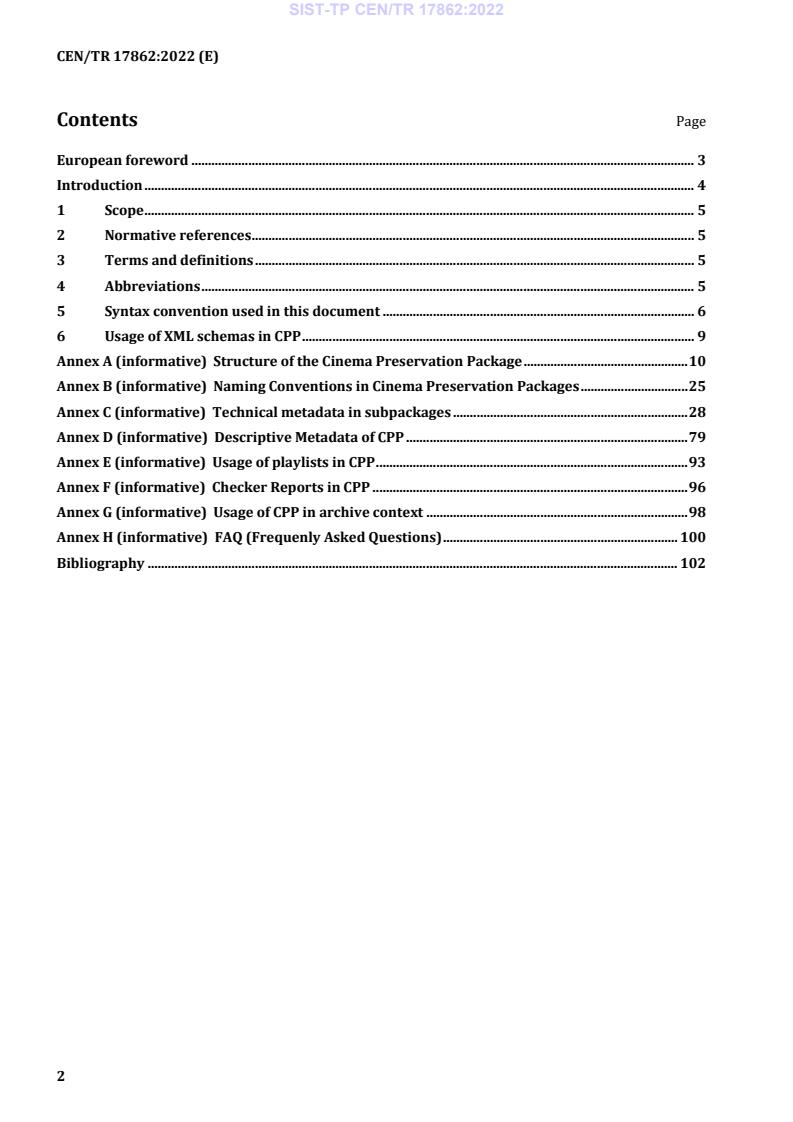
Contents Page
European foreword . 3
Introduction . 4
1 Scope . 5
2 Normative references . 5
3 Terms and definitions . 5
4 Abbreviations . 5
5 Syntax convention used in this document . 6
6 Usage of XML schemas in CPP . 9
Annex A (informative) Structure of the Cinema Preservation Package . 10
Annex B (informative) Naming Conventions in Cinema Preservation Packages . 25
Annex C (informative) Technical metadata in subpackages . 28
Annex D (informative) Descriptive Metadata of CPP . 79
Annex E (informative) Usage of playlists in CPP . 93
Annex F (informative) Checker Reports in CPP . 96
Annex G (informative) Usage of CPP in archive context . 98
Annex H (informative) FAQ (Frequenly Asked Questions) . 100
Bibliography . 102
European foreword
This document (CEN/TR 17862:2022) has been prepared by Technical Committee CEN/TC 457 “Digital
preservation of cinematographic works”, the secretariat of which is held by DIN.
Attention is drawn to the possibility that some of the elements of this document may be the subject of
patent rights. CEN shall not be held responsible for identifying any or all such patent rights.
This document has been prepared based on the Rolling Plan for ICT standardization 2015-2018.
This document serves as implementation guide to the European Standard EN 17650: A framework for
digital preservation of cinematographic works — The Cinema Preservation Package.
Any feedback and questions on this document should be directed to the users’ national standards body.
A complete listing of these bodies can be found on the CEN website.
Introduction
This document is part of a series of standards and technical recommendations for the digital preservation
of cinematographic work. It gives European film archives and producers a guideline how to store and
manage film content in the digital age.
Versions of digital cinematographic work using different encoding formats can be preserved in a layered
structure where the lowest level is describing the physical file. The files can carry data representing
images, sound, movies, subtitles, metadata or ancillary information like QC reports or film posters.
To structure these files in a consistent and interoperable way, the Cinema Preservation Package (CPP) is
specified and adds additional metadata like file lists, links or hash values. The Cinema Preservation
Package uses different XML files to store these additional metadata. The XML files are based on existing
schemas with extensions, in particular METS, EBUCore and PREMIS. The XML files also contain hash
values to ensure data integrity and version control. The syntax for this description and the methods for
the hash value generation are specified in EN 17650. Various types of content coding are described as
reference for concrete implementations.
The Cinema Preservation Package is well suited to serve as a Submission Information Package (SIP) in an
OAIS compliant preservation system [2] and/or as a self-contained exchange format between media
archives. The CPP does not necessarily contain a complete cinematographic work, it can also be used for
exchange of parts of a work (see Annex G).
1 Scope
This document describes the implementation of the Cinema Preservation Package (CPP) to facilitate the
digital preservation of cinematographic works. The related standard EN 17650 specifies methods to
describe the relationship of components of the cinematographic work and delivers syntax to describe the
package content. EN 17650 specifies the structure of the package and the constraints that are necessary
to enable compliance and interoperability. This document gives additional information how to implement
EN 17650 and gives additional explanations to the structure.
2 Normative references
The following documents are referred to in the text in such a way that some or all of their content
constitutes requirements of this document. For dated references, only the edition cited applies. For
undated references, the latest edition of the referenced document (including any amendments) applies.
EN 17650, A framework for digital preservation of cinematographic works — The Cinema Preservation
Package
3 Terms and definitions
For the purposes of this document, the terms and definitions given in EN 17650 and the following apply.
ISO and IEC maintain terminological databases for use in standardization at the following addresses:
• ISO Online browsing platform: available at http://www.iso.org/obp
• IEC Electropedia: available at http://www.electropedia.org/
3.1
ancillary data
small additional data supporting other data in the same hierarchy, preferably annotations
3.2
element
simple or essential part of which anything exists
3.3
file
collection of information stored on a digital storage medium
3.4
persistent identifier
unique identifier that ensures permanent access for a digital object by providing access to it
independently of its physical location or current ownership
3.5
preservation
act of maintaining information in a correct and independently understandable form over a long time
4 Abbreviations
ACES Academy Color Encoding System
ASCII American Standard Code for Information Interchange
BMFF Base Media File format
CPP Cinema Preservation Package
DCP Digital Cinema Package
DPX Digital Picture Exchange
IMF Interoperable Master Format
JPEG Joint Photographic Experts Group
LoC Library of Congress, see https://www.loc.gov/
MPEG Moving Pictures Experts Group
OAIS Open Archive Information System
PCM Pulse code modulation
PDF Portable Document Format
PNG Portable Network Graphics
SIP Submission Information Package
TIFF Tagged Image File Format
UUID Universal Unique Identifier
XML Extensible Markup Language
5 Syntax convention used in this document
5.1 General
For the file and folder name descriptions the following conventions are used.
5.2 Expressions used to denote file or folder names
5.2.1 Composition of name with parts
A name may be composed of one or several parts.
5.2.2 Literal parts
A literal part appearing between quotes appears as is.
EXAMPLE “LiteralPart” designates a part which is exactly “LiteralPart”.
5.2.3 Optional part
A part appearing between brackets appears zero or one time.
EXAMPLE [“OptionalPart”]”Radical” designates a name which is either “OptionalPartRadical” or “Radical”.
5.2.4 Alternative parts
Exactly one of the items in parentheses, separated by a vertical line ‘|’, appears in the result.
EXAMPLE (“Prefix1”|“Prefix2”|“Prefix3”)“Radical” designates a name which is either “Prefix1Radical”,
“Prefix2Radical” or “Prefix3Radical”.
5.2.5 Explicitly defined part
is a placeholder text and is replaced as specified by the prose.
EXAMPLE “Name_” designates a name which could be “Name_0123456789”, supposing
“0123456789” is defined as a valid custom identifier.
5.3 Expressions used to denote file or folder multiplicity
5.3.1 General
Some files or folders may appear several times in the parent folder. The final modifier therefore indicates
the allowed multiplicity.
5.3.2 One occurrence or more
A file or folder name with a trailing ‘+’ appears one or more times in the parent folder.
EXAMPLE “File_”+ designates a set of multiple files such as “File_0000”, or “File_0000” and
“File_0001” and “File_0002”, etc., assuming the prose describes such a 4-digit numbering.
5.3.3 Zero occurrence or more
A file or folder name with a trailing ‘*’ appears zero or more times in the parent folder.
EXAMPLE “File_”* designates a set of multiple files such as no file, “File_0000”, or “File_0000” and
“File_0001” and “File_0002”, etc., assuming the prose describes such a 4-digit numbering.
5.3.4 Optional file or folder
A file or folder name with a trailing ‘?’ appears zero or one time in the parent folder.
EXAMPLE “OptionalFile”? designates no file, or exactly one file with name “OptionalFile”.
5.4 Typographic conventions
5.4.1 Monospaced fonts
In the document, monospaced fonts are used for literal expression of textual content of a file, for instance
as example quotation.
EXAMPLE example text
5.4.2 Italic
In the document, italic text is expected to be substituted as specified in the prose.
EXAMPLE relative path to file is the path from the root folder to the Descriptive Metadata file including the
filename.
5.5 Conventions used to denote XML content
5.5.1 General consideration
Constraints on XML files are specified either as an XML Schema to apply, or as listed constraints for each
element of a list of specific XML Nodes.
5.5.2 Hierarchy
To denote the hierarchical position of a node the XPath syntax is used.
EXAMPLE “/rootElement/subElement/subSubElement” denotes an element with name “”
which is a child of a “” element, which itself is a child of the “” root element.
NOTE When an element in the path occurs more than one time, the XPath will be completed with discriminary
attributes if necessary. If the description applies to multiple elements, no discriminatory attribute will be added.
5.5.3 Namespace
XML elements may use a prefix to denote a namespace. The prefix indicated in the prose is only used for
convenience, and does not denote a namespace. The prefix in the file may be different and this is suitable
as long as the relation with the namespace is correctly indicated as a namespace attribute from a parent
element.
EXAMPLE “/mainNs:rootElement/mainNs:subElement” the “” and the “” belong
to the namespace denoted by “mainNs” in the prose.
5.5.4 Subelements
The following are used:
— @attributeName: denotes the name of an attribute of the element;
— #children: denotes the child elements;
— #text: denotes the child text of the element.
EXAMPLE
example 2
“/mainNs:rootElement/#children” denotes “subElement1” or “subElement2”
“/mainNs:rootElement/@attribute1” denotes “attribute1” with value “example 1”
“/mainNs:rootElement/subElement2/#text” denotes “example 2”
5.5.5 Property
If the XPath includes a part inside brackets, this is a constraint to properly address the right element.
EXAMPLE “/mainNs:rootElement/subElement[@position='first']” denotes the element which
is a child of the root element and has an attribute “position” with value “first”.
5.5.6 Conventions used in XML constraints list tables
Prior to each table, the current XML element is reminded using the XPath syntax.
In the following sections, the presence of elements is specified using tables. In these tables the “Element
Arity” column indicates the multiplicity allowed for an element:
• 1: the element is mandatory, exactly one element is present;
• 0/1: the element is optional, it appears zero or one time;
• 1/n or 1/∞: multiple mandatory. The element appears at least one time and may be repeated;
• 0/n or 0/∞: multiple optional. The element might not be present, or might be present one or multiple
times.
For each element subelements are indicated. The “Subelement mandatory” column indicates if this
subelement is mandatory. An ‘x’ in the corresponding cell indicates that the subelement is present, an ‘o’
in the same column indicates the subelement may be present. An attribute starts with the character ‘@’.
#text denotes the child text, if mandatory, the element cannot be empty. #children indicates xml child
elements.
Aiming to reduce the number of tables and sections in this document, when the semantic allows to do so
consistently, subelements are sometimes documented in the same table when only few elements are
described.
EXAMPLE ‘title/dc:title’ indicates that the subelement contains itself a sub-subelement <dc:title>,</br>
meaning that the whole XML segment has to be added to the current element described.</br>
<title typeLabel="titleType"></br>
<dc:title lang="fr"> title name</dc:title></br>
6 Usage of XML schemas in CPP
The CPP incorporates the specifications METS, EBUCore and PREMIS and its related XML schemas. The
specifications will be used separately in different files for specific utilizations in the CPP. The schemas of
the specifications will not be mixed in one file.
Each of these recommendations has some few mandatory requirements to conform with; in addition,
they provide much more optional elements allowing adjusting each of these recommendations to specific
client use cases.
CPP extends EBUCore specification with the EBUCore internal extension mechanism using
technicalAttributes. CPP do not use METS extension points. CPP does not prohibit the use of METS
extension points. CPP does not extend PREMIS. A minimal CPP does not require any PREMIS document
at all.
For achieving highest interoperability the extensions for a specific schema should be limited to the
extensions provided in the standard EN 17650. CPP compliant does not automatically mean that the full
set of METS, EBUCore and PREMIS elements must be supported, but the minimal set of mandatory
elements has to be met for all recommendations.
Interoperability differs from standard conformance. To maximize interoperability your CPP tool-set
should support all mandatory and optional elements of METS, EBUCore and PREMIS.
Annex A
(informative)
Structure of the Cinema Preservation Package
A.1 General
This annex describes the structure of the Cinema Preservation Package (CPP) in general parlance and
with illustrative drawings and gives advice for implementing the package. The CPP is aimed to contain
parts or all elements of a cinematographic work. In the case where only parts of a cinematographic work
are contained, the CPP can be used as exchange format for a film scan or a specific variant between
archives or between service provider and archives. In other use cases the CPP can be used as long-term
preservation format or as submission format to an archive system.
A.2 CPP overview
The Cinema Preservation Package follows a specific physical structure as illustrated in Figure A.1.
Figure A.1 — Physical structure of a CPP
The basic elements are:
• Packing lists, denoted as preservationPackingList.xml or packingList.xml, which list elements in
subfolders, link audiovisual content files to metadata files and include hash values for the listed files.
• Content in Subpackages or data folders: for the root level, content is stored as subpackages. For the
subpackages, content files are stored in its data folder, denoted as data. Each subpackage contains
content files of only one specific content type.
• Metadata folders, denoted as metadata, for metadata files. In the subpackage these metadata are
specific to the subpackage data. The metadata folder on the root level contains metadata that are
applicable to the complete CPP.
• Ancillary data folders, denoted as ancillaryData, for ancillary data files which are neither
audiovisual content nor metadata but can help in interpreting the audiovisual data files, so called
annotation files. In the subpackage ancillary data files are specific to the subpackage data. The
ancillary data folder on the root level contains ancillary data files that are applicable to the complete
cinematographic work.
In addition to the basic elements the CPP can contain in the root folder a playlists folder, denoted as
playlists, with files for linking a group of audiovisual content files to another group of audiovisual content
files located in a different subpackage or a checker reports folder, denoted as checkerReports, for check
report files of the package.
A.3 Subpackage
A.3.1 Introduction
The Cinema Preservation Package is organized in subpackages that will contain movie data or extra data
in part or as a whole. Each subpackage contains exactly one type of audiovisual data or for general
purposes extra data, together with supporting data (metadata or ancillary data). The type of audiovisual
data can be image sequences, sound files, timed-text data, wrapped movie files like MP4 files or
multichannel sound files, or complete componentized packages like DCPs or IMF packages. Extra data
subpackages contain data elements associated with the cinematographic work like press kits, poster or
archive specific data records.
All subpackages with movie data contain one metadata file in the metadata folder for technical
information about the audiovisual data and optionally metadata files for digital provenance, events and
processes. In addition, subpackages can contain ancillary data files in the ancillary data folder, typically
notes or single sheets (annotations), associated to this specific subpackage.
A.3.2 Basic structure
The basic structure of a subpackage is illustrated in Figure A.2.
Figure A.2 — Subpackage structure
A.3.3 Subpackage folder
All movie data belonging to one consecutive piece of the movie or extra data to the cinematographic work
are contained in a subpackage. The subpackage is stored in a subfolder called
_. Thus, movie data or extra data can be uniquely identified by its type and
its unique identifier.
The subpackage types are given in Table A.1.
Table A.1 — Subpackage types
Description
imagePackage This subpackage type contains one sequence of image files, e.g. *.dpx, *.tif
or *.exr, which are temporally consecutive in the movie (typically one reel).
soundPackage This subpackage type contains one set of single channel sound files, e.g.
*.wav, which are temporally associated (typically one reel).
timedTextPackage This subpackage type contains timedText files, e.g. *.xml or *.png files,
which are temporally associated (typically one reel).
audiovisualPackage This subpackage type contains movie data or multichannel sound in
wrapped files, e.g. *.mp4, *.mov, *.mkv or *.wav. The wrapped files form a
playable piece of the movie or sound.
componentizedPackage This subpackage type contains one set of files, which form a standardized
master or distribution package, e.g. a DCP, an IMF or a DPP.
extraPackage This subpackage type contains one set of files, which do not belong directly
to the audiovisual part of the cinematographic work, but is created to
support such work, like press kits, posters etc. Proprietary metadata
records from archives databases will also fit here.
is the unique identifier number (UUID) associated with the subpackage. Each time data are
modified inside the subpackage, a new UUID will be created. This ensures a unique identification of data
sets.
The subpackage folder contains two mandatory subfolder, data and metadata, and one optional
subfolder ancillaryData.
A.3.4 Elements in the subpackage
Movie data elements or extra data elements, which can be images, sound files, a complete movie or
something else, dependent on the type, are located in the folder data.
For the data elements in the data folder – either a single file or a set of files – one technical metadata file
has to be created. This file is stored in the metadata folder and named techMD__.xml.
in the file name is identical with the UUID in the subpackage name. is a consecutive
number to allow multiple metadata files, starting with index 0 and uses 4 digits. At the moment only one
metadata file techMD__0000.xml is expected, but for future extensions the number is included
in the same way as it is in other file names. techMD__.xml files are constructed based on
the EBUCore schema with CPP specific extensions.
The data elements are optionally linked to digital provenance data. This information about events and
processes of data objects are stored in files called digiprovMD__.xml inside the metadata
folder.
The most important additional file in the subpackage is the packing list. The packing list
packingList.xml is the inventory list of the data and ancillaryData folder and links the data
elements to the metadata files in the metadata folder. Figure A.3 shows the linking between the files in
a subpackage.
Figure A.3 — Linking inside the subpackage
A.3.5 XML elements and attributes in packing list of subpackages
The packing list packingList.xml is constructed based on the METS schema and contains at least the
following sections as described in Figure A.4.
Figure A.4 — METS sections in packingList.xml files
Table A.2 describes the most important elements. A detailed description of the elements and attributes
can be found in the METS documentation [3].
Table A.2 — METS elements in packingList.xml files
Element Type May contain Has attributes Contained within Min/max
ID 0/∞
ROLE
OTHERROLE
TYPE
OTHERTYPE
ID 0/∞
TYPE
amdSecType ID 0/∞
Element Type May contain Has attributes Contained within Min/max
mdSecType ID 0/∞
GROUPID
AMDID
CREATED
STATUS
ORDER
LABEL
DMDID
ADMID
TYPE
CONTENTIDS
xlink:label
fileType ID 0/∞
MIMETYPE 0/∞
SEQ
SIZE
CREATED
CHECKSUM
CHECKSUMTYPE
OWNERID
ADMID
DMDID
GROUPID
USE
fileGrpType ID 0/∞
VERSDATE 0/∞
ADMID
USE
ID 0/∞
Element Type May contain Has attributes Contained within Min/max
ID 0/∞
USE
__________
attributeGroup
ref:Location
LOCTYPE
OTHERLOCTYPE
__________
attributeGroup
ref:
xlink:simpleLink
ID
FILEID
CONTENTIDS
ID
0/1
MIMETYPE
0/1
SIZE 0/1
CREATED 0/1
CHECKSUM 0/1
CHECKSUMTYPE
LABEL
XPTR
__________
attributeGroup
ref:LOCATION
LOCTYPE
OTHERLOCTYPE
__________
attributeGroup
ref:METDATA
MDTYPE
OTHERMDTYPE
MDTYPEVERSION
metsType ID
OBJID
LABEL
TYPE
PROFILE
Element Type May contain Has attributes Contained within Min/max
ID 0/1
ADMID
CREATEDATE
LASTMODDATE
RECORDSTATUS
ID
CONTENTIDS
__________
attributeGroup
ref:LOCATION
LOCTYPE
OTHERLOCTYPE
__________
attributeGroup
ref:LOCATION
xlink:simpleLink
xsd:string 1
xsd:string 0/∞
structMapTy
pe
TYPE
LABEL
mdSecType ID 0/∞
GROUPID
AMDID
CREATED
STATUS
A.3.6 Example of packing list file in subpackages
xmlns:xlink="http://www.w3.org/1999/xlink/">
CPP-Packager
MDTYPE="OTHER" OTHERMDTYPE="EBUCORE" MIMETYPE="text/xml" SIZE="6420"
CHECKSUM="ad7b2c0c63f7f717531d29796ca7b6bd572d4fa6fd75dec5b2ef79ea176a9d0f"
CHECKSUMTYPE="SHA-256" />
ADMID="techMD_6aac082c-008f-4827-becb-a4697d2383a7_0000"
USE="imagePackage">
MIMETYPE="image/x-dpx" SIZE="210692"
CHECKSUM="3e46fdacdd9e5fbf0c5af2dec76d618ea828d1a81f53bd04d4773ff117b69fb3"
CHECKSUMTYPE="SHA-256">
MIMETYPE="image/x-dpx" SIZE="210692"
CHECKSUM="446a7cb4cb3b6ea843aa65d2db36b90ec43513c1d426b20b5175b33ef8f432b5"
CHECKSUMTYPE="SHA-256">
MIMETYPE="image/x-dpx" SIZE="210692"
CHECKSUM="6cfdae2b4ca9eaabf2be58b70ef16966177d4673de06c092ea27181261601667"
CHECKSUMTYPE="SHA-256">
MIMETYPE="image/x-dpx" SIZE="210692"
CHECKSUM="d13d41780ffbdd0bc163323ab98b3b5a927481b6150164e72c6fc7dc53973934"
CHECKSUMTYPE="SHA-256">
MIMETYPE="image/x-dpx" SIZE="210692"
CHECKSUM="066c13babdfc820c6446bfaaa2795df8e4a638e162598e9343f26d91d3f25e63"
CHECKSUMTYPE="SHA-256">
A.4 CPP root folder
A.4.1 Elements of the root folder
The Cinema Preservation Package contains in the root folder a packing list called
preservationPackingList.xml. In addition to the basic elements – the subpackage folders as content
container, the subfolders metadata and optionally ancillaryData – two optional special folders called
playlists and checkerReports can be present.
The preservationPackingList.xml file is a METS file like the packing list in the subpackages but with
some small differences:
• This packing list references all subpackages by listing all packingList.xml files in the
section and as reference in the section. It is based on the METS schema and
builds together with all packing lists a hierarchical system of METS files.
• The descriptive metadata files and the digital provenance metadata files for the complete package
are stored in the root metadata folder and listed in the section and section of
the preservationPackingList.xml file. Inside the packing list an UUID for the complete package
is defined, which is reused in the file names for the descriptive and global digital
provenance metadata, identifying a specific CPP package. When a modification is done in the package
this UUID must be regenerated.
• All files in the playlists folder are listed in the
The metadata folder in the root folder contains metadata files related to the complete package. Typically,
these files contain descriptive metadata. At least one file descMD__0000.xml is mandatory that
contains metadata according to EN 15744 standard and is based on EBUCore schema.
Notes as additional data related to the complete package and not bundled in subpackages can be stored
in an optional folder called ancillaryData folder.
The playlists folder contains playlist files named playlist_.xml that link movie
data elements together to form a playable piece of the movie. Typically, this will be used to link basic
elements in imagePackages and soundPackages together. is a unique UUID
identifying the specific playlist.
The checkerReports folder contains validation check results or file and folder reports, which are
generated automatically giving an overview on the consistency of the elements contained in the CPP.
Large amounts of additional data related to the complete cinematographic work can be stored in separate
extra subpackages, as proprietary metadata records from archive specific databases, for example.
The linking of the files on the root level is illustrated in Figure A.5.
Figure A.5 — Linking of files on root level
A.4.2 XML elements and attributes in preservation packing list of CPP
The packing list preservationPackingList.xml file is the inventory of the CPP. It lists all files in the
playlists and ancillaryData folder and links the data elements to the metadata files. The packing list
is constructed based on the METS schema. It also lists the packing lists in the subpackages and builds a
hierarchical system of packing lists by using the XML element. Typical sections in a
preservationPackingList.xml file are illustrated in Figure A.6.
Figure A.6 — METS sections in preservationPackingList.xml files
In addition to the packing list in the subpackages it allows the XML elements given in Table A.3.
Table A.3 — Additional METS elements in the root packing list
ELEMENT TYPE MAY CONTAIN HAS ATTRIBUTES CONTAINED WITHIN MIN/MAX
mdSecType ID 0/∞
GROUPID
AMDID
CREATED
STATUS
ID
CONTENTIDS
__________
attributeGroup
ref:LOCATION
LOCTYPE
OTHERLOCTYPE
__________
attributeGroup
ref:LOCATION
xlink:simpleLink
A.4.3 Example of preservation packing list in CPP
xmlns:xlink="http://www.w3.org/1999/xlink">
CPP-Packager
MDTYPE="OTHER" OTHERMDTYPE="EBUCORE" MIMETYPE="text/xml" SIZE="1767"
CHECKSUM="977bd877a048ef3e9ab6422ecc215156453b76f889282eade6a29429d59be4dd"
CHECKSUMTYPE="SHA-256" />
MDTYPE="PREMIS" MIMETYPE="text/xml" SIZE="1698"
CHECKSUM="97c02bc1d4170c67a8637666910d02098d3e921dd225dcf5eb68b2ec94161778"
CHECKSUMTYPE="SHA-256" />
SIZE="9108"
CHECKSUM="891990d22c318ca16adfae21d62b20bcc5b0021c3da7c03402f005768e8ee553"
CHECKSUMTYPE="SHA-256">
xlink:href="playlists/playlist_87c4543d-fe1f-4482-bade-
11c281a74355.xml" />
MIMETYPE="application/pdf" SIZE="312"
CHECKSUM="87d7f7f6e86979985e0fffcca4587b1238a0308c6fecb9d5cff0ff530069a387"
CHECKSUMTYPE="SHA-256">
xlink:href="ancillaryData/myFirstAncillaryFile.pdf" />
MIMETYPE="image/tiff" SIZE="1308"
CHECKSUM="137c4d1f4ba2e399b59245a2ea47f11113369e4cef883ed206f81a24733f1bbd"
CHECKSUMTYPE="SHA-256">
xlink:href="ancillaryData/mySecondAncillaryData.tiff" />
MIMETYPE="text/xml" SIZE="3287"
CHECKSUM="550e8ce4e3a256f5bc9c72547222b855b227989e061c2e9c4d2ca1a1817296d5"
CHECKSUMTYPE="SHA-256">
xlink:href="imagePackage_6aac082c-008f-4827-becb-
a4697d2383a7/packingList.xml" />
MIMETYPE="text/xml" SIZE="2549"
CHECKSUM="477a31673d65eee62004d6575c194c74d4ae7fef2cb70d84c4a5b32465c68909"
CHECKSUMTYPE="SHA-256">
xlink:href="soundPackage_1c0284b2-0695-4f21-8792-
2c679342228e/packingList.xml" />
DMDID="descMD_69b0eccf-373c-454a-8b42-d53701af8898_0000"
LABEL="TestPackage">
xlink:href="imagePackage_6aac082c-008f-4827-becb-
a4697d2383a7/packingList.xml" />
xlink:href="soundPackage_1c0284b2-0695-4f21-8792-
2c679342228e/packingList.xml" />
A.5 CPP logical structure
A.5.1 Introduction
The CPP physical structure contains all elements of a cinematographic work in subpackages. Typically,
these elements come from submissions to the archive, from postproduction steps or will be reused to
bundle deliveries to partners, archives, festivals and so on. To avoid multiple copies of the same data in
the CPP, each subpackage can be stored in the CPP only once. To allow a specific bundling of multiple data
elements, a logical grouping is possible to track generation, postproduction or delivery processes. This
grouping can be done in the METS top level packing list preservationPackingList.xml file by adding
different sections in the METS file.
Exactly one section is associated with the physical structure, optionally additional
sections can be associated with logical structures. This allows the grouping of data. For
example a scan process can deliver multiple reels and sound files which will be stored in Image and Sound
packages. A logical can be used to group these data together.
A.5.2 Examples of logical structure
Figure A.7 illustrates examples of logical structures in a CPP.
Figure A.7 — Examples of logical structures in a CPP
The following example describes a logical structure with two imagePackages and one soundPackage in
the preservationPackingList.xml file as in METS syntax:
A.6 CPP usage overview
Figure A.8 shows an example of the CPP usage with annotations.
Figure A.8 — CPP Usage Overview
A.7 CPP general structure
Figure A.9 shows the multiplicity of elements in a CPP.
Figure A.9 — CPP general structure
A.8 Checker reports
The quality control (QC) of the preservation process happens within the CPP using file integrity checking,
version control and protocolling of file attributes in the techMD XML files.
Reports on media quality are stored in the checkerReports folder. QC applications generating checker
reports can be freely chosen, they can be processed automatically, or semi-automatically. To foster
automatic processes, the top element in the checkerReports folder is a XML file documenting the used
QC tool with version, the used QC tool settings/policies in machine readable form and the time of finishing
a checker report. Checker Report files are listed in the preservationPackingList.xml file. More
details can be found in Annex F.
Annex B
(informative)
Naming Conventions in Cinema Preservation Packages
B.1 General
This annex describes the naming conventions of the Cinema Preservation Package.
B.2 Naming conventions for ID's in METS file preservationPackingList.xml
Table B.1 — METS ID naming in file preservationPackingList.xml
Name Type Use
descMD__ dmdSec ID as ID for descriptive metadata in
dmdSec, referenced by DMDID
digiprovMD__ digiprovMD ID as ID for digiprovMD in amdSec,
referenced by ADMID for full CPP
ancillaryData_ ...