


prEN 10307
(Main)Non-destructive testing - Ultrasonic testing of austenitic and austenitic-ferritic stainless steels flat products of thickness equal to or greater than 6 mm (reflection method)
General Information
- Abstract
This document describes a method for the ultrasonic-testing of uncoated flat austenitic and austenitic-ferritic stainless steel product for internal discontinuities.
This document is applicable to flat product in nominal thickness range of 6 mm to 200 mm.
This document also defines four quality classes for the flat product body (classes S1, SA, S2 and S3) and four quality classes (E1, E2, E3, E4) for the edges (see Clause 15).
A list of equivalent terms in several European languages is given in Annex A.
- Status
- Not Published
- Publication Date
- 10-Mar-2027
- Technical Committee
- ECISS/TC 101 - Test methods for steel (other than chemical analysis)
- Drafting Committee
- WG 2 - Ultrasonic testing of steel flat products
- Current Stage
- 4060 - Closure of enquiry - Enquiry
- Start Date
- 29-Jan-2026
- Due Date
- 07-Jan-2026
- Completion Date
- 29-Jan-2026



Overview
prEN 10307:2025 (CEN) is a draft European standard for non‑destructive testing (NDT) by ultrasonic testing (UT) using the reflection method. It covers inspection of uncoated flat austenitic and austenitic‑ferritic stainless steel products with nominal thicknesses from 6 mm to 200 mm, to detect and evaluate internal discontinuities. The document updates and will supersede EN 10307:2001 and includes new technical provisions, classification schemes and test settings.
Key topics and technical requirements
- Scope and product range: Flat stainless steel products, thickness 6–200 mm; testing is normally performed from one side during the first ultrasonic scan.
- Testing principle: Reflection of ultrasonic waves with beam axis approximately perpendicular to the surface. Discontinuity evaluation is by comparison with reference flat‑bottomed holes (DAC/DGS or equivalent) and, where applicable, contouring by the 6 dB drop method.
- Quality classes: Four body quality classes - S1, SA, S2, S3 - and four edge quality classes - E1, E2, E3, E4. These define acceptance criteria and recording levels (see Clause 15).
- Procedure and agreements: Purchaser and supplier must agree on stages of manufacture to test, coverage (grid or complete scanning), quality class, acceptance criteria, technique for sensitivity setting, and whether testing is witnessed by the purchaser.
- Personnel and equipment: Personnel qualification per EN ISO 9712; equipment and probes to comply with relevant EN/ISO ultrasonic test instrument and probe standards (EN ISO 22232 series, EN ISO 18563 series).
- Operational details: Written test procedures required; both manual and automated/semi‑automated testing definitions provided; routine checks, surface condition, couplant, sensitivity setting and scanning (updated scanning speed: 500 mm/s) are specified.
- Evaluation and recording: Methods for sizing and interpreting echoes with single and dual‑transducer probes, plus requirements for test reporting and recording level (acceptance criteria updated in Tables 3–6).
Practical applications
- Quality control and acceptance testing for manufacturers and processors of stainless steel flat products (sheets, plates).
- Incoming inspection and in‑process testing to detect planar/laminar imperfections, inclusion bands, clusters and other internal discontinuities.
- Contractual NDT requirements between suppliers and purchasers where defined quality classes and acceptance criteria are required.
- Use in production lines employing manual, semi‑automated or fully automated ultrasonic inspection systems (including phased‑array alternatives where demonstrated equivalent).
Who should use this standard
- Steel producers and rolling mills
- NDT/UT technicians and inspection teams
- Quality assurance, metallurgical and materials engineers
- Procurement and inspection representatives specifying acceptance criteria in contracts
Related standards
Key normative references include:
- EN ISO 9712 (NDT personnel qualification)
- EN ISO 16810 / 16811 / 16827 (UT principles, sensitivity, characterization)
- EN ISO 22232‑1/2/3 and EN ISO 18563‑1/2/3 (equipment and phased‑array characterization)
- EN 1330‑1 / EN 1330‑2 and EN ISO 5577 (NDT terminology and vocabulary)
prEN 10307 also includes an Annex with equivalent terms in several European languages, supporting multilingual implementation and contract use.
Relations
- Effective Date
- 05-Oct-2024
Get Certified
Connect with accredited certification bodies for this standard

Element Materials Technology
Materials testing and product certification.

Inštitut za kovinske materiale in tehnologije
Institute of Metals and Technology. Materials testing, metallurgical analysis, NDT.
Sponsored listings
Frequently Asked Questions
prEN 10307 is a draft published by the European Committee for Standardization (CEN). Its full title is "Non-destructive testing - Ultrasonic testing of austenitic and austenitic-ferritic stainless steels flat products of thickness equal to or greater than 6 mm (reflection method)". This standard covers: This document describes a method for the ultrasonic-testing of uncoated flat austenitic and austenitic-ferritic stainless steel product for internal discontinuities. This document is applicable to flat product in nominal thickness range of 6 mm to 200 mm. This document also defines four quality classes for the flat product body (classes S1, SA, S2 and S3) and four quality classes (E1, E2, E3, E4) for the edges (see Clause 15). A list of equivalent terms in several European languages is given in Annex A.
This document describes a method for the ultrasonic-testing of uncoated flat austenitic and austenitic-ferritic stainless steel product for internal discontinuities. This document is applicable to flat product in nominal thickness range of 6 mm to 200 mm. This document also defines four quality classes for the flat product body (classes S1, SA, S2 and S3) and four quality classes (E1, E2, E3, E4) for the edges (see Clause 15). A list of equivalent terms in several European languages is given in Annex A.
prEN 10307 is classified under the following ICS (International Classification for Standards) categories: 77.040.20 - Non-destructive testing of metals; 77.140.50 - Flat steel products and semi-products. The ICS classification helps identify the subject area and facilitates finding related standards.
prEN 10307 has the following relationships with other standards: It is inter standard links to EN 10307:2001. Understanding these relationships helps ensure you are using the most current and applicable version of the standard.
prEN 10307 is available in PDF format for immediate download after purchase. The document can be added to your cart and obtained through the secure checkout process. Digital delivery ensures instant access to the complete standard document.
Standards Content (Sample)
SLOVENSKI STANDARD
01-december-2025
Neporušitvene preiskave - Ultrazvočno preskušanje avstenitnih in avstenitno-
feritnih nerjavnih ploščatih jeklenih izdelkov debelin, ki so enake ali večje od 6 mm
(odbojna metoda)
Non-destructive testing - Ultrasonic testing of austenitic and austenitic-ferritic stainless
steels flat products of thickness equal to or greater than 6 mm (reflection method)
Zerstörungsfreie Prüfung - Ultraschallprüfung von Flacherzeugnissen aus
austenitischem und austenitisch-ferritischem nichtrostendem Stahl ab 6 mm Dicke
(Reflexionsverfahren)
Essais non destructifs - Contrôle par ultrasons des produits plats en acier inoxydable
austénitique et austéno-ferritique d'épaisseur égale ou supérieure à 6 mm (méthode par
réflexion)
Ta slovenski standard je istoveten z: prEN 10307
ICS:
77.040.20 Neporušitveno preskušanje Non-destructive testing of
kovin metals
77.140.50 Ploščati jekleni izdelki in Flat steel products and semi-
polizdelki products
2003-01.Slovenski inštitut za standardizacijo. Razmnoževanje celote ali delov tega standarda ni dovoljeno.
DRAFT
EUROPEAN STANDARD
NORME EUROPÉENNE
EUROPÄISCHE NORM
November 2025
ICS 77.040.20 Will supersede EN 10307:2001
English Version
Non-destructive testing - Ultrasonic testing of austenitic
and austenitic-ferritic stainless steels flat products of
thickness equal to or greater than 6 mm (reflection
method)
Essais non destructifs - Contrôle par ultrasons des Zerstörungsfreie Prüfung - Ultraschallprüfung von
produits plats en acier inoxydable austénitique et Flacherzeugnissen aus austenitischem und
austéno-ferritique d'épaisseur égale ou supérieure à 6 austenitisch-ferritischem nichtrostendem Stahl ab 6
mm (méthode par réflexion) mm Dicke (Reflexionsverfahren)
This draft European Standard is submitted to CEN members for enquiry. It has been drawn up by the Technical Committee
CEN/TC 459/SC 1.
If this draft becomes a European Standard, CEN members are bound to comply with the CEN/CENELEC Internal Regulations
which stipulate the conditions for giving this European Standard the status of a national standard without any alteration.
This draft European Standard was established by CEN in three official versions (English, French, German). A version in any other
language made by translation under the responsibility of a CEN member into its own language and notified to the CEN-CENELEC
Management Centre has the same status as the official versions.
CEN members are the national standards bodies of Austria, Belgium, Bulgaria, Croatia, Cyprus, Czech Republic, Denmark, Estonia,
Finland, France, Germany, Greece, Hungary, Iceland, Ireland, Italy, Latvia, Lithuania, Luxembourg, Malta, Netherlands, Norway,
Poland, Portugal, Republic of North Macedonia, Romania, Serbia, Slovakia, Slovenia, Spain, Sweden, Switzerland, Türkiye and
United Kingdom.
Recipients of this draft are invited to submit, with their comments, notification of any relevant patent rights of which they are
aware and to provide supporting documentation.
Warning : This document is not a European Standard. It is distributed for review and comments. It is subject to change without
notice and shall not be referred to as a European Standard.
EUROPEAN COMMITTEE FOR STANDARDIZATION
COMITÉ EUROPÉEN DE NORMALISATION
EUROPÄISCHES KOMITEE FÜR NORMUNG
CEN-CENELEC Management Centre: Rue de la Science 23, B-1040 Brussels
© 2025 CEN All rights of exploitation in any form and by any means reserved Ref. No. prEN 10307:2025 E
worldwide for CEN national Members.
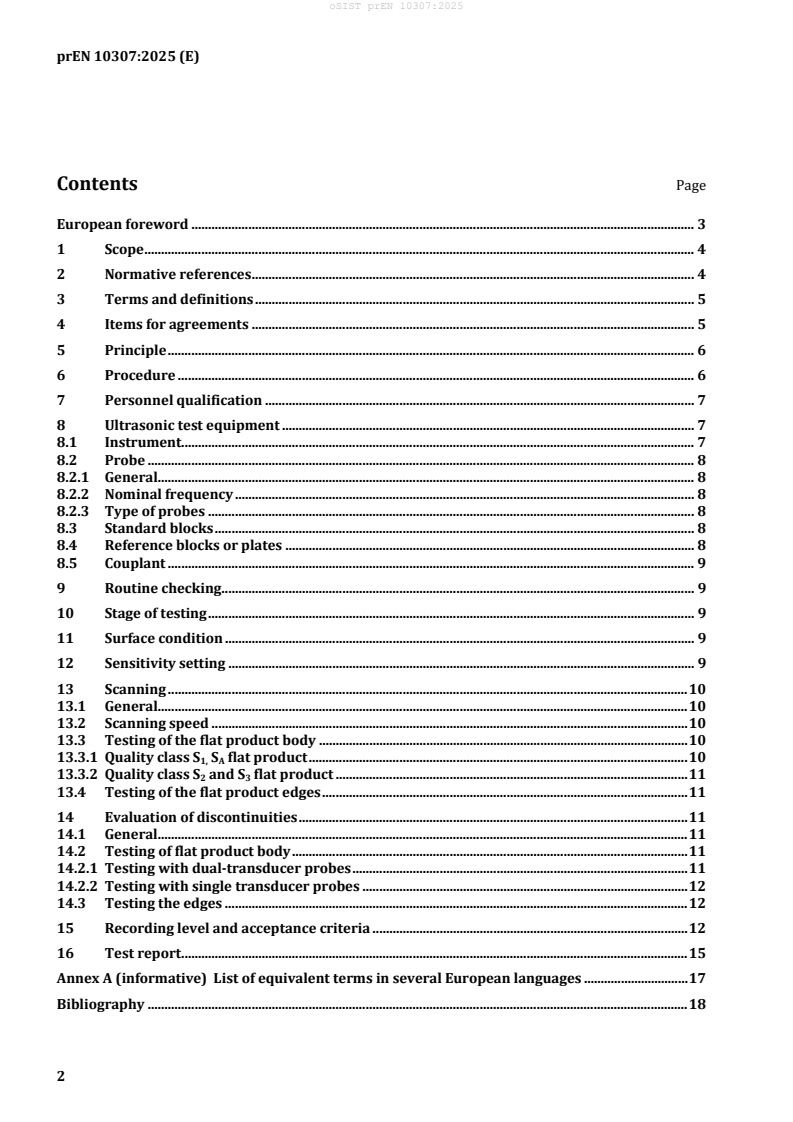
Contents Page
European foreword . 3
1 Scope . 4
2 Normative references . 4
3 Terms and definitions . 5
4 Items for agreements . 5
5 Principle . 6
6 Procedure . 6
7 Personnel qualification . 7
8 Ultrasonic test equipment . 7
8.1 Instrument. 7
8.2 Probe . 8
8.2.1 General. 8
8.2.2 Nominal frequency . 8
8.2.3 Type of probes . 8
8.3 Standard blocks . 8
8.4 Reference blocks or plates . 8
8.5 Couplant . 9
9 Routine checking . 9
10 Stage of testing . 9
11 Surface condition . 9
12 Sensitivity setting . 9
13 Scanning . 10
13.1 General. 10
13.2 Scanning speed . 10
13.3 Testing of the flat product body . 10
13.3.1 Quality class S S flat product . 10
1, A
13.3.2 Quality class S and S flat product . 11
2 3
13.4 Testing of the flat product edges . 11
14 Evaluation of discontinuities . 11
14.1 General. 11
14.2 Testing of flat product body . 11
14.2.1 Testing with dual-transducer probes . 11
14.2.2 Testing with single transducer probes . 12
14.3 Testing the edges . 12
15 Recording level and acceptance criteria . 12
16 Test report . 15
Annex A (informative) List of equivalent terms in several European languages . 17
Bibliography . 18
European foreword
This document (prEN 10307:2025) has been prepared by Technical Committee CEN/TC 459/SC 1 “Test
methods for steel (other than chemical analysis)”, the secretariat of which is held by AFNOR.
This document is currently submitted to the CEN Enquiry.
This document will supersede EN 10307:2001.
— The Scope was modified;
— Clause 2: Normative References has been updated;
— Definition 3.5 was updated;
— Clause 5: Principle was developed;
— A new quality class for the flat product body (S ) was added;
A
— The method of settings in Clause 12 was updated;
— The scanning speed in 13.2 was changed to 500 mm/s;
— Some elements while testing the edges in 14.2 were modified;
— Values of Table 5 and Table 6 – Acceptance criteria with dual/single-transducer probes were
updated.
1 Scope
This document describes a method for the ultrasonic-testing of uncoated flat austenitic and austenitic-
ferritic stainless steel product for internal discontinuities.
This document is applicable to flat product in nominal thickness range of 6 mm to 200 mm.
This document also defines four quality classes for the flat product body (classes S , S , S and S ) and
1 A 2 3
four quality classes (E , E , E , E ) for the edges (see Clause 15).
1 2 3 4
A list of equivalent terms in several European languages is given in Annex A.
2 Normative references
The following documents are referred to in the text in such a way that some or all of their content
constitutes requirements of this document. For dated references, only the edition cited applies. For
undated references, the latest edition of the referenced document (including any amendments) applies.
EN ISO 9712, Non-destructive testing — Qualification and certification of NDT personnel (ISO 9712)
EN ISO 16810, Non-destructive testing — Ultrasonic testing — General principles (ISO 16810)
EN ISO 16811, Non-destructive testing — Ultrasonic testing — Sensitivity and range setting (ISO 16811)
EN ISO 16827, Non-destructive testing — Ultrasonic testing — Characterization and sizing of
discontinuities (ISO 16827)
EN 1330-1, Non destructive testing — Terminology — Part 1: List of general terms
EN 1330-2, Non destructive testing — Terminology — Part 2: Terms common to the non-destructive testing
methods
EN ISO 5577, Non-destructive testing — Ultrasonic testing — Vocabulary (ISO 5577)
EN ISO 2400, Non-destructive testing — Ultrasonic testing — Specification for standard block No. 1
(ISO 2400)
EN ISO 18563-1, Non-destructive testing — Characterization and verification of ultrasonic phased array
equipment — Part 1: Instruments (ISO 18563-1)
EN ISO 18563-2, Non-destructive testing — Characterization and verification of ultrasonic phased array
equipment — Part 2: Array probes (ISO 18563-2)
EN ISO 18563-3, Non-destructive testing — Characterization and verification of ultrasonic phased array
equipment — Part 3: Complete systems (ISO 18563-3)
EN ISO 22232-1, Non-destructive testing — Characterization and verification of ultrasonic test
equipment — Part 1: Instruments (ISO 22232-1)
EN ISO 22232-2, Non-destructive testing — Characterization and verification of ultrasonic test
equipment — Part 2: Probes (ISO 22232-2)
EN ISO 22232-3, Non-destructive testing — Characterization and verification of ultrasonic test
equipment — Part 3: Combined equipment (ISO 22232-3)
3 Terms and definitions
For the purposes of this document, the terms and definitions given in EN 1330-1, EN 1330-2, EN ISO 5577
and the following apply.
ISO and IEC maintain terminology databases for use in standardization at the following addresses:
— ISO Online browsing platform: available at https://www.iso.org/obp/
— IEC Electropedia: available at https://www.electropedia.org/
3.1
internal discontinuity
any imperfection lying within the thickness of the flat product, e.g planar or laminar imperfection, single-
plane or multi-plane inclusion bands or clusters
Note 1 to entry: It is referred to in the text as discontinuity.
3.2
defect
internal discontinuity, i.e. exceeding the specified maximum size or population density limits
3.3
population density
number of individual internal discontinuities of a size greater than a specified minimum size and less
than a specified maximum size per specified area of body or length of edge zone
3.4
manual testing
testing by an operator applying an ultrasonic probe, or probes, to the flat product surface, manually
executing the appropriate scanning pattern on the flat product surface and assessing ultrasonic signal
indications on the ultrasonic instrument either by direct viewing or by built-in signal amplitude alarm
devices
3.5
automated and semi-automated testing
testing using a mechanized means of applying the ultrasonic probe or probes to, and executing the
appropriate scanning pattern on the flat product surface, together with ultrasonic signal indication
evaluation by using fully automated software-based data acquisition
Note 1 to entry: Such testing shall be either fully automatic, or semi-automatic when the operator performs basic
equipment operation functions and validates testing results.
4 Items for agreements
The following aspects concerning ultrasonic testing shall be agreed between the purchaser and supplier
at the time of the enquiry or order:
a) the manufacturing stage(s) at which ultrasonic testing shall be performed (see Clause 10);
b) the volume(s) to be tested and whether grid scanning coverage or complete scanning coverage is
required (see Clause 13);
c) the Quality Class required, or the Quality Classes and the zones to which they apply (see Clause 15);
d) the applicable recording level and acceptance criteria if different from those detailed in Tables 3 to 6;
e) whether any special scanning coverage, equipment or couplant is required in addition to that detailed
in Clauses 8 and 13;
f) the techniques to evaluate discontinuities (see Clause 14);
g) the technique(s) to be used for setting sensitivity (see Clause 12);
h) whether the test is to be conducted in the presence of the purchaser or his representative;
i) whether a written procedure shall be submitted for approval by the purchaser (see Clause 6).
5 Principle
The method shall be based on the reflection of ultrasonic waves, the beam axis of which is approximately
perpendicular to the surface of the product.
The examination shall consist of:
a) locating and evaluation of discontinuity by comparing the amplitude of the discontinuity echo with
the amplitude of the echo of a flat-bottomed hole of a given diameter and located at the same depth
as the discontinuity (DAC, DGS, or equivalent methods);
NOTE Only those discontinuities giving an echo amplitude greater than that obtained with the reference flat-
bottomed hole are taken into consideration.
b) if applicable according to Clause 14, determining the contour of the discontinuity being defined by
the positions of the centre of the probe corresponding to an echo amplitude of half the maximum
amplitude of the discontinuity under consideration (6 dB drop method).
The width of the discontinuity shall be determined perpendicular to the direction of rolling. The
length shall be determined in the rolling direction.
The examination shall be carried out during the first ultrasonic scan for all the flat product thicknesses
and from one side only.
If areas with significant drop of backwall echo or the signal-to-noise ratio are observed, the testing
conditions shall be adjusted in order to test these areas with the required sensitivity level in accordance
with Clause 12.
Other methods of testing, e.g. by phased-array technique or other test equipment, may be used at the
manufacturer's discretion provided that they give equivalent results to those obtained under the
conditions of this document. In the event of a dispute, only the method defined in this document prevails.
Testing of flat product of thickness less than 6 mm or higher than 200 mm can be the subject of special
agreements between the parties concerned.
6 Procedure
The testing shall be carried out in the place of production or on the premises of the supplier. If specified
on the order, the testing may take place in the presence of the purchaser or his representative (see
Clause 4 h)).
Ultrasonic testing shall be performed in accordance with a written procedure. Where specified in the
enquiry or order, the written procedure shall be submitted to the purchaser for approval prior to testing.
1 In this case, all steps should be taken to ensure that the production process is not disturbed.
This written procedure shall be in the form of:
— a product specification ; or
— a procedure written specifically for the application ; or
— this document may be used if it is accompanied by examination details specific to the application.
The procedure shall contain the following details as a minimum requirement:
a) description of the item to be examined;
b) reference documents;
c) qualification and certification of examination personnel;
d) stage of manufacture at which the examination is carried out;
e) examination zones specified in terms of the applicable Quality Classes;
f) any special preparation of scanning surfaces, if applicable;
g) couplant;
h) description of examination equipment;
i) setting;
j) scanning plan;
k) description and sequence of examination operations;
l) recording levels;
m) characterization of discontinuities;
n) acceptance criteria;
o) examination report.
7 Personnel qualification
Testing shall be carried out by a qualified and certified personnel under the responsibility of a qualified
and certified Level 3 personnel in accordance with EN ISO 9712.
8 Ul
...