

CEN/TS 17553:2022
(Main)Textiles and textile products - Community face coverings - Minimum requirements, methods of testing and use
- Abstract
This document specifies the minimum requirements for reusable or single use community face coverings intended for the general public, covering the nose, mouth and chin (for minimum coverage area, see Figure 2) in order to reduce the risk of droplet/aerosol projection towards nearby people. These requirements include:
— innocuousness,
— design (including fit),
— performance,
— test methods,
— marking,
— packaging,
— information for use.
Figure 2 — Community face coverings minimum coverage area (dark area)
These requirements are applicable to:
— community face coverings made of one or multiple fabric layers (including woven, knitted, nonwoven), and including community face coverings with a removable filter in between the layers;
— community face coverings including a transparent window which allows for the wearer's mouth and facial expressions to be seen, in order to facilitate full facial recognition, lip reading and/or sign language alongside other methods of communication (see A.6);
— structured community face coverings including moulded plastic shells and rigid face coverings' components.
This document is not intended for community face coverings for children up to 4 years of age (it means until 3 years and 11 months) (see A.1).
This document is not intended for medical face masks (medical devices specified in EN 14683), nor for filtering masks to protect against particles (personal protective equipment specified in EN 149).
This document excludes impermeable nose and mouth shields (including visors) and face coverings incorporating inhalation and/or exhalation valve(s) (see A.2).
- Status
- Published
- Publication Date
- 22-Nov-2022
- Technical Committee
- CEN/TC 248 - Textiles and textile products
- Current Stage
- 9060 - Closure of 2 Year Review Enquiry - Review Enquiry
- Start Date
- 04-Jun-2026
- Completion Date
- 04-Jun-2026

Overview
CEN/TS 17553:2022 - Textiles and textile products: Community face coverings - Minimum requirements, methods of testing and use - is a CEN Technical Specification that defines minimum safety, performance and information requirements for reusable or single‑use community face coverings intended for the general public. The document covers coverings that fit the nose, mouth and chin (see Figure 2 for minimum coverage area) and aims to reduce droplet/aerosol projection to nearby people. It was approved for provisional application in November 2022.
Key topics and requirements
The specification sets out requirements and test methods across these technical areas:
- Innocuousness: safety of materials in contact with skin (allergens, harmful substances).
- Design and fit: sizing, coverage, head harness, nose-bridge, and ergonomic considerations to ensure coverage and wearer comfort.
- Materials: applicability to woven, knitted and nonwoven constructions, multilayer assemblies and removable filter inserts.
- Community face coverings with transparent windows: guidance for designs enabling lip reading and facial recognition.
- Breathability: differential pressure of materials and breathing resistance of the complete covering.
- Filtration efficiency: particulate filtration performance and related test procedures (see Annex B for particle-size dependent test method).
- Durability and ageing: assessment of performance after cleaning/use cycles.
- Head harness strength: mechanical tests for straps and attachments.
- Marking, packaging and information for use: required labeling, user instructions, warnings and purchase information.
- Exclusions: not intended for children under 4 years old, medical face masks (EN 14683) or filtering respirators (EN 149), nor for impermeable shields or masks with valves.
Practical applications and users
CEN/TS 17553:2022 is practical for:
- Manufacturers and product designers developing community masks (textile converters, apparel companies).
- Test laboratories and QA teams implementing breathability, filtration and mechanical tests.
- Procurement and retail buyers specifying minimum product information and packaging.
- Public health organizations and consumer safety regulators seeking harmonized guidance for non‑medical face coverings.
- Designers of transparent-window masks for accessibility (lip reading, sign language).
Using this specification helps ensure community face coverings balance filtration performance, breathability and wearer acceptability - improving real‑world effectiveness and consumer confidence.
Related standards
- EN 14683 (medical face masks) - NOT covered by this TS
- EN 149 (filtering half masks / respirators) - NOT covered by this TS
- CWA/CEN works referenced in annexes and normative references for test methods (see document bibliography)
Keywords: CEN/TS 17553:2022, community face coverings, face masks, filtration efficiency, breathability, test methods, textile face coverings, mask design, packaging, marking.
Relations
- Effective Date
- 09-Feb-2026
- Effective Date
- 09-Feb-2026
- Effective Date
- 28-Jan-2026
- Effective Date
- 28-Jan-2026
- Effective Date
- 28-Jan-2026
- Effective Date
- 28-Jan-2026
- Effective Date
- 28-Jan-2026
- Effective Date
- 28-Jan-2026
Get Certified
Connect with accredited certification bodies for this standard

CIS Institut d.o.o.
Personal Protective Equipment (PPE) certification body. Notified Body NB-2890 for EU Regulation 2016/425 PPE.

Kiwa BDA Testing
Building and construction product certification.
Kmetijski inštitut Slovenije
Agricultural Institute of Slovenia. Soil testing, plant health, agricultural product analysis.
Sponsored listings
Frequently Asked Questions
CEN/TS 17553:2022 is a technical specification published by the European Committee for Standardization (CEN). Its full title is "Textiles and textile products - Community face coverings - Minimum requirements, methods of testing and use". This standard covers: This document specifies the minimum requirements for reusable or single use community face coverings intended for the general public, covering the nose, mouth and chin (for minimum coverage area, see Figure 2) in order to reduce the risk of droplet/aerosol projection towards nearby people. These requirements include: — innocuousness, — design (including fit), — performance, — test methods, — marking, — packaging, — information for use. Figure 2 — Community face coverings minimum coverage area (dark area) These requirements are applicable to: — community face coverings made of one or multiple fabric layers (including woven, knitted, nonwoven), and including community face coverings with a removable filter in between the layers; — community face coverings including a transparent window which allows for the wearer's mouth and facial expressions to be seen, in order to facilitate full facial recognition, lip reading and/or sign language alongside other methods of communication (see A.6); — structured community face coverings including moulded plastic shells and rigid face coverings' components. This document is not intended for community face coverings for children up to 4 years of age (it means until 3 years and 11 months) (see A.1). This document is not intended for medical face masks (medical devices specified in EN 14683), nor for filtering masks to protect against particles (personal protective equipment specified in EN 149). This document excludes impermeable nose and mouth shields (including visors) and face coverings incorporating inhalation and/or exhalation valve(s) (see A.2).
This document specifies the minimum requirements for reusable or single use community face coverings intended for the general public, covering the nose, mouth and chin (for minimum coverage area, see Figure 2) in order to reduce the risk of droplet/aerosol projection towards nearby people. These requirements include: — innocuousness, — design (including fit), — performance, — test methods, — marking, — packaging, — information for use. Figure 2 — Community face coverings minimum coverage area (dark area) These requirements are applicable to: — community face coverings made of one or multiple fabric layers (including woven, knitted, nonwoven), and including community face coverings with a removable filter in between the layers; — community face coverings including a transparent window which allows for the wearer's mouth and facial expressions to be seen, in order to facilitate full facial recognition, lip reading and/or sign language alongside other methods of communication (see A.6); — structured community face coverings including moulded plastic shells and rigid face coverings' components. This document is not intended for community face coverings for children up to 4 years of age (it means until 3 years and 11 months) (see A.1). This document is not intended for medical face masks (medical devices specified in EN 14683), nor for filtering masks to protect against particles (personal protective equipment specified in EN 149). This document excludes impermeable nose and mouth shields (including visors) and face coverings incorporating inhalation and/or exhalation valve(s) (see A.2).
CEN/TS 17553:2022 is classified under the following ICS (International Classification for Standards) categories: 13.340.20 - Head protective equipment. The ICS classification helps identify the subject area and facilitates finding related standards.
CEN/TS 17553:2022 has the following relationships with other standards: It is inter standard links to ISO 21501-1:2009, ISO 21501-4:2018, EN ISO 9237:1995, EN 13274-3:2001, EN ISO 7500-1:2018, EN ISO 16890-2:2016, EN ISO 6330:2021, EN 14683:2019+AC:2019. Understanding these relationships helps ensure you are using the most current and applicable version of the standard.
CEN/TS 17553:2022 is available in PDF format for immediate download after purchase. The document can be added to your cart and obtained through the secure checkout process. Digital delivery ensures instant access to the complete standard document.
Standards Content (Sample)
SLOVENSKI STANDARD
01-januar-2023
Tekstilije in tekstilni izdelki - Obrazne maske za splošno uporabo - Minimalne
zahteve, metode preskušanja in uporaba
Textiles and textile products - Community face coverings - Minimum requirements,
methods of testing and use
Textilien und textile Produkte - Alltagsmasken - Mindestanforderungen, Prüfverfahren
und Verwendung
Textiles et produits textiles - Masques communautaires - Exigences, méthodes d'essai et
instructions d'utilisation
Ta slovenski standard je istoveten z: CEN/TS 17553:2022
ICS:
13.340.20 Varovalna oprema za glavo Head protective equipment
59.080.99 Drugi izdelki tekstilne Other products of the textile
industrije industry
2003-01.Slovenski inštitut za standardizacijo. Razmnoževanje celote ali delov tega standarda ni dovoljeno.
CEN/TS 17553
TECHNICAL SPECIFICATION
SPÉCIFICATION TECHNIQUE
November 2022
TECHNISCHE SPEZIFIKATION
ICS 13.340.20 Supersedes CWA 17553:2020
English Version
Textiles and textile products - Community face coverings -
Minimum requirements, methods of testing and use
Textiles et produits textiles - Masques grand public - Textilien und textile Produkte - Alltagsmasken -
Exigences minimales, méthodes d'essai et utilisation Mindestanforderungen, Prüfverfahren und
Verwendung
This Technical Specification (CEN/TS) was approved by CEN on 19 September 2022 for provisional application.
The period of validity of this CEN/TS is limited initially to three years. After two years the members of CEN will be requested to
submit their comments, particularly on the question whether the CEN/TS can be converted into a European Standard.
CEN members are required to announce the existence of this CEN/TS in the same way as for an EN and to make the CEN/TS
available promptly at national level in an appropriate form. It is permissible to keep conflicting national standards in force (in
parallel to the CEN/TS) until the final decision about the possible conversion of the CEN/TS into an EN is reached.
CEN members are the national standards bodies of Austria, Belgium, Bulgaria, Croatia, Cyprus, Czech Republic, Denmark, Estonia,
Finland, France, Germany, Greece, Hungary, Iceland, Ireland, Italy, Latvia, Lithuania, Luxembourg, Malta, Netherlands, Norway,
Poland, Portugal, Republic of North Macedonia, Romania, Serbia, Slovakia, Slovenia, Spain, Sweden, Switzerland, Türkiye and
United Kingdom.
EUROPEAN COMMITTEE FOR STANDARDIZATION
COMITÉ EUROPÉEN DE NORMALISATION
EUROPÄISCHES KOMITEE FÜR NORMUNG
CEN-CENELEC Management Centre: Rue de la Science 23, B-1040 Brussels
© 2022 CEN All rights of exploitation in any form and by any means reserved Ref. No. CEN/TS 17553:2022 E
worldwide for CEN national Members.
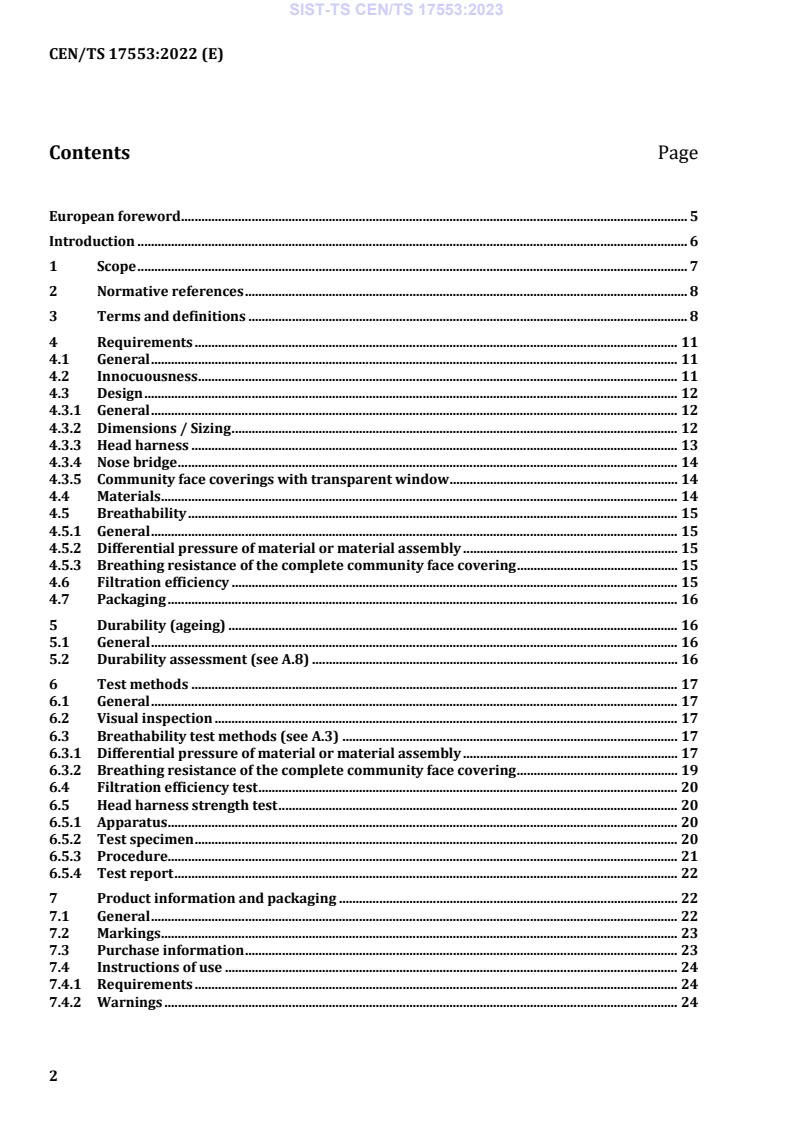
Contents Page
European foreword . 5
Introduction . 6
1 Scope . 7
2 Normative references . 8
3 Terms and definitions . 8
4 Requirements . 11
4.1 General . 11
4.2 Innocuousness . 11
4.3 Design . 12
4.3.1 General . 12
4.3.2 Dimensions / Sizing . 12
4.3.3 Head harness . 13
4.3.4 Nose bridge . 14
4.3.5 Community face coverings with transparent window . 14
4.4 Materials . 14
4.5 Breathability . 15
4.5.1 General . 15
4.5.2 Differential pressure of material or material assembly . 15
4.5.3 Breathing resistance of the complete community face covering . 15
4.6 Filtration efficiency . 15
4.7 Packaging . 16
5 Durability (ageing) . 16
5.1 General . 16
5.2 Durability assessment (see A.8) . 16
6 Test methods . 17
6.1 General . 17
6.2 Visual inspection . 17
6.3 Breathability test methods (see A.3) . 17
6.3.1 Differential pressure of material or material assembly . 17
6.3.2 Breathing resistance of the complete community face covering . 19
6.4 Filtration efficiency test . 20
6.5 Head harness strength test . 20
6.5.1 Apparatus . 20
6.5.2 Test specimen . 20
6.5.3 Procedure. 21
6.5.4 Test report . 22
7 Product information and packaging . 22
7.1 General . 22
7.2 Markings . 23
7.3 Purchase information . 23
7.4 Instructions of use . 24
7.4.1 Requirements . 24
7.4.2 Warnings . 24
Annex A (informative) Rationale . 26
A.1 Age limitation . 26
A.2 Valves and nose and mouth shields . 26
A.3 Breathability. 26
A.4 Test aerosol . 26
A.5 Filtration efficiency . 27
A.6 Community face coverings with transparent window . 28
A.7 Head harness . 28
A.8 Durability (see 5.2) . 28
A.9 Environmental impact (see 4.1, 4.4) . 28
A.10 Biocides . 29
A.11 Cleaning (see 4.1) . 29
A.12 Do It Yourself (DIY) . 30
Annex B (normative) Test method for the determination of the filtration efficiency as a
function of the particle size . 31
B.1 General . 31
B.2 Principle . 31
B.3 Aerosol . 31
B.4 Apparatus . 31
B.4.1 General . 31
B.4.2 Aerosol generator . 32
B.4.3 Balancing upstream and downstream . 32
B.4.4 Aerosol spectrometer (see A.5) . 32
B.5 Validation of the test rig (qualification testing) . 34
B.6 Preparation of the test specimens . 34
B.7 Conditioning and testing atmosphere . 35
B.7.1 Condition of the test specimens. 35
B.7.2 Testing atmosphere . 35
B.8 Procedure . 35
B.9 Calculation and expression of the results . 36
B.10 Uncertainty of measurement . 36
B.11 Test report . 36
Annex C (normative) Special national conditions . 37
Annex D (informative) Anthropometric data . 38
D.1 Facial measurements . 38
D.2 Human test panels for facial features - Examples . 40
D.2.1 From a French survey. 40
D.2.2 From Dutch surveys (online database). 42
Annex E (informative) Design considerations . 43
E.1 General . 43
E.2 Design considerations for diverse wearers . 44
Annex F (informative) Practical performance assessment for checking the ergonomic
features of community face coverings . 46
F.1 General . 46
F.2 Practical performance testing procedures . 46
F.3 Parameters for practical testing for community face coverings . 47
F.3.1 Free from harmful features . 47
F.3.2 Community face coverings, putting on, taking off and fit . 47
F.3.3 Operation of closures, adjustment and restraint systems . 47
F.3.4 Coverage of the area intended to be covered, coverage maintained during
movements . 47
F.3.5 Freedom of movement . 48
F.4 Reasons for concluding if a product is unacceptable . 48
Annex G (informative) Topics for further investigations . 49
G.1 Microorganisms . 49
G.2 Cleaning . 49
G.3 Sizing . 49
G.4 Breathability . 49
G.5 Filtration efficiency . 49
Bibliography . 50
European foreword
This document (CEN/TS 17553:2022) has been prepared by Technical Committee CEN/TC 248 “Textiles
and textile products”, the secretariat of which is held by BSI.
Attention is drawn to the possibility that some of the elements of this document may be the subject of
patent rights. CEN shall not be held responsible for identifying any or all such patent rights.
This document supersedes CWA 17553:2020.
Any feedback and questions on this document should be directed to the users’ national standards body.
A complete listing of these bodies can be found on the CEN website.
According to the CEN/CENELEC Internal Regulations, the national standards organisations of the
following countries are bound to announce this Technical Specification: Austria, Belgium, Bulgaria,
Croatia, Cyprus, Czech Republic, Denmark, Estonia, Finland, France, Germany, Greece, Hungary, Iceland,
Ireland, Italy, Latvia, Lithuania, Luxembourg, Malta, Netherlands, Norway, Poland, Portugal, Republic of
North Macedonia, Romania, Serbia, Slovakia, Slovenia, Spain, Sweden, Switzerland, Türkiye and the
United Kingdom.
Introduction
The use of community face coverings was acknowledged during the SARS-CoV-2 pandemic as part of a
comprehensive strategy of measures. They are intended for use by people in areas of known or suspected
community or cluster transmission of respiratory infection. Typically, the general public wear community
face coverings in indoor (for example, shops, shared workplaces, schools, transport, etc.) and outdoor
settings where physical distancing can be impractical. Further guidance on where the general public may
be encouraged to use community face coverings, is given by national or local health authorities and
[1]
through World Health Organization recommendation .
Community face coverings are not suitable for children up to 4 years of age. It is recommended that
children between 4 and 12 years of age are supervised while wearing the community face covering.
NOTE 1 The minimum age criteria can be higher if required by national legal provisions or as advised by national
health professionals.
The wearing of a community face covering, schematically shown in Figure 1, reduces the
projection of the wearer's respiratory droplets of saliva, sputum or respiratory secretions when
talking, coughing or sneezing. A community face covering might also reduce penetration of the
respiratory droplets from an external source to a wearer’s nose and mouth, without claiming
protection for the wearer. It might also reduce how often a wearer touches his/her face with the
hands.
Figure 1 — Limitation of the respiratory droplets projection to the environment
This document specifies the functional and performance levels for community face coverings together
with information for use, marking, labelling and packaging. The appropriate test methods are also
defined.
IMPORTANT — Community face coverings are not subject to a mandatory conformity assessment
by notified bodies or laboratories. Their design in accordance with accepted best practices and
production quality control remain the producer's responsibility. The producer may need to call
upon a laboratory to verify the required performance.
IMPORTANT — The community face coverings specified in this document are not medical devices
(MD) within the meaning of Regulation EU/2017/745, nor are they personal protective
equipment (PPE) within the meaning of Regulation EU/2016/425.
The informative Annex G lists topics of further investigation which might lead to necessary improvement
of the safety requirements of the community face coverings.
1 Scope
This document specifies the minimum requirements for reusable or single use community face coverings
intended for the general public, covering the nose, mouth and chin (for minimum coverage area, see
Figure 2) in order to reduce the risk of droplet/aerosol projection towards nearby people. These
requirements include:
— innocuousness,
— design (including fit),
— performance,
— test methods,
— marking,
— packaging,
— information for use.
Figure 2 — Community face coverings minimum coverage area (dark area)
These requirements are applicable to:
— community face coverings made of one or multiple fabric layers (including woven, knitted,
nonwoven), and including community face coverings with a removable filter in between the layers;
— community face coverings including a transparent window which allows for the wearer's mouth and
facial expressions to be seen, in order to facilitate full facial recognition, lip reading and/or sign
language alongside other methods of communication (see A.6);
— structured community face coverings including moulded plastic shells and rigid face coverings'
components.
This document is not intended for community face coverings for children up to 4 years of age (it means
until 3 years and 11 months) (see A.1).
This document is not intended for medical face masks (medical devices specified in EN 14683), nor for
filtering masks to protect against particles (personal protective equipment specified in EN 149).
This document excludes impermeable nose and mouth shields (including visors) and face coverings
incorporating inhalation and/or exhalation valve(s) (see A.2).
2 Normative references
The following documents are referred to in the text in such a way that some or all of their content
constitutes requirements of this document. For dated references, only the edition cited applies. For
undated references, the latest edition of the referenced document (including any amendments) applies.
EN 13274-3:2001, Respiratory protective devices - Methods of test - Part 3: Determination of breathing
resistance
EN 14683:2019+AC:2019, Medical face masks - Requirements and test methods
EN ISO 6330, Textiles - Domestic washing and drying procedures for textile testing (ISO 6330)
EN ISO 7500-1, Metallic materials - Calibration and verification of static uniaxial testing machines - Part 1:
Tension/compression testing machines - Calibration and verification of the force-measuring system
(ISO 7500-1)
EN ISO 9237:1995, Textiles - Determination of permeability of fabrics to air (ISO 9237:1995)
EN ISO 16890-2:2016, Air filters for general ventilation - Part 2: Measurement of fractional efficiency and
air flow resistance (ISO 16890-2:2016)
ISO 21501-1, Determination of particle size distribution — Single particle light interaction methods — Part
1: Light scattering aerosol spectrometer
ISO 21501-4, Determination of particle size distribution — Single particle light interaction methods — Part
4: Light scattering airborne particle counter for clean spaces
3 Terms and definitions
For the purposes of this document, the following terms and definitions apply.
ISO and IEC maintain terminological databases for use in standardization at the following addresses:
— ISO Online browsing platform: available at https://www.iso.org/obp
— IEC Electropedia: available at https://www.electropedia.org/
3.1
aerosol
suspension of solid, liquid, or solid and liquid particles in a gaseous medium, having a negligible falling
velocity
[SOURCE: EN 16972:2020, 3.6 without “(3.170)” and “(generally considered to be less than 0,25 m/s)”]
3.2
air permeability
volume of air per unit surface area (square metre or m ) and unit time (second or s) passing
perpendicularly through a fabric under the specified test conditions (surface area, pressure loss and
duration)
3.3
breathing resistance
resistance of community face coverings to the flow of inhaled air (inhalation resistance) or exhaled air
(exhalation resistance)
3.4
cleaning cycle
full processing cycle (washing and drying) of the product
3.5
community face covering
facepiece covering at least the mouth, nose and chin, with or without a head harness which can fastened
behind the head, looped behind the ears or other means of being retained in position
Note 1 to entry: The expression “community face covering” is used to differentiate from the term “mask”,
commonly used for personal protective equipment (PPE) or medical devices (MD).
3.6
droplet
very small drop of liquid
Note 1 to entry: A small drop, such as a particle of moisture discharged from the mouth during coughing,
sneezing, or speaking.
Note 2 to entry: These can transmit pathogens, resulting in infection, by dispersion into the air.
[SOURCE: ISO 15190:2020, 3.10]
3.7
exhaled air
air exhaled by the wearer
3.8
exhalation valve
non-return valve which allows the escape of (unfiltered) exhaled air from the facepiece
3.9
inhaled air
air inhaled by the wearer
3.10
inhalation valve
non-return valve which allows air to enter the facepiece and prevents exhaled air from leaving via the
inhalation path
3.11
material
component of community face coverings forming the barrier
3.12
material assembly
combination of all materials making up the community face covering presented exactly as the finished
community face covering construction
3.13
nose bridge
device of the community face covering to enhance fit by conforming to the contours of the nose
3.14
particle
solid or liquid substance in the finely divided state
[SOURCE: EN 16972:2020, 3.170]
3.15
particle size
diameter of a sphere that produces a response, by a given particle-sizing instrument, that is equivalent to
the response produced by the particle being measured
Note 1 to entry: For discrete-particle light-scattering instruments, the equivalent optical diameter is used.
[SOURCE: ISO 14644-1:2015, 3.2.2]
3.16
producer
— the manufacturer of the product, when he is established in the European Union, and any other person
presenting himself as the manufacturer by affixing to the product their name, trade mark or other
distinctive mark, or the person who reconditions the product;
— the manufacturer's representative, when the manufacturer is not established in the European Union
or, if there is no representative established in the European Union, the importer of the product;
— other professionals in the supply chain, insofar as their activities may affect the safety properties of a
product
[2]
[SOURCE: General Product Safety Directive 2001/95/EC ]
3.17
reusable
designed by the producer as suitable for re-use after maintenance
3.18
single use
product intended to be used once and then discarded
3.19
head harness
means of holding a face covering in place on the head
3.20
innocuousness
quality of a product causing no chemical, physical, mechanical harm to the wearer
3.21
essential articles worn on the head
medical devices and implants to improve hearing, sight, or for reduction head/skull damage
EXAMPLE Hearing aids, cochlear implants, spectacles/glasses, protective cap.
4 Requirements
4.1 General
The community face coverings are intended to be reusable or single use.
For the single use community face coverings, it is recommended to use material known to be recyclable
or compostable to reduce the environmental impact (see A.9).
Community face coverings shall meet the following requirements as received and, when reusable, after
durability assessment (Clause 5).
There shall be no visible defects when tested according to 6.2. Examples of defects include tears or
deformation of components. If any damage to the community face coverings is detected, they are deemed
non-compliant.
The community face coverings, specified as reusable, shall withstand at least five cleaning cycles (or
cleaning procedures) or the higher number of cleaning cycles (or cleaning procedures) claimed by the
producer (see Clause 5) at the claimed cleaning conditions.
For machine washable community face coverings, the claimed cleaning conditions of reusable community
face coverings shall include (see A.11):
— The minimum washing temperature of 40 °C with the use of consumer laundry detergent;
— The minimum washing temperature of 60 °C if the use of consumer laundry detergent is not
instructed;
NOTE Health agencies in some countries recommend a minimum washing temperature of 60 °C.
— The duration of washing machine cycle of a minimum of 30 min (normal settings – not the economic
settings)
— The prohibition of the dry cleaning (see A.11).
For non-machine washable community face covering, the claimed cleaning conditions of reusable
community face coverings shall include a disinfection process based on hand washing with
soap/detergent at room temperature water, followed by soaking in a bleach solution, containing 0,1 %
active chlorine, for one minute then thoroughly by rinsing with room temperature water (in order to
avoid any toxic residue of chlorine).
If provisions of certain countries differ from the requirements of this document, they are listed in
Annex C.
Design consideration can be found in Annex E.
4.2 Innocuousness
The community face coverings shall not adversely affect the health or hygiene of the wearer. The
materials shall not, in the foreseeable conditions of normal use, release substances known to be toxic,
carcinogenic, genotoxic (mutagenic), sensitizing (allergenic), toxic to reproduction or irritating to skin,
eyes, or respiratory tract or identified as endocrine disrupting.
Particular attention shall be paid to the presence of plasticisers, unreacted components, heavy metals,
impurities and the chemical identity of pigments, dyes, perfluorinated compounds (PFAS) and biocides.
In case of use of biocides, particular attention should be given to ensuring that the active substances have
been assessed for their oral toxicity and inhalation toxicity as these community face coverings are used
in close proximity to the mouth and nose (see A.10).
[2]
NOTE The safety or health of the user (wearer) is mentioned in the EU General Product Safety Directive ,
[3] [4] [5]
the REACH Regulation , the POP Regulation and the Biocide Regulation .
If the determination of harmful substances has not been reported on the components of a community
face covering, the determination can be carried out on community face coverings as received (it means
without applying the durability assessment as described in 5.2).
Cleaning products shall not present any health risk, for example, by leaving behind hazardous substances
at the end of the process. For this reason, it is recommended to use consumer laundry detergent (see
A.11). Use of laundry fabric softener is not recommended (see A.11).
The community face coverings shall be designed to ensure that the non-textile components and welds
shall not have sharp edges, roughness or projections which are likely to cause injury to the wearer. The
use of staples for connecting parts is not permitted. Verification of the fulfilment of this requirement shall
be made by manual and visual inspection (6.2).
4.3 Design
4.3.1 General
The community face coverings shall have a means of attachment for around either the head or ears that
ensures the community face covering remains in the correct position during use - when breathing, talking,
nodding, etc. (see also F.3.5).
It shall be able to be fixed and maintained over the nose (for example with a nose bridge or other design
feature), cheeks and chin of the wearer in order to ensure that the inhaled and exhaled air passes through
the materials of the community face covering, when the wearer’s skin is dry or damp or when the wearer
moves their head.
The construction of the community face covering shall not be pierced or perforated (for example to ease
the breathing) or valves through which the air can move in and out of the community face covering freely
(see A.2).
When designing community face coverings, care should be taken to consider compatibility with essential
articles worn on the head of the wearer (see A.7) – for example, with head harness (see also E.2).
Verification of the fulfilment of this requirement shall be made by manual and visual inspection (6.2).
4.3.2 Dimensions / Sizing
Community face coverings should be made available in appropriate sizes taking into account the variation
of the morphology of the intended wearers.
Community face coverings shall have minimum dimensions in order to always cover the critical nose /
mouth / chin zone.
Critical facial measurements, as defined in Table 1, are considered for sizing for both adults and children.
Other facial measurements and head size dimension ranges in Annex D are provided as guidance. The
dimensions provided are anthropometric data. Actual face coverings might need to be larger to ensure
that the community face covering when worn covers the nose, mouth and chin while breathing, talking
nodding, etc.
Table 1 — Description, definition, and diagrams of selected landmarks
(Extract from ISO/TS 16976-2:2015)
Description Definition Diagram
Maximum horizontal breadth of the face as
a
measured with a spreading calliper between the
Face width
zygomatic arches. The subject sits looking straight
(Bizygomatic
ahead and with teeth together (lightly occluded).
breadth)
Only enough pressure is exerted to ensure that the
calliper tips are on the zygomatic arches.
The distance in the midsagittal plane between the
menton landmark at the bottom of the chin and the
sellion landmark at the deepest point of the nasal
Face length root depression is measured with a sliding
a
(menton-sellion calliper . The subject sits looking straight ahead
length) and with teeth together (lightly occluded). The
fixed blade of the calliper is placed on the sellion.
Only enough pressure is exerted to obtain contact
between the calliper and the skin is exerted.
a
A calliper is not commonly used by garment makers. A measuring tape is commonly used as an alternative
device.
4.3.3 Head harness
Where provided, the head harness shall be designed such that the community face coverings can be easily
put on, used and removed.
It shall be sufficiently robust to hold the community face coverings in place in such a way as to avoid
excessive tightness and discomfort when worn. The head harness can go around the wearer’s head or
ears.
The head harness should be adjustable in order to ensure a close fit to minimize the leak at the face. It
can be self-adjusting or made up of laces, and can be made using an elastic strip or a fabric tie such as bias
tape or other fabric, attached to the material. It can be sewn or welded. Other attachment methods are
permitted.
Ear loops are the preferred options for head harnesses on children’s community face coverings in order
to reduce the risk of strangulation (see A.7). Where ear loops are provided with adjusting devices, the
cord shall pass through the toggle(s) such that they are captive. However, for certain children, who, for
example have essential articles worn on the head, alternative head harness styles might be necessary (see
A.7).
Verification of the fulfilment of these requirements shall be made by visual inspection (6.2).
When the head harness is locally attached to the main body of the community face covering (Figure 3 and
Figure 4), the attachment strength for the community face covering head harness shall withstand a load
of 50 N for reusable community face coverings (see A.7) and 10 N for single use community face
coverings, when testing is carried out in accordance with 6.5. Figure 5 shows examples of head harness
attachments, made of continuous cords (in red) which are not to be tested, unless any loop has a joint as
in Figure 4.
Figure 3 — Examples of head harness with local attachment (to be tested at indicated points)
Figure 4 — Examples of head harness with joint in loop (circled joint be tested)
Figure 5 — Examples of head harness sewn along main body (top/bottom or sides – in red) or
passes within a channel
4.3.4 Nose bridge
If a nose bridge is provided, it is recommended that it is a minimum of 8 cm long for adults and a minimum
of 5 cm long for children.
4.3.5 Community face coverings with transparent window
Whatever the combination of both the impermeable to air material (transparent window) and the air
permeable material, the community face coverings with transparent window shall be designed in order
to meet the breathability (4.5) and filtration efficiency (4.6) requirements. The community face coverings
with transparent window shall be tested as a complete item for breathing resistance (4.5.3) and filtration
efficiency (Annex B).
4.4 Materials
The materials used for manufacturing the community face coverings shall be able to withstand handling
and wear throughout the lifetime of community face coverings as claimed by the producer.
The producer shall take into account the following when selecting materials:
— breathability;
— filtration efficiency;
— innocuousness;
— For reusable community face coverings, the materials used shall withstand the care cycles (for
example dimensional stability, which may cause fit or function issues), laundry detergents and
methods specified by the producer.
NOTE Different markets can require the use of different minimum temperatures.
— Where community face coverings include a transparent window, minimization of condensation on
the transparent window shall be considered.
In addition, the producer should consider the comfort of the wearer when selecting materials.
When selecting materials, environmental aspects should be taken into account in relation to the circular
economy (sustainability) alongside their intended lifespan, such as reuse/recycling/waste, for example:
number of washes of the face covering, disposing of face coverings that are contaminated, effects on
biodiversity and the use of compostable/biodegradable materials (see A9).
4.5 Breathability
4.5.1 General
Community face coverings shall meet the requirements of either 4.5.2 or 4.5.3.
Community face coverings in which it is possible to test a flat and uniform construction surface
(approximately 90 % of the area) shall meet the requirements of 4.5.2.
Other community face coverings, including rigid community face coverings containing non-textile
materials such as plastic (transparent window) or three-dimensional face coverings shall meet the
requirements of 4.5.3.
4.5.2 Differential pressure of material or material assembly
When the material or material assembly of the community face covering is tested according to 6.3.1, the
differential pressure of the material shall be less than or equal to 300 Pa (see A.3).
NOTE World Health Organization (WHO) recommends a preferred differential pressure of 40 Pa/cm for
adults and of 20 Pa/cm for children/paediatrics (i.e. 200 Pa and 100 Pa, respectively, if tested according to 6.3.1).
4.5.3 Breathing resistance of the complete community face covering
When the complete community face covering is tested according to 6.3.2, the static breathing resistance
shall not exceed the following limit:
— Inhalation resistance of 240 Pa (2,4 mbar).
NOTE The breathing resistance has been found suitable, for example, for community face coverings produced
from moulded plastic shell, rigid face coverings, community face coverings with transparent window.
The measurement of breathing resistance is recommended when the material of the community face
coverings cannot be tested flat.
4.6 Filtration efficiency
When the material or material assembly of the community face covering, or complete community face
covering, is tested according to 6.4, the filtration efficiency to particles at (nominal size) 3 µm shall be
greater than or equal to 70 % (see A.4).
NOTE Some countries can have national regulations or requirements that indicate what level of filtration
efficiency is suitable for the intended use of the community face covering (see Annex C).
Optionally, if it is desired to characterize the filtration efficiency using different sizes of particles (for
example at 1 µm), the test method, as described in Annex B, is applied by selecting the appropriate
aerosol particle sizes.
4.7 Packaging
Community face coverings should be packaged in such a way as to protect them against any
con
...