

EN 13274-3:2001
(Main)Respiratory protective devices - Methods of test - Part 3: Determination of breathing resistance
- Abstract
This European Standard specifies the general procedure for measurement of breathing resistance of filters for respiratory protective devices and respiratory protective devices incorporating facepieces, except for diving for respiratory protective devices. The requirements and any special conditions for the apparatus, and of filter measurements are described in the relevant device standard.
- Status
- Published
- Publication Date
- 18-Sep-2001
- Technical Committee
- CEN/TC 79 - Respiratory protective devices
- Drafting Committee
- CEN/TC 79/WG 9 - Test methods and interpretation of CEN/TC 79 standards
- Current Stage
- 9093 - Decision to confirm - Review Enquiry
- Start Date
- 03-Dec-2022
- Completion Date
- 07-Oct-2026
89/686/EEC - Personal protective equipment (PPE)OJ Ref: C 190, C 2, C 203, C 247, C 306, C 46, C 91 OJ Date: 10-Aug-2002

Overview
EN 13274-3:2001 (CEN) defines test methods for the determination of breathing resistance of filters and complete respiratory protective devices (facepieces), excluding diving equipment. It provides standardized procedures, equipment requirements and reporting conventions so manufacturers and test laboratories can measure inhalation resistance, exhalation resistance, and overall breathing resistance reproducibly and comparably.
Key topics and technical requirements
- Scope: Applies to filters for respiratory protective devices and devices incorporating facepieces (except diving). Device-specific limits or special conditions are given in the relevant device standard.
- Pre-requisites: Relevant device standard must specify specimen count, pre‑conditioning, mounting, flow rates, repeat tests, facepiece sizes, orientations and pass/fail criteria.
- Ambient conditions: Tests performed with flows corrected to 23 °C and 1 bar absolute; ambient test temperature nominally 16 °C–32 °C (±1 °C tolerance).
- Methods
- Method 1 – Static breathing resistance: Constant flow through a mounted device or filter. Two ways to flow filters: a chamber (push) or drawing through the filter (suck). Filter resistance is reported as PF − PH (filter pressure drop minus holder/set‑up pressure drop).
- Method 2 – Dynamic breathing resistance: Sinusoidal breathing using a breathing machine to simulate real inhalation/exhalation; peak pressures recorded.
- Equipment:
- Calibrated pressure gauge (sensitivity better than 10% of the limit value); for dynamic tests the gauge and recorder response time shall be <30 ms (10%→90%).
- Calibrated flowmeter(s) and regulated blower/suction or breathing machine.
- Support fixtures (e.g., Sheffield dummy head/torso, filter holder) and fittings per the device standard.
- Orientation and fitting: Exhalation resistance measured in five orientations (upright, up, down, left side, right side); hoods that seal at the neck use the normative fitting procedure in Annex A.
- Reporting convention: Negative pressure inside facepiece (relative to ambient) is reported without a sign; positive pressure is prefixed with “+”.
- Uncertainty: Annex B addresses measurement uncertainty and reporting of results.
Applications and who uses it
- Manufacturers of filters and respirators use EN 13274-3 to validate product breathing resistance and demonstrate compliance with device-specific standards.
- Independent test laboratories and certification bodies use the standard for type testing and performance verification.
- PPE engineers, procurement officers and safety managers use results to compare products and ensure end-user comfort and safety (breathability).
- Regulators reference this standard in conformity assessments and when aligning with EU directives.
Related standards
- EN 132 (Respiratory protective devices – Definitions) and other parts of EN 13274 series (e.g., Part 1 inward leakage, Part 7 aerosol penetration) provide complementary test methods and requirements.
Relations
- Effective Date
- 28-Jan-2026
- Effective Date
- 28-Jan-2026
- Effective Date
- 28-Jan-2026
- Effective Date
- 28-Jan-2026
- Effective Date
- 28-Jan-2026
- Effective Date
- 28-Jan-2026
- Effective Date
- 28-Jan-2026
- Effective Date
- 28-Jan-2026
- Effective Date
- 28-Jan-2026
- Effective Date
- 28-Jan-2026
- Effective Date
- 28-Jan-2026
- Effective Date
- 28-Jan-2026
- Referred By
EN 143:2021 - Respiratory protective devices - Particle filters - Requirements, testing, marking - Effective Date
- 28-Jan-2026
- Effective Date
- 28-Jan-2026
- Effective Date
- 28-Jan-2026
Get Certified
Connect with accredited certification bodies for this standard

CIS Institut d.o.o.
Personal Protective Equipment (PPE) certification body. Notified Body NB-2890 for EU Regulation 2016/425 PPE.

Kiwa BDA Testing
Building and construction product certification.
Kmetijski inštitut Slovenije
Agricultural Institute of Slovenia. Soil testing, plant health, agricultural product analysis.
Sponsored listings
Frequently Asked Questions
EN 13274-3:2001 is a standard published by the European Committee for Standardization (CEN). Its full title is "Respiratory protective devices - Methods of test - Part 3: Determination of breathing resistance". This standard covers: This European Standard specifies the general procedure for measurement of breathing resistance of filters for respiratory protective devices and respiratory protective devices incorporating facepieces, except for diving for respiratory protective devices. The requirements and any special conditions for the apparatus, and of filter measurements are described in the relevant device standard.
This European Standard specifies the general procedure for measurement of breathing resistance of filters for respiratory protective devices and respiratory protective devices incorporating facepieces, except for diving for respiratory protective devices. The requirements and any special conditions for the apparatus, and of filter measurements are described in the relevant device standard.
EN 13274-3:2001 is classified under the following ICS (International Classification for Standards) categories: 13.340.30 - Respiratory protective devices. The ICS classification helps identify the subject area and facilitates finding related standards.
EN 13274-3:2001 has the following relationships with other standards: It is inter standard links to EN ISO 16972:2020, EN 14593-1:2005, EN 137:2006, EN 14594:2005, EN 1073-1:2016+A1:2018, EN 14593-2:2005, EN 13794:2002, EN 14387:2021, EN 402:2003, CEN/TS 17553:2022, EN 14594:2018, EN 14435:2004, EN 143:2021, EN 14529:2005, EN 14387:2004+A1:2008. Understanding these relationships helps ensure you are using the most current and applicable version of the standard.
EN 13274-3:2001 is associated with the following European legislation: EU Directives/Regulations: 2016/425, 89/686/EEC; Standardization Mandates: M/031. When a standard is cited in the Official Journal of the European Union, products manufactured in conformity with it benefit from a presumption of conformity with the essential requirements of the corresponding EU directive or regulation.
EN 13274-3:2001 is available in PDF format for immediate download after purchase. The document can be added to your cart and obtained through the secure checkout process. Digital delivery ensures instant access to the complete standard document.
Standards Content (Sample)
2003-01.Slovenski inštitut za standardizacijo. Razmnoževanje celote ali delov tega standarda ni dovoljeno.Respiratory protective devices - Methods of test - Part 3: Determination of breathing resistanceOprema za varovanje dihal – Metode preskušanja – 3. del: Ugotavljanje dihalne upornostiAppareils de protection respiratoire - Méthodes d'essai - Partie 3: Détermination de la résistance respiratoireAtemschutzgeräte - Prüfverfahren - Teil 3: Bestimmung des Atemwiderstandes13.340.30Varovalne dihalne napraveRespiratory protective devicesICS:SIST EN 13274-3:2002enTa slovenski standard je istoveten z:EN 13274-3:200101-junij-2002SIST EN 13274-3:2002SLOVENSKI
STANDARD
EUROPEAN STANDARDNORME EUROPÉENNEEUROPÄISCHE NORMEN 13274-3September 2001ICS 13.340.30English versionRespiratory protective devices - Methods of test - Part 3:Determination of breathing resistanceAppareils de protection respiratoire - Méthodes d'essai -Partie 3: Détermination de la résistance respiratoireAtemschutzgeräte - Prüfverfahren - Teil 3: Bestimmung desAtemwiderstandesThis European Standard was approved by CEN on 17 August 2001.CEN members are bound to comply with the CEN/CENELEC Internal Regulations which stipulate the conditions for giving this EuropeanStandard the status of a national standard without any alteration. Up-to-date lists and bibliographical references concerning such nationalstandards may be obtained on application to the Management Centre or to any CEN member.This European Standard exists in three official versions (English, French, German). A version in any other language made by translationunder the responsibility of a CEN member into its own language and notified to the Management Centre has the same status as the officialversions.CEN members are the national standards bodies of Austria, Belgium, Czech Republic, Denmark, Finland, France, Germany, Greece,Iceland, Ireland, Italy, Luxembourg, Netherlands, Norway, Portugal, Spain, Sweden, Switzerland and United Kingdom.EUROPEAN COMMITTEE FOR STANDARDIZATIONCOMITÉ EUROPÉEN DE NORMALISATIONEUROPÄISCHES KOMITEE FÜR NORMUNGManagement Centre: rue de Stassart, 36
B-1050 Brussels© 2001 CENAll rights of exploitation in any form and by any means reservedworldwide for CEN national Members.Ref. No. EN 13274-3:2001 E
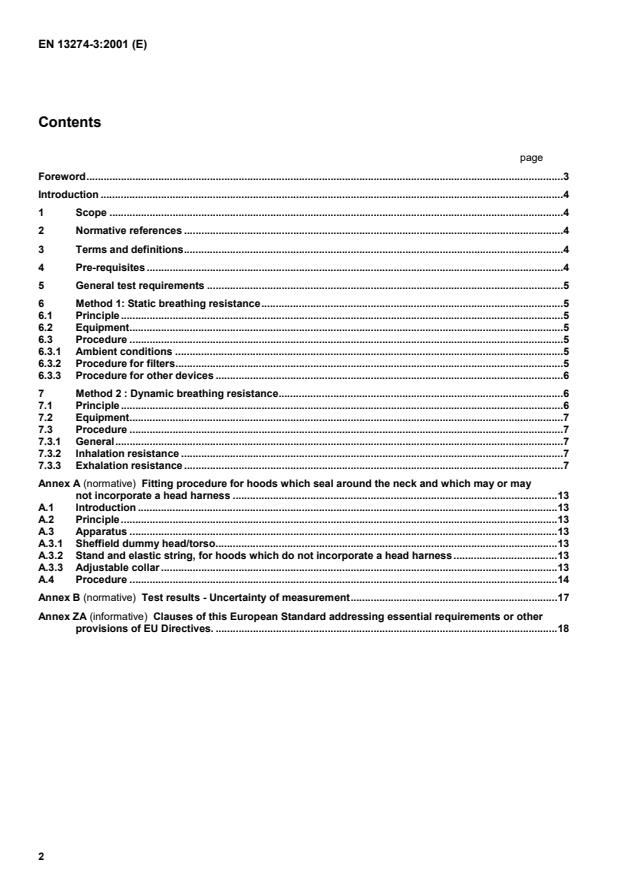
Fitting procedure for hoods which seal around the neck and which may or maynot incorporate a head harness.13A.1Introduction.13A.2Principle.13A.3Apparatus.13A.3.1Sheffield dummy head/torso.13A.3.2Stand and elastic string, for hoods which do not incorporate a head harness.13A.3.3Adjustable collar.13A.4Procedure.14Annex B (normative)
Test results - Uncertainty of measurement.17Annex ZA (informative)
Clauses of this European Standard addressing essential requirements or otherprovisions of EU Directives.18
pre-conditioning;
The convention of reporting breathing resistance is that if during the inhalation resistance test, the pressure inside thefacepiece relative to atmosphere is negative, no sign is used in front of the result. If the relative pressure inside the facepiece ispositive, the result is prefixed with a ‘+’.6.2 Equipment6.2.1Pressure gauge, calibrated in the appropriate range and with a sensitivity better than 10% of the limit valueof breathing resistance specified in the relevant device standard.6.2.2Flowmeter(s) calibrated in the appropriate range.6.2.3Regulated blower/compressed air source or a variable suction device.6.2.4Support for the device (e.g. filter holder, Sheffield dummy head with insert or torso with insert) as describedin the relevant device standard.6.3 Procedure6.3.1 Ambient conditionsIf ambient conditions differ from 23 °C and 1 bar absolute, all flow rates shall be adjusted so that they give thecorrect flow rate when corrected to 23 °C and 1 bar absolute.6.3.2 Procedure for filtersTwo methods of passing air through the filter are possible and typical examples are shown in Figures 1a) and 1b).The first method employs a chamber in which the filter holding device is fixed (see Figure 1a)). Air is directed into
...