

EN 16603-35-01:2014
(Main)Space engineering - Liquid and electric propulsion for spacecraft
- Abstract
This Standard defines the regulatory aspects applicable to elements and processes for liquid, including cold gas, and electrical propulsion for spacecraft. It specifies the activities to be performed in the engineering of such propulsion systems, their applicability, and defines the requirements for the engineering aspects: functional, interfaces, environmental, design, quality factors, operational and verification.
General requirements applying to all type of Propulsion Systems Engineering are defined in ECSS-E-ST-35.
This standard may be tailored for the specific characteristics and constraints of a space project in conformance with ECSS-S-ST-00.
- Status
- Published
- Publication Date
- 09-Sep-2014
- Withdrawal Date
- 30-Mar-2015
- Technical Committee
- CEN/CLC/TC 5 - Space
- Drafting Committee
- CEN/CLC/TC 5 - Space
- Current Stage
- 9060 - Closure of 2 Year Review Enquiry - Review Enquiry
- Start Date
- 03-Mar-2020
- Completion Date
- 03-Mar-2020

Overview
EN 16603-35-01:2014 - Space engineering: Liquid and electric propulsion for spacecraft is a CEN-adopted standard that defines regulatory and engineering requirements for liquid (including cold gas) and electric propulsion systems. Derived from ECSS-E-ST-35-01, it specifies the engineering activities, applicability and requirements covering functional definition, interfaces, environmental constraints, design, quality factors, operations and verification for spacecraft propulsion subsystems.
Key topics and technical requirements
- Scope and applicability
- Covers liquid propulsion (monopropellant/bipropellant and cold gas) and electric propulsion systems used for orbit transfer, station‑keeping, attitude control, rendezvous and docking.
- May be tailored per project in conformance with ECSS‑S‑ST‑00.
- Functional and interface requirements
- Mission-driven requirements for ground, pre‑launch and in‑orbit operations.
- Detailed spacecraft and power‑bus interface definitions for electric propulsion.
- Environmental and mechanical constraints
- Acceleration loads, induced and environmental temperatures, thermal fluxes and thruster plume effects are addressed.
- Requirements for pressure vessels, propellant tanks and blow‑down management.
- Design and components
- Selection, sizing and design development guidance for thrusters, valves, filters, pressure vessels, propellant management assemblies and thrust‑vector control.
- Special considerations for contamination, draining, pyrotechnic devices and risk of explosion.
- Electrical and EMC (electric propulsion)
- High‑frequency current loop management, electromagnetic compatibility and spacecraft charging considerations.
- Power supply, control and processing subsystem design guidance.
- Verification and validation
- Verification by analysis, by test (including environmental and functional tests) and data exchange requirements for modelling.
- Quality, production and operations
- Reliability, production/manufacturing best practices, ground support equipment (GSE) and operational/disposal guidance.
Practical applications and who uses it
- Intended for propulsion system engineers, spacecraft systems engineers, test engineers, QA/product assurance teams, procurement specialists and project managers working on satellite and spacecraft missions in Europe and organizations adopting ECSS/CEN standards.
- Used to:
- Define procurement specifications and interface control documents for propulsion subsystems.
- Guide design reviews, safety assessments and verification plans.
- Ensure compliance with project tailoring of ECSS requirements for flight hardware, GSE and ground operations.
Related standards
- ECSS-E-ST-35 (Propulsion - general requirements)
- ECSS-E-ST-35-01 (origin of this document)
- ECSS-S-ST-00 (system tailoring and glossary)
- ECSS-E-ST-10, -20, -31, -32 and ECSS-Q-ST-30 (system engineering, electrical/electronic, thermal, structural, dependability)
Using EN 16603-35-01:2014 helps teams align propulsion system engineering with established European space engineering practices for reliable, verifiable and interoperable spacecraft propulsion solutions.
Relations
- Effective Date
- 29-May-2013
- Effective Date
- 28-Jan-2026
- Effective Date
- 28-Jan-2026
- Effective Date
- 28-Jan-2026
- Effective Date
- 28-Jan-2026
- Effective Date
- 28-Jan-2026
- Effective Date
- 28-Jan-2026
- Effective Date
- 28-Jan-2026
- Effective Date
- 28-Jan-2026
Get Certified
Connect with accredited certification bodies for this standard

BUREAU VERITAS Certification Germany
Bureau Veritas certification in Germany.

Element Materials Technology
Materials testing and product certification.

AQMS Ltd.
AQMS provides ISO certification to SMEs across the UK.
Sponsored listings
Frequently Asked Questions
EN 16603-35-01:2014 is a standard published by the European Committee for Standardization (CEN). Its full title is "Space engineering - Liquid and electric propulsion for spacecraft". This standard covers: This Standard defines the regulatory aspects applicable to elements and processes for liquid, including cold gas, and electrical propulsion for spacecraft. It specifies the activities to be performed in the engineering of such propulsion systems, their applicability, and defines the requirements for the engineering aspects: functional, interfaces, environmental, design, quality factors, operational and verification. General requirements applying to all type of Propulsion Systems Engineering are defined in ECSS-E-ST-35. This standard may be tailored for the specific characteristics and constraints of a space project in conformance with ECSS-S-ST-00.
This Standard defines the regulatory aspects applicable to elements and processes for liquid, including cold gas, and electrical propulsion for spacecraft. It specifies the activities to be performed in the engineering of such propulsion systems, their applicability, and defines the requirements for the engineering aspects: functional, interfaces, environmental, design, quality factors, operational and verification. General requirements applying to all type of Propulsion Systems Engineering are defined in ECSS-E-ST-35. This standard may be tailored for the specific characteristics and constraints of a space project in conformance with ECSS-S-ST-00.
EN 16603-35-01:2014 is classified under the following ICS (International Classification for Standards) categories: 49.140 - Space systems and operations. The ICS classification helps identify the subject area and facilitates finding related standards.
EN 16603-35-01:2014 has the following relationships with other standards: It is inter standard links to EN 14607-5-1:2004, EN ISO 9241-305:2008, EN ISO 9241-304:2008, EN ISO 9241-306:2008, EN ISO 9241-300:2008, EN ISO 23125:2010, EN ISO 9241-151:2008, EN ISO 9241-307:2008, EN ISO 24502:2010. Understanding these relationships helps ensure you are using the most current and applicable version of the standard.
EN 16603-35-01:2014 is associated with the following European legislation: Standardization Mandates: M/496. When a standard is cited in the Official Journal of the European Union, products manufactured in conformity with it benefit from a presumption of conformity with the essential requirements of the corresponding EU directive or regulation.
EN 16603-35-01:2014 is available in PDF format for immediate download after purchase. The document can be added to your cart and obtained through the secure checkout process. Digital delivery ensures instant access to the complete standard document.
Standards Content (Sample)
2003-01.Slovenski inštitut za standardizacijo. Razmnoževanje celote ali delov tega standarda ni dovoljeno.Vesoljska tehnika - Pogon za vesoljska plovilaRaumfahrttechnik - Flüssige und elektrische Antriebe von RaumfahrzeugenIngénierie spatiale - Propulsion liquide et électrique pour satellitesSpace engineering - Liquid and electric propulsion for spacecraft49.140Vesoljski sistemi in operacijeSpace systems and operationsICS:Ta slovenski standard je istoveten z:EN 16603-35-01:2014SIST EN 16603-35-01:2014en,fr,de01-november-2014SIST EN 16603-35-01:2014SLOVENSKI
STANDARDSIST EN 14607-5-1:20051DGRPHãþD
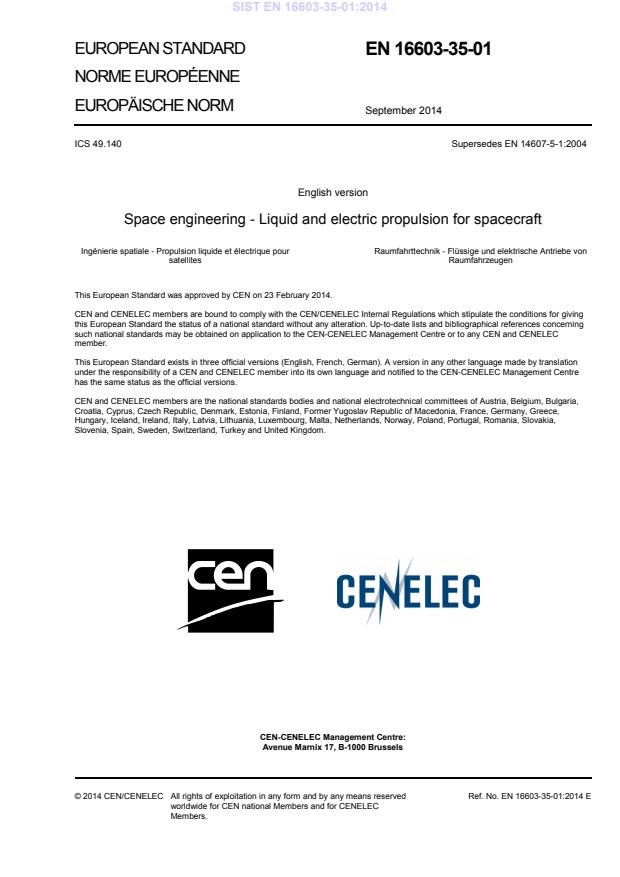
EUROPEAN STANDARD NORME EUROPÉENNE EUROPÄISCHE NORM
EN 16603-35-01
September 2014 ICS 49.140
Supersedes EN 14607-5-1:2004 English version
Space engineering - Liquid and electric propulsion for spacecraft
Ingénierie spatiale - Propulsion liquide et électrique pour satellites
Raumfahrttechnik - Flüssige und elektrische Antriebe von Raumfahrzeugen This European Standard was approved by CEN on 23 February 2014.
CEN and CENELEC members are bound to comply with the CEN/CENELEC Internal Regulations which stipulate the conditions for giving this European Standard the status of a national standard without any alteration. Up-to-date lists and bibliographical references concerning such national standards may be obtained on application to the CEN-CENELEC Management Centre or to any CEN and CENELEC member.
This European Standard exists in three official versions (English, French, German). A version in any other language made by translation under the responsibility of a CEN and CENELEC member into its own language and notified to the CEN-CENELEC Management Centre has the same status as the official versions.
CEN and CENELEC members are the national standards bodies and national electrotechnical committees of Austria, Belgium, Bulgaria, Croatia, Cyprus, Czech Republic, Denmark, Estonia, Finland, Former Yugoslav Republic of Macedonia, France, Germany, Greece, Hungary, Iceland, Ireland, Italy, Latvia, Lithuania, Luxembourg, Malta, Netherlands, Norway, Poland, Portugal, Romania, Slovakia, Slovenia, Spain, Sweden, Switzerland, Turkey and United Kingdom.
CEN-CENELEC Management Centre: Avenue Marnix 17, B-1000 Brussels © 2014 CEN/CENELEC All rights of exploitation in any form and by any means reserved worldwide for CEN national Members and for CENELEC Members. Ref. No. EN 16603-35-01:2014 E
Liquid and electric propulsion for spacecrafts ECSS-E-ST-35-02 Solid propulsion for spacecrafts and launchers ECSS-E-ST-35-03 Liquid propulsion for launchers • Standard covering particular propulsion aspects ECSS-E-ST-35-06 Cleanliness requirements for spacecraft propulsion hardware ECSS-E-ST-35-10 Compatibility testing for liquid propulsion systems
EN reference Reference in text Title EN 16601-01 ECSS-S-ST-00-01 ECSS system – Glossary of terms EN 16603-10 ECSS-E-ST-10 Space engineering – System engineering general requirements EN 16603-20 ECSS-E-ST-20 Space engineering – Electrical and electronic EN 16603-20-06 ECSS-E-ST-20-06 Space engineering – Spacecraft changing EN 16603-20-07 ECSS-E-ST-20-07 Space engineering – Electromagnetic compatibility EN 16603-31 ECSS-E-ST-31 Space engineering – Thermal control general requirements EN 16603-32 ECSS-E-ST-32 Space engineering – Structural general requirements EN 16603-35 ECSS-E-ST-35 Space engineering – Propulsion general requirements EN 16602-30 ECSS-Q-ST-30 Space product assurance – Dependability
For example: functional control, testing, propellant, simulant loading and spacecraft transportation. 2. Pre-launch and launch activities NOTE
For example: integration, storage, ageing and transport. 3. In-orbit operations. NOTE
For example: orbit transfer, orbit maintenance and attitude control) and the complete in-orbit life. SIST EN 16603-35-01:2014
For example: steady state, off-modulation, pulse mode. 2. Thrust level and orientation 3. Thrust-vector control 4. Thrust centroid time 5. Minimum impulse bit 6. Impulse reproducibility 7. Total impulse 8. Cycle life 9. Mission life 10. Reliability level 11. Thrust noise 12. Propellant gauging. c. The propulsion system shall fulfil its functions while subjected to the specified external loads during its mission, including: 1. mechanical loads; NOTE
For example: quasi-static loads, vibrations, transportation. 2. thermal loads; 3. electrical loads. 4.3 Constraints 4.3.1 Accelerations a. Limits on acceleration levels, induced or experienced by the propulsion system, shall be specified at spacecraft level. NOTE
This is in order to: • avoid perturbations, e.g. during possible observations or experiments; • protect sensitive equipments; • design adequate tank PMD. SIST EN 16603-35-01:2014
a. Elements of the spacecraft sensitive to plume effects shall be identified. b. The allowed plume effects on elements identified in clause 4.3.5a shall be specified at spacecraft level. c. The generation of perturbing torques, forces, thermal gradients, contamination and erosion of surfaces, due to plume effects, shall be defined and documented accordingly. d. The plume analysis specified in 4.3.5c shall be reported in conformance with the Plume analysis report DRD in ECSS-E-ST-35. 4.4 Interfaces a. The liquid propulsion system shall conform to its specified spacecraft interfaces, including: 1. Structure NOTE
For example: inserts, tank support structure and vibration levels. 2. Thermal NOTE
For example: conduction, radiation levels, tank, thruster and line thermal control. 3. Power NOTE
For example: valve drivers, pressure transducers, thermistors, heaters and thermocouples. 4. Electromagnetic compatibility 5. Pyrotechnics NOTE
For example: pyrotechnic valves. SIST EN 16603-35-01:2014
For example: valves, regulators, actuators and actuation system. 7. AOCS, OBDH and TM/TC. NOTE
For example: commanding, handling of data for status and health monitoring and failure detection. b. Interfaces shall be defined: 1. For ground tests and loading activities, with the propulsion GSE. 2. For safety and prelaunch operation with the launcher authorities. 4.5 Design 4.5.1 General 4.5.1.1 Architecture a. The propulsion system architecture shall apply the requirements in ECSS-Q-ST-30. b. The propulsion system architecture shall provide evidence that fail safe, redundancy, reliability and safety requirements are met. 4.5.1.2 Replacement of parts a. For replacement of parts during development, testing and mission life pre-launch activities ECSS-E-ST-35, requirements 4.5.1c, d and e. shall be applied. 4.5.1.3 Water-hammer effect a. A water-hammer effects analysis shall be performed to support the
propulsion system design and ensure proper functioning. b. The analysis specified in 4.5.1.3a shall be reported in conformance with the Propulsion transient analysis report DRD in ECSS-E-ST-35. 4.5.1.4 Piping a. A pipework design analysis shall be performed including non-consumables, cross-coupling, leakage, pressure, eigenfrequencies, water-hammer. b. The consequences in terms of operational restrictions shall be identified. 4.5.1.5 Closed volumes a. The design of the propulsion system shall prevent hazardous pressure increase in closed volumes. b. The need for any pressure relief capability shall be identified and analysed. SIST EN 16603-35-01:2014
See ECSS-E-ST-32-02. 2. Conform to the environmental aspects, including but not limited to: (a) Temperature (b) Vibration (c) Humidity (d) Corrosive environment (e) Vacuum (f) Outgassing (g) Radiation. 4.5.1.7 Multi-tanks a. If a multi-tank layout is used, inadvertent propellant transfer between tanks shall be prevented by design. b. If PMD tanks are being used, the consequences of selecting parallel or series connections shall be analysed. 4.5.1.8 Cycles a. The system and its components shall be designed for the expected number of cycles during the whole mission life, for both on-ground and in-service operation. 4.5.2 Selection 4.5.2.1 Reporting a. The reporting shall be done in the DJF in conformance with ECSS-E-ST-10. 4.5.2.2 General a. The selection shall be based on trade-off analyses of: 1. The propulsion system. NOTE
For example: monopropellant, bipropellant, or cold gas. 2. The operating mode. NOTE
For example: pressure regulated and blow-down. SIST EN 16603-35-01:2014
NOTE
Compatibility includes: • dissolution; • chemical reaction; • erosion; • corrosion. 4.5.2.3 Propellant selection 4.5.2.3.1 General a. The criteria to be used for propellant selection shall include: 1. Mission requirements 2. Resulting layout of the propulsion system 3. Availability of off-the-shelf components 4. Experience 5. Compatibility and contamination 6. Performance. b. The propellant shall be defined and specified including:
1. Chemical composition 2. Purity 3. Cleanliness. 4.5.2.3.2 Propellant for Thruster qualification a. Thruster qualification firing tests shall use the same propellant grade as the one selected for flight. 4.5.3 Sizing a. The sizing process shall begin with a definition of the life phases of each subsystem or component, including at least:
1. Pressure cycles combined with temperature cycles 2. Propellant, pressurant and leakage budgets 3. Establishment of the operational envelope 4. Minimum and maximum electrical supply voltages 5. Interfaces with GSE functions 6. Evolution of the operational conditions. b. The sizing process shall demonstrate margins based on: 1. Safety 2. Reliability requirements established by the customer SIST EN 16603-35-01:2014
shall include: 1. Their impact on lifetime 2. Variation of performance during lifetime 3. Quantity for deorbiting 4. Residuals. 4.5.4 Design development 4.5.4.1 General a. The development shall allow for an incremental verification at component or block level, if a fully representative functional test (i.e. hot firing and gravity-dependent functions) cannot be performed after the integration of the system components on the spacecraft. b. If the flight version of the system is divided into independent blocks, they should be separated by safety barriers such as pyrovalves, latch valves or burst membranes.
4.5.4.2 Development tests a. Development tests of each block should be defined to represent the conditions foreseen during the operation of the complete system. b. At least the following characteristics of the propellant feed system shall be determined by hydraulic tests: 1. mass flow rate; 2. dynamic and static pressure; 3. temperature; 4. response time. c. The testability at integrated spacecraft level and the ability to return after test to safe and clean conditions shall be demonstrated for each of the system blocks. d. Design and procedures shall be defined according to 4.5.4.2c. SIST EN 16603-35-01:2014
Contaminants deposition on sensitive elements, such as solar panels, star trackers, and optics, depends on the propellants used, the thruster characteristics, the layout of the propulsion system, the thruster orientation and the thruster duty cycle. b. The potential hazard of contamination and the expected level of contamination due to thruster exhaust shall be included in the plume analysis. NOTE
See clause 4.3.5c. 4.5.5.2 Internal contamination
a. The propulsion system shall be designed to avoid the effects of internal contaminants, including propellant vapours, by: 1. Preventing intrusion, internal generation and circulation of contaminants. 2. Preventing or controlling accumulation of contaminants throughout the various parts of the system. 3. Preventing accumulation of contaminants during the various steps of production, verification and operation of the system. NOTE 1 The presence of contaminants inside the propulsion system can lead to the loss of performance of some components or even to catastrophic failures. NOTE 2 For example, propellant vapours can be considered as contaminants in a pressurisation system. b. The expected maximum level of contaminants inside the propulsion system shall be specified. c. The propulsion system design shall conform to the expected maximum level of contaminants. 4.5.6 Draining a. The system design shall allow for on-ground draining. b. The location of fill-and-drain valves and piping layout shall: 1. Prevent trapping of liquid in the system by on-ground draining. 2. Prevent contact between dissimilar fluids. 3. Allow purging of the system after draining. SIST EN 16603-35-01:2014
4.5.8 Components guidelines a. A design assessment for failure tolerance shall be performed for every component. NOTE 1 See ECSS-Q-ST-30-02. NOTE 2 Table 4-1 covers the component failure modes generally encountered in the use of standard components. Failure to operate are not mentioned while external leakage is only reported for tanks and tubing. Table 4-1: Component failure modes Component type Failure mode
Failure detection Failure prevention Tanks, tubing
Crack growth External leakage
Analysis Corrosion pitting - Visual inspection - Contamination - Surface treatment - Material selection
Internal leakage (diaphragms) - Decreased expulsion
efficiency - gas bubble in
propellant - Design,
manufacturing
procedures, quality
control - material selection Structural failure of PMD screens - Visual inspection - X-ray, Ultrasound Design, quality control
manufacturing procedures Pressure regulator
Internal leakage
Pressure test
Cleanliness SIST EN 16603-35-01:2014
Failure detection Failure prevention Electrically actuated valves - Undesired
operation - Internal leakage
- Pressure test - Position indication - Internal leak test
- Electrical inhibits - Cleanliness Pneumatically actuated valves - Undesired
operation - Internal leakage
- Pressure test - Position indication - Internal leak test
Cleanliness
Propellant fill-and-drain valves Undesired operation Leakage Cleanliness
Propellant mixing
Chemical reaction Use of: - different colours
for components - different connectors
(size and thread) Manually actuated valves
Internal leakage - Pressure test - Internal leak test
- Cleanliness Non-return valves Internal leakage - Pressure test - Internal leak test - Cleanliness - Design assessment Pyrovalves Undesired operation Pressure test - Electrical inhibits - Cleanliness Particle generation Pressure test & Ground test Design assessment Thrust chambers and nozzles Structural failure Firing test
Design assessment Overheating cooling circuit Firing test Design assessment
Loss of catalyst integrity
Gas-flow test - Shock absorber,
orientation of
thruster. - Preheating of
catalyst bed
Catalyst poisoning
Performance loss - Use of purified
anhydrous
hydrazine;
- Si-leaching
minimization from
bladder or
diaphragm tanks. Filters Clogging Pressure test Cleanliness Pressure transducer Zero shift, measurement anomalies
Calibration
- Orifices, cavitating venturis, flow restrictors
Clogging
Pressure test
Cleanliness
For example: actuation valves, pressure regulators, injectors and thrusters. c. Design of filters shall cover at least: 1. Total throughput 2. Retention capacity 3. Pressure drop 4. Absolute and relative filtering rate 5. Particle size. 4.5.10 Pressure vessels a. In order to eliminate explosion or leakage risks, requirements on design, development, production, verification and operation of pressure vessels for propulsion systems shall be addressed specifically. NOTE
For design and verification requirements of pressured vessels see ECSS-E-ST-32-02.
4.5.11 Propellant tanks 4.5.11.1 General a. The tank design shall account for all forces acting on the propellant during ground handling and all mission phases.
b. To avoid propellant freezing and control propellant tank pressures, the tank and line temperatures shall be controlled during the whole mission.
c. The tank design shall comply with the propellant gauging requirements. d. The reporting of the item identified in 4.5.11.1c
shall be in conformance with the Gauging analysis report DRD in ECSS-E-ST-35. e. Propellant tank design shall prevent ingestion of pressurant gas into the propellant supply lines during ground handling and all mission phases. f. The tank design shall comply with sloshing requirements. g. Propellant tanks shall provide the thrusters with propellants according to their specified conditions. SIST EN 16603-35-01:2014
For example: by silica-leaching. 2. Pressurant gas permeation through the PED 3. Propellant adsorption 4. Material compatibility. NOTE
For example: very slow propellant decomposition and gas formation. b. In case metallic diaphragms are used in a multiple tank configuration, the design shall prevent asymmetrical depletion. c. The design of the PED tank shall comply with the launch configuration
NOTE
For example: filling ratio. 4.5.11.3 Surface tension device (STD) tanks a. Due to the difficulty of on-ground functional testing, the STD design shall be supported by: 1. A detailed analysis allocating margins for all mission phases. 2. A demonstration plan including tests. NOTE
For example: neutral buoyancy, bubble point, expulsion against gravity. SIST EN 16603-35-01:2014
For example: Isp, combustion stability and mixture ratio shift. 4.5.13 Flow calibration a. The flow calibration of the propulsion system shall ensure the performance of thrusters for every phase of the mission and environmental conditions. b. Flow calibration can be done at propulsion system or thruster level.
4.5.14 Thrusters a. The thruster design shall comply with operating conditions including: 1. Inlet pressure range 2. Temperature range for both propellant and thruster 3. Voltage range. 4.5.14.2 Thruster alignment a. The support structure shall allow the installation of a device to adjust thruster alignment.
4.5.14.3 Thrust mismatch a. The difference in thrust between two thrusters operating in pair on the same branch shall meet the thrust mismatch requirements. 4.5.14.4 Flow calibration orifices a. Flow calibration orifices, if necessary, shall be designed to adapt pressure and flow rates, based on the analysis of: 1. Pressure drop 2. Mixture ratio 3. Spacecraft CoM shift 4. Thruster cross-coupling 5. Temperature. 4.5.14.5 Heat soak-back a. The thruster design shall allow nominal operation during possible heat soak-back conditions inherent to the specified thruster operation modes (i.e. duty cycles). b. The thruster integrity shall not be impaired by heat soak-back. SIST EN 16603-35-01:2014
b. The influence of impulse bit repeatability on the propellant budget at system level shall be defined. NOTE
Stringent requirements on impulse bit repeatability have an impact on propulsion system complexity due to the difficulties to identify and act upon the sources for deviations (e.g. dribble volume, valve function, soak-back conditions and previous thruster operation) and to verify conformity to the specification (e.g. test conditions and test evaluation). 4.5.15 Thrust-vector control (TVC) a. Thrust-vector control shall allow adjustment of the thrust-vector direction on command. b. At engine level, the following parameters shall be known: 1. Mass and CoM of the movable part of the engine 2. Inertia of the movable part of the engine 3. The needed torque NOTE
The needed torque is calculated taking into account all contributions, joints, feed lines and other flexible lines or connections. 4. The engine structural dynamics in the operational configuration. c. For the performance of the TVC system, the following parameters shall be used: 1. The maximum thrust deflection angle 2. The accuracy and repeatability 3. The response times for: (a) command to actuation; (b) actuation to full deflection and back. SIST EN 16603-35-01:2014
For pyrotechnics devices, see ECSS-E-ST-33-11. 4.5.17 Mass imbalance a. The maximum mass imbalance of the propulsion system shall be specified. NOTE
The spacecraft centre of mass changes through the mission due to tank depletion and thermal differentials. 4.5.18 Monitoring and failure detection
a. Health monitoring and failure detection shall be available through telemetry. NOTE 1 Pressure and temperature of tanks, valve status and operating branch pressure measurements are recommended as a minimum. NOTE 2 Thrusters operation and health can be monitored with thermocouples or thermistors, but also additional equipments (e.g. pressure transducers and accelerometers). b. The minimum monitoring needs allowing a safe mode operation shall be identified. c. The autonomous actions required to allow a safe operation shall be identified. d. Monitoring shall ensure the propellant gauging function. 4.5.19 Ground support equipment (GSE) 4.5.19.1 General a. The design of the propulsion GSE shall conform to the safety requirements of the facility where it is operated. b. The design of the GSE and the procedures to operate it shall prevent the inadvertent activation of the systems and subsystems. SIST EN 16603-35-01:2014
See ECSS-E-ST-70 for general specification regarding ground support. d. The design shall prevent contact between materials causing hazards, such as explosion, chemical reaction and poisoning. e. The GSE design, functioning and procedures shall ensure that the fluids delivered to the spacecraft, including the effects of dissolved gas, are conforming to the required levels of: 1. Contamination 2. Pressure 3. Temperature 4. Cleanliness. 4.5.19.3 Electrical a. The design of the GSE shall allow the safe check-out of all electrical components. b. In case the GSE is used in the vicinity of inflammable or explosive materials, it shall be explosion proof. 4.6 Verification 4.6.1 General a. A verification matrix shall be established indicating the type of verification method to apply for the individual requirements. NOTE 1 For verification of liquid propulsion systems, see ECSS-E-ST-10-02. NOTE 2
Verification is performed to demonstrate that the system or subsystem fully conforms to the requirements. This can be achieved by adequately documented analysis, tests, review of the design, inspection, or by a combination of them. NOTE 3 In the following clauses of this clause 4.6, it is considered that: • verification by review of the design is included in verification by analysis, and • verification by inspection is included in verification by test. SIST EN 16603-35-01:2014
4.6.2.2 Steady state 4.6.2.2.1 General a. Representative validated models shall be used. 4.6.2.2.2 Steady-state characteristics a. The establishment of the steady-state characteristics for the complete set of operating conditions of the propulsion system shall be performed including: 1. The establishment of: (a) The pressure losses in lines and components. (b) The mixture ratio shifts and their effects on propellant residuals, propellant budgets and the thruster performance shifts. (c) The mass of unusable propellants due to tank expulsion efficiencies, line and component trapping, propellant vaporization, leakage and permeation, and thermal gradients between tanks. (d) In case of a blow-down analysis, the evaluation of the pressure through the mission life, using the temperature history during the mission. 2. The analysis of the aspects specified in 4.6.2.2.2a.1, reported in conformance with the Propulsion performanc
...