


EN 1777:2010
(Main)Hydraulic platforms (HPs) for fire fighting and rescue services - Safety requirements and testing
Hydraulic platforms (HPs) for fire fighting and rescue services - Safety requirements and testing
This European Standard applies to vehicle mounted Hydraulic Platforms (HP's) as defined in 3.1, intended for use by fire and rescue services. HP's may participate in fire fighting, rescue or protection of persons, protection of the environment and in a variety of other technical operations.
This document identifies the significant hazards (see Clause 4) for all sizes of HP's used by fire and rescue services, on the basis that they are supplied in a complete form, tested and ready for use. It also gives methods for the elimination or reduction of these hazards. This document applies only to HP's classified in group B type 1 according to EN 280:2001, 1.4.
NOTE 1 HPs of group B type 1 are those where the vertical projection of the centre of gravity of the load may be outside the tipping lines and for which travelling is only allowed with the HP in its travel condition.
Consequently this document does not apply to HP's with the following classification according to EN 280:2001, 1.4:
- group A - type 1;
- group A - type 2;
- group A - type 3;
- group B - type 2;
- group B - type 3.
This document is intended to be used in conjunction with EN 1846 2 and EN 1846 3.
This document deals with the technical safety requirements to minimise the hazards listed in Clause 4 which can arise during the commissioning, the operational use, the routine checking and maintenance of hydraulic platforms when carried out in accordance with the specifications given by the manufacturer or his authorised representative.
This document deals with all significant hazards, hazardous situations and events relevant to HP's, when they are used as intended and under conditions of misuse which are reasonably foreseeable by the manufacturer and taking account of their whole lifecycle (see Clause 4).
NOTE 2 The lifecycle includes construction, transport, assembly and installation, commissioning, use (including setting, teaching/programming or process changeover), operation, (...)
Hubrettungsfahrzeuge für Feuerwehren und Rettungsdienste, Hubarbeitsbühnen (HABn) - Sicherheitstechnische Anforderungen und Prüfung
Diese Europäische Norm gilt für auf Fahrzeugen aufgebaute Hubarbeitsbühnen (HABn) nach 3.1 für die Feuerwehr und Rettungsdienste. HABn können an der Brandbekämpfung, der Rettung und dem Schutz von Personen, dem Schutz der Umwelt und an vielfältigen sonstigen technischen Einsätzen beteiligt sein.
Dieses Dokument legt die wesentlichen Gefährdungen (siehe Abschnitt 4) bei Verwendung aller HABn Grö¬ßen für die Feuerwehr und Rettungsdienste fest, vorausgesetzt, sie werden in komplettem, geprüftem und einsatzbereitem Zustand ausgeliefert. Außerdem legt die Norm Verfahren zur Beseitigung oder Verminderung dieser Gefährdungen fest. Das vorliegende Dokument gilt nur für HABn, die nach EN 280:2001, 1.4 in Gruppe B – Typ 1 eingruppiert sind.
ANMERKUNG 1 HABn der Gruppe B – Typ 1 sind diejenigen, bei denen die senkrechte Ausladung des Lastschwer-punktes außerhalb der Kippkanten liegen kann und bei denen das Umsetzen nur zulässig ist, wenn sich die HAB in ihrer Transportstellung befindet.
Folglich gilt dieses Dokument nicht für HABn mit der folgenden Klassifizierung nach EN 280:2001, 1.4:
- Gruppe A – Typ 1;
- Gruppe A Typ 2;
- Gruppe A Typ 3;
- Gruppe B Typ 2;
- Gruppe B Typ 3.
Es ist vorgesehen, dieses Dokument in Verbindung mit EN 1846 2 und EN 1846 3 zu verwenden.
Das vorliegende Dokument behandelt die technischen Sicherheitsanforderungen zum Minimieren der in Abschnitt 4 aufgeführten Gefährdungen, die während der Inbetriebnahme, des betrieblichen Einsatzes, der Routineüberprüfungen und Instandhaltung von Hubarbeitsbühnen auftreten können, wenn diese Arbeiten in Übereinstimmung mit den Festlegungen des Herstellers oder seines bevollmächtigten Stellvertreters ausge-führt werden.
Bras Élévateur Aérien (BEA) des services d'incendie et de secours - Prescriptions de sécurité et essais
La présente Norme européenne s'applique aux véhicules équipés d'un bras élévateur aérien (BEA) tel que défini au 3.1, destinés à l'usage des services de secours et de lutte contre l'incendie. Les BEA peuvent participer aux opérations de lutte contre l'incendie, de sauvetage ou de protection des personnes et de l'environnement, ainsi qu'à d'autres interventions techniques.
Le présent document identifie les phénomènes dangereux significatifs (voir Article 4) pour toutes les tailles de BEA utilisés par des services de secours et de lutte contre l'incendie, tel qu'ils sont fournis sous leur forme finale, ayant été soumis à essai et prêts à être utilisés. Il fournit également des méthodes pour éliminer ou réduire ces phénomènes dangereux. Le présent document s'applique uniquement aux BEA classés dans le groupe B – type 1 conformément à l’EN 280:2001, 1.4.
NOTE 1 Les BEA du groupe B – type 1 sont ceux pour lesquels la projection verticale du centre de gravité de la charge peut être à l'extérieur des lignes de renversement et pour lesquels le déplacement est uniquement autorisé lorsque le BEA est dans sa position de transport.
Par conséquent le présent document ne s’applique pas aux BEA appartenant à la classification suivante conformément à l’EN 280:2001, 1.4 :
- groupe A type 1 ;
- groupe A type 2 ;
- groupe A type 3 ;
- groupe B type 2 ;
- groupe B type 3.
Le présent document est destiné à être utilisé conjointement avec l'EN 1846 2 et l'EN 1846 3.
Le présent document traite des prescriptions de sécurité techniques destinées à réduire au maximum les phénomènes dangereux énumérés à l'Article 4 qui peuvent intervenir pendant la mise en œuvre, l'utilisation opérationnelle, la vérification de routine et l'entretien des bras élévateurs aériens lorsqu'ils sont effectués selon les spécifications du fabricant ou de son mandataire.
Hidravlične ploščadi (HPs) za gasilske in reševalne enote - Varnostne zahteve in preskušanje
Ta evropski standard velja za hidravlične ploščadi (HP), nameščene na vozila, kot so opredeljene v točki 3.1, namenjene temu, da jih uporabljajo gasilske in reševalne enote. HP so lahko udeležene pri gašenju požarov, reševanju ali zaščiti oseb, zaščiti okolja in pri različnih drugih tehničnih operacijah. Ta dokument opredeljuje velike nevarnosti (glej Klavzulo 4) za vse velikosti HP, ki jih uporabljajo gasilske in reševalne enote, pod pogojem, da so priskrbljene v popolni obliki, preskušene in pripravljene za uporabo. Prav tako podaja metode za odpravo ali zmanjševanje teh nevarnosti. Ta dokument velja le za HP, klasificirane v skupino B – vrste 1 po EN 280:2001, točki 1.4. Ta dokument se uporablja skupaj z EN 1846-2 in EN 1846-3. Ta dokument obravnava tehnične varnostne zahteve za minimaliziranje nevarnosti, navedenih v Klavzuli 4, do katerih lahko pride med prevzemom, operativno rabo, rutinskim pregledom in vzdrževanjem hidravličnih ploščadi, ki se izvajajo v skladu s specifikacijami, ki jih je podal proizvajalec ali njegov pooblaščeni predstavnik. Ta evropski standard obravnava vse velike nevarnosti, nevarne situacije in primere, ki se tičejo HP, kadar se uporabljajo, kot je predvideno, in pod pogoji napačne uporabe, ki jih razumno predvidi proizvajalec in ob upoštevanju njihovega celotnega življenjskega cikla(glej Klavzulo 4).
General Information
Relations
Overview
EN 1777:2010 - Hydraulic platforms (HPs) for fire fighting and rescue vehicles - Safety requirements and testing - is the European standard that defines safety, testing and verification requirements for vehicle‑mounted hydraulic platforms used by fire and rescue services. The standard covers HPs classified as group B − type 1 (EN 280:2001 classification), and addresses significant hazards across the HP lifecycle - from design, transport and commissioning through operational use, maintenance and periodic testing. EN 1777:2010 is intended to be used together with EN 1846‑2 and EN 1846‑3.
Key topics and technical requirements
EN 1777:2010 focuses on practical safety and testing measures for hydraulic platforms. Major technical topics include:
- Hazard identification and risk reduction for all foreseeable use and misuse scenarios.
- Stability and structural calculations - loads, forces, stability and fatigue considerations.
- Chassis and stabilizers requirements for safe deployment and support.
- Extending structure design: prevention of overturning, locking, crush/shear point protections and transport support to avoid vibration.
- Drive systems: requirements for wire rope and chain drives (design guidance in Annex D), and self‑revealing failure modes.
- Hydraulic cylinders and drive systems - structural design and prevention of unintended movement.
- Platform design and safety - guardrails, doors, anchorage points and emergency evacuation means.
- Controls, electrical, pneumatic and hydraulic controls - safe control logic, warning signals (visual + acoustic) and fail‑safe behaviour.
- Safety devices and sensing - moment sensing systems, vertical load sensing and overload protection strategies (including residual load criteria).
- Verification and testing: type tests (static, residual, overload, dynamic), acceptance tests and periodical examinations, plus noise testing and test documentation.
- Information for use: mandatory instruction handbook, marking, safety signs and maintenance guidance.
- Normative/Informative annexes covering wire rope calculations, dynamic factors, alterations and relationship to EU Directive 2006/42/EC (Annex ZA).
Practical applications - who uses this standard
EN 1777:2010 is essential for:
- Manufacturers and designers of vehicle‑mounted hydraulic platforms to ensure compliant design and safety validation.
- Test laboratories and certification bodies performing type and acceptance testing.
- Procurement teams in fire and rescue services specifying safe HP equipment.
- Maintenance engineers and safety officers executing periodic examinations, maintenance and operator training.
- Regulators and conformity assessors aligning HPs with EU machinery requirements.
Related standards
- EN 280:2001 (classification for aerial work platforms)
- EN 1846‑2 and EN 1846‑3 (fire service vehicle standards)
- EN 983, EN 982 (basic requirements for pneumatic/hydraulic controls)
- EU Directive 2006/42/EC (machinery directive) - see Annex ZA
EN 1777:2010 provides a comprehensive safety and testing framework specifically tailored to hydraulic platforms for fire‑fighting and rescue, helping manufacturers and services reduce risk and demonstrate compliant operation.
Standards Content (Sample)
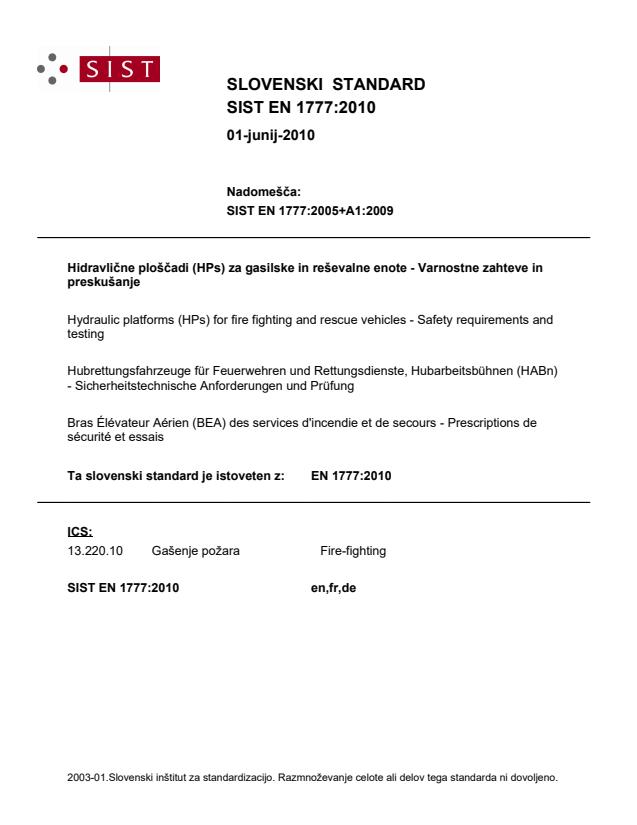
2003-01.Slovenski inštitut za standardizacijo. Razmnoževanje celote ali delov tega standarda ni dovoljeno.SUHVNXãDQMHHubrettungsfahrzeuge für Feuerwehren und Rettungsdienste, Hubarbeitsbühnen (HABn) - Sicherheitstechnische Anforderungen und PrüfungBras Élévateur Aérien (BEA) des services d'incendie et de secours - Prescriptions de sécurité et essaisHydraulic platforms (HPs) for fire fighting and rescue vehicles - Safety requirements and testing13.220.10Gašenje požaraFire-fightingICS:Ta slovenski standard je istoveten z:EN 1777:2010SIST EN 1777:2010en,fr,de01-junij-2010SIST EN 1777:2010SLOVENSKI
STANDARDSIST EN 1777:2005+A1:20091DGRPHãþD
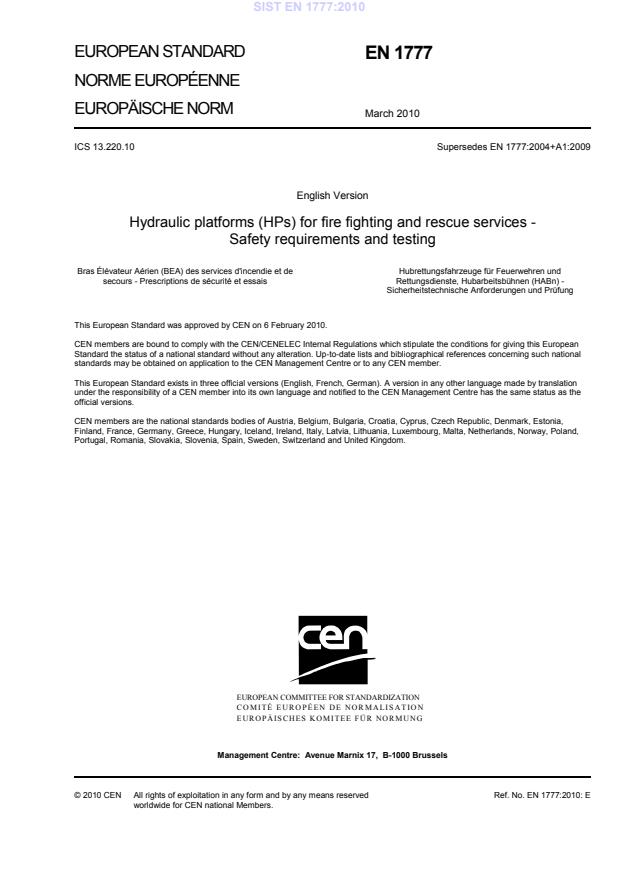
EUROPEAN STANDARD NORME EUROPÉENNE EUROPÄISCHE NORM
EN 1777
March 2010 ICS 13.220.10 Supersedes EN 1777:2004+A1:2009English Version
Hydraulic platforms (HPs) for fire fighting and rescue services - Safety requirements and testing
Bras Élévateur Aérien (BEA) des services d'incendie et de secours - Prescriptions de sécurité et essais
Hubrettungsfahrzeuge für Feuerwehren und Rettungsdienste, Hubarbeitsbühnen (HABn) - Sicherheitstechnische Anforderungen und Prüfung This European Standard was approved by CEN on 6 February 2010.
CEN members are bound to comply with the CEN/CENELEC Internal Regulations which stipulate the conditions for giving this European Standard the status of a national standard without any alteration. Up-to-date lists and bibliographical references concerning such national standards may be obtained on application to the CEN Management Centre or to any CEN member.
This European Standard exists in three official versions (English, French, German). A version in any other language made by translation under the responsibility of a CEN member into its own language and notified to the CEN Management Centre has the same status as the official versions.
CEN members are the national standards bodies of Austria, Belgium, Bulgaria, Croatia, Cyprus, Czech Republic, Denmark, Estonia, Finland, France, Germany, Greece, Hungary, Iceland, Ireland, Italy, Latvia, Lithuania, Luxembourg, Malta, Netherlands, Norway, Poland, Portugal, Romania, Slovakia, Slovenia, Spain, Sweden, Switzerland and United Kingdom.
EUROPEAN COMMITTEE FOR STANDARDIZATION
COMITÉ EUROPÉEN DE NORMALISATION EUROPÄISCHES KOMITEE FÜR NORMUNG
Management Centre:
Avenue Marnix 17,
B-1000 Brussels © 2010 CEN All rights of exploitation in any form and by any means reserved worldwide for CEN national Members. Ref. No. EN 1777:2010: ESIST EN 1777:2010
Special loads and forces — Use of HP's in wind speeds greater than Beaufort Scale 6 (see 5.2.3.4.1) . 65Annex B (informative)
Dynamic factors in stability and structural calculations . 66Annex C (informative)
Major alterations and repairs. 67Annex D (normative)
Design of wire rope drive systems for the extending structures and platform levelling systems . 68D.1 General . 68D.2 Calculation of rope drive . 68D.3 Calculation of rope diameter (coefficient c) . 68D.4 Calculation of the diameters of rope drums, rope pulleys and compensating pulleys [coefficient (h1 × h2)] . 70D.5 Efficiency of rope drives . 73Annex E (informative)
Calculation example of Annex D for wire rope, drum and pulley diameters . 75E.1 Notes . 75E.2 Annex D method summarised . 75E.3 Example . 76E.3.1 General . 76E.3.2 Drive group — See D.2 and Table D.1 . 76E.3.3 Calculation of minimum rope diameter — See D.3 . 76E.3.4 Calculation of the diameters of rope drums, pulleys and static pulleys — See D.4 . 77Annex ZA (informative)
Relationship between this European Standard and the Essential Requirements of EU Directive 2006/42/EC . 80Bibliography . 81 SIST EN 1777:2010
EN 60947-5-1, Low-voltage switchgear and controlgear — Part 5-1: Control circuit devices and switching elements — Electromechanical control circuit devices (IEC 60947-5-1:2003)
CEN/TS 15989, Firefighting vehicles and equipment — Symbols for operator controls and other displays EN ISO 12100-1:2003, Safety of machinery — Basic concepts, general principles for design — Part 1: Basic terminology, methodology (ISO 12100-1:2003) EN ISO 12100-2:2003, Safety of machinery — Basic concepts, general principles for design — Part 2: Technical principles (ISO 12100-2:2003) EN ISO 13732-1, Ergonomics of the thermal environment — Methods for the assessment of human responses to contact with surfaces — Part 1: Hot surfaces (ISO 13732-1:2006) EN ISO 13849-1:2008, Safety of machinery — Safety-related parts of control systems — Part 1: General principles for design (ISO 13849-1:2006) EN ISO 13849-2, Safety of machinery — Safety-related parts of control systems — Part 2: Validation (ISO 13849-2:2003) EN ISO 13850, Safety of machinery — Emergency stop — Principles for design (ISO 13850:2006) EN ISO 14122-3, Safety of machinery — Permanent means of access to machinery — Part 3: Stairs, stepladders and guard-rails (ISO 14122-3:2001) SIST EN 1777:2010
3 Terms and definitions For the purposes of this document, the terms and definitions given in EN 1846-1:1998, EN 1846-2:2009, EN ISO 12100-1:2003 and the following apply. NOTE The terms platform, extending structure, base, lowering/raising, slewing, rotating and travelling are illustrated in Figure 1 and Figure 2. 3.1 hydraulic platform
HP elevating platform consisting of a work platform and a hydraulic extending structure, mounted on a base that is a self propelled chassis and intended for moving persons and their equipment, and in some cases also fire fighting monitors, to working locations for interventions such as those related to fire fighting, rescue or protection of persons, protection of the environment and in a variety of other technical operations 3.2 platform fenced platform in which persons and equipment are carried and which can be moved under load to the required working position by the extending structure and/or by movement of the base NOTE Secondary platforms may include for example extended floors outside guardrails for rescue purposes or landings for access to boom ladders. 3.3 extending structure one or more rigid or telescopic or articulating mechanisms, or any combination of them in the form of booms and/or ladders or scissor mechanism which may or may not slew on the base 3.4 stabilizer device or system used to maintain the stability of the HP NOTE These include for example screw jacks, hydraulic jacks, outriggers, vehicle suspension locking devices, extending axles, systems for levelling the extending structure relative to the base, etc. SIST EN 1777:2010
NOTE There may be more than one combination of rated load (see 3.12) and working envelope. 3.14 residual slope deviation from horizontal of the base or any slewing mechanism after deployment of the stabilizers 3.15 full flow hydraulic/pneumatic control control where the control level or handle used by the operator is an integral part of, or is connected mechanically to, the valve which directs the full flow of the medium to the machine actuators (motors, cylinders, etc.) with no other intermediate control system (pilot hydraulic, master/slave, electrical, pneumatic, etc.) NOTE There are hydraulic or pneumatic full flow controls. SIST EN 1777:2010
NOTE See Figure 16. 3.17 rescue height vertical height from the horizontal ground surface to the bottom of the rescue cage without loading NOTE The rescue height is expressed in metres (m). 3.18 rescue ladder rated load
maximum number of persons each with a mass of 90 kg allowed on a ladder as specified by the manufacturer 3.19 access ladder ladder intended to access to the deck of the base and to the platform 3.20 rescue ladder ladder on or being part of the extending structure intended to be used for rescuing persons by carrying them down and for the crew by stepping down from the cage to the deck of the base 3.21 loose equipment item carried on the platform which is neither permanently secured nor part of the operator's basic minimum protective equipment EXAMPLES Hoses, nozzles, rescue lines, resuscitators, etc. 3.22 manual force force exerted by operators on the platform on objects/structures which is outside of the platform when the platform is stationary 3.23 load sensing system system of monitoring the vertical load and vertical forces on the platform NOTE The system includes the measuring device(s), the method of mounting the measuring device(s) and the signal processing system. 3.24 moment sensing system system of monitoring the overturning moment acting about the tipping line tending to overturn the hydraulic platform and system of monitoring exceeding permissible stresses NOTE The system includes the measuring devices(s), the method of mounting the measuring devices(s) and the signal processing system.
Key 1 platform (3.2) 2 extending structure (3.3) 3 base Figure 1 — Illustration of definitions in 3.2 and 3.3 1 3 2 4 Key 1 lowering/raising (3.7/3.8) 3 rotating (3.9) 2 slewing (3.10) 4 travelling (3.11) Figure 2 — Illustration of definitions in 3.7 to 3.11 4 List of significant hazards This clause contains in Table 1 all the significant hazards, hazardous situations and events, as far as they are dealt with in this document, identified by risk assessment as significant for this type of machinery and which require action to eliminate or reduce the risk. The significant hazards are based on EN ISO 14121-1:2007, Annex A. Also shown are the subclause references to the safety requirements and/or protective measures in this document, if applicable.
used or exhausted by machinery for example: 4.7.1 Hazards resulting from contact with or inhalation of harmful fluids, gases, mists, dusts and fumes 5.3.16 4.7.2 Fire or explosion hazard 5.3.18 4.8 Hazards generated by neglecting ergonomic principles in machine design (mismatch of machinery with human characteristics and abilities) caused e.g. by: 4.8.1 Unhealthy postures or excessive efforts 5.6.7 4.8.2 Inadequacy with human hand-arm or foot-leg anatomy 5.7.4, 5.7.5 4.8.3 Neglected use of personal protection equipment 5.7.4, 5.7.5 4.8.4 Inadequate local lighting 5.7.1 4.8.5 Mental overload or under-load, stress, etc. 5.4.6, 5.7.1, 5.7.6 4.8.6 Human errors 5.9.8, 5.10.11 SIST EN 1777:2010
Table 1 (continued) No Hazard Corresponding clause/subclause in this document 4.9 Hazards caused by failure of energy supply, breaking down of machinery parts, and other functional disorders e.g.: 4.9.1 Failure of energy supply (of power and/or control circuits) 5.7.8, 5.7.11, 5.7.14 4.9.2 Unexpected ejection of machine parts or fluids 5.7.15 4.9.3 Failure/disorder of control system 5.7.1, 7.2.2 4.9.4 Errors of fitting 5.8, 5.9.8, 5.10.11 4.9.5 Overturn, unexpected loss of machine stability 5.2.4, 6.1.2, 6.1.6 4.10 Hazards caused by (temporary) missing and/or incorrectly positioned safety-related measures/means, e.g.: 4.10.1 All kinds of guard 5.3.14 4.10.2 All kinds of safety related (protection) devices 5.3.12, 5.4.4 4.10.3 Starting and stopping devices 5.7.1, 5.7.7 4.10.4 Safety signs and tags 5.10.10, 7.2.2, 7.3 4.10.5 All kinds of information or warning devices 5.3.1, 5.3.9, 7.1.7, c), 7.2 4.10.6 Energy supply disconnecting devices 5.10.10 4.10.7 Emergency devices 5.7.7, 5.7.11 4.10.8 Essential equipment and accessories for safe adjustingand/or maintaining 7.1.7, d) 4.10.9 Equipment evacuating gases, etc. 5.3.16 4.11 Inadequate lighting of moving/working area 5.7.1 4.12 Hazards due to sudden movement, instability, etc. during handling 5.2, 5.2.3 4.13 Inadequate/non ergonomic design of driving/operating position: 4.13.1 Hazards due to dangerous environments (contact with moving parts, exhaust gases, etc.) 5.3.14, 5.3.16 4.13.2 Inadequate visibility from driver's/operator's position 5.3.13, 5.7.6 4.13.3 Inadequate seat/seating (seat index point) 5.4.6 4.13.4 Inadequate/non ergonomic design/positioning of controls 5.7.1 4.13.5 Starting/moving of self-propelled machinery 5.7.2 4.14 Mechanical hazards: 4.14.1 Hazards to exposed persons due to uncontrolled movement 5.7.1 4.14.2 Hazards due to break-up and/or ejection of parts 5.2 4.14.3 Inadequate means of access 5.3.18, 5.6.7 4.14.4 Hazards due to batteries, fire, emissions, etc. 5.3.17, 5.3.19 4.15 Hazards due to lifting operation 4.15.1 Lack of stability 5.4.1, 6.1.2 4.15.2 Loss of mechanical strength of machinery and lifting
accessories 5.2.5, 5.4.1 4.15.3 Hazards caused by uncontrolled movements 5.4.1, 5.5.1.1, 5.5.1.3 4.16 Inadequate view of trajectories of the moving parts 5.7.6 4.17 Hazards caused by lightning 5.3.20 4.18
Hazards due to loading/overloading, etc.
5.4.1 SIST EN 1777:2010
The rated load shall be taken to act: a) statically when the platform is not moving; b) dynamically when the platform is moving. Dimensions in metres
Key 1 tipping line n number of persons mp mass of each person Figure 3 — Related load −−−− persons SIST EN 1777:2010
Key 1 tipping line
Figure 4 — Related load −−−− equipment 5.2.3.2 Structural loads The masses of the components of the HP and fixed items of equipment on the platform or the extending structure shall be taken to be static structural loads when they are not moving. These masses shall be taken to be dynamic structural loads when they are moving. 5.2.3.3 Rescue ladder rated load The mass of each person on a ladder, on or forming part of the extending structure, shall be taken to act on one ladder rung. The maximum number of persons and their disposition on each ladder section shall be specified by the manufacturer. 5.2.3.4 Wind loads 5.2.3.4.1 HP's used out-of-doors shall be regarded as being affected by wind at a pressure of not less than 100 N/m2, equivalent to a wind speed of 12,5 m/s (Beaufort Scale 6). See Annex A. Wind forces are assumed to act horizontally at the centre of area of the parts of the HP and persons and equipment on the platform and/or ladders. They shall be taken to be dynamic forces. If the HP is intended to be used at higher wind speed the corresponding higher forces shall be taken into account. 5.2.3.4.2 The following shape factors shall be applied to areas exposed t
...
Frequently Asked Questions
EN 1777:2010 is a standard published by the European Committee for Standardization (CEN). Its full title is "Hydraulic platforms (HPs) for fire fighting and rescue services - Safety requirements and testing". This standard covers: This European Standard applies to vehicle mounted Hydraulic Platforms (HP's) as defined in 3.1, intended for use by fire and rescue services. HP's may participate in fire fighting, rescue or protection of persons, protection of the environment and in a variety of other technical operations. This document identifies the significant hazards (see Clause 4) for all sizes of HP's used by fire and rescue services, on the basis that they are supplied in a complete form, tested and ready for use. It also gives methods for the elimination or reduction of these hazards. This document applies only to HP's classified in group B type 1 according to EN 280:2001, 1.4. NOTE 1 HPs of group B type 1 are those where the vertical projection of the centre of gravity of the load may be outside the tipping lines and for which travelling is only allowed with the HP in its travel condition. Consequently this document does not apply to HP's with the following classification according to EN 280:2001, 1.4: - group A - type 1; - group A - type 2; - group A - type 3; - group B - type 2; - group B - type 3. This document is intended to be used in conjunction with EN 1846 2 and EN 1846 3. This document deals with the technical safety requirements to minimise the hazards listed in Clause 4 which can arise during the commissioning, the operational use, the routine checking and maintenance of hydraulic platforms when carried out in accordance with the specifications given by the manufacturer or his authorised representative. This document deals with all significant hazards, hazardous situations and events relevant to HP's, when they are used as intended and under conditions of misuse which are reasonably foreseeable by the manufacturer and taking account of their whole lifecycle (see Clause 4). NOTE 2 The lifecycle includes construction, transport, assembly and installation, commissioning, use (including setting, teaching/programming or process changeover), operation, (...)
This European Standard applies to vehicle mounted Hydraulic Platforms (HP's) as defined in 3.1, intended for use by fire and rescue services. HP's may participate in fire fighting, rescue or protection of persons, protection of the environment and in a variety of other technical operations. This document identifies the significant hazards (see Clause 4) for all sizes of HP's used by fire and rescue services, on the basis that they are supplied in a complete form, tested and ready for use. It also gives methods for the elimination or reduction of these hazards. This document applies only to HP's classified in group B type 1 according to EN 280:2001, 1.4. NOTE 1 HPs of group B type 1 are those where the vertical projection of the centre of gravity of the load may be outside the tipping lines and for which travelling is only allowed with the HP in its travel condition. Consequently this document does not apply to HP's with the following classification according to EN 280:2001, 1.4: - group A - type 1; - group A - type 2; - group A - type 3; - group B - type 2; - group B - type 3. This document is intended to be used in conjunction with EN 1846 2 and EN 1846 3. This document deals with the technical safety requirements to minimise the hazards listed in Clause 4 which can arise during the commissioning, the operational use, the routine checking and maintenance of hydraulic platforms when carried out in accordance with the specifications given by the manufacturer or his authorised representative. This document deals with all significant hazards, hazardous situations and events relevant to HP's, when they are used as intended and under conditions of misuse which are reasonably foreseeable by the manufacturer and taking account of their whole lifecycle (see Clause 4). NOTE 2 The lifecycle includes construction, transport, assembly and installation, commissioning, use (including setting, teaching/programming or process changeover), operation, (...)
EN 1777:2010 is classified under the following ICS (International Classification for Standards) categories: 13.220.10 - Fire-fighting. The ICS classification helps identify the subject area and facilitates finding related standards.
EN 1777:2010 has the following relationships with other standards: It is inter standard links to EN 1777:2004+A1:2009, EN 1777:2004. Understanding these relationships helps ensure you are using the most current and applicable version of the standard.
EN 1777:2010 is associated with the following European legislation: EU Directives/Regulations: 2006/42/EC, 98/37/EC; Standardization Mandates: M/079, M/396. When a standard is cited in the Official Journal of the European Union, products manufactured in conformity with it benefit from a presumption of conformity with the essential requirements of the corresponding EU directive or regulation.
You can purchase EN 1777:2010 directly from iTeh Standards. The document is available in PDF format and is delivered instantly after payment. Add the standard to your cart and complete the secure checkout process. iTeh Standards is an authorized distributor of CEN standards.
記事タイトル:EN 1777:2010 - 消防および救助サービス用の油圧プラットフォーム(HP)- 安全要件および試験 記事内容:この欧州規格は、3.1で定義された車両搭載型油圧プラットフォーム(HP)を、消防および救助サービスで使用することを意図しています。HPは消火、救助、人命保護、環境保護およびさまざまな技術作業に参加する場合があります。 この文書は、使用準備が整った状態で提供される、消防および救助サービスで使用されるあらゆるサイズのHPの重大な危険(4節参照)を特定します。また、これらの危険を除去または軽減する方法も提供しています。この文書は、EN 280:2001、1.4に基づきBグループ-1型と分類されるHPにのみ適用されます。 注意1)Bグループ-1型のHPは、荷重の重心の垂直投影が傾き線の外になる場合があり、HP自体が移動状態でのみ許可されるものです。 したがって、この文書はEN 280:2001、1.4に基づく以下の分類のHPには適用されません: - Aグループ-1型 - Aグループ-2型 - Aグループ-3型 - Bグループ-2型 - Bグループ-3型 この文書はEN 1846 2およびEN 1846 3と併用することを目的としています。 この文書は、メーカーまたはメーカーの認定代理人が指定した仕様に従って、HPの稼働開始時、運用使用時、定期的なチェックおよび保守時に発生する可能性のある4節にリストアップされた危険を最小限に抑えるための技術的な安全要件を取り扱っています。 この文書は、HPが意図したように使用され、製造業者が合理的に予測可能な誤用状況を考慮し、製品のライフサイクル全体を見越している場合に発生するHPに関連するすべての重大な危険、危険な状況、イベントについて取り扱います。 注意2)ライフサイクルには、建設、輸送、組み立ておよび設置、稼働開始、使用(設定、教育/プログラミングまたはプロセス変更を含む)、操作、(...)が含まれます。
기사 제목: EN 1777:2010 - 소방 및 구조 서비스용 유압 플랫폼(HP) - 안전 요구 사항 및 테스트 기사 내용: 이 유럽 표준은 3.1에서 정의된 차량 장착형 유압 플랫폼(HP)을 대상으로 하며, 소방 및 구조 서비스에서 사용하기 위한 것이다. HP는 소방, 구조 또는 인명 구조, 환경 보호 및 다양한 기술 작업에 참여할 수 있다. 이 문서는 제공된 상태로 완전한 형태로 제공되며 사용 준비가 된 모든 크기의 HP에 대한 중요한 위험(4조 참조)을 식별한다. 또한 이러한 위험을 제거 또는 줄이기 위한 방법을 제시한다. 이 문서는 EN 280:2001, 1.4에 따라 B 그룹-1 유형으로 분류된 HP에만 적용된다. 참고1) B 그룹-1 유형의 HP는 하중의 중심의 수직 사영이 뒤집기 선 외에 있을 수 있는 하중의 중앙 및 HP의 이동상태에서만 허용되는 HP를 말한다. 따라서 이 문서는 EN 280:2001, 1.4에 따라 다음과 같은 분류의 HP에는 적용되지 않는다: - A 그룹-1 유형; - A 그룹-2 유형; - A 그룹-3 유형; - B 그룹-2 유형; - B 그룹-3 유형. 이 문서는 EN 1846 2 및 EN 1846 3과 함께 사용할 것을 목적으로 한다. 이 문서는 제조업체나 그의 관련 대리인이 제시한 사양에 따라 HP의 개시, 운용 사용, 정기 점검 및 유지 보수 중 발생할 수 있는 4조에서 나열된 위험을 최소화하기 위한 기술적인 안전 요구 사항에 대해 다룬다. 이 문서는 HP가 의도 된 대로 사용되고 제조업체가 합리적으로 예상할 수 있는 오용 상황 하에서 및 수명주기 전반을 고려할 때, HP와 관련된 모든 중요한 위험, 위험 상황 및 사건에 대해 다룬다. 참고2) 수명주기에는 건설, 운송, 조립 및 설치, 개시, 사용(설정, 교육/프로그래밍 또는 공정전환 포함), 운영, (...)이 포함된다.
The article discusses European Standard EN 1777:2010, which outlines safety requirements and testing for vehicle-mounted Hydraulic Platforms (HPs) used by fire and rescue services. The standard identifies significant hazards associated with HPs and provides methods for eliminating or reducing these hazards. It specifically applies to HPs classified as group B - type 1, which are HPs where the center of gravity of the load may be outside the tipping lines and traveling is only allowed with the HP in its travel condition. The standard does not apply to other classifications of HPs according to EN 280:2001. It is meant to be used in conjunction with other related standards. The document addresses safety requirements during commissioning, operational use, routine checking, and maintenance of HPs. It also considers foreseeable misuse situations and their impact on the HP's lifecycle.
Questions, Comments and Discussion
Ask us and Technical Secretary will try to provide an answer. You can facilitate discussion about the standard in here.
Loading comments...