


FprEN 18039
(Main)Mountaineering equipment - Autobelay devices for recreational use - Safety requirements and test methods
Mountaineering equipment - Autobelay devices for recreational use - Safety requirements and test methods
This document specifies requirements, test methods, marking and information to be supplied for autobelay devices, intended to protect against falls during recreational use in a climbing structure. An autobelay device is a movable personal fall protection system for single person use.
This document does not specify requirements for descender devices or retractable fall arresters that are used for descending/climbing in mountaineering, rescue, rope access, fall arrest or work positioning systems.
NOTE 1 A climbing structure is e.g. a ropes course, a climbing gym.
NOTE 2 An autobelay device which enables the user to belay and descent himself/herself and which conforms to this document is personal protective equipment (PPE).
NOTE 3 For mountaineering standards, see Annex E.
Persönliche Absturzschutzausrüstung - Selbstsicherungs-Automaten im Freizeitsportbereich - Sicherheitsanforderungen und Prüfverfahren
Dieses Dokument legt Anforderungen, Prüfverfahren, Kennzeichnungen und Informationen fest, die für automatische Selbstsicherungsgeräte, die als Schutz gegen Abstürzen bei der Freizeitnutzung in einer Kletteranlage bestimmt sind, bereitzustellen sind. Ein automatisches Selbstsicherungsgerät ist ein bewegliches persönliches Absturzsicherungssystem für die Benutzung durch eine einzelne Person.
Dieses Dokument legt keine Anforderungen für Abseilgeräte oder aufrollbare Absturzsicherungen fest, die zum Abseilen/Klettern in Systemen des Bergsteigens, der Rettung, der Seilzugangstechnik, der Absturzsicherung oder der Arbeitspositionierung verwendet werden.
ANMERKUNG 1 Eine Kletteranlage ist z. B. ein Seilgarten, eine Kletterhalle.
ANMERKUNG 2 Ein automatisches Selbstsicherungsgerät, das es dem Benutzer/der Benutzerin ermöglicht, sich selbst zu sichern und abzuseilen, und das diesem Dokument entspricht, ist eine persönliche Schutzausrüstung (PSA).
ANMERKUNG 3 Für Normen für Bergsteigerausrüstung siehe Anhang E.
Equipement d'alpinisme et d'escalade - Auto-assureur automatique pour le loisir
Gorniška oprema - Samovarovala za rekreativno uporabo - Varnostne zahteve in preskusne metode
General Information
- Status
- Not Published
- Publication Date
- 08-Sep-2026
- Technical Committee
- CEN/TC 136 - Sports, playground and other recreational equipment
- Drafting Committee
- CEN/TC 136/WG 5 - Mountaineering and climbing equipment
- Current Stage
- 6055 - CEN Ratification completed (DOR) - Publishing
- Start Date
- 29-Jun-2026
- Due Date
- 29-Apr-2025
- Completion Date
- 29-Jun-2026

Overview
prEN 18039 (CEN) - Mountaineering equipment: Autobelay devices for recreational use - Safety requirements and test methods - is a draft European standard that defines safety, testing, marking and user information for autobelay devices used to protect a single user from falls in recreational climbing structures (e.g., climbing gyms, ropes courses). It covers design, performance and lab test methods applicable to movable personal fall protection systems intended for leisure climbing, and clarifies exclusions (not for descender devices or retractable fall arresters used in rescue, rope access, work positioning or mountaineering).
Key topics and requirements
This standard sets out technical requirements and test methods including:
- Design, materials and construction: requirements for retractable safety lines, connection elements and line terminations.
- Retraction system: checks, malfunction criteria, twisting resistance and acceptable retraction speed.
- Dynamic strength performance: shock load (impact) testing, dyno tests and free-fall performance evaluations for device classes.
- Energy dissipation: dynamic performance tests for integrated energy-absorbing elements and descent energy limits.
- Static strength: static load tests for device body, line terminations and retractable safety lines.
- Function in environmental conditions: operation and tests in dry, wet, cold and very-cold conditions.
- Corrosion resistance and electrical systems: salt spray and EMC considerations for electrically supported autobelay systems and battery safety.
- Marking and user information: mandatory device markings, pictograms at climb start, and manufacturer’s instructions to ensure safe installation and operation.
- Test sample and method specifications: detailed procedures for test labs (e.g., sample selection, shock tests, retraction speed measurements).
The standard also references normative documents (EN 362, EN 1891, EN 12275, EN 15567-1, EN ISO 9227, etc.) and includes informative annexes (pictograms, speed-climbing risks, related mountaineering standards and EU legal relationship).
Applications and who uses it
prEN 18039 is primarily used by:
- Manufacturers and designers of autobelay devices to design compliant products and compile technical documentation.
- Test laboratories and certification bodies performing dynamic, static and environmental testing for product approval.
- Climbing facility operators and safety managers (climbing gyms, ropes courses) for procurement, installation and maintenance guidelines.
- Regulators and conformity assessors to align with CE-marking and EU safety requirements (see Annex ZA).
- Safety engineers and product buyers seeking reliable personal fall protection solutions for recreational settings.
Keywords: autobelay devices, mountaineering equipment, safety requirements, test methods, recreational climbing, climbing gym, ropes course, personal fall protection, prEN 18039, CEN.
Related standards
Relevant referenced standards include EN 362 (connectors), EN 1891 (low-stretch ropes), EN 12275 (connectors), EN 15567-1 (ropes courses) and EN ISO 9227 (corrosion tests). See Annex D for additional mountaineering standards.
Get Certified
Connect with accredited certification bodies for this standard

CIS Institut d.o.o.
Personal Protective Equipment (PPE) certification body. Notified Body NB-2890 for EU Regulation 2016/425 PPE.

Kiwa BDA Testing
Building and construction product certification.
Kmetijski inštitut Slovenije
Agricultural Institute of Slovenia. Soil testing, plant health, agricultural product analysis.
Sponsored listings
Frequently Asked Questions
FprEN 18039 is a draft published by the European Committee for Standardization (CEN). Its full title is "Mountaineering equipment - Autobelay devices for recreational use - Safety requirements and test methods". This standard covers: This document specifies requirements, test methods, marking and information to be supplied for autobelay devices, intended to protect against falls during recreational use in a climbing structure. An autobelay device is a movable personal fall protection system for single person use. This document does not specify requirements for descender devices or retractable fall arresters that are used for descending/climbing in mountaineering, rescue, rope access, fall arrest or work positioning systems. NOTE 1 A climbing structure is e.g. a ropes course, a climbing gym. NOTE 2 An autobelay device which enables the user to belay and descent himself/herself and which conforms to this document is personal protective equipment (PPE). NOTE 3 For mountaineering standards, see Annex E.
This document specifies requirements, test methods, marking and information to be supplied for autobelay devices, intended to protect against falls during recreational use in a climbing structure. An autobelay device is a movable personal fall protection system for single person use. This document does not specify requirements for descender devices or retractable fall arresters that are used for descending/climbing in mountaineering, rescue, rope access, fall arrest or work positioning systems. NOTE 1 A climbing structure is e.g. a ropes course, a climbing gym. NOTE 2 An autobelay device which enables the user to belay and descent himself/herself and which conforms to this document is personal protective equipment (PPE). NOTE 3 For mountaineering standards, see Annex E.
FprEN 18039 is classified under the following ICS (International Classification for Standards) categories: 13.340.60 - Protection against falling and slipping; 97.220.40 - Outdoor and water sports equipment. The ICS classification helps identify the subject area and facilitates finding related standards.
FprEN 18039 is associated with the following European legislation: EU Directives/Regulations: 2016/425; Standardization Mandates: M/571, M/571 AMD 1. When a standard is cited in the Official Journal of the European Union, products manufactured in conformity with it benefit from a presumption of conformity with the essential requirements of the corresponding EU directive or regulation.
FprEN 18039 is available in PDF format for immediate download after purchase. The document can be added to your cart and obtained through the secure checkout process. Digital delivery ensures instant access to the complete standard document.
Standards Content (Sample)
SLOVENSKI STANDARD
oSIST prEN 18039:2024
01-junij-2024
Gorniška oprema - Samovarovala za rekreativno uporabo - Varnostne zahteve in
preskusne metode
Mountaineering equipment - Autobelay devices for recreational use - Safety
requirements and test methods
Persönliche Absturzschutzausrüstung - Selbstsicherungs-Automaten im
Freizeitsportbereich - Sicherheitsanforderungen und Prüfverfahren
Equipement d'alpinisme et d'escalade - Auto-assureur automatique pour le loisir
Ta slovenski standard je istoveten z: prEN 18039
ICS:
97.220.40 Oprema za športe na Outdoor and water sports
prostem in vodne športe equipment
oSIST prEN 18039:2024 en,fr,de
2003-01.Slovenski inštitut za standardizacijo. Razmnoževanje celote ali delov tega standarda ni dovoljeno.
oSIST prEN 18039:2024
oSIST prEN 18039:2024
DRAFT
EUROPEAN STANDARD
prEN 18039
NORME EUROPÉENNE
EUROPÄISCHE NORM
March 2024
ICS 97.220.40
English Version
Mountaineering equipment - Autobelay devices for
recreational use - Safety requirements and test methods
Equipement d'alpinisme et d'escalade - Auto-assureur Bergsteigerausrüstung - Automatische
automatique pour le loisir Selbstsicherungsgeräte für Freizeitnutzung
This draft European Standard is submitted to CEN members for enquiry. It has been drawn up by the Technical Committee
CEN/TC 136.
If this draft becomes a European Standard, CEN members are bound to comply with the CEN/CENELEC Internal Regulations
which stipulate the conditions for giving this European Standard the status of a national standard without any alteration.
This draft European Standard was established by CEN in three official versions (English, French, German). A version in any other
language made by translation under the responsibility of a CEN member into its own language and notified to the CEN-CENELEC
Management Centre has the same status as the official versions.
CEN members are the national standards bodies of Austria, Belgium, Bulgaria, Croatia, Cyprus, Czech Republic, Denmark, Estonia,
Finland, France, Germany, Greece, Hungary, Iceland, Ireland, Italy, Latvia, Lithuania, Luxembourg, Malta, Netherlands, Norway,
Poland, Portugal, Republic of North Macedonia, Romania, Serbia, Slovakia, Slovenia, Spain, Sweden, Switzerland, Türkiye and
United Kingdom.
Recipients of this draft are invited to submit, with their comments, notification of any relevant patent rights of which they are
aware and to provide supporting documentation.
Warning : This document is not a European Standard. It is distributed for review and comments. It is subject to change without
notice and shall not be referred to as a European Standard.
EUROPEAN COMMITTEE FOR STANDARDIZATION
COMITÉ EUROPÉEN DE NORMALISATION
EUROPÄISCHES KOMITEE FÜR NORMUNG
CEN-CENELEC Management Centre: Rue de la Science 23, B-1040 Brussels
© 2024 CEN All rights of exploitation in any form and by any means reserved Ref. No. prEN 18039:2024 E
worldwide for CEN national Members.
oSIST prEN 18039:2024
prEN 18039:2024 (E)
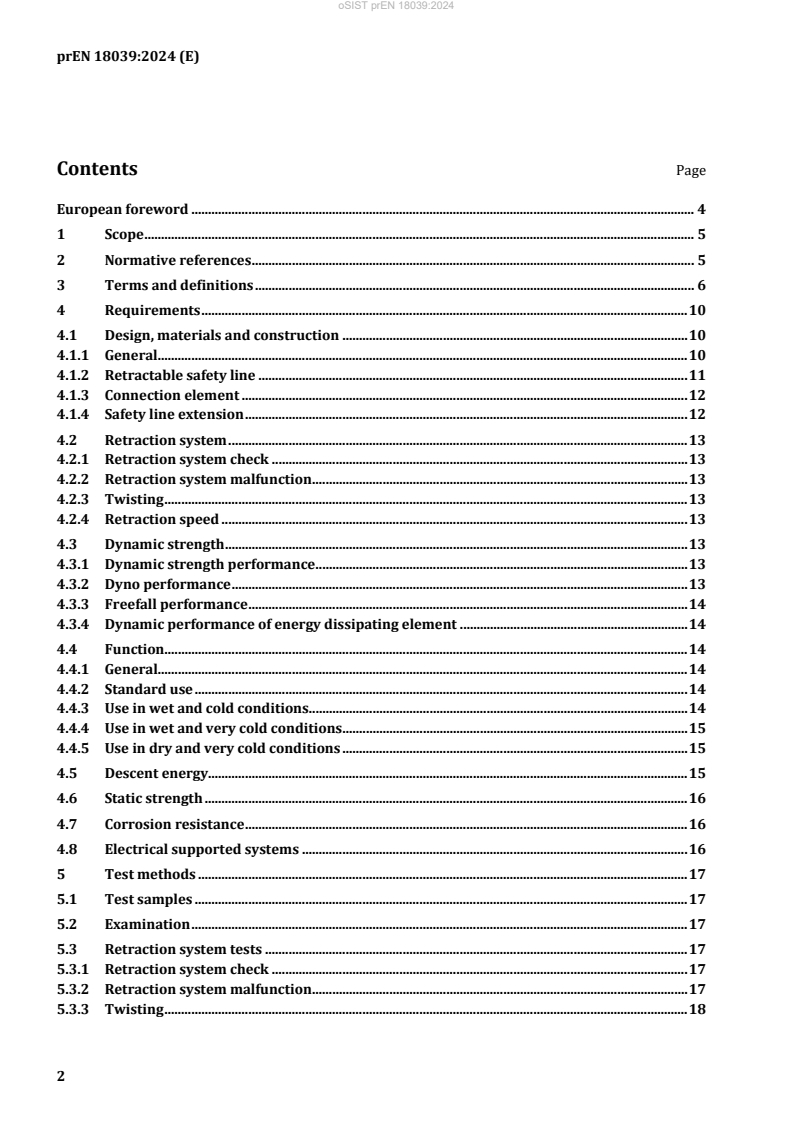
Contents Page
European foreword . 4
1 Scope . 5
2 Normative references . 5
3 Terms and definitions . 6
4 Requirements . 10
4.1 Design, materials and construction . 10
4.1.1 General. 10
4.1.2 Retractable safety line . 11
4.1.3 Connection element . 12
4.1.4 Safety line extension . 12
4.2 Retraction system . 13
4.2.1 Retraction system check . 13
4.2.2 Retraction system malfunction . 13
4.2.3 Twisting . 13
4.2.4 Retraction speed . 13
4.3 Dynamic strength . 13
4.3.1 Dynamic strength performance . 13
4.3.2 Dyno performance . 13
4.3.3 Freefall performance . 14
4.3.4 Dynamic performance of energy dissipating element . 14
4.4 Function . 14
4.4.1 General. 14
4.4.2 Standard use . 14
4.4.3 Use in wet and cold conditions . 14
4.4.4 Use in wet and very cold conditions . 15
4.4.5 Use in dry and very cold conditions . 15
4.5 Descent energy. 15
4.6 Static strength . 16
4.7 Corrosion resistance . 16
4.8 Electrical supported systems . 16
5 Test methods . 17
5.1 Test samples . 17
5.2 Examination . 17
5.3 Retraction system tests . 17
5.3.1 Retraction system check . 17
5.3.2 Retraction system malfunction . 17
5.3.3 Twisting . 18
oSIST prEN 18039:2024
prEN 18039:2024 (E)
5.3.4 Retraction speed . 19
5.4 Dynamic strength tests . 19
5.4.1 Shock load test of autobelay device . 19
5.4.2 Dyno test of autobelay devices . 20
5.4.3 Free fall performance test for autobelay device class B . 22
5.4.4 Dynamic performance of safety line extension with energy dissipating element . 23
5.5 Function tests . 23
5.5.1 Dry condition . 23
5.5.2 Wet condition . 23
5.5.3 Wet and cold condition . 23
5.5.4 Wet and very cold condition . 24
5.5.5 Dry and very cold condition . 24
5.6 Descent energy test . 24
5.7 Static strength test . 26
5.7.1 General . 26
5.7.2 Static strength test of safety line end termination in autobelay device . 26
5.7.3 Static strength test of autobelay device . 27
5.7.4 Static strength of retractable safety line . 27
5.8 Corrosion resistance test . 27
6 Marking . 28
6.1 General . 28
6.2 On the device . 28
6.3 On a termination of the retractable safety line. 28
6.4 On the climb start . 29
7 Manufacturer’s instructions and information . 29
Annex A (informative) Autobelay Device Belay Gate . 31
Annex B (informative) Examples for pictograms at autobelay device climbing start . 32
Annex C (informative) Speed climbing immanent risk . 33
Annex D (informative) Standards on mountaineering equipment . 34
Annex ZA (informative) Relationship between this European Standard and the safety
requirements of Directive 2001/95/EC aimed to be covered . 36
Bibliography . 37
oSIST prEN 18039:2024
prEN 18039:2024 (E)
European foreword
This document (prEN 18039:2024) has been prepared by Technical Committee CEN/TC 136 WG 5
“Mountaineering Equipment”, the secretariat of which is held by DIN.
This document is currently submitted to the CEN Enquiry.
This document has been prepared under a standardization request addressed to CEN by the European
Commission. The Standing Committee of the EFTA States subsequently approves these requests for its
Member States.
For the relationship with EU Legislation, see informative Annex ZA, which is an integral part of this
document.
oSIST prEN 18039:2024
prEN 18039:2024 (E)
1 Scope
This document specifies requirements, test methods, marking and information to be supplied for
autobelay devices, intended to protect against falls during recreational use in a climbing structure. An
autobelay device is a movable personal fall protection system for single person use.
This document does not specify requirements for descender devices or retractable fall arresters that are
used for descending/climbing in mountaineering, rescue, rope access, fall arrest or work positioning
systems.
NOTE 1 A climbing structure is e.g. a ropes course, a climbing gym.
NOTE 2 An autobelay device which enables the user to belay and descent himself and which conforms to this
document is personal protective equipment (PPE).
NOTE 3 For mountaineering standards, see Annex D.
2 Normative references
The following documents are referred to in the text in such a way that some or all of their content
constitutes requirements of this document. For dated references, only the edition cited applies. For
undated references, the latest edition of the referenced document (including any amendments) applies.
EN 362:2004, Personal protective equipment against falls from a height - Connectors
EN 364:1992, Personal protective equipment against falls from a height - Test methods
EN 1176-1:2017+A1:2023, Playground equipment and surfacing - Part 1: General safety requirements and
test methods
EN 1891:1998, Personal protective equipment for the prevention of falls from a height - Low stretch
kernmantel ropes
EN 12275:2013, Mountaineering equipment - Connectors - Safety requirements and test methods
EN 12385-1:2002+A1:2008, Steel wire ropes - Safety - Part 1: General requirements
EN 13411-1:2002+A1:2008, Terminations for steel wire ropes - Safety - Part 1: Thimbles for steel wire rope
slings
EN 13411-2:2001+A1:2008, Terminations for steel wire ropes - Safety - Part 2: Splicing of eyes for wire
rope slings
EN 13411-3:2022, Terminations for steel wire ropes - Safety - Part 3: Ferrules and ferrule-securing
EN 15567-1:2015+A1:2020, Sports and recreational facilities - Ropes courses - Part 1: Construction and
safety requirements
EN 60335-1:2012, Household and similar electrical appliances - Safety - Part 1: General requirements
(IEC 60335-1:2010, modified)
EN 60335-2-29:2021, Household and similar electrical appliances - Safety - Part 2-29: Particular
requirements for battery chargers (IEC 60335-2-29:2016)
EN 60335-2-30:2009, Household and similar electrical appliances - Safety - Part 2-30: Particular
requirements for room heaters (IEC 60335-2-30:2009)
oSIST prEN 18039:2024
prEN 18039:2024 (E)
EN 60335-2-80:2003, Household and similar electrical appliances - Safety - Part 2-80: Particular
requirements for fans
EN 60529:1991, Degrees of protection provided by enclosures (IP Code) (IEC 60529:1989)
EN 61558-2-16:2009, Safety of transformers, reactors, power supply units and similar products for supply
voltages up to 1 100 V - Part 2-16: Particular requirements and tests for switch mode power supply units
and transformers for switch mode power supply units
EN 62133-1:2017, Secondary cells and batteries containing alkaline or other non-acid electrolytes - Safety
requirements for portable sealed secondary cells, and for batteries made from them, for use in portable
applications – Part 1: Nickel systems
EN 62133-2:2017, Secondary cells and batteries containing alkaline or other non-acid electrolytes - Safety
requirements for portable sealed secondary cells, and for batteries made from them, for use in portable
applications – Part 2: Lithium systems
EN IEC 55014-1:2021, Electromagnetic compatibility - Requirements for household appliances, electric
tools and similar apparatus - Part 1: Emission (CISPR 14-1:2020)
EN IEC 55014-2:2021, Electromagnetic compatibility - Requirements for household appliances, electric
tools and similar apparatus - Part 2: Immunity - Product family standard (CISPR 14-2:2020)
EN IEC 61000-6-2:2019, Electromagnetic compatibility (EMC) - Part 6-2: Generic standards - Immunity
standard for industrial environments (IEC 61000-6-2:2016)
EN IEC 61000-6-3:2021, Electromagnetic compatibility (EMC) - Part 6-3: Generic standards - Emission
standard for equipment in residential environments (IEC 61000-6-3:2020)
EN IEC 62368-1:2020, Audio/video, information and communication technology equipment - Part 1: Safety
requirements (IEC 62368-1:2018)
EN ISO 9227:2022, Corrosion tests in artificial atmospheres - Salt spray tests (ISO 9227:2022)
EN ISO 13849-1:2023, Safety of machinery - Safety-related parts of control systems - Part 1: General
principles for design (ISO 13849-1:2023)
3 Terms and definitions
For the purposes of this document, the following terms and definitions apply.
ISO and IEC maintain terminology databases for use in standardization at the following addresses:
— ISO Online browsing platform: available at https://www.iso.org/obp/
— IEC Electropedia: available at https://www.electropedia.org/
Under revision.
Under revision.
oSIST prEN 18039:2024
prEN 18039:2024 (E)
3.1
autobelay device
automatic operated device, usually installed on top of a route and above the user, including a self-
retractable safety line, to which the user is connected, allowing climbing up without slack in the
retractable safety line and in case of loading the retractable safety line by the user, the device lowers the
user automatically speed regulated at a safe speed
Note 1 to entry: The device has a braking system that does not require an intervention for speed regulation by the
user once the descent has commenced.
3.1.1
class A autobelay device
autobelay device which has a safety line extension less than or equal to 70 cm, intended only for climbing
up and descending without impact
3.1.2
class B autobelay device
autobelay device which has a safety line extension greater than 70 cm, for additional functions
EXAMPLE Freefall devices with a slack in retractable safety line.
3.1.3
autobelay device for speed climbing
autobelay device which is intended for climbing style, where high climbing speed is the target
3.2
route
distance between ground floor and height of fully retracted connection element when autobelay device
is installed in accordance with the instructions and information
Note 1 to entry: See Figure 1.
oSIST prEN 18039:2024
prEN 18039:2024 (E)
Key
1 autobelay device
2 connection element
3 route
4 climbing hold
Figure 1 — Route
3.3
retractable safety line
self-retractable lanyard of the autobelay device with an attachment point on its outer end termination
Note 1 to entry: See Figure 2.
EXAMPLES Wire rope, textile rope, or webbing.
3.4
safety line extension
element permanently or temporarily added to the end of retractable safety line (3.3) that does not retract
into the belay device and provides a new fixation for the connection element and also additional functions
Note 1 to entry: Examples of additional functions are but not limited to elastic webbing assemblies to create
freefall, or energy absorbers or line extensions required for specific site applications.
3.5
connection element
integral element permitting connection between the attachment point and the harness attachment point
Note 1 to entry: See Figure 2.
oSIST prEN 18039:2024
prEN 18039:2024 (E)
3.6
attachment point
component of the retractable safety line permitting the fixation of the connection element or temporary
safety line extension
Note 1 to entry: See Figure 2.
3.7
anchor point
component of the autobelay device which is used to connect the autobelay device to the load bearing
structure
Note 1 to entry: See Figure 2.
Key
1 anchor point
2 connection element
3 retractable safety line
4 attachment point
Figure 2 — Terminology of autobelay device components
3.8
build-in speed-regulating system
integral braking system of the descender device used to control the velocity of the decent
3.9
descent energy
energy measured in joules and expressed as W, which results from the product of the descent load, the
gravity, the descent height and the number of descents
Note 1 to entry:
Descent energy W = m × g × h × n
where
W is the descent energy, expressed in joules (J);
m is the descent mass, expressed in kilograms (kg);
g is the gravity 9,81 m/s ;
h is the descent height, expressed in metres (m);
n is the number of descents.
[SOURCE: EN 341:2011, 3.1.2]
oSIST prEN 18039:2024
prEN 18039:2024 (E)
3.10
minimum rated load
minimum mass of the user, including all gear, as specified in manufacturer’s instructions and information
Note 1 to entry: Minimum rated load is expressed in kilograms.
3.11
maximum rated load
maximum mass of the user, including all gear, as specified in manufacturer’s instructions and information
Note 1 to entry: Maximum rated load is expressed in kilograms.
3.12
energy dissipating element
element or component or arrangement of a fall arresting system, which is designed to reduce impact force
of the kinetic energy developed during a fall of the user
3.13
braking force
maximum force F in kilonewtons measured at the anchor point during the braking period of the
max
dynamic strength test
3.14
minimum mounting height
shortest vertical distance between ground and anchor point of autobelay device which is allowed in the
manufacturer’s instructions and information
3.15
maximum mounting height
longest vertical distance between ground and anchor point of autobelay device which is allowed in the
manufacturer’s instructions and information
3.16
man-made fibres
fibre obtained by a manufacturing process
Note 1 to entry: Man-made fibres refer to ISO/TR 11827:2012.
4 Requirements
4.1 Design, materials and construction
4.1.1 General
The minimum rated load shall be specified according to 6.2 h).
The maximum rated load shall be specified in the manufacturer’s instructions and information and shall
be at least 100 kg according to 6.2 h).
Materials which may come into contact with the skin of a user shall not be known to, or suspected to,
adversely affect user hygiene or health, e.g. cause irritating or sensitization effects, during normal use of
the autobelay device, according to 5.2.
Autobelay devices shall not have sharp or rough edges that may cut, abrade or otherwise damage
retractable safety line or cause injury to the user, according to 5.2.
oSIST prEN 18039:2024
prEN 18039:2024 (E)
There shall be no gaps between 8 mm and 25 mm and with a depth greater than 15 mm which can lead
to entrapment according to 5.2. Finger entrapment does not apply to anchor points and connecting
element.
Energy dissipating elements of the autobelay device shall transmit an impact force not exceeding 6 kN,
when tested according to 5.4.
4.1.2 Retractable safety line
4.1.2.1 General
Retractable safety line shall be made of galvanized steel wire rope or stainless-steel wire rope, textile
rope or webbing.
Retractable safety line shall have a connection element intended for attachment of a user.
Retractable safety line including its terminations shall allow inspections as specified in the
manufacturer’s instructions and information.
All requirements of this subclause are to be checked according to 5.2.
4.1.2.2 Attachment point
The attachment point shall be terminated using appropriate methods depending on the retractable safety
line material(s). The structural material of the attachment point shall be protected from wear.
All requirements of this subclause are checked in 5.2.
4.1.2.3 Wire rope retractable safety line
Wire rope retractable safety line shall be made in one piece and shall be stress and torsion relieved.
Wire rope retractable safety line made of steel, except stainless steel, shall be galvanized in accordance
with EN 12385-1:2002+A1:2008.
The nominal tensile strength of the wire of the steel or stainless-steel wire rope retractable safety line
shall not exceed 1 960 N/mm .
All requirements of this subclause are to be checked according to 5.2.
For autobelay devices it should be indicated to be particularly careful when selecting lines made of
stainless steel as some types of stainless steel can have unpredictable fatigue and corrosion
characteristics.
A limit of the nominal tensile strength is necessary, because the wires become too brittle with a higher
nominal tensile strength.
4.1.2.4 Textile rope retractable safety line
Textile rope retractable safety line shall be of kernmantel construction and shall conform to
EN 1891:1998, 4.5, type A. They shall be made of man-made fibres suitable for the use intended.
All requirements of this subclause are checked in 5.2.
4.1.2.5 Webbing retractable safety line
Webbing retractable safety line shall meet the requirements of EN 1891:1998, 4.5, type A.
Webbing retractable safety line shall be made of man-made fibres suitable for the use intended.
All requirements of this subclause are checked in 5.2.
oSIST prEN 18039:2024
prEN 18039:2024 (E)
4.1.2.6 Termination
Retractable safety line shall be terminated on the user side in such a manner that it can be connected,
directly or by a connection element, as specified in manufacturer’s instructions and information, to the
harness of the user.
Reinforcement or other methods shall be used to reduce abrasion of connection element due to
concentrated wear at all retractable safety line-to-metal fitting interfaces.
Where visible stitching is used to provide safety and strength (e.g. in joints) it shall contrast with the
webbing/rope in colour or surface appearance.
Webbing/textile rope ends shall be sealed or otherwise prevented from unravelling.
All splices shall be secured to prevent splice moving.
Eye terminations of wire rope shall be made with thimbles and splices or with thimbles and pressed
ferrules, in accordance with EN 13411-1:2002+A1:2008, EN 13411-2:2001+A1:2008 and
EN 13411-3:2022.
All requirements of this subclause are to be checked according to 5.2.
It should be indicated to take care that the retractable safety line has an adequate protection against
abrasive climbing wall surfaces.
4.1.3 Connection element
The connection element shall conform to EN 362:2004, class M or T, or EN 12275:2013, class T, with
triple action gate locking device or comparable safe gate locking device (e.g. 2 opposing double action
gates, gate locked with key) to prevent accidental opening during use.
Reinforcement or other methods shall be used to reduce abrasion of connection element due to
concentrated wear at all retractable safety line-to-metal fitting interfaces.
All requirements of this subclause are to be checked according to 5.2. It should be indicated to take care
that the connection element has an adequate protection against abrasive climbing wall surfaces.
4.1.4 Safety line extension
Safety line extension shall be made of galvanized steel wire rope or stainless-steel wire rope, textile rope
or webbing.
Safety line extension shall have a connection element intended for attachment of a user.
Safety line extension including its terminations shall allow inspections as specified in the manufacturer’s
instructions and information.
All terminations of the safety line extension structural material shall be protected from wear.
Safety line extensions shall have a permanent or openable connection to the retractable safety line. The
openable safety line extension connection to the retractable safety line shall be openable only with a tool.
All above requirements of this subclause are to be checked according to 5.2.
Safety line extension shall be assessed in combination with the autobelay device in 4.3, 4.5, 4.6.
Autobelay device class A shall have a safety line extension ≤ 70 cm. Safety line extension for class A that
is part of an energy absorbing system shall have a shock load ≤ 6 kN when tested in accordance with 5.4.1.
Autobelay device class B shall have a safety line extension > 70 cm.
Safety line extension for class B that is part of an energy absorbing system shall have a shock load ≤ 6 kN
when tested in accordance with 5.4.1 and 5.4.3.
oSIST prEN 18039:2024
prEN 18039:2024 (E)
Safety line extension with energy dissipating element for safety purposes shall have a shock load ≤ 6 kN
when tested in accordance with 5.4.4.
4.2 Retraction system
4.2.1 Retraction system check
An autobelay device shall have an indicator or control procedure which allows evaluating in short time
the function of retracting retractable safety line. This shall be prescribed in manufacturer’s instructions
and information. When tested in accordance with 5.3.1 the performing of evaluation shall not need more
than 10 seconds.
4.2.2 Retraction system malfunction
An autobelay device shall be constructed in such a way that there is no safety problem when, during a
climb, the retraction system for the retractable safety line has a malfunction and the user stops climbing
up. When tested in accordance with 5.3.2, the retractable safety line shall not unravel itself and the masses
shall descent at a safe landing speed (see 4.4.2).
4.2.3 Twisting
When tested in accordance with 5.3.3, the retractable safety line shall be retracted fully into the autobelay
device.
This test is not required for twin-safety lines.
4.2.4 Retraction speed
When tested in accordance with 5.3.4, an autobelay device shall have a retraction speed > 0,5 m/s.
When tested in accordance with 5.3.4, an autobelay device for speed climbing shall have a retraction
speed > 3,5 m/s.
4.3 Dynamic strength
4.3.1 Dynamic strength performance
This requirement applies for autobelay device classes A and B.
When tested in accordance with 5.4.1, which simulates a fall on a slack safety line:
— the autobelay device shall not release the test mass;
— no part of the autobelay device shall show sign of breaking or tearing;
— braking force shall be ≤ 6 kN;
— landing speed shall be ≤ 2 m/s;
— or, with fall protection floor, see 4.4.2, landing speed shall be ≤ 3 m/s.
4.3.2 Dyno performance
This requirement applies for autobelay device classes A and B.
When tested in accordance with 5.4.2, which simulates a dynamic move of a climber ending in a fall, the
autobelay device:
— shall not release the test mass;
— no part of the autobelay device shall show any signs of breaking or tearing;
oSIST prEN 18039:2024
prEN 18039:2024 (E)
— braking force shall be ≤ 6 kN;
— landing speed shall be ≤ 2 m/s;
— or, with fall protection floor, see 4.4.2, landing speed shall be ≤ 3 m/s.
4.3.3 Freefall performance
This requirement applies for autobelay device class B.
When tested in accordance with 5.4.3, which simulates a jump from a platform, the autobelay device:
— shall not release the test mass;
— no part of the autobelay device shall show any signs of breaking or tearing;
— braking force shall be ≤ 6 kN;
— landing speed shall be ≤ 2 m/s;
— or, with fall protection floor, see 4.4.2, landing speed shall be ≤ 3 m/s.
4.3.4 Dynamic performance of energy dissipating element
This requirement applies for autobelay device with energy dissipating element in safety line extension.
When tested in accordance with 5.4.4, which verifies the performance of energy dissipating elements, the
safety line extension:
— shall not release the test mass;
— braking force shall be ≤ 6 kN.
4.4 Function
4.4.1 General
The authorized environmental conditions for the use of the autobelay device shall be indicated. Standard
use (see 4.4.2) shall always be met whilst subclauses 4.4.3 to 4.4.5 shall be met if claimed by the
manufacturer’s instructions and information; see Table 1.
4.4.2 Standard use
When tested in the dry and wet condition in accordance with 5.5.1 and 5.5.2:
— landing speed between 0,1 m/s and 2 m/s shall be maintained when no specific fall attenuation
surface is required;
— if fall attenuation surface for fall heights > 2 000 mm is used according to EN 1176-1:2017+A1:2023,
the landing speed shall be ≤ 3 m/s.
4.4.3 Use in wet and cold conditions
When claimed in the manufacturer’s instructions and information that the autobelay device can be used
in wet and cold condition according to 5.5.3:
— landing speed between 0,1 m/s and 2 m/s shall be maintained when no specific fall attenuation
surface is required;
— if fall attenuation surface for fall heights > 2 000 mm is used according to EN 1176-1:2017+A1:2023,
the landing speed shall be ≤ 3 m/s.
oSIST prEN 18039:2024
prEN 18039:2024 (E)
4.4.4 Use in wet and very cold conditions
When claimed in the manufacturer’s instructions and information that the autobelay device can be used
in wet and very cold condition in accordance with 5.5.4:
— landing speed between 0,1 m/s and 2 m/s shall be maintained when no specific fall attenuation
surface is required;
— if fall attenuation surface for fall heights > 2 000 mm is used according to EN 1176-1:2017+A1:2023,
the landing speed shall be ≤ 3 m/s.
4.4.5 Use in dry and very cold conditions
When claimed in the manufacturer’s instructions and information that the autobelay device can be used
outdoor in dry condition (e.g. protected by rain cover, without condensing effects) it shall be tested
additionally in dry and very cold condition in accordance with 5.5.5:
— landing speed between 0,1 m/s and 2 m/s shall be maintained when no specific fall attenuation
surface is required;
— if fall attenuation surface for fall heights > 2 000 mm is used in accordance with
EN 1176-1:2017+A1:2023, the landing speed shall be ≤ 3 m/s.
Table 1 — Function tests of autobelay devices
Environmental
Mandatory Optional Test subclause
condition
Dry x 5.5.1
Wet x 5.5.2
Wet and cold x 5.5.3
Wet and very cold x 5.5.4
Dry and very cold x 5.5.5
4.5 Descent energy
Autobelay devices are classified as follows:
descent energy W: ≥ 7,5 × 10 J; (10 × type A of EN 341:2011)
NOTE 1 Value is no life time limit but qualification as autobelay device.
NOTE 2 In practice, autobelay devices are subject to different load scenarios which can have different influences
on the life time of the product. This is something to consider with regard to the use, service, maintenance and
disposal of the product.
When tested in accordance with 5.6, with the descents being carried out in succession, the autobelay
device shall meet the following requirements:
a) it shall resist the descent energy W: ≥ 7,5 × 10 J and still has to function properly;
b) it shall be possible to maintain the descent velocity (at landing) between 0,1 m/s and 2 m/s. When no
specific ground floor is required; If appropriate fall attenuation surface for fall heights > 2 m is used
(EN 1176-1:2017+A1:2023) landing speed can be higher up to 3 m/s.
oSIST prEN 18039:2024
prEN 18039:2024 (E)
The retractable safety line can be replaced according to manufacturer’s instructions and information
when it is worn during this testing, but shall meet at least 1 × 7,5 × 10 J (like EN 341:2011, type A) and
static strength test in 4.6.
After the energy test, the textile retractable safety line shall not show any heat damage (melted fibres);
glassy surface is allowed.
After the energy test, the steel cable retractable safety line shall not show any wire/cable damage.
4.6 Static strength
When tested in accordance with 5.7.2, autobelay devices shall withstand a test force of 5 times the
+0,25
maximum rated load, but at least 6 kN, applied for 3 min.
When tested in accordance with 5.7.3, autobelay devices with blocked retractable safety line shall hold a
+0,25
test force of 10 times the maximum rated load, but at least 12 kN, applied for 3 min.
When tested in accordance with 5.7.4, autobelay device retractable safety lines shall withstand a test
+0,25
force of 10 times the maximum rated load, but at least 15 kN, applied for 3 min.
4.7 Corrosion resistance
After testing in accordance with 5.8, no part of the autobelay device shall show evidence of corrosion that
would affect its function.
NOTE 1 White scaling or tarnishing is acceptable if the function is not impaired.
NOTE 2 Conformity with this requirement does not imply suitability for use in e.g. a marine environment or
indoor swimming pool.
4.8 Electrical supported systems
If the electrical support of the autobelay device is for safety relevant issues, the autobelay device shall be
equipped with an integrated indication system which indicates to the user if the system is on and if the
energy supply of the device is outside of its normal operating capabilities. The indicator(s) shall be visible
to the user when used according to the manufacturer’ instructions and information.
Reports of electronical system evaluation shall be given in the manufacturer’ instructions and
information.
All requirements of this subclause are to be checked according to 5.2.
For electronic system, the following standards shall be met:
a) Electronic: EN ISO 13849-1:2023;
b) Software: EN ISO 13849-1:2023, 7.3 and 7.4;
c) Charger: EN 61558-2-16:2009; EN 60335-2-29:2021; EN IEC 62368-1:2020;
d) Battery: EN 62133-1:2017 and EN 62133-2:2017;
e) Motor: EN 60335-1:2012; EN 60335-2-30:2009; EN 60335-2-80:2003;
f) Controller: EN 60335-1:2012; EN 60529:1991; EN IEC 62368-1:2020;
oSIST prEN 18039:2024
prEN 18039:2024 (E)
g) EMC: EN IEC 55014-1:2021, EN IEC 55014-2:2021; EN IEC 61000-6-2:2019;
EN IEC 61000-6-3:2021.
5 Test methods
5.1 Test samples
A minimum of two new autobelay device samples shall be provided: one for the purposes of the tests
specified in 5.2, 5.3, 5.5 and 5.8 and one for the purposes of the tests specified in 5.4, 5.6 and 5.7.
NOTE Depending on the configuration, the claim in the manufacturer’s instruction and information for the
intended use, the material of the retractable safety line and the class of the device, more than two samples or
additional samples of components can be required.
5.2 Examination
Confirm by reference to appropriate documentation accompanying the autobelay device and by
measurement and by normal or corrected vision and/or tactile examination of the autobelay device that
it conforms to the relevant part of 4.1.1, 4.1.2, 4.1.2.2, 4.1.2.3, 4.1.2.4, 4.1.2.5, 4.1.2.6, 4.1.3, relevant part
of 4.1.4 and relevant part 4.8. If necessary to examine internal parts, dismantle the autobelay device.
5.3 Retraction system tests
5.3.1 Retraction system check
For checking retraction system check ability use method like prescribed in manufacturer’s instructions
and information. Measure the time for evaluation.
5.3.2 Retraction system malfunction
The autobelay device retraction system for retractable safety line is manipulated in accordance with the
manufacturer’s instruction and information in a way that simulates neutralization of a retraction spring
(other failures shall be evaluated if no spring system used).
The manipulated autobelay device is attached by its anchor point to the test apparatus, in accordance
with manufacturer’s instructions and information, at maximum mounting height (±100) mm. Suspend
with an anchor point within 300 mm maximum horizontal distance from the anchor point used for the
autobelay device a mass equivalent to the maximum rated load in accordance with manufacturer ́s
+100
instructions and information, at a height 3 000 mm from the ground (see Figure 3).
Attach the connection element to the mass, and then verify if retractable safety line comes out of device
without additional pull (only retractable safety line weight pulls on it).
Then, the following test shall be done:
+100
With the same test apparatus raise the mass by 500 mm and drop it (see Figure 3). Record the
landing speed. Verify that the requirements in 4.2.2 are met.
oSIST prEN 18039:2024
prEN 18039:2024 (E)
Dimensions in millimetres
Key
1 test apparatus fixation points
2 autobelay device
3 quick release mechanism
4 retractable safety line
5 test mass with maximum rated load
MHmax maximum mounting height
Figure 3 — Retraction system malfunction test setup
NOTE Alternatively, retractable safety line can be shortened by a knot if testing height is not sufficient.
5.3.3 Twisting
The autobelay device is attached by its anchor point to the anchor point of a crane or winch and not
allowed to rotate, in accordance with manufacturer’s instructions and information, at maximum
mounting height. The retractable safety line, pulled out of the device at its maximum, is twisted with
10 turns in one direction. While holding the connection element stationary at its intended user load
bearing point, the autobelay device should be lowered down completely via crane or winch from
maximum height to the connection element, allowing the retractable safety line to retract, with a
retraction speed 0,5 m/s < v < 1,0 m/s. The retractable safety line shall retract fully and continuously into
autobelay device during the lowering of the autobelay device. Untwisting the webbing shall be verified.
The test shall be repeated twisting retractable safety line 10 turns in the opposite direction.
---------
...