

EN 859:2007+A2:2012
(Main + Amendment)Safety of woodworking machines - Hand fed surface planing machines
- Abstract
This document specifies all significant hazards, hazardous situation and events as listed in Clause 4 relevant to stationary and displaceable hand fed surface planing machines fitted or not with demountable power feed unit hereinafter referred to as "machines" designed to cut solid wood, chipboard, fibreboard and plywood when they are used as intended and under the conditions foreseen by the manufacturer including reasonably foreseeable misuse.
Machines which are designed to work wood based materials may also be used for working hardened plastic materials with similar physical characteristics as wood.
This document does not apply to:
a) machines set up on a bench or a table similar to a bench, which is intended to carry out work in a stationary position, capable of being lifted by one person by hand;
NOTE 1 Transportable motor-operated electric tools are dealt with by EN 61029-1:2009 together with
EN 61029-2-3:2009.
b) hand held planers or any adaptation permitting their use in a different mode, i.e. bench mounting.
NOTE 2 Hand-held motor-operated electric tools are dealt with by EN 60745-1:2009 together with EN 60745 2-14:2009.
This document is not applicable to hand fed surface planing machines which are manufactured before the date of its publication as EN.
NOTE 3 Machines covered by this document are listed under 2 of Annex IV of the Machinery Directive.
- Status
- Withdrawn
- Publication Date
- 19-Jun-2012
- Withdrawal Date
- 06-Oct-2026
- Technical Committee
- CEN/TC 142 - Woodworking machines - Safety
- Drafting Committee
- CEN/TC 142/WG 14 - Safety of manually fed machines
- Current Stage
- 9960 - Withdrawal effective - Withdrawal
- Start Date
- 03-Jul-2019
- Completion Date
- 07-Oct-2026
- Directive
- 2006/42/EC - Directive 2006/42/EC of the European Parliament and of the Council of 17 May 2006 on machinery, and amending Directive 95/16/EC (recast)OJ Ref: C, C 256 OJ Date: 24-Aug-2012

Relations
- Merged From
EN 859:2007+A1:2009/FprA2 - Safety of woodworking machines - Hand fed surface planing machines - Effective Date
- 19-Jan-2023
- Effective Date
- 18-Jan-2023
- Effective Date
- 03-Aug-2016
- Effective Date
- 25-Aug-2026
- Effective Date
- 25-Aug-2026
- Effective Date
- 25-Aug-2026
- Effective Date
- 25-Aug-2026
- Effective Date
- 09-Feb-2026
- Effective Date
- 09-Feb-2026
- Effective Date
- 09-Feb-2026
- Effective Date
- 09-Feb-2026
- Effective Date
- 09-Feb-2026
- Effective Date
- 09-Feb-2026
- Effective Date
- 09-Feb-2026
- Effective Date
- 09-Feb-2026
Get Certified
Connect with accredited certification bodies for this standard

Gozdarski inštitut Slovenije
Slovenian Forestry Institute. Forest management certification support, timber testing.
Sponsored listings
Frequently Asked Questions
EN 859:2007+A2:2012 is a standard published by the European Committee for Standardization (CEN). Its full title is "Safety of woodworking machines - Hand fed surface planing machines". This standard covers: This document specifies all significant hazards, hazardous situation and events as listed in Clause 4 relevant to stationary and displaceable hand fed surface planing machines fitted or not with demountable power feed unit hereinafter referred to as "machines" designed to cut solid wood, chipboard, fibreboard and plywood when they are used as intended and under the conditions foreseen by the manufacturer including reasonably foreseeable misuse. Machines which are designed to work wood based materials may also be used for working hardened plastic materials with similar physical characteristics as wood. This document does not apply to: a) machines set up on a bench or a table similar to a bench, which is intended to carry out work in a stationary position, capable of being lifted by one person by hand; NOTE 1 Transportable motor-operated electric tools are dealt with by EN 61029-1:2009 together with EN 61029-2-3:2009. b) hand held planers or any adaptation permitting their use in a different mode, i.e. bench mounting. NOTE 2 Hand-held motor-operated electric tools are dealt with by EN 60745-1:2009 together with EN 60745 2-14:2009. This document is not applicable to hand fed surface planing machines which are manufactured before the date of its publication as EN. NOTE 3 Machines covered by this document are listed under 2 of Annex IV of the Machinery Directive.
This document specifies all significant hazards, hazardous situation and events as listed in Clause 4 relevant to stationary and displaceable hand fed surface planing machines fitted or not with demountable power feed unit hereinafter referred to as "machines" designed to cut solid wood, chipboard, fibreboard and plywood when they are used as intended and under the conditions foreseen by the manufacturer including reasonably foreseeable misuse. Machines which are designed to work wood based materials may also be used for working hardened plastic materials with similar physical characteristics as wood. This document does not apply to: a) machines set up on a bench or a table similar to a bench, which is intended to carry out work in a stationary position, capable of being lifted by one person by hand; NOTE 1 Transportable motor-operated electric tools are dealt with by EN 61029-1:2009 together with EN 61029-2-3:2009. b) hand held planers or any adaptation permitting their use in a different mode, i.e. bench mounting. NOTE 2 Hand-held motor-operated electric tools are dealt with by EN 60745-1:2009 together with EN 60745 2-14:2009. This document is not applicable to hand fed surface planing machines which are manufactured before the date of its publication as EN. NOTE 3 Machines covered by this document are listed under 2 of Annex IV of the Machinery Directive.
EN 859:2007+A2:2012 is classified under the following ICS (International Classification for Standards) categories: 79.120.10 - Woodworking machines. The ICS classification helps identify the subject area and facilitates finding related standards.
EN 859:2007+A2:2012 has the following relationships with other standards: It is inter standard links to EN 859:2007+A1:2009/FprA2, EN 859:2007+A1:2009, EN ISO 19085-7:2019, ISO 7571:1986, ISO 7960:1995, ISO 7490:1990, ISO 8598:1996, EN 50178:1997, HD 22.4 S4:2004, EN 61800-5-2:2007, EN 50370-1:2005, EN 60529:1991, EN 61496-1:2004, EN 60439-1:1999, EN 61310-1:2008. Understanding these relationships helps ensure you are using the most current and applicable version of the standard.
EN 859:2007+A2:2012 is associated with the following European legislation: EU Directives/Regulations: 2006/42/EC; Standardization Mandates: M/396. When a standard is cited in the Official Journal of the European Union, products manufactured in conformity with it benefit from a presumption of conformity with the essential requirements of the corresponding EU directive or regulation.
EN 859:2007+A2:2012 is available in PDF format for immediate download after purchase. The document can be added to your cart and obtained through the secure checkout process. Digital delivery ensures instant access to the complete standard document.
Standards Content (Sample)
2003-01.Slovenski inštitut za standardizacijo. Razmnoževanje celote ali delov tega standarda ni dovoljeno.Sicherheit von Holzbearbeitungsmaschinen - Abrichthobelmaschinen mit HandvorschubSécurité des machines pour le travail du bois - Machines à dégauchir à avance manuelleSafety of woodworking machines - Hand fed surface planing machines79.120.10Lesnoobdelovalni strojiWoodworking machines25.080.25Planing machinesICS:Ta slovenski standard je istoveten z:EN 859:2007+A2:2012SIST EN 859:2009+A2:2012en,fr,de01-september-2012SIST EN 859:2009+A2:2012SLOVENSKI
STANDARDSIST EN 859:2009+A1:20101DGRPHãþD
EUROPEAN STANDARD NORME EUROPÉENNE EUROPÄISCHE NORM
EN 859:2007+A2
June 2012 ICS 79.120.10 Supersedes EN 859:2007+A1:2009English Version
Safety of woodworking machines - Hand fed surface planing machines
Sécurité des machines pour le travail du bois - Machines à dégauchir à avance manuelle
Sicherheit von Holzbearbeitungsmaschinen - Abrichthobelmaschinen mit Handvorschub This European Standard was approved by CEN on 10 May 2007 and includes Amendment 1 approved by CEN on 24 October 2009 and Amendment 2 approved by CEN on 13 May 2012.
CEN members are bound to comply with the CEN/CENELEC Internal Regulations which stipulate the conditions for giving this European Standard the status of a national standard without any alteration. Up-to-date lists and bibliographical references concerning such national standards may be obtained on application to the CEN-CENELEC Management Centre or to any CEN member.
This European Standard exists in three official versions (English, French, German). A version in any other language made by translation under the responsibility of a CEN member into its own language and notified to the CEN-CENELEC Management Centre has the same status as the official versions.
CEN members are the national standards bodies of Austria, Belgium, Bulgaria, Croatia, Cyprus, Czech Republic, Denmark, Estonia, Finland, France, Germany, Greece, Hungary, Iceland, Ireland, Italy, Latvia, Lithuania, Luxembourg, Malta, Netherlands, Norway, Poland, Portugal, Romania, Slovakia, Slovenia, Spain, Sweden, Switzerland, Turkey and United Kingdom.
EUROPEAN COMMITTEE FOR STANDARDIZATION
COMITÉ EUROPÉEN DE NORMALISATION EUROPÄISCHES KOMITEE FÜR NORMUNG
Management Centre:
Avenue Marnix 17,
B-1000 Brussels © 2012 CEN All rights of exploitation in any form and by any means reserved worldwide for CEN national Members. Ref. No. EN 859:2007+A2:2012: ESIST EN 859:2009+A2:2012
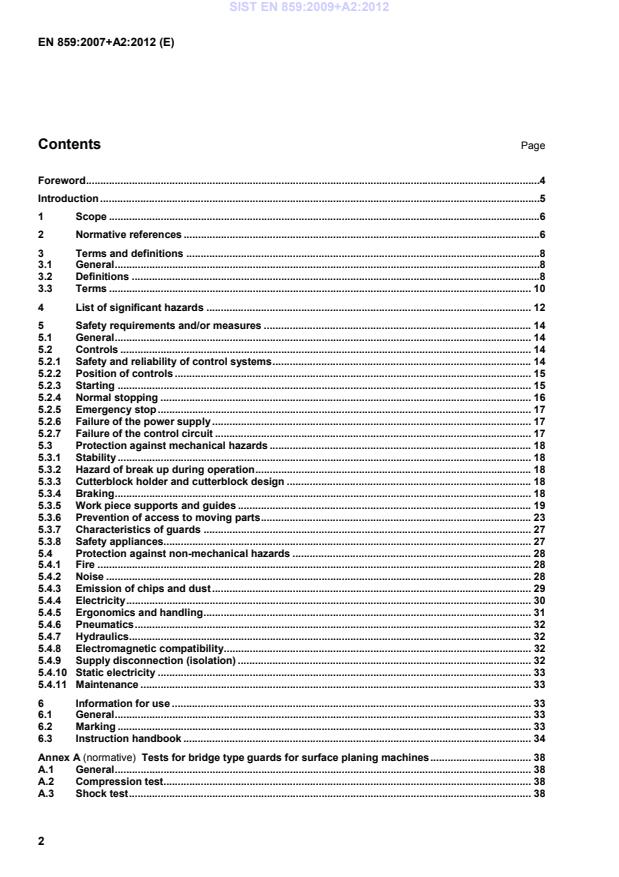
Tests for bridge type guards for surface planing machines . 38A.1 General . 38A.2 Compression test. 38A.3 Shock test . 38SIST EN 859:2009+A2:2012
Table lip resistance test . 40B.1 General . 40B.2 Work piece . 40B.3 Measurements . 43B.4 Test . 43B.5 Result . 44Annex C (normative)
Stability test for displaceable machines . 45Annex D (normative)
Impact test method for guards . 46D.1 General . 46D.2 Test method . 46D.2.1 Preliminary remarks . 46D.2.2 Testing equipment . 46D.2.3 Projectile for guards . 46D.2.4 Sampling. 46D.2.5 Test procedure . 47D.3 Results . 47D.4 Assessment . 47D.5 Test report . 47D.6 Test equipment for impact test . 47Annex E (normative)
Braking tests . 51E.1 Conditions for all tests . 51E.2
####Un-braked$$$$ run-down time . 51E.3 Braked run-down time . 51Annex ZA (informative)
!Relationship between this European Standard and the Essential Requirements of EU Directive 2006/42/EC"""" . 53Bibliography . 56 SIST EN 859:2009+A2:2012
December 2012. Attention is drawn to the possibility that some of the elements of this document may be the subject of patent rights. CEN [and/or CENELEC] shall not be held responsible for identifying any or all such patent rights. This document includes Amendment 1, approved by CEN on 2009-10-24 and Amendment 2, approved by CEN on 2012-05-13. The start and finish of text introduced or altered by amendment is indicated in the text by tags! " and
# $. This document supersedes #EN 859:2007+A1:2009$. This document has been prepared under a mandate given to CEN by the European Commission and the European Free Trade Association, and supports essential requirements of the #Machinery EU Directive$. #For relationship with Machinery EU Directive, see informative Annex ZA, which is an integral part of this document.$ Organisation contributing to the preparation of this document include the European Association of Manufacturer of Woodworking Machines "EUMABOIS". The European Standards produced by CEN/TC 142 are particular to woodworking machines and complement the relevant A and B standards on the subject of general safety (see introduction of #EN ISO 12100:2010$ for a description of A, B and C standards). According to the CEN/CENELEC Internal Regulations, the national standards organizations of the following countries are bound to implement this European Standard: Austria, Belgium, Bulgaria, Croatia, Cyprus, Czech Republic, Denmark, Estonia, Finland, France, Germany, Greece, Hungary, Iceland, Ireland, Italy, Latvia, Lithuania, Luxembourg, Malta, Netherlands, Norway, Poland, Portugal, Romania, Slovakia, Slovenia, Spain, Sweden, Switzerland, Turkey and the United Kingdom.
#EN 61029-2-3:2009$. b) hand held planers or any adaptation permitting their use in a different mode, i.e. bench mounting. NOTE 2 Hand-held motor-operated electric tools are dealt with by #EN 60745-1:2009$ together with #EN 60745-2-14:2009$. This document is not applicable to hand fed surface planing machines which are manufactured before the date of its publication as EN. NOTE 3 Machines covered by this document are listed under #2$ of Annex IV of the Machinery Directive. 2 Normative references The following referenced documents are indispensable for the application of this document. For dated references, only the edition cited applies. For undated references, the latest edition of the referenced document (including any amendments) applies. !deleted text" #EN 847-1:2005+A1:2007$, Tools for woodworking — Safety requirements — Part 1: Milling tools, circular saw blades #deleted text$ #EN 1005-2:2003+A1:2008$, Safety of machinery — Human physical performance — Part 2: Manual handling of machinery and component parts of machinery #EN 1005-4:2005+A1:2008$, Safety of machinery — Human physical performance — Part 4: Evaluation of working postures and movements in relation to machinery #EN 1037:1995+A1:2008$, Safety of machinery — Prevention of unexpected start-up EN 50178:1997, Electronic equipment for use in power installations EN 50370-1:2005, Electromagnetic compatibility (EMC) — Product family standard for machine tools —
Part 1: Emission SIST EN 859:2009+A2:2012
Part 2: Immunity EN 60204-1:2006, Safety of machinery — Electrical equipment of machines — Part 1: General requirements (IEC 60204-1:2005, modified) EN 60439-1:19991), Low-voltage switchgear and controlgear assemblies — Part 1: Type-tested and partially type-tested assemblies (IEC 60439-1:1999) EN 60529:19912), Degrees of protection provided by enclosures (IP code) (IEC 60529:1989) !EN 61310-1:2008, Safety of machinery — Indication, marking and actuation — Part 1: Requirements for visual, auditory and tactile signals (IEC 61310-1:2007)" EN 61496-1:2004, Safety of machinery — Electro-sensitive protective equipment — Part 1: General requirements and tests (IEC 61496-1:2004, modified) #deleted text$ #EN 61800-5-2:2007, Adjustable speed electrical power drive systems — Part 5-2: Safety requirements — Functional (IEC 61800-5-2:2007)$ #EN ISO 3743-1:2010$, #Acoustics — Determination of sound power levels and sound energy levels of noise sources using sound pressure — Engineering methods for small movable sources in reverberant fields — Part 1: Comparison method for a hard-walled test room (ISO 3743-1:2010)$ #EN ISO 3743-2:2009$, Acoustics — Determination of sound power levels of noise sources using sound pressure — Engineering methods for small, movable sources in reverberant fields — Part 2: Methods for special reverberation test rooms (ISO 3743-2:1994) #EN ISO 3744:2010$, #Acoustics — Determination of sound power levels and sound energy levels of noise sources using sound pressure — Engineering methods for an essentially free field over a reflecting plane (ISO 3744:2010)$ #EN ISO 3745:2009$, Acoustics — Determination of sound power levels of noise sources using sound pressure — Precision methods for anechoic and semi-anechoic rooms (ISO 3745:2003) #EN ISO 3746:2010$, #Acoustics — Determination of sound power levels and sound energy levels of noise sources using sound pressure — Survey method using an enveloping measurement surface over a reflecting plane (ISO 3746:2010)$ #EN ISO 4413:2010, Hydraulic fluid power — General rules and safety requirements for systems and their components (ISO 4413:2010) EN ISO 4414:2010, Pneumatic fluid power — General rules and safety requirements for systems and their components (ISO 4414:2010)$ #EN ISO 4871:2009$, Acoustics — Declaration and verification of noise emission values of machinery and equipment (ISO 4871:1996) #EN ISO 9614-1:2009$, Acoustics — Determination of sound power levels of noise sources using sound intensity — Part 1: Measurement at discreet points (ISO 9614-1:1993)
1) #EN 60439-1:1999 is impacted by EN 60439-1:1999/A1:2004.$ 2) #EN 60529:1991 is impacted by EN 60529:1991/A1:2000.$ SIST EN 859:2009+A2:2012
(ISO 13850:2006)" !EN ISO 13857:2008, Safety of machinery — Safety distances to prevent hazard zones being reached by upper and lower limbs (ISO 13857:2008)" HD 22.4 S4:2004, Cables of rated voltages up to and including 450/750 V and having crosslinked insulation — Part 4: Cords and flexible cables
ISO 7571:1986, Woodworking machines — Surface planing machines with cutterblock for one-side dressing — Nomenclature and acceptance conditions ISO 7960:1995, Airborne noise emitted by machine tools — Operating conditions for woodworking machines 3 Terms and definitions 3.1 General For the purposes of this document, the terms and definitions given in #EN ISO 12100:2010$ and the following apply: 3.2 Definitions 3.2.1 handfed surface planing machine machine designed for cutting off layers of the lower surface of a work piece by a cutterblock rotating around a horizontal axis, mounted at right angles to the infeed direction between two tables designed to position and support the work piece NOTE The cutterblock is a cylindrical shaped complex tool equipped with blades with horizontal straight cutting line that cuts while rotating (see also for a description of the complex tool #EN 847-1:2005+A1:2007$). The work piece is fed into the machine against the direction of the cut. SIST EN 859:2009+A2:2012
####3.2.15$$$$ information from the supplier statement, sales literature, leaflets or other documents, where a manufacturer (or supplier) declares either the characteristics or the compliance of the material or product to a relevant standard ####3.2.16 performance level PL discrete level used to specify the ability of safety-related parts of control systems to perform a safety function [EN ISO 13849-1:2008, 3.1.23]$
3.3 Terms The names of the main parts of the machine are shown in Figure 1. Working operations when using the machine in the surfacing mode are shown in Figure 2.
Key
1 main frame 2 infeed table 3 outfeed table 4 tiltable fence 5 bridge guard 6 bridge guard adjustment 7 guard rear the fence 8 cutterblock 9 controls 10 fence tilting adjustment 11 table height adjustment 12 dust extraction outlet Figure 1 — Example of hand fed surface planing machine
Figure 2 — Planing (left) and edging (right) SIST EN 859:2009+A2:2012
No Hazards, hazardous situations and hazardous events EN ISO 12100:2010
Relevant clause of this document
1 Mechanical hazards related to: - machine parts or work pieces due to:
a) shape; 6.2.2.1, 6.2.2.2, 6.3 5.3.3, 5.3.5, 5.3.6
b) relative location; 5.2.2, 5.3.5, 5.3.6
c) mass and stability (potential energy of elements which may move under the effect of gravity); 5.3.1, 5.3.5
e) mechanical strength; 5.3.5, 5.3.6, 5.3.7
- accumulation of energy inside the machinery by:
f) elastic elements (springs); 6.2.10, 6.3.5.4 5.3.6
g) liquids and gases under pressure.
5.4.6, 5.4.7 1.1 Crushing hazard
5.3.7 1.3 Cutting or severing hazard 5.3.3, 5.3.7 1.4 Entanglement hazard 5.3.7 1.5 Drawing-in or trapping hazard 5.3.7 1.6 Impact hazard 5.3.5 1.9 High pressure fluid injection or ejection hazard 6.2.10 5.4.6, 5.4.7 2 Electrical hazards due to: 2.1 Contact of persons with live parts (direct contact) 6.2.9, 6.3.5.4 5.4.4 2.2 Contact of persons with parts which have become live under faulty conditions (indirect contact) 6.2.9 5.4.4 to be continued SIST EN 859:2009+A2:2012
No Hazards, hazardous situations and hazardous events EN ISO 12100:2010
Relevant clause of this document
4 Hazards generated by noise, resulting in: 4.1 Hearing loss (deafness), other physiological disorders (loss of balance, loss of awareness) 6.2.2.2, 6.3 5.4.2 4.2 Interference with speech communication, acoustic signals 5.4.2 7 Hazards generated by materials and substances (and their constituent elements) processed or used by the machinery: 7.1 Hazards from contact with or inhalation of harmful fluids and dusts 6.2.3, 6.2.4
5.4.3 7.2 Fire
6.2.4
5.4.1 8 Hazards generated by neglecting ergonomic principles in machinery design: 8.1 Unhealthy postures or excessive effort 6.2.7, 6.2.8, 6.2.11.12, 6.3.5.5, 6.3.5.6 5.2.2 8.2 Hand-arm or foot-leg anatomy 6.2.8.3 5.3.6 8.4 Local lighting 6.2.8.6
6.3 8.6 Human error, human behaviour 6.2.8, 6.2.11.8, 6.2.11.10, 6.3.5.2, 6.4 6.3 8.7 Design, location or identification of manual controls 6.2.8.7, 6.2.11.8
5.2.2 8.8 Design or location of visual display units 6.2.8.8, 6.4.2 5.4.5, 6.2 9 Hazard combination 6.3.2.1 5.2.3, 5.2.5, 5.2.6, 5.2.7, 5.4.9 and 5.4.10 10 Unexpected start-up, unexpected overrun/overspeed (or any similar malfunction) from: 10.1 Failure/disorder of the control system 6.2.11, 6.3.5.4
5.2.1, 5.2.6, 5.2.7 10.2 Restoration of energy supply after an interruption 6.2.11.4
5.2.6 10.3 External influences on electrical equipment 6.2.11.11 5.2.1, 5.4.8 to be continuedSIST EN 859:2009+A2:2012
No Hazards, hazardous situations and hazardous events EN ISO 12100:2010
Relevant clause of this document
10.5 Errors in the software 6.2.11.7 5.2.1 11 Impossibility of stopping the machine in the best possible conditions 6.2.11.1, 6.2.11.3, 6.3.5.2
5.2.4, 5.2.5, 5.3.4 13 Failure of the power supply 6.2.11.1, 6.2.11.4 5.2.6 14 Failure of the control circuit 6.2.11, 6.3.5.4
5.2.1, 5.2.7 16 Break-up during operation 6.2.3 5.3.2 17 Falling or ejected objects or fluids 6.2.3, 6.2.10
5.3.2, 5.3.3, 5.3.5 18 Loss of stability / overturning of machinery 6.3.2.6
5.3.1 $
5 Safety requirements and/or measures 5.1 General The machine shall comply with the safety requirements and/or protective measures of Clause 5. #In addition, the machine should be designed according to the principles of EN ISO 12100:2010 for hazards relevant but not significant, which are not dealt with by this document (e.g. sharp edges of the machine frame). For guidance in connection with risk reduction by design see 6.2 of EN ISO 12100:2010 and for safeguarding measures see 6.3 of EN ISO 12100:2010.$ 5.2 Controls 5.2.1 Safety and reliability of control systems #deleted text$ For the purpose of this document safety related part of a control system means the system from the initial device, e.g. actuator or position detector or sensor up to and including the power control element of the final machine actuator, e.g. motor or brake. Safety related parts of the control system of this machine comprise parts concerning the following functions and #they shall fulfil at least the requirements of the PL given below in accordance with the requirements of EN ISO 13849-1:2008:$ starting: #PL=c$ (see 5.2.3 and 5.3.4.2); normal stopping: #PL=c$ (see 5.2.4); emergency stop: #PL=c$ (see 5.2.5); SIST EN 859:2009+A2:2012
1 800 mm above the floor level and the distance between its front face and the front edge of the infeed table shall be not more than 650 mm. The front face of the panel shall not protrude beyond the surface planing table at the operator position side. Verification: By checking the relevant drawings, measurement and inspection of the machine. 5.2.3 Starting Before starting or restarting the machine all the interlocked safeguards shall be in place and functional. This is achieved by the interlocking arrangement described in 5.3.7. For non interlocked guards, guides adjustments' provisions before starting see 6.3 j). Start or restart shall only be possible by actuation of the start control device provided for that purpose. For electrically operated machines the requirements of 9.2.5.2 of EN 60204-1:2006 shall apply and in addition: for the purpose of this document "operation" means rotation of the cutterblock and/or powered adjustment; start of a demountable power feed unit – if fitted – shall be possible only where the #cutterblock$ motor is running #deleted text$. #When adjustment of the infeed table is powered, the control shall be via a hold to run control or a preset electronic control. SIST EN 859:2009+A2:2012
cutterblock motor and to the table adjustment if under preset electronic control, and apply the brake; 2) #cut power to the brake after the tool has come to rest e.g. by a time delay of fail safe technique e.g. of capacity type or conforming at least to PL=c in accordance with the requirements of
EN ISO 13849-1:2008.$ The design of the #control systems$ shall be such as to satisfy the normal stopping sequence requirements. If a time delay device is used the time delay shall be at least equal to the braking time. The time delay shall be fixed or the time delay adjustment device shall be sealed. #The safety related part of the control systems (also see 5.2.1) for normal stopping shall be at least PL=c in accordance with in accordance with the requirements of EN ISO 13849-1:2008.$ For machines designed to be used with de-mountable power feed unit or if a socket for a demountable power feed unit is fitted a separate category 1 stop control device in accordance with the requirements in 9.2.2 of
EN 60204-1:2006 shall be provided for the de-mountable power feed unit only. Verification: By checking the relevant drawings and/or circuit diagrams, inspection of the machine and relevant functional testing of the machine. SIST EN 859:2009+A2:2012
#For emergency stop of PDS(SR) see 4.2.2.2 "safe torque off (STO)” and 4.2.2.3 “safe stop 1 (SS1)” of EN 61800-5-2:2007.$ In addition the following requirements shall be met: If the machine is fitted with #a spring operated mechanical brake$ the emergency stop function shall conform to category 0 in accordance with the requirements in 4.1.4 of #EN ISO 13850:2008$ and the emergency stop control circuit shall conform to category 0 in accordance with the requirements in 9.2.2 of EN 60204-1:2006 and shall fulfil the requirements of 9.2.5.4.2 of EN 60204-1:2006. If the machine #is fitted with any other type of brake e.g. an electrical brake$ the emergency stop function shall conform to category 1 in accordance with the requirements in 4.1.4 of #EN ISO 13850:2008$ and the emergency stop control circuit shall conform to category 1 in accordance with the requirements in 9.2.2 of EN 60204-1:2006 and shall fulfil the requirements of 9.2.5.4.2 of EN 60204-1:2006. When initiated the emergency stopping sequence shall be the same as for normal stopping (see 5.2.4). The design of the #control systems$ shall be such as to satisfy the emergency stopping sequence requirements. If a time delay device is used the time delay shall be at least the maximum run-down time. Either the time delay shall be fixed or the time delay adjustment device shall be sealed. #The safety related part of the control sytems (also see 5.2.1) for emergency stop shall be at least PL=c in accordance with the requirements of EN ISO 13849-1:2008.$ Verification: By checking the relevant drawings and/or circuits diagrams, inspection of the machine and functional testing of the machine. 5.2.6 Failure of the power supply The restoration of the energy supply after a supply interruption shall not result in a restart of any machine actuator in accordance with the requirements of #EN 1037:1995+A1:2008$. For electrically driven machines this is achieved e.g. by providing an #under voltage$ protection at a predetermined #under voltage$ level in accordance with the requirements in 7.5, paragraphs 1 and 3 of EN 60204-1:2006. In the case of pneumatic and/or hydraulic supply interruption and where a dangerous movement is possible after the restoration of the supply pressure re-starting of any dangerous movement of the machine shall be prevented. Verification: By checking the relevant drawings and/or circuit diagrams, inspection of the machine and functional testing of the machine. 5.2.7 Failure of the control circuit The requirements of Clause 6 of #EN 1037:1995+A1:2008$ shall apply and in addition: The control circuits shall be designed so that a line rupture in any circuit (e.g. broken wire, pipe or hose) will not result in the loss of a safety function e.g. involuntary start in accordance with EN 60204-1:2006, #EN ISO 4413:2010$ and #EN ISO 4414:2010$. For requirements for the #control systems$ see 5.2.1. SIST EN 859:2009+A2:2012
#EN 847-1:2005+A1:2007$. A gauge for the correct positioning of the knives shall be provided for machines where the knives are not automatically positioned. Verification: By checking the relevant drawings and inspection of the machine. 5.3.4 Braking 5.3.4.1 General #An automatic brake shall be provided for cutterblock drive with an un-braked run-down time exceeding 10 s.$ The braked run-down time shall be less than 10 s. #A PLr of at least c for the braking function shall be achieved.$ #Where a mechanical brake is fitted the last paragraph of 9.3.4 of EN 60204-1:2006 does not apply.$ For electrical braking systems, reverse current injection braking shall not be used. #As an exception where an electrical braking system is used and contains electronic compone
...