


EN 1279-1:2018
(Main)Glass in Building - Insulating glass units - Part 1: Generalities, system description, rules for substitution, tolerances and visual quality
Glass in Building - Insulating glass units - Part 1: Generalities, system description, rules for substitution, tolerances and visual quality
This document (all parts) covers the requirements for insulating glass units. The main intended uses of the insulating glass units are installations in windows, doors, curtain walling, bonded glazing for doors, windows and curtain walling, roofs and partitions.
The achievement of the requirements of this standard indicates that insulating glass units fulfil the needs for intended use and ensures by means of the evaluation of conformity to this standard that, visual, energetic, acoustic, safety parameters do not change significantly over time.
In cases where there is no protection against direct ultraviolet radiation or permanent shear load on the edge seal, as in bonded glazing for doors, windows and curtain walling systems, it is essential to follow additional European Technical Specifications (see EN 15434, EN 13022 1 and prEN 16759).
Insulating glass units that are intended for artistic purposes (e.g. lead glass or fused glass) are excluded from the scope of this standard.
Vacuum insulating glass is not covered by this standard (see ISO DIS 19916 1).
Glass/plastics composites are under the scope as long as the surface of contact with sealants is a glass component.
NOTE For glass products with electrical wiring or connections for, e.g. alarm or heating purposes, other directives, e.g. Low Voltage Directive, may apply.
This European Standard gives definitions for insulating glass units and covers the rules for the system description, the optical and visual quality and the dimensional tolerances thereof and describes the substitution rules based on an existing system description.
Glas im Bauwesen - Mehrscheiben-Isolierglas - Teil 1: Allgemeines, Systembeschreibung, Austauschregeln, Toleranzen und visuelle Qualität
Dieses Dokument (alle Teile) behandelt die Anforderungen an Mehrscheiben-Isoliergläser. Die Haupt-verwendungsgebiete für Mehrscheiben-Isoliergläser sind der Einbau in Fenster, Türen, Vorhangfassaden, geklebte Verglasungen für Türen, Fenster, vorgehängte Fassaden, Dächer und Trennwände.
Das Erfüllen der Anforderungen dieser Norm bedeutet, dass Mehrscheiben-Isoliergläser den Bedarf für den bestimmungsgemäßen Gebrauch erfüllen und stellt mit Hilfe der Bewertung der Konformität mit dieser Norm sicher, dass visuelle, energetische, akustische und sicherheitsbezogene Parameter sich mit der Zeit nicht signifikant ändern.
In Fällen, in denen kein Schutz vor direkter UV-Bestrahlung gegeben ist oder bei dauernden, auf den Rand-verbund wirkenden Scherlasten wie in geklebten Verglasungen für Türen, Fenster und vorgehängte Fassaden sind zusätzliche Europäische Technische Spezifikationen zu befolgen (siehe EN 15434, EN 13022-1 und prEN 16759).
Mehrscheiben-Isoliergläser für künstlerische Zwecke (z. B. Bleiglas oder verschmolzenes Glas) sind nicht Gegenstand dieser Norm.
Vakuumisolierglas ist nicht Gegenstand dieser Norm (siehe ISO/DIS 19916-1).
Glas/Kunststoff-Verbunde gehören zum Anwendungsbereich, solange die Oberfläche, die mit dem Dichtstoff in Kontakt steht, aus Glas ist.
ANMERKUNG Für Glaserzeugnisse mit elektrischer Verdrahtung oder elektrischen Anschlüssen, für z. B. Alarm- oder Heizfunktionen, können weitere Richtlinien, z. B. die Niederspannungsrichtlinie, gelten.
Diese Europäische Norm umfasst Definitionen für Mehrscheiben-Isoliergläser und die Regeln für die System-beschreibung, die optische und visuelle Qualität sowie die Maßtoleranzen und beschreibt die Regeln für den Austausch innerhalb einer bestehenden Systembeschreibung.
Verre dans la construction - Vitrage isolant - Partie 1 : Généralités, description du système, règles de substitution, tolérances et qualité visuelle
Le présent document (toutes les parties) couvre les exigences relatives aux vitrages isolants. Les usages prévus des vitrages isolants sont principalement les installations dans des fenêtres, des portes, des façades-rideaux, des vitrages extérieurs collés, des toitures et des cloisons.
Lorsque les exigences à cette norme sont satisfaites, les vitrages isolants répondent aux besoins pour l'usage prévu et il est assuré, du fait de l'évaluation de la conformité à cette norme, que les paramètres visuels, énergétiques, acoustiques et de sécurité ne varient pas de façon significative dans le temps.
En l'absence de protection contre les rayonnements ultraviolets directs en cas de cisaillement permanent sur les bords, comme dans le cas des vitrages extérieurs collés, il est nécessaire de se conformer à des Spécifications Techniques Européennes supplémentaires (voir EN 15434 et EN 13022-1 et prEN 16759).
Les vitrages isolants, destinés à une utilisation artistique (par exemple, verre au plomb ou verre fondu) ne relèvent pas du domaine d'application de la présente norme.
Les vitrages isolants à lame de vide ne sont pas couverts par la présente norme (voir ISO DIS 19916-1).
Les composites verre/plastique relèvent du domaine d'application de la présente norme pour autant que la surface de contact avec les mastics de scellement soit un composant verrier.
NOTE Pour les produits verriers équipés d'un câblage ou de branchements électriques pour les besoins d'alarme ou de chauffage par exemple, d'autres directives, comme par exemple la Directive « Basse tension », peuvent s'appliquer.
La présente Norme européenne donne des définitions pour les vitrages isolants et couvre les règles pour la description du système, la qualité optique et visuelle ainsi que les tolérances dimensionnelles et décrit les règles de substitution, dans une description de système existant.
Steklo v gradbeništvu - Izolacijsko steklo - 1. del: Splošno, opis sistema, pravila za zamenjavo, tolerance in vizualna kakovost
Ta evropski standard (vsi deli) zajema zahteve za izolacijsko steklo. Glavne predvidene uporabe izolacijskega stekla so vgradnja v okna, vrata, obešene fasade, strukturno zasteklitev, strehe in predelne stene.
Izpolnitev zahtev tega standarda pomeni, da izolacijsko steklo izpolnjuje potrebe predvidene uporabe in s pomočjo ocene skladnosti s tem standardom zagotovi, da se vizualni, energetski, zvočni in varnostni parametri s časom bistveno ne spremenijo.
Kadar ni nobene zaščite pred neposrednim ultravijoličnim sevanjem ali trajnimi strižnimi obremenitvami robov, kot pri sistemih strukturnih zasteklitev, je nujno upoštevati dodatne evropske tehnične specifikacije (glejte EN 15434 in EN 13022-1).
Izolacijsko steklo za umetniške namene (npr. svinčevo steklo ali taljeno steklo) ne spada na področje uporabe tega standarda. Stekleni/polimerni kompoziti spadajo na področje uporabe tega standarda, če je površina stika s tesnili steklena komponenta.
OPOMBA: za steklene proizvode z električno napeljavo ali priključki za npr. alarmne ali grelne namene se lahko uporabljajo druge direktive, npr. direktiva o nizki napetosti.
Ta evropski standard določa definicije za izolacijsko steklo in zajema pravila za opis sistema, optično in vizualno kakovost ter dimenzijska odstopanja in opisuje pravila o zamenjavi znotraj obstoječega opisa sistema. Podaja tudi informativna navodila za vgradnjo izolacijskega stekla v okna in fasade.
General Information
Relations

Standards Content (Sample)
2003-01.Slovenski inštitut za standardizacijo. Razmnoževanje celote ali delov tega standarda ni dovoljeno.Steklo v gradbeništvu - Izolacijsko steklo - 1. del: Splošno, opis sistema, pravila za zamenjavo, tolerance in vizualna kakovostGlas im Bauwesen - Mehrscheiben-Isolierglas - Teil 1: Allgemeines, Systembeschreibung, Austauschregeln, Toleranzen und visuelle QualitätVerre dans la construction - Vitrage isolant - Partie 1: Généralités, description du système, règles de substitution, tolérances et qualité visuelleGlass in Building - Insulating glass units - Part 1: Generalities, system description, rules for substitution, tolerances and visual quality81.040.20Steklo v gradbeništvuGlass in buildingICS:Ta slovenski standard je istoveten z:EN 1279-1:2018SIST EN 1279-1:2018en,fr,de01-oktober-2018SIST EN 1279-1:2018SLOVENSKI
STANDARDSIST EN 1279-1:2004/AC:2006SIST EN 1279-1:20041DGRPHãþD
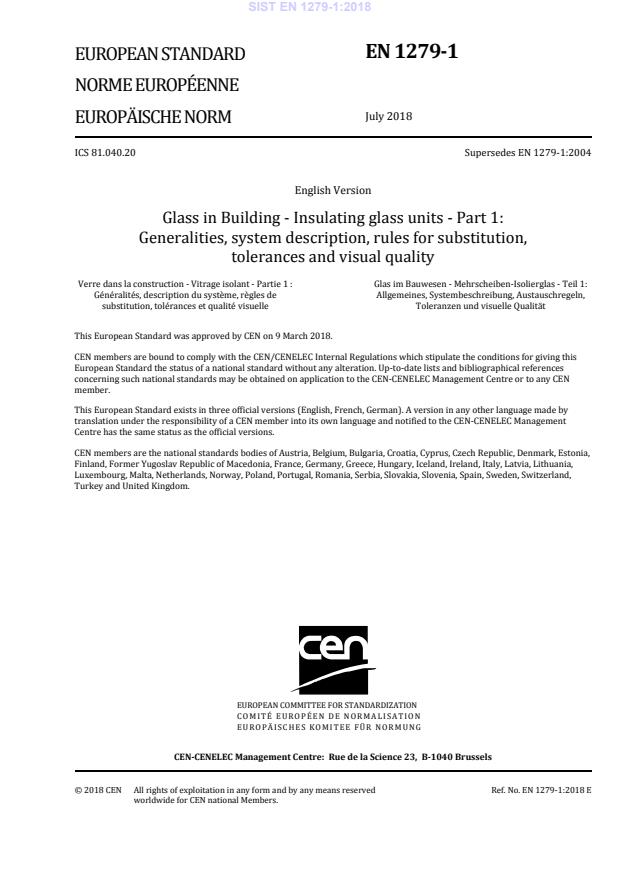
EUROPEAN STANDARD NORME EUROPÉENNE EUROPÄISCHE NORM
EN 1279-1
July
t r s z ICS
z sä r v rä t r Supersedes EN
s t y {æ sã t r r vEnglish Version
Glass in Building æ Insulating glass units æ Part
sã Generalitiesá system descriptioná rules for substitutioná tolerances and visual quality Verre dans la construction æ Vitrage isolant æ Partie
s ã Généralitésá description du systèmeá règles de substitutioná tolérances et qualité visuelle
Glas im Bauwesen æ MehrscheibenæIsolierglas æ Teil
sã Allgemeinesá Systembeschreibungá Austauschregelná Toleranzen und visuelle Qualität This European Standard was approved by CEN on
{ March
t r s zä
egulations which stipulate the conditions for giving this European Standard the status of a national standard without any alterationä Upætoædate lists and bibliographical references concerning such national standards may be obtained on application to the CENæCENELEC Management Centre or to any CEN memberä
translation under the responsibility of a CEN member into its own language and notified to the CENæCENELEC Management Centre has the same status as the official versionsä
CEN members are the national standards bodies of Austriaá Belgiumá Bulgariaá Croatiaá Cyprusá Czech Republicá Denmarká Estoniaá Finlandá Former Yugoslav Republic of Macedoniaá Franceá Germanyá Greeceá Hungaryá Icelandá Irelandá Italyá Latviaá Lithuaniaá Luxembourgá Maltaá Netherlandsá Norwayá Polandá Portugalá Romaniaá Serbiaá Slovakiaá Sloveniaá Spainá Swedená Switzerlandá Turkey and United Kingdomä
EUROPEAN COMMITTEE FOR STANDARDIZATION COMITÉ EUROPÉEN DE NORMALISATION EUROPÄISCHES KOMITEE FÜR NORMUNG
CEN-CENELEC Management Centre:
Rue de la Science 23,
B-1040 Brussels
t r s z CEN All rights of exploitation in any form and by any means reserved worldwide for CEN national Membersä Refä Noä EN
s t y {æ sã t r s z ESIST EN 1279-1:2018
System description of insulating glass units . 22 Annex B (normative)
Examples of insulating glass unit systems . 23 B.1 General . 23 B.2 Organic sealed insulating glass units with rigid hollow spacer . 23 B.3 Insulating glass units sealed by hot applied flexible spacer incorporating desiccant . 23 B.4 Insulating glass units with prefabricated flexible spacer . 24 B.5 Organic sealed insulating glass units with U-channel shaped spacer incorporating desiccant matrix . 25 B.6 Air filled insulating glass units sealed by a metal strip between the glass panes . 27 Annex C (informative)
Compatibility of components within an insulating glass unit system . 28 C.1 Compatibility . 28 C.2 Diffusion and equilibrium . 28 C.3 Contact . 28 C.4 Interaction . 28 C.5 Factors affecting compatibility . 28 SIST EN 1279-1:2018
Rules to substitute materials and components, possible changes within components and addition in the system description . 30 D.1 General comments. 30 D.2 Tables of possibilities to substitute materials and components, and of possible changes within components . 30 D.3 Addition of components . 35 D.3.1 Addition of cavity inserts without change of the permeation barrier design . 35 D.3.2 Addition of cavity inserts with change of the permeation barrier design . 35 Annex E (informative)
Edge seal strength comparison in case of substituting outer sealant . 36 Annex F (normative)
Visual quality of insulating glass units . 37 F.1 General . 37 F.2 Observation conditions . 37 F.3 Insulating glass unit made of two panes of monolithic glass . 38 F.3.1 Spot faults . 38 F.3.2 Residues . 39 F.3.3 Linear / extended fault . 39 F.4 Insulating glass units other than made of two monolithic glass panes. 39 F.5 Insulating glass unit containing a heat treated glass . 40 F.6 Edge defects . 40 F.7 Tolerance on spacer straightness . 40 F.8 Curved insulating glass units . 41 Annex G (informative)
Other visual aspects of insulating glass units . 42 G.1 General . 42 G.2 Inherent colour . 42 G.3 Difference in insulating glass unit colour . 42 G.4 Interference effect . 42 G.5 Specific effect due to barometric conditions . 42 G.6 Multiple reflections . 42 G.7 Anisotropy (iridescence) . 43 G.8 Condensation on the external surface of the insulating glass unit . 43 G.9 Wetting of glass surfaces . 43 Bibliography . 44
IEC Electropedia: available at http://www.electropedia.org/
ISO Online browsing platform: available at http://www.iso.org/obp 3.1 insulating glass unit IGU assembly consisting of at least two panes of glass, separated by one or more spacers, hermetically sealed along the periphery, mechanically stable and durable (as specified in 6.1) 3.1.1 IGU type A IGU, when used for installation without permanent shear load in the sealant and protected against direct UV exposure on edge seal 3.1.2 IGU type B IGU, when used for installation with at least one edge not completely protected against direct UV radiation without permanent shear load in the sealant 3.1.3 IGU type C IGU when used for installation as bonded glazing for doors, windows and curtain walling with possible permanent shear load on edge sealant with or without direct UV radiation exposure Note 1 to entry: Permanent shear load can be avoided by mechanical support to carry the weight. Note 2 to entry: For IGU type B and C additional requirements in accordance with EN 15434 and EN 13022-1 may apply. SIST EN 1279-1:2018
Figure 1 — Example of permeation geometry 3.6 cross-over stress sealant tensile strength value at which its stress/strain curve crosses the line joining a stress of 0,50 MPa and a strain of 50 % Note 1 to entry: Value is determined following EN 1279-4:2018, Annex A. SIST EN 1279-1:2018
Figure 2 — Main families of spacers 3.16 hollow spacer spacer intended to be filled with desiccant 3.17 rigid spacer frame set of hollow spacers, that provide enough rigidity to be
preassembled prior to application and applied against one pane of the insulating glass unit before the assembly Note 1 to entry: examples of rigid spacer frame are a frame bent with joint piece or connected with corner keys, or a welded frame. 3.18 hollow metallic spacer hollow spacer, painted or not, where at least 1/4 of the inner sealant adhesion height r (see Figure 3) and all of the contact surface with outer sealant shall be metallic adhesion surface (see 3.23) 3.19 joint piece piece that connects parts of a spacer SIST EN 1279-1:2018
«2
® d «1) quantity of water vapour steadily transmitted through a 2 mm sealant film at specified conditions of temperature and water vapour concentration Note 1 to entry: Water vapour transmission rate (WVTR) was called moisture vapour transmission rate (MVTR) in the previous version of the standard. 3.44 gas permeation rate
«2
® d «1) quantity of gas, steadily transmitted through a 2 mm sealant film at specified conditions of temperature and gas concentration 3.45 standard laboratory conditions ambient temperature of (23 ± 2) °C and relative humidity of (50 ± 5) % 3.46 gas chemical compound or element in gaseous state Note 1 to entry: In the context of this standard gas is all gas other than air. 3.47 standard moisture adsorption capacity Tc (%) Total capacity of a desiccant material to adsorb moisture at specified conditions Note 1 to entry: Tc is expressed as the sum of AWAC and LOI following EN 1279-4:2018, Annex E. 3.48 moisture penetration index I (%) amount of available moisture adsorption capacity consumed SIST EN 1279-1:2018
EN 1279-4:2018, Annex E 3.51 gas-filled insulating glass units insulating glass unit in which the cavity is filled with gas(es) usually for improving thermal insulation 3.52 gas concentration ci (%) percentage by volume of gas in the cavity Note 1 to entry: gas concentration is determined by EN 1279-3 testing 3.53 gas leakage rate Li (%.a-1) gas volume leaking from insulating glass unit given in percentage of volume per year at 20 °C 4 Symbols and abbreviations for edge seal The edge seal is characterized by its geometry and when relevant by the weight R of inner sealant per length (g/m). An example is given in Figure 3. SIST EN 1279-1:2018
Key 1 cavity 2 inner sealant 3 outer sealant 4 spacer, containing desiccant r average height of the inner sealant on glass surface s average height of outer sealant on glass surface t height of spacer u average effective height of outer sealant on the back of the spacer v width of spacer w concavity of outer seal d total thickness of IGU Figure 3 — Example of edge seal dimensions 5 Requirements 5.1 General The great number of possible different IGUs allow for a distinction to be made between systems, based on common edge seal design, edge seal materials and other edge components. For conformity control purposes, the manufacturer shall describe his system in a system description, which will be a part of the factory production control documentation. See also Annex A, Annex B and EN 1279-6:2018. The rules for the system description are given in Annex A. It contains mainly a list of the applied edge seal materials and components, the nominal edge seal dimensions of the finished product, the action limits and the absolute limits. Insulating glass unit systems can vary in the materials listed below, the limits in height, width, cavity width, glass thickness and number of cavities. These lists are not exhaustive. SIST EN 1279-1:2018
EN 572-2 — Polished wired glass EN 572-3 — Drawn sheet glass EN 572-4 — Patterned glass EN 572-5 — Wired patterned glass EN 572-6 — Supplied and final cut sizes EN 572-8 5.2.3 Special basic glasses These are glass products manufactured from a variety of compositions, which are in accordance with appropriate European Standards, and consist of the following: — Borosilicate glass EN 1748-1-1 — Glass ceramics EN 1748-2-1 — Alkaline earth silicate glass EN 14178-1 — Alumino silicate glass EN 15681-1 5.2.4 Strengthened glasses These are soda lime silicate glasses that have been strengthened by thermal or chemical means and are as follows: SIST EN 1279-1:2018
EN ISO 12543-3 — Laminated safety glass
EN ISO 12543-2 5.2.7 Coated glasses — coated glass
EN 1096-1 A list of coatings allowed to be used in direct contact with certain sealant(s) shall be established by and obtained from the coated glass manufacturer. Further layer combinations or coatings may be added to this list when evaluated in accordance with EN 1279-4:2018, Annex B. If a combination coating / sealant is not in that list, the insulating glass unit manufacturer shall not use that sealant in direct contact with that coating, Some coatings are not allowed to be used in direct contact with a sealant, whatever the sealant. In that case, the coating shall be deleted at the edges of the coated glass. 5.2.8 Surface worked glass — Surface worked glass (e.g. sand blasted, acid etched). The glass panes, processed or unprocessed, may be: — transparent, translucent or opaque; — clear or tinted. 5.2.9 Curved glass — Curved glass
ISO 11485, all relevant parts SIST EN 1279-1:2018
· 18 mm the tensile load on the sealant increases significantly. In these cases, a calculation of the edge seal tensile load should be made using prEN 16612:–1), Annex B. Calculation is made with climate load only. If the calculation result is higher than 1,3 N/mm the insulating glass unit edge seal design should be adjusted. NOTE Some indicative examples of tensile load in the sealant are given in Table 1 and Figure 3. They refer to the boundary condition of EN 1279-2:2018 test (testing temperature: 58 °C, manufacturing temperature: 15 °C). These values are defined without altitude variation. Table 1 — Comparative edge seal maximum tensile load in insulating glass units Insulating glass unit design (dimension of 352x502 mm) Edge seal Maximum tensile load (N/mm) 4/12/4 1,0 4/12/4/12/4 1,3 4/18/4/18/4 1,6 4/16/4 1,0
1) Under preparation. Stage at the time of publication: prEN 16612:2017. SIST EN 1279-1:2018
Key x length of the side (m) y maximum tensile load (N/mm) Figure 4 — Tensile load in insulating glass units depending on the design and the short side (ratio of sides is 1:3) NOTE The maximum load values cannot be recalculated to maximum tensile load within the edge seal components. Substitution of materials and of components shall maintain the conformity of the system with the definition of insulating glass units. The relevant rules are summarized in Tables D.1 to D.7, together with the validation methods. When meeting these requirements, the substituting materials and components shall be added to the system description. Curved insulating glass units according to ISO 11485-1 comply with this standard without having to undergo additional tests provided that non curved insulating glass unit with the same system complies to EN 1279. In this case special attention shall be addressed to the design of the seal system. 6.2 Optical and visual quality of the insulating glass unit Optical and visual quality requirements for insulating glass units are described in Annex F. NOTE Other visual aspects are described in Annex G. 6.3 Dimensional tolerances 6.3.1 General The following tolerances are based on the tolerances for single panes of glass given in the European Standards listed in 5.2, and offer the worst-case situations. Narrowing these tolerances can be a subject of contractual agreement between the insulating glass unit manufacturer and his glass supplier and/or SIST EN 1279-1:2018
Figure 5 — Examples of width and heignt relative to the pane shape The dimensional tolerances shall be part of the system description and subject to the factory production control in relevant clauses of EN 1279-6:2018. Guidance on dimensional tolerances are given in Table 2. Table 2 — Guidance on dimensional tolerances of insulating glass units Double / triple IGU Tolerances on B and H Misalignment all panes
¶ 6 mm, and (B and H)
¶ 2 000 mm
± 2 mm
¶ 2 mm 6 mm < thickest pane
¶ 12 mm, or 2 000 mm < (B or H)
¶ 3 500 mm ±3 mm
¶ 3 mm 3 500 mm < (B or H)
¶ 5 000 mm and thickest pane
¶ 12 mm ±4 mm
¶ 4 mm 1 pane > 12 mm, or (B or H) > 5 000 mm ±5 mm
¶ 5 mm Thicknesses are nominal thickness. Special dimensions and tolerances may be agreed. 6.3.3 Thickness tolerances along the periphery of the unit The actual thickness shall be measured between the outside glass surfaces of the unit, at each corner and at the approximate centre points of the edges. The values shall be measured to 0,01 mm accuracy and given to the nearest 0,1 mm. The measured thicknesses shall not vary from the nominal thickness given by the manufacturer of the insulating glass units by more than the tolerances shown in Table 3. SIST EN 1279-1:2018
Glazing Pane IGU thickness tolerance a double glazing All panes are annealed float glass ±1,0 mm At least one pane is laminated, patterned or not annealed glass ±1,5 mm triple glazing All panes are annealed float glass ±1,4 mm At least one pane is laminated, patterned or not annealed glass +2,8
mm a If one glass component has a nominal thickness greater than 12 mm in the case of annealed or toughened glass, or 20 mm in the case of laminated glass, the insulating glass unit manufacturer should be consulted. SIST EN 1279-1:2018
System description of insulating glass units The system description shall contain at least: — the IGU description including edge seal design and tolerances; — a list of components including absolute limits for tolerances. Action limits may be included. The component descriptions shall consist of: a) a drawing of a cross section of the sealed edge of the insulating glass unit to scale, with each component numbered (an example of this is given in Figure 3, see also Annex B). When not all components appear in the drawing, additional drawings shall be made; b) a list of the components according to the numbering of the detailed drawing(s), and in accordance with the relevant examples of Annex B; c) a list of inserts not detailed in the drawing; d) a record for each of the components. Each record shall contain: — a reference to the drawing with number and functional name of the component; — the name of supplier(s) or manufacturer(s); — a general description of the material(s) used for the component (e.g. desiccant), followed where appropriate by some more detailed information (e.g. molecular sieve 3 Å); — a drawing with dimensions related to the permeation geometry, when relevant. SIST EN 1279-1:2018
Examples of insulating glass unit systems B.1 General This annex gives examples of IGU systems commonly available. EN 1279-6:2018 gives the factory production control related to each of them. Depending on the system, the insulating glass unit can be either air-filled or gas-filled. B.2 Organic sealed insulating glass units with rigid hollow spacer Figure B.1 shows the principle of organic sealed insulating glass units with rigid hollow spacer, with outer sealant (cold or hot applied).
Key 1
desiccant 4 glass 2
spacer bar 5 inner sealant 3
diffusion openings 6 outer sealant Figure B.1 — Principle of an organic sealed insulating glass units with hollow spacer B.3 Insulating glass units sealed by hot applied flexible spacer incorporating desiccant Figure B.2 shows the principle of IGU with a flexible spacer frame with a hot applied flexible spacer incorporating desiccant. SIST EN 1279-1:2018
Key 1 glass 2 hot applied flexible spacer incorporating desiccant 3 outer sealant without desiccant 4 permeation barrier or spacer Figure B.2 — Examples of insulating glass units sealed by hot applied flexible spacer incorporating desiccant B.4 Insulating glass units with prefabricated flexible spacer Figure B.3 shows the principle of insulating glass units with prefabricated flexible spacer. Flexible spacers with pre-applied inner sealant are covered by this description. SIST EN 1279-1:2018
Key 1 glass 2 flexi
...
Questions, Comments and Discussion
Ask us and Technical Secretary will try to provide an answer. You can facilitate discussion about the standard in here.
Loading comments...