

ASTM D6466-10(2018)
(Test Method)Standard Test Method for Diameter of Wool and Other Animal Fibers By Sirolan-Laserscan Fiber Diameter Analyser
General Information
- Abstract
SIGNIFICANCE AND USE
5.1 This test method is considered satisfactory for acceptance testing of commercial shipments of wool and other animal fibers in raw and sliver form because current estimates of between-laboratory precision are acceptable. In cases of disagreement arising from differences in values reported by the purchaser and the supplier when using this test method for acceptance testing, Test Method D2130 shall be used as a referee method.
5.2 This test method may be used for determining compliance with average fiber diameter and diameter variation to assign grades when determining conformance of shipments to material specifications given in Specifications D2252, D2816, D3991, and D3992.
5.3 The procedures for determining mean fiber diameter and standard deviation of fiber diameter provided in this test method and in IWTO-12 are in essential agreement.
SCOPE
1.1 This test method covers a procedure, using the Sirolan-Laserscan, for the determination of the average fiber diameter and the fiber diameter variation in wool and other animal fibers in their various forms.
1.2 The values stated in SI units are to be regarded as the standard.
1.3 This standard does not purport to address all of the safety concerns, if any, associated with its use. It is the responsibility of the user of this standard to establish appropriate safety, health, and environmental practices and determine the applicability of regulatory limitations prior to use.
1.4 This international standard was developed in accordance with internationally recognized principles on standardization established in the Decision on Principles for the Development of International Standards, Guides and Recommendations issued by the World Trade Organization Technical Barriers to Trade (TBT) Committee.
- Status
- Published
- Publication Date
- 30-Jun-2018
- Technical Committee
- D13 - Textiles
- Drafting Committee
- D13.13 - Wool and Felt
Overview
ASTM D6466-10(2018): Standard Test Method for Diameter of Wool and Other Animal Fibers By Sirolan-Laserscan Fiber Diameter Analyser provides a standardized procedure for measuring the average fiber diameter and diameter variation of wool and other animal fibers using the Sirolan-Laserscan instrument. This method supports the accurate and repeatable assessment of fiber fineness, which is a critical quality parameter in textile manufacturing and fiber trading. The standard applies to wool and other animal fibers in various forms, including raw, sliver, and top preparations.
ASTM D6466-10(2018) is suitable for acceptance testing in commercial transactions, as its specified precision and agreement with international methods are recognized within the industry. This method is also referenced in key material specifications for compliance and grading purposes.
Key Topics
- Test Method Scope: Outlines procedures for determining mean fiber diameter and fiber diameter variation using the Sirolan-Laserscan fiber diameter analyzer. This includes preparation, sampling, measurement, and statistical evaluation.
- Significance for Trade and Quality Control: The method ensures consistent and reliable measurement of fiber diameter, which enables fair commercial evaluation and quality grading of wool and animal fibers.
- Sampling and Specimen Preparation: Describes standardized sampling techniques for loose fiber, sliver, and top to ensure representative test results.
- Instrument Calibration and Validation: Details calibration requirements using certified reference materials to maintain accuracy and conformity with international benchmarks.
- Reporting and Statistical Analysis: Specifies how to report average fiber diameter, distribution, standard deviation, and confidence limits for robust quality assessment.
Applications
- Textile Manufacturing: Fiber diameter is a key determinant of yarn quality, fabric performance, and end-use applications in apparel, upholstery, and technical textiles. Consistent measurement enables manufacturers to control quality throughout processing.
- Commercial Shipments and Trading: Provides a basis for acceptance testing in commercial shipments of raw wool, tops, and other animal fibers, ensuring objective evaluation in buyer-supplier agreements.
- Material Grading and Specification Compliance: Supports grading in accordance with specific material specifications, such as those for wool, mohair, and specialty fibers, enabling assignment of fineness grades and conformity to standards like ASTM D2252, D3991, and D3992.
- Research and Development: Fosters comparative studies and innovation in processing by providing statistically reliable fiber diameter data.
Related Standards
- ASTM D2130: Standard Test Method for Diameter of Wool and Other Animal Fibers by Microprojection. Used as a referee method in case of disputes.
- ASTM D2252, D3991, D3992: Specifications and standards related to the fineness grading of alpaca, wool, mohair, and tops.
- IWTO-12: International Wool Textile Organization test method for measuring the mean and distribution of fiber diameter using the Sirolan-Laserscan, aligning with ASTM D6466 procedures.
- ASTM D1776: Standard Practice for Conditioning and Testing Textiles, referenced for specimen preparation.
- ASTM D123, D584, D1060: Associated terminology, content testing, and sampling standards for wool fibers.
- Official U.S. Standards (USDA): Referenced for wool grades and measurement methods.
Keywords: ASTM D6466, Sirolan-Laserscan, wool fiber diameter, animal fiber testing, wool grading, fiber diameter measurement, textile standards, fiber quality control, acceptance testing, sliver, top, commercial wool shipment, fiber diameter variation, test method.
Relations
- Effective Date
- 01-Jul-2018
- Effective Date
- 01-Nov-2023
- Effective Date
- 01-May-2019
- Refers
ASTM D584-10(2018) - Standard Test Method for Wool Content of Raw Wool—Laboratory Scale - Effective Date
- 01-Jul-2018
- Effective Date
- 01-Jul-2018
- Effective Date
- 01-Jul-2018
- Effective Date
- 01-Jul-2018
- Effective Date
- 01-Mar-2017
- Effective Date
- 01-May-2016
- Effective Date
- 15-Sep-2015
- Effective Date
- 01-Sep-2015
- Effective Date
- 01-Apr-2015
- Effective Date
- 01-Nov-2013
- Effective Date
- 15-Jun-2013
- Effective Date
- 15-Jun-2013
Get Certified
Connect with accredited certification bodies for this standard

Control Union Certifications
Global certification for agriculture and sustainability.

Hohenstein Institut
Textile testing and certification.

Bureau Veritas Bangladesh
Bureau Veritas certification services in Bangladesh.
Sponsored listings
Frequently Asked Questions
ASTM D6466-10(2018) is a standard published by ASTM International. Its full title is "Standard Test Method for Diameter of Wool and Other Animal Fibers By Sirolan-Laserscan Fiber Diameter Analyser". This standard covers: SIGNIFICANCE AND USE 5.1 This test method is considered satisfactory for acceptance testing of commercial shipments of wool and other animal fibers in raw and sliver form because current estimates of between-laboratory precision are acceptable. In cases of disagreement arising from differences in values reported by the purchaser and the supplier when using this test method for acceptance testing, Test Method D2130 shall be used as a referee method. 5.2 This test method may be used for determining compliance with average fiber diameter and diameter variation to assign grades when determining conformance of shipments to material specifications given in Specifications D2252, D2816, D3991, and D3992. 5.3 The procedures for determining mean fiber diameter and standard deviation of fiber diameter provided in this test method and in IWTO-12 are in essential agreement. SCOPE 1.1 This test method covers a procedure, using the Sirolan-Laserscan, for the determination of the average fiber diameter and the fiber diameter variation in wool and other animal fibers in their various forms. 1.2 The values stated in SI units are to be regarded as the standard. 1.3 This standard does not purport to address all of the safety concerns, if any, associated with its use. It is the responsibility of the user of this standard to establish appropriate safety, health, and environmental practices and determine the applicability of regulatory limitations prior to use. 1.4 This international standard was developed in accordance with internationally recognized principles on standardization established in the Decision on Principles for the Development of International Standards, Guides and Recommendations issued by the World Trade Organization Technical Barriers to Trade (TBT) Committee.
SIGNIFICANCE AND USE 5.1 This test method is considered satisfactory for acceptance testing of commercial shipments of wool and other animal fibers in raw and sliver form because current estimates of between-laboratory precision are acceptable. In cases of disagreement arising from differences in values reported by the purchaser and the supplier when using this test method for acceptance testing, Test Method D2130 shall be used as a referee method. 5.2 This test method may be used for determining compliance with average fiber diameter and diameter variation to assign grades when determining conformance of shipments to material specifications given in Specifications D2252, D2816, D3991, and D3992. 5.3 The procedures for determining mean fiber diameter and standard deviation of fiber diameter provided in this test method and in IWTO-12 are in essential agreement. SCOPE 1.1 This test method covers a procedure, using the Sirolan-Laserscan, for the determination of the average fiber diameter and the fiber diameter variation in wool and other animal fibers in their various forms. 1.2 The values stated in SI units are to be regarded as the standard. 1.3 This standard does not purport to address all of the safety concerns, if any, associated with its use. It is the responsibility of the user of this standard to establish appropriate safety, health, and environmental practices and determine the applicability of regulatory limitations prior to use. 1.4 This international standard was developed in accordance with internationally recognized principles on standardization established in the Decision on Principles for the Development of International Standards, Guides and Recommendations issued by the World Trade Organization Technical Barriers to Trade (TBT) Committee.
ASTM D6466-10(2018) is classified under the following ICS (International Classification for Standards) categories: 59.060.10 - Natural fibres. The ICS classification helps identify the subject area and facilitates finding related standards.
ASTM D6466-10(2018) has the following relationships with other standards: It is inter standard links to ASTM D6466-10, ASTM E1750-23, ASTM E126-19, ASTM D584-10(2018), ASTM D2816-18, ASTM D2252-18, ASTM D1060-10(2018), ASTM D123-17, ASTM E1750-10(2016), ASTM D123-15b, ASTM D123-15a, ASTM D123-15, ASTM E126-13a, ASTM D123-13a, ASTM D123-13ae1. Understanding these relationships helps ensure you are using the most current and applicable version of the standard.
ASTM D6466-10(2018) is available in PDF format for immediate download after purchase. The document can be added to your cart and obtained through the secure checkout process. Digital delivery ensures instant access to the complete standard document.
Standards Content (Sample)
This international standard was developed in accordance with internationally recognized principles on standardization established in the Decision on Principles for the
Development of International Standards, Guides and Recommendations issued by the World Trade Organization Technical Barriers to Trade (TBT) Committee.
Designation: D6466 − 10 (Reapproved 2018)
Standard Test Method for
Diameter of Wool and Other Animal Fibers By Sirolan-
Laserscan Fiber Diameter Analyser
This standard is issued under the fixed designation D6466; the number immediately following the designation indicates the year of
original adoption or, in the case of revision, the year of last revision. A number in parentheses indicates the year of last reapproval. A
superscript epsilon (´) indicates an editorial change since the last revision or reapproval.
1. Scope D2252 Specification for Fineness of Types ofAlpaca (With-
drawn 2018)
1.1 This test method covers a procedure, using the Sirolan-
D2816 Test Method for Cashmere Coarse-Hair Content in
Laserscan, for the determination of the average fiber diameter 3
Cashmere (Withdrawn 2018)
and the fiber diameter variation in wool and other animal fibers
D3991 Specifications for Fineness of Wool or Mohair and
in their various forms.
Assignment of Grade
D3992 Specifications for Fineness of Wool Top or Mohair
1.2 The values stated in SI units are to be regarded as the
Top and Assignment of Grade
standard.
E126 Test Method for Inspection, Calibration, and Verifica-
1.3 This standard does not purport to address all of the
tion of ASTM Hydrometers
safety concerns, if any, associated with its use. It is the
E1750 Guide for Use of Water Triple Point Cells
responsibility of the user of this standard to establish appro-
2.2 Federal Standards:
priate safety, health, and environmental practices and deter-
Official Standards of the United States for Grades of
mine the applicability of regulatory limitations prior to use. Wool, Section 31.0
Measurement Method for Determining Grade of Wool, Sec-
1.4 This international standard was developed in accor-
tion 31.204
dance with internationally recognized principles on standard-
Official Standards of the United States for Grades of Wool
ization established in the Decision on Principles for the
Top, Section 31.1
Development of International Standards, Guides and Recom-
Measurement Method for Determining Grade of Wool
mendations issued by the World Trade Organization Technical
Top, Section 31.301
Barriers to Trade (TBT) Committee.
IWTO-8 Method of Determining Wool Fiber Diameter by
the Projection Microscope
2. Referenced Documents
IWTO-12 Measurement of the Mean and Distribution of
2.1 ASTM Standards: Fibre Diameter Using the Sirolan-Laserscan Fibre Diam-
D123 Terminology Relating to Textiles eter Analyser
D584 Test Method for Wool Content of Raw Wool—
3. Terminology
Laboratory Scale
3.1 For all terminology relating to D13.13, Wool and Wool
D1060 PracticeforCoreSamplingofRawWoolinPackages
Felt, refer to Terminology D4845.
for Determination of Percentage of Clean Wool Fiber
2 3.1.1 The following terms are relevant to this standard:
Present
average fiber diameter, grade, and snippet.
D1776 Practice for Conditioning and Testing Textiles
3.2 For definitions of other textile terms used in this test
D2130 Test Method for Diameter ofWool and OtherAnimal
method, refer to Terminology D123.
Fibers by Microprojection
4. Summary of Test Method
4.1 This test method describes procedures for sampling
This test method is under the jurisdiction ofASTM Committee D13 on Textiles
variousformsofwool,thereductionofthesampletosmalltest
and is the direct responsibility of Subcommittee D13.13 on Wool and Felt.
Current edition approved July 1, 2018. Published August 2018. Originally
approved in 1999. Last previous edition approved in 2010 as D6466 – 10. DOI: The last approved version of this historical standard is referenced on
10.1520/D6466-10R18. www.astm.org.
2 4
For referenced ASTM standards, visit the ASTM website, www.astm.org, or Federal Register, Vol 30, No. 161, Aug. 20, 1965, pp. 10829–10833.
contact ASTM Customer Service at service@astm.org. For Annual Book of ASTM Federal Register, Vol 33, No. 248, Dec. 21, 1968, pp. 19073–19076.
Standards volume information, refer to the standard’s Document Summary page on International Wool Textile Organization, International Wool Secretariat, Com-
the ASTM website. mercial Development Department, Valley Drive, Ilkley, LS298PB, England.
Copyright © ASTM International, 100 Barr Harbor Drive, PO Box C700, West Conshohocken, PA 19428-2959. United States
D6466 − 10 (2018)
specimens, and measurement of the diameter of a number of 6. Apparatus and Materials
fibers from the test specimens using the Laserscan. Snippets 6
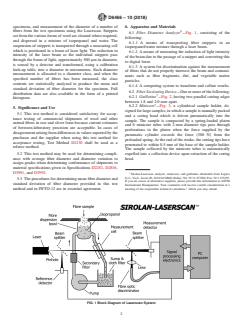
6.1 Fiber Diameter Analyzer —Fig. 1, consisting of the
cut from the various forms of wool are cleaned where required,
following:
and dispersed in a mixture of isopropanol and water. The
6.1.1 A means of transporting fiber snippets in an
suspension of snippets is transported through a measuring cell
isopropanol/water mixture through a laser beam.
which is positioned in a beam of laser light. The reduction in
6.1.2 A means of measuring the reduction of light intensity
intensity of the laser beam as the individual snippets pass
of the beam due to the passage of a snippet and converting this
through the beam of light, approximately 500 µm in diameter,
to digital form.
is sensed by a detector and transformed, using a calibration
6.1.3 A system for discrimination against the measurement
look-up table, into a diameter in micrometres. Each diameter
of fibers that do not properly intersect the beam and contami-
measurement is allocated to a diameter class, and when the
nants such as fiber fragments, dirt, and vegetable matter
specified number of fibers has been measured, the class
particles.
contents are statistically analyzed to produce the mean and
6.1.4 A computing system to transform and collate results.
standard deviation of fiber diameter for the specimen. Full
6.2 Fiber Sectioning Device—Oneormoreofthefollowing:
distribution data are also available in the form of a printed
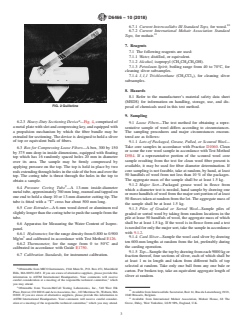
6.2.1 Guillotine —Fig. 2, having two parallel cutting edges
histogram.
between 1.8 and 2.0 mm apart.
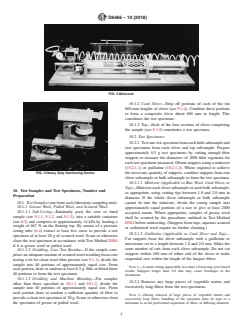
6.2.2 Minicore —Fig. 3, a cylindrical sample holder, de-
5. Significance and Use
signedforlargesamples,inwhichasampleismanuallypacked
5.1 This test method is considered satisfactory for accep-
and a coring head which is driven pneumatically into the
tance testing of commercial shipments of wool and other
sample. The sample is compacted by a spring-loaded platen
animal fibers in raw and sliver form because current estimates
and 6 minicore tubes with 2-mm diameter tips pass through
of between-laboratory precision are acceptable. In cases of
perforations in the platen when the force supplied by the
disagreement arising from differences in values reported by the
pneumatic cylinder exceeds the force (300 N) from the
purchaser and the supplier when using this test method for
preloaded spring.At the end of the stroke, the cutting tips have
acceptance testing, Test Method D2130 shall be used as a
penetrated to within 0.5 mm of the base of the sample holder.
referee method.
The sample collected by the minicore tubes is automatically
5.2 This test method may be used for determining compli-
expelled into a collection device upon retraction of the coring
ance with average fiber diameter and diameter variation to
head.
assign grades when determining conformance of shipments to
material specifications given in Specifications D2252, D2816,
D3991, and D3992. 7
Sirolan-Laserscan analyzer, minicorer, and guillotine obtainable from Loptex
S.r.l.,Via L. Leoni 20, 2210 0 COMO (Italia).Tel: 39 31 273502; Fax: 39 1 273255.
5.3 Theproceduresfordeterminingmeanfiberdiameterand
If you are aware of alternative suppliers, please provide this information to ASTM
standard deviation of fiber diameter provided in this test
International Headquarters. Your comments will receive careful consideration at a
method and in IWTO-12 are in essential agreement. meeting of the responsible technical committee, which you may attend.
FIG. 1 Block Diagram of Laserscan System
D6466 − 10 (2018)
6.7.1 Current Interwoollabs III Standard Tops, for wood.
6.7.2 Current International Mohair Association Standard
Tops, for mohair.
7. Reagents
7.1 The following reagents are used:
7.1.1 Water, distilled, or equivalent.
7.1.2 Alcohol, isopropyl (CH CH CH OH).
3 2 2
7.1.3 Petroleum Spirit, boiling range from 40 to 70°C, for
cleaning sliver subsamples.
7.1.4 1,1,1 Trichlorethane (CH CCl ), for cleaning sliver
3 3
subsamples.
8. Hazards
8.1 Refer to the manufacturer’s material safety data sheet
(MSDS) for information on handling, storage, use, and dis-
FIG. 2 Guillotine
posal of chemicals used in this test method.
9. Sampling
6.2.3 Heavy-Duty Sectioning Device —Fig. 4, comprised of
9.1 Loose Fibers—The test method for obtaining a repre-
ametalplatewithslotandcompressingkey,andequippedwith
sentative sample of wool differs according to circumstances.
a propulsion mechanism by which the fiber bundle may be
The sampling procedures and major circumstances encoun-
extruded for sectioning. The device is designed to hold a sliver
tered are as follows:
of top or equivalent bulk of fibers.
9.1.1 Lots of Packaged, Grease, Pulled, or Scoured Wool—
Take core samples in accordance with Practice D1060. Clean
6.3 Box for Compressing Loose Fibers—Abox, 300 by 150
or scour the raw wool sample in accordance with Test Method
by 375 mm deep in inside dimensions, equipped with floating
D584. If a representative portion of the scoured wool core
top which has 16 randomly spaced holes 20 mm in diameter
sample resulting from the test for clean wool fiber present is
over its area. The sample may be firmly compressed by
available, it may be used for fiber diameter determination. If
applying pressure on the top. The top is held in place by two
core sampling is not feasible, take at random, by hand, at least
rodsextendingthroughholesinthesideoftheboxandoverthe
50 handfuls of wool from not less than 10 % of the packages.
top. The coring tube is thrust through the holes in the top to
The aggregate mass of the sample shall be at least 1.5 kg.
obtain a sample.
9.1.2 Major Sort—Packaged grease wool in fleece from
6.4 Pressure Coring Tube —A 13-mm inside-diameter
which a diameter test is needed, hand sample by drawing one
metaltube,approximately760mmlong,reamedandtappedon
ormorehandfulsofwoolfromthemajorsortportionofatleast
one end to hold a sharp 10 or 13-mm diameter cutting tip. The
50 fleeces taken at random from the lot.The aggregate mass of
tube is fitted with a “T” cross bar about 500 mm long.
the sample shall be at least 1.5 kg.
6.5 Core Extruder—A 6-mm wood dowel or aluminum rod
9.1.3 Piles of Graded or Sorted Wool—Sample piles of
slightlylongerthanthecoringtubetopushthesamplefromthe graded or sorted wool by taking from random locations in the
tube.
pile at lease 50 handfuls of wool, the aggregate mass of which
shall be at least 1.5 kg. If the wool is in fleece form and a test
6.6 Apparatus for Measuring the Water Content of Isopro-
isneededforonlythemajorsort,takethesampleinaccordance
panol.
with 9.1.2.
6.6.1 Hydrometer, for the range density from 0.800 to 0.900
9.1.4 Card Sliver—Sample the wool card sliver by drawing
Mg/m and calibrated in accordance with Test Method E126.
ten 600-mm lengths at random from the lot, preferably during
6.6.2 Thermometer, for the range from 0 to 50°C and
the carding operation.
calibrated in accordance with Guide E1750.
9.1.5 Top—Samplethetopbydrawingfromeach9000kgor
6.7 Calibration Standards, for instrument calibration.
fraction thereof, four sections of sliver, each of which shall be
at least1min length and taken from different balls of top
selected at random. Take only one ball from any one bale or
Obtainable from MICO Instruments, 1944 Main St., P.O. Box 451, Marshfield
carton. For broken top, take an equivalent aggregate length of
Hills, MA02051-0451. If you are aware of alternative suppliers, please provide this
sliver at random.
information to ASTM International Headquarters. Your comments will receive
careful consideration at a meeting of the responsible technical committee, which
you may attend.
Obtainable from Yocom-McColl Testing Laboratories, Inc., 540 West Elk
Place,Denver,CO80216andAcroAssociates,Inc.,163MerrimacSt.,Woburn,MA Available from Interwoollabs Secretariat, Boit 14, Rue du Luxembourg 19/21,
01801. If you are aware of alternative suppliers, please provide this information to 1040 Brussels, Belgium.
ASTM International Headquarters. Your comments will receive careful consider- Available from International Mohair Association, Mohair House, 68 The
ation at a meeting of the responsible technical committee, which you may attend. Grove, Ilkley, West Yorkshire, LS29 9PA, England, U.K.
D6466 − 10 (2018)
FIG. 3 Minicorer
10.1.2 Card Sliver—Strip off portions of each of the ten
600-mm lengths of sliver (see 9.1.4). Combine these portions
to form a composite sliver about 600 mm in length. This
constitutes the test specimen.
10.1.3 Top—Each of the four sections of sliver comprising
the sample (see 9.1.5) constitutes a test specimen.
10.2 Test Specimens:
10.2.1 Testonetestspecimenfromeachbulksubsampleand
two specimens from each sliver and top subsample. Prepare
approximately 0.3 g test specimens by cutting enough fiber
snippets to measure the diameters of 2000 fiber segments for
each test specimen measured. Obtain snippets using a minicore
(10.2.1.1) or guillotine (10.2.1.2). Where required to achieve
the necessary quantity of snippets, combine snippets from one
FIG. 4 Heavy Duty Sectioning Device
sliver subsample or bulk subsample to form the test specimen.
10.2.1.1 Minicore (Applicable to Raw Wool, Card Sliver, or
Top)—Minicoreeachsliversubsampleoreachbulksubsample,
10. Test Samples and Test Specimens, Number and
as appropriate, using cutting tips between 1.8 and 2.0 mm in
Preparation
diameter. If the whole sliver subsample or bulk subsample
10.1 Test Samples(onefromeachlaboratorysamplingunit):
cannot fit into the minicore, divide the coring sample into
10.1.1 Grease Wool, Pulled Wool, and Scoured Wool:
approximately equal portions of a size to give at least 2000
10.1.1.1 Sub-Coring—Randomly pack the core or hand
accepted counts. Where appropriate, samples of greasy wool
sample (see 9.1.1, 9.1.2, and 9.1.3), into a suitable container
shall be scoured by the procedures outlined in Test Method
(see 6.3) and compress to approximately 14 kPa by loading a
D584 before minicoring. (Snippets from tops, aqueous scoured
weight of 667 N on the floating top. By means of a pressure
or carbonized wool require no further cleaning.)
coring tube (6.4) extract at least five cores to provide a test
10.2.1.2 Guillotine (Applicable to Card Sliver and Top)—
specimen of at least 20 g of scoured wool. Scour or otherwise
Cut snippets from the sliver subsample with a guillotine or
clean the test specimen in accordance with Test Method D584
microtome set to a length between 1.8 and 2.0 mm. Make the
if it is grease wool or pulled wool.
same number of cuts from each sliver subsample. Do not cut
10.1.1.2 Gridding, Core Test Residue—If the sample com-
snippets within 100 mm of either end of the sliver or make
prises an adequate amount of scoured wool resulting from core
sequential cuts within the length of the longest fibers.
testing a lot for clean wool fiber present (see 9.1.1), divide the
sample into 40 portions of approximately equal size. From
NOTE 1—Acutter setting appreciably less than 1.8 mm may give biased
each portion, draw at random at least 0.5 g. Mix or blend these
results. Snippets longer than 2.0 mm may cause blockages in the
40 portions to form the test specimen.
instrument.
10.1.1.3 Gridding and Machine Blending—For samples
10.2.2 Remove any large pieces of vegetable matter and
other than those specified in 10.1.1 and 10.1.2, divide the
excessively long fibers from the test specimens.
sample into 40 portions of approximately equal size. From
each portion draw at random a sufficient quantity of fiber to
NOTE 2—During removal of large pieces of vegetable matter and
provide a clean test specimen of 20 g. Scour or otherwise clean
excessively long fibers, handling of the specimen must be kept to a
the specimen of grease or pulled wool. minimum to avoid preferential separation of fibers of differing diameter.
--------
...