

ASTM D8394-21
(Test Method)Standard Test Method for Automated Measurement of Maturity, Fineness, Ribbon Width, and Micronaire of Cotton Fibers
General Information
- Abstract
SIGNIFICANCE AND USE
5.1 Cotton fiber that is on average finer and more mature is more desirable than coarse or immature fiber, although distinction between these qualities cannot be made quickly and accurately using current test methods. Immature fibers break more easily during processing and have a tendency to form into neps (small entanglements) during processing in the spinning mill. These consequences adversely affect yarn and fabric quality and appearance. Yarn and fabric produced from immature fiber is typically also less lustrous and does not take up dye consistently so yarn and fabric appearance may be different after dyeing.
5.2 Maturity has a high positive correlation with fiber length and strength but genetic differences and differences in fiber wall thickness caused by plant diseases, soil, and water conditions during the growing season interfere with this relationship.
5.2.1 Fine fibers are required for fine count yarn manufacture and fiber fineness affects yarn count, evenness and strength. Both fineness and ribbon width are strong genetic traits evident between species and affected by growing conditions within species.
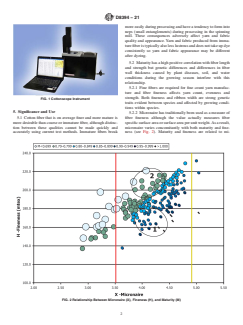
5.2.2 Micronaire has traditionally been used as a measure of fiber fineness although the value actually measures fiber specific surface area or surface area per unit weight. As a result, micronaire varies concomitantly with both maturity and fineness (see Fig. 2). Maturity and fineness are related to micronaire via Lord’s equation.4
FIG. 2 Relationship Between Micronaire (X), Fineness (H), and Maturity (M)
5.3 Cottonscope values have been judged against fineness, maturity and ribbon width values produced by examination of thousands of individual, magnified fiber cross-sections. Relationships with equivalent values by these and other older test methods are highly significant5,6 particularly if the number of cross-sections analyzed is high (>3000) and the cross-sections are carefully prepared and measured. Cottonscope measures approximately 20,...
SCOPE
1.1 This test method covers the determination of linear density (gravimetric fineness hereafter stated as fineness), maturity, micronaire, and ribbon width of cotton fibers from a loose, chemically untreated sample taken before harvest, during ginning, during mill processing or unraveled from raw (undyed) yarn or fabric.
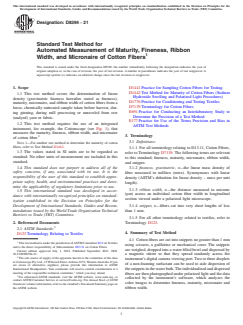
1.2 This test method requires the use of an integrated instrument, for example, the Cottonscope (see Fig. 1), that measures the maturity, fineness, ribbon width, and micronaire of cotton fiber.2
FIG. 1 Cottonscope Instrument
Note 1: For another test method to determine the maturity of cotton fibers, refer to Test Method D1442.
1.3 The values stated in SI units are to be regarded as standard. No other units of measurement are included in this standard.
1.4 This standard does not purport to address all of the safety concerns, if any, associated with its use. It is the responsibility of the user of this standard to establish appropriate safety, health, and environmental practices and determine the applicability of regulatory limitations prior to use.
1.5 This international standard was developed in accordance with internationally recognized principles on standardization established in the Decision on Principles for the Development of International Standards, Guides and Recommendations issued by the World Trade Organization Technical Barriers to Trade (TBT) Committee.
- Status
- Published
- Publication Date
- 30-Jun-2021
- Technical Committee
- D13 - Textiles
- Drafting Committee
- D13.11 - Cotton Fibers
Overview
ASTM D8394-21 is an international standard developed by ASTM International for the automated measurement of cotton fiber properties, specifically maturity, fineness, ribbon width, and micronaire. This test method streamlines and standardizes the evaluation of cotton fibers, enabling rapid, consistent, and non-invasive analysis suitable for a range of testing environments. The method is particularly valuable for both raw and processed cotton samples, contributing directly to improved yarn and fabric quality in textile production.
Key to this standard is the use of integrated instruments-such as Cottonscope-which automate the capture and analysis of fiber snippet images under polarized light. By providing objective, reproducible data on crucial fiber attributes, ASTM D8394-21 supports informed decision-making in cotton breeding, commerce, and manufacturing.
Key Topics
- Automated Measurement: Utilizes specialized instruments (e.g., Cottonscope) to objectively measure fiber maturity, fineness (linear density), ribbon width, and micronaire.
- Significance of Maturity & Fineness: Finer, more mature cotton fibers are highly desirable for textile production as they enhance yarn strength, evenness, and dye uptake, while reducing neps and breakage during processing.
- Micronaire Value: Traditionally used as an indicator of fiber fineness, micronaire actually reflects both surface area and maturity, providing a composite metric for quality analysis.
- Sampling and Preparation: Encompasses best practices for cutting fiber snippets from samples at different processing stages (pre-harvest, ginning, mill, or yarn/fabric) and dispersing them for image analysis.
- Calibration and Precision: Ensures reliable results through regular calibration against known reference samples and statistically validated precision and reproducibility guidelines.
Applications
- Textile Manufacturing: Supports quality control by allowing mills and spinners to select cotton lots with the optimum maturity and fineness for producing high-quality, fine-count yarns.
- Cotton Breeding and Research: Provides breeders and scientists with reliable data on genetic and environmental effects on cotton fiber properties, enabling better selection and improvement of cotton varieties.
- Commercial Cotton Trading: Standardized fiber property measurement reduces subjectivity in grading and valuation, thus supporting fair market transactions.
- Process Optimization: Enables manufacturers to monitor and adjust processing conditions based on measured fiber characteristics, reducing waste and improving product uniformity.
- Comparative Analysis: Facilitates comparisons of results between laboratories and over time, provided the instruments are calibrated and the test procedures standardized according to the ASTM D8394-21 protocol.
Related Standards
- ASTM D1441: Practice for Sampling Cotton Fibers for Testing
- ASTM D1442: Test Method for Maturity of Cotton Fibers (Sodium Hydroxide Swelling and Polarized Light Procedures)
- ASTM D1776: Practice for Conditioning and Testing Textiles
- ASTM D7139: Terminology for Cotton Fibers
- ASTM E691: Practice for Conducting an Interlaboratory Study to Determine the Precision of a Test Method
- ASTM E177: Practice for Use of the Terms Precision and Bias in ASTM Test Methods
Practical Value
By establishing a repeatable and precise protocol for evaluating key cotton fiber properties, ASTM D8394-21 helps eliminate subjectivity, enhances data comparability, and improves overall fiber quality management. This benefits every stakeholder in the cotton supply chain, from breeders and processors to manufacturers and traders, ensuring products meet the increasingly stringent standards of the global textile industry.
Keywords: ASTM D8394-21, cotton fiber maturity, cotton fineness, cotton micronaire, ribbon width measurement, automated cotton testing, Cottonscope, textile quality control, fiber analysis, cotton fiber standardization.
Relations
- Effective Date
- 01-Jul-2020
- Effective Date
- 01-Jul-2020
- Effective Date
- 01-Jul-2019
- Effective Date
- 01-Mar-2017
- Effective Date
- 15-Sep-2015
- Effective Date
- 01-Sep-2015
- Effective Date
- 01-Apr-2015
- Effective Date
- 01-May-2014
- Effective Date
- 01-Jul-2013
- Effective Date
- 15-Jun-2013
- Effective Date
- 15-Jun-2013
- Effective Date
- 15-May-2013
- Effective Date
- 01-May-2013
- Effective Date
- 01-May-2013
- Effective Date
- 01-Jul-2012
Get Certified
Connect with accredited certification bodies for this standard

Control Union Certifications
Global certification for agriculture and sustainability.

Hohenstein Institut
Textile testing and certification.

Bureau Veritas Bangladesh
Bureau Veritas certification services in Bangladesh.
Sponsored listings
Frequently Asked Questions
ASTM D8394-21 is a standard published by ASTM International. Its full title is "Standard Test Method for Automated Measurement of Maturity, Fineness, Ribbon Width, and Micronaire of Cotton Fibers". This standard covers: SIGNIFICANCE AND USE 5.1 Cotton fiber that is on average finer and more mature is more desirable than coarse or immature fiber, although distinction between these qualities cannot be made quickly and accurately using current test methods. Immature fibers break more easily during processing and have a tendency to form into neps (small entanglements) during processing in the spinning mill. These consequences adversely affect yarn and fabric quality and appearance. Yarn and fabric produced from immature fiber is typically also less lustrous and does not take up dye consistently so yarn and fabric appearance may be different after dyeing. 5.2 Maturity has a high positive correlation with fiber length and strength but genetic differences and differences in fiber wall thickness caused by plant diseases, soil, and water conditions during the growing season interfere with this relationship. 5.2.1 Fine fibers are required for fine count yarn manufacture and fiber fineness affects yarn count, evenness and strength. Both fineness and ribbon width are strong genetic traits evident between species and affected by growing conditions within species. 5.2.2 Micronaire has traditionally been used as a measure of fiber fineness although the value actually measures fiber specific surface area or surface area per unit weight. As a result, micronaire varies concomitantly with both maturity and fineness (see Fig. 2). Maturity and fineness are related to micronaire via Lord’s equation.4 FIG. 2 Relationship Between Micronaire (X), Fineness (H), and Maturity (M) 5.3 Cottonscope values have been judged against fineness, maturity and ribbon width values produced by examination of thousands of individual, magnified fiber cross-sections. Relationships with equivalent values by these and other older test methods are highly significant5,6 particularly if the number of cross-sections analyzed is high (>3000) and the cross-sections are carefully prepared and measured. Cottonscope measures approximately 20,... SCOPE 1.1 This test method covers the determination of linear density (gravimetric fineness hereafter stated as fineness), maturity, micronaire, and ribbon width of cotton fibers from a loose, chemically untreated sample taken before harvest, during ginning, during mill processing or unraveled from raw (undyed) yarn or fabric. 1.2 This test method requires the use of an integrated instrument, for example, the Cottonscope (see Fig. 1), that measures the maturity, fineness, ribbon width, and micronaire of cotton fiber.2 FIG. 1 Cottonscope Instrument Note 1: For another test method to determine the maturity of cotton fibers, refer to Test Method D1442. 1.3 The values stated in SI units are to be regarded as standard. No other units of measurement are included in this standard. 1.4 This standard does not purport to address all of the safety concerns, if any, associated with its use. It is the responsibility of the user of this standard to establish appropriate safety, health, and environmental practices and determine the applicability of regulatory limitations prior to use. 1.5 This international standard was developed in accordance with internationally recognized principles on standardization established in the Decision on Principles for the Development of International Standards, Guides and Recommendations issued by the World Trade Organization Technical Barriers to Trade (TBT) Committee.
SIGNIFICANCE AND USE 5.1 Cotton fiber that is on average finer and more mature is more desirable than coarse or immature fiber, although distinction between these qualities cannot be made quickly and accurately using current test methods. Immature fibers break more easily during processing and have a tendency to form into neps (small entanglements) during processing in the spinning mill. These consequences adversely affect yarn and fabric quality and appearance. Yarn and fabric produced from immature fiber is typically also less lustrous and does not take up dye consistently so yarn and fabric appearance may be different after dyeing. 5.2 Maturity has a high positive correlation with fiber length and strength but genetic differences and differences in fiber wall thickness caused by plant diseases, soil, and water conditions during the growing season interfere with this relationship. 5.2.1 Fine fibers are required for fine count yarn manufacture and fiber fineness affects yarn count, evenness and strength. Both fineness and ribbon width are strong genetic traits evident between species and affected by growing conditions within species. 5.2.2 Micronaire has traditionally been used as a measure of fiber fineness although the value actually measures fiber specific surface area or surface area per unit weight. As a result, micronaire varies concomitantly with both maturity and fineness (see Fig. 2). Maturity and fineness are related to micronaire via Lord’s equation.4 FIG. 2 Relationship Between Micronaire (X), Fineness (H), and Maturity (M) 5.3 Cottonscope values have been judged against fineness, maturity and ribbon width values produced by examination of thousands of individual, magnified fiber cross-sections. Relationships with equivalent values by these and other older test methods are highly significant5,6 particularly if the number of cross-sections analyzed is high (>3000) and the cross-sections are carefully prepared and measured. Cottonscope measures approximately 20,... SCOPE 1.1 This test method covers the determination of linear density (gravimetric fineness hereafter stated as fineness), maturity, micronaire, and ribbon width of cotton fibers from a loose, chemically untreated sample taken before harvest, during ginning, during mill processing or unraveled from raw (undyed) yarn or fabric. 1.2 This test method requires the use of an integrated instrument, for example, the Cottonscope (see Fig. 1), that measures the maturity, fineness, ribbon width, and micronaire of cotton fiber.2 FIG. 1 Cottonscope Instrument Note 1: For another test method to determine the maturity of cotton fibers, refer to Test Method D1442. 1.3 The values stated in SI units are to be regarded as standard. No other units of measurement are included in this standard. 1.4 This standard does not purport to address all of the safety concerns, if any, associated with its use. It is the responsibility of the user of this standard to establish appropriate safety, health, and environmental practices and determine the applicability of regulatory limitations prior to use. 1.5 This international standard was developed in accordance with internationally recognized principles on standardization established in the Decision on Principles for the Development of International Standards, Guides and Recommendations issued by the World Trade Organization Technical Barriers to Trade (TBT) Committee.
ASTM D8394-21 is classified under the following ICS (International Classification for Standards) categories: 59.060.10 - Natural fibres. The ICS classification helps identify the subject area and facilitates finding related standards.
ASTM D8394-21 has the following relationships with other standards: It is inter standard links to ASTM D7139-20, ASTM D1441-12(2020), ASTM D1442-06(2019), ASTM D123-17, ASTM D123-15b, ASTM D123-15a, ASTM D123-15, ASTM E177-14, ASTM D7139-09(2013), ASTM D123-13a, ASTM D123-13ae1, ASTM D123-13, ASTM E691-13, ASTM E177-13, ASTM D1442-06(2012). Understanding these relationships helps ensure you are using the most current and applicable version of the standard.
ASTM D8394-21 is available in PDF format for immediate download after purchase. The document can be added to your cart and obtained through the secure checkout process. Digital delivery ensures instant access to the complete standard document.
Standards Content (Sample)
This international standard was developed in accordance with internationally recognized principles on standardization established in the Decision on Principles for the
Development of International Standards, Guides and Recommendations issued by the World Trade Organization Technical Barriers to Trade (TBT) Committee.
Designation: D8394 − 21
Standard Test Method for
Automated Measurement of Maturity, Fineness, Ribbon
Width, and Micronaire of Cotton Fibers
This standard is issued under the fixed designation D8394; the number immediately following the designation indicates the year of
original adoption or, in the case of revision, the year of last revision.Anumber in parentheses indicates the year of last reapproval.A
superscript epsilon (´) indicates an editorial change since the last revision or reapproval.
1. Scope D1441Practice for Sampling Cotton Fibers for Testing
D1442Test Method for Maturity of Cotton Fibers (Sodium
1.1 This test method covers the determination of linear
Hydroxide Swelling and Polarized Light Procedures)
density (gravimetric fineness hereafter stated as fineness),
D1776Practice for Conditioning and Testing Textiles
maturity, micronaire, and ribbon width of cotton fibers from a
D7139Terminology for Cotton Fibers
loose, chemically untreated sample taken before harvest, dur-
E691Practice for Conducting an Interlaboratory Study to
ing ginning, during mill processing or unraveled from raw
Determine the Precision of a Test Method
(undyed) yarn or fabric.
E177Practice for Use of the Terms Precision and Bias in
1.2 This test method requires the use of an integrated
ASTM Test Methods
instrument, for example, the Cottonscope (see Fig. 1), that
measures the maturity, fineness, ribbon width, and micronaire
3. Terminology
of cotton fiber.
NOTE 1—For another test method to determine the maturity of cotton 3.1 Definitions:
fibers, refer to Test Method D1442.
3.1.1 For all terminology relating to D13.11, Cotton Fibers,
1.3 The values stated in SI units are to be regarded as
refer to Terminology D7139. The following terms are relevant
standard. No other units of measurement are included in this
to this standard; fineness, maturity, micronaire, ribbon width,
standard.
and snippet.
1.4 This standard does not purport to address all of the
3.1.2 fineness, gravimetric, n—the linear mass density of
safety concerns, if any, associated with its use. It is the
fiber measured in millitex (mtex). Synonymous with linear
responsibility of the user of this standard to establish appro-
density (ASTM’s definition for linear density – mass per unit
priate safety, health, and environmental practices and deter-
length).
mine the applicability of regulatory limitations prior to use.
3.1.3 ribbon width, n—the distance measured in microns
1.5 This international standard was developed in accor-
(µm) across an individual cotton fiber width in longitudinal
dance with internationally recognized principles on standard-
section viewed under a polarized light microscope.
ization established in the Decision on Principles for the
Development of International Standards, Guides and Recom-
3.1.4 snippet, n—fibers cut into very short lengths of less
mendations issued by the World Trade Organization Technical
than 1 mm.
Barriers to Trade (TBT) Committee.
3.1.5 For all other terminology related to textiles, refer to
2. Referenced Documents
Terminology D123.
2.1 ASTM Standards:
4. Summary of Test Method
D123Terminology Relating to Textiles
4.1 Cotton fibers are cut into snippets no greater than 1 mm
ThistestmethodisunderthejurisdictionofASTMCommitteeD13onTextiles
using scissors, a guillotine or mechanical corer. The snippets
and is the direct responsibility of Subcommittee D13.11 on Cotton Fibers.
areweighed,droppedintoawaterfilledbowlanddispersedby
Current edition approved July 1, 2021. Published September 2021. DOI:
10.1520/D8394-21.
a magnetic stirrer so that they spread randomly across the
The sole source of supply of the apparatus known to the committee at this time
instrument’sdigitalcameraviewingport.Twotothreedroplets
isCottonscopePty.Ltd.,13WillcockStreet,Ardross6153,WesternAustralia.Ifyou
of a non-foaming surfactant can be used to aide dispersion of
are aware of alternative suppliers, please provide this information to ASTM
thesnippetsinthewaterbath.Theindividualizedanddispersed
International Headquarters. Your comments will receive careful consideration at a
meeting of the responsible technical committee, which you may attend.
fibers are then photographed under polarized light and the data
For referenced ASTM standards, visit the ASTM website, www.astm.org, or
collected by the instrument’s software, which analyzes the
contact ASTM Customer Service at service@astm.org. For Annual Book of ASTM
color images to determine fineness, maturity, micronaire and
Standards volume information, refer to the standard’s Document Summary page on
the ASTM website. ribbon width.
Copyright © ASTM International, 100 Barr Harbor Drive, PO Box C700, West Conshohocken, PA 19428-2959. United States
D8394 − 21
moreeasilyduringprocessingandhaveatendencytoforminto
neps (small entanglements) during processing in the spinning
mill. These consequences adversely affect yarn and fabric
quality and appearance.Yarn and fabric produced from imma-
turefiberistypicallyalsolesslustrousanddoesnottakeupdye
consistently so yarn and fabric appearance may be different
after dyeing.
5.2 Maturityhasahighpositivecorrelationwithfiberlength
and strength but genetic differences and differences in fiber
wall thickness caused by plant diseases, soil, and water
conditions during the growing season interfere with this
relationship.
5.2.1 Fine fibers are required for fine count yarn manufac-
ture and fiber fineness affects yarn count, evenness and
strength. Both fineness and ribbon width are strong genetic
FIG. 1 Cottonscope Instrument
traits evident between species and affected by growing condi-
tions within species.
5. Significance and Use
5.2.2 Micronairehastraditionallybeenusedasameasureof
5.1 Cotton fiber that is on average finer and more mature is fiber fineness although the value actually measures fiber
specificsurfaceareaorsurfaceareaperunitweight.Asaresult,
moredesirablethancoarseorimmaturefiber,althoughdistinc-
tion between these qualities cannot be made quickly and micronaire varies concomitantly with both maturity and fine-
accurately using current test methods. Immature fibers break ness (see Fig. 2). Maturity and fineness are related to mi-
FIG. 2 Relationship Between Micronaire (X), Fineness (H), and Maturity (M)
D8394 − 21
4 2 7
cronaire via Lord’s equation. 6.2 Guillotine or Pneumatic Corer for cutting snippets
from samples of loose cotton fiber to a length less than 1 mm.
5.3 Cottonscope values have been judged against fineness,
maturity and ribbon width values produced by examination of 6.3 Tweezers, Weighing Pans, Cleaning Brush.
thousands of individual, magnified fiber cross-sections. Rela-
6.4 Balance, with a capacity of at least 100 mg and a
tionships with equivalent values by these and other older test
sensitivity of 0.1 mg.
5,6
methods are highly significant particularly if the number of
6.5 Surfactant, clear, low-foaming liquid surfactant, for
cross-sections analyzed is high (>3000) and the cross-sections
example, Teric169, to aid the dispersion of snippets in the
are carefully prepared and measured. Cottonscope measures
water bath.
approximately 20,000 fiber (snippets) per measurement and is
a quick test in comparison to previous methods, for example,
7. Hazards
directly measuring cross-sections. The good relationship ob-
7.1 Care should be applied when cutting fiber specimens
served between ribbon width and the perimeter of fiber
using the guillotine or corer.
cross-sections makes ribbon width of interest to plant breeders
and scientists observing fiber perimeter responses to plant and
8. Sampling and Preparation of Test Specimens
crop treatments.
8.1 Test specimens should be taken from sub-samples or
5.4 The precision of Cottonscope has been measured. Mea-
samples in accordance with a competent statistical analysis.
surement of consistent quality, machine picked cotton using a
Practice D1441 may be used. Measurements of maturity and
testregimeofoneinthreebales(withtwospecimenstestedper
ribbon width do not require samples to be pre-conditioned
balesample),providesaprecisionofbetween6.8and7.5%for
before measurement.
fineness, between 1.2 and 1.5 % for maturity, between 4 and
8.1.1 For unprocessed (raw) cotton from the gin or cotton
5% for micronaire and less than 1 % for ribbon width. These
bale that has not been blended, at least five sub-samples from
values incorporate sample and instrument variance but not
different areas of the sample are required. Regimes for sam-
inter-laboratory variance. Precision is improved by increasing
pling fiber from cotton fruit on single plants or multiple plants
the number of sub-samples measured per bale. The values for
in rows need to be determined using competent statistical
maturity and micronaire are similar to reported high volume
analyses.
instrument values.
8.1.2 Forintermediateorsemi-processedmillproductssuch
5.4.1 The method has not yet been widely controlled for
as card or draw frame sliver, three sub-samples from different
acceptance testing. Inter-laboratory trials have shown agree-
areas of the sample are required.
ment and precision can be good if instrument calibrations and
8.1.3 Fibers can be unraveled or unpicked from yarn or
test procedures are properly coincided. Calibration material
fabric for testing. Sampling fiber from yarn or fabric should be
should be conditioned before testing as directed in Practice
determined using competent statistical analyses.
D1776.
5.4.2 Cottonscope algorithms are calibrated using known
8.2 If standard conditions are not used, average fineness
cotton and fiber standards, for example, USDAAMS prepared
valueswillbeaffected.Applicationofrelativehumidityvalues
calibration cottons, measured on a manufacturer’s standard
15 to 25% above or below standard relative humidity affects
instrument with values and the calibration material passed to
average fineness values by up to 3 %.
the next instrument. It is advised if there are differences of
8.3 Fibers are guillotined or cored to produce snippets for
practical significance between reported test values for two or
testing. The test specimen will be comprised of these snippets
more laboratories, comparative tests should be performed to
and shall weigh 50.0 6 0.5 mg. Use a brush to thoroughly
determine any statistical bias between them, using competent
cleanthepreparationarea,weighingtray,andcuttingdeviceor
statistical analysis. Ideally, these tests are performed using the
guillotine of snippets before preparing the next sample.
same homogenous material.
8.4 Weighed snippets (test specimen) are tipped into the
instrument’s water bowl and allowed to submerge and then
6. Apparatus and Reagents
disperse. Once the snippets are dispersed, start the test.
6.1 Cottonscope Instrument (Fig. 1) is a known instrument
with these capacities.
9. Preparation of Cottonscope
9.1 The Cottonscope instrument should be located on a
vibration-free table or bench top in a dry, low draft location
away from direct sunlight. The operating temperature should
be between 5 and 50 °C. Otherwise, operate under conditions
as directed in Practice D1776.
Lord,E.,“AirThroughPlugsofTextileFibres,PartII.TheMicronaireTestfor
Cotton,” J. Textile Inst., 47, T17-T47, 1956.
5 7
Rodgers J, Delhom C, F
...