

ASTM D2130-22
(Test Method)Standard Test Method for Diameter of Wool and Other Animal Fibers by Microprojection
General Information
- Abstract
SIGNIFICANCE AND USE
5.1 This test method specifies a sampling and testing procedure for the measurement of average fiber diameter and variation in diameter of animal fibers as required in Test Method D2968.
5.2 Test Method D2130 for testing wool and other animal fibers for average fiber diameter is considered satisfactory for acceptance testing of commercial shipments since current estimates of between-laboratory precision are acceptable and the method has been used extensively in the trade for acceptance testing. In cases of disagreement arising from differences in values reported by the purchaser and the seller when using this method for acceptance testing, the statistical bias, if any, between the laboratory of the purchaser and the laboratory of the seller should be determined with each comparison being based on the testing of specimens randomly drawn from one sample of material of the type being evaluated.
SCOPE
1.1 This test method covers a procedure, using the microprojector, for the determination of the average fiber diameter and the fiber diameter variation on wool and other animal fibers, such as mohair, cashmere, alpaca, camel's hair, etc. (Note 1) in their various forms.
1.2 The values stated in inch-pound units are to be regarded as standard. The values given in parentheses are mathematical conversions to SI units that are provided for information only and are not considered standard.
Note 1: This test method may also be applied to any fibers having a round cross section and accordingly may be used many times for melt-spun man-made fibers such as polyamides, polyesters, and glass; also it may be applied to a limited number of polyacrylics and regenerated cellulose type fibers. The values given in Appendix X1 for density and correction factors, however, apply only to wool and should not be used for other fibers. For suitable values for the density of other fibers, see Table 5 in Test Methods D629, Quantitative Analysis of Textiles.
Note 2: In subsequent sections of this test method, the term “wool” also signifies mohair or other fibers if the circumstances are applicable.
Note 3: For fineness specifications for wool, wool top, mohair, mohair top, alpaca, and cashmere, refer to Specifications D3991 and D3992, Specification D2252, Test Method D2816.
1.3 This standard does not purport to address all of the safety concerns, if any, associated with its use. It is the responsibility of the user of this standard to establish appropriate safety, health, and environmental practices and determine the applicability of regulatory limitations prior to use.
1.4 This international standard was developed in accordance with internationally recognized principles on standardization established in the Decision on Principles for the Development of International Standards, Guides and Recommendations issued by the World Trade Organization Technical Barriers to Trade (TBT) Committee.
- Status
- Published
- Publication Date
- 31-May-2022
- Technical Committee
- D13 - Textiles
- Drafting Committee
- D13.13 - Wool and Felt
Overview
ASTM D2130-22 is the recognized international standard for determining the diameter of wool and other animal fibers by microprojection. Developed by ASTM International under the guidance of Committee D13 on Textiles, this test method outlines a highly reliable, widely used laboratory procedure for measuring both the average fiber diameter and the variation in diameter of fibers, including such animal fibers as wool, mohair, cashmere, alpaca, and camel's hair. Results from ASTM D2130-22 are essential for quality control, acceptance testing, and meeting industry specifications in the textile trade.
Key Topics
- Purpose: Establishes a standardized microprojection method for measuring the average and variability of fiber diameters in wool and similar animal fibers.
- Scope: Applies to wool and animal fibers in diverse forms (raw, sliver, yarn, fabric), and can also be extended to fibers with round cross sections such as certain man-made fibers.
- Precision and Acceptance: Extensively used for commercial shipments, this method is recognized for its reliability and inter-laboratory consistency, making it a referee method for acceptance testing.
- Sampling and Testing: Details specific sampling procedures for a variety of fiber forms to ensure representative and statistically significant results.
- Data Reporting: Standardizes reporting metrics such as average fiber diameter (in micrometers), fiber diameter distribution, standard deviation, coefficient of variation, and 95% confidence intervals.
- Measurement Technique: Describes the use of microprojector equipment and slide preparation, including detailed calibration and focusing procedures for accurate fiber measurement.
- Guidance on Disputes: Provides instructions for statistical comparison of data to resolve discrepancies between sellers and purchasers during acceptance testing.
Applications
ASTM D2130-22 is extensively utilized in the textile industry for critical tasks, including:
- Quality Control in Fiber Production: Used by fiber producers, processors, and manufacturers to ensure products meet desired specifications for mean fiber diameter and uniformity.
- Acceptance Testing and Certification: Facilitates objective acceptance testing of wool, mohair, cashmere, and other animal fibers between buyers and sellers by providing a trusted, standardized method.
- Textile Testing Laboratories: Serves as a reference method for laboratory analysis and ensures reliability in results when certifying fiber properties.
- Research and Development: Supports studies in fiber science, new product development, and material comparison due to its precise methodology and documented repeatability.
- Evaluation of Man-Made Fibers: Although optimized for animal fibers, the method may also be applied to man-made fibers with round cross-sections, like polyamides and polyesters, when appropriate conversion factors are used.
- Regulatory Compliance: Ensures compliance with international trade and commercial standards, assisting global trade and harmonized product specifications in line with WTO guidelines.
Related Standards
ASTM D2130-22 aligns and complements a suite of textile and fiber testing standards, including:
- ASTM D2968: Test Method for Med and Kemp Fibers in Wool and Other Animal Fibers by Microprojection.
- ASTM D3992 & D3991: Specifications for fineness of wool top, mohair, alpaca, and cashmere.
- ASTM D123: Terminology Relating to Textiles, providing definitions for key terms.
- ASTM D629: Test Methods for Quantitative Analysis of Textiles (for density values and analysis).
- ASTM D2252 & D2816: Specifications and test methods related to fiber fineness and content.
- ASTM D1776: Practice for Conditioning and Testing Textiles.
- Federal and International Protocols: References methods such as IWTO-8-66 for international wool fiber diameter measurement.
By implementing ASTM D2130-22, organizations gain confidence in the consistency and quality of fiber measurements, supporting fair trade practices, product development, and compliance with industry and international standards.
Keywords: ASTM D2130-22, fiber diameter, wool testing, animal fibers, microprojection, textile standards, fiber measurement, quality control, acceptance testing, laboratory methods.
Relations
- Effective Date
- 01-Jul-2018
- Effective Date
- 01-Jul-2018
- Effective Date
- 01-Jul-2018
- Effective Date
- 01-Jul-2018
- Refers
ASTM D584-10(2018) - Standard Test Method for Wool Content of Raw Wool—Laboratory Scale - Effective Date
- 01-Jul-2018
- Effective Date
- 01-Mar-2017
- Effective Date
- 15-Sep-2015
- Effective Date
- 01-Sep-2015
- Effective Date
- 01-Apr-2015
- Effective Date
- 01-Feb-2015
- Effective Date
- 15-Jun-2013
- Effective Date
- 15-Jun-2013
- Effective Date
- 15-May-2013
- Effective Date
- 01-Mar-2012
- Effective Date
- 01-Feb-2012
Get Certified
Connect with accredited certification bodies for this standard

Control Union Certifications
Global certification for agriculture and sustainability.

Hohenstein Institut
Textile testing and certification.

Bureau Veritas Bangladesh
Bureau Veritas certification services in Bangladesh.
Sponsored listings
Frequently Asked Questions
ASTM D2130-22 is a standard published by ASTM International. Its full title is "Standard Test Method for Diameter of Wool and Other Animal Fibers by Microprojection". This standard covers: SIGNIFICANCE AND USE 5.1 This test method specifies a sampling and testing procedure for the measurement of average fiber diameter and variation in diameter of animal fibers as required in Test Method D2968. 5.2 Test Method D2130 for testing wool and other animal fibers for average fiber diameter is considered satisfactory for acceptance testing of commercial shipments since current estimates of between-laboratory precision are acceptable and the method has been used extensively in the trade for acceptance testing. In cases of disagreement arising from differences in values reported by the purchaser and the seller when using this method for acceptance testing, the statistical bias, if any, between the laboratory of the purchaser and the laboratory of the seller should be determined with each comparison being based on the testing of specimens randomly drawn from one sample of material of the type being evaluated. SCOPE 1.1 This test method covers a procedure, using the microprojector, for the determination of the average fiber diameter and the fiber diameter variation on wool and other animal fibers, such as mohair, cashmere, alpaca, camel's hair, etc. (Note 1) in their various forms. 1.2 The values stated in inch-pound units are to be regarded as standard. The values given in parentheses are mathematical conversions to SI units that are provided for information only and are not considered standard. Note 1: This test method may also be applied to any fibers having a round cross section and accordingly may be used many times for melt-spun man-made fibers such as polyamides, polyesters, and glass; also it may be applied to a limited number of polyacrylics and regenerated cellulose type fibers. The values given in Appendix X1 for density and correction factors, however, apply only to wool and should not be used for other fibers. For suitable values for the density of other fibers, see Table 5 in Test Methods D629, Quantitative Analysis of Textiles. Note 2: In subsequent sections of this test method, the term “wool” also signifies mohair or other fibers if the circumstances are applicable. Note 3: For fineness specifications for wool, wool top, mohair, mohair top, alpaca, and cashmere, refer to Specifications D3991 and D3992, Specification D2252, Test Method D2816. 1.3 This standard does not purport to address all of the safety concerns, if any, associated with its use. It is the responsibility of the user of this standard to establish appropriate safety, health, and environmental practices and determine the applicability of regulatory limitations prior to use. 1.4 This international standard was developed in accordance with internationally recognized principles on standardization established in the Decision on Principles for the Development of International Standards, Guides and Recommendations issued by the World Trade Organization Technical Barriers to Trade (TBT) Committee.
SIGNIFICANCE AND USE 5.1 This test method specifies a sampling and testing procedure for the measurement of average fiber diameter and variation in diameter of animal fibers as required in Test Method D2968. 5.2 Test Method D2130 for testing wool and other animal fibers for average fiber diameter is considered satisfactory for acceptance testing of commercial shipments since current estimates of between-laboratory precision are acceptable and the method has been used extensively in the trade for acceptance testing. In cases of disagreement arising from differences in values reported by the purchaser and the seller when using this method for acceptance testing, the statistical bias, if any, between the laboratory of the purchaser and the laboratory of the seller should be determined with each comparison being based on the testing of specimens randomly drawn from one sample of material of the type being evaluated. SCOPE 1.1 This test method covers a procedure, using the microprojector, for the determination of the average fiber diameter and the fiber diameter variation on wool and other animal fibers, such as mohair, cashmere, alpaca, camel's hair, etc. (Note 1) in their various forms. 1.2 The values stated in inch-pound units are to be regarded as standard. The values given in parentheses are mathematical conversions to SI units that are provided for information only and are not considered standard. Note 1: This test method may also be applied to any fibers having a round cross section and accordingly may be used many times for melt-spun man-made fibers such as polyamides, polyesters, and glass; also it may be applied to a limited number of polyacrylics and regenerated cellulose type fibers. The values given in Appendix X1 for density and correction factors, however, apply only to wool and should not be used for other fibers. For suitable values for the density of other fibers, see Table 5 in Test Methods D629, Quantitative Analysis of Textiles. Note 2: In subsequent sections of this test method, the term “wool” also signifies mohair or other fibers if the circumstances are applicable. Note 3: For fineness specifications for wool, wool top, mohair, mohair top, alpaca, and cashmere, refer to Specifications D3991 and D3992, Specification D2252, Test Method D2816. 1.3 This standard does not purport to address all of the safety concerns, if any, associated with its use. It is the responsibility of the user of this standard to establish appropriate safety, health, and environmental practices and determine the applicability of regulatory limitations prior to use. 1.4 This international standard was developed in accordance with internationally recognized principles on standardization established in the Decision on Principles for the Development of International Standards, Guides and Recommendations issued by the World Trade Organization Technical Barriers to Trade (TBT) Committee.
ASTM D2130-22 is classified under the following ICS (International Classification for Standards) categories: 59.060.10 - Natural fibres. The ICS classification helps identify the subject area and facilitates finding related standards.
ASTM D2130-22 has the following relationships with other standards: It is inter standard links to ASTM D2252-18, ASTM D4845-10(2018), ASTM D1060-10(2018), ASTM D2816-18, ASTM D584-10(2018), ASTM D123-17, ASTM D123-15b, ASTM D123-15a, ASTM D123-15, ASTM D629-15, ASTM D123-13ae1, ASTM D123-13a, ASTM D123-13, ASTM D2258-99(2012), ASTM D123-12e1. Understanding these relationships helps ensure you are using the most current and applicable version of the standard.
ASTM D2130-22 is available in PDF format for immediate download after purchase. The document can be added to your cart and obtained through the secure checkout process. Digital delivery ensures instant access to the complete standard document.
Standards Content (Sample)
This international standard was developed in accordance with internationally recognized principles on standardization established in the Decision on Principles for the
Development of International Standards, Guides and Recommendations issued by the World Trade Organization Technical Barriers to Trade (TBT) Committee.
Designation: D2130 − 22
Standard Test Method for
Diameter of Wool and Other Animal Fibers by
Microprojection
This standard is issued under the fixed designation D2130; the number immediately following the designation indicates the year of
original adoption or, in the case of revision, the year of last revision.Anumber in parentheses indicates the year of last reapproval.A
superscript epsilon (´) indicates an editorial change since the last revision or reapproval.
This standard has been approved for use by agencies of the U.S. Department of Defense.
1. Scope 2. Referenced Documents
2.1 ASTM Standards:
1.1 This test method covers a procedure, using the
D123Terminology Relating to Textiles
microprojector, for the determination of the average fiber
D584Test Method for Wool Content of Raw Wool—
diameter and the fiber diameter variation on wool and other
Laboratory Scale
animal fibers, such as mohair, cashmere, alpaca, camel’s hair,
D629Test Methods for Quantitative Analysis of Textiles
etc. (Note 1) in their various forms.
D1060PracticeforCoreSamplingofRawWoolinPackages
1.2 Thevaluesstatedininch-poundunitsaretoberegarded
for Determination of Percentage of Clean Wool Fiber
as standard. The values given in parentheses are mathematical
Present
conversions to SI units that are provided for information only
D1776Practice for Conditioning and Testing Textiles
and are not considered standard.
D2252Specification for Fineness of Types of Alpaca
D2258Practice for Sampling Yarn for Testing
NOTE 1—This test method may also be applied to any fibers having a
D2816Test Method for Cashmere Coarse-Hair Content in
round cross section and accordingly may be used many times for
Cashmere
melt-spunman-madefiberssuchaspolyamides,polyesters,andglass;also
D2968Test Method for Med and Kemp Fibers in Wool and
it may be applied to a limited number of polyacrylics and regenerated
cellulose type fibers. The values given in Appendix X1 for density and Other Animal Fibers by Microprojection
correctionfactors,however,applyonlytowoolandshouldnotbeusedfor
D3992Specifications for Fineness of Wool Top or Mohair
other fibers. For suitable values for the density of other fibers, see Table 3
Top and Assignment of Grade (Withdrawn 2021)
5 in Test Methods D629, Quantitative Analysis of Textiles.
D4845Terminology Relating to Wool
NOTE 2—In subsequent sections of this test method, the term “wool”
E380Practice for Use of the International System of Units
also signifies mohair or other fibers if the circumstances are applicable.
(SI) (the Modernized Metric System) (Withdrawn 1997)
NOTE3—Forfinenessspecificationsforwool,wooltop,mohair,mohair
top, alpaca, and cashmere, refer to Specifications D3991 and D3992, 2.2 Other Standards:
Specification D2252, Test Method D2816.
Federal Standard, Official Standard of the United States for
Grades of Wool, Section 31.0,Measurement Method for
1.3 This standard does not purport to address all of the
Determining Grade of Wool, Section 31.204
safety concerns, if any, associated with its use. It is the
IWTO-8-66(E)Method of Determining Wool Fiber Diam-
responsibility of the user of this standard to establish appro-
eter by the Projection Microscope
priate safety, health, and environmental practices and deter-
mine the applicability of regulatory limitations prior to use.
3. Terminology
1.4 This international standard was developed in accor-
3.1 For all terminology related to D13.13, Wool and Felt,
dance with internationally recognized principles on standard-
see Terminology D4845.
ization established in the Decision on Principles for the
Development of International Standards, Guides and Recom-
mendations issued by the World Trade Organization Technical
For referenced ASTM standards, visit the ASTM website, www.astm.org, or
Barriers to Trade (TBT) Committee.
contact ASTM Customer Service at service@astm.org. For Annual Book of ASTM
Standards volume information, refer to the standard’s Document Summary page on
the ASTM website.
The last approved version of this historical standard is referenced on
ThistestmethodisunderthejurisdictionofASTMCommitteeD13onTextiles www.astm.org.
and is the direct responsibility of Subcommittee D13.13 on Wool and Felt. Service and Regulatory Announcement, No. 135, U. S. Department of
Current edition approved June 1, 2022. Published August 2022. Originally Agriculture, C & MS, April 1966.
approvedin1961.Lastpreviouseditionapprovedin2013asD2130–13whichwas International Wool Textile Organization, International Wool Secretariat, Raw
withdrawn in January 2022 and reinstated in June 2022. DOI: 10.1520/D2130-22. Wool Services, Valley Drive, Ilkley, Yorkshire LS29 8PB, England.
Copyright © ASTM International, 100 Barr Harbor Drive, PO Box C700, West Conshohocken, PA 19428-2959. United States
D2130 − 22
3.1.1 The following terms are relevant to this standard:
average fiber diameter, grade.
3.2 FordefinitionsofallothertextiletermsseeTerminology
D123.
4. Summary of Test Method
4.1 This test method describes procedures for sampling
variousformsofwoolandotheranimalfibers,thereductionof
the sample to small test specimens, and the measurement, at
high magnification, of the diameter of a number of fibers from
the test specimens. From the observed data, computations are
made to obtain the average fiber diameter, a measure of
variation of fiber diameter and the percentage of medullated FIG. 1 Heavy-Duty Cross-Section Device
and kemp fibers, if present, as directed inTest Method D2968.
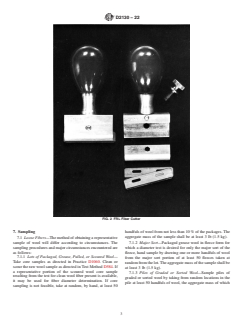
6.3.3 FRL Fiber Cutter —Adevice comprised of two razor
5. Significance and Use
blades, a threaded pin and an assemblage that will hold the
5.1 This test method specifies a sampling and testing pro-
blades rigidly in position. The device (Fig. 2), which is
cedure for the measurement of average fiber diameter and operated by applying pressure vertically downward, cuts fibers
variation in diameter of animal fibers as required in Test
approximately 250 µm (Note 4) in length.
Method D2968.
NOTE 4—Adescription of the Swiss Fiber Cutting device described in
5.2 Test Method D2130 for testing wool and other animal earlier editions can be found in Part 25 of the Annual Book of ASTM
Standards, issued in 1971 and previous volumes.
fibers for average fiber diameter is considered satisfactory for
acceptance testing of commercial shipments since current
6.4 Microscope Slides, 1 in. by 3 in. (25 mm by 75 mm).
estimates of between-laboratory precision are acceptable and
6.5 Cover Glasses, No. 1 thickness, ⁄8 in. by 2 in. (22 mm
the method has been used extensively in the trade for accep-
by 50 mm).
tancetesting.Incasesofdisagreementarisingfromdifferences
6.6 Mounting Medium —Colorless immersion oil with a
in values reported by the purchaser and the seller when using
refractive index of 1.480 6 0.005 at 68°F (20°C), and a
this method for acceptance testing, the statistical bias, if any,
viscosity of 78.81 SUS at 100°F (37.8°C).
between the laboratory of the purchaser and the laboratory of
the seller should be determined with each comparison being
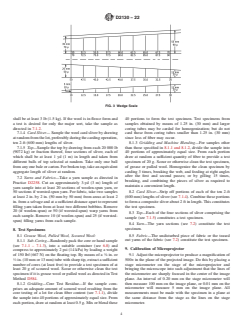
6.7 Wedge Scale —Strips of heavy paper or Bristol board,
based on the testing of specimens randomly drawn from one
imprintedwithawedgeforuseatamagnificationof500×(Fig.
sample of material of the type being evaluated.
3).
6.8 Box for Compressing Loose Fibers—A box 12 in. by 6
6. Apparatus and Material
in. by 15 in. (300 mm by 150 mm by 375 mm) deep, inside
6.1 Microprojector —The microscope shall be equipped
dimensions, equipped with a floating top which has 16 ran-
with a fixed body tube, a focusable stage responsive to coarse
domly spaced holes 0.75 in. (20 mm) in diameter over its area.
and fine adjustments, a focusable substage with condenser and
The wool may be firmly compressed by applying pressure on
iris diaphragm, and a vertically installed adequate light source
thetop.Thetopisheldinplacebytworodsextendingthrough
to give a precise magnification of 500×, that is, a 12.5×
holes in the side of the box and over the top. The coring tube
eyepiece and a 21×, 0.50 numerical aperture objective.
is thrust through the holes in the top to sample the wool.
6.2 Stage Micrometer, —calibratedinintervalsof0.01mm 1
6.9 Pressure Coring Tube —A ⁄2 in. (13 mm) inside-
for accurate setting and control of the magnification.
diameter metal tube, approximately 30 in. (760 mm) long,
3 1
6.3 Fiber Sectioning Apparatus: reamed and tapped on one end to hold a sharp ⁄8 in. or ⁄2 in.
(10 mm or 13 mm) cutting tip. The tube is fitted with a “T”
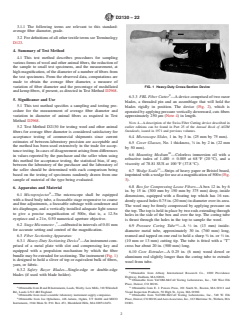
6.3.1 Heavy-DutySectioningDevice —Aninstrumentcom-
prised of a metal plate with slot and compressing key and cross bar about 20 in. (500 mm) long.
equipped with a propulsion mechanism by which the fiber
6.10 Core Extruder—A 0.25 in. (6 mm) wood dowel or
bundlemaybeextrudedforsectioning.Theinstrument(Fig.1)
aluminum rod slightly longer than the coring tube to extrude
is designed to hold a sliver of top or equivalent bulk of fibers,
wool from tube.
yarn, or fabric.
6.3.2 Safety Razor Blades—Single-edge or double-edge
Obtainable from Albany International Research Co., 1000 Providence
blades (if used with blade holder).
Highway, Dedham, MA 02026.
Obtainable from YoCOM-McColl Testing Laboratories, Inc., 540 West Elk
Place, Denver, CO 80216.
6 11
ObtainablefromRandBInstruments,Leeds,Wortly.LowMills,318Whitehall Obtainable from E. J. Powers Press, 201 South St., Boston, MA 02111 and
Rd., Leeds L512 4RJ England. Visual Inspection Products, 50 High St., Lynn, MA 01902.
7 12
Obtainable from most scientific laboratory instrument supply companies. Obtainable from YoCOM-McColl Testing Laboratories, Inc., 540 W. Elk
Obtainable from Joe Opheikens, 426 Adams, Ogden, UT 84404 and MICO Place,Denver,CO80216andAeroAssociates,Inc.,163MerrimacSt.,Woburn,MA
Instruments, 1944 Main St. P.O. Box 451, Marshfield Hills, MA 02051-0451. 01801.
D2130 − 22
FIG. 2 FRL Fiber Cutter
7. Sampling handfulsofwoolfromnotlessthan10%ofthepackages.The
aggregate mass of the sample shall be at least 3 lb (1.5 kg).
7.1 LooseFibers—Themethodofobtainingarepresentative
7.1.2 Major Sort—Packaged grease wool in fleece form for
sample of wool will differ according to circumstances. The
which a diameter test is desired for only the major sort of the
sampling procedures and major circumstances encountered are
as follows: fleece, hand sample by drawing one or more handfuls of wool
7.1.1 Lots of Packaged, Grease, Pulled, or Scoured Wool— from the major sort portion of at least 50 fleeces taken at
Take core samples as directed in Practice D1060. Clean or
randomfromthelot.Theaggregatemassofthesampleshallbe
scourtherawwoolsampleasdirectedinTestMethodD584.If
at least 3 lb (1.5 kg).
a representative portion of the scoured wool core sample
7.1.3 Piles of Graded or Sorted Wool—Sample piles of
resultingfromthetestforcleanwoolfiberpresentisavailable,
graded or sorted wool by taking from random locations in the
it may be used for fiber diameter determination. If core
pile at least 50 handfuls of wool, the aggregate mass of which
sampling is not feasible, take at random, by hand, at least 50
D2130 − 22
FIG. 3 Wedge Scale
shall be at least 3 lb (1.5 kg). If the wool is in fleece form and 40 portions to form the test specimen. Test specimens from
a test is desired for only the major sort, take the sample as samples obtained by means of 1.25 in. (30 mm) and larger
directed in 7.1.2. coring tubes may be carded for homogenization; but do not
7.1.4 Card Sliver—Samplethewoolcardsliverbydrawing card those from coring tubes smaller than 1.25 in. (30 mm)
atrandomfromthelot,preferablyduringthecardingoperation, since loss of fiber may occur.
ten 2-ft (600 mm) lengths of sliver. 8.1.3 Gridding and Machine Blending—For samples other
7.1.5 Top—Sample the top by drawing from each 20 000 lb than those specified in 8.1.1 and 8.1.2, divide the sample into
(9072 kg) or fraction thereof, four sections of sliver, each of 40 portions of approximately equal size. From each portion
which shall be at least 1 yd (1 m) in length and taken from draw at random a sufficient quantity of fiber to provide a test
different balls of top selected at random. Take only one ball specimen of 20 g. Scour or otherwise clean the test specimen,
fromanyonebaleorcarton.Forbrokentop,takeanequivalent of grease or pulled wool. Homogenize the clean specimen by
aggregate length of sliver at random. carding 3 times, breaking the web, and feeding at right angles
after the first and second passes; or by gilling 15 times,
7.2 Yarns and Fabrics—Take a yarn sample as directed in
breaking, and combining the pieces of silver as required to
Practice D2258. Cut an approximately 3-yd (3 m) length of
maintain a convenient length.
yarn sample into at least 20 sections of woolen-spun yarn, or
50 sections if worsted-spun yarn. For fabric, take two samples 8.2 Card Sliver—Strip off portions of each of the ten 2-ft
at least 2 in. by 2 in. (50 mm by 50 mm) from areas at least 2 (600mm)lengthsofsliver(see7.1.4).Combinetheseportions
in.fromaselvageandatasufficientdistanceaparttorepresent toformacompositesliverabout2ftinlength.Thisconstitutes
filling yarn taken from at least two different bobbins. Remove the test specimen.
20 (if woolen-spun) or 50 (if worsted-spun) warp yarns from
8.3 Top—Each of the four sections of sliver comprising the
each sample. Remove 10 (if woolen-spun) and 25 (if worsted-
sample (see 7.1.5) constitutes a test specimen.
spun) filling yarns from each sample.
8.4 Yarn—The yarn sections (see 7.2) constitute the test
specimen.
8. Test Specimens
8.5 Fabric—The undisturbed piece of fabric or the teased
8.1 Grease Wool, Pulled Wool, Scoured Wool:
out yarns of the fabric (see 7.2) constitute the test specimen.
8.1.1 Sub-Coring—Randomly pack the core or hand sample
(see 7.1.1 – 7.1.3), into a suitable container (see 6.8) and
9. Calibration of Microprojector
compress to approximately 2 psi (14 kPa) by loading a weight
of 150 lbf (667 N) on the floating top. By means of a ⁄8 in. or 9.1 Adjust the microprojector to produce a magnification of
⁄2in.(10mmor13mm)tubewithsharptip,extractasufficient 500× in the plane of the projected image. Do this by placing a
number of cores (at least five) to provide a test specimen of at stage micrometer on the stage of the microprojector and
least 20 g of scoured wool. Scour or otherwise clean the test bringing the microscope into such adjustment that the lines of
specimen if it is grease wool or pulled wool as directed inTest the micrometer are sharply focused in the center of the image
Method D584. plane. An interval of 0.20 mm on the stage micrometer will
8.1.2 Gridding—Core Test Residue—If the sample com- then measure 100 mm on the image plane, or 0.01 mm on the
prises an adequate amount of scoured wool resulting from the micrometer will measure 5 mm on the image plane. All
core testing of a lot for clean fiber content (see 7.1.1), divide measurements must be made with the specimen in a plane at
the sample into 40 portions of approximately equal size. From the same distance from the stage as the lines on the stage
eachportion,drawatrandomatleast0.5g.Mixorblendthese micrometer.
D2130 − 22
10. Conditioning razor blade, cut off this projecting fiber bundle flush with the
upper surface of the fiber-holding plate, and discard the
10.1 Precondition all test specimens to approximate equi-
section.
librium in an atmosphere having a relative humidity of 10 to
25% and a temperature of not over 122°F (50°C), then
12.3 Final Sectioning of Specimen—Again extrude the fiber
condition the samples for at least4hinthe standard atmo-
bundleapproximately0.25mm(250µm).Withtherazorblade,
sphere for testing textiles, 65 6 2% relative humidity and cut off the projecting fibers flush with the plate, leaving the
70°F 6 2°F (21°C 6 1°C), as directed in Practice D1776.
fiber pieces adhering to the razor blade.
12.4 MountingtheFibersontheSlide—Placeafewdropsof
11. Test Provisions
mounting medium on a clean glass slide. With a dissecting
11.1 Separate observations shall be made by two operators.
needle, scrape the fiber pieces from the blade onto the slide.
11.2 Each operator shall independently prepare at least one
Thoroughly disperse the fibers in the oil with the dissecting
slide for each test specimen. needle (Fig. 4), and cover the specimen with a cover glass.
NOTE 5—Use sufficient oil in the preparation of the slide to ensure
12. Preparation of Slides by Use of Heavy-Duty Cross-
thorough distribution of the fibers, but an excess must be avoided, as
Section Device
practically no oil should be permitted to flow out or be squeezed out
beyond the borders of the cover glass. If the number of fibers is too great
12.1 Compacting Specimen:
to permit proper distribution on the slide, or if an excess of oil has been
12.1.1 Sliver Specimen—At an area of the sliver, estimated
used, wipe away a portion of the mixture after thorough dispersion of the
to be a full fiber length or more from the end, place the
fibers.
specimen in the slot of the metal plate, compress with the key,
and secure with the set screw.
13. Preparation of Slides by Use of the FRL Fiber Cutter
12.1.2 Bulk Specimen—Draw small quantities of fiber at
13.1 Cutting Specimens:
random, pack the assemblage of fibers into the slot, compress
13.1.1 Fabric—Using the equipment described in 6.3.3,
and secure as directed in 12.1.1.
withtherazorbladesinalignmentandfirmlysecured,forcethe
12.1.3 Yarn Specimen—Pack the assemblage of yar
...