

ASTM D3279-19
(Test Method)Standard Test Method for n-Heptane Insolubles
General Information
- Abstract
SIGNIFICANCE AND USE
4.1 This test method is useful in quantifying the asphaltene content of petroleum asphalts, gas oils, heavy fuel oils, and crude petroleum. Asphaltene content is defined as those components not soluble in n-heptane.
SCOPE
1.1 This test method covers determination of the mass percent of asphaltenes as defined by insolubility in normal-heptane solvent. It is applicable to all solid and semi-solid petroleum asphalts containing little or no mineral matter, to gas oils, to heavy fuel oils, and to crude petroleum that has been topped to a cut-point of 343 °C or higher.
1.2 The values stated in SI units are to be regarded as the standard. No other units of measurement are included in this standard.
1.3 The text of this standard references notes and footnotes which provide explanatory material. These notes and footnotes (excluding those in tables and figures) shall not be considered as requirements of the standard.
1.4 This standard does not purport to address all of the safety concerns, if any, associated with its use. It is the responsibility of the user of this standard to establish appropriate safety, health, and environmental practices and determine the applicability of regulatory limitations prior to use. See Section 7 for a specific hazard statement.
1.5 This international standard was developed in accordance with internationally recognized principles on standardization established in the Decision on Principles for the Development of International Standards, Guides and Recommendations issued by the World Trade Organization Technical Barriers to Trade (TBT) Committee.
- Status
- Published
- Publication Date
- 14-Jun-2019
- Technical Committee
- D04 - Road and Paving Materials
- Drafting Committee
- D04.47 - Miscellaneous Asphalt Tests

Overview
ASTM D3279-19 is the internationally recognized standard test method for determining n-heptane insolubles-commonly referred to as asphaltenes-in petroleum asphalts, gas oils, heavy fuel oils, and certain crude petroleum samples. By quantifying the mass percent of components not soluble in normal-heptane, this method provides critical data for the evaluation and analysis of petroleum products, especially in terms of purity, stability, and processing characteristics.
The procedure described in ASTM D3279-19 is widely referenced within petroleum research and industry, supporting both product quality control and regulatory compliance efforts. All measurements are specified in SI units, in line with global standardization practices.
Key Topics
- Asphaltenes Determination: Defines asphaltene content as the fraction of a petroleum sample that is insoluble in n-heptane solvent.
- Applicable Materials: Suitable for all solid and semi-solid petroleum asphalts with minimal mineral matter, along with gas oils, heavy fuel oils, and topped crude petroleum (cut-point ≥ 343°C).
- Test Method Summary:
- The sample is dispersed in n-heptane.
- Insoluble material is isolated via filtration using a glass microfiber filter pad.
- Filtrate is washed, dried in an oven, cooled in a desiccator, and weighed.
- The percentage of n-heptane insolubles is calculated based on sample mass.
- Required Apparatus: Erlenmeyer flask, magnetic stirrer and hot plate, bitumen crucible (Gooch crucible), filter flask and pad, oven, desiccator, analytical balance, and safety-related equipment.
- Safety Considerations: n-Heptane is highly flammable; operations should be conducted in well-ventilated fume hoods and away from ignition sources. Users must implement proper safety, health, and environmental procedures in compliance with relevant regulations.
Applications
The ASTM D3279-19 standard offers significant practical value across the petroleum refinery and energy industries:
- Quality Control: Helps determine the purity and suitability of asphalt and fuel oil products by measuring asphaltene content as n-heptane insolubles.
- Product Classification: Asphaltene measurement assists in the classification and grading of petroleum asphalts, influencing their commercial applications.
- Process Optimization: Monitoring insolubles informs process adjustments and mitigates operational fouling or plugging issues in refineries and pipelines.
- Research and Development: Supports formulation studies and process engineering by providing benchmark data on asphaltene behavior in heavy fuels and topped crude oils.
- Regulatory Compliance: Ensures that materials conform to international standards, reducing the risk of product rejection and facilitating trade.
Related Standards
Professionals utilizing ASTM D3279-19 may also find the following standards beneficial:
- ASTM C670 – Practice for Preparing Precision and Bias Statements for Test Methods for Construction Materials
- Additional ASTM standards related to petroleum testing can be found at www.astm.org.
Maintaining up-to-date practices according to ASTM D3279-19 ensures reliable measurement of n-heptane insolubles, supporting both laboratory accuracy and operational excellence across the petroleum sector.
Relations
- Effective Date
- 15-Jun-2019
- Effective Date
- 01-Feb-2024
- Effective Date
- 01-Jan-2024
- Effective Date
- 01-Jul-2013
- Effective Date
- 01-Oct-2010
- Effective Date
- 10-Jan-2003
- Effective Date
- 01-Jan-1996
- Effective Date
- 15-Jun-2019
- Effective Date
- 15-Jun-2019
Get Certified
Connect with accredited certification bodies for this standard

DIBt (Deutsches Institut für Bautechnik)
German Institute for Building Technology.
DIN CERTCO
DIN Group product certification.
Zavod za gradbeništvo Slovenije (ZAG) - Inšpekcija
ZAG inspection body for construction products, structures, and materials.
Sponsored listings
Frequently Asked Questions
ASTM D3279-19 is a standard published by ASTM International. Its full title is "Standard Test Method for <emph type="ital">n</emph>-Heptane Insolubles". This standard covers: SIGNIFICANCE AND USE 4.1 This test method is useful in quantifying the asphaltene content of petroleum asphalts, gas oils, heavy fuel oils, and crude petroleum. Asphaltene content is defined as those components not soluble in n-heptane. SCOPE 1.1 This test method covers determination of the mass percent of asphaltenes as defined by insolubility in normal-heptane solvent. It is applicable to all solid and semi-solid petroleum asphalts containing little or no mineral matter, to gas oils, to heavy fuel oils, and to crude petroleum that has been topped to a cut-point of 343 °C or higher. 1.2 The values stated in SI units are to be regarded as the standard. No other units of measurement are included in this standard. 1.3 The text of this standard references notes and footnotes which provide explanatory material. These notes and footnotes (excluding those in tables and figures) shall not be considered as requirements of the standard. 1.4 This standard does not purport to address all of the safety concerns, if any, associated with its use. It is the responsibility of the user of this standard to establish appropriate safety, health, and environmental practices and determine the applicability of regulatory limitations prior to use. See Section 7 for a specific hazard statement. 1.5 This international standard was developed in accordance with internationally recognized principles on standardization established in the Decision on Principles for the Development of International Standards, Guides and Recommendations issued by the World Trade Organization Technical Barriers to Trade (TBT) Committee.
SIGNIFICANCE AND USE 4.1 This test method is useful in quantifying the asphaltene content of petroleum asphalts, gas oils, heavy fuel oils, and crude petroleum. Asphaltene content is defined as those components not soluble in n-heptane. SCOPE 1.1 This test method covers determination of the mass percent of asphaltenes as defined by insolubility in normal-heptane solvent. It is applicable to all solid and semi-solid petroleum asphalts containing little or no mineral matter, to gas oils, to heavy fuel oils, and to crude petroleum that has been topped to a cut-point of 343 °C or higher. 1.2 The values stated in SI units are to be regarded as the standard. No other units of measurement are included in this standard. 1.3 The text of this standard references notes and footnotes which provide explanatory material. These notes and footnotes (excluding those in tables and figures) shall not be considered as requirements of the standard. 1.4 This standard does not purport to address all of the safety concerns, if any, associated with its use. It is the responsibility of the user of this standard to establish appropriate safety, health, and environmental practices and determine the applicability of regulatory limitations prior to use. See Section 7 for a specific hazard statement. 1.5 This international standard was developed in accordance with internationally recognized principles on standardization established in the Decision on Principles for the Development of International Standards, Guides and Recommendations issued by the World Trade Organization Technical Barriers to Trade (TBT) Committee.
ASTM D3279-19 is classified under the following ICS (International Classification for Standards) categories: 91.100.50 - Binders. Sealing materials; 93.080.20 - Road construction materials. The ICS classification helps identify the subject area and facilitates finding related standards.
ASTM D3279-19 has the following relationships with other standards: It is inter standard links to ASTM D3279-12e1, ASTM C670-24a, ASTM C670-24, ASTM C670-13, ASTM C670-10, ASTM C670-03, ASTM C670-96, ASTM D6703-19, ASTM D7996-15. Understanding these relationships helps ensure you are using the most current and applicable version of the standard.
ASTM D3279-19 is available in PDF format for immediate download after purchase. The document can be added to your cart and obtained through the secure checkout process. Digital delivery ensures instant access to the complete standard document.
Standards Content (Sample)
This international standard was developed in accordance with internationally recognized principles on standardization established in the Decision on Principles for the
Development of International Standards, Guides and Recommendations issued by the World Trade Organization Technical Barriers to Trade (TBT) Committee.
Designation: D3279 − 19
Standard Test Method for
n-Heptane Insolubles
This standard is issued under the fixed designation D3279; the number immediately following the designation indicates the year of
original adoption or, in the case of revision, the year of last revision.Anumber in parentheses indicates the year of last reapproval.A
superscript epsilon (´) indicates an editorial change since the last revision or reapproval.
1. Scope 3. Summary of Test Method
3.1 The sample is dispersed in n-heptane and filtered
1.1 This test method covers determination of the mass
percent of asphaltenes as defined by insolubility in normal- through a glass-fiber pad. The insoluble material is washed,
dried, and weighed.
heptane solvent. It is applicable to all solid and semi-solid
petroleumasphaltscontaininglittleornomineralmatter,togas
oils, to heavy fuel oils, and to crude petroleum that has been 4. Significance and Use
topped to a cut-point of 343°C or higher.
4.1 This test method is useful in quantifying the asphaltene
content of petroleum asphalts, gas oils, heavy fuel oils, and
1.2 The values stated in SI units are to be regarded as the
crude petroleum. Asphaltene content is defined as those com-
standard. No other units of measurement are included in this
ponents not soluble in n-heptane.
standard.
1.3 The text of this standard references notes and footnotes
5. Apparatus and Materials
which provide explanatory material.These notes and footnotes
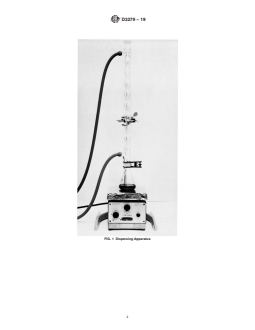
5.1 Theassemblyofthedispersingapparatusisillustratedin
(excluding those in tables and figures) shall not be considered
Fig. 1 with details of the component parts as follows:
as requirements of the standard.
5.1.1 Erlenmeyer Flask, of 250-mL capacity adapted to an
1.4 This standard does not purport to address all of the
Allihn-type reflux condenser.
safety concerns, if any, associated with its use. It is the
5.1.2 Magnetic Stirrer and Magnetic-Stirrer Hot Plate.
responsibility of the user of this standard to establish appro-
5.1.3 Bitumen Crucible or Gooch Crucible, glazed inside
priate safety, health, and environmental practices and deter-
and outside with the exception of the outside bottom surface.
mine the applicability of regulatory limitations prior to use.
The approximate dimensions shall be a diameter of 44 mm at
See Section 7 for a specific hazard statement.
the top tapering to 36 mm at the bottom and a depth of 20 to
1.5 This international standard was developed in accor-
30mm.
dance with internationally recognized principles on standard-
5.1.4 Glass Microfiber Filter Pad,32to34mmindiameter,
ization established in the Decision on Principles for the
fine porosity, fast flow rate, 1.5-µm particle retention.
Development of International Standards, Guides and Recom-
mendations issued by the World Trade Organization Technical 5.1.5 Filter Flask, heavy-wall with side tube, 500-mL
Barriers to Trade (TBT) Committee. capacity.
5.1.6 Filter Tube, 40 to 42 mm in inside diameter.
2. Referenced Documents
5.1.7 Rubber Tubing, or adapter for holding Gooch crucible
on the filter tube.
2.1 ASTM Standards:
C670Practice for Preparing Precision and Bias Statements
NOTE 1—Other suitable assemblies permitting vacuum filtration with a
for Test Methods for Construction Materials
crucible may be used.
5.1.8 Oven, capable of maintaining a temperature of 110 6
5°C.
This test method is under the jurisdiction of ASTM Committee D04 on Road
5.1.9 Desicator, of suitable size, charged with an effective
and Paving Materials and is the direct responsibility of Subcommittee D04.47 on
desiccant.
Miscellaneous Asphalt Tests.
Current edition approved June 15, 2019. Published June 2019. Originally
5.1.10 Balance, capable of making the required measure-
approved in 1973. Last previous edition approved in 2012 as D3279–12. DOI:
ments to an accuracy of at least 0.0001 g.
10.1520/D3279-19.
For referenced ASTM standards, visit the ASTM website, www.astm.org, or
contact ASTM Customer Service at service@astm.org. For Annual Book of ASTM
6. Reagent
Standards volume information, refer to the standard’s Document Summary page on
the ASTM website. 6.1 n-Heptane, 99.0 minimum mol% (pure grade).
Copyright © ASTM International, 100 Barr Harbor Drive, PO Box C700, West Conshohocken, PA 19428-2959. United States
D3279 − 19
7. Hazards To aid in filtration, slightly warm the flask containing the
sample plus solvent on the hot plate and pour its contents
7.1 n-Heptane has a boiling point of 98°C and a flash point
(exceptforthemagneticstirrer)throughthefilterusingagentle
of −1°C, which means that it should be handled with care. It
vacuum. Filtration will proceed most rapidly if the supernatant
is recommended that both the reflux dispersion and filtration
liquidisfilteredfirstwiththeinsolublestransferredtothefilter
steps be conducted in a ventilated hood and away from flames
last. Police the beaker or flask while transferring the final
or other sources of heat.
precipitate, using either a rubber policeman or stainless steel
8. Preparation of Crucible
spatulawithasquared
...
This document is not an ASTM standard and is intended only to provide the user of an ASTM standard an indication of what changes have been made to the previous version. Because
it may not be technically possible to adequately depict all changes accurately, ASTM recommends that users consult prior editions as appropriate. In all cases only the current version
of the standard as published by ASTM is to be considered the official document.
´1
Designation: D3279 − 12 D3279 − 19
Standard Test Method for
n-Heptane Insolubles
This standard is issued under the fixed designation D3279; the number immediately following the designation indicates the year of
original adoption or, in the case of revision, the year of last revision. A number in parentheses indicates the year of last reapproval. A
superscript epsilon (´) indicates an editorial change since the last revision or reapproval.
ε NOTE—Section 8.1 was editorially corrected in March 2016.
1. Scope
1.1 This test method covers determination of the mass percent of asphaltenes as defined by insolubility in normal-heptane
solvent. It is applicable to all solid and semi-solid petroleum asphalts containing little or no mineral matter, to gas oils, to heavy
fuel oils, and to crude petroleum that has been topped to a cut-point of 343°C343 °C or higher.
1.2 The values stated in SI units are to be regarded as the standard. No other units of measurement are included in this standard.
1.3 The text of this standard references notes and footnotes which provide explanatory material. These notes and footnotes
(excluding those in tables and figures) shall not be considered as requirements of the standard.
1.4 This standard does not purport to address all of the safety concerns, if any, associated with its use. It is the responsibility
of the user of this standard to establish appropriate safety safety, health, and healthenvironmental practices and determine the
applicability of regulatory limitations prior to use. See Section 7 for a specific hazard statement.
1.5 This international standard was developed in accordance with internationally recognized principles on standardization
established in the Decision on Principles for the Development of International Standards, Guides and Recommendations issued
by the World Trade Organization Technical Barriers to Trade (TBT) Committee.
2. Referenced Documents
2.1 ASTM Standards:
C670 Practice for Preparing Precision and Bias Statements for Test Methods for Construction Materials
3. Summary of Test Method
3.1 The sample is dispersed in n-heptane and filtered through a glass-fiber pad. The insoluble material is washed, dried, and
weighed.
4. Significance and Use
4.1 This test method is useful in quantifying the asphaltene content of petroleum asphalts, gas oils, heavy fuel oils, and crude
petroleum. Asphaltene content is defined as those components not soluble in n-heptane.
5. Apparatus and Materials
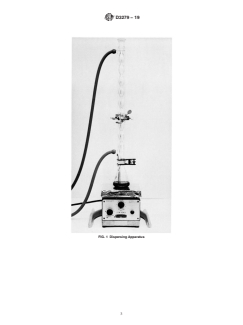
5.1 The assembly of the dispersing apparatus is illustrated in Fig. 1 with details of the component parts as follows:
5.1.1 Erlenmeyer Flask, of 250-mL capacity adapted to an Allihn-type reflux condenser.
5.1.2 Magnetic Stirrer and Magnetic-Stirrer Hot PlatePlate.
5.1.3 Bitumen Crucible or Gooch Crucible, glazed inside and outside with the exception of the outside bottom surface. The
approximate dimensions shall be a diameter of 44 mm at the top tapering to 36 mm at the bottom and a depth of 20–30 mm.20
to 30 mm.
5.1.4 Glass Microfiber Filter Pad, 32–34 32 to 34 mm in diameter, fine porosity, fast flow rate, 1.5υm1.5-μm particle retention.
5.1.5 Filter Flask, heavy-wall with side tube, 500-mL capacity.
5.1.6 Filter Tube, 40 to 42 mm in inside diameter.
This test method is under the jurisdiction of ASTM Committee D04 on Road and Paving Materials and is the direct responsibility of Subcommittee D04.47 on
Miscellaneous Asphalt Tests.
Current edition approved Dec. 1, 2012June 15, 2019. Published December 2012June 2019. Originally approved in 1973. Last previous edition approved in 20072012 as
D3279 – 07.D3279 – 12. DOI: 10.1520/D3279-12E01.10.1520/D3279-19.
For referenced ASTM standards, visit the ASTM website, www.astm.org, or contact ASTM Customer Service at service@astm.org. For Annual Book of ASTM Standards
volume information, refer to the standard’s Document Summary page on the ASTM website.
Copyright © ASTM International, 100 Barr Harbor Drive, PO Box C700, West Conshohocken, PA 19428-2959. United States
D3279 − 19
5.1.7 Rubber Tubing, or adapter for holding Gooch crucible on the filter tube.
NOTE 1—Other suitable assemblies permitting vacuum filtration with a crucible may be used.
5.1.8 Oven, Oven, capable of maintaining a temperature of 110 6 5ºC.5 °C.
5.1.9 Desicator, of suitable size, charged with an effective desiccant.
5.1.10 Balance, capable of making the required measurements to an accuracy of at least 0.0001 g.
6. Reagent
6.1 n-Heptane, 99.0 minimum mol % (Pure Grade).(pure grade).
7. Hazards
7.1 n-Heptane has a boiling point of 98°C98 °C and a flash point of −1°C,−1 °C, which means that it should be handled with
care. It is recommended that both the reflux dispersion and filtration steps be conducted in a ventilated hood and away from flames
or other sources of heat.
8. Preparation of Crucible
8.1 Place the Gooch crucible plus one thickness filter pad in an oven at about 110 6 5ºC5 °C for 30 min, allow to cool in a
desiccator for 30 6 5 min, and then determine the mass to the nearest 0.1 mg. Designate this mass as A. Store in a desiccator until
ready for use.
9. Sample Preparation
9.1 If the sample is not fluid, heat to any convenient temperature, but in any case not more than 100ºC100 °C above the
softening point.
10. Procedure
10.1 Note Safetysafety precautions in Section 7. Transfer into the tare
...