

ASTM D6703-19
(Test Method)Standard Test Method for Automated Heithaus Titrimetry
General Information
- Abstract
SIGNIFICANCE AND USE
5.1 This test method is intended as a laboratory diagnostic tool for estimating the colloidal stability of bitumen asphalt, asphalt cross blends, aged asphalt, and heavy oil residuum. Historically, bituminous asphalt and heavy oil residua have been modeled as colloidal suspensions in which a polar associated asphaltene moiety (the dispersed phase) is suspended in a maltene solvent moiety (the dispersing medium) (refer to Test Methods D3279 and D4124 for further definition of asphalt fraction materials). The extent to which these two moieties remain in state of peptization is a measure of the compatibility (colloidal stability) of the suspension. Compatibility may influence the physical properties of these materials, including rheological properties, for example, phase angle and viscosity. This test method and other similar test methods, along with the classical Heithaus test, may be recommended as a measure of the overall compatibility of a colloidal system by determining a parameter referred to as the state of peptization, P. The value of P commonly varies between 2.5 to 10 for unmodified or neat asphalts. Materials calculated to have low values of P are designated incompatible. Materials calculated to have high P values are designated compatible. Values in P are calculated as a function of two parameters that relate to the peptizability of the asphaltene moiety (the asphaltene peptizability parameter, pa) and the solvent power of the maltene moiety (the maltene peptizing power parameter, po). Values of pa and po are calculated as functions of the quantities Cmin and FRmax. Values of Cmin and FRmax are determined from experimental variables, the weight of asphalt (Wa), the volume of solvent (VS) to dissolve the weight of asphalt, and the volume of titrant (VT) added to initiate flocculation.
SCOPE
1.1 This test method describes a procedure for quantifying three Heithaus compatibility parameters that quantify the colloidal stability of asphalts and asphalt cross blends and aged asphalts.
1.2 Units—The values stated in SI units are to be regarded as standard. No other units of measurement are included in this standard.
1.3 The text of this standard references notes and footnotes which provide explanatory material. These notes and footnotes (excluding those in tables and figures) shall not be considered as requirements of the standard.
1.4 This standard does not purport to address all of the safety concerns, if any, associated with its use. It is the responsibility of the user of this standard to establish appropriate safety, health, and environmental practices and determine the applicability of regulatory limitations prior to use.
1.5 This international standard was developed in accordance with internationally recognized principles on standardization established in the Decision on Principles for the Development of International Standards, Guides and Recommendations issued by the World Trade Organization Technical Barriers to Trade (TBT) Committee.
- Status
- Published
- Publication Date
- 14-Dec-2019
- Technical Committee
- D04 - Road and Paving Materials
- Drafting Committee
- D04.47 - Miscellaneous Asphalt Tests
Overview
ASTM D6703-19: Standard Test Method for Automated Heithaus Titrimetry provides a standardized laboratory procedure for quantifying the colloidal stability of asphalt, bitumen, asphalt blends, aged asphalt, and heavy oil residua. This test method focuses on estimating compatibility within these materials by measuring their ability to maintain a stable colloidal suspension, which is essential for their performance as road and paving materials. The method uses automated titrimetry, building upon classical Heithaus testing, to deliver accurate and reproducible results on colloidal stability.
Key Topics
- Colloidal Stability of Asphalt: The standard measures how well asphaltenes (dispersed phase) remain suspended in maltenes (dispersing medium), which is a key indicator of material compatibility and performance.
- Heithaus Compatibility Parameters: Three primary parameters- asphaltene peptizability (pa), maltene peptizing power (po), and the overall state of peptization (P)- are determined. P values typically range from 2.5 to 10, indicating incompatible to compatible materials respectively.
- Automated Titrimetry: The method employs automated equipment, including a UV-visible spectrophotometer and metering pumps, to monitor flocculation and measure key compatibility indicators in a controlled, repeatable fashion.
- Significance in Material Performance: The state of peptization and compatibility measured by this standard strongly influence the physical and rheological properties of bitumens and asphalts, such as viscosity and phase angle.
Applications
- Asphalt Quality Assessment: This method is used as a diagnostic and research tool in laboratories to estimate the compatibility of asphalts, blends, aged materials, and heavy oil residua.
- Material Selection: Results help in choosing materials with optimal colloidal stability for paving, roofing, and industrial applications.
- Blending and Aging Studies: The test informs how cross-blending different asphalts or aging affects material stability and performance, aiding in product development and quality assurance.
- Process Optimization: Refineries and bitumen processors use the results to enhance the processing and formulation of bituminous materials to achieve desired performance outcomes.
Related Standards
When using ASTM D6703-19 for automated Heithaus titrimetry, consider these related ASTM standards:
- ASTM D3279 - Test Method for n-Heptane Insolubles
- ASTM D4124 - Test Method for Separation of Asphalt into Four Fractions
- ASTM D8 - Terminology Relating to Materials for Roads and Pavements
- ASTM D3666 - Specification for Minimum Requirements for Agencies Testing and Inspecting Road and Paving Materials
Practical Value
- Reproducibility and Objectivity: Automated titrimetry reduces operator variability, ensuring consistent assessment of asphalt colloidal stability.
- Decision-Making Support: The method’s clear parameters (pa, po, P) offer actionable data for materials purchasing, quality control, and troubleshooting in asphalt production.
- Industry Alignment: Conforms with internationally recognized principles, supporting global interoperability and compliance in the road and paving materials sector.
- Research and Development: Supports innovation in asphalt materials through in-depth study of compatibility and stability, ultimately contributing to improved longevity and performance of pavements and other bituminous applications.
In summary, ASTM D6703-19 provides an essential, standardized approach to evaluating asphalt and bitumen colloidal stability, helping industry professionals ensure the reliability and quality of critical paving materials.
Relations
- Effective Date
- 15-Dec-2019
- Effective Date
- 01-Nov-2019
- Effective Date
- 01-Aug-2019
- Effective Date
- 15-Jun-2019
- Effective Date
- 15-Dec-2018
- Effective Date
- 15-Aug-2018
- Effective Date
- 01-Jul-2018
- Effective Date
- 01-Feb-2018
- Effective Date
- 01-Jan-2018
- Effective Date
- 15-Jul-2017
- Effective Date
- 15-Jun-2017
- Effective Date
- 01-May-2017
- Effective Date
- 01-Mar-2017
- Effective Date
- 01-Dec-2016
- Effective Date
- 01-Oct-2016
Get Certified
Connect with accredited certification bodies for this standard

BSMI (Bureau of Standards, Metrology and Inspection)
Taiwan's standards and inspection authority.
Sponsored listings
Frequently Asked Questions
ASTM D6703-19 is a standard published by ASTM International. Its full title is "Standard Test Method for Automated Heithaus Titrimetry". This standard covers: SIGNIFICANCE AND USE 5.1 This test method is intended as a laboratory diagnostic tool for estimating the colloidal stability of bitumen asphalt, asphalt cross blends, aged asphalt, and heavy oil residuum. Historically, bituminous asphalt and heavy oil residua have been modeled as colloidal suspensions in which a polar associated asphaltene moiety (the dispersed phase) is suspended in a maltene solvent moiety (the dispersing medium) (refer to Test Methods D3279 and D4124 for further definition of asphalt fraction materials). The extent to which these two moieties remain in state of peptization is a measure of the compatibility (colloidal stability) of the suspension. Compatibility may influence the physical properties of these materials, including rheological properties, for example, phase angle and viscosity. This test method and other similar test methods, along with the classical Heithaus test, may be recommended as a measure of the overall compatibility of a colloidal system by determining a parameter referred to as the state of peptization, P. The value of P commonly varies between 2.5 to 10 for unmodified or neat asphalts. Materials calculated to have low values of P are designated incompatible. Materials calculated to have high P values are designated compatible. Values in P are calculated as a function of two parameters that relate to the peptizability of the asphaltene moiety (the asphaltene peptizability parameter, pa) and the solvent power of the maltene moiety (the maltene peptizing power parameter, po). Values of pa and po are calculated as functions of the quantities Cmin and FRmax. Values of Cmin and FRmax are determined from experimental variables, the weight of asphalt (Wa), the volume of solvent (VS) to dissolve the weight of asphalt, and the volume of titrant (VT) added to initiate flocculation. SCOPE 1.1 This test method describes a procedure for quantifying three Heithaus compatibility parameters that quantify the colloidal stability of asphalts and asphalt cross blends and aged asphalts. 1.2 Units—The values stated in SI units are to be regarded as standard. No other units of measurement are included in this standard. 1.3 The text of this standard references notes and footnotes which provide explanatory material. These notes and footnotes (excluding those in tables and figures) shall not be considered as requirements of the standard. 1.4 This standard does not purport to address all of the safety concerns, if any, associated with its use. It is the responsibility of the user of this standard to establish appropriate safety, health, and environmental practices and determine the applicability of regulatory limitations prior to use. 1.5 This international standard was developed in accordance with internationally recognized principles on standardization established in the Decision on Principles for the Development of International Standards, Guides and Recommendations issued by the World Trade Organization Technical Barriers to Trade (TBT) Committee.
SIGNIFICANCE AND USE 5.1 This test method is intended as a laboratory diagnostic tool for estimating the colloidal stability of bitumen asphalt, asphalt cross blends, aged asphalt, and heavy oil residuum. Historically, bituminous asphalt and heavy oil residua have been modeled as colloidal suspensions in which a polar associated asphaltene moiety (the dispersed phase) is suspended in a maltene solvent moiety (the dispersing medium) (refer to Test Methods D3279 and D4124 for further definition of asphalt fraction materials). The extent to which these two moieties remain in state of peptization is a measure of the compatibility (colloidal stability) of the suspension. Compatibility may influence the physical properties of these materials, including rheological properties, for example, phase angle and viscosity. This test method and other similar test methods, along with the classical Heithaus test, may be recommended as a measure of the overall compatibility of a colloidal system by determining a parameter referred to as the state of peptization, P. The value of P commonly varies between 2.5 to 10 for unmodified or neat asphalts. Materials calculated to have low values of P are designated incompatible. Materials calculated to have high P values are designated compatible. Values in P are calculated as a function of two parameters that relate to the peptizability of the asphaltene moiety (the asphaltene peptizability parameter, pa) and the solvent power of the maltene moiety (the maltene peptizing power parameter, po). Values of pa and po are calculated as functions of the quantities Cmin and FRmax. Values of Cmin and FRmax are determined from experimental variables, the weight of asphalt (Wa), the volume of solvent (VS) to dissolve the weight of asphalt, and the volume of titrant (VT) added to initiate flocculation. SCOPE 1.1 This test method describes a procedure for quantifying three Heithaus compatibility parameters that quantify the colloidal stability of asphalts and asphalt cross blends and aged asphalts. 1.2 Units—The values stated in SI units are to be regarded as standard. No other units of measurement are included in this standard. 1.3 The text of this standard references notes and footnotes which provide explanatory material. These notes and footnotes (excluding those in tables and figures) shall not be considered as requirements of the standard. 1.4 This standard does not purport to address all of the safety concerns, if any, associated with its use. It is the responsibility of the user of this standard to establish appropriate safety, health, and environmental practices and determine the applicability of regulatory limitations prior to use. 1.5 This international standard was developed in accordance with internationally recognized principles on standardization established in the Decision on Principles for the Development of International Standards, Guides and Recommendations issued by the World Trade Organization Technical Barriers to Trade (TBT) Committee.
ASTM D6703-19 is classified under the following ICS (International Classification for Standards) categories: 17.060 - Measurement of volume, mass, density, viscosity. The ICS classification helps identify the subject area and facilitates finding related standards.
ASTM D6703-19 has the following relationships with other standards: It is inter standard links to ASTM D6703-14, ASTM E644-11(2019), ASTM D8-19, ASTM D3279-19, ASTM D8-18c, ASTM D8-18b, ASTM D8-18a, ASTM D8-18, ASTM D4124-09(2018), ASTM D8-17c, ASTM D8-17b, ASTM D8-17a, ASTM D8-17, ASTM D8-16b, ASTM D3666-16. Understanding these relationships helps ensure you are using the most current and applicable version of the standard.
ASTM D6703-19 is available in PDF format for immediate download after purchase. The document can be added to your cart and obtained through the secure checkout process. Digital delivery ensures instant access to the complete standard document.
Standards Content (Sample)
This international standard was developed in accordance with internationally recognized principles on standardization established in the Decision on Principles for the
Development of International Standards, Guides and Recommendations issued by the World Trade Organization Technical Barriers to Trade (TBT) Committee.
Designation:D6703 −19
Standard Test Method for
Automated Heithaus Titrimetry
This standard is issued under the fixed designation D6703; the number immediately following the designation indicates the year of
original adoption or, in the case of revision, the year of last revision. A number in parentheses indicates the year of last reapproval. A
superscript epsilon (´) indicates an editorial change since the last revision or reapproval.
1. Scope D8055 Guide for Selecting an Appropriate Electronic Ther-
mometer for Replacing Mercury Thermometers in D04
1.1 This test method describes a procedure for quantifying
Road and Paving Standards
three Heithaus compatibility parameters that quantify the
E169 PracticesforGeneralTechniquesofUltraviolet-Visible
colloidalstabilityofasphaltsandasphaltcrossblendsandaged
Quantitative Analysis
asphalts.
E563 Practice for Preparation and Use of an Ice-Point Bath
1.2 Units—The values stated in SI units are to be regarded
as a Reference Temperature
as standard. No other units of measurement are included in this
E644 Test Methods for Testing Industrial Resistance Ther-
standard.
mometers
1.3 The text of this standard references notes and footnotes
3. Terminology
which provide explanatory material.These notes and footnotes
3.1 Refer to Terminology D8 for definitions of terms relat-
(excluding those in tables and figures) shall not be considered
ing to materials for roads and pavements.
as requirements of the standard.
3.2 Definitions of Terms Specific to This Standard:
1.4 This standard does not purport to address all of the
3.2.1 asphaltene peptizability, n—the tendency of as-
safety concerns, if any, associated with its use. It is the
phaltenes to exist as a stable dispersion in a maltene solvent,
responsibility of the user of this standard to establish appro-
measured by the Heithaus parameter p .
priate safety, health, and environmental practices and deter-
a
mine the applicability of regulatory limitations prior to use.
3.2.2 asphalt state of peptization, n—a measure of the
1.5 This international standard was developed in accor-
ability of the combination of a maltene solvent and dispersed
dance with internationally recognized principles on standard-
asphaltenes to form a stable dispersed system.
ization established in the Decision on Principles for the
3.2.3 colloidal suspension, n—an intimate mixture of two
Development of International Standards, Guides and Recom-
substances, one of which, called the dispersed phase (or
mendations issued by the World Trade Organization Technical
colloid), is uniformly distributed in a finely divided state
Barriers to Trade (TBT) Committee.
throughthesecondsubstance,calledthedispersionmedium(or
dispersing medium).
2. Referenced Documents
3.2.4 compatibility, n—the state of peptization of an asphalt,
2.1 ASTM Standards:
which is measured quantitatively by the Heithaus parameter P.
D8 Terminology Relating to Materials for Roads and Pave-
3.2.5 dispersed phase, n—one phase of a dispersion consist-
ments
ingofparticlesordropletsofonesubstancedistributedthrough
D3279 Test Method forn-Heptane Insolubles
a second phase.
D3666 Specification for Minimum Requirements for Agen-
cies Testing and Inspecting Road and Paving Materials
3.2.6 dispersing medium, n—one phase of a dispersion that
D4124 Test Method for Separation of Asphalt into Four
distributes particles or droplets of another substance, the
Fractions
disperse phase.
3.2.7 flocculation, n—theprocessofaggregationandcoales-
cence into a flocculent mass. See Test Method D3279.
This test method is under the jurisdiction of ASTM Committee D04 on Road
and Paving Materials and is the direct responsibility of Subcommittee D04.47 on 3.2.8 Heithaus compatibility parameters, n—three param-
Miscellaneous Asphalt Tests.
eters: asphaltene peptizability (p ), maltene peptizing power
a
Current edition approved Dec. 15, 2019. Published January 2020. Originally
(p ), and asphalt state of peptization (P), measured using
o
approved in 2001. Last previous edition approved in 2014 as D6703 – 14. DOI:
Heithaus titration methods.
10.1520/D6703-19.
For referenced ASTM standards, visit the ASTM website, www.astm.org, or
3.2.9 maltene peptizing power, n—the ability of a maltene
contact ASTM Customer Service at service@astm.org. For Annual Book of ASTM
solvent to disperse asphaltenes, measured by the Heithaus
Standards volume information, refer to the standard’s Document Summary page on
the ASTM website. parameter p .
o
Copyright © ASTM International, 100 Barr Harbor Drive, PO Box C700, West Conshohocken, PA 19428-2959. United States
D6703−19
4. Summary of Test Method transmittance %T of detected radiation at 740 nm plotted as a
function of time t (Fig. 3), as the titrated solution passes
4.1 Three 40-mLreaction vials shall be tared (Fig. 1).Three
through a quartz flow cell.
samples of asphalt of weights 0.400 g, 0.600 g, and 0.800 g
shall be transferred to each of three reaction vials. Toluene 4.3 The spectrophotometer output signal measures turbidity
(3.000 mL) shall be added to each reaction vial to dissolve the of the sample solution as a titration experiment proceeds to a
asphalt constituting three solutions which differ by concentra- flocculation onset point, corresponding to the onset of floccu-
tion. Each solution is titrated with isooctane (2,2,4-trimethyl lating asphaltene phase separating from the solution. Fig. 3
pentane) to promote onset of flocculation of the solution. illustrates a plot of %T versus t for three test solutions. Values
of %T increase with time up to the flocculation onset point,
4.2 Titrations are performed by placing reaction vials sepa-
afterwhichvaluesof%Tdecreasewithtime.Thetimerequired
rately in the apparatus illustrated in Fig. 2. Each reaction vial
to reach flocculation onset t multiplied by the titrant flow rate
f
is separately placed into a 250-mL water-jacketed reaction
gives the titrant flocculation volume V .
T
vessel. A sample circulation loop is made by pumping the
solution through a short path length quartz flow cell housed in 4.4 The measured weight of each asphalt sample, W , the
a
an ultraviolet-visible spectrophotometer then back to the reac- volume of toluene initially used to dissolve each sample, V ,
S
tion vial with high flow rate metering pump.Atitration loop is and the volume of titrant at onset of flocculation, V , shall be
T
made by pumping titrant into the sample reaction vial at a used as the input data required to calculate compatibility
constant flow rate using a low flow rate metering pump, thus a parameters.
secondreactionvesselcontainingtitrantisplacedintoasecond
5. Significance and Use
250-mL water-jacketed reaction vessel. During a titration the
outputsignalfromaspectrophotometerisrecordedusingadata 5.1 This test method is intended as a laboratory diagnostic
acquisition system (computer) to record the change in percent tool for estimating the colloidal stability of bitumen asphalt,
FIG. 1Reaction Vial (40 mL) with TFE-fluorocarbon Cover and Temperature Probe
D6703−19
FIG. 2Automated Titration Apparatus
FIG. 3Onset of Flocculation Peaks Measured at Three Successively Increasing Concentrations (Solvent: Toluene, Titrant: Isooctane)
asphalt cross blends, aged asphalt, and heavy oil residuum. values of P are designated incompatible. Materials calculated
Historically, bituminous asphalt and heavy oil residua have to have high P values are designated compatible. Values in P
been modeled as colloidal suspensions in which a polar
are calculated as a function of two parameters that relate to the
associated asphaltene moiety (the dispersed phase) is sus-
peptizability of the asphaltene moiety (the asphaltene peptiz-
pended in a maltene solvent moiety (the dispersing medium)
ability parameter, p ) and the solvent power of the maltene
a
(refer to Test Methods D3279 and D4124 for further definition
moiety (the maltene peptizing power parameter, p ). Values of
o
of asphalt fraction materials). The extent to which these two
p and p are calculated as functions of the quantities C and
a o min
moieties remain in state of peptization is a measure of the
FR . Values of C and FR are determined from experi-
max min max
compatibility (colloidal stability) of the suspension. Compat-
mental variables, the weight of asphalt (W ), the volume of
a
ibility may influence the physical properties of these materials,
solvent (V ) to dissolve the weight of asphalt, and the volume
S
including rheological properties, for example, phase angle and
of titrant (V ) added to initiate flocculation.
T
viscosity. This test method and other similar test methods,
along with the classical Heithaus test, may be recommended as
6. Apparatus
a measure of the overall compatibility of a colloidal system by
determining a parameter referred to as the state of peptization, 6.1 UV-Visible Spectrophotometer, shall have a wavelength
scanning range from 200 to 1000 nm, with adjustable aperture
P. The value of P commonly varies between 2.5 to 10 for
unmodified or neat asphalts. Materials calculated to have low or attenuator.
D6703−19
6.2 Digital Acquisition System (computer). 6.18 Tubing Clamps, shall be sized to fit 13-mm inside
diameter tubing.
6.3 Water-Jacketed Reaction Vessel,shallbeofvolume:250
mL, two. 6.19 Thermometer, shall be a platinum resistance thermom-
eter (PRT) readable to the nearest 0.1 °C, with a Pt 100 Class
6.4 TFE-Fluorocarbon Covers, two.
AA tolerance rating with probe length >80 mm, and probe
6.4.1 TFE-Fluorocarbon Cover No. 1, (see Fig. 1), shall be
diameter 3.0 mm. Standardize the PRT system (probe and
threaded to hold a 40-mL reaction vial. Three holes, 1.5-mm
readout device) in accordance with Test Methods E644. Cor-
diameter, concentric to the cover’s center shall be tapped to set
rections shall be applied to ensure accurate measurements
within the inside diameter of the vial when attached to the
within 0.1 °C (shall be calibrated to 60.1 °C, and shall
TFE-fluorocarbon cover. One additional hole, 3.0 mm, shall be
conform to Guide D8055, Practice E563, and Test Methods
tapped off center, positioned just to the outside of where the
E644).
reaction vial is positioned in the TFE-fluorocarbon cover. This
holeshallallowforatemperatureprobe(refertoGuideD8055, 6.20 Graduated Cylinders, two. Shall be of volumes: 1.000
Practice E563, and Test Methods E644) to be inserted into the 6 0.001 mL and 10.0 6 0.1 mL.
water-filled reaction vessel.
6.21 Argon Gas Supply.
6.4.2 TFE-Fluorocarbon Cover No. 2, may be used as a lid
6.22 Laboratory Jacks—Laboratory jacks may be used as
for the second 200-mLwater-jacketed reaction vessel, contain-
stands for metering pumps.
ing titrant. Dimensions: thickness, 2.0 mm; diameter, 70 mm.
One hole 1.5 mm in diameter tapped through the cover’s
6.23 Beakers, two. Shall be of volume: 500 mL.
center. This cover shall be identical to the cover described in
6.24 Polypropylene Rinse Bottles, two. Shall be of volume:
6.4.1 except for the number of holes, and should be threaded to
200 mL.
hold a second 40-mL reaction vial as a titration reservoir.
6.25 TFE-Fluorocarbon Lined Caps, shall be 40-mL reac-
6.5 High Flow Rate Metering Pump, shall have a flow rate
tion vials.
range from 0.5 to 10.0 mL/min; flow rate consistency, 60.1
mL/min; and piston chamber resistant to damage from solvent
7. Reagents
contact.
7.1 Purity of Reagents—HPLC-grade chemicals should be
6.6 Low Flow Rate Metering Pump, shall have a flow rate
used in all sample preparations and tests. Unless otherwise
range from 0.100 to 1.000 mL/min; flow rate consistency,
indicated, it is intended that all reagents conform to the
60.002 mL/min; and piston chamber resistant to damage from
specifications of the Committee on Analytical Reagents of the
solvent contact.
American Chemical Society, where such specifications are
available. Other grades may be used, provided it is first
6.7 Magnetic Stirring Plates, two.
ascertained that the reagent is of sufficiently high purity to
6.8 Refrigerated Water Bath Circulator, shall have a tem-
permit its use without lessening the accuracy of the determi-
perature variation of 60.1 °C and temperature range from 0 °C
nation.
to 100 °C.
7.2 Isooctane (2,2,4-trimethylpentane), HPLC grade.
6.9 Quartz Flow Cell, shall have a 0.20-mm path length
7.3 Toluene, HPLC grade.
with 6.35-mm flanged fittings.
7.4 Toluene, reagent grade.
6.10 TFE-Fluorocarbon Tubing, shall have a 0.559-mm
inside diameter/1.575-mm outside diameter.
8. Assembly
6.11 Reaction Vials, shall be of a 40-mL volume capacity.
8.1 Installation Requirements:
6.12 “4-hole” TFE-Fluorocarbon Cover and “1-hole”
8.1.1 The following assembly should be conducted in a
TFE-Fluorocarbon Cover.
fume hood. The fume hood should be of sufficient size to
6.13 TFE-fluorocarbon-Coated Magnetic Stir Bars. accommodate all pieces of the apparatus and supplies needed
to perform the test method.
6.14 Stopwatch.
8.1.2 The fume hood should be equipped with a pump or
6.15 Syringe, shall be 5.000 mL, glass, gas-sealed, and
house vacuum line for the assembly of a vacuum trap, used
resistant to solvents toluene and n-heptane.
during the procedural cleanup step (see 10.2.8).
6.16 TFE-Fluorocarbon Tube Fittings (4), which shall in-
8.2 Assembly (Fig. 2):
clude standard 6.35-mm flanged fittings for 0.559-mm inside
8.2.1 Circulation Loop Assembly—A sample (circulation
diameter/1.575-mmoutsidediameterTFE-fluorocarbontubing.
loop) is assembled using a high flow rate metering pump
6.17 Neoprene Tubing, shall be 13 mm inside diameter.
Reagent Chemicals, American Chemical Society Specifications, American
The sole source of supply of the apparatus known to the committee at this time Chemical Society, Washington, DC. For Suggestions on the testing of reagents not
is Starna Cells, Inc. If you are aware of alternative suppliers, please provide this listed by the American Chemical Society, see Analar Standards for Laboratory
information to ASTM International Headquarters. Your comments will receive Chemicals, BDH Ltd., Poole, Dorset, U.K., and the United States Pharmacopeia
careful consideration at a meeting of the responsible technical committee, which and National Formulary, U.S. Pharmacopeial Convention, Inc. (USPC), Rockville,
you may attend. MD.
D6703−19
plumbed between a short path length flow cell and a TFE- 8.2.3.1 A 13-mm inside diameter neoprene tubing and
fluorocarbon cover (fitted to a 40-mL reaction vial/200-mL tubing clamps is plumbed between the water outflow nozzle of
water-jacketed reaction vessel assembly) using 0.559-mm the first 200-mL water-jacketed reaction vessel and the inflow
inside diameter/1.575-mm outside diameter TFE-fluorocarbon nozzle of the second 200-mL water-jacketed reaction vessel.
tubing fitted with standard 6.35-mm flange fittings adaptable to
8.2.3.2 Two additional pieces of 13-mm inside diameter
0.559-mm inside diameter/1.575-mm outside diameter tubing. neoprene tubing are plumbed between the inflow and outflow
8.2.1.1 One of the 200-mL water-jacketed reaction vessels couplers of the refrigerated water bath circulator and the two
should be positioned on one of the stir plates, next to the 200-mL water-jacketed reaction vessel’s nozzles.
cuvette cell housing of the UV-visible spectrophotometer.
8.2.1.2 A0.1-mm path length flow cell should be positioned 9. Preparation and Calibration
in the cell housing of the spectrophotometer and secured into
9.1 UV-Visible Spectrophotometer:
place.
9.1.1 The manufacturer’s instructions and specifications
8.2.1.3 The high flow rate metering pump should be posi-
should be consulted for operation of the UV-visible spectro-
tioned on a laboratory jack next to the stir plate. Attach a
photometer.
6.35-mm flanged fitting to one end of a 100-mm long piece of
9.1.2 TheUV-visiblespectrophotometershallbeoperatedin
0.559-mm inside diameter/1.575-mm outside diameter TFE-
the percent transmittance detection mode.
fluorocarbontubingandattachtheflangedfittingprovidedwith
9.1.3 The spectrophotometer wavelength shall be set to
the flow cell to the opposite end of this piece of tubing. Fasten
740 nm (see Note 1).
the tubing between the inflow end of the flow cell and the
NOTE 1—A wavelength of 740 nm has been selected as the detection
outflow end of the high flow rate metering pump.
wavelengthforthepresenttestmethod.Atthiswavelengththelightsource
8.2.1.4 A second flanged fitting provided with the flow cell
scatters light when transmitted through a turbid solution of flocculating
is attached to one end of a second 300-mm long piece of
particles, but will otherwise not promote absorption of light by molecular
0.559-mm inside diameter/1.575-mm outside diameter TFE-
species (asphaltenes) present in a test sample.
fluorocarbon tubing, leaving the other tubing end free. The
9.1.4 The spectrophotometer should be calibrated in accor-
flanged fitting end of this tubing is fastened to the outflow end
dance with the manufacturer’s instruction and specifications.
of the flow cell.
Calibration shall be performed using toluene as the 100 %
8.2.1.5 A 6.35-mm flanged fitting is attached to a third
transmittance spectral background.
200-mm long piece of 0.559-mm inside diameter/1.575-mm
9.1.4.1 Guidelines for properly obtaining a reference ba
...
This document is not an ASTM standard and is intended only to provide the user of an ASTM standard an indication of what changes have been made to the previous version. Because
it may not be technically possible to adequately depict all changes accurately, ASTM recommends that users consult prior editions as appropriate. In all cases only the current version
of the standard as published by ASTM is to be considered the official document.
Designation: D6703 − 14 D6703 − 19
Standard Test Method for
Automated Heithaus Titrimetry
This standard is issued under the fixed designation D6703; the number immediately following the designation indicates the year of
original adoption or, in the case of revision, the year of last revision. A number in parentheses indicates the year of last reapproval. A
superscript epsilon (´) indicates an editorial change since the last revision or reapproval.
1. Scope
1.1 This test method describes a procedure for quantifying three Heithaus compatibility parameters that quantify the colloidal
stability of asphalts and asphalt cross blends and aged asphalts.
1.2 Units—The values stated in SI units are to be regarded as standard. No other units of measurement are included in this
standard.
1.3 The text of this standard references notes and footnotes which provide explanatory material. These notes and footnotes
(excluding those in tables and figures) shall not be considered as requirements of the standard.
1.4 This standard does not purport to address all of the safety concerns, if any, associated with its use. It is the responsibility
of the user of this standard to establish appropriate safety safety, health, and healthenvironmental practices and determine the
applicability of regulatory limitations prior to use.
1.5 This international standard was developed in accordance with internationally recognized principles on standardization
established in the Decision on Principles for the Development of International Standards, Guides and Recommendations issued
by the World Trade Organization Technical Barriers to Trade (TBT) Committee.
2. Referenced Documents
2.1 ASTM Standards:
D8 Terminology Relating to Materials for Roads and Pavements
D3279 Test Method forn-Heptane Insolubles
D3666 Specification for Minimum Requirements for Agencies Testing and Inspecting Road and Paving Materials
D4124 Test Method for Separation of Asphalt into Four Fractions
D5546D8055 Test Method for Solubility of Asphalt Binders in Toluene by CentrifugeGuide for Selecting an Appropriate
Electronic Thermometer for Replacing Mercury Thermometers in D04 Road and Paving Standards (Withdrawn 2017)
E169 Practices for General Techniques of Ultraviolet-Visible Quantitative Analysis
E563 Practice for Preparation and Use of an Ice-Point Bath as a Reference Temperature
E644 Test Methods for Testing Industrial Resistance Thermometers
3. Terminology
3.1 Refer to Terminology D8 for definitions of terms relating to materials for roads and pavements.
3.2 Definitions of Terms Specific to This Standard:
3.2.1 asphaltene peptizability, n—the tendency of asphaltenes to exist as a stable dispersion in a maltene solvent, measured by
the Heithaus parameter p .
a
3.2.2 asphalt state of peptization, n—a measure of the ability of the combination of a maltene solvent and dispersed asphaltenes
to form a stable dispersed system.
3.2.3 colloidal suspension, n—an intimate mixture of two substances, one of which, called the dispersed phase (or colloid), is
uniformly distributed in a finely divided state through the second substance, called the dispersion medium (or dispersing medium).
3.2.4 compatibility, n—the state of peptization of an asphalt, which is measured quantitatively by the Heithaus parameter P.
This test method is under the jurisdiction of ASTM Committee D04 on Road and Paving Materials and is the direct responsibility of Subcommittee D04.47 on
Miscellaneous Asphalt Tests.
Current edition approved June 1, 2014Dec. 15, 2019. Published July 2014January 2020. Originally approved in 2001. Last previous edition approved in 20132014 as
D6703 – 13.D6703 – 14. DOI: 10.1520/D6703-14.10.1520/D6703-19.
For referenced ASTM standards, visit the ASTM website, www.astm.org, or contact ASTM Customer Service at service@astm.org. For Annual Book of ASTM Standards
volume information, refer to the standard’s Document Summary page on the ASTM website.
Copyright © ASTM International, 100 Barr Harbor Drive, PO Box C700, West Conshohocken, PA 19428-2959. United States
D6703 − 19
3.2.5 dispersed phase, n—one phase of a dispersion consisting of particles or droplets of one substance distributed through a
second phase.
3.2.6 dispersing medium, n—one phase of a dispersion that distributes particles or droplets of another substance, the disperse
phase.
3.2.7 flocculation, n—the process of aggregation and coalescence into a flocculent mass. See Test Method D3279.
3.2.8 Heithaus compatibility parameters, n—three parameters: asphaltene peptizability (p ), maltene peptizing power (p ), and
a o
asphalt state of peptization (P), measured using Heithaus titration methods.
3.2.9 maltene peptizing power, n—the ability of a maltene solvent to disperse asphaltenes, measured by the Heithaus parameter
p .
o
4. Summary of Test Method
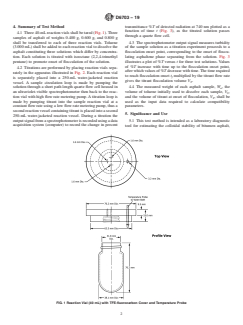
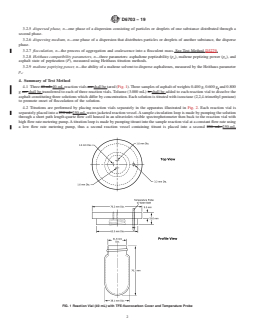
4.1 Three 40 mL 40-mL reaction vials are shall be tared (Fig. 1). Three samples of asphalt of weights 0.400 g, 0.600 g, and 0.800
g are shall be transferred to each of three reaction vials. Toluene (3.000 mL) is shall be added to each reaction vial to dissolve the
asphalt constituting three solutions which differ by concentration. Each solution is titrated with isooctane (2,2,4-trimethyl pentane)
to promote onset of flocculation of the solution.
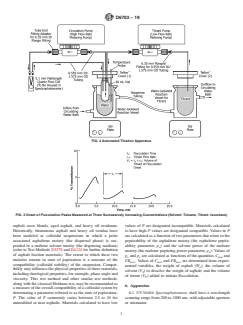
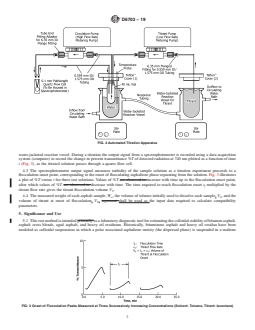
4.2 Titrations are performed by placing reaction vials separately in the apparatus illustrated in Fig. 2. Each reaction vial is
separately placed into a 250 mL 250-mL water-jacketed reaction vessel. A sample circulation loop is made by pumping the solution
through a short path length quartz flow cell housed in an ultraviolet-visible spectrophotometer then back to the reaction vial with
high flow rate metering pump. A titration loop is made by pumping titrant into the sample reaction vial at a constant flow rate using
a low flow rate metering pump, thus a second reaction vessel containing titrant is placed into a second 250 mL 250-mL
FIG. 1 Reaction Vial (40 mL) with TFE-fluorocarbon Cover and Temperature Probe
D6703 − 19
FIG. 2 Automated Titration Apparatus
water-jacketed reaction vessel. During a titration the output signal from a spectrophotometer is recorded using a data acquisition
system (computer) to record the change in percent transmittance %T of detected radiation at 740 nm plotted as a function of time
t (Fig. 3), as the titrated solution passes through a quartz flow cell.
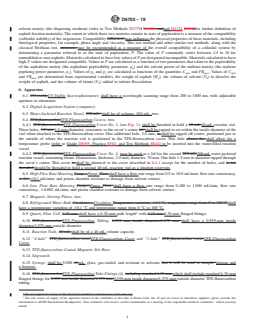
4.3 The spectrophotometer output signal measures turbidity of the sample solution as a titration experiment proceeds to a
flocculation onset point, corresponding to the onset of flocculating asphaltene phase separating from the solution. Fig. 3 illustrates
a plot of %T versus t for three test solutions. Values of %T are observed to increase with time up to the flocculation onset point,
after which values of %T are observed to decrease with time. The time required to reach flocculation onset t multiplied by the
f
titrant flow rate gives the titrant flocculation volume V .
T
4.4 The measured weight of each asphalt sample, W , the volume of toluene initially used to dissolve each sample, V , and the
a S
volume of titrant at onset of flocculation, V , represent shall be used as the input data required to calculate compatibility
T
parameters.
5. Significance and Use
5.1 This test method is intended primarily as a laboratory diagnostic tool for estimating the colloidal stability of bitumen asphalt,
asphalt cross blends, aged asphalt, and heavy oil residuum. Historically, bituminous asphalt and heavy oil residua have been
modeled as colloidal suspensions in which a polar associated asphaltene moiety (the dispersed phase) is suspended in a maltene
FIG. 3 Onset of Flocculation Peaks Measured at Three Successively Increasing Concentrations (Solvent: Toluene, Titrant: Isooctane)
D6703 − 19
solvent moiety (the dispersing medium) (refer to Test Methods D3279, D4124, andand D4124 D5546for further definition of
asphalt fraction materials). The extent to which these two moieties remain in state of peptization is a measure of the compatibility
(colloidal stability) of the suspension. Compatibility influences may influence the physical properties of these materials, including
rheological properties, for example, phase angle and viscosity. This test method and other similar test methods, along with the
classical Heithaus test, measures may be recommended as a measure of the overall compatibility of a colloidal system by
determining a parameter referred to as the state of peptization, P. The value of P commonly varies between 2.5 to 10 for
unmodified or neat asphalts. Materials calculated to have low values of P are designated incompatible. Materials calculated to have
high P values are designated compatible. Values in P are calculated as a function of two parameters that relate to the peptizability
of the asphaltene moiety (the asphaltene peptizability parameter, p ) and the solvent power of the maltene moiety (the maltene
a
peptizing power parameter, p ). Values of p and p are calculated as functions of the quantities C and FR . Values of C
o a o min max min
and FR are determined from experimental variables, the weight of asphalt (W ), the volume of solvent (V ) to dissolve the
max a S
weight of asphalt, and the volume of titrant (V ) added to initiate flocculation.
T
6. Apparatus
6.1 UV-visibleUV-Visible Spectrophotometer, shall have a wavelength scanning range from 200 to 1000 nm, with adjustable
aperture or attenuator.
6.2 Digital Acquisition System (computer).
6.3 Water-Jacketed Reaction Vessel, 250-mL, shall be of volume: 250 mL, two.
6.4 TFE-fluorocarbonTFE-Fluorocarbon Covers, two.
6.4.1 TFE-fluorocarbonTFE-Fluorocarbon Cover No. 1, (see Fig. 1), shall be threaded to hold a 40 mL 40-mL reaction vial.
Three holes, 1.5 mm 1.5-mm diameter, concentric to the cover’s center are shall be tapped to set within the inside diameter of the
vial when attached to the TFE-fluorocarbon cover. One additional hole, 3.0 mm, is shall be tapped off center, positioned just to
the outside of where the reaction vial is positioned in the TFE-fluorocarbon cover. This hole allows the shall allow for a
temperature probe (refer to Guide D8055, Practice E563, and Test Methods E644) to be inserted into the water-filled reaction
vessel.
6.4.2 TFE-fluorocarbonTFE-Fluorocarbon Cover No. 2, may be used as a lid for the second 200-mL,200-mL water-jacketed
reaction vessel, containing titrant. Dimensions: thickness, 2.0 mm; diameter, 70 mm. One hole 1.5 mm in diameter tapped through
the cover’s center. This cover is shall be identical to the cover described in 6.4.1 except for the number of holes, and is not
threaded.should be threaded to hold a second 40-mL reaction vial as a titration reservoir.
6.5 High Flow Rate Metering Pump—Pump, Flow shall have a flow rate range from 0.5 to 10.0 mL/min; flow rate consistency,
6 0.1 60.1 mL/min; and piston chamber resistant to damage from solvent contact.
6.6 Low Flow Rate Metering Pump—Pump, Flow shall have a flow rate range from 0.100 to 1.000 mL/min; flow rate
consistency, 60.002 mL/min; and piston chamber resistant to damage from solvent contact.
6.7 Magnetic Stirring Plates, two.
6.8 Refrigerated Water Bath Circulator—Circulator, Temperature variation, 60.1°C; temperature range from 0 to 100°C.shall
have a temperature variation of 60.1 °C and temperature range from 0 °C to 100 °C.
6.9 Quartz Flow Cell, 0.20 mm shall have a 0.20-mm path length with 6.35 mm 6.35-mm flanged fittings.
6.10 TFE-fluorocarbonTFE-Fluorocarbon Tubing, 0.559 mm inside diameter/1.575 mm shall have a 0.559-mm inside
diameter/1.575-mm outside diameter.
6.11 Reaction Vials, 40 mL shall be of a 40-mL volume capacity.
6.12 “4-hole” TFE-fluorocarbon coverTFE-Fluorocarbon Cover and “1-hole” TFE-fluorocarbon cover.TFE-Fluorocarbon
Cover.
6.13 TFE-fluorocarbon-Coated Magnetic Stir Bars.
6.14 Stopwatch.
6.15 Syringe, shall be 5.000 cc,mL, glass, gas-sealed, and resistant to solvents that it will be used to sample. toluene and
n-heptane.
6.16 TFE-fluorocarbonTFE-Fluorocarbon Tube Fittings (4), including standard 6.35 mm which shall include standard 6.35-mm
flanged fittings for 0.559 mm inside diameter/1.575 mm 0.559-mm inside diameter/1.575-mm outside diameter TFE-fluorocarbon
tubing.
The last approved version of this historical standard is referenced on www.astm.org.
The sole source of supply of the apparatus known to the committee at this time is Starna Cells, Inc. If you are aware of alternative suppliers, please provide this
information to ASTM International Headquarters. Your comments will receive careful consideration at a meeting of the responsible technical committee, which you may
attend.
D6703 − 19
6.17 Neoprene Tubing, shall be 13 mm inside diameter.
6.18 Tubing Clamps, shall be sized to fit 13 mm 13-mm inside diameter tubing.
6.19 Digital Probe Thermometer, °C (calibrated to 60.2°C). Probe length, >80-mm, probe diameter, 3.0 mm.shall be a platinum
resistance thermometer (PRT) readable to the nearest 0.1 °C, with a Pt 100 Class AA tolerance rating with probe length >80 mm,
and probe diameter 3.0 mm. Standardize the PRT system (probe and readout device) in accordance with Test Methods E644.
Corrections shall be applied to ensure accurate measurements within 0.1 °C (shall be calibrated to 60.1 °C, and shall conform to
Guide D8055, Practice E563, and Test Methods E644).
6.20 Graduated Cylinders, two. Volumes: Shall be of volumes: 1.000 6 0.001 mL and 10.0 6 0.1 mL.
6.21 Argon Gas Supply.
6.22 Laboratory Jacks—Laboratory jacks may be used as stands for metering pumps.
6.23 Beakers, two. Volume: Shall be of volume: 500 mL.
6.24 Polypropylene Rinse Bottles, two. Volume: Shall be of volume: 200 mL.
6.25 TFE-fluorocarbonTFE-Fluorocarbon Lined Caps, for 40 mLshall be 40-mL reaction vials.
7. Reagents
7.1 Purity of Reagents—HPLC grade HPLC-grade chemicals shallshould be used in all sample preparations and tests. Unless
otherwise indicated, it is intended that all reagents conform to the specifications of the Committee on Analytical Reagents of the
American Chemical Society, where such specifications are available. Other grades may be used, provided it is first ascertained
that the reagent is of sufficiently high purity to permit its use without lessening the accuracy of the determination.
7.2 Isooctane (2,2,4-trimethylpentane), HPLC grade.
7.3 Toluene, HPLC grade.
7.4 Toluene, reagent grade.
8. Assembly
8.1 Installation Requirements:
8.1.1 It is recommended that the The following assembly should be conducted in a fume hood. The fume hood should be of
sufficient size to accommodate all pieces of the apparatus and supplies needed to perform the test method.
8.1.2 The fume hood should be equipped with a pump or house vacuum line for the assembly of a vacuum trap, used during
the procedural cleanup step (see 10.2.8).
8.2 Assembly (Fig. 2):
8.2.1 Circulation Loop Assembly—A sample (circulation loop) is assembled using a high flow rate metering pump plumbed
between a short path length flow cell and a TFE-fluorocarbon cover (fitted to a 40 mL reaction vial/200 mL 40-mL reaction
vial/200-mL water-jacketed reaction vessel assembly) using 0.559 mm 0.559-mm inside diameter/1.575-mm outside diameter
TFE-fluorocarbon tubing fitted with standard 6.2 mm 6.35-mm flange fittings adaptable to 0.559 mm inside diameter/1.575 mm
0.559-mm inside diameter/1.575-mm outside diameter tubing.
8.2.1.1 Position one One of the 200-mL,200-mL water-jacketed reaction vessels should be positioned on one of the stir plates,
next to the cuvette cell housing of the UV-visible spectrophotometer.
8.2.1.2 Position a A 0.1-mm path length flow cell should be positioned in the cell housing of the spectrophotometer and secure
it secured into place.
8.2.1.3 Position the The high flow rate metering pump should be positioned on a laboratory jack next to the stir plate. Attach
a 6.35 mm 6.35-mm flanged fitting to one end of a 100 mm 100-mm long piece of 0.559 mm inside diameter/1.575 mm 0.559-mm
inside diameter/1.575-mm outside diameter TFE-fluorocarbon tubing and attach the flanged fitting provided with the flow cell to
the opposite end of this piece of tubing. Fasten the tubing between the inflow end of the flow cell and the outflow end of the high
flow rate metering pump.
8.2.1.4 Attach a A second flanged fitting provided with the flow cell is attached to one end of a second 300 mm 300-mm long
piece of 0.559 mm inside diameter/1.575 mm 0.559-mm inside diameter/1.575-mm outside diameter TFE-fluorocarbon tubing,
leaving the other tubing end free. Fasten the The flanged fitting end of this tubing is fastened to the outflow end of the flow cell.
8.2.1.5 Attach a 6.35 mm A 6.35-mm flanged fitting is attached to a third 200 mm 200-mm long piece of 0.559 mm inside
diameter/1.575 mm 0.559-mm inside diameter/1.575-mm outside diameter TFE-fluorocarbon tubing, leaving the other tubing end
Reagent Chemicals, American Chemical Society Specifications, American Chemical Society, Washington, DC. For Suggestions on the testing of reagents not listed by
the American Chemical Society, see AnnualAnalar Standards for Laboratory Chemicals, BDH Ltd., Poole, Dorset, U.K., and the United States Pharmacopeia and National
Formulary, U.S. Pharmacopeial Convention, Inc. (USPC), Rockville, MD.
D6703 − 19
free. Fasten this fitting to the inflow end of the high flow rate metering pump. The two free ends of tubing (8.2.1.4 and 8.2.1.5)
will lead to the 40 mL 40-mL reaction vial, positioned through the holes provided in the top of the “4-hole” TFE-fluorocarbon
cover.
8.2.2 Titrant Loop Assembly—A titrant dispenser (titrant loop) is assembled using a low flow rate metering pump plumbed
between the reaction vial and titrant vial using 0.559 mm inside diameter/1.575 mm 0.559-mm inside diameter/1.575-mm outside
diameter flanged fitting.
8.2.2.1 Position a 200 mL A 200-mL water-jacketed reaction vessel should be positioned on a second stir plate, next to the high
flow rate metering pump/laboratory jack assembly.
8.2.2.2 Position the The low flow rate metering pump should be positioned on a second laboratory jack next to the 200 mL
200-mL water-jacketed reaction vessel/stir plate assembly.
8.2.2.3 Attach a 300 mm A 300-mm piece of 0.559 mm inside diameter/1.575 mm 0.559-mm inside diameter/1.575-mm outside
diameter TFE-fluorocarbon tubing fitted with one 6.35 mm 6.35-mm flanged fitting is attached to the inflow end of a low flow rate
metering pump.
8.2.2.4 The free end of the tubing is placed through the hole provided in the second TFE-fluorocarbon cover into the 200 mL
200-mL water-jacketed reaction vessel.
8.2.2.5 Attach a 200 mm A 200-mm piece of 0.559 mm inside diameter/1.575 mm 0.559-mm inside diameter/1.575-mm outside
diameter TFE-fluorocarbon tubing fitted with a standard 6.35 mm flange fitting 6.35-mm flanged fitting is attached to the outflow
end of the low flow rate metering pump. The free end of tubing runs to the 30 mL 30-mL reaction vial.
8.2.3 Refrigerated Water Bath Circulator Assembly:
8.2.3.1 Using 13 mm A 13-mm inside diameter neoprene tubing and tubing clamps, plumb cla
...