

ASTM D4124-09(2018)
(Test Method)Standard Test Method for Separation of Asphalt into Four Fractions
General Information
- Abstract
SIGNIFICANCE AND USE
5.1 This test method separates asphalts into four well-defined fractions. Analysis of these fractions can be used to evaluate asphalt composition (1, 2).4 For example, one can compare the ratios of the fractions with other asphalt systems to evaluate processing and aging parameters that relate to performance properties of the asphalt.
SCOPE
1.1 This test method covers the separation of four defined fractions from petroleum asphalts. The four fractions are defined as saturates, naphthene aromatics, polar aromatics, and iso-octane insoluble asphaltenes. This method can also be used to isolate saturates, naphthene aromatics, and polar aromatics from distillate products such as vacuum gas oils, lubricating oils, and cycle stocks. These distillate products usually do not contain asphaltenes.
1.2 The values stated in SI units are to be regarded as standard.
1.3 Since a precision estimate for this standard has not been developed, this test method is to be used for research or informational purposes only. Therefore, this standard should not be used for acceptance or rejection of a material for purchasing purposes.
1.4 This standard does not purport to address all of the safety concerns, if any, associated with its use. It is the responsibility of the user of this standard to establish appropriate safety, health, and environmental practices and determine the applicability of regulatory limitations prior to use. Specific precautionary statements are given in Section 8.
1.5 This international standard was developed in accordance with internationally recognized principles on standardization established in the Decision on Principles for the Development of International Standards, Guides and Recommendations issued by the World Trade Organization Technical Barriers to Trade (TBT) Committee.
- Status
- Published
- Publication Date
- 31-Dec-2017
- Technical Committee
- D04 - Road and Paving Materials
- Drafting Committee
- D04.47 - Miscellaneous Asphalt Tests
Overview
ASTM D4124-09(2018): Standard Test Method for Separation of Asphalt into Four Fractions is a widely referenced international standard developed by ASTM for analyzing the composition of petroleum asphalts. This test method details the process used to separate asphalt into four well-defined fractions: saturates, naphthene aromatics, polar aromatics, and iso-octane insoluble asphaltenes. This separation facilitates a deeper understanding of asphalt's chemical make-up, providing valuable insights for research, quality evaluation, and process optimization. While primarily intended for research or informational purposes, ASTM D4124 enhances comparative analysis across different asphalt sources and processing methods, impacting performance evaluation and aging studies.
Key Topics
- Asphalt Fractionation: The standard describes a laboratory method for splitting asphalt into four primary fractions:
- Saturates: Non-polar hydrocarbons not retained by alumina in alkane eluate.
- Naphthene Aromatics: Ring compounds with both saturated and aromatic characteristics, adsorbed and desorbed under set conditions.
- Polar Aromatics (Resins): Compounds exhibiting polar aromaticity, extracted using polar solvents.
- Asphaltenes: High-molecular-weight fractions insoluble in alkanes.
- Sample Applicability: Primarily applies to petroleum asphalts, but can also be used for distillate products such as vacuum gas oils, lubricating oils, and cycle stocks (these generally lack asphaltenes).
- Method Purpose: Enables researchers to evaluate and compare asphalt compositions, helping assess processing quality, degree of aging, and potential performance in pavement and roofing applications.
Applications
The practical value of ASTM D4124 lies in its ability to provide a detailed breakdown of asphalt’s constituents, which is critical in various applied contexts:
- Research and Development: Supports academic and industry research by providing standardized methodology for asphalt composition analysis.
- Asphalt Performance Evaluation: By correlating fraction ratios, users can infer processing and aging history, which connects directly to functional properties such as durability, flexibility, and resistance to environmental factors.
- Comparative Analysis: Enables benchmarking between asphalts from different sources or those processed with varying methods.
- Quality Control (Non-Acceptance Use): Assists in quality assessments, but is not intended for material acceptance or rejection in purchasing decisions.
- Distillate Product Characterization: The method extends to analyzing vacuum gas oils, lubricating oils, and cycle stocks for saturates, naphthene aromatics, and polar aromatics content, broadening its utility in refinery operations.
Related Standards
- ASTM D140: Practice for Sampling Bituminous Materials - referenced for the collection of representative samples to be tested by D4124.
- Manual on Hydrocarbon Analysis: Additional analytical guidance document cited within the standard.
- World Trade Organization (WTO) TBT Principles: Development of ASTM D4124 follows internationally recognized standardization practices, ensuring global relevance and compatibility.
Conclusion
ASTM D4124-09(2018) establishes a crucial laboratory procedure for the separation of asphalt into four key fractions. Following this guideline enables stakeholders across research, industry, and quality control sectors to gain meaningful insights into asphalt composition, facilitating improved product development, process optimization, and comparative assessments. For optimal implementation, adherence to safety practices and awareness of the standard’s research-focused limitations are essential.
Keywords: asphalt composition, fractionation, asphaltenes, saturates, naphthene aromatics, polar aromatics, ASTM D4124, bituminous materials, petroleum asphalt analysis, research asphalt standard.
Relations
- Effective Date
- 01-Jan-2018
- Effective Date
- 01-Feb-2007
- Effective Date
- 10-Jun-2001
- Effective Date
- 10-Jun-2001
- Effective Date
- 01-Jan-2018
- Effective Date
- 01-Jan-2018
- Effective Date
- 01-Jan-2018
Get Certified
Connect with accredited certification bodies for this standard

DIBt (Deutsches Institut für Bautechnik)
German Institute for Building Technology.
DIN CERTCO
DIN Group product certification.
Zavod za gradbeništvo Slovenije (ZAG) - Inšpekcija
ZAG inspection body for construction products, structures, and materials.
Sponsored listings
Frequently Asked Questions
ASTM D4124-09(2018) is a standard published by ASTM International. Its full title is "Standard Test Method for Separation of Asphalt into Four Fractions". This standard covers: SIGNIFICANCE AND USE 5.1 This test method separates asphalts into four well-defined fractions. Analysis of these fractions can be used to evaluate asphalt composition (1, 2).4 For example, one can compare the ratios of the fractions with other asphalt systems to evaluate processing and aging parameters that relate to performance properties of the asphalt. SCOPE 1.1 This test method covers the separation of four defined fractions from petroleum asphalts. The four fractions are defined as saturates, naphthene aromatics, polar aromatics, and iso-octane insoluble asphaltenes. This method can also be used to isolate saturates, naphthene aromatics, and polar aromatics from distillate products such as vacuum gas oils, lubricating oils, and cycle stocks. These distillate products usually do not contain asphaltenes. 1.2 The values stated in SI units are to be regarded as standard. 1.3 Since a precision estimate for this standard has not been developed, this test method is to be used for research or informational purposes only. Therefore, this standard should not be used for acceptance or rejection of a material for purchasing purposes. 1.4 This standard does not purport to address all of the safety concerns, if any, associated with its use. It is the responsibility of the user of this standard to establish appropriate safety, health, and environmental practices and determine the applicability of regulatory limitations prior to use. Specific precautionary statements are given in Section 8. 1.5 This international standard was developed in accordance with internationally recognized principles on standardization established in the Decision on Principles for the Development of International Standards, Guides and Recommendations issued by the World Trade Organization Technical Barriers to Trade (TBT) Committee.
SIGNIFICANCE AND USE 5.1 This test method separates asphalts into four well-defined fractions. Analysis of these fractions can be used to evaluate asphalt composition (1, 2).4 For example, one can compare the ratios of the fractions with other asphalt systems to evaluate processing and aging parameters that relate to performance properties of the asphalt. SCOPE 1.1 This test method covers the separation of four defined fractions from petroleum asphalts. The four fractions are defined as saturates, naphthene aromatics, polar aromatics, and iso-octane insoluble asphaltenes. This method can also be used to isolate saturates, naphthene aromatics, and polar aromatics from distillate products such as vacuum gas oils, lubricating oils, and cycle stocks. These distillate products usually do not contain asphaltenes. 1.2 The values stated in SI units are to be regarded as standard. 1.3 Since a precision estimate for this standard has not been developed, this test method is to be used for research or informational purposes only. Therefore, this standard should not be used for acceptance or rejection of a material for purchasing purposes. 1.4 This standard does not purport to address all of the safety concerns, if any, associated with its use. It is the responsibility of the user of this standard to establish appropriate safety, health, and environmental practices and determine the applicability of regulatory limitations prior to use. Specific precautionary statements are given in Section 8. 1.5 This international standard was developed in accordance with internationally recognized principles on standardization established in the Decision on Principles for the Development of International Standards, Guides and Recommendations issued by the World Trade Organization Technical Barriers to Trade (TBT) Committee.
ASTM D4124-09(2018) is classified under the following ICS (International Classification for Standards) categories: 91.100.50 - Binders. Sealing materials; 93.080.20 - Road construction materials. The ICS classification helps identify the subject area and facilitates finding related standards.
ASTM D4124-09(2018) has the following relationships with other standards: It is inter standard links to ASTM D4124-09, ASTM D140-01(2007), ASTM D140-00, ASTM D140-01, ASTM D6703-19, ASTM D5505-14(2020), ASTM D8-22a. Understanding these relationships helps ensure you are using the most current and applicable version of the standard.
ASTM D4124-09(2018) is available in PDF format for immediate download after purchase. The document can be added to your cart and obtained through the secure checkout process. Digital delivery ensures instant access to the complete standard document.
Standards Content (Sample)
This international standard was developed in accordance with internationally recognized principles on standardization established in the Decision on Principles for the
Development of International Standards, Guides and Recommendations issued by the World Trade Organization Technical Barriers to Trade (TBT) Committee.
Designation: D4124 − 09 (Reapproved 2018)
Standard Test Method for
Separation of Asphalt into Four Fractions
This standard is issued under the fixed designation D4124; the number immediately following the designation indicates the year of
original adoption or, in the case of revision, the year of last revision. A number in parentheses indicates the year of last reapproval. A
superscript epsilon (´) indicates an editorial change since the last revision or reapproval.
1. Scope 2.2 Other Documents:
Manual on Hydrocarbon Analysis
1.1 This test method covers the separation of four defined
fractions from petroleum asphalts. The four fractions are
3. Terminology
defined as saturates, naphthene aromatics, polar aromatics, and
iso-octane insoluble asphaltenes.This method can also be used 3.1 Definitions of Terms Specific to This Standard:
3.1.1 asphaltenes or alkane insolubles—insoluble matter
to isolate saturates, naphthene aromatics, and polar aromatics
from distillate products such as vacuum gas oils, lubricating that can be separated from asphalt following digestion of the
asphalt in n-alkane (and in some cases, branched alkanes)
oils, and cycle stocks. These distillate products usually do not
contain asphaltenes. under the specified conditions in this test method.
3.1.2 naphthene—any of a group of hydrocarbon ring com-
1.2 The values stated in SI units are to be regarded as
pounds of the general formula, C H , derivatives of cyclopen-
standard.
n 2n
tane and cyclohexane, found in certain petroleum stocks.
1.3 Since a precision estimate for this standard has not been
3.1.3 naphthene aromatics—material that is adsorbed on
developed, this test method is to be used for research or
calcined CG-20 alumina in the presence of n-heptane, and
informational purposes only. Therefore, this standard should
desorbed by toluene, after removal of saturates under the
not be used for acceptance or rejection of a material for
conditions specified.
purchasing purposes.
3.1.4 petrolenes (also referred to as maltenes)—(1) any of
1.4 This standard does not purport to address all of the
the constituents of a bitumen, as asphalt, that are soluble in
safety concerns, if any, associated with its use. It is the
n-alkanes (and in some cases, branched alkanes), which
responsibility of the user of this standard to establish appro-
generally range in carbon number between n-C to n-C
5 10
priate safety, health, and environmental practices and deter-
alkanes, n-heptane being the most common solvent used; (2)
mine the applicability of regulatory limitations prior to use.
the low molecular weight alkane-soluble matter recovered
Specific precautionary statements are given in Section 8.
following separation of asphaltenes from the digested mixture
1.5 This international standard was developed in accor-
under the specified conditions described in this and similar test
dance with internationally recognized principles on standard-
methods.
ization established in the Decision on Principles for the
3.1.5 polar aromatics (resins)—material desorbed from cal-
Development of International Standards, Guides and Recom-
cinedCG-20aluminaabsorbent,afterthesaturatesfractionand
mendations issued by the World Trade Organization Technical
naphthenic aromatics fraction have been removed, using tolu-
Barriers to Trade (TBT) Committee.
ene:methanol (50:50, vol:vol) and trichloroethylene eluate
under the conditions specified.
2. Referenced Documents
3.1.6 saturates—material that, on percolation in an alkane
2.1 ASTM Standards:
eluate, is not absorbed on calcined CG-20 alumina absorbent
D140 Practice for Sampling Bituminous Materials
under the conditions specified.
4. Summary of Test Method
This test method is under the jurisdiction of ASTM Committee D04 on Road
and Paving Materials and is the direct responsibility of Subcommittee D04.47 in 4.1 The sample containing the four defined fractions is first
Miscellaneous Asphalt Tests.
separated into alkane-insoluble asphaltenes and alkane-soluble
Current edition approved Jan. 1, 2018. Published January 2018. Originally
petrolenes. Petrolenes are then adsorbed onto calcined CG-20
approved in 1982. Last previous edition approved in 2009 as D4124 – 09. DOI:
alumina and further fractionated into saturate, naphthene
10.1520/D4124-09R18.
For referenced ASTM standards, visit the ASTM website, www.astm.org, or
contact ASTM Customer Service at service@astm.org. For Annual Book of ASTM
Standards volume information, refer to the standard’s Document Summary page on
the ASTM website. Available from ASTM as MNL3-6TH-EB.
Copyright © ASTM International, 100 Barr Harbor Drive, PO Box C700, West Conshohocken, PA 19428-2959. United States
D4124 − 09 (2018)
aromatic, and polar aromatic fractions by pumping an eluo- 6.2.1 LC Apparatus (Fig. 2)—(a) ring stand with clamp,
tropic series of elution solvents upwards through a glass flask (25-mL round bottom or Erlenmeyer flask); (b) metering
chromatographiccolumnpackedwithcalcinedalumina.Eluted pump; (c) sealed glass LC column; (d) UV detector with data
fractions are recovered by solvent removal prior to final acquisition system (wavelength range 200 to 500 nm at
weighing. The three eluted fractions plus the alkane- 0.1 nm); (e) graduated cylinder (Fig. 2).
precipitated asphaltenes comprise the four fractions as defined 6.2.2 UVDetectorwithDataAcquisitionSystem(Fig.2)—A
in Section 3.
UV detector with data acquisition system suitable for use with
liquid chromatography or HPLC used to detect the occurrence
5. Significance and Use
of material fractions (peak response) as they are eluted from
5.1 This test method separates asphalts into four well- the column.
defined fractions. Analysis of these fractions can be used to 6.2.3 Metering Pump (Fig. 2)—Piston and piston chamber
evaluate asphalt composition (1, 2). For example, one can
will be constructed of materials resistant to deterioration by
compare the ratios of the fractions with other asphalt systems solvents that will be used to perform the method. Flow rate
to evaluate processing and aging parameters that relate to
range of the pump will be 0.1 to 5.0 mL/min 6 0.1 mL/min
performance properties of the asphalt. flow rate stability.
6.2.4 LC Column with Water Jacket—Closed glass liquid
6. Apparatus and Materials
chromatography column, 70 cm long and 1.5 cm inside
6.1 Reflux Apparatus for Asphaltene/Maltene Separation, diameter (volume, 124 cc). The LC column will be a closed
with features as specified in Fig. 1. (See 6.1.1.)
column with end plates containing solvent-permeable dia-
6.1.1 Apparatus (Fig. 1)—(a) ring stand with clamp; (b) phragms and fitting ports for 6.35-mm ( ⁄4-in.) tubing fittings.
heater stirring plate; (c) 500-mL Erlenmeyer flask with 29/42
6.2.5 Refrigerated/Heating Circulator—A refrigerated/
sintered glass neck; (d) reducer, 29/42 to 24/40 sintered glass
heating circulator, temperature range between 0 and 100 °C 6
necks; (e) Allihn-type reflux condenser with 24/40 sintered
0.1 °C stability, with water circulation through the LC column
glass neck.
water jacket via high-pressure hose 15.9-mm ( ⁄8-in. ID).
6.2 Chromatographic Column Apparatus, with features as
6.3 Materials:
specified in Fig. 2 (see 6.2.1 – 6.2.5).
6.3.1 Utilities—Fume hood, vacuum source, nitrogen gas
source, cold water source, nitrogen gas-purged vacuum drying
oven, rotary solvent evaporator (water bath and oil bath type),
The boldface numbers in parentheses refer to a list of references at the end of
nitrogen gas stream evaporator with heater water bath.
this standard.
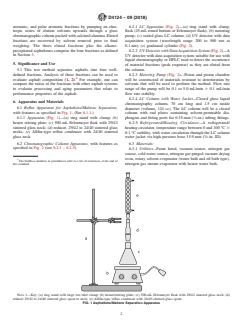
NOTE 1—Key: (a) ring stand with large test tube clamp; (b) heater/stirring plate; (c) 500-mL Erlenmeyer flask with 29/42 sintered glass neck; (d)
reducer 29/42 to 24/40 sintered glass spout to neck; (e) Allihn-type reflux condenser with 24/40 sintered glass spout.
FIG. 1 Asphaltene/Maltene Separation Apparatus
D4124 − 09 (2018)
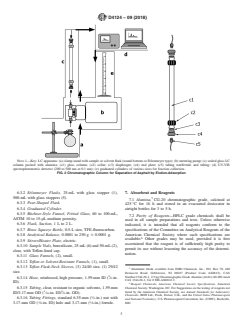
NOTE 1—Key: LC apparatus: (a) clamp stand with sample or solvent flask (round bottom or Erlenmeyer type); (b) metering pump; (c) sealed glass LC
column packed with alumina; (c1) glass column; (c2) collar; (c3) diaphragm; (c4) end plate; (c5) tubing nut/ferrule and tubing; (d) UV-VIS
spectrophotometric detector (200 to 500 nm at 0.1 nm); (e) graduated cylinders of various sizes for fraction collection.
FIG. 2 Chromatographic Column for Separation of Asphalt by Elution-Adsorption
6.3.2 Erlenmeyer Flasks, 25-mL with glass stopper (1), 7. Absorbent and Reagents
500-mL with glass stoppers (5). 5
7.1 Alumina, CG-20 chromatographic grade, calcined at
6.3.3 Pear-Shaped Flask.
425 °C for 16 h and stored in an evacuated desiccator in
6.3.4 Graduated Cylinder.
airtight bottles for 3 to 5 h.
6.3.5 Büchner-Style Funnel, Fritted Glass, 60 to 100-mL,
7.2 Purity of Reagents—HPLC grade chemicals shall be
ASTM 10 to 15-µL medium porosity.
used in all sample preparations and tests. Unless otherwise
6.3.6 Flask, Suction,1Lto2L.
indicated, it is intended that all reagents conform to the
6.3.7 Rinse Squeeze Bottle, 0.5-L size, TFE-fluorocarbon. specifications of the Committee on Analytical Reagents of the
American Chemical Society where such specifications are
6.3.8 Analytical Balance, 0.0001 to 250 g 6 0.0001 g.
available. Other grades may be used, provided it is first
6.3.9 Stirrer/Heater Plate, electric.
ascertained that the reagent is of sufficiently high purity to
6.3.10 Sample Vials, borosilicate, 25-mL(6) and 50-mL(2),
permit its use without lessening the accuracy of the determi-
clear, with Teflon-lined cap.
nation.
6.3.11 Glass Funnels, (2), small.
6.3.12 Teflon or Solvent-Resistant Funnels, (1), small.
6.3.13 Teflon Flask-Neck Sleeves, (3) 24/40 size, (1) 29/42
Aluminum Oxide available from EMD Chemicals, Inc., P.O. Box 70, 480
size.
Democrat Road, Gibbstown, NJ 08027 (Product Code AX0612), CAS
5 Number:1344-28-1, 2.5 kg Chromatographic Grade Alumina (Al O ) 80-200 mesh
6.3.14 Hose, reinforced, high pressure, 1.59-mm ID ( ⁄8-in. 2 3
CAS 1344-28-1, Cat # EM-AXO612-3.
ID).
Reagent Chemicals, American Chemical Society Specifications, American
6.3.15 Tubing, clear, resistant to organic solvents, 1.59-mm Chemical Society, Washington, DC. For Suggestions on the testing of reagents not
1 1 listed by the American Chemical Society, see Annual Standards for Laboratory
ID/3.17-mm OD ( ⁄16-in. ID/ ⁄8-in. OD).
Chemicals, BDH Ltd., Poole, Dorset, U.K., and the United States Pharmacopeia
6.3.16 Tubing Fittings, standard 6.35-mm ( ⁄4-in.) nut with
and National Formulary, U.S. Pharmacopeial Convention, Inc. (USPC), Rockville,
1 1
3.17-mm OD ( ⁄8-in. ID) hole and 3.17-mm ( ⁄8-in.) ferrule. MD.
D4124 − 09 (2018)
7.3 Reagents: sidesoftheflask.Oncethesamplehasbeenobservedtogointo
7.3.1 iso-Octane (2,2,4-trimethyl pentane), HPLC grade, solution, stir the solution with refluxing for an additional 1 h
0.01 % water. (Note 2).
7.3.2 n-Heptane, HPLC grade, 0.01 % water.
NOTE2—Normally2hisasufficientamountoftimetodissolve(digest)
7.3.3 Methanol, anhydrous, HPLC grade, 0.01 % water.
straight reduced asphalts, but for air-blown or chemically modified
7.3.4 Toluene, HPLC grade, 0.001 % water.
asphalts, the dissolution time may need to be extended to 3 h.
7.3.5 Trichloroethylene, ACS grade, 0.02 % water, boiling
9.5 After the 2 to 3-h period of time required for refluxing
point 86.5 to 87.5 °C.
with stirring, turn off the heater element of the stirrer/heater
plate and allow the sample solution to cool with stirring.
8. Safety Precautions
Continue to stir the cooled sample solution for an additional
8.1 Most organic solvents used in these methods are flam-
2 h after cooling, at which time discontinue stirring, remove
mable and to some degree toxic. Reference should be made to
the Allihn-type reflux condenser, stopper the flask, and allow
Material Safety Data Sheets available from the supplier. These
the sample solution to settle for 2 h prior to filtering (Note 3).
solvents should be handled with care and only in well-
NOTE 3—At some time during the stirring process, after heating has
ventilated areas such as a fume hood.All working areas should
been discontinued, rinse down the reflux assembly with 10 to 20 mL of
be kept free of sparks, flames, or other sources of high
iso-octane by dispensing solvent from the top of the Allihn-type reflux
temperature.
condenser into the flask using a squeeze bottle.
9.6 Set up a Büchner-style fritted-glass funnel (60-mL,
9. Separation of Asphalt into Asphaltenes and Petrolenes
ASTM 10 to 15-µLmedium porosity) by placing the funnel on
(Maltenes)
a 1-Lsuction flask with a filter ring.Attach the suction flask to
9.1 Representative asphalt samples free of foreign sub-
a cold-trapped vacuum source with high-pressure hose and
stances will be collected in accordance with Practice D140.
hose clamps and secure the suction flask to a ring stand or
Samples for testing can be transferred by chilling to facilitate
mount rack with a clamp. Prior to filtration, tare the Büchner-
fracturing the sample or by heating the sample until it becomes
style fritted-glass funnel.
sufficiently fluid to pour. Warning—In no case shall the
9.7 Filter the sample solution prepared in 9.2 – 9.5,by
samples be heated more than 50 °C above the expected
quantitatively decanting the liquid contents of the sample
softeningpointofthematerial,whichisapproximately100 °C.
solution from the 500-mL Erlenmeyer flask directly into the
9.2 Transfer to the nearest 0.001 g, 2.000 g of the asphalt
Büchner-style fritted-glass funnel while applying suction to the
into a tared 500-mL Erlenmeyer flask and record the mass of
1-L suction flask.
the asphalt, M .Allow the sample to cool if transferred by
asphalt
9.8 Quantitatively transfer the filtered decant, using a glass
heating and pouring prior to adding the iso-octane in the ratio
funnel, to a 1-Lpear-shaped flask clamped to a ring stand, (this
of 100 mL of solvent per1gof sample.Add 200 6 0.1 mL of
decant represents the first portion of petrolenes dissolved in
HPLC grade iso-octane to the sample asphalt in the 500-mL
iso-octane). Transfer the 1-L pear-shaped flask to a rotary
Erlenmeyer flask.
evaporator and distill the iso-octane off of the petrolene
9.3 In a fume hood of sufficient size to accommodate all
fraction. Return the Büchner-style fritted-glass funnel to the
required components of the apparatus and supplies used to
suction flask.
perform this procedure, assemble a reflux apparatus in accor-
9.9 Wash the asphaltenes which remain in the 500-mL
dance with the setup shown in Fig. 1. Place a stir bar into the
Erlenmeyer flask with 100 mLof iso-octane. Place the 500-mL
500-mLErlenmeyerflaskcontainingthesamplesolution.Place
Erlenmeyer flask back onto the heater/stirrer plate and gently
the 500-mLErlenmeyer flask on a stirrer/heater plate. Place an
heat the contents of the Erlenmeyer flask for approximately
Allihn-type reflux condenser into the neck of 500-mL Erlen-
30 min with stirring to remove the remaining soluble materials
meyer flask (Note 1). Ensure that the reflux apparatus is
potentially entrained in the asphaltene phase. Allow the solu-
secured with lab clamps to a heavy ring stand or a laboratory
tion to cool and settle (1 to 2 h). Quantitatively transfer all of
mounting assembly housed in the fume hood by clamping both
theremainingcontentsofthe500-mLErlenmeyerflaskintothe
the neck of the 500-mL Erlenmeyer flask and the Allihn-type
Büchner-style fritted-glass funnel while applying suction to the
refluxcondenser.ConnecttheAllihn-typerefluxcondensertoa
1-L suction flask in order to filter off the asphaltenes. Toward
cold water source using high pressure hose 15.9-mm ( ⁄8-in.
the end of this transfer step, use a squirt bottle containing
ID) and secure with hose clamps at all connections.
iso-octane to rinse the final remaining loose material from the
NOTE 1—PlaceTeflon flask-neck sleeves between sintered glass fittings
500-mL Erlenmeyer flask into the Büchner-style fritted-glass
to ensure easy disassembly of the reflux apparatus.
funnel. Set the empty 500-mL Erlenmeyer flask aside until
9.4 Slowly heat the sample solution on a stirrer/heater plate
9.15.
until the solution is observed to begin to reflux. Maintain the
9.10 Continue washing the asphaltene filter cake with addi-
solution temperature near the boiling point of iso-octane
tional iso-octane dispensed from a squeeze bottle until the
(99 °C).Begintostirthecontentsoftheflaskatamoderaterate
eluate draining from the filter cake is observed to become
once the solution begins to reflux. Stir the contents of the
colorless (Note 4).
500-mL Erlenmeyer flask for 1 to2hor until no visual
evidence of undissolved (undigested) asphalt adheres to the NOTE 4—Do not allow the filter cake to dry and crack during this step.
D4124 − 09 (2018)
The filter cake should remain wet with iso-octane during this step to
10. Assembly for Separation of Petrolene (Maltenes) into
ensure a tight seal between the filter cake and the funnel surface.
Three Defined Fractions
9.11 When the eluate draining from the filter cake becomes
10.1 Assembly of LC Column Apparatus (Fig. 2)—The
colorless, discontinue washing and allow the remaining elution
following assembly must be set up in a fume hood. The fume
solvent to drain off of the filter so that the filter cake dries and hood should be of sufficient size to accommodate all required
cracks, then discontinue the vacuum. components of the apparatus and supplies used to perform this
procedure.
9.12 Quantitatively transfer the eluate collected in the 1-L
10.2 Pump and Column Assembly (Fig. 2)—Set up a chro-
suction flask to the 1-L pear-shaped flask containing the
matographic column as shown in Fig. 2. Ensure that the LC
petrolenes previously recovered from the filtration of the
column is secured with lab clamps to a heavy ring stand or a
decant (see 9.7 and 9.8). Attach the 1-L pear-shaped flask to a
laboratory mounting assembly housed in the fume hood.
rotary evaporator and distill off all but 10 to 15 mL of the
Assembleameteringpump(flowrate=0.1to10.0mL/min)by
iso-octane solvent to retain a liquid concentrate. Quantitatively
plumbing the metering pump between the sample/solvent
transfer the concentrate to a tared 50-mL borosilicate screw-
flasks that will be used to introduce the solution and eluting
cap vial. Remove the remaining iso-octane solvent present in
solvents into the LC column and the bottom of the LC column
the petrolene concentrate by placing the vial on a 35 °C heated
using two 30.5-cm (12-in.) long pieces of 1.59-mm ID/
n
...