

ASTM D4599-21
(Practice)Standard Practice for Measuring the Concentration of Toxic Gases or Vapors Using Length-of-Stain Dosimeters
General Information
- Abstract
SIGNIFICANCE AND USE
5.1 The U.S. Occupational Safety and Health Administration (OSHA) in 29 CFR 1910.1000, Subpart Z, designates that certain gases and vapors present in work place atmospheres must be controlled so that their concentrations do not exceed specified limits. Other countries have similar regulations.
5.2 This practice will provide a means for the measurement of airborne concentrations of certain gases and vapors listed in 29 CFR 1910.1000 and in other countries’ regulations.
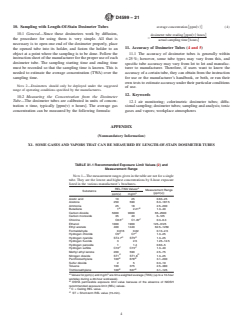
5.3 A partial list of chemicals for which this practice is applicable is presented in Appendix X1 with current National Institute for Occupational Safety and Health (NIOSH) recommended exposure limit (REL) values (2) and typical measurement ranges for the selected chemicals as obtained from various manufacturer’s specifications. This list is for guidance purposes only; the user of this practice is responsible for determining the applicability of commercially available tubes to specific exposure limits.
5.4 This practice may be used for either personal or area monitoring.
SCOPE
1.1 This practice describes the detection and measurement of time weighted average (TWA) concentrations of toxic gases or vapors using length-of-stain colorimetric dosimeter tubes. A list of some of the gases and vapors that can be detected by this practice is provided in Appendix X1. This list is given as a guide and should be considered neither absolute nor complete.
1.2 Length-of-stain colorimetric dosimeters work by diffusional sampling. The results are immediately available by visual observation; thus no auxiliary sampling, test, nor analysis equipment are needed. The dosimeters, therefore, are extremely simple to use and very cost effective.
1.3 The values stated in SI units are to be regarded as standard. No other units of measurement are included in this standard.
1.4 This standard does not purport to address all of the safety concerns, if any, associated with its use. It is the responsibility of the user of this standard to establish appropriate safety, health, and environmental practices and determine the applicability of regulatory limitations prior to use.
1.5 This international standard was developed in accordance with internationally recognized principles on standardization established in the Decision on Principles for the Development of International Standards, Guides and Recommendations issued by the World Trade Organization Technical Barriers to Trade (TBT) Committee.
- Status
- Published
- Publication Date
- 28-Feb-2021
- Technical Committee
- D22 - Air Quality
- Drafting Committee
- D22.04 - Workplace Air Quality
Buy Documents
ASTM D4599-21 - Standard Practice for Measuring the Concentration of Toxic Gases or Vapors Using Length-of-Stain Dosimeters
REDLINE ASTM D4599-21 - Standard Practice for Measuring the Concentration of Toxic Gases or Vapors Using Length-of-Stain Dosimeters
Overview
ASTM D4599-21 is the standard practice for measuring the concentration of toxic gases or vapors using length-of-stain dosimeters. Developed by ASTM International, this standard specifies procedures for detecting and quantifying time weighted average (TWA) concentrations of hazardous gases and vapors in workplace atmospheres. It uses length-of-stain colorimetric dosimeter tubes, a simple and cost-effective solution for air monitoring required by regulations such as the U.S. OSHA 29 CFR 1910.1000 Subpart Z, and similar international standards.
Key Topics
- Length-of-Stain Dosimeter Tubes: These are glass tubes containing granulated material infused with chemicals that react with specific gases or vapors, causing a measurable color change. Each tube is individually calibrated for direct, immediate results.
- Diffusional Sampling: The standard uses passive diffusion to collect air samples. No pumps or auxiliary equipment are needed, providing great ease of use.
- Immediate Results: Users can visually determine results on-site by measuring the length of the stained section on the tube, making this method suitable for real-time monitoring.
- Compliance: Designed to support regulatory compliance in industrial hygiene, particularly for substances listed in OSHA regulations and other country-specific limits.
- Applicability: Can be used for both personal exposure monitoring and area or environmental sampling.
Applications
ASTM D4599-21 is essential for workplace safety, industrial hygiene, and occupational health monitoring. Its applications include:
- Occupational Exposure Monitoring: Used to determine if employees are exposed to hazardous levels of toxic gases or vapors such as ammonia, formaldehyde, carbon monoxide, sulfur dioxide, and more.
- Industrial Hygiene: Facilitates periodic or continuous assessment of air quality in factories, chemical plants, refineries, and laboratories.
- Regulatory Compliance: Helps organizations demonstrate adherence to legal exposure limits set by OSHA, NIOSH, or corresponding bodies in other jurisdictions.
- Personal and Area Monitoring: Dosimeter tubes can be clipped to a worker’s clothing for personal monitoring or placed in specific areas for environmental assessment.
Practical Benefits:
- Simplicity and Cost Efficiency: Minimal training required; visual readouts make interpretation straightforward.
- Versatility: Suitable for a wide range of gases and vapors, including but not limited to acetic acid, acetone, ammonia, butadiene, carbon monoxide, chlorine, formaldehyde, hydrogen sulfide, and toluene.
- No Power or Electronics Required: Ideal for field use and emergency response in various settings.
Related Standards
Organizations involved in air quality monitoring and workplace safety should be aware of related standards and documents:
- ASTM D1356: Terminology Relating to Sampling and Analysis of Atmospheres.
- OSHA 29 CFR 1910.1000 Subpart Z: U.S. regulations for occupational exposure to airborne contaminants.
- NIOSH Pocket Guide to Chemical Hazards: Source of recommended exposure limits for numerous substances.
- Other global regulations: Country-specific occupational health and safety regulations may reference or align with principles in ASTM D4599.
By implementing ASTM D4599-21, organizations can support accurate detection and measurement of hazardous gases and vapors, ensuring a safer working environment, regulatory compliance, and effective workplace air monitoring. For further information, consult the full ASTM D4599-21 standard or relevant regulatory guidance.
Relations
- Effective Date
- 01-Sep-2020
- Effective Date
- 15-Mar-2020
- Effective Date
- 15-Oct-2015
- Effective Date
- 01-Jul-2015
- Effective Date
- 01-Dec-2014
- Effective Date
- 01-May-2014
- Effective Date
- 15-Jan-2014
- Effective Date
- 01-Apr-2010
- Effective Date
- 01-May-2005
- Effective Date
- 10-Nov-2000
Buy Documents
ASTM D4599-21 - Standard Practice for Measuring the Concentration of Toxic Gases or Vapors Using Length-of-Stain Dosimeters
REDLINE ASTM D4599-21 - Standard Practice for Measuring the Concentration of Toxic Gases or Vapors Using Length-of-Stain Dosimeters
Get Certified
Connect with accredited certification bodies for this standard

CIS Institut d.o.o.
Personal Protective Equipment (PPE) certification body. Notified Body NB-2890 for EU Regulation 2016/425 PPE.

Kiwa BDA Testing
Building and construction product certification.
Kmetijski inštitut Slovenije
Agricultural Institute of Slovenia. Soil testing, plant health, agricultural product analysis.
Sponsored listings
Frequently Asked Questions
ASTM D4599-21 is a standard published by ASTM International. Its full title is "Standard Practice for Measuring the Concentration of Toxic Gases or Vapors Using Length-of-Stain Dosimeters". This standard covers: SIGNIFICANCE AND USE 5.1 The U.S. Occupational Safety and Health Administration (OSHA) in 29 CFR 1910.1000, Subpart Z, designates that certain gases and vapors present in work place atmospheres must be controlled so that their concentrations do not exceed specified limits. Other countries have similar regulations. 5.2 This practice will provide a means for the measurement of airborne concentrations of certain gases and vapors listed in 29 CFR 1910.1000 and in other countries’ regulations. 5.3 A partial list of chemicals for which this practice is applicable is presented in Appendix X1 with current National Institute for Occupational Safety and Health (NIOSH) recommended exposure limit (REL) values (2) and typical measurement ranges for the selected chemicals as obtained from various manufacturer’s specifications. This list is for guidance purposes only; the user of this practice is responsible for determining the applicability of commercially available tubes to specific exposure limits. 5.4 This practice may be used for either personal or area monitoring. SCOPE 1.1 This practice describes the detection and measurement of time weighted average (TWA) concentrations of toxic gases or vapors using length-of-stain colorimetric dosimeter tubes. A list of some of the gases and vapors that can be detected by this practice is provided in Appendix X1. This list is given as a guide and should be considered neither absolute nor complete. 1.2 Length-of-stain colorimetric dosimeters work by diffusional sampling. The results are immediately available by visual observation; thus no auxiliary sampling, test, nor analysis equipment are needed. The dosimeters, therefore, are extremely simple to use and very cost effective. 1.3 The values stated in SI units are to be regarded as standard. No other units of measurement are included in this standard. 1.4 This standard does not purport to address all of the safety concerns, if any, associated with its use. It is the responsibility of the user of this standard to establish appropriate safety, health, and environmental practices and determine the applicability of regulatory limitations prior to use. 1.5 This international standard was developed in accordance with internationally recognized principles on standardization established in the Decision on Principles for the Development of International Standards, Guides and Recommendations issued by the World Trade Organization Technical Barriers to Trade (TBT) Committee.
SIGNIFICANCE AND USE 5.1 The U.S. Occupational Safety and Health Administration (OSHA) in 29 CFR 1910.1000, Subpart Z, designates that certain gases and vapors present in work place atmospheres must be controlled so that their concentrations do not exceed specified limits. Other countries have similar regulations. 5.2 This practice will provide a means for the measurement of airborne concentrations of certain gases and vapors listed in 29 CFR 1910.1000 and in other countries’ regulations. 5.3 A partial list of chemicals for which this practice is applicable is presented in Appendix X1 with current National Institute for Occupational Safety and Health (NIOSH) recommended exposure limit (REL) values (2) and typical measurement ranges for the selected chemicals as obtained from various manufacturer’s specifications. This list is for guidance purposes only; the user of this practice is responsible for determining the applicability of commercially available tubes to specific exposure limits. 5.4 This practice may be used for either personal or area monitoring. SCOPE 1.1 This practice describes the detection and measurement of time weighted average (TWA) concentrations of toxic gases or vapors using length-of-stain colorimetric dosimeter tubes. A list of some of the gases and vapors that can be detected by this practice is provided in Appendix X1. This list is given as a guide and should be considered neither absolute nor complete. 1.2 Length-of-stain colorimetric dosimeters work by diffusional sampling. The results are immediately available by visual observation; thus no auxiliary sampling, test, nor analysis equipment are needed. The dosimeters, therefore, are extremely simple to use and very cost effective. 1.3 The values stated in SI units are to be regarded as standard. No other units of measurement are included in this standard. 1.4 This standard does not purport to address all of the safety concerns, if any, associated with its use. It is the responsibility of the user of this standard to establish appropriate safety, health, and environmental practices and determine the applicability of regulatory limitations prior to use. 1.5 This international standard was developed in accordance with internationally recognized principles on standardization established in the Decision on Principles for the Development of International Standards, Guides and Recommendations issued by the World Trade Organization Technical Barriers to Trade (TBT) Committee.
ASTM D4599-21 is classified under the following ICS (International Classification for Standards) categories: 13.320 - Alarm and warning systems. The ICS classification helps identify the subject area and facilitates finding related standards.
ASTM D4599-21 has the following relationships with other standards: It is inter standard links to ASTM D1356-20a, ASTM D1356-20, ASTM D1356-15a, ASTM D1356-15, ASTM D1356-14b, ASTM D1356-14a, ASTM D1356-14, ASTM D1356-05(2010), ASTM D1356-05, ASTM D1356-00a. Understanding these relationships helps ensure you are using the most current and applicable version of the standard.
ASTM D4599-21 is available in PDF format for immediate download after purchase. The document can be added to your cart and obtained through the secure checkout process. Digital delivery ensures instant access to the complete standard document.
Standards Content (Sample)
This international standard was developed in accordance with internationally recognized principles on standardization established in the Decision on Principles for the
Development of International Standards, Guides and Recommendations issued by the World Trade Organization Technical Barriers to Trade (TBT) Committee.
Designation: D4599 − 21
Standard Practice for
Measuring the Concentration of Toxic Gases or Vapors
Using Length-of-Stain Dosimeters
This standard is issued under the fixed designation D4599; the number immediately following the designation indicates the year of
original adoption or, in the case of revision, the year of last revision.Anumber in parentheses indicates the year of last reapproval.A
superscript epsilon (´) indicates an editorial change since the last revision or reapproval.
1. Scope 2.2 Other Document:
U.S. Occupational Safety and Health Standard—Title
1.1 This practice describes the detection and measurement
291910.1000, Subpart Z
of time weighted average (TWA) concentrations of toxic gases
orvaporsusinglength-of-staincolorimetricdosimetertubes.A
3. Terminology
listofsomeofthegasesandvaporsthatcanbedetectedbythis
3.1 Definitions—For definitions of terms used in this
practice is provided in Appendix X1. This list is given as a
practice, refer to Terminology D1356.
guide and should be considered neither absolute nor complete.
4. Summary of Practice
1.2 Length-of-stain colorimetric dosimeters work by diffu-
sional sampling. The results are immediately available by
4.1 Length-of-stain colorimetric dosimeters consist of a
visual observation; thus no auxiliary sampling, test, nor analy-
sealed glass tube containing a detector inside the tube (1-5).
sis equipment are needed. The dosimeters, therefore, are
The detector is a length of granulated material impregnated
extremely simple to use and very cost effective.
with a reactive chemical that is sensitive to the particular gas
for which the dosimeter is designed. To use the tube, one end
1.3 The values stated in SI units are to be regarded as
is opened. The gas, if present, diffuses into the tube and reacts
standard. No other units of measurement are included in this
with the chemical reagent on the carrier material, causing the
standard.
latter to change color. Each lot of dosimeters is individually
1.4 This standard does not purport to address all of the
calibratedsothatbymeasuringthelengthofstainandthetime
safety concerns, if any, associated with its use. It is the
ofexposure,theTWAconcentrationtowhichthedosimeterhas
responsibility of the user of this standard to establish appro-
been exposed can be measured directly and immediately.
priate safety, health, and environmental practices and deter-
4.2 Information on the correct use of length of stain dosim-
mine the applicability of regulatory limitations prior to use.
eter tubes is presented.
1.5 This international standard was developed in accor-
dance with internationally recognized principles on standard-
5. Significance and Use
ization established in the Decision on Principles for the
5.1 The U.S. Occupational Safety and Health Administra-
Development of International Standards, Guides and Recom-
tion (OSHA) in 29 CFR 1910.1000, Subpart Z, designates that
mendations issued by the World Trade Organization Technical
certain gases and vapors present in work place atmospheres
Barriers to Trade (TBT) Committee.
must be controlled so that their concentrations do not exceed
specified limits. Other countries have similar regulations.
2. Referenced Documents
5.2 This practice will provide a means for the measurement
2.1 ASTM Standards:
of airborne concentrations of certain gases and vapors listed in
D1356Terminology Relating to Sampling and Analysis of
29 CFR 1910.1000 and in other countries’regulations.
Atmospheres
5.3 A partial list of chemicals for which this practice is
applicable is presented in Appendix X1 with current National
Institute for Occupational Safety and Health (NIOSH) recom-
This practice is under the jurisdiction of ASTM Committee D22 on Air
Qualityand is the direct responsibility of Subcommittee D22.04 on WorkplaceAir
mended exposure limit (REL) values (2) and typical measure-
Quality.
ment ranges for the selected chemicals as obtained from
Current edition approved March 1, 2021. Published March 2021. Originally
approved in 1986. Last previous edition approved in 2020 as D4599–20. DOI:
10.1520/D4599-21. Code of Federal Regulations, available from U.S. Government Printing Office,
For referenced ASTM standards, visit the ASTM website, www.astm.org, or Superintendent of Documents, 732 N. Capitol St., NW, Washington, DC 20401-
contact ASTM Customer Service at service@astm.org. For Annual Book of ASTM 0001, http://www.access.gpo.gov.
Standards volume information, refer to the standard’s Document Summary page on The boldface numbers in parentheses refer to a list of references at the end of
the ASTM website. this standard.
Copyright © ASTM International, 100 Barr Harbor Drive, PO Box C700, West Conshohocken, PA 19428-2959. United States
D4599 − 21
various manufacturer’s specifications. This list is for guidance dm DA∆c
5 (1)
purposes only; the user of this practice is responsible for dt l
NOTE 1—The diffusion coefficient of a molecule is a function of the
determining the applicability of commercially available tubes
temperature and the nature of the medium through which it is diffusing.
to specific exposure limits.
Themoleculesofthecontaminantreachthegranularreagent
5.4 This practice may be used for either personal or area
layer. At this point the chemical conversion to a colored
monitoring.
reactionproducttakesplace.Theincreaseinlengthofthecolor
zone dl is proportional to the converted mass of contaminant
6. Interferences
dm (Eq 2).
6.1 The instructions may provide correction factors to be
dm
applied when certain interferences are present. Some common
dl 5 (2)
kA
interfering gases or vapors for each dosimeter are listed in the
instruction sheets for the dosimeter provided by the manufac-
where:
turers.
k = absorption capacity of a layer element, ng/cm , and
A = cross-sectional area of the reagent layer, cm (assumed
7. Apparatus
constant).
7.1 Dosimeter Tube:
Thisprocess,calledchemisorption,hasthefollowingeffects
7.1.1 General Description—A length-of-stain dosimeter
on the remaining measuring process:
tube, also called a “colorimetric diffusion tube,” consists of a
9.1.1 Since the gas molecules to be measured are bound
glass tube containing an inert granular material impregnated
chemically, they are practically no longer present in the
with a chemical system that reacts with the gas or vapor of
atmosphere directly above the granular carrier material. Thus,
interest.As a result of this reaction, the impregnated chemical
additional sample molecules are able to flow into the detector
changescolor.Thegranularmaterialisheldinplacewithinthe
tube according to Fick’s First Law of Diffusion, since the
glass tube by porous plugs of a suitable inert material. To
concentration gradient ∆c is maintained.
protect the contents during storage, the ends of the glass tube
9.1.2 The effect of the color zone formed in the process is
are flame sealed.The calibration scale is printed on the tube to
thatthesubsequentcontaminantmoleculesmustcoveralonger
make it easy to read the length of stain of reacted chemical.
diffusionpath, l,untiltheyreachtheunusedreagentlayer.This
7.1.2 Stability on Storage—Stability on storage may vary
means that the diffusion path, l, as defined in the diffusion law,
depending on manufacturer and type of dosimeter, but most
isnotconstant,butbecomesgreaterwithprogressiveexposure.
dosimeter tubes can be stored for at least 24 months with no
The transport rate dm/dt of the sample molecules decreases in
deleterious effects. The manufacturers specify a storage tem-
theprocess.Theslowdowninmasstransporthasadirecteffect
perature range on the package, typically 5 to 25 °C, or simply
on the shape of the calibration curves of the indicating tubes.
indicate to store in a dark and cool place.
The mathematical correlation can be traced to Eq 1 and 2.
Eliminating the contaminant mass, dm, from Eq 1 and 2 and
7.2 Tube Holders—Duringuse,thedosimetertubeisheldin
int
...
This document is not an ASTM standard and is intended only to provide the user of an ASTM standard an indication of what changes have been made to the previous version. Because
it may not be technically possible to adequately depict all changes accurately, ASTM recommends that users consult prior editions as appropriate. In all cases only the current version
of the standard as published by ASTM is to be considered the official document.
Designation: D4599 − 20 D4599 − 21
Standard Practice for
Measuring the Concentration of Toxic Gases or Vapors
Using Length-of-Stain Dosimeters
This standard is issued under the fixed designation D4599; the number immediately following the designation indicates the year of
original adoption or, in the case of revision, the year of last revision. A number in parentheses indicates the year of last reapproval. A
superscript epsilon (´) indicates an editorial change since the last revision or reapproval.
1. Scope
1.1 This practice describes the detection and measurement of time weighted average (TWA) concentrations of toxic gases or
vapors using length-of-stain colorimetric dosimeter tubes. A list of some of the gases and vapors that can be detected by this
practice is provided in Annex A1Appendix X1. This list is given as a guide and should be considered neither absolute nor complete.
1.2 Length-of-stain colorimetric dosimeters work by diffusional sampling. The results are immediately available by visual
observation; thus no auxiliary sampling, test, nor analysis equipment are needed. The dosimeters, therefore, are extremely simple
to use and very cost effective.
1.3 The values stated in SI units are to be regarded as standard. No other units of measurement are included in this standard.
1.4 This standard does not purport to address all of the safety concerns, if any, associated with its use. It is the responsibility
of the user of this standard to establish appropriate safety, health, and environmental practices and determine the applicability of
regulatory limitations prior to use.
1.5 This international standard was developed in accordance with internationally recognized principles on standardization
established in the Decision on Principles for the Development of International Standards, Guides and Recommendations issued
by the World Trade Organization Technical Barriers to Trade (TBT) Committee.
2. Referenced Documents
2.1 ASTM Standards:
D1356 Terminology Relating to Sampling and Analysis of Atmospheres
2.2 Other Document:
U.S. Occupational Safety and Health Standard—Title 29 1910.10001910.1000, Subpart Z
3. Terminology
3.1 Definitions—For definitions of terms used in this practice, refer to Terminology D1356.
This practice is under the jurisdiction of ASTM Committee D22 on Air Quality and is the direct responsibility of Subcommittee D22.04 on Workplace Air Quality.
Current edition approved Nov. 1, 2020March 1, 2021. Published December 2020March 2021. Originally approved in 1986. Last previous edition approved in 20142020
as D4599 – 14.D4599 – 20. DOI: 10.1520/D4599-20.10.1520/D4599-21.
For referenced ASTM standards, visit the ASTM website, www.astm.org, or contact ASTM Customer Service at service@astm.org. For Annual Book of ASTM Standards
volume information, refer to the standard’sstandard’s Document Summary page on the ASTM website.
Code of Federal Regulations, available from U.S. Government Printing Office, Superintendent of Documents, 732 N. Capitol St., NW, Washington, DC 20401-0001,
http://www.access.gpo.gov.
Copyright © ASTM International, 100 Barr Harbor Drive, PO Box C700, West Conshohocken, PA 19428-2959. United States
D4599 − 21
4. Summary of Practice
4.1 Length-of-stain colorimetric dosimeters consist of a sealed glass tube containing a detector inside the tube (1-5). The detector
is a length of granulated material impregnated with a reactive chemical that is sensitive to the particular gas for which the dosimeter
is designed. To use the tube, one end is opened. The gas, if present, diffuses into the tube and reacts with the chemical reagent on
the carrier material, causing the latter to change color. Each lot of dosimeters is individually calibrated so that by measuring the
length of stain and the time of exposure, the TWA concentration to which the dosimeter has been exposed can be measured directly
and immediately.
4.2 Information on the correct use of length of stain dosimeter tubes is presented.
5. Significance and Use
5.1 The U.S. Occupational Safety and Health Administration (OSHA) in 29 CFR 1910.10001910.1000, Subpart Z, designates that
certain gases and vapors present in work place atmospheres must be controlled so that their concentrations do not exceed specified
limits. Other countries have similar regulations.
5.2 This practice will provide a means for the measurement of airborne concentrations of certain gases and vapors listed in 29 CFR
1910.1000 and in other countries’ regulations.
5.3 A partial list of chemicals for which this practice is applicable is presented in Annex A1Appendix X1 with current Threshold
Limit Values (TLV)National Institute for Occupational Safety and Health (NIOSH) recommended exposure limit (REL) values (2)
and typical measurement ranges for the selected chemicals as obtained from various manufacturer’s specifications. This list is for
guidance purposes only; the user of this practice is responsible for determining the applicability of commercially available tubes
to specific exposure limits.
5.4 This practice may be used for either personal or area monitoring.
6. Interferences
6.1 The instructions may provide correction factors to be applied when certain interferences are present. Some common interfering
gases or vapors for each dosimeter are listed in the instruction sheets for the dosimeter provided by the manufacturers.
7. Apparatus
7.1 Dosimeter Tube:
7.1.1 General Description—A length-of-stain dosimeter tube, also called a “colorimetric diffusion tube,” consists of a glass tube
containing an inert granular material impregnated with a chemical system that reacts with the gas or vapor of interest. As a result
of this reaction, the impregnated chemical changes color. The granular material is held in place within the glass tube by porous
plugs of a suitable inert material. To protect the contents during storage, the ends of the glass tube are flame sealed. The calibration
scale is printed on the tube to make it easy to read the length of stain of reacted chemical.
7.1.2 Stability on Storage—Stability on storage may vary depending on manufacturer and type of dosimeter, but most dosimeter
tubes can be stored for at least 24 months with no deleterious effects. The manufacturers specify a storage temperature range on
the package, typically 5 to 25 °C, or simply indicate to store in a dark and cool place.
7.2 Tube Holders—During use, the dosimeter tube is held in a lightweight, plastic holder. The tube holder protects the dosimeter
during use and also helps to minimize effects of air currents on performance. The holder has a clip that allows it to be fastened
to a collar or pocket during personal sampling or to some appropriate object during area sampling. For a personal sampling, the
holder with the length-of-stain dosimeter must be fastened in the breathing zone.
8. Reagents
8.1 The reagents used to impregnate the granular material in the dosimeters are specific for each tube, and, to detect a specific gas
The boldface numbers in parentheses refer to a list of references at the end of this standard.
D4599 − 21
or vapor, may vary from manufacturer to manufacturer. The instruction sheets supplied by the manufacturers usually give the
principal chemical reaction(s) that occur(s) in the tube.
9. Diffusional Sampling Theory
9.1 Fick’s First Law of Diffusion states that the mass (m) of material that diffuses is directly proportional to the diffusion
coefficient (D) of the material, the diffusional cross sectional area (A), the concentration gradient (Δc) and the time (t), and
inversely proportional to the length of the diffusion path (l). These parameters are linked by Fick’s First Law of Diffusion as
follows:
dm DAΔc
5 (1)
dt l
NOTE 1—The diffusion coefficient of a molecule is a function of the temperature and the nature of the medium through which it is diffusing.
The molecules of the contaminant reach the granular reagent layer. At this point the chemical conversion to a colored reaction
product takes place. The increase in length of the color zone dl is proportional to the converted mass of contaminant dm (Eq 2).
dm
dl 5 (2)
kA
where:
k = absorption capacity of a layer element, ng/cm , and
A = cross-sectional area of the reagent layer, cm (assumed constant).
This process, called chemisorption, has the following effects on the remaining measuring process:
9.1.1 Since the gas molecules to be measured are bound chemically, they are practically no longer present in the atmosphere
directly above the granular carrier material. Thus, additional sample molecules are able to flow into the d
...