

ASTM E2885-21
(Specification)Standard Specification for Handheld Point Chemical Vapor Detectors (HPCVD) for Homeland Security Applications
General Information
- Abstract
ABSTRACT
This specification establishes baseline performance requirements and additional optional capabilities for handheld point chemical vapor detectors (HPCVD) intended for homeland security applications. It provides HPCVD designers, manufacturers, integrators, procurement personnel, end users/practitioners, and responsible authorities a common set of parameters to match capabilities and user needs. The document specifies chemical detection performance requirements, system requirements, environmental requirements, manuals and documentation, product marking, and packaging.
SCOPE
1.1 General:
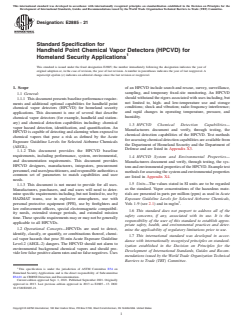
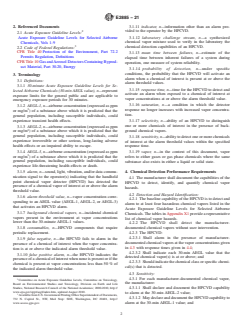
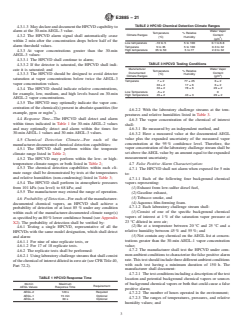
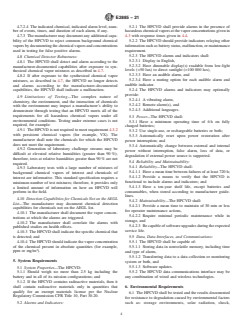
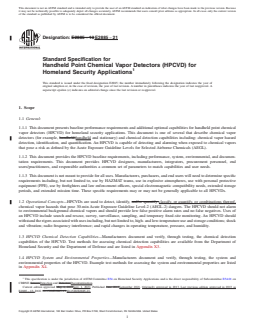
1.1.1 This document presents baseline performance requirements and additional optional capabilities for handheld point chemical vapor detectors (HPCVD) for homeland security applications. This document is one of several that describe chemical vapor detectors (for example, handheld and stationary) and chemical detection capabilities including: chemical vapor hazard detection, identification, and quantification. An HPCVD is capable of detecting and alarming when exposed to chemical vapors that pose a risk as defined by the Acute Exposure Guideline Levels for Selected Airborne Chemicals (AEGL).
1.1.2 This document provides the HPCVD baseline requirements, including performance, system, environmental, and documentation requirements. This document provides HPCVD designers, manufacturers, integrators, procurement personnel, end users/practitioners, and responsible authorities a common set of parameters to match capabilities and user needs.
1.1.3 This document is not meant to provide for all uses. Manufacturers, purchasers, and end users will need to determine specific requirements including, but not limited to, use by HAZMAT teams, use in explosive atmospheres, use with personal protective equipment (PPE), use by firefighters and law enforcement officers, special electromagnetic compatibility needs, extended storage periods, and extended mission time. These specific requirements may or may not be generally applicable to all HPCVDs.
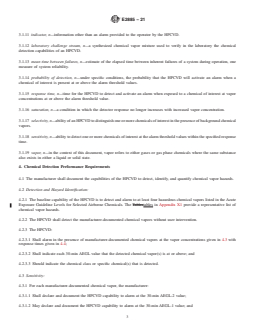
1.2 Operational Concepts—HPCVDs are used to detect, identify, classify, or quantify, or combinations thereof, chemical vapor hazards that pose 30-min Acute Exposure Guideline Level-2 (AEGL-2) dangers. The HPCVD should not alarm to environmental background chemical vapors and should provide low false positive alarm rates and no false negatives. Uses of an HPCVD include search and rescue, survey, surveillance, sampling, and temporary fixed-site monitoring. An HPCVD should withstand the rigors associated with uses including, but not limited to, high- and low-temperature use and storage conditions; shock and vibration; radio frequency interference; and rapid changes in operating temperature, pressure, and humidity.
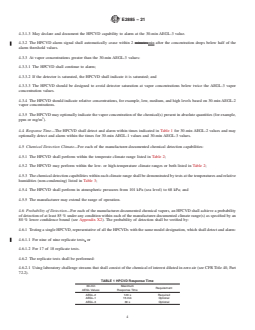
1.3 HPCVD Chemical Detection Capabilities—Manufacturers document and verify, through testing, the chemical detection capabilities of the HPCVD. Test methods for assessing chemical detection capabilities are available from the Department of Homeland Security and the Department of Defense and are listed in Appendix X3.
1.4 HPCVD System and Environmental Properties—Manufacturers document and verify, through testing, the system and environmental properties of the HPCVD. Example test methods for assessing the system and environmental properties are listed in Appendix X4.
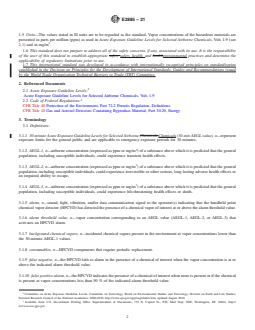
1.5 Units—The values stated in SI units are to be regarded as the standard. Vapor concentrations of the hazardous materials are presented in parts per million (ppm) as used in Acute Exposure Guideline Levels for Selected Airborne Chemicals, Vols 1-9 (see 2.1) and in mg/m3.
1.6 This standard does not purport to address all of the safety concerns, if any, associated with its use. It is the responsibility of the user of this standard to establish appropriate safety, health, and environmental practices and determine the applicability of regulatory limitations prior to use.
1.7 This international standard was ...
- Status
- Published
- Publication Date
- 31-Aug-2021
- Technical Committee
- E54 - Homeland Security Applications
- Drafting Committee
- E54.01 - CBRNE Detection and CBRN Protection
Buy Documents
ASTM E2885-21 - Standard Specification for Handheld Point Chemical Vapor Detectors (HPCVD) for Homeland Security Applications
REDLINE ASTM E2885-21 - Standard Specification for Handheld Point Chemical Vapor Detectors (HPCVD) for Homeland Security Applications
Overview
ASTM E2885-21: Standard Specification for Handheld Point Chemical Vapor Detectors (HPCVD) for Homeland Security Applications sets minimum performance requirements and optional capabilities for handheld chemical vapor detectors intended for use in homeland security. This international standard aligns with globally recognized principles and aids various stakeholders-including manufacturers, end users, integrators, and authorities-in evaluating and procuring devices that reliably detect hazardous airborne chemicals.
By specifying detection, system, and environmental requirements, ASTM E2885-21 promotes interoperability, enhances public safety, and supports procurement processes for organizations concerned with chemical threat detection, such as first responders, law enforcement, firefighting teams, and hazardous materials (HAZMAT) units.
Key Topics
- Baseline Performance Requirements: The standard establishes quantitative baseline detection criteria, such as alarm thresholds based on Acute Exposure Guideline Levels (AEGL) for hazardous chemicals.
- Detection Capabilities: HPCVDs must detect and, optionally, identify or quantify chemical vapors that pose short-term acute health risks (AEGL-2 for 30-min exposure).
- False Positive and Negative Alarms: Devices should demonstrate minimal false positives to ensure reliable operation in real-world environments, and must avoid false negatives.
- Environmental Robustness: Performance validation includes resistance to temperature extremes, humidity, shock, vibration, atmospheric pressure changes, radio frequency interference, and other operational stresses.
- System Features: Requirements cover indicators and alarms (audible, visible, and optional vibration), display readability, battery operation time, data storage, and communication interfaces.
- Documentation and Marking: Standards for user manuals, maintenance guides, data handling, and clear device marking are outlined to facilitate use, maintenance, and safety compliance.
Applications
ASTM E2885-21 has significant practical value for:
- First Responders: Enabling reliable hazard detection during emergency response, search and rescue, surveys, surveillance, and incident sampling.
- Law Enforcement and Security: Supporting security assessments at high-risk venues and events to identify chemical vapor hazards quickly and accurately.
- Military and HAZMAT Teams: Assisting in detection and response to chemical threats or accidental releases in various field and operational environments.
- Procurement and Regulatory Compliance: Providing a technical benchmark for purchasing, certifying, or approving HPCVDs for operational use.
- Device Manufacturers and Integrators: Guiding R&D and quality processes to ensure products meet rigorous performance and reliability criteria essential for homeland security operations.
The standard emphasizes adaptability by allowing for the documentation of capabilities for chemicals not listed in AEGLs and by enabling device optimization according to user-specific scenarios (e.g., use with personal protective equipment, in explosive atmospheres, or for extended missions).
Related Standards
- Acute Exposure Guideline Levels (AEGL): Reference values that determine alarm thresholds and safety criteria for hazardous airborne chemicals.
- CFR Title 40, Protection of the Environment: Regulations for environmental safety and device operation requirements.
- CFR Title 10, Gas and Aerosol Detectors: Guidelines concerning the use of radioactive materials in detection devices.
- Other ASTM Standards from Committee E54: Cover additional chemical, biological, radiological, nuclear, and explosive (CBRNE) detection and decontamination.
- International Consensus Standards: Cited for environmental testing and device robustness validation.
Practical Value
Implementing ASTM E2885-21 ensures that handheld chemical vapor detectors for homeland security applications are tested, documented, and ready for reliable deployment in critical scenarios. The standard provides a unified language for requirements, supports procurement decisions, and increases operational confidence across emergency response and public safety sectors.
Keywords: ASTM E2885-21, handheld point chemical vapor detector, HPCVD, homeland security, chemical detection, AEGL, HAZMAT, emergency response, false alarms, environmental testing, system requirements, public safety.
Buy Documents
ASTM E2885-21 - Standard Specification for Handheld Point Chemical Vapor Detectors (HPCVD) for Homeland Security Applications
REDLINE ASTM E2885-21 - Standard Specification for Handheld Point Chemical Vapor Detectors (HPCVD) for Homeland Security Applications
Get Certified
Connect with accredited certification bodies for this standard

CIS Institut d.o.o.
Personal Protective Equipment (PPE) certification body. Notified Body NB-2890 for EU Regulation 2016/425 PPE.

Kiwa BDA Testing
Building and construction product certification.
Kmetijski inštitut Slovenije
Agricultural Institute of Slovenia. Soil testing, plant health, agricultural product analysis.
Sponsored listings
Frequently Asked Questions
ASTM E2885-21 is a technical specification published by ASTM International. Its full title is "Standard Specification for Handheld Point Chemical Vapor Detectors (HPCVD) for Homeland Security Applications". This standard covers: ABSTRACT This specification establishes baseline performance requirements and additional optional capabilities for handheld point chemical vapor detectors (HPCVD) intended for homeland security applications. It provides HPCVD designers, manufacturers, integrators, procurement personnel, end users/practitioners, and responsible authorities a common set of parameters to match capabilities and user needs. The document specifies chemical detection performance requirements, system requirements, environmental requirements, manuals and documentation, product marking, and packaging. SCOPE 1.1 General: 1.1.1 This document presents baseline performance requirements and additional optional capabilities for handheld point chemical vapor detectors (HPCVD) for homeland security applications. This document is one of several that describe chemical vapor detectors (for example, handheld and stationary) and chemical detection capabilities including: chemical vapor hazard detection, identification, and quantification. An HPCVD is capable of detecting and alarming when exposed to chemical vapors that pose a risk as defined by the Acute Exposure Guideline Levels for Selected Airborne Chemicals (AEGL). 1.1.2 This document provides the HPCVD baseline requirements, including performance, system, environmental, and documentation requirements. This document provides HPCVD designers, manufacturers, integrators, procurement personnel, end users/practitioners, and responsible authorities a common set of parameters to match capabilities and user needs. 1.1.3 This document is not meant to provide for all uses. Manufacturers, purchasers, and end users will need to determine specific requirements including, but not limited to, use by HAZMAT teams, use in explosive atmospheres, use with personal protective equipment (PPE), use by firefighters and law enforcement officers, special electromagnetic compatibility needs, extended storage periods, and extended mission time. These specific requirements may or may not be generally applicable to all HPCVDs. 1.2 Operational Concepts—HPCVDs are used to detect, identify, classify, or quantify, or combinations thereof, chemical vapor hazards that pose 30-min Acute Exposure Guideline Level-2 (AEGL-2) dangers. The HPCVD should not alarm to environmental background chemical vapors and should provide low false positive alarm rates and no false negatives. Uses of an HPCVD include search and rescue, survey, surveillance, sampling, and temporary fixed-site monitoring. An HPCVD should withstand the rigors associated with uses including, but not limited to, high- and low-temperature use and storage conditions; shock and vibration; radio frequency interference; and rapid changes in operating temperature, pressure, and humidity. 1.3 HPCVD Chemical Detection Capabilities—Manufacturers document and verify, through testing, the chemical detection capabilities of the HPCVD. Test methods for assessing chemical detection capabilities are available from the Department of Homeland Security and the Department of Defense and are listed in Appendix X3. 1.4 HPCVD System and Environmental Properties—Manufacturers document and verify, through testing, the system and environmental properties of the HPCVD. Example test methods for assessing the system and environmental properties are listed in Appendix X4. 1.5 Units—The values stated in SI units are to be regarded as the standard. Vapor concentrations of the hazardous materials are presented in parts per million (ppm) as used in Acute Exposure Guideline Levels for Selected Airborne Chemicals, Vols 1-9 (see 2.1) and in mg/m3. 1.6 This standard does not purport to address all of the safety concerns, if any, associated with its use. It is the responsibility of the user of this standard to establish appropriate safety, health, and environmental practices and determine the applicability of regulatory limitations prior to use. 1.7 This international standard was ...
ABSTRACT This specification establishes baseline performance requirements and additional optional capabilities for handheld point chemical vapor detectors (HPCVD) intended for homeland security applications. It provides HPCVD designers, manufacturers, integrators, procurement personnel, end users/practitioners, and responsible authorities a common set of parameters to match capabilities and user needs. The document specifies chemical detection performance requirements, system requirements, environmental requirements, manuals and documentation, product marking, and packaging. SCOPE 1.1 General: 1.1.1 This document presents baseline performance requirements and additional optional capabilities for handheld point chemical vapor detectors (HPCVD) for homeland security applications. This document is one of several that describe chemical vapor detectors (for example, handheld and stationary) and chemical detection capabilities including: chemical vapor hazard detection, identification, and quantification. An HPCVD is capable of detecting and alarming when exposed to chemical vapors that pose a risk as defined by the Acute Exposure Guideline Levels for Selected Airborne Chemicals (AEGL). 1.1.2 This document provides the HPCVD baseline requirements, including performance, system, environmental, and documentation requirements. This document provides HPCVD designers, manufacturers, integrators, procurement personnel, end users/practitioners, and responsible authorities a common set of parameters to match capabilities and user needs. 1.1.3 This document is not meant to provide for all uses. Manufacturers, purchasers, and end users will need to determine specific requirements including, but not limited to, use by HAZMAT teams, use in explosive atmospheres, use with personal protective equipment (PPE), use by firefighters and law enforcement officers, special electromagnetic compatibility needs, extended storage periods, and extended mission time. These specific requirements may or may not be generally applicable to all HPCVDs. 1.2 Operational Concepts—HPCVDs are used to detect, identify, classify, or quantify, or combinations thereof, chemical vapor hazards that pose 30-min Acute Exposure Guideline Level-2 (AEGL-2) dangers. The HPCVD should not alarm to environmental background chemical vapors and should provide low false positive alarm rates and no false negatives. Uses of an HPCVD include search and rescue, survey, surveillance, sampling, and temporary fixed-site monitoring. An HPCVD should withstand the rigors associated with uses including, but not limited to, high- and low-temperature use and storage conditions; shock and vibration; radio frequency interference; and rapid changes in operating temperature, pressure, and humidity. 1.3 HPCVD Chemical Detection Capabilities—Manufacturers document and verify, through testing, the chemical detection capabilities of the HPCVD. Test methods for assessing chemical detection capabilities are available from the Department of Homeland Security and the Department of Defense and are listed in Appendix X3. 1.4 HPCVD System and Environmental Properties—Manufacturers document and verify, through testing, the system and environmental properties of the HPCVD. Example test methods for assessing the system and environmental properties are listed in Appendix X4. 1.5 Units—The values stated in SI units are to be regarded as the standard. Vapor concentrations of the hazardous materials are presented in parts per million (ppm) as used in Acute Exposure Guideline Levels for Selected Airborne Chemicals, Vols 1-9 (see 2.1) and in mg/m3. 1.6 This standard does not purport to address all of the safety concerns, if any, associated with its use. It is the responsibility of the user of this standard to establish appropriate safety, health, and environmental practices and determine the applicability of regulatory limitations prior to use. 1.7 This international standard was ...
ASTM E2885-21 is classified under the following ICS (International Classification for Standards) categories: 13.320 - Alarm and warning systems. The ICS classification helps identify the subject area and facilitates finding related standards.
ASTM E2885-21 is available in PDF format for immediate download after purchase. The document can be added to your cart and obtained through the secure checkout process. Digital delivery ensures instant access to the complete standard document.
Standards Content (Sample)
This international standard was developed in accordance with internationally recognized principles on standardization established in the Decision on Principles for the
Development of International Standards, Guides and Recommendations issued by the World Trade Organization Technical Barriers to Trade (TBT) Committee.
Designation:E2885 −21
Standard Specification for
Handheld Point Chemical Vapor Detectors (HPCVD) for
Homeland Security Applications
This standard is issued under the fixed designation E2885; the number immediately following the designation indicates the year of
original adoption or, in the case of revision, the year of last revision. A number in parentheses indicates the year of last reapproval. A
superscript epsilon (´) indicates an editorial change since the last revision or reapproval.
1. Scope of an HPCVD include search and rescue, survey, surveillance,
sampling, and temporary fixed-site monitoring. An HPCVD
1.1 General:
should withstand the rigors associated with uses including, but
1.1.1 This document presents baseline performance require-
not limited to, high- and low-temperature use and storage
ments and additional optional capabilities for handheld point
conditions; shock and vibration; radio frequency interference;
chemical vapor detectors (HPCVD) for homeland security
and rapid changes in operating temperature, pressure, and
applications. This document is one of several that describe
humidity.
chemical vapor detectors (for example, handheld and station-
ary) and chemical detection capabilities including: chemical
1.3 HPCVD Chemical Detection Capabilities—
vapor hazard detection, identification, and quantification. An
Manufacturers document and verify, through testing, the
HPCVD is capable of detecting and alarming when exposed to
chemical detection capabilities of the HPCVD. Test methods
chemical vapors that pose a risk as defined by the Acute
for assessing chemical detection capabilities are available from
Exposure Guideline Levels for Selected Airborne Chemicals
the Department of Homeland Security and the Department of
(AEGL).
Defense and are listed in Appendix X3.
1.1.2 This document provides the HPCVD baseline
requirements, including performance, system, environmental,
1.4 HPCVD System and Environmental Properties—
and documentation requirements. This document provides
Manufacturers document and verify, through testing, the sys-
HPCVD designers, manufacturers, integrators, procurement
temandenvironmentalpropertiesoftheHPCVD.Exampletest
personnel,endusers/practitioners,andresponsibleauthoritiesa
methods for assessing the system and environmental properties
common set of parameters to match capabilities and user
are listed in Appendix X4.
needs.
1.5 Units—The values stated in SI units are to be regarded
1.1.3 This document is not meant to provide for all uses.
as the standard. Vapor concentrations of the hazardous mate-
Manufacturers, purchasers, and end users will need to deter-
rials are presented in parts per million (ppm) as used in Acute
mine specific requirements including, but not limited to, use by
Exposure Guideline Levels for Selected Airborne Chemicals,
HAZMAT teams, use in explosive atmospheres, use with
personal protective equipment (PPE), use by firefighters and Vols 1-9 (see 2.1) and in mg/m .
law enforcement officers, special electromagnetic compatibil-
1.6 This standard does not purport to address all of the
ity needs, extended storage periods, and extended mission
safety concerns, if any, associated with its use. It is the
time. These specific requirements may or may not be generally
responsibility of the user of this standard to establish appro-
applicable to all HPCVDs.
priate safety, health, and environmental practices and deter-
1.2 Operational Concepts—HPCVDs are used to detect,
mine the applicability of regulatory limitations prior to use.
identify, classify, or quantify, or combinations thereof, chemi-
1.7 This international standard was developed in accor-
cal vapor hazards that pose 30-min Acute Exposure Guideline
dance with internationally recognized principles on standard-
Level-2 (AEGL-2) dangers. The HPCVD should not alarm to
ization established in the Decision on Principles for the
environmental background chemical vapors and should pro-
Development of International Standards, Guides and Recom-
vide low false positive alarm rates and no false negatives. Uses
mendations issued by the World Trade Organization Technical
Barriers to Trade (TBT) Committee.
This specification is under the jurisdiction of ASTM Committee E54 on
Homeland Security Applications and is the direct responsibility of Subcommittee
E54.01 on CBRNE Detection and Decontamination.
Current edition approved Sept. 1, 2021. Published September 2021. Originally
approved in 2013. Last previous edition approved in 2013 as E2885 – 13. DOI:
10.1520/E2885-21.
Copyright © ASTM International, 100 Barr Harbor Drive, PO Box C700, West Conshohocken, PA 19428-2959. United States
E2885−21
2. Referenced Documents 3.1.11 indicator, n—information other than an alarm pro-
2 vided to the operator by the HPCVD.
2.1 Acute Exposure Guideline Levels:
Acute Exposure Guideline Levels for Selected Airborne 3.1.12 laboratory challenge stream, n—a synthesized
chemical vapor mixture used to verify in the laboratory the
Chemicals, Vols 1-9
2.2 Code of Federal Regulations: chemical detection capabilities of an HPCVD.
CFR Title 40 Protection of the Environment, Part 72.2
3.1.13 mean time between failures, n—estimate of the
Permits Regulation, Definitions
elapsed time between inherent failures of a system during
CFRTitle10 GasandAerosolDetectorsContainingByprod-
operation, one measure of system reliability.
uct Material, Part 30.20, Energy
3.1.14 probability of detection, n—under specific
conditions, the probability that the HPCVD will activate an
3. Terminology
alarm when a chemical of interest is present at or above the
3.1 Definitions:
alarm threshold values.
3.1.1 30-minute Acute Exposure Guideline Levels for Se-
3.1.15 response time, n—time for the HPCVD to detect and
lected Airborne Chemicals (30-min AEGL value), n—represent
activate an alarm when exposed to a chemical of interest at
exposure limits for the general public and are applicable to
vapor concentrations at or above the alarm threshold value.
emergency exposure periods for 30 minutes.
3.1.16 saturation, n—a condition in which the detector
3.1.2 AEGL-1, n—airborneconcentration(expressedasppm
response no longer increases with increased vapor concentra-
or mg/m ) of a substance above which it is predicted that the
tion.
general population, including susceptible individuals, could
experience transient health effects.
3.1.17 selectivity, n—ability of an HPCVD to distinguish
one or more chemicals of interest in the presence of back-
3.1.3 AEGL-2, n—airborneconcentration(expressedasppm
ground chemical vapors.
or mg/m ) of a substance above which it is predicted that the
general population, including susceptible individuals, could
3.1.18 sensitivity, n—abilitytodetectoneormorechemicals
experience irreversible or other serious, long-lasting adverse
of interest at the alarm threshold values within the specified
health effects or an impaired ability to escape.
response time.
3.1.4 AEGL-3, n—airborneconcentration(expressedasppm
3.1.19 vapor, n—in the context of this document, vapor
or mg/m ) of a substance above which it is predicted that the
refers to either gases or gas phase chemicals where the same
general population, including susceptible individuals, could
substance also exists in either a liquid or solid state.
experience life-threatening health effects or death.
4. Chemical Detection Performance Requirements
3.1.5 alarm, n—sound, light, vibration, and/or data commu-
nication signal to the operator(s) indicating that the handheld
4.1 The manufacturer shall document the capabilities of the
point chemical vapor detector (HPCVD) has detected the
HPCVD to detect, identify, and quantify chemical vapor
presence of a chemical vapor of interest at or above the alarm
hazards.
threshold value.
4.2 Detection and Hazard Identification:
3.1.6 alarm threshold value, n—vapor concentration corre-
4.2.1 The baseline capability of the HPCVD is to detect and
sponding to an AEGL value (AEGL-1, AEGL-2, or AEGL-3)
alarm to at least four hazardous chemical vapors listed in the
that activates an HPCVD alarm.
Acute Exposure Guideline Levels for Selected Airborne
3.1.7 background chemical vapors, n—incidental chemical
Chemicals.ThetablesinAppendixX1providearepresentative
vapors present in the environment at vapor concentrations
list of chemical vapor hazards.
lower than the 30-minute AEGL-1 values.
4.2.2 The HPCVD shall detect the manufacturer-
3.1.8 consumables, n—HPCVD components that require documented chemical vapors without user intervention.
periodic replacement. 4.2.3 The HPCVD:
4.2.3.1 Shall alarm in the presence of manufacturer-
3.1.9 false negative, n—the HPCVD fails to alarm in the
documented chemical vapors at the vapor concentrations given
presence of a chemical of interest when the vapor concentra-
in 4.3 with response times given in 4.4;
tion is at or above the indicated alarm threshold value.
4.2.3.2 Shall indicate each 30-min AEGL value that the
3.1.10 false positive alarm, n—the HPCVD indicates the
detected chemical vapor(s) is at or above; and
presenceofachemicalofinterestwhennoneispresentorifthe
4.2.3.3 Shouldindicatethechemicalclassorspecificchemi-
chemical is present at vapor concentrations less than 50 % of
cal(s) that is detected.
the indicated alarm threshold value.
4.3 Sensitivity:
4.3.1 For each manufacturer-documented chemical vapor,
Committee on Acute Exposure Guideline Levels, Committee on Toxicology,
the manufacturer:
Board on Environmental Studies and Toxicology, Division on Earth and Life
Studies, National Research Council of the National Academies; 2000-2010, http://
4.3.1.1 Shall declare and document the HPCVD capability
www.epa.gov/oppt/aegl/index.htm, updated August 2010.
to alarm at the 30-min AEGL-2 value;
AvailablefromU.S.GovernmentPrintingOfficeSuperintendentofDocuments,
4.3.1.2 MaydeclareanddocumenttheHPCVDcapabilityto
732 N. Capitol St., NW, Mail Stop: SDE, Washington, DC 20401, http://
www.access.gpo.gov. alarm at the 30-min AEGL-1 value; and
E2885−21
TABLE 2 HPCVD Chemical Detection Climate Ranges
4.3.1.3 MaydeclareanddocumenttheHPCVDcapabilityto
alarm at the 30-min AEGL-3 value. Water Vapor
Temperature % Relative
Climate Ranges Content
4.3.2 The HPCVD alarm signal shall automatically cease
(°C) Humidity
(g/m )
within 2 min after the concentration drops below half of the
Low temperature -10 to 5 5 to 100 0.1 to 6.8
alarm threshold values.
Temperate 5 to 35 5 to 100 0.3 to 32
High temperature 35 to 50 5 to 77 2.0 to 32
4.3.3 At vapor concentrations greater than the 30-min
AEGL-3 values:
4.3.3.1 The HPCVD shall continue to alarm;
TABLE 3 HPCVD Testing Conditions
4.3.3.2 If the detector is saturated, the HPCVD shall indi-
Manufacturer Water Vapor
cate it is saturated; and
Temperature % Relative
Documented Content
4.3.3.3 The HPCVD should be designed to avoid detector (°C) Humidity
Climate Ranges (g/m )
saturation at vapor concentrations below twice the AEGL-3
Temperate 7 ± 2 77 ± 25 6 ± 2
vapor concentration values.
33±2 17±6 6±2
33±2 78±6 29±2
4.3.4 The HPCVD should indicate relative concentrations,
Low Temperature -5 ± 2 0
for example, low, medium, and high levels based on 30-min
High Temperature 45 ± 2 43 ± 3 29 ± 2
AEGL-2 vapor concentrations.
4.3.5 The HPCVD may optionally indicate the vapor con-
centration of the chemical(s) present in absolute quantities (for
4.6.2.2 With the laboratory challenge streams at the tem-
example, ppm or mg/m ).
peratures and relative humidities listed in Table 3.
4.4 Response Time—The HPCVD shall detect and alarm
4.6.3 The vapor concentration of the chemical of interest
within times indicated in Table 1 for 30-min AEGL-2 values
shall:
and may optionally detect and alarm within the times for
4.6.3.1 Be measured by an independent method, and
30-min AEGL-1 values and 30-min AEGL-3 values.
4.6.3.2 Have a measured value at the documented AEGL
value plus the expanded uncertainty of the measured vapor
4.5 Chemical Detection Climate—For each of the
concentration at the 95 % confidence level. Therefore, the
manufacturer-documented chemical detection capabilities:
vapor concentration of the laboratory challenge stream shall be
4.5.1 The HPCVD shall perform within the temperate
set above theAEGLvalue by an amount equal to the expanded
climate range listed in Table 2;
measurement uncertainty.
4.5.2 The HPCVD may perform within the low- or high-
temperature climate ranges or both listed in Table 2;
4.7 False Positive Alarm Characterization:
4.5.3 The chemical detection capabilities within each cli-
4.7.1 The HPCVD shall not alarm when exposed for 5 min
mate range shall be demonstrated by tests at the temperatures
to:
and relative humidities (non-condensing) listed in Table 3;
4.7.1.1 Each of the following four background chemical
4.5.4 The HPCVD shall perform in atmospheric pressures
vapors representing:
from 101 kPa (sea level) to 68 kPa; and
(1) Exhaust from low-sulfur diesel fuel,
4.5.5 The manufacturer may extend the range of operation.
(2) Gasoline exhaust,
(3) Tobacco smoke, and
4.6 Probability of Detection—For each of the manufacturer-
(4) Aqueous film-forming foam.
documented chemical vapors, an HPCVD shall achieve a
4.7.1.2 Each laboratory challenge stream shall:
probability of detection of at least 85 % under any condition
(1) Consist of one of the specific background chemical
within each of the manufacturer-documented climate range(s)
vapors of interest at 1 % of the saturation vapor pressure at
asspecifiedbyan80%lowerconfidencebound(seeAppendix
23 °C diluted in zero air;
X2). The probability of detection shall be verified by:
(2) Be at a temperature between 20 °C and 25 °C and a
4.6.1 Testing a single HPCVD, representative of all the
relative humidity between 45 % and 55 %; and
HPCVDs with the same model designation, which shall detect
(3) Not contain any chemical on the AEGL list at concen-
and alarm:
trations greater than the 30-min AEGL-1 vapor concentration
4.6.1.1 For nine of nine replicate tests, or
value;
4.6.1.2 For 17 of 18 replicate tests.
4.7.2 The manufacturer shall test the HPCVD under com-
4.6.2 The replicate tests shall be performed:
monambientconditionstocharacterizethefalsepositivealarm
4.6.2.1 Using laboratory challenge streams that shall consist
rate.This test should include three different ambient conditions
ofthechemicalofinterestdilutedinzeroair(seeCFRTitle40,
with each test having a minimum duration of 150 h. The
Part 72.2).
manufacturer shall document:
4.7.2.1 Thetestconditionsincludingadescriptionofthetest
TABLE 1 HPCVD Response Time
location and potential background chemical vapors or sources
30-min Maximum of background chemical vapors or both that could cause a false
Requirement
AEGL Values Response Time
positive alarm;
AEGL-2 120 s Required
4.7.2.2 The number of hours operated in the environment;
AEGL-1 15 min Optional
4.7.2.3 The ranges of temperatures, pressures, and relative
AEGL-3 30 s Optional
humidity values; and
E2885−21
4.7.2.4 The indicated chemical, indicated alarm level, num- 5.2.1 The HPCVD shall provide alarms in the presence of
ber of events, times, and duration of each alarm, if any. hazardouschemicalvaporsatthevaporconcentrationsgivenin
4.7.3 The manufacturer may document any additional capa- 4.3 with response times given in 4.4.
bility of the HPCVD to reject common background chemical 5.2.2 The HPCVD should provide indicators relaying other
vaporsbydocumentingthechemicalvaporsandconcentrations
informationsuchasbatterystatus,malfunction,ormaintenance
used in testing for false positive alarms. requirement.
5.2.3 The HPCVD alarms and indicators shall:
4.8 Chemical Detector Robustness:
5.2.3.1 Display in English,
4.8.1 The HPCVD shall detect and alarm according to the
5.2.3.2 Have dimmable display(s) readable from low-light
manufacturer-documented capabilities after exposure to syn-
levels (<50 lux) to direct sunlight (>100 000 lux),
thesized chemical vapor mixtures as described in 4.7.
5.2.3.3 Have an audible alarm, and
4.8.2 If after exposure to the synthesized chemical vapor
5.2.3.4 Have a muting option for each audible alarm and
mixtures, as described in 4.7, the HPCVD no longer detects
audible indicator.
and alarms according to the manufacturer-documented
5.2.4 The HPCVD alarms and indicators may optionally
capabilities, the HPCVD shall indicate a malfunction.
provide:
4.9 Limitations of Testing—The complex nature of
5.2.4.1 A vibrating alarm,
chemistry, the environment, and the interaction of chemicals
5.2.4.2 Remote alarm(s), and
with the environment may impact a manufacturer’s ability to
5.2.4.3 Additional languages.
demonstrate through testing that an HPCVD meets all of the
requirements for all hazardous chemical vapors under all
5.3 Power—The HPCVD shall:
environmental conditions. Testing under extreme cases is not
5.3.1 Have a minimum operating time of 6 h on fully
required, for example:
charged batteries;
4.9.1 The HPCVD is not required to meet requirement 4.3.2
5.3.2 Use single-use, or rechargeable batteries or both;
with persistent chemical vapors (for example, VX). The
5.3.3 Automatically reset upon power restoration after
manufacturer shall note the chemicals for which the HPCVD
power interruption; and
does not meet the requirement.
5.3.4 Automatically change between external and internal
4.9.2 Generation of laboratory challenge streams may be
power without interruption, false alarm, loss of data, or
difficult at elevated relative humidities (greater than 90 %);
degradation if external power source is supported.
therefore, tests at relative humidities greater than 90 % are not
5.4 Reliability and Maintainability:
required.
5.4.1 Reliability—The HPCVD shall:
4.9.3 Laboratory tests with a large number of mixtures of
5.4.1.1 Have a mean time between failures of at least 720 h;
background chemical vapors of interest and chemicals of
5.4.1.2 Provide a means to verify that the HPCVD is
interest are informative. This standard specification requires a
functional to include alarms and indicators; and
minimum number of test mixtures; therefore, it provides only
5.4.1.3 Have a ten-year shelf life, except batteries and
a limited amount of information on how an HPCVD will
consumables, when stored according to manufacturer guide-
perform in the field.
lines.
4.10 Detection Capabilities for Chemicals Not on the AEGL
5.4.2 Maintainability—The HPCVD shall:
List—The manufacturer may document chemical detection
5.4.2.1 Provide a mean time to maintain of 30 min or less
capabilities for chemicals not on the AEGL list.
for operator maintenance actions,
4.10.1 The manufacturer shall document the vapor concen-
5.4.2.2 Require minimal periodic maintenance while in
trations at which the alarms are triggered.
storage, and
4.10.2 The manufacturer shall correlate the alarms with
5.4.2.3 Becapableofsoftwareupgradesduringtheexpected
published studies on health effects.
service life.
4.10.3 The HPCVD shall indicate the specific chemical that
is detected; and
5.5 Data, Data Interfaces, and Communications:
4.10.4 The HPCVD should indicate the vapor concentration
5.5.1 The HPCVD shall be capable of:
of the chemical present in absolute quantities (for example,
5.5.1.1 Storing data in nonvolatile memory, including time
ppm or mg/m ).
and type of alarm,
5.5.1.2 Transferring data to a data collection or monitoring
5. System Requirements
system or both, and
5.5.1.3 Software updates.
5.1 System Properties—The HPCVD:
5.5.2 The HPCVD data communications interface may be
5.1.1 Should weigh no more than 2.5 kg including the
battery and in all of its mission configurations; and any combination of wired and wireless technologies.
5.1.2 If the HPCVD contains radioactive materials, then it
6. Environmental Requirements
shall contain radioactive materials only in quantities that
qualify for an exempt materials license per the Nuclear
6.1 The HPCVD shall be tested and the results documented
Regulatory Commission CFR Title 10, Part 30.20.
for resistance to degradation caused by environmental factors
5.2 Alarms and Indicators: such as: storage environments, solar radiation, shock,
E2885−21
vibration, ingress of moisture and dust, salt environments, 7.2.3.1 Field maintenance;
altitude, and electromagnetic interference. 7.2.3.2 User maintenance, including troubleshooting guide;
7.2.3.3 Service and repair; and
6.2 These tests shall be conducted using consensus
7.2.3.4 Calibration.
standards, government standards, and other international stan-
7.2.4 Field manual(s) shall include:
dards; see Appendix X4.
7.2.4.1 Chemical detection capabilities (Section 4);
7.2.4.2 Specific chemical vapors and the threshold 30-min
7. Manuals and Documentation
AEGL values;
7.1 The accompanying manuals may be provided in print or
7.2.4.3 Basic use instructions;
electronic media or both in any appropriate format.
7.2.4.4 Battery and charging instructions;
7.2.4.5 External power requirements (voltage and
7.2 The HPCVD manuals shall include:
frequency), if applicable; and
7.2.1 User manuals shall describe the capabilities and uses
7.2.4.6 Consumable replacement procedures.
for the HPCVD:
7.2.1.1 Manufacturer-documented capabilities; 7.2.5 Operator training manuals.
7.2.6 Shipping and transport manuals shall describe:
7.2.1.2 Chemical detection capabilities (Section 4);
7.2.6.1 Instructions for packaging and shipping, and
7.2.1.3 Specific chemical vapors and the threshold 30-min
7.2.6.2 Transport configuration when not in shipping con-
AEGL values;
tainer.
7.2.1.4 Mission and transport weight and dimensions;
7.2.7 Licenses and certificates required for ownership and
7.2.1.5 Climate range(s) (Table 2);
operation.
7.2.1.6 Hardware;
7.2.1.7 Software;
8. Product Marking
7.2.1.8 Accessories;
8.1 The HPCVD shall be appropriately marked, including:
7.2.1.9 Instructions for normal operations, special
8.1.1 Manufacturer’s name;
operations, and restrictions;
8.1.2 Model number;
7.2.1.10 Consumables and the replacement frequency per
8.1.3 Unique serial number;
number of operating hours, replacement frequency per number
8.1.4 Each control and connection for its intended use;
of non-operating hours, and packaged shelf life;
8.1.5 Battery type;
7.2.1.11 Calibration frequency and associated consumables
8.1.6 Battery charging capability and accessories;
required for calibration;
8.1.7 External power, if applicable;
7.2.1.12 Description of all alarms and indicators;
8.1.8 Certified for use in explosive atmospheres, if appli-
7.2.1.13 Recommended decontamination procedures;
cable; and
7.2.1.14 HPCVD operating time while the HPCVD is pow-
8.1.9 Hazard labels.
ered by batteries, when not in alarm mode, and when in
continuous alarm mode at ambient temperatures of 0 °C,
8.2 The HPCVD accessories or the packaging shall be
20 °C, and 50 °C and battery type used (for example alkaline
appropriately marked, including:
and lithium ion);
8.2.1 Manufacturer’s name;
7.2.1.15 Recommended hazardous waste disposal proce-
8.2.2 Model number;
dures to include consumables, acc
...
This document is not an ASTM standard and is intended only to provide the user of an ASTM standard an indication of what changes have been made to the previous version. Because
it may not be technically possible to adequately depict all changes accurately, ASTM recommends that users consult prior editions as appropriate. In all cases only the current version
of the standard as published by ASTM is to be considered the official document.
Designation: E2885 − 13 E2885 − 21
Standard Specification for
Handheld Point Chemical Vapor Detectors (HPCVD) for
Homeland Security Applications
This standard is issued under the fixed designation E2885; the number immediately following the designation indicates the year of
original adoption or, in the case of revision, the year of last revision. A number in parentheses indicates the year of last reapproval. A
superscript epsilon (´) indicates an editorial change since the last revision or reapproval.
1. Scope
1.1 General:
1.1.1 This document presents baseline performance requirements and additional optional capabilities for handheld point chemical
vapor detectors (HPCVD) for homeland security applications. This document is one of several that describe chemical vapor
detectors (for example, handheld,handheld and stationary) and chemical detection capabilities including: chemical vapor hazard
detection, identification, and quantification. An HPCVD is capable of detecting and alarming when exposed to chemical vapors
that pose a risk as defined by the Acute Exposure Guideline Levels for Selected Airborne Chemicals (AEGL).
1.1.2 This document provides the HPCVD baseline requirements, including performance, system, environmental, and documen-
tation requirements. This document provides HPCVD designers, manufacturers, integrators, procurement personnel, end
users/practitioners, and responsible authorities a common set of parameters to match capabilities and user needs.
1.1.3 This document is not meant to provide for all uses. Manufacturers, purchasers, and end users will need to determine specific
requirements including, but not limited to, use by HAZMAT teams, use in explosive atmospheres, use with personal protective
equipment (PPE), use by firefighters and law enforcement officers, special electromagnetic compatibility needs, extended storage
periods, and extended mission time. These specific requirements may or may not be generally applicable to all HPCVDs.
1.2 Operational Concepts—HPCVDs are used to detect, identify, and/or quantify classify, or quantify, or combinations thereof,
chemical vapor hazards that pose 30-min Acute Exposure Guideline Level-2 (AEGL-2) dangers. The HPCVD should not alarm
to environmental background chemical vapors and should provide low false positive alarm rates and no false negatives. Uses of
an HPCVD include search and rescue, survey, surveillance, sampling, and temporary fixed-site monitoring. An HPCVD should
withstand the rigors associated with uses including, but not limited to, high- and low-temperature use and storage conditions; shock
and vibration; radio frequency interference; and rapid changes in operating temperature, pressure, and humidity.
1.3 HPCVD Chemical Detection Capabilities—Manufacturers document and verify, through testing, the chemical detection
capabilities of the HPCVD. Test methods for assessing chemical detection capabilities are available from the Department of
Homeland Security and the Department of Defense and are listed in Appendix X3.
1.4 HPCVD System and Environmental Properties—Manufacturers document and verify, through testing, the system and
environmental properties of the HPCVD. Example test methods for assessing the system and environmental properties are listed
in Appendix X4.
This specification is under the jurisdiction of ASTM Committee E54 on Homeland Security Applications and is the direct responsibility of Subcommittee E54.01 on
CBRNE SensorsDetection and DetectorsDecontamination.
Current edition approved May 1, 2013Sept. 1, 2021. Published June 2013September 2021. Originally approved in 2013. Last previous edition approved in 2013 as
E2885 – 13. DOI: 10.1520/E2885-13.10.1520/E2885-21.
Copyright © ASTM International, 100 Barr Harbor Drive, PO Box C700, West Conshohocken, PA 19428-2959. United States
E2885 − 21
1.5 Units—The values stated in SI units are to be regarded as the standard. Vapor concentrations of the hazardous materials are
presented in parts per million (ppm) as used in Acute Exposure Guideline Levels for Selected Airborne Chemicals, Vols 1-9 (see
2.1) and in mg/m .
1.6 This standard does not purport to address all of the safety concerns, if any, associated with its use. It is the responsibility
of the user of this standard to establish appropriate safety safety, health, and healthenvironmental practices and determine the
applicability of regulatory limitations prior to use.
1.7 This international standard was developed in accordance with internationally recognized principles on standardization
established in the Decision on Principles for the Development of International Standards, Guides and Recommendations issued
by the World Trade Organization Technical Barriers to Trade (TBT) Committee.
2. Referenced Documents
2.1 Acute Exposure Guideline Levels:
Acute Exposure Guideline Levels for Selected Airborne Chemicals, Vols 1-9
2.2 Code of Federal Regulations:
CFR Title 40 Protection of the Environment, Part 72.2 Permits Regulation, Definitions
CFR Title 10 Gas and Aerosol Detectors Containing Byproduct Material, Part 30.20, Energy
3. Terminology
3.1 Definitions:
3.1.1 30-minute Acute Exposure Guideline Levels for Selected Airborne Chemicals,Chemicals (30-min AEGL value), n—represent
exposure limits for the general public and are applicable to emergency exposure periods for 30 minutes.
3.1.2 AEGL-1, n—airborne concentration (expressed as ppm or mg/m ) of a substance above which it is predicted that the general
population, including susceptible individuals, could experience transient health effects.
3.1.3 AEGL-2, n—airborne concentration (expressed as ppm or mg/m ) of a substance above which it is predicted that the general
population, including susceptible individuals, could experience irreversible or other serious, long-lasting adverse health effects or
an impaired ability to escape.
3.1.4 AEGL-3, n—airborne concentration (expressed as ppm or mg/m ) of a substance above which it is predicted that the general
population, including susceptible individuals, could experience life-threatening health effects or death.
3.1.5 alarm, n—sound, light, vibration, and/or data communication signal to the operator(s) indicating that the handheld point
chemical vapor detector (HPCVD) has detected the presence of a chemical vapor of interest at or above the alarm threshold value.
3.1.6 alarm threshold value, n—vapor concentration corresponding to an AEGL value (AEGL-1, AEGL-2, or AEGL-3) that
activates an HPCVD alarm.
3.1.7 background chemical vapors, n—incidental chemical vapors present in the environment at vapor concentrations lower than
the 30-minute AEGL-1 values.
3.1.8 consumables, n—HPCVD components that require periodic replacement.
3.1.9 false negative, n—the HPCVD fails to alarm in the presence of a chemical of interest when the vapor concentration is at or
above the indicated alarm threshold value.
3.1.10 false positive alarm, n—the HPCVD indicates the presence of a chemical of interest when none is present or if the chemical
is present at vapor concentrations less than 50 % of the indicated alarm threshold value.
Committee on Acute Exposure Guideline Levels, Committee on Toxicology, Board on Environmental Studies and Toxicology, Division on Earth and Life Studies,
National Research Council of the National Academies; 2000-2010, http://www.epa.gov/oppt/aegl/index.htm, updated August 2010.
Available from U.S. Government Printing Office Superintendent of Documents, 732 N. Capitol St., NW, Mail Stop: SDE, Washington, DC 20401, http://
www.access.gpo.gov.
E2885 − 21
3.1.11 indicator, n—information other than an alarm provided to the operator by the HPCVD.
3.1.12 laboratory challenge stream, n—a synthesized chemical vapor mixture used to verify in the laboratory the chemical
detection capabilities of an HPCVD.
3.1.13 mean time between failures, n—estimate of the elapsed time between inherent failures of a system during operation, one
measure of system reliability.
3.1.14 probability of detection, n—under specific conditions, the probability that the HPCVD will activate an alarm when a
chemical of interest is present at or above the alarm threshold values.
3.1.15 response time, n—time for the HPCVD to detect and activate an alarm when exposed to a chemical of interest at vapor
concentrations at or above the alarm threshold value.
3.1.16 saturation, n—a condition in which the detector response no longer increases with increased vapor concentration.
3.1.17 selectivity, n—ability of an HPCVD to distinguish one or more chemicals of interest in the presence of background chemical
vapors.
3.1.18 sensitivity, n—ability to detect one or more chemicals of interest at the alarm threshold values within the specified response
time.
3.1.19 vapor, n—in the context of this document, vapor refers to either gases or gas phase chemicals where the same substance
also exists in either a liquid or solid state.
4. Chemical Detection Performance Requirements
4.1 The manufacturer shall document the capabilities of the HPCVD to detect, identify, and quantify chemical vapor hazards.
4.2 Detection and Hazard Identification:
4.2.1 The baseline capability of the HPCVD is to detect and alarm to at least four hazardous chemical vapors listed in the Acute
Exposure Guideline Levels for Selected Airborne Chemicals. The Tablestables in Appendix X1 provide a representative list of
chemical vapor hazards.
4.2.2 The HPCVD shall detect the manufacturer-documented chemical vapors without user intervention.
4.2.3 The HPCVD:
4.2.3.1 Shall alarm in the presence of manufacturer-documented chemical vapors at the vapor concentrations given in 4.3 with
response times given in 4.4;
4.2.3.2 Shall indicate each 30-min AEGL value that the detected chemical vapor(s) is at or above; and
4.2.3.3 Should indicate the chemical class or specific chemical(s) that is detected.
4.3 Sensitivity:
4.3.1 For each manufacturer-documented chemical vapor, the manufacturer:
4.3.1.1 Shall declare and document the HPCVD capability to alarm at the 30-min AEGL-2 value;
4.3.1.2 May declare and document the HPCVD capability to alarm at the 30-min AEGL-1 value; and
E2885 − 21
4.3.1.3 May declare and document the HPCVD capability to alarm at the 30-min AEGL-3 value.
4.3.2 The HPCVD alarm signal shall automatically cease within 2 minutesmin after the concentration drops below half of the
alarm threshold values.
4.3.3 At vapor concentrations greater than the 30-min AEGL-3 values:
4.3.3.1 The HPCVD shall continue to alarm;
4.3.3.2 If the detector is saturated, the HPCVD shall indicate it is saturated; and
4.3.3.3 The HPCVD should be designed to avoid detector saturation at vapor concentrations below twice the AEGL-3 vapor
concentration values.
4.3.4 The HPCVD should indicate relative concentrations, for example, low, medium, and high levels based on 30-min AEGL-2
vapor concentrations.
4.3.5 The HPCVD may optionally indicate the vapor concentration of the chemical(s) present in absolute quantities (for example,
ppm or mg/m ).
4.4 Response Time—The HPCVD shall detect and alarm within times indicated in Table 1 for 30-min AEGL-2 values and may
optionally detect and alarm within the times for 30-min AEGL-1 values and 30-min AEGL-3 values.
4.5 Chemical Detection Climate—For each of the manufacturer-documented chemical detection capabilities:
4.5.1 The HPCVD shall perform within the temperate climate range listed in Table 2;
4.5.2 The HPCVD may perform within the low- or high-temperature climate ranges or both listed in Table 2;
4.5.3 The chemical detection capabilities within each climate range shall be demonstrated by tests at the temperatures and relative
humidities (non-condensing) listed in Table 3;
4.5.4 The HPCVD shall perform in atmospheric pressures from 101 kPa (sea level) to 68 kPa; and
4.5.5 The manufacturer may extend the range of operation.
4.6 Probability of Detection—For each of the manufacturer-documented chemical vapors, an HPCVD shall achieve a probability
of detection of at least 85 % under any condition within each of the manufacturer-documented climate range(s) as specified by an
80 % lower confidence bound (see Appendix X2). The probability of detection shall be verified by:
4.6.1 Testing a single HPCVD, representative of all the HPCVDs with the same model designation, which shall detect and alarm:
4.6.1.1 For nine of nine replicate tests, or
4.6.1.2 For 17 of 18 replicate tests.
4.6.2 The replicate tests shall be performed:
4.6.2.1 Using laboratory challenge streams that shall consist of the chemical of interest diluted in zero air (see CFR Title 40, Part
72.2).
TABLE 1 HPCVD Response Time
30-min Maximum
Requirement
AEGL Values Response Time
AEGL-2 120 s Required
AEGL-1 15 min Optional
AEGL-3 30 s Optional
E2885 − 21
TABLE 2 HPCVD Chemical Detection Climate Ranges
Water Vapor
Temperature % Relative
Climate Ranges Content
(°C) Humidity
(g/m )
Low temperature -10 to 5 5 to 100 0.1 to 6.8
Temperate 5 to 35 5 to 100 0.3 to 32
High temperature 35 to 50 5 to 77 2.0 to 32
TABLE 3 HPCVD Testing Conditions
Manufacturer Water Vapor
Temperature % Relative
Documented Content
(°C) Humidity
Climate Ranges (g/m )
Temperate 7 ± 2 77 ± 25 6 ± 2
33 ± 2 17 ± 6 6 ± 2
33 ± 2 78 ± 6 29 ± 2
Low Temperature -5 ± 2 0
High Temperature 45 ± 2 43 ± 3 29 ± 2
4.6.2.2 With the laboratory challenge streams at the temperatures and relative humidities listed in Table 3.
4.6.3 The vapor concentration of the chemical of interest shall:
4.6.3.1 Be measured by an independent method, and
4.6.3.2 Have a measured value at the documented AEGL value plus the expanded uncertainty of the measured vapor concentration
at the 95 % 95 % confidence level. Therefore, the vapor concentration of the laboratory challenge stream shall be set above the
AEGL value by an amount equal to the expanded measurement uncertainty.
4.7 False Positive Alarm Characterization:
4.7.1 The HPCVD shall not alarm when exposed for 5 minutesmin to:
4.7.1.1 Each of the following four background chemical vapors representing:
(1) Exhaust from low-sulfur diesel fuel,
(2) Gasoline exhaust,
(3) Tobacco smoke, and
(4) Aqueous film-forming foam.
4.7.1.2 Each laboratory challenge stream shall:
(1) Consist of one of the specific background chemical vapors of interest at 1 % 1 % of the saturation vapor pressure at
23°C23 °C diluted in zero air;
(2) Be at a temperature between 20°C20 °C and 25°C25 °C and a relative humidity between 45 % and 55 %; 45 % and 55 %;
and
(3) Not contain any chemical on the AEGL list at concentrations greater than the 30-min AEGL-1 vapor concentration value;
4.7.2 The manufacturer shall test the HPCVD under common ambient conditions to characterize the false positive alarm rate. This
test should include three different ambient conditions with each test having a minimum duration of 150 hours.h. The manufacturer
shall document:
4.7.2.1 The test conditions including a description of the test location and potential background chemical vapors or sources of
background chemical vapors or both that could cause a false positive alarm;
4.7.2.2 The number of hours operated in the environment;
4.7.2.3 The ranges of temperatures, pressures, and relative humidity values; and
4.7.2.4 The indicated chemical, indicated alarm level, number of events, times, and duration of each alarm, if any.
E2885 − 21
4.7.3 The manufacturer may document any additional capability of the HPCVD to reject common background chemical vapors
by documenting the chemical vapors and concentrations used in testing for false positive alarms.
4.8 Chemical Detector Robustness:
4.8.1 The HPCVD shall detect and alarm according to the manufacturer-documented capabilities after exposure to synthesized
chemical vapor mixtures as described in section 4.7.
4.8.2 If after exposure to the synthesized chemical vapor mixtures, as described in section 4.7, the HPCVD no longer detects and
alarms according to the manufacturer-documented capabilities, the HPCVD shall indicate a malfunction.
4.9 Limitations of Testing—The complex nature of chemistry, the environment, and the interaction of chemicals with the
environment may impact a manufacturer’s ability to demonstrate through testing that an HPCVD meets all of the requirements for
all hazardous chemical vapors under all environmental conditions. Testing under extreme cases is not required, for example:
4.9.1 The HPCVD is not required to meet requirement 4.3.2 with persistent chemical vapors (for example, VX). The manufacturer
shall note the chemicals for which the HPCVD does not meet the requirement.
4.9.2 Generation of laboratory challenge streams may be difficult at elevated relative humidities (greater than 90 %); 90 %);
therefore, tests at relative humidities greater than 90 % 90 % are not required.
4.9.3 Laboratory tests with a large number of mixtures of background chemical vapors of interest and chemicals of interest are
informative. This standard specification requires a minimum number of test mixtures; therefore, it provides only a limited amount
of information on how an HPCVD will perform in the field.
4.10 Detection Capabilities for Chemicals Not on the AEGL List—The manufacturer may document chemical detection
capabilities for chemicals not on the AEGL list.
4.10.1 The manufacturer shall document the vapor concentrations at which the alarms are triggered.
4.10.2 The manufacturer shall correlate the alarms with published studies on health effects.
4.10.3 The HPCVD shall indicate the specific chemical that is detected; and
4.10.4 The HPCVD should indicate the vapor concentration of the chemical present in absolute quantities (for example, ppm or
mg/m ).
5. System Requirements
5.1 System Properties—The HPCVD:
5.1.1 Should weigh no more than 2.5 kg including the battery and in all of its mission configurations; and
5.1.2 If the HPCVD contains radioactive materials, then it shall contain radioactive materials only in quantities that qualify for
an exempt materials license per the Nuclear Regulatory Commission CFR Title 10, Part 30.20.
5.2 Alarms and Indicators:
5.2.1 The HPCVD shall provide alarms in the presence of hazardous chemical vapors at the vapor concentrations given in 4.3 with
response times given in 4.4.
5.2.2 The HPCVD should provide indicators relaying other information such as battery status, malfunction, or maintenance
requirement.
5.2.3 The HPCVD alarms and indicators shall:
E2885 − 21
5.2.3.1 Display in English,
5.2.3.2 Have dimmable display(s) readable from low-light levels (< 50 (<50 lux) to direct sunlight (>100 000 lux),
5.2.3.3 Have an audible alarm, and
5.2.3.4 Have a muting option for each audible alarm and audible indicator.
5.2.4 The HPCVD alarms and indicators may optionally provide:
5.2.4.1 A vibrating alarm,
5.2.4.2 Remote alarm(s), and
5.2.4.3 Additional languages.
5.3 Power—The HPCVD shall:
5.3.1 Have a minimum operating time of 6 h 6 h on fully charged batteries;
5.3.2 Use single-use, or rechargeable batteries or both;
5.3.3 Automatically reset upon power restoration after power interruption; and
5.3.4 Automatically change between external and internal power without interruption, false alarm, loss of data, or degradation if
external power source is supported.
5.4 Reliability and Maintainability:
5.4.1 Reliability—The HPCVD shall:
5.4.1.1 Have a mean time between failures of at least 720 h;
5.4.1.2 Provide a means to verify that the HPCVD is functional to include alarms and indicators; and
5.4.1.3 Have a ten-year shelf life, except batteries and consumables, when stored according to manufacturer guidelines.
5.4.2 Maintainability—The HPCVD shall:
5.4.2.1 Provide a mean time to maintain of 30 min or less for operator maintenance actions,
5.4.2.2 Require minimal periodic maintenance while in storage, and
5.4.2.3 Be capable of software upgrades during the expected service life.
5.5 Data, Data Interfaces, and Communications:
5.5.1 The HPCVD shall be capable of:
5.5.1.1 Storing data in nonvolatile memory, including time and type of alarm,
5.5.1.2 Transferring data to a data collection or monitoring system or both, and
5.5.1.3 Software updates.
5.5.2 The HPCVD data communications interface may be any combination of wired and wireless technologies.
E2885 − 21
6. Environmental Requirements
6.1 The HPCVD shall be tested and the results documented for resistance to degradation caused by environmental factors such
as: storage environments, solar radiation, shock, vibration, ingress of moisture and dust, salt environments, altitude, and
electromagnetic interference.
6.2 These tests shall be conducted using consensus standards, government standards, and other international standards; see
Appendix X4.
7. Manuals and Documentation
7.1 The accompanying manuals may be provided in print or electronic media or both in any appropriate format.
7.2 The HPCVD manuals shall include:
7.2.1 User manuals shall describe the capabilities and uses for the HPCVD:
7.2.1.1 Manufacturer-documented capabilities;
7.2.1.2 Chemical detection capabilities (Section 4);
7.2.1.3 Specific chemical vapors and the threshold 30-min AEGL values;
7.2.1.4 Mission and transport weight and dimensions;
7.2.1.5 Climate range(s) (Table 2);
7.2.1.6 Hardware;
7.2.1.7 Software;
7.2.1.8 Accessories;
7.2.1.9 Instructions for normal operations, special operations, and restrictions;
7.2.1.10 Consumables and the replacement frequency per number of operating hours, replacement frequency per number of
non-operating hours, and packaged shelf life;
7.2.1.11 Calibration frequency and associated consumables required for calibration;
7.2.1.12 Description of all alarms and indicators;
7.2.1.13 Recommended decontamination procedures;
7.2.1.14 HPCVD operating time while the HPCVD is powered by batteries, when not in alarm mode, and when in continuous
alarm mode at ambient temperatures of 0, 20,0 °C, 20 °C, and 50°C50 °C and battery type used (for example alkaline and lithium
ion);
7.2.1.15 Recommended hazardous waste disposal procedures to include consumables, accessories, and the HPCVD;
7.2.1.16 Explanation of the controls and connectors;
7.2.1.17 Description and protocols for communication methods for transmitting and receiving data;
7.2.1.18 Description of data, data interfaces, and communications;
7.2.1.19 Warning statements; and
E2885 − 21
7.2.1.20 Recommended storage practices.
7.2.2 Data and communications manuals shall describe all elements of the data and communications systems in 5.5.
7.2.3 Maintenance manuals shall describe:
7.2.3.1 Field maintenance;
7.2.3.2 User maintenance, including troubleshooting guide;
7.2.3.3 Service and repair; and
7.2.3.4 Calibration.
7.2.4 Field manual(s) shall include:
7.2.4.1 Chemical detection capabilities (Section 4);
7.2.4.2 Specific chemical vapors and the threshold 30-min AEGL values;
7.2.4.3 Basic use instructions;
7.2.4.4 Battery and charging instructions;
7.2.4.5 External power requirements (voltage and frequency), if applicable; and
7.2.4.6 Consumable replacement procedures.
7.2.5 Operator training manuals.
7.2.6 Shipping and transport manuals shall describe:
7.2.6.1 Instructions for packaging and shipping, and
7.2.6.2 Transport configuration when not in shipping container.
7.2.
...