

ASTM F1742-03(2020)
(Specification)Standard Specification for PVC Insulating Sheeting
General Information
- Abstract
ABSTRACT
This guide provides a recommended list of selected ship structure details for use in ship construction. Structural details which have failed in service and are not recommended for use in ship construction are included as well. This guide is intended to convey the lessons learned on different configurations of ship structure details, not the dimensions, thickness, or construction methods which would result from structural calculations. Details are shown for the ten families of structural details, which are: beam brackets, clearance cut-outs, gunwale connections, miscellaneous cut-outs, non-tight collars, panel stiffeners, stanchion ends, stiffener ends, tight collars, and tripping brackets. Evaluation of details is based on in-service experience as described in "Design Guide for Structural Details". Data for over 400 details is summarized and rated by observed relative successful performance. Each of the ten families of details includes configurations with no signs of failures. The details without failures within each family group are shown in descending order of numbers observed. Those details with failures are shown in ascending order of failures (percentages are indicated for each). Thus the first detail shown in each family group has the best observed service performance and is most highly recommended while the last has the highest failure rate and therefore least desirable. The details provide guidance in the selection of structural detail configurations in future design and repair of such details.
SCOPE
1.1 This specification covers acceptance testing of Poly Vinyl Chloride insulating sheeting for use as a covering for protection of workers.
1.2 The following safety hazards caveat applies only to the test method portion, Sections 17 – 19, of this specification: This standard does not purport to address all of the safety concerns, if any, associated with its use. It is the responsibility of the user of this standard to establish appropriate safety, health, and environmental practices and determine the applicability of regulatory limitations prior to use.
1.3 This international standard was developed in accordance with internationally recognized principles on standardization established in the Decision on Principles for the Development of International Standards, Guides and Recommendations issued by the World Trade Organization Technical Barriers to Trade (TBT) Committee.
- Status
- Published
- Publication Date
- 31-Dec-2019
- Technical Committee
- F18 - Electrical Protective Equipment for Workers
- Drafting Committee
- F18.25 - Insulating Cover-Up Equipment
Overview
ASTM F1742-03(2020), Standard Specification for PVC Insulating Sheeting, establishes requirements for the acceptance testing and use of polyvinyl chloride (PVC) insulating sheeting. This standard is published by ASTM International and is primarily intended for use as a protective covering to safeguard workers from electrical hazards. Developed following internationally recognized standardization principles, this document outlines the necessary physical and electrical properties, test methods, and marking requirements to ensure the safety, reliability, and performance of PVC insulating sheeting during handling and application.
Key Topics
- Scope of Application: Defines acceptance testing for PVC insulating sheeting used to protect workers in various settings.
- Safety Considerations: Highlights the responsibility of users to establish appropriate safety, health, and environmental practices as the standard does not address all safety concerns.
- Classification: PVC insulating sheeting is categorized into Class 0 and Class 1 based on electrical properties, with each class associated with specific voltage ratings.
- Physical Property Requirements: Specifies minimum standards for tensile strength, elongation, moisture absorption, hardness, transmission, tear resistance, stiffness, and puncture resistance.
- Electrical Properties: Outlines dielectric strength, proof-test voltage, and breakdown voltage requirements for both AC and DC conditions.
- Marking and Identification: Requires permanent marking of every piece of sheeting with relevant identification, including manufacturer and class information.
- Inspection and Testing: Details the procedures for sampling, inspection, and the criteria for rejection of nonconforming materials.
- Packaging and Storage: Sets standards for packaging (typically in rolls) and optimal storage conditions to prevent distortion and maintain material quality.
Applications
- Worker Protection: PVC insulating sheeting manufactured to ASTM F1742-03(2020) is widely used as a safety covering in environments where employees may be exposed to live electrical systems. Common uses include utilities, electrical installations, and maintenance operations.
- Electrical Insulation: Provides a clear, flexible barrier for insulating and isolating energized components, reducing the risk of accidental contacts.
- Temporary Protection: Especially suitable for temporary worksite safety measures, offering reliable dielectric properties and mechanical durability.
- Custom Fit: The standard allows for variations in width and length, enabling adaptation to specific worksite or application requirements.
Related Standards
For comprehensive understanding, the following referenced standards and related documents are integral:
- ASTM D149 - Test Method for Dielectric Breakdown Voltage and Dielectric Strength of Solid Electrical Insulating Materials
- ASTM D412 - Test Methods for Vulcanized Rubber and Thermoplastic Elastomers – Tension
- ASTM D570 - Test Method for Water Absorption of Plastics
- ASTM D2240 - Test Method for Rubber Property – Durometer Hardness
- ANSI C84.1 - Voltage Ratings for Electric Power Systems and Equipment (60 Hz)
- ASTM D1746 - Test Method for Transparency of Plastic Sheeting
By adhering to ASTM F1742-03(2020), manufacturers, suppliers, and end-users can ensure high standards for PVC insulating sheeting, promoting workplace safety, regulatory compliance, and reliable material performance in electrical protection applications. Implementing this standard helps minimize risks, enhances operational safety, and supports best practices for the use of electrical insulation materials.
Relations
- Effective Date
- 01-Jan-2020
- Effective Date
- 01-Feb-2024
- Effective Date
- 01-Jan-2020
- Effective Date
- 01-Apr-2019
- Effective Date
- 01-Nov-2014
- Effective Date
- 01-Oct-2012
- Effective Date
- 01-Jun-2011
- Effective Date
- 01-Apr-2010
- Refers
ASTM D1004-09 - Standard Test Method for Tear Resistance (Graves Tear) of Plastic Film and Sheeting - Effective Date
- 01-May-2009
- Effective Date
- 01-Feb-2009
- Refers
ASTM D1004-08 - Standard Test Method for Tear Resistance (Graves Tear) of Plastic Film and Sheeting - Effective Date
- 01-Nov-2008
- Effective Date
- 01-Aug-2008
- Refers
ASTM D1004-07 - Standard Test Method for Tear Resistance (Graves Tear) of Plastic Film and Sheeting - Effective Date
- 01-Apr-2007
- Effective Date
- 01-Nov-2005
- Effective Date
- 01-Feb-2005
Get Certified
Connect with accredited certification bodies for this standard

DIN CERTCO
DIN Group product certification.

Smithers Quality Assessments
US management systems and product certification.
Sponsored listings
Frequently Asked Questions
ASTM F1742-03(2020) is a technical specification published by ASTM International. Its full title is "Standard Specification for PVC Insulating Sheeting". This standard covers: ABSTRACT This guide provides a recommended list of selected ship structure details for use in ship construction. Structural details which have failed in service and are not recommended for use in ship construction are included as well. This guide is intended to convey the lessons learned on different configurations of ship structure details, not the dimensions, thickness, or construction methods which would result from structural calculations. Details are shown for the ten families of structural details, which are: beam brackets, clearance cut-outs, gunwale connections, miscellaneous cut-outs, non-tight collars, panel stiffeners, stanchion ends, stiffener ends, tight collars, and tripping brackets. Evaluation of details is based on in-service experience as described in "Design Guide for Structural Details". Data for over 400 details is summarized and rated by observed relative successful performance. Each of the ten families of details includes configurations with no signs of failures. The details without failures within each family group are shown in descending order of numbers observed. Those details with failures are shown in ascending order of failures (percentages are indicated for each). Thus the first detail shown in each family group has the best observed service performance and is most highly recommended while the last has the highest failure rate and therefore least desirable. The details provide guidance in the selection of structural detail configurations in future design and repair of such details. SCOPE 1.1 This specification covers acceptance testing of Poly Vinyl Chloride insulating sheeting for use as a covering for protection of workers. 1.2 The following safety hazards caveat applies only to the test method portion, Sections 17 – 19, of this specification: This standard does not purport to address all of the safety concerns, if any, associated with its use. It is the responsibility of the user of this standard to establish appropriate safety, health, and environmental practices and determine the applicability of regulatory limitations prior to use. 1.3 This international standard was developed in accordance with internationally recognized principles on standardization established in the Decision on Principles for the Development of International Standards, Guides and Recommendations issued by the World Trade Organization Technical Barriers to Trade (TBT) Committee.
ABSTRACT This guide provides a recommended list of selected ship structure details for use in ship construction. Structural details which have failed in service and are not recommended for use in ship construction are included as well. This guide is intended to convey the lessons learned on different configurations of ship structure details, not the dimensions, thickness, or construction methods which would result from structural calculations. Details are shown for the ten families of structural details, which are: beam brackets, clearance cut-outs, gunwale connections, miscellaneous cut-outs, non-tight collars, panel stiffeners, stanchion ends, stiffener ends, tight collars, and tripping brackets. Evaluation of details is based on in-service experience as described in "Design Guide for Structural Details". Data for over 400 details is summarized and rated by observed relative successful performance. Each of the ten families of details includes configurations with no signs of failures. The details without failures within each family group are shown in descending order of numbers observed. Those details with failures are shown in ascending order of failures (percentages are indicated for each). Thus the first detail shown in each family group has the best observed service performance and is most highly recommended while the last has the highest failure rate and therefore least desirable. The details provide guidance in the selection of structural detail configurations in future design and repair of such details. SCOPE 1.1 This specification covers acceptance testing of Poly Vinyl Chloride insulating sheeting for use as a covering for protection of workers. 1.2 The following safety hazards caveat applies only to the test method portion, Sections 17 – 19, of this specification: This standard does not purport to address all of the safety concerns, if any, associated with its use. It is the responsibility of the user of this standard to establish appropriate safety, health, and environmental practices and determine the applicability of regulatory limitations prior to use. 1.3 This international standard was developed in accordance with internationally recognized principles on standardization established in the Decision on Principles for the Development of International Standards, Guides and Recommendations issued by the World Trade Organization Technical Barriers to Trade (TBT) Committee.
ASTM F1742-03(2020) is classified under the following ICS (International Classification for Standards) categories: 83.080.20 - Thermoplastic materials. The ICS classification helps identify the subject area and facilitates finding related standards.
ASTM F1742-03(2020) has the following relationships with other standards: It is inter standard links to ASTM F1742-03(2011), ASTM D1048-24, ASTM D149-20, ASTM D1048-14(2019), ASTM D1048-14, ASTM D1048-12, ASTM D1048-11, ASTM D747-10, ASTM D1004-09, ASTM D1746-09, ASTM D1004-08, ASTM D747-08, ASTM D1004-07, ASTM D570-98(2005), ASTM D1048-05. Understanding these relationships helps ensure you are using the most current and applicable version of the standard.
ASTM F1742-03(2020) is available in PDF format for immediate download after purchase. The document can be added to your cart and obtained through the secure checkout process. Digital delivery ensures instant access to the complete standard document.
Standards Content (Sample)
This international standard was developed in accordance with internationally recognized principles on standardization established in the Decision on Principles for the
Development of International Standards, Guides and Recommendations issued by the World Trade Organization Technical Barriers to Trade (TBT) Committee.
Designation:F1742 −03 (Reapproved 2020)
Standard Specification for
PVC Insulating Sheeting
This standard is issued under the fixed designation F1742; the number immediately following the designation indicates the year of
original adoption or, in the case of revision, the year of last revision. A number in parentheses indicates the year of last reapproval. A
superscript epsilon (´) indicates an editorial change since the last revision or reapproval.
1. Scope D2240 Test Method for Rubber Property—Durometer Hard-
ness
1.1 This specification covers acceptance testing of Poly
2.2 American National Standard:
Vinyl Chloride insulating sheeting for use as a covering for
protection of workers. ANSI C84.1 Voltage Ratings for Electric Power Systems
and Equipment (60 Hz)
1.2 The following safety hazards caveat applies only to the
testmethodportion,Sections17–19,ofthisspecification:This
3. Terminology
standard does not purport to address all of the safety concerns,
if any, associated with its use. It is the responsibility of the user 3.1 Definitions:
of this standard to establish appropriate safety, health, and 3.1.1 voltage, maximum use—the ac voltage (rms) classifi-
environmental practices and determine the applicability of cation of the protective equipment that designates the maxi-
regulatory limitations prior to use. mum nominal design voltage of the energized system that may
1.3 This international standard was developed in accor- be safely worked. The nominal design voltage is equal to
dance with internationally recognized principles on standard- phase-to-phase voltage on multiphase circuits.
ization established in the Decision on Principles for the 3.1.1.1 Discussion—If there is no multiphase exposure in a
Development of International Standards, Guides and Recom- system area, and the voltage exposure is limited to phase
mendations issued by the World Trade Organization Technical (polarityondcsystems)togroundpotential,thephase(polarity
ondcsystems)togroundpotentialshallbeconsideredtobethe
Barriers to Trade (TBT) Committee.
nominal design voltage.
2. Referenced Documents
3.1.1.2 Discussion—If electrical equipment and devices are
insulated, or isolated, or both, such that the multiphase expo-
2.1 ASTM Standards:
sure on a grounded wye circuit is removed, then the nominal
D149 Test Method for Dielectric Breakdown Voltage and
design voltage may be considered as the phase-to-ground
DielectricStrengthofSolidElectricalInsulatingMaterials
voltage on that circuit.
at Commercial Power Frequencies
D412 Test Methods forVulcanized Rubber andThermoplas-
3.1.2 voltage, nominal design—a nominal value consistent
tic Elastomers—Tension with the latest revision of ANSI C84.1, assigned to the circuit
D570 Test Method for Water Absorption of Plastics
or system for the purpose of conveniently designating its
D747 Test Method for Apparent Bending Modulus of Plas- voltage class.
tics by Means of a Cantilever Beam (Withdrawn 2019)
D1004 Test Method for Tear Resistance (Graves Tear) of 4. Significance and Use
Plastic Film and Sheeting
4.1 This specification covers the minimum electrical and
D1048 Specification for Rubber Insulating Blankets
physical properties guaranteed by the manufacturer and the
D1746 Test Method for Transparency of Plastic Sheeting
detailed procedures by which such properties are to be deter-
mined. The purchaser may at his option perform or have
performed any of these tests in order to verify the guarantee.
This specification is under the jurisdiction of ASTM Committee F18 on
Claims for failure to meet the specification are subject to
Electrical Protective Equipment for Workers and is the direct responsibility of
verification by the manufacturer.
Subcommittee F18.25 on Insulating Cover-Up Equipment.
Current edition approved Jan. 1, 2020. Published January 2020. Originally
NOTE 1—This material is intended for a single use application.
approved in 1996. Last previous edition approved in 2011 as F1742– 03(2011).
4.2 The safe and proper field use of PVC sheeting is beyond
DOI: 10.1520/F1742-03R20.
For referenced ASTM standards, visit the ASTM website, www.astm.org, or the scope of this specification.
contact ASTM Customer Service at service@astm.org. For Annual Book of ASTM
Standards volume information, refer to the standard’s Document Summary page on
the ASTM website.
3 4
The last approved version of this historical standard is referenced on Available from American National Standards Institute, 11 West 42nd St., 13th
www.astm.org. Floor, New York, NY 10036.
Copyright © ASTM International, 100 Barr Harbor Drive, PO Box C700, West Conshohocken, PA 19428-2959. United States
F1742−03 (2020)
TABLE 2 AC Voltage Requirements
4.2.1 When authorizing use of PVC sheeting for personal
protection, a margin of safety should be allowed between the Dielectric
Electrode Clearances
Proof Test
A Breakdown Test
Min
maximum voltage at which it is used and the proof-test voltage
Class Voltage
Voltage
rms V
at which it is tested. The relationship between proof-test and mm in.
rms V
the maximum voltage at which sheeting shall be used is shown 0 76 3 5000 10 000
1 76 3 10 000 20 000
in Table 1.
A
Thesenominalclearancesareintendedtoavoidflashoverandmaybeincreased
fromthestandardof100kPa(1atm)barometricpressureandaveragehumidityby
5. Classification
no more than 51 mm (2 in.) when required by change in atmospheric conditions.
5.1 PVCinsulatingsheetingcoveredunderthisspecification These clearances may be decreased if atmospheric conditions permit.
shall be designated as Class 0 or Class 1.
5.1.1 The class designation shall be based on the electrical
TABLE 3 DC Voltage Requirements
properties as shown in Table 2 or Table 3.
Dielectric
Electrode Clearances
Proof Test
A
Breakdown
6. Ordering Information Min
Class Voltage
Test Voltage
avg V
mm in.
6.1 Orders for PVC insulating sheeting under this specifi- avg V
0 76 3 8500 17 000
cation should include the following information:
1 76 3 17 000 44 000
6.1.1 Class,
A
Thesenominalclearancesareintendedtoavoidflashoverandmaybeincreased
6.1.2 Thickness,
fromthestandardof100kPa(1atm)barometricpressureandaveragehumidityby
6.1.3 Width, and no more than 51 mm (2 in.) when required by change in atmospheric conditions.
These clearances may be decreased if atmospheric conditions permit.
6.1.4 Length.
7. Manufacture and Marking
7.1 The insulating sheet shall consist of a clear PVC
9.2 The sheeting material when tested between 51-mm
compound with a smooth, polished finish on each surface (see
(2-in.) disk electrodes with edges rounded to a radius of 6 mm
Fig. 1).
(0.25 in.), shall show a 60-Hz dielectric strength of not less
7.2 Each piece of sheeting shall be marked clearly and than the requirements shown in Table 2 or Table 3 for the
permanently at a maximum interval of1m(3ft) with the name thickness of each individual specimen.
of the manufacture or supplier, ASTM D and class.
10. Dimensions and Permissible Variations
8. Physical Requirements
10.1 Width—Standard widths shall be 1220 6 25 mm (48 6
8.1 Insulating sheeting shall conform to the physical re-
1 in.). Other widths may be negotiated with the manufacturer.
quirements in Table 4.
10.2 Thickness—The thickness of the sheeting shall be as
8.2 PVC insulating sheeting should remain flexible for use
specified in Table 5.
through normal temperature ranges.
11. Workmanship and Finish
8.3 PVC insulating sheeting is clear but may be tinted to aid
11.1 The sheeting shall be smooth and uniform and free of
in visual identification.
harmful physical irregularities, which can be detected by a
9. Electrical Requirements
thorough test or inspection.
11.1.1 Nonharmful Irregularities—Flow marks may be
9.1 The entire length of each roll of sheeting when new
present on all PVC sheeting due to inherent difficulties in the
(unused) shall withstand the 60-Hz ac proof-test voltage (rms
manufacturing process. These irregularities may appear as
value) specified in Table 2 or the dc proof-test voltage (avg
waves in the sheeting which are acceptable provided that the
value) specified in Table 3. The test voltage shall be applied
sheeting thickness at any irregularity conforms to the thickness
continuously for 1 min.
requirements of Table 5.
TABLE 1 Proof Test/Use Voltage Relationship
12. Guarantee
NOTE 1—The ac voltage (rms) classification of the protective equip-
12.1 The manufacturer or supplier shall replace, without
ment designates the maximum nominal design voltage of the energized
charge to the purchaser, unused sheeting which at any time
systemthatmaybesafelyworked.Thenominaldesignvoltageisequalto:
within a period of nine months from date of initial delivery of
(a) The phase to phase on multiphase circuits, or
shipment to the purchaser or his designee, fail to pass the tests
(b) The phase to ground voltage on single phase grounded circuits.
in this specification. This guarantee will be binding on the
Maximum Use
Class of Insulating AC Proof-Test DC Proof-Test
A
Voltage Phase-
manufacturer or supplier only if the sheeting has been properly
Sheeting Voltage, rms V Voltage, avg V
Phase ac rms, max
stored and has not been subjected to more than an original
0 1000 5000 8500
1 7500 10 000 17 000 acceptance test and one retest.
A
Except for class 0 equipment, the maximum AC use voltage is based on the
12.2 Any acceptance test made by the purchaser or the
following formula: Maximum use voltage (maximum nominal design voltage) =
purchaser’s designee, shall be performed within the first two
0.95 ac proof-test voltage-2000.
months of the guarantee period unless otherwise specified.
F1742−03 (2020)
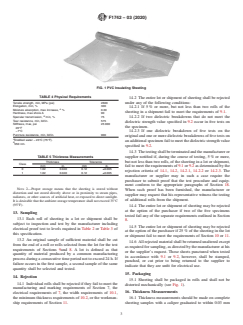
FIG. 1 PVC Insulating Sheeting
TABLE 4 Physical Requirements
14.2 The entire lot or shipment of sheeting shall be rejected
Tensile strength, min, MPa (psi) 2600 under any of the following conditions:
Elongation, min, % 300
14.2.1 If 5 % or more, but not less than two rolls of the
A
Moisture absorption, max increase, % 0.30
sheeting in a shipment fail to meet the requirements of 9.1.
Hardness, max shore A 90
B
Specular transmission, min, % 75 14.2.2 If two dielectric breakdowns that do not meet the
Tear resistance, min, lbf/in. 575
dielectric strength value specified in 9.2 occur in five tests on
Stiffness, max, psi 25 000
the specimen.
20°F
−7°C 14.2.3 If one dielectric breakdown of five tests on the
Puncture resistance, min, lbf/in. 900
original and one or more dielectric breakdowns of five tests on
A
Distilled water − 23°C (75°F).
anadditionalspecimenfailtomeetthedielectricstrengthvalue
B
550 nm.
specified in 9.2.
14.3 Thetestingshallbeterminatedandthemanufactureror
TABLE 5 Thickness Measurements supplier notified if, during the course of testing, 5 % or more,
but not less than two rolls, of the sheeting in a lot or shipment,
Thickness Tolerance
Class
mm in. mm in.
fail to meet the requirements of 9.1 or 9.2 as determined by the
0 1.02 0.040 0.12 ±0.005
rejection criteria of 14.1, 14.2, 14.2.1, 14.2.2 or 14.2.3. The
1 1.02 0.040 0.12 ±0.005
manufacturer or supplier may in such a case require the
purchaser to submit proof that the test procedure and equip-
ment conform to the appropriate paragraphs of Section 18.
NOTE 2—Proper storage means that t
...