

ASTM F1701-12(2018)
(Specification)Standard Specification for Unused Rope with Special Electrical Properties
General Information
- Abstract
ABSTRACT
This specification covers the requirements, sizes, construction, tests, and procedures for unused ropes for use by electrical utilities and related industries on energized lines operating at voltages higher than a certain value. Electrical test shall be performed in order to determine the rope's electrical conductivity and resistivity to water. Physical properties such as hardness, diameter, breaking strength, elongation, and melt point shall be determined as well. Rope and strands shall be free from kinks, strand knots, and darting yarns or loose ends (inside yarns which project through cover yarns of strand at intervals along the rope).
SCOPE
1.1 This specification covers the requirements, sizes, construction, tests, and procedures for unused ropes for use by electrical utilities and related industries on energized lines operating at voltages higher than 1 kV.
1.2 This specification covers the minimum electrical, mechanical, and physical properties guaranteed by the manufacturer and the detailed procedures by which such properties are to be determined. The purchaser has the option to perform or have performed any of these tests in order to verify the guarantee. Claims for failure to meet the specification are subject to verification by the manufacturer.
1.3 The rope to which this specification applies is designed to be used in a clean and dry condition, on or near energized lines.
1.4 A margin of safety shall be allowed between the maximum voltage and working distances on which it is used and the test voltage and lengths at which it is tested.
1.5 It is common practice for the user of this type of equipment to prepare complete instructions and regulations to govern in detail the correct and safe use of such equipment.
1.6 The use and maintenance of this equipment is beyond the scope of this specification.
1.7 The values stated in SI units are to be regarded as the standard.
1.8 The following safety hazards caveat pertains only to the test method portion, Section 11, of this specification: This standard does not purport to address all of the safety concerns, if any, associated with its use. It is the responsibility of the user of this standard to establish appropriate safety, health, and environmental practices and determine the applicability of regulatory limitations prior to use. The test levels used in this standard are for testing under laboratory conditions and are not to be regarded as safe use levels.
1.9 This international standard was developed in accordance with internationally recognized principles on standardization established in the Decision on Principles for the Development of International Standards, Guides and Recommendations issued by the World Trade Organization Technical Barriers to Trade (TBT) Committee.
- Status
- Published
- Publication Date
- 30-Sep-2018
- Technical Committee
- F18 - Electrical Protective Equipment for Workers
- Drafting Committee
- F18.35 - Tools & Equipment
Overview
ASTM F1701-12(2018) is the standard specification developed by ASTM International for unused rope with special electrical properties, specifically designed for use by electrical utilities and related industries. This standard defines requirements for the sizes, construction, testing, and quality of nonconductive ropes intended for work on or near energized power lines operating at voltages higher than 1 kV.
The specification ensures that ropes provide necessary electrical and mechanical performance for safe utility operations. It covers minimum electrical, mechanical, and physical properties, as well as test procedures to verify compliance. The standard supports both manufacturers in the production process and purchasers in quality assurance and verification.
Key Topics
Electrical Properties
- Ropes must undergo testing for electrical conductivity and resistance to water, both in dry and wet conditions.
- Electrical testing includes voltage withstand levels, current leakage limits, and assessment under simulated field conditions.
Mechanical & Physical Properties
- Minimum breaking strength, elongation, hardness, diameter, and melt point are specified.
- Tests verify durability, load-bearing capacity, and resilience under tension.
- Ropes must be free from defects such as kinks, strand knots, and darting yarns or loose ends.
Workmanship & Quality
- All ropes must be evenly laid, well balanced, and constructed to high standards for safety and reliability in energized environments.
- Specific criteria for packaging, marking, and traceability are required.
Testing Procedures
- Clearly defined sampling, testing, and retest protocols ensure consistent results.
- Both electrical and mechanical tests are specified, with safety recommendations for test apparatus and personnel protection.
- Testing is carried out under controlled laboratory conditions and must meet strict acceptance criteria.
Certification and Documentation
- Manufacturers are required to provide certification and, if requested, detailed test reports to purchasers, demonstrating compliance with the standard.
Applications
Electrical Utilities
- Used by line workers for tasks including insulator replacement, line maintenance, and rescue operations near energized equipment.
- Essential for live-line work requiring ropes that maintain integrity and nonconductive properties even under wet conditions.
Industrial Facilities
- Employed where operations are conducted near high-voltage installations, substation environments, or test labs.
Telecommunications and Infrastructure
- Utilized in applications where accidental electrical contact is possible and insulation is crucial for worker safety.
Regulatory Compliance
- Serves as a reference for safety protocols in procurement practices and utility maintenance standards for energized line work.
Related Standards
To ensure comprehensive safety and quality in rope selection and maintenance, reference may be made to other key documents:
- ASTM F711 - Specification for Fiberglass-Reinforced Plastic (FRP) Rod and Tube Used in Live Line Tools.
- ASTM D1125 - Test Methods for Electrical Conductivity and Resistivity of Water.
- ASTM E4 - Practices for Force Verification of Testing Machines.
- Cordage Institute CI-1301 - Standard for Polypropylene Fiber Rope Construction.
- IEEE Standard 4 - Standard Techniques for High Voltage Testing.
Implementation of ASTM F1701-12(2018) helps organizations assure the safety, performance, and reliability of ropes used in proximity to high-voltage power lines. Compliance with this standard minimizes risk to personnel and maintains industry best practices in linework and energized line maintenance.
Relations
- Effective Date
- 01-Oct-2018
- Effective Date
- 01-Jun-2014
- Effective Date
- 01-Nov-2013
- Effective Date
- 01-Jun-2010
- Effective Date
- 01-Nov-2009
- Effective Date
- 01-Apr-2009
- Effective Date
- 01-Dec-2008
- Effective Date
- 01-Jun-2008
- Effective Date
- 01-Oct-2007
- Effective Date
- 01-Jan-2007
- Refers
ASTM D1125-95(2005) - Standard Test Methods for Electrical Conductivity and Resistivity of Water - Effective Date
- 01-Apr-2005
- Effective Date
- 10-Aug-2003
- Effective Date
- 10-Nov-2002
- Effective Date
- 10-May-2002
- Effective Date
- 10-Jan-2002
Get Certified
Connect with accredited certification bodies for this standard

DIN CERTCO
DIN Group product certification.

Smithers Quality Assessments
US management systems and product certification.
Sponsored listings
Frequently Asked Questions
ASTM F1701-12(2018) is a technical specification published by ASTM International. Its full title is "Standard Specification for Unused Rope with Special Electrical Properties". This standard covers: ABSTRACT This specification covers the requirements, sizes, construction, tests, and procedures for unused ropes for use by electrical utilities and related industries on energized lines operating at voltages higher than a certain value. Electrical test shall be performed in order to determine the rope's electrical conductivity and resistivity to water. Physical properties such as hardness, diameter, breaking strength, elongation, and melt point shall be determined as well. Rope and strands shall be free from kinks, strand knots, and darting yarns or loose ends (inside yarns which project through cover yarns of strand at intervals along the rope). SCOPE 1.1 This specification covers the requirements, sizes, construction, tests, and procedures for unused ropes for use by electrical utilities and related industries on energized lines operating at voltages higher than 1 kV. 1.2 This specification covers the minimum electrical, mechanical, and physical properties guaranteed by the manufacturer and the detailed procedures by which such properties are to be determined. The purchaser has the option to perform or have performed any of these tests in order to verify the guarantee. Claims for failure to meet the specification are subject to verification by the manufacturer. 1.3 The rope to which this specification applies is designed to be used in a clean and dry condition, on or near energized lines. 1.4 A margin of safety shall be allowed between the maximum voltage and working distances on which it is used and the test voltage and lengths at which it is tested. 1.5 It is common practice for the user of this type of equipment to prepare complete instructions and regulations to govern in detail the correct and safe use of such equipment. 1.6 The use and maintenance of this equipment is beyond the scope of this specification. 1.7 The values stated in SI units are to be regarded as the standard. 1.8 The following safety hazards caveat pertains only to the test method portion, Section 11, of this specification: This standard does not purport to address all of the safety concerns, if any, associated with its use. It is the responsibility of the user of this standard to establish appropriate safety, health, and environmental practices and determine the applicability of regulatory limitations prior to use. The test levels used in this standard are for testing under laboratory conditions and are not to be regarded as safe use levels. 1.9 This international standard was developed in accordance with internationally recognized principles on standardization established in the Decision on Principles for the Development of International Standards, Guides and Recommendations issued by the World Trade Organization Technical Barriers to Trade (TBT) Committee.
ABSTRACT This specification covers the requirements, sizes, construction, tests, and procedures for unused ropes for use by electrical utilities and related industries on energized lines operating at voltages higher than a certain value. Electrical test shall be performed in order to determine the rope's electrical conductivity and resistivity to water. Physical properties such as hardness, diameter, breaking strength, elongation, and melt point shall be determined as well. Rope and strands shall be free from kinks, strand knots, and darting yarns or loose ends (inside yarns which project through cover yarns of strand at intervals along the rope). SCOPE 1.1 This specification covers the requirements, sizes, construction, tests, and procedures for unused ropes for use by electrical utilities and related industries on energized lines operating at voltages higher than 1 kV. 1.2 This specification covers the minimum electrical, mechanical, and physical properties guaranteed by the manufacturer and the detailed procedures by which such properties are to be determined. The purchaser has the option to perform or have performed any of these tests in order to verify the guarantee. Claims for failure to meet the specification are subject to verification by the manufacturer. 1.3 The rope to which this specification applies is designed to be used in a clean and dry condition, on or near energized lines. 1.4 A margin of safety shall be allowed between the maximum voltage and working distances on which it is used and the test voltage and lengths at which it is tested. 1.5 It is common practice for the user of this type of equipment to prepare complete instructions and regulations to govern in detail the correct and safe use of such equipment. 1.6 The use and maintenance of this equipment is beyond the scope of this specification. 1.7 The values stated in SI units are to be regarded as the standard. 1.8 The following safety hazards caveat pertains only to the test method portion, Section 11, of this specification: This standard does not purport to address all of the safety concerns, if any, associated with its use. It is the responsibility of the user of this standard to establish appropriate safety, health, and environmental practices and determine the applicability of regulatory limitations prior to use. The test levels used in this standard are for testing under laboratory conditions and are not to be regarded as safe use levels. 1.9 This international standard was developed in accordance with internationally recognized principles on standardization established in the Decision on Principles for the Development of International Standards, Guides and Recommendations issued by the World Trade Organization Technical Barriers to Trade (TBT) Committee.
ASTM F1701-12(2018) is classified under the following ICS (International Classification for Standards) categories: 83.080.20 - Thermoplastic materials. The ICS classification helps identify the subject area and facilitates finding related standards.
ASTM F1701-12(2018) has the following relationships with other standards: It is inter standard links to ASTM F1701-12, ASTM E4-14, ASTM F711-02(2013), ASTM E4-10, ASTM E4-09a, ASTM E4-09, ASTM E4-08, ASTM C1500-08, ASTM F711-02(2007), ASTM E4-07, ASTM D1125-95(2005), ASTM E4-03, ASTM E4-02, ASTM F711-02, ASTM C1500-02. Understanding these relationships helps ensure you are using the most current and applicable version of the standard.
ASTM F1701-12(2018) is available in PDF format for immediate download after purchase. The document can be added to your cart and obtained through the secure checkout process. Digital delivery ensures instant access to the complete standard document.
Standards Content (Sample)
This international standard was developed in accordance with internationally recognized principles on standardization established in the Decision on Principles for the
Development of International Standards, Guides and Recommendations issued by the World Trade Organization Technical Barriers to Trade (TBT) Committee.
Designation:F1701 −12 (Reapproved 2018)
Standard Specification for
Unused Rope with Special Electrical Properties
This standard is issued under the fixed designation F1701; the number immediately following the designation indicates the year of
original adoption or, in the case of revision, the year of last revision. A number in parentheses indicates the year of last reapproval. A
superscript epsilon (´) indicates an editorial change since the last revision or reapproval.
1. Scope 1.9 This international standard was developed in accor-
dance with internationally recognized principles on standard-
1.1 This specification covers the requirements, sizes,
ization established in the Decision on Principles for the
construction, tests, and procedures for unused ropes for use by
Development of International Standards, Guides and Recom-
electrical utilities and related industries on energized lines
mendations issued by the World Trade Organization Technical
operating at voltages higher than 1 kV.
Barriers to Trade (TBT) Committee.
1.2 This specification covers the minimum electrical,
2. Referenced Documents
mechanical, and physical properties guaranteed by the manu-
facturer and the detailed procedures by which such properties
2.1 ASTM Standards:
are to be determined. The purchaser has the option to perform
C1500 Test Method for Nondestructive Assay of Plutonium
or have performed any of these tests in order to verify the
by Passive Neutron Multiplicity Counting
guarantee. Claims for failure to meet the specification are
D1125 Test Methods for Electrical Conductivity and Resis-
subject to verification by the manufacturer.
tivity of Water
D4268 Test Methods for Testing Fiber Ropes (Withdrawn
1.3 The rope to which this specification applies is designed
2002)
to be used in a clean and dry condition, on or near energized
E4 Practices for Force Verification of Testing Machines
lines.
F711 Specification for Fiberglass-Reinforced Plastic (FRP)
1.4 A margin of safety shall be allowed between the
Rod and Tube Used in Live Line Tools
maximum voltage and working distances on which it is used
2.2 IEEE Standards:
and the test voltage and lengths at which it is tested.
IEEE Std 4 Standard Techniques for High Voltage Testing
1.5 It is common practice for the user of this type of
2.3 Other Standard:
equipment to prepare complete instructions and regulations to
Cordage Institute CI-1301 Polypropylene Fiber Rope
govern in detail the correct and safe use of such equipment.
3-Strand and 8-Strand Constructions (April 1999)
1.6 The use and maintenance of this equipment is beyond
3. Terminology
the scope of this specification.
3.1 General—The terms used in this specification are com-
1.7 The values stated in SI units are to be regarded as the
mon to and well known by the industries that will be using
standard.
them.
1.8 The following safety hazards caveat pertains only to the
4. Ordering Information
test method portion, Section 11, of this specification: This
standarddoesnotpurporttoaddressallofthesafetyconcerns,
4.1 Orders for rope under this specification should include
ifany,associatedwithitsuse.Itistheresponsibilityoftheuser
the following information:
of this standard to establish appropriate safety, health, and
4.2 Manufacturer’s designation of the rope.
environmental practices and determine the applicability of
4.3 Length of Coil or Reel:
regulatory limitations prior to use. The test levels used in this
standard are for testing under laboratory conditions and are not
to be regarded as safe use levels.
For referenced ASTM standards, visit the ASTM website, www.astm.org, or
contact ASTM Customer Service at service@astm.org. For Annual Book of ASTM
Standards volume information, refer to the standard’s Document Summary page on
the ASTM website.
1 3
This specification is under the jurisdiction of ASTM Committee F18 on The last approved version of this historical standard is referenced on
Electrical Protective Equipment for Workers and is the direct responsibility of www.astm.org.
Subcommittee F18.35 on Tools & Equipment. Available from Institute of Electrical and Electronics Engineers, Inc. (IEEE),
Current edition approved Oct. 1, 2018. Published October 2018. Originally 445 Hoes Ln., P.O. Box 1331, Piscataway, NJ 08854-1331.
approved in 1996. Last previous edition approved in 2012 as F1701-12. DOI: Available from The Cordage Institute, 994 Old Eagle School Rd., Suite 1019,
10.1520/F1701-12R18. Wayne, PA 19087.
Copyright © ASTM International, 100 Barr Harbor Drive, PO Box C700, West Conshohocken, PA 19428-2959. United States
F1701−12 (2018)
4.3.1 Lengths—Each package shall be continuous through- 11. Test Methods and Performance Requirements
out without splices or knots. Ends shall be taped, heat sealed,
11.1 The ropes complying with these specifications shall
or served to prevent unraveling.
undergo two different tests, electrical and mechanical/physical,
and are to be termed “nonconductive” rope. Samples of rope
5. Physical Properties
selected in accordance with Section 8 from every production
5.1 Hardness—Refer to 11.5. lot (single finished production length) shall be tested and each
reel identified by lot (see 15.3).
5.2 Diameter, Break Strength, and Elongation—Refer to
11.1.1 The test sequence is (1) visual (Refer to Section 7;
11.5.
(2) dry electrical (Refer to 11.3); (3) wet electrical (Refer to
11.4); (4) mechanical/physical (Refer to 11.5).
6. Mechanical Properties
11.2 Caution—It is recommended that the test apparatus be
6.1 Theprimarymechanicalpropertyofropeisthebreaking
designed to afford the operator full protection in performance
strength. Minimum breaking strengths, and associated nominal
of his duties. Reliable means of deenergizing and grounding
design characteristics (dimensions, mass, and acceptable varia-
the high-voltage circuit shall be provided.
tions) of ropes are available from manufacturer or the Cordage
11.3 Electrical Test Procedure Dry Test—This is a dry
Institute.
specimen test to be used on new rope prior to wet test.
11.3.1 Specimen for Test—When selected in accordance
7. Workmanship, Finish, and Appearance
with Section 8, the test specimen shall be at least 1.8 m (6 ft)
7.1 All sizes of rope shall be evenly laid and well balanced
long so that when the rope is held in a vertical position, there
in accordance with best rope making workmanship. Rope and
willbe1.0m(3ft)ofropefreefromknots,eyes,orsplices(see
strandsshallbefreefromkinks,strandknots,anddartingyarns
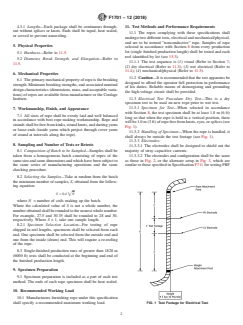
Fig. 1).
or loose ends (inside yarns which project through cover yarns
11.3.2 Handling of Specimen—When the rope is handled, it
of strand at intervals along the rope).
shall always be outside the test footage (see Fig. 1).
11.3.3 Electrodes:
8. Sampling and Number of Tests or Retests
11.3.3.1 The electrodes shall be designed to shield out the
8.1 Composition of Batch to be Sampled—Samples shall be majority of stray capacitive currents.
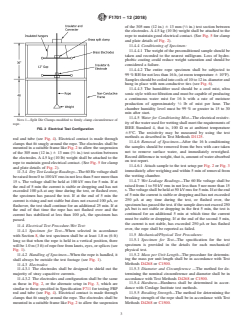
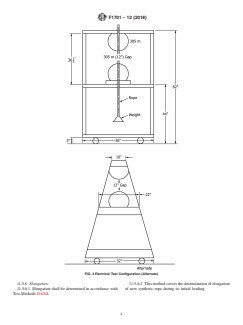
taken from a homogeneous batch consisting of ropes of the 11.3.3.2 The electrodes and configuration shall be the same
samesizeandsamedimensionsandwhichhavebeensubjectto as those in Fig. 2, or the alternate setup in Fig. 3, which are
the same series of manufacturing operations and the same similar to those specified in Specification F711 for testing FRP
checking procedure.
8.2 Selecting the Samples—Take at random from the batch
the minimum number of samples, S, obtained from the follow-
ing equation:
=
S 5 0.4 N
where N = number of coils making up the batch.
Where the calculated value of S is not a whole number, the
numberobtainedshallberoundedtothenearestwholenumber.
For example, 27.5 and 30.35 shall be rounded to 28 and 30,
respectively. Where S < 1, take one sample length.
8.2.1 Specimen Selection Location—For testing of rope
shipped in reel lengths, specimens shall be selected from each
end. One specimen shall be selected from the outside end and
one from the inside (drum) end. This will require a re-reeling
of the rope.
8.3 Single-finished production runs of greater than 1828 m
(6000 ft) tests shall be conducted at the beginning and end of
the finished production length.
9. Specimen Preparation
9.1 Specimen preparation is included as a part of each test
method. The ends of each rope specimen shall be heat sealed.
10. Recommended Working Load
10.1 Manufacturers furnishing rope under this specification
shall specify a recommended maximum working load. FIG. 1 Test Footage for Electrical Test
F1701−12 (2018)
of the 305 mm (12 in.) 6 13 mm ( ⁄2 in.) test section between
the electrodes.A4.5 kg (10 lb) weight shall be attached to the
rope to maintain good electrical contact. (See Fig. 5 for clamp
and plate details of Fig. 2).
11.4.4 Conditioning of Specimen:
11.4.4.1 The weight of the preconditioned sample should be
taken and recorded to the nearest milligram. Loss of hydro-
phobic coating could reduce weight saturation and should be
considered a failure.
11.4.4.2 The entire rope specimen shall be subjected to
99 % RH for not less than 16 h, (at room temperature 6 10°F).
Samplesshouldbecoiledint
...