

ASTM C1129-17
(Practice)Standard Practice for Estimation of Heat Savings by Adding Thermal Insulation to Bare Valves and Flanges
General Information
- Abstract
SIGNIFICANCE AND USE
5.1 Manufacturers of thermal insulation for valves typically express the performance of their products in charts and tables showing heat loss per valve. These data are presented for both bare and insulated valves of different pipe sizes, ANSI classes, insulation types, insulation thicknesses, and service temperatures. Additional information on effects of wind velocity, jacket emittance, bare valve emittance, and ambient conditions are also required to properly select an insulation system. Due to the infinite combination of pipe sizes, ANSI classes, insulation types and thicknesses, service temperatures, insulation cover geometries, surface emittance values, and ambient conditions, it is not possible to publish data for each possible case.
5.2 Users of thermal insulation for piping systems faced with the problem of designing large systems of insulated piping, encounter substantial engineering costs to obtain the required thermal information. This cost can be substantially reduced by both the use of accurate engineering data tables, or by the use of available computer analysis tools, or both.
5.3 The use of this practice by the manufacturer, contractor, and users of thermal insulation for valves and flanges will provide standardized engineering data of sufficient accuracy and consistency for predicting the savings in heating energy use by insulating bare valves and flanges.
5.4 Computers are now readily available to most producers and consumers of thermal insulation to permit use of this practice.
5.5 The computer program in Practice C680 has been developed to calculate the heat loss per unit length, or per unit surface area, of both bare and insulated pipe. With values for bare valve or flange surface areas, heat loss can be estimated. By estimating the outer insulation surface area from an insulation manufacturer's or contractor's drawings, the heat loss from the insulation surface can likewise be calculated by taking the product of heat loss per unit ar...
SCOPE
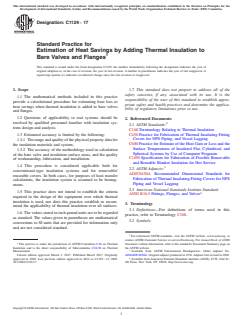
1.1 The mathematical methods included in this practice provide a calculational procedure for estimating heat loss or heat savings when thermal insulation is added to bare valves and flanges.
1.2 Questions of applicability to real systems should be resolved by qualified personnel familiar with insulation systems design and analysis.
1.3 Estimated accuracy is limited by the following:
1.3.1 The range and quality of the physical property data for the insulation materials and system,
1.3.2 The accuracy of the methodology used in calculation of the bare valve and insulation surface areas, and the quality of workmanship, fabrication, and installation.
1.4 This procedure is considered applicable both for conventional-type insulation systems and for removable/reuseable covers. In both cases, for purposes of heat transfer calculations, the insulation system is assumed to be homogenous.
1.5 This practice does not intend to establish the criteria required in the design of the equipment over which thermal insulation is used, nor does this practice establish or recommend the applicability of thermal insulation over all surfaces.
1.6 The values stated in inch-pound units are to be regarded as standard. The values given in parentheses are mathematical conversions to SI units that are provided for information only and are not considered standard.
1.7 This standard does not purport to address all of the safety concerns, if any, associated with its use. It is the responsibility of the user of this standard to establish appropriate safety and health practices and determine the applicability of regulatory limitations prior to use.
- Status
- Published
- Publication Date
- 28-Feb-2017
- Technical Committee
- C16 - Thermal Insulation
- Drafting Committee
- C16.30 - Thermal Measurement
Buy Documents
ASTM C1129-17 - Standard Practice for Estimation of Heat Savings by Adding Thermal Insulation to Bare Valves and Flanges
REDLINE ASTM C1129-17 - Standard Practice for Estimation of Heat Savings by Adding Thermal Insulation to Bare Valves and Flanges
Overview
ASTM C1129-17 is a standard practice published by ASTM International that provides a mathematical procedure for estimating heat savings achieved by adding thermal insulation to bare valves and flanges. This standard enables manufacturers, contractors, and users in the thermal insulation industry to estimate energy savings and heat loss reductions in piping systems using standardized engineering data. By focusing on both insulated and uninsulated components, ASTM C1129-17 establishes a consistent method for calculating thermal performance in a wide range of real-world conditions.
Key Topics
- Estimation Methodology: The standard outlines steady-state heat transfer theory and calculation techniques consistent with ASTM C680, covering both conventional insulation systems and removable/reusable covers.
- Required Data Inputs:
- Bare and insulated surface areas of valves and flanges
- Insulation thickness and material type
- Service and ambient temperatures
- Wind speed and surface emittance values
- Number of service hours per year
- Accuracy and Limitations: The procedure’s accuracy is influenced by:
- The reliability of physical property data for insulation materials
- The accuracy of surface area measurements
- Quality of installation and fabrication
- Standardized Tables and Calculations: Includes reference tables for surface areas based on pipe size and ANSI class, facilitating quick estimations without custom measurements in every situation.
- Applicability: The method is suitable for conventional and removable insulation systems, assuming homogenous insulation for heat transfer calculations.
Applications
ASTM C1129-17 is widely used in industrial, commercial, and utility sectors where energy efficiency and heat loss management are crucial. Common applications include:
- Industrial Plants:
- Estimating energy savings in steam, hot water, and process piping systems
- Assessing the impact of insulation for maintenance or retrofit projects
- Facility Design and Maintenance:
- Supporting decisions on whether to insulate valves and flanges for new construction or upgrades
- Prioritizing insulation retrofits to maximize ROI and meet sustainability goals
- Energy Audits:
- Quantifying heat loss for utility incentive programs or internal benchmarking
- Calculating potential energy cost reductions and CO₂ emissions savings
- Product Evaluation:
- Comparing performance data of different insulation products
- Simulating various operational conditions, such as differing temperatures, wind speeds, and surface finishes
Related Standards
For a comprehensive approach to thermal insulation and heat loss estimation, ASTM C1129-17 references several related standards:
- ASTM C680: Practice for Estimate of the Heat Gain or Loss and the Surface Temperatures of Insulated Systems by Use of Computer Programs
- ASTM C450: Practice for Fabrication of Thermal Insulating Fitting Covers for NPS Piping and Vessel Lagging
- ASTM C168: Terminology Relating to Thermal Insulation
- ASTM C1695: Specification for Fabrication of Flexible Removable and Reusable Blanket Insulation for Hot Service
- ANSI B16.5: Standard covering Fittings, Flanges, and Valves dimensions, as referenced for consistent pipe and fitting data
Practical Value
By applying ASTM C1129-17, organizations can:
- Reduce engineering costs through standardized data and calculation methods
- Make informed decisions on insulation investments for valves and flanges
- Improve system energy efficiency and reduce operational heat loss
- Achieve regulatory or corporate sustainability targets through documented energy performance
Adopting this standard supports efficient, data-driven design and maintenance practices in thermal piping systems, facilitating significant energy and cost savings over the lifecycle of an installation.
Relations
- Effective Date
- 01-Mar-2017
- Effective Date
- 15-Apr-2024
- Effective Date
- 01-Nov-2023
- Effective Date
- 01-Apr-2019
- Effective Date
- 01-Nov-2018
- Effective Date
- 15-Apr-2018
- Effective Date
- 01-Apr-2018
- Effective Date
- 15-Mar-2018
- Effective Date
- 01-Nov-2017
- Effective Date
- 01-Jun-2017
- Effective Date
- 15-Oct-2015
- Effective Date
- 01-Sep-2015
- Effective Date
- 01-Jun-2015
- Effective Date
- 01-Sep-2014
- Effective Date
- 01-Apr-2014
Buy Documents
ASTM C1129-17 - Standard Practice for Estimation of Heat Savings by Adding Thermal Insulation to Bare Valves and Flanges
REDLINE ASTM C1129-17 - Standard Practice for Estimation of Heat Savings by Adding Thermal Insulation to Bare Valves and Flanges
Get Certified
Connect with accredited certification bodies for this standard

Institut za varilstvo d.o.o. (Welding Institute)
Slovenia's leading welding institute since 1952. ISO 3834, EN 1090, pressure equipment certification, NDT personnel, welder qualification. Only IIW Au
Sponsored listings
Frequently Asked Questions
ASTM C1129-17 is a standard published by ASTM International. Its full title is "Standard Practice for Estimation of Heat Savings by Adding Thermal Insulation to Bare Valves and Flanges". This standard covers: SIGNIFICANCE AND USE 5.1 Manufacturers of thermal insulation for valves typically express the performance of their products in charts and tables showing heat loss per valve. These data are presented for both bare and insulated valves of different pipe sizes, ANSI classes, insulation types, insulation thicknesses, and service temperatures. Additional information on effects of wind velocity, jacket emittance, bare valve emittance, and ambient conditions are also required to properly select an insulation system. Due to the infinite combination of pipe sizes, ANSI classes, insulation types and thicknesses, service temperatures, insulation cover geometries, surface emittance values, and ambient conditions, it is not possible to publish data for each possible case. 5.2 Users of thermal insulation for piping systems faced with the problem of designing large systems of insulated piping, encounter substantial engineering costs to obtain the required thermal information. This cost can be substantially reduced by both the use of accurate engineering data tables, or by the use of available computer analysis tools, or both. 5.3 The use of this practice by the manufacturer, contractor, and users of thermal insulation for valves and flanges will provide standardized engineering data of sufficient accuracy and consistency for predicting the savings in heating energy use by insulating bare valves and flanges. 5.4 Computers are now readily available to most producers and consumers of thermal insulation to permit use of this practice. 5.5 The computer program in Practice C680 has been developed to calculate the heat loss per unit length, or per unit surface area, of both bare and insulated pipe. With values for bare valve or flange surface areas, heat loss can be estimated. By estimating the outer insulation surface area from an insulation manufacturer's or contractor's drawings, the heat loss from the insulation surface can likewise be calculated by taking the product of heat loss per unit ar... SCOPE 1.1 The mathematical methods included in this practice provide a calculational procedure for estimating heat loss or heat savings when thermal insulation is added to bare valves and flanges. 1.2 Questions of applicability to real systems should be resolved by qualified personnel familiar with insulation systems design and analysis. 1.3 Estimated accuracy is limited by the following: 1.3.1 The range and quality of the physical property data for the insulation materials and system, 1.3.2 The accuracy of the methodology used in calculation of the bare valve and insulation surface areas, and the quality of workmanship, fabrication, and installation. 1.4 This procedure is considered applicable both for conventional-type insulation systems and for removable/reuseable covers. In both cases, for purposes of heat transfer calculations, the insulation system is assumed to be homogenous. 1.5 This practice does not intend to establish the criteria required in the design of the equipment over which thermal insulation is used, nor does this practice establish or recommend the applicability of thermal insulation over all surfaces. 1.6 The values stated in inch-pound units are to be regarded as standard. The values given in parentheses are mathematical conversions to SI units that are provided for information only and are not considered standard. 1.7 This standard does not purport to address all of the safety concerns, if any, associated with its use. It is the responsibility of the user of this standard to establish appropriate safety and health practices and determine the applicability of regulatory limitations prior to use.
SIGNIFICANCE AND USE 5.1 Manufacturers of thermal insulation for valves typically express the performance of their products in charts and tables showing heat loss per valve. These data are presented for both bare and insulated valves of different pipe sizes, ANSI classes, insulation types, insulation thicknesses, and service temperatures. Additional information on effects of wind velocity, jacket emittance, bare valve emittance, and ambient conditions are also required to properly select an insulation system. Due to the infinite combination of pipe sizes, ANSI classes, insulation types and thicknesses, service temperatures, insulation cover geometries, surface emittance values, and ambient conditions, it is not possible to publish data for each possible case. 5.2 Users of thermal insulation for piping systems faced with the problem of designing large systems of insulated piping, encounter substantial engineering costs to obtain the required thermal information. This cost can be substantially reduced by both the use of accurate engineering data tables, or by the use of available computer analysis tools, or both. 5.3 The use of this practice by the manufacturer, contractor, and users of thermal insulation for valves and flanges will provide standardized engineering data of sufficient accuracy and consistency for predicting the savings in heating energy use by insulating bare valves and flanges. 5.4 Computers are now readily available to most producers and consumers of thermal insulation to permit use of this practice. 5.5 The computer program in Practice C680 has been developed to calculate the heat loss per unit length, or per unit surface area, of both bare and insulated pipe. With values for bare valve or flange surface areas, heat loss can be estimated. By estimating the outer insulation surface area from an insulation manufacturer's or contractor's drawings, the heat loss from the insulation surface can likewise be calculated by taking the product of heat loss per unit ar... SCOPE 1.1 The mathematical methods included in this practice provide a calculational procedure for estimating heat loss or heat savings when thermal insulation is added to bare valves and flanges. 1.2 Questions of applicability to real systems should be resolved by qualified personnel familiar with insulation systems design and analysis. 1.3 Estimated accuracy is limited by the following: 1.3.1 The range and quality of the physical property data for the insulation materials and system, 1.3.2 The accuracy of the methodology used in calculation of the bare valve and insulation surface areas, and the quality of workmanship, fabrication, and installation. 1.4 This procedure is considered applicable both for conventional-type insulation systems and for removable/reuseable covers. In both cases, for purposes of heat transfer calculations, the insulation system is assumed to be homogenous. 1.5 This practice does not intend to establish the criteria required in the design of the equipment over which thermal insulation is used, nor does this practice establish or recommend the applicability of thermal insulation over all surfaces. 1.6 The values stated in inch-pound units are to be regarded as standard. The values given in parentheses are mathematical conversions to SI units that are provided for information only and are not considered standard. 1.7 This standard does not purport to address all of the safety concerns, if any, associated with its use. It is the responsibility of the user of this standard to establish appropriate safety and health practices and determine the applicability of regulatory limitations prior to use.
ASTM C1129-17 is classified under the following ICS (International Classification for Standards) categories: 23.040.60 - Flanges, couplings and joints. The ICS classification helps identify the subject area and facilitates finding related standards.
ASTM C1129-17 has the following relationships with other standards: It is inter standard links to ASTM C1129-12, ASTM C168-24, ASTM C680-23a, ASTM C1695-19, ASTM C1695-18a, ASTM C168-18, ASTM C450-18, ASTM C1695-18, ASTM C450-17, ASTM C168-17, ASTM C168-15a, ASTM C1695-10(2015), ASTM C168-15, ASTM C680-14, ASTM C450-08(2014). Understanding these relationships helps ensure you are using the most current and applicable version of the standard.
ASTM C1129-17 is available in PDF format for immediate download after purchase. The document can be added to your cart and obtained through the secure checkout process. Digital delivery ensures instant access to the complete standard document.
Standards Content (Sample)
This international standard was developed in accordance with internationally recognized principles on standardization established in the Decision on Principles for the
Development of International Standards, Guides and Recommendations issued by the World Trade Organization Technical Barriers to Trade (TBT) Committee.
Designation: C1129 − 17
Standard Practice for
Estimation of Heat Savings by Adding Thermal Insulation to
Bare Valves and Flanges
This standard is issued under the fixed designation C1129; the number immediately following the designation indicates the year of
original adoption or, in the case of revision, the year of last revision.Anumber in parentheses indicates the year of last reapproval.A
superscript epsilon (´) indicates an editorial change since the last revision or reapproval.
1. Scope 1.7 This standard does not purport to address all of the
safety concerns, if any, associated with its use. It is the
1.1 The mathematical methods included in this practice
responsibility of the user of this standard to establish appro-
provide a calculational procedure for estimating heat loss or
priate safety and health practices and determine the applica-
heat savings when thermal insulation is added to bare valves
bility of regulatory limitations prior to use.
and flanges.
1.2 Questions of applicability to real systems should be
2. Referenced Documents
resolved by qualified personnel familiar with insulation sys-
2.1 ASTM Standards:
tems design and analysis.
C168Terminology Relating to Thermal Insulation
1.3 Estimated accuracy is limited by the following: C450Practice for Fabrication of Thermal Insulating Fitting
Covers for NPS Piping, and Vessel Lagging
1.3.1 Therangeandqualityofthephysicalpropertydatafor
C680Practice for Estimate of the Heat Gain or Loss and the
the insulation materials and system,
Surface Temperatures of Insulated Flat, Cylindrical, and
1.3.2 The accuracy of the methodology used in calculation
Spherical Systems by Use of Computer Programs
of the bare valve and insulation surface areas, and the quality
C1695Specification for Fabrication of Flexible Removable
of workmanship, fabrication, and installation.
and Reusable Blanket Insulation for Hot Service
1.4 This procedure is considered applicable both for
2.2 ASTM Adjuncts:
conventional-type insulation systems and for removable/
ADJC0450A Recommended Dimensional Standards for
reuseable covers. In both cases, for purposes of heat transfer
Fabrication of Thermal Insulating Fitting Covers for NPS
calculations, the insulation system is assumed to be homog-
Piping and Vessel Lagging
enous.
2.3 American National Standards Institute Standard:
1.5 This practice does not intend to establish the criteria
ANSI B16.5Fittings, Flanges, and Valves
required in the design of the equipment over which thermal
insulation is used, nor does this practice establish or recom-
3. Terminology
mend the applicability of thermal insulation over all surfaces.
3.1 Definitions—For definitions of terms used in this
1.6 Thevaluesstatedininch-poundunitsaretoberegarded
practice, refer to Terminology C168.
as standard. The values given in parentheses are mathematical
3.2 Symbols:
conversions to SI units that are provided for information only
and are not considered standard.
For referenced ASTM standards, visit the ASTM website, www.astm.org, or
contact ASTM Customer Service at service@astm.org. For Annual Book of ASTM
This practice is under the jurisdiction of ASTM Committee C16 on Thermal Standards volume information, refer to the standard’s Document Summary page on
Insulation and is the direct responsibility of Subcommittee C16.30 on Thermal the ASTM website.
Measurement. Available from ASTM International Headquarters. Order Adjunct No.
Current edition approved March 1, 2017. Published March 2017. Originally ADJADJC0450A. Original adjunct produced in 1976.Adjunct last revised in 2002.
approved in 1989. Last previous edition approved in 2012 as C1129–12. DOI: Available fromAmerican National Standards Institute (ANSI), 25 W. 43rd St.,
10.1520/C1129-17. 4th Floor, New York, NY 10036, http://www.ansi.org.
Copyright © ASTM International, 100 Barr Harbor Drive, PO Box C700, West Conshohocken, PA 19428-2959. United States
C1129 − 17
4. Summary of Practice
4.1 The procedures for estimating heat loss used in this
practice are based upon standard steady-state heat transfer
theoryasoutlinedinPracticeC680(orprogramsconformingto
it such as 3E Plus ). Practice C680 and 3E plus are used to
estimate the heat loss per unit surface area for the particular
conditions and for all configurations, both bare and insulated.
4.2 The procedures for estimating surface areas used in this
practicearebasedonstandardgeometriclogic:forabarevalve
or flange, the contours of the metal surface are considered. For
aninsulatedvalveorflange,thefabricatedshapeofthefinished
insulation system is considered.
4.3 Data Input:
4.3.1 Total bare surface area and total insulation surface
area of the valve or flange,
4.3.2 Service and ambient temperatures,
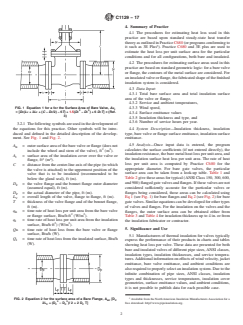
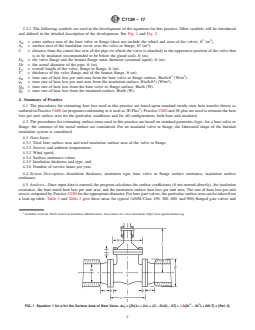
FIG. 1 Equation 1 for a for the Surface Area of Bare Valve,A
4.3.3 Wind speed,
B
V
2 2
=[D (L +2L +(C −D /2)−6T)+ 1.5(D −D )+6D T] π (Ref.
P V F P F P F
4.3.4 Surface emittance values
3)
4.3.5 Insulation thickness and type, and
4.3.6 Number of service hours per year.
3.2.1 Thefollowingsymbolsareusedinthedevelopmentof
the equations for this practice. Other symbols will be intro- 4.4 System Description—Insulation thickness, insulation
duced and defined in the detailed description of the develop- type, bare valve or flange surface emittance, insulation surface
ment. See Fig. 1 and Fig. 2. emittance.
4.5 Analysis—Once input data is entered, the program
A = outersurfaceareaofthebarevalveorflange(doesnot
B
2 2
calculates the surface coefficients (if not entered directly), the
include the wheel and stem of the valve), ft (m ).
insulationresistance,thebaremetalheatlossperunitarea,and
A = surface area of the insulation cover over the valve or
I
2 2
the insulation surface heat loss per unit area. The rate of heat
flange, ft (m ).
loss per unit area is computed by Practice C680 for the
C = distancefromthecenter-lineaxisofthepipe(towhich
appropriate diameter. For bare gate valves, the particular
the valve is attached) to the uppermost position of the
surface area can be taken from a look-up table. Table 1 and
valve that is to be insulated (recommended to be
Table2givetheseareasfortypical(ANSIClass150,300,600,
below the gland seal), ft (m).
and900)flangedgatevalvesandflanges.Ifthesevalvesarenot
D = the valve flange and the bonnet flange outer diameter
F
considered sufficiently accurate for the particular valves or
(assumed equal), ft (m).
flanges being considered, those areas can be calculated using
D = the actual diameter of the pipe, ft (m).
P
Eq1(seeFig.1)forbareflangesandEq2(seeFig.2)forbare
L = overall length of the valve, flange to flange, ft (m).
V
T = thickness of the valve flange and of the bonnet flange,
gatevalves.Similarequationscanbedevelopedforothertypes
ft (m). of valves and flanges. For the insulation on the valves and the
q = timerateofheatlossperunitareafromthebarevalve
flanges, the outer surface area can be obtained either from
B
2 2
or flange surface, Btu/h·ft (W/m ).
Table 3 and Table 4 for insulation thickness up to 4 in. or from
q = time rate of heat loss per unit area from the insulation
I the insulation fabricator or contractor.
2 2
surface, Btu/h·ft)(W/m ).
5. Significance and Use
Q = time rate of heat loss from the bare valve or flange
B
surface, Btu/h (W).
5.1 Manufacturers of thermal insulation for valves typically
Q = timerateofheatlossfromtheinsulatedsurface,Btu/h
I
express the performance of their products in charts and tables
(W).
showing heat loss per valve. These data are presented for both
bare and insulated valves of different pipe sizes,ANSI classes,
insulation types, insulation thicknesses, and service tempera-
tures.Additionalinformationoneffectsofwindvelocity,jacket
emittance, bare valve emittance, and ambient conditions are
alsorequiredtoproperlyselectaninsulationsystem.Duetothe
infinite combination of pipe sizes, ANSI classes, insulation
types and thicknesses, service temperatures, insulation cover
geometries, surface emittance values, and ambient conditions,
it is not possible to publish data for each possible case.
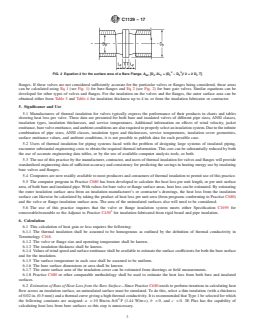
FIG. 2 Equation 2 for the surface area of a Bare Flange, A [D Available from the NorthAmerican Insulation ManufacturersAssociation for a
BF P
2 2
2L +(D –D )/2+2D T] free download. http//:www.pipeinsulation.org.
F F P F
C1129 − 17
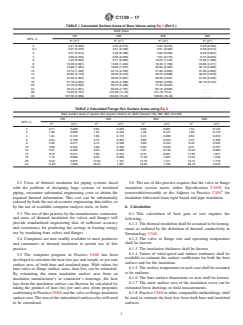
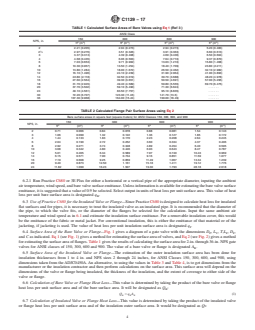
TABLE 1 Calculated Surface Areas of Bare Valves using Eq 1 (Ref3)
ANSI Class
150 300 600 900
NPS, in.
2 2 2 2 2 2 2 2
ft (m)ft (m)ft (m)ft (m )
2 2.21 (0.205) 2.94 (0.273) 2.94 (0.273) 5.20 (0.483)
2 ⁄2 2.97 (0.276) 3.51 (0.326) 3.91 (0.363) 6.60 (0.613)
3 3.37 (0.313) 4.39 (0.408) 4.69 (0.436) 6.50 (0.604)
4 4.68 (0.435) 6.06 (0.563) 7.64 (0.710) 9.37 (0.870)
6 7.03 (0.653) 9.71 (0.902) 13.03 (1.210) 15.80 (1.468)
8 10.30 (0.957) 13.50 (1.254) 18.40 (1.709) 23.80 (2.211)
10 13.80 (1.284) 18.00 (1.672) 26.50 (2.462) 32.10 (2.982)
12 16.10 (1.496) 24.10 (2.239) 31.90 (2.964) 41.90 (3.893)
14 22.80 (2.118) 32.50 (3.019) 39.70 (3.688) 48.20 (4.978)
16 27.60 (2.564) 39.30 (3.651) 50.50 (4.691) 57.00 (5.295)
18 31.70 (2.945) 49.40 (4.589) 59.80 (5.555) 69.70 (6.475)
20 37.70 (3.502) 59.10 (5.490) 71.30 (6.624) .
24 49.10 (4.561) 83.50 (7.757) 95.10 (8.835) .
30 72.20 (6.707) 123.30 (11.46) 141.70 (13.6) .
36 107.30 (9.968) 164.00 (15.24) 199.00 (18.49) .
TABLE 2 Calculated Flange Pair Surface Areas using Eq 2
Bare surface areas in square feet (square meters) for ANSI Classes 150, 300, 600, and 900
150 300 600 900
NPS, in.
2 2 2 2 2 2 2 2
ft (m)ft (m)ft (m)ft (m )
2 0.71 0.066 0.84 0.078 0.88 0.081 1.54 0.143
3 1.06 0.099 1.32 0.122 1.36 0.127 1.85 0.172
4 1.44 0.133 1.83 0.170 2.23 0.208 2.64 0.245
6 2.04 0.190 2.72 0.252 3.60 0.334 4.37 0.406
8 2.92 0.271 3.74 0.348 4.89 0.454 6.40 0.595
10 3.68 0.342 4.80 0.446 6.93 0.643 8.47 0.787
12 5.01 0.465 6.34 0.589 7.97 0.740 10.43 0.969
14 6.15 0.571 7.90 0.734 9.16 0.851 11.59 1.077
16 7.19 0.668 9.25 0.859 11.49 1.067 13.34 1.239
20 9.40 0.873 12.50 1.161 15.18 1.411 19.12 1.776
24 11.82 1.099 16.23 1.507 19.30 1.793 28.18 2.618
5.2 Users of thermal insulation for piping systems faced 5.6 The use of this practice requires that the valve or flange
with the problem of designing large systems of insulated insulation system meets either Specification C1695 for
piping, encounter substantial engineering costs to obtain the removeable/reuseable or the Adjunct to Practice C450 for
required thermal information. This cost can be substantially insulation fabricated from rigid board and pipe insulation.
reduced by both the use of accurate engineering data tables, or
by the use of available computer analysis tools, or both.
6. Calculation
5.3 The use of this practice by the manufacturer, contractor,
6.1 This calculation of heat gain or loss requires the
and users of thermal insulation for valves and flanges will
following:
provide standardized engineering data of sufficient accuracy
6.1.1 Thethermalinsulationshallbeassumedtobehomog-
and consistency for predicting the savings in heating energy
enous as outlined by the definition of thermal conductivity in
use by insulating bare valves and flanges.
Terminology C168.
6.1.2 The valve or flange size and operating temperature
5.4 Computers are now readily available to most producers
shall be known.
and consumers of thermal insulation to permit use of this
practice. 6.1.3 The insulation thickness shall be known.
6.1.4 Values of wind speed and surface emittance shall be
5.5 The computer program in Practice C680 has been
available to estimate the surface coefficients for both the bare
developed to calculate the heat loss per unit length, or per unit
surface and for the insulation.
surface area, of both bare and insulated pipe. With values for
6.1.5 Thesurfacetemperatureineachcaseshallbeassumed
bare valve or flange surface areas, heat loss can be estimated.
to be uniform.
By estimating the outer insulation surface area from an
6.1.6 The bare surface dimensions or area shall be known.
insulation manufacturer’s or contractor’s drawings, the heat
6.1.7 The outer surface area of the insulation cover can be
loss from the insulation surface can likewise be calculated by
estimated from drawings or field measurements.
taking the product of heat loss per unit area (from programs
conformingtoPracticeC680)andthevalveorflangeinsulation 6.1.8 Practice C680 or other comparable methodology shall
surfacearea.Theareaoftheuninsulatedsurfacesalsowillneed be used to estimate the heat loss from both bare and insulated
to be considered. surfaces.
C1129 − 17
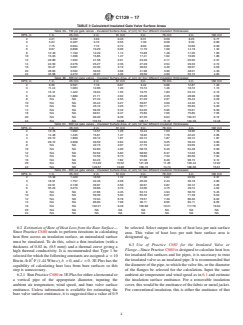
TABLE 3 Calculated Insulated Gate Valve Surface Areas
Table 3A - 150 psi gate valves - insulated Surface Area, sf (sm) for four different insulation thicknesses
NPS, in. 1 in. 25 mm 2 in. 51 mm 3 in. 76 mm 4 in. 102 mm
2 4.21 0.392 4.64 0.43 6.31 0.59 8.25 0.77
3 5.24 0.487 5.73 0.53 7.30 0.68 9.30 0.86
4 7.15 0.664 7.72 0.72 8.60 0.80 10.60 0.99
6 9.67 0.898 10.29 0.96 11.70 1.09 14.18 1.32
8 12.49 1.160 12.29 1.14 15.89 1.48 17.26 1.60
10 15.03 1.396 15.85 1.47 17.41 1.62 19.99 1.86
12 20.80 1.932 21.58 2.01 23.39 2.17 25.50 2.37
14 24.50 2.276 25.27 2.35 27.29 2.54 29.33 2.72
16 33.27 3.091 34.30 3.19 36.64 3.40 39.07 3.63
20 38.66 3.592 39.63 3.68 41.98 3.90 48.01 4.46
24 45.98 4.272 46.97 4.36 49.50 4.60 52.12 4.84
Table 3B - 300 psi gate valves - insulated Surface Area, sf (sm) for four different insulation thicknesses
NPS, in. 1 in. 25 mm 2 in. 51 mm 3 in. 76 mm 4 in. 102 mm
2 6.36 0.591 7.16 0.67 9.42 0.88 12.87 1.20
3 11.44 1.063 12.96 1.20 15.74 1.46 18.72 1.74
4 15.31 1.422 16.64 1.55 19.75 1.83 23.10 2.15
6 20.24 1.880 21.71 2.02 25.28 2.35 28.98 2.69
8 NA NA 27.43 2.55 31.29 2.91 35.44 3.29
10 NA NA 35.24 3.27 39.67 3.69 44.32 4.12
12 NA NA 45.72 4.25 50.71 4.71 55.93 5.20
14 NA NA 58.32 5.42 64.05 5.95 70.01 6.50
16 NA NA 69.61 6.47 75.85 7.05 75.85 7.05
20 NA NA 90.30 8.39 97.35 9.04 104.61 9.72
24 NA NA 118.16 10.98 126.17 11.72 134.39 12.48
Table 3C - 600 psi gate valves - insulated Surface Area, sf (sm) for four different insulation thicknesses
NPS, in. 1 in. 25 mm 2 in. 51 mm 3 in. 76 mm 4 in. 102 mm
2 10.78 1.002 13.57 1.26 16.44 1.53 18.96 1.76
3 14.48 1.345 15.81 1.47 18.92 1.76 22.22 2.06
4 20.12 1.869 20.12 1.87 20.12 1.87 20.12 1.87
6 28.72 2.668 30.59 2.84 34.94 3.25 39.43 3.66
8 NA NA 42.73 3.97 47.75 4.44 53.05 4.93
10 NA NA 52.80 4.90 58.70 5.45 64.48 5.99
12 NA NA 62.62 5.82 68.60 6.37 74.03 6.88
14 NA NA 72.50 6.73 78.89 7.33 85.50 7.94
16 NA NA 84.23 7.82 91.08 8.46 98.15 9.12
20 NA NA 113.29 10.52 121.26 11.26 129.44 12.02
24 NA NA 149.57 13.90 158.72 14.74 168.08 15.61
Table 3D - 900 psi gate valves - insulated Surface Area, sf (sm) for four different insulation thicknesses
NPS, in. 1 in. 25 mm 2 in. 51 mm 3 in. 76 mm 4 in. 102 mm
2 15.38 1.429 18.56 1.72 21.96 2.04 25.55 2.37
3 18.91 1.757 22.46 2.09 26.20 2.43 30.18 2.80
4 23.01 2.138 26.87 2.50 30.91 2.87 35.12 3.26
6 35.23 3.273 39.86 3.70 44.66 4.15 49.74 4.62
8 NA NA 47.86 4.45 53.13 4.94 58.70 5.45
10 NA NA 59.39 5.52 65.32 6.07 71.48 6.64
12 NA NA 72.94 6.78 79.51 7.39 86.30 8.02
14 NA NA 86.00 7.99 93.11 8.65 93.11 8.65
16 NA NA 102.21 9.49 109.88 10.21 117.78 10.94
20 NA NA NA NA NA NA NA NA
24 NA NA NA NA NA NA NA NA
6.2 Estimation of Rate of Heat Loss from the Bare Surface— be selected. Select output in units of heat loss per unit surface
Since Practice C680 needs to perform iterations in calculating area. This value of heat loss per unit bare surface area is
heat flow across an insulation surface, an uninsulated surface
designated q .
B
must be simulated. To do this, select a thin insulation (with a
6.3 Use of Practice C680 for the Insulated Valve or
thickness of 0.02 in. (0.5 mm)) and a thermal curve giving a
Flange—Since Practice C680 is designed to calculate heat loss
high thermal conductivity. It is recommended that Type 1 be
for insulated flat surfaces and for pipes, it is necessary to treat
selectedforwhichthefollowingconstantsareassigned:a =10
theinsulatedvalveasaninsulatedpipe.Itisrecommendedthat
Btu·in.⁄h·ft ·F(1.44W/m·c), b =0,and c =0.3EPlushasthe
thediameterofthepipe,towhichthevalvefits,orthediameter
capability of calculating heat loss from bare surfaces so this
of the flanges be selected for the calculation. Input the same
step is unnecessary.
ambient air temperature and
...
This document is not an ASTM standard and is intended only to provide the user of an ASTM standard an indication of what changes have been made to the previous version. Because
it may not be technically possible to adequately depict all changes accurately, ASTM recommends that users consult prior editions as appropriate. In all cases only the current version
of the standard as published by ASTM is to be considered the official document.
Designation: C1129 − 12 C1129 − 17
Standard Practice for
Estimation of Heat Savings by Adding Thermal Insulation to
Bare Valves and Flanges
This standard is issued under the fixed designation C1129; the number immediately following the designation indicates the year of
original adoption or, in the case of revision, the year of last revision. A number in parentheses indicates the year of last reapproval. A
superscript epsilon (´) indicates an editorial change since the last revision or reapproval.
1. Scope
1.1 The mathematical methods included in this practice provide a calculational procedure for estimating heat loss or heat
savings when thermal insulation is added to bare valves and flanges.
1.2 Questions of applicability to real systems should be resolved by qualified personnel familiar with insulation systems design
and analysis.
1.3 Estimated accuracy is limited by the following:
1.3.1 The range and quality of the physical property data for the insulation materials and system,
1.3.2 The accuracy of the methodology used in calculation of the bare valve and insulation surface areas, and the quality of
workmanship, fabrication, and installation.
1.4 This procedure is considered applicable both for conventional-type insulation systems and for removable/reuseable covers.
In both cases, for purposes of heat transfer calculations, the insulation system is assumed to be homogenous.
1.5 This practice does not intend to establish the criteria required in the design of the equipment over which thermal insulation
is used, nor does this practice establish or recommend the applicability of thermal insulation over all surfaces.
1.6 The values stated in inch-pound units are to be regarded as standard. The values given in parentheses are mathematical
conversions to SI units that are provided for information only and are not considered standard.
1.7 This standard does not purport to address all of the safety concerns, if any, associated with its use. It is the responsibility
of the user of this standard to establish appropriate safety and health practices and determine the applicability of regulatory
limitations prior to use.
2. Referenced Documents
2.1 ASTM Standards:
C168 Terminology Relating to Thermal Insulation
C450 Practice for Fabrication of Thermal Insulating Fitting Covers for NPS Piping, and Vessel Lagging
C680 Practice for Estimate of the Heat Gain or Loss and the Surface Temperatures of Insulated Flat, Cylindrical, and Spherical
Systems by Use of Computer Programs
C1695 Specification for Fabrication of Flexible Removable and Reusable Blanket Insulation for Hot Service
2.2 ASTM Adjuncts:
ADJC0450A Recommended Dimensional Standards for Fabrication of Thermal Insulating Fitting Covers for NPS Piping and
Vessel Lagging
2.3 American National Standards Institute Standard:
ANSI B16.5 Fittings, Flanges, and Valves
3. Terminology
3.1 Definitions—For definitions of terms used in this practice, refer to Terminology C168.
3.2 Symbols:
This practice is under the jurisdiction of ASTM Committee C16 on Thermal Insulation and is the direct responsibility of Subcommittee C16.30 on Thermal Measurement.
Current edition approved May 1, 2012March 1, 2017. Published July 2012March 2017. Originally approved in 1989. Last previous edition approved in 20082012 as
C1129–89C1129 – 12. (2008). DOI: 10.1520/C1129-12. 10.1520/C1129-17.
For referenced ASTM standards, visit the ASTM website, www.astm.org, or contact ASTM Customer Service at service@astm.org. For Annual Book of ASTM Standards
volume information, refer to the standard’s Document Summary page on the ASTM website.
Available from ASTM International Headquarters. Order Adjunct No. ADJADJC0450A. Original adjunct produced in 1976. Adjunct last revised in 2002.
Available from American National Standards Institute (ANSI), 25 W. 43rd St., 4th Floor, New York, NY 10036, http://www.ansi.org.
Copyright © ASTM International, 100 Barr Harbor Drive, PO Box C700, West Conshohocken, PA 19428-2959. United States
C1129 − 17
3.2.1 The following symbols are used in the development of the equations for this practice. Other symbols will be introduced
and defined in the detailed description of the development. See Fig. 1 and Fig. 2.
2 2
A = outer surface area of the bare valve or flange (does not include the wheel and stem of the valve), ft (m ).
B
2 2
A = surface area of the insulation cover over the valve or flange, ft (m ).
I
C = distance from the center-line axis of the pipe (to which the valve is attached) to the uppermost position of the valve that
is to be insulated (recommended to be below the gland seal), ft (m).
D = the valve flange and the bonnet flange outer diameter (assumed equal), ft (m).
F
D = the actual diameter of the pipe, ft (m).
P
L = overall length of the valve, flange to flange, ft (m).
V
T = thickness of the valve flange and of the bonnet flange, ft (m).
2 2
q = time rate of heat loss per unit area from the bare valve or flange surface, Btu/h·ft (W/m ).
B
2 2
q = time rate of heat loss per unit area from the insulation surface, Btu/h·ft ) (W/m ).
I
Q = time rate of heat loss from the bare valve or flange surface, Btu/h (W).
B
Q = time rate of heat loss from the insulated surface, Btu/h (W).
I
4. Summary of Practice
4.1 The procedures for estimating heat loss used in this practice are based upon standard steady-state heat transfer theory as
outlined in Practice C680 (or programs conforming to it such as 3E Plus ). Practice C680 and 3E plus are used to estimate the heat
loss per unit surface area for the particular conditions and for all configurations, both bare and insulated.
4.2 The procedures for estimating surface areas used in this practice are based on standard geometric logic: for a bare valve or
flange, the contours of the metal surface are considered. For an insulated valve or flange, the fabricated shape of the finished
insulation system is considered.
4.3 Data Input:
4.3.1 Total bare surface area and total insulation surface area of the valve or flange,
4.3.2 Service and ambient temperatures,
4.3.3 Wind speed,
4.3.4 Surface emittance values
4.3.5 Insulation thickness and type, and
4.3.6 Number of service hours per year.
4.4 System Description—Insulation thickness, insulation type, bare valve or flange surface emittance, insulation surface
emittance.
4.5 Analysis—Once input data is entered, the program calculates the surface coefficients (if not entered directly), the insulation
resistance, the bare metal heat loss per unit area, and the insulation surface heat loss per unit area. The rate of heat loss per unit
area is computed by Practice C680 for the appropriate diameter. For bare gate valves, the particular surface area can be taken from
a look-up table. Table 1 and Table 2 give these areas for typical (ANSI Class 150, 300, 600, and 900) flanged gate valves and
Available from the North American Insulation Manufacturers Association for a free download. http//:www.pipeinsulation.org.
2 2
FIG. 1 Equation 1 for a for the Surface Area of Bare Valve, A = [D (L + 2L + (C − D /2) − 6T) + 1.5(D − D ) + 6D T] π (Ref. 3)
B P V F P F P F
V
C1129 − 17
2 2
FIG. 2 Equation 2 for the surface area of a Bare Flange, A [D 2L + (D – D )/ 2 + 2 D T]
BF P F F P F
flanges. If these valves are not considered sufficiently accurate for the particular valves or flanges being considered, those areas
can be calculated using Eq 1 (see Fig. 1) for bare flanges and Eq 2 (see Fig. 2) for bare gate valves. Similar equations can be
developed for other types of valves and flanges. For the insulation on the valves and the flanges, the outer surface area can be
obtained either from Table 3 and Table 4 for insulation thickness up to 4 in. or from the insulation fabricator or contractor.
5. Significance and Use
5.1 Manufacturers of thermal insulation for valves typically express the performance of their products in charts and tables
showing heat loss per valve. These data are presented for both bare and insulated valves of different pipe sizes, ANSI classes,
insulation types, insulation thicknesses, and service temperatures. Additional information on effects of wind velocity, jacket
emittance, bare valve emittance, and ambient conditions are also required to properly select an insulation system. Due to the infinite
combination of pipe sizes, ANSI classes, insulation types and thicknesses, service temperatures, insulation cover geometries,
surface emittance values, and ambient conditions, it is not possible to publish data for each possible case.
5.2 Users of thermal insulation for piping systems faced with the problem of designing large systems of insulated piping,
encounter substantial engineering costs to obtain the required thermal information. This cost can be substantially reduced by both
the use of accurate engineering data tables, or by the use of available computer analysis tools, or both.
5.3 The use of this practice by the manufacturer, contractor, and users of thermal insulation for valves and flanges will provide
standardized engineering data of sufficient accuracy and consistency for predicting the savings in heating energy use by insulating
bare valves and flanges.
5.4 Computers are now readily available to most producers and consumers of thermal insulation to permit use of this practice.
5.5 The computer program in Practice C680 has been developed to calculate the heat loss per unit length, or per unit surface
area, of both bare and insulated pipe. With values for bare valve or flange surface areas, heat loss can be estimated. By estimating
the outer insulation surface area from an insulation manufacturer’s or contractor’s drawings, the heat loss from the insulation
surface can likewise be calculated by taking the product of heat loss per unit area (from programs conforming to Practice C680)
and the valve or flange insulation surface area. The area of the uninsulated surfaces also will need to be considered.
5.6 The use of this practice requires that the valve or flange insulation system meets either Specification C1695 for
removeable/reuseable or the Adjunct to Practice C450 for insulation fabricated from rigid board and pipe insulation.
6. Calculation
6.1 This calculation of heat gain or loss requires the following:
6.1.1 The thermal insulation shall be assumed to be homogenous as outlined by the definition of thermal conductivity in
Terminology C168.
6.1.2 The valve or flange size and operating temperature shall be known.
6.1.3 The insulation thickness shall be known.
6.1.4 Values of wind speed and surface emittance shall be available to estimate the surface coefficients for both the bare surface
and for the insulation.
6.1.5 The surface temperature in each case shall be assumed to be uniform.
6.1.6 The bare surface dimensions or area shall be known.
6.1.7 The outer surface area of the insulation cover can be estimated from drawings or field measurements.
6.1.8 Practice C680 or other comparable methodology shall be used to estimate the heat loss from both bare and insulated
surfaces.
6.2 Estimation of Rate of Heat Loss from the Bare Surface—Since Practice C680 needs to perform iterations in calculating heat
flow across an insulation surface, an uninsulated surface must be simulated. To do this, select a thin insulation (with a thickness
of 0.02 in. (0.5 mm)) and a thermal curve giving a high thermal conductivity. It is recommended that Type 1 be selected for which
the following constants are assigned: a = 10 Btu·in. ⁄h·ft ·F (1.44 W/m·c), b = 0, and c = 0. 3E Plus has the capability of
calculating heat loss from bare surfaces so this step is unnecessary.
C1129 − 17
TABLE 1 Calculated Surface Areas of Bare Valves using Eq 1 (Ref 3 )
ANSI Class
150 300 600 900
NPS, in.
2 2 2 2 2 2 2 2
ft (m ) ft (m ) ft (m ) ft (m )
2 2.21 (0.205) 2.94 (0.273) 2.94 (0.273) 5.20 (0.483)
2 ⁄2 2.97 (0.276) 3.51 (0.326) 3.91 (0.363) 6.60 (0.613)
3 3.37 (0.313) 4.39 (0.408) 4.69 (0.436) 6.50 (0.604)
4 4.68 (0.435) 6.06 (0.563) 7.64 (0.710) 9.37 (0.870)
6 7.03 (0.653) 9.71 (0.902) 13.03 (1.210) 15.80 (1.468)
8 10.30 (0.957) 13.50 (1.254) 18.40 (1.709) 23.80 (2.211)
10 13.80 (1.284) 18.00 (1.672) 26.50 (2.462) 32.10 (2.982)
12 16.10 (1.496) 24.10 (2.239) 31.90 (2.964) 41.90 (3.893)
14 22.80 (2.118) 32.50 (3.019) 39.70 (3.688) 48.20 (4.978)
16 27.60 (2.564) 39.30 (3.651) 50.50 (4.691) 57.00 (5.295)
18 31.70 (2.945) 49.40 (4.589) 59.80 (5.555) 69.70 (6.475)
20 37.70 (3.502) 59.10 (5.490) 71.30 (6.624) . . . . . .
24 49.10 (4.561) 83.50 (7.757) 95.10 (8.835) . . . . . .
30 72.20 (6.707) 123.30 (11.46) 141.70 (13.6) . . . . . .
36 107.30 (9.968) 164.00 (15.24) 199.00 (18.49) . . . . . .
TABLE 2 Calculated Flange Pair Surface Areas using Eq 2
Bare surface areas in square feet (square meters) for ANSI Classes 150, 300, 600, and 900
150 300 600 900
NPS, in.
2 2 2 2 2 2 2 2
ft (m ) ft (m ) ft (m ) ft (m )
2 0.71 0.066 0.84 0.078 0.88 0.081 1.54 0.143
3 1.06 0.099 1.32 0.122 1.36 0.127 1.85 0.172
4 1.44 0.133 1.83 0.170 2.23 0.208 2.64 0.245
6 2.04 0.190 2.72 0.252 3.60 0.334 4.37 0.406
8 2.92 0.271 3.74 0.348 4.89 0.454 6.40 0.595
10 3.68 0.342 4.80 0.446 6.93 0.643 8.47 0.787
12 5.01 0.465 6.34 0.589 7.97 0.740 10.43 0.969
14 6.15 0.571 7.90 0.734 9.16 0.851 11.59 1.077
16 7.19 0.668 9.25 0.859 11.49 1.067 13.34 1.239
20 9.40 0.873 12.50 1.161 15.18 1.411 19.12 1.776
24 11.82 1.099 16.23 1.507 19.30 1.793 28.18 2.618
6.2.1 Run Practice C680 or 3E Plus for either a horizontal or a vertical pipe of the appropriate diameter, inputing the ambient
air temperature, wind speed, and bare valve surface emittance. Unless information is available for estimating the bare valve surface
emittance, it is suggested that a value of 0.9 be selected. Select output in units of heat loss per unit surface area. This value of heat
loss per unit bare surface area is designated q .
B
6.3 Use of Practice C680 for the Insulated Valve or Flange—Since Practice C680 is designed to calculate heat loss for insulated
flat surfaces and for pipes, it is necessary to treat the insulated valve as an insulated pipe. It is recommended that the diameter of
the pipe, to which the valve fits, or the diameter of the flanges be selected for the calculation. Input the same ambient air
temperature and wind speed as in 6.1 and estimate the insulation surface emittance. For a removable insulation cover, this would
be the emittance of the fabric or metal jacket. For conventional insulation, this is either the emittance of that material or of the
jacketing, if jacketing is used. The value of heat loss per unit insulation surface area is designated q .
I
6.4 Surface Area of the Bare Valve or Flange—Fig. 1 gives a diagram of a gate valve with the dimensions D , L , T,L , D ,
P V F F
and C as indicated. Eq 1 (see Fig. 1) gives a method for estimating the surface area of valves, and Eq 2 (see Fig. 2) gives a method
for estimating the surface area of flanges. Table 1 gives the results of calculating the surface area for 2-in. through 36-in. NPS gate
valves for ANSI classes of 150, 300, 600 and 900. The value of a bare valve or flange is designated A .
B
6.5 Surface Area of the Insulated Valve or Flange—The estimation of the outer insulation surface area has been done for
insulation thicknesses from 1 to 4 in. and NPS sizes 2 through 24 inches, for ANSI Classes 150, 300, 600, and 900, using
dimensions taken from the ADJC0450A. An alternative, to using the values in Table 3 and Table 4, is to get dimensions from the
manufacturer or the insulation contractor and then perform calculations on the surface area. This surface area will depend on the
dimensions of the valve or flange being insulated, the thickness of the insulation, and the extent of coverage to either side of the
valve or flange.
6.6 Calculation of Bare Valve or Flange Heat Loss—This value is determined by taking the product of the bare valve or flange
heat loss per unit surface area and of the bare surface area. It will be designated as Q :
B
Q 5 q A (1)
B B B
6.7 Calculation of Insulated Valve or Flange Heat Loss—This value is determined by taking the product of the insulated valve
or flange heat loss per unit surface area and of the insulation outer surface area. It would be designated as Q :
I
C1129 − 17
TABLE 3 Calculated Insulated Gate Valve Surface Areas
Table 3A - 150 psi gate valves - insulated Surface Area, sf (sm) for four different insulation thicknesses
NPS, in. 1 in. 25 mm 2 in. 51 mm 3 in. 76 mm 4 in. 102 mm
2 4.21 0.392 4.64 0.43 6.31 0.59 8.25 0.77
3 5.24 0.487 5.73 0.53 7.30 0.68 9.30 0.86
4 7.15 0.664 7.72 0.72 8.60 0.80 10.60 0.99
6 9.67 0.898 10.29 0.96 11.70 1.09 14.18 1.32
8 12.49 1.160 12.29 1.14 15.89 1.48 17.26 1.60
10 15.03 1.396 15.85 1.47 17.41 1.62 19.99 1.86
12 20.80 1.932 21.58 2.01 23.39 2.17 25.50 2.
...