

ASTM F1913-19
(Specification)Standard Specification for Vinyl Sheet Floor Covering Without Backing
General Information
- Abstract
ABSTRACT
This specification covers sheet floor covering having a vinyl wear layer without backing. Products also may contain a clear specialty performance top layers. This type of floor covering is intended for use in commercial and light commercial buildings. The wear layer shall have a vinyl plastic binder and may include pigments, fillers, extenders, and other ingredients. This layer shall be stabilized against heat and light deterioration. The binder content of the PVC-pattern portion of the wear layer such as vinyl resins, plasticizers, and stabilizers shall be a minimum of 50 %.
SCOPE
1.1 This specification covers sheet floor covering having a vinyl wear layer without backing. Products also may contain a clear specialty performance top layer(s).
1.2 This type of floor covering is intended for use in commercial and light commercial buildings. General information and performance characteristics, which determine serviceability and recommended use, are included in this specification.
1.3 The values stated in inch-pound units are to be regarded as standard. The values given in parentheses are mathematical conversions to SI units that are provided for information only and are not considered standard.
1.4 This standard does not purport to address all of the safety concerns, if any, associated with its use. It is the responsibility of the user of this standard to establish appropriate safety, health, and environmental practices and determine the applicability of regulatory limitations prior to use.
1.5 This international standard was developed in accordance with internationally recognized principles on standardization established in the Decision on Principles for the Development of International Standards, Guides and Recommendations issued by the World Trade Organization Technical Barriers to Trade (TBT) Committee.
- Status
- Published
- Publication Date
- 31-Aug-2019
- Technical Committee
- F06 - Resilient Floor Coverings
- Drafting Committee
- F06.80 - Specifications
Buy Documents

ASTM F1913-19 - Standard Specification for Vinyl Sheet Floor Covering Without Backing
REDLINE ASTM F1913-19 - Standard Specification for Vinyl Sheet Floor Covering Without Backing
Overview
ASTM F1913-19: Standard Specification for Vinyl Sheet Floor Covering Without Backing provides requirements for sheet vinyl flooring products intended for commercial and light commercial use. This international ASTM standard addresses vinyl flooring with a wear layer but without a backing, and includes general information regarding material composition, minimum performance criteria, sampling, testing, and marking. Sheet vinyl flooring covered by ASTM F1913-19 is commonly selected for its durability, appearance, and ease of maintenance in high-traffic environments.
Key Topics
- Material Composition: The wear layer must feature a vinyl plastic binder, which can include pigments, fillers, and stabilizers to ensure product stability under heat and light. The vinyl resin content within the binder must be at least 60% by weight, with a minimum of 50% binder content in the pattern portion.
- Performance Top Layer: Products may incorporate a clear specialty performance top layer to enhance specific properties and protect the visual design. This layer is included in the total thickness calculation when at least 0.0004 in. thick.
- Physical Requirements: The standard specifies properties for residual indentation, flexibility, resistance to static loads, chemical resistance, and color stability under heat and light.
- Dimensions and Appearance: Standard roll widths and minimum total thickness are established. Products must be free of defects affecting appearance or performance and must match approved samples in color and pattern.
- Testing and Quality Assurance: Methods for sampling, testing, inspection, and certification are prescribed, referencing ASTM and ANSI/ASQC standards such as F386 (thickness), F410 (wear layer thickness), F137 (flexibility), F970 (static loading), F925 (chemical resistance), F1514 (heat stability), and F1515 (light stability).
- Marking and Packaging: Clear guidance is provided for marking packaging and shipping containers with product information, as well as standard commercial packaging practices for protection during transport and storage.
Applications
Vinyl sheet floor coverings without backing, as defined by ASTM F1913-19, are suited for:
- Commercial Environments: Schools, hospitals, retail stores, offices, and hospitality areas where resilience, ease of cleaning, and appearance retention are required.
- Light Commercial Uses: Common areas in multi-family dwellings, hotel/motel guest rooms, and similar spaces benefit from the cost-effectiveness and durability of unbacked sheet vinyl.
- Institutional Spaces: The chemical and stain resistance make these materials suitable for healthcare and educational facilities exposed to rigorous cleaning protocols.
- Where a Backing Layer is Not Needed: This specification applies particularly in installations where a substrate or underlayment provides required support and underfoot comfort.
Related Standards
ASTM F1913-19 references several other key standards that govern resilient floor coverings:
- ASTM F137: Test method for flexibility of resilient flooring.
- ASTM F386: Measurement of flooring material thickness.
- ASTM F410: Optical measurement of wear layer thickness.
- ASTM F925: Chemical resistance testing.
- ASTM F970: Recovery properties after static loading.
- ASTM F1514/F1515: Heat and light stability by color change.
- ASTM F1914: Indentation testing methods.
- ANSI/ASQC Z1.4: Sampling procedures for inspection by attributes.
Additional referenced practices and guides, such as ASTM F710 for preparing floors and F1482 for wood underlayments, can inform installation and substrate preparation strategies.
These referenced standards ensure that products meeting ASTM F1913-19 deliver reliable performance, safety, and quality, supporting their ongoing selection for demanding commercial and institutional flooring applications. For detailed installation, maintenance, and safety practices, consult relevant ASTM standards and manufacturer recommendations.
Relations
- Effective Date
- 01-Sep-2019
- Effective Date
- 01-Dec-2023
- Effective Date
- 01-Aug-2023
- Effective Date
- 01-Jul-2020
- Effective Date
- 01-Nov-2019
- Effective Date
- 01-Oct-2018
- Effective Date
- 01-Jun-2018
- Effective Date
- 01-Dec-2017
- Effective Date
- 01-Dec-2015
- Effective Date
- 01-Dec-2013
- Effective Date
- 01-Dec-2013
- Effective Date
- 01-May-2013
- Effective Date
- 01-May-2013
- Effective Date
- 01-Mar-2012
- Effective Date
- 01-Dec-2011
Buy Documents
ASTM F1913-19 - Standard Specification for Vinyl Sheet Floor Covering Without Backing
REDLINE ASTM F1913-19 - Standard Specification for Vinyl Sheet Floor Covering Without Backing
Frequently Asked Questions
ASTM F1913-19 is a technical specification published by ASTM International. Its full title is "Standard Specification for Vinyl Sheet Floor Covering Without Backing". This standard covers: ABSTRACT This specification covers sheet floor covering having a vinyl wear layer without backing. Products also may contain a clear specialty performance top layers. This type of floor covering is intended for use in commercial and light commercial buildings. The wear layer shall have a vinyl plastic binder and may include pigments, fillers, extenders, and other ingredients. This layer shall be stabilized against heat and light deterioration. The binder content of the PVC-pattern portion of the wear layer such as vinyl resins, plasticizers, and stabilizers shall be a minimum of 50 %. SCOPE 1.1 This specification covers sheet floor covering having a vinyl wear layer without backing. Products also may contain a clear specialty performance top layer(s). 1.2 This type of floor covering is intended for use in commercial and light commercial buildings. General information and performance characteristics, which determine serviceability and recommended use, are included in this specification. 1.3 The values stated in inch-pound units are to be regarded as standard. The values given in parentheses are mathematical conversions to SI units that are provided for information only and are not considered standard. 1.4 This standard does not purport to address all of the safety concerns, if any, associated with its use. It is the responsibility of the user of this standard to establish appropriate safety, health, and environmental practices and determine the applicability of regulatory limitations prior to use. 1.5 This international standard was developed in accordance with internationally recognized principles on standardization established in the Decision on Principles for the Development of International Standards, Guides and Recommendations issued by the World Trade Organization Technical Barriers to Trade (TBT) Committee.
ABSTRACT This specification covers sheet floor covering having a vinyl wear layer without backing. Products also may contain a clear specialty performance top layers. This type of floor covering is intended for use in commercial and light commercial buildings. The wear layer shall have a vinyl plastic binder and may include pigments, fillers, extenders, and other ingredients. This layer shall be stabilized against heat and light deterioration. The binder content of the PVC-pattern portion of the wear layer such as vinyl resins, plasticizers, and stabilizers shall be a minimum of 50 %. SCOPE 1.1 This specification covers sheet floor covering having a vinyl wear layer without backing. Products also may contain a clear specialty performance top layer(s). 1.2 This type of floor covering is intended for use in commercial and light commercial buildings. General information and performance characteristics, which determine serviceability and recommended use, are included in this specification. 1.3 The values stated in inch-pound units are to be regarded as standard. The values given in parentheses are mathematical conversions to SI units that are provided for information only and are not considered standard. 1.4 This standard does not purport to address all of the safety concerns, if any, associated with its use. It is the responsibility of the user of this standard to establish appropriate safety, health, and environmental practices and determine the applicability of regulatory limitations prior to use. 1.5 This international standard was developed in accordance with internationally recognized principles on standardization established in the Decision on Principles for the Development of International Standards, Guides and Recommendations issued by the World Trade Organization Technical Barriers to Trade (TBT) Committee.
ASTM F1913-19 is classified under the following ICS (International Classification for Standards) categories: 97.150 - Floor coverings. The ICS classification helps identify the subject area and facilitates finding related standards.
ASTM F1913-19 has the following relationships with other standards: It is inter standard links to ASTM F1913-04(2014), ASTM F1914-18(2023), ASTM F141-23, ASTM F925-13(2020), ASTM F1514-19, ASTM F137-08(2018), ASTM F1914-18, ASTM F1914-17, ASTM F970-15, ASTM F137-08(2013), ASTM F410-08(2013), ASTM F925-13, ASTM F1514-03(2013), ASTM F141-12, ASTM F141-11. Understanding these relationships helps ensure you are using the most current and applicable version of the standard.
ASTM F1913-19 is available in PDF format for immediate download after purchase. The document can be added to your cart and obtained through the secure checkout process. Digital delivery ensures instant access to the complete standard document.
Standards Content (Sample)
This international standard was developed in accordance with internationally recognized principles on standardization established in the Decision on Principles for the
Development of International Standards, Guides and Recommendations issued by the World Trade Organization Technical Barriers to Trade (TBT) Committee.
Designation:F1913 −19
Standard Specification for
Vinyl Sheet Floor Covering Without Backing
This standard is issued under the fixed designation F1913; the number immediately following the designation indicates the year of
original adoption or, in the case of revision, the year of last revision. A number in parentheses indicates the year of last reapproval. A
superscript epsilon (´) indicates an editorial change since the last revision or reapproval.
1. Scope F925 Test Method for Resistance to Chemicals of Resilient
Flooring
1.1 This specification covers sheet floor covering having a
F970 Test Method for Measuring Recovery Properties of
vinyl wear layer without backing. Products also may contain a
Floor Coverings after Static Loading
clear specialty performance top layer(s).
F1514 TestMethodforMeasuringHeatStabilityofResilient
1.2 This type of floor covering is intended for use in
Flooring by Color Change
commercial and light commercial buildings. General informa-
F1515 Test Method for Measuring Light Stability of Resil-
tion and performance characteristics, which determine service-
ient Flooring by Color Change
abilityandrecommendeduse,areincludedinthisspecification.
F1914 Test Methods for Short-Term Indentation and Re-
sidual Indentation of Resilient Floor Covering
1.3 The values stated in inch-pound units are to be regarded
as standard. The values given in parentheses are mathematical
2.2 ANSI/ASQC Standard:
conversions to SI units that are provided for information only ANS/ASQC Z1.4 Sampling Procedures and Tables for In-
and are not considered standard.
spection by Attributes
1.4 This standard does not purport to address all of the
3. Terminology
safety concerns, if any, associated with its use. It is the
3.1 Definitions—Terms used in this specification are defined
responsibility of the user of this standard to establish appro-
in accordance with Terminology F141.
priate safety, health, and environmental practices and deter-
mine the applicability of regulatory limitations prior to use.
3.2 Definitions of Terms Specific to This Standard:
1.5 This international standard was developed in accor-
3.2.1 wear layer, n—the portion of a resilient floor covering
dance with internationally recognized principles on standard-
that contains the pattern effect.
ization established in the Decision on Principles for the
3.2.1.1 Discussion—The wear layer thickness and total
Development of International Standards, Guides and Recom-
thickness of through pattern unbacked sheet vinyl flooring are
mendations issued by the World Trade Organization Technical
the same.Aclear specialty performance top layer may be used
Barriers to Trade (TBT) Committee.
to enhance specific properties and to protect the pattern effect
and shall be counted as part of the wear layer. The wear layer
2. Referenced Documents
does not include temporary finishes or maintenance coatings.
2.1 ASTM Standards:
4. Significance and Use
F137 Test Method for Flexibility of Resilient Flooring Ma-
terials with Cylindrical Mandrel Apparatus
4.1 The information in this specification is for use by
F141 Terminology Relating to Resilient Floor Coverings
specifiers as a reference when selecting unbacked resilient
F386 Test Method for Thickness of Resilient Flooring Ma-
sheet vinyl flooring for areas within commercial and light
terials Having Flat Surfaces
commercial buildings.
F410 Test Method for Wear Layer Thickness of Resilient
Floor Coverings by Optical Measurement
5. Classification
5.1 Sheet Vinyl floor covering shall conform to the follow-
ing.
This specification is under the jurisdiction of ASTM Committee F06 on
5.1.1 The binder content of the PVC-pattern portion of the
Resilient Floor Coverings and is the direct responsibility of Subcommittee F06.80
on Specifications.
wear layer (vinyl resins, plasticizers, and stabilizers) shall be a
Current edition approved Sept. 1, 2019. Published September 2019. Originally
minimum of 50 %.Aclear specialty performance layer(s) used
approved in 1998. Last previous edition approved in 2014 as F1913 – 04(2014).
as the top layer is not described by binder limits.
DOI: 10.1520/F1913-19.
For referenced ASTM standards, visit the ASTM website, www.astm.org, or
contact ASTM Customer Service at service@astm.org. For Annual Book of ASTM
Standards volume information, refer to the standard’s Document Summary page on Available fromAmerican National Standards Institute (ANSI), 25 W. 43rd St.,
the ASTM website. 4th Floor, New York, NY 10036, http://www.ansi.org.
Copyright © ASTM International, 100 Barr Harbor Drive, PO Box C700, West Conshohocken, PA 19428-2959. United States
F1913−19
7.1.3 Thecompositionshallbeuniformandextendthrough-
PVC Binder Content
Minimum % PVC Wear Layer Description
out the full thickness of the pattern portion of the wear layer.
50 % The material shall be a vinyl compound consisting
of a blended composition of pigments stabilized 7.2 Specialty Performance Top Layer—A clear specialty
against heat and light deterioration. The design,
performance top layer(s) of a product can be a PVC or non
color and pattern extends throughout the thickness
PVC layer(s), which may constitute part of the total thickness
of the wear layer.
up to a maximum 0.005 in. and is not removable by normal
5.1.1.1 All flooring may have a clear specialty performance
maintenance procedures.
toplayer(s)withanaverageminimumtotalthicknessof0.0004
in. The specialty performance top layer(s) may consist of a
8. Physical Requirements
single layer or multiple layers, which do not delaminate under
normal use. Top layer(s) thinner than 0.0004 in. may be used 8.1 Sheetvinylfloorcoveringshallmeettherequirementsin
but cannot be counted as part of the clear specialty perfor- Table 2.
mance top layer.
5.1.2 The total thickness is the sum of the PVC wear layer 9. Dimensions
and the clear specialty top layer(s).The total thickness average
9.1 Common roll widths are 49-in. (1.25-m), 59-in. (1.5-m),
minimum is 0.075 in. (1.9 mm).
72-in. (1.83-m), and 78-in. (2-m) widths (minus 0 in.). Other
widths may be available.
6. Ordering Information
9.2 The floor covering shall be furnished in a minimum
6.1 Sheet vinyl floor covering without backing shall be
average overall thickness of 0.075 in. (1.9 mm).
ordered according to characteristics important to the purchaser
for the intended use as indicated by Table 1.
10. Workmanship, Finish, and Appearance
6.2 Intended Use—The following is a partial list providing
10.1 Materials furnished under this specification shall be an
generic guidance on typical applications of product use. For
acceptable match to an approved sample(s) in pattern, color,
specific applications, refer to the manufacturers product rec-
and surface appearance. The product shall be free of defects,
ommendations.
which would adversely affect performance or appearance.
6.2.1 LC (Light Commercial):
6.2.1.1 Multi-family Dwelling—Common Areas.
11. Sampling
6.2.1.2 Hotel/Motel Guest Rooms.
11.1 Sampling for testing physical characteristics listed in
6.2.2 C (Commercial):
Table 2 shall be done in accordance with the provisions set
6.2.2.1 Educational/Institutional.
forth in ANSI/ASQC Z1.4. The inspection level shall be
6.2.2.2 Hospital/Health Care.
special inspection level S-1 as noted in Table 1 and the
6.2.2.3 Retail/Mercantile.
acceptablequalitylevel(AQL)shallbe6.5defects/100unitsas
6.2.2.4 Office
noted in Table II-A or as otherwise specified in 11.3. The lot
6.2.2.5 Hospitality.
size shall be expressed in units. A unit represents a single,
6.3 The purchaser may wish to specify the following items:
manufactured, inventoried, finished roll.
6.3.1 Manufacturer,
11.2 Samples shall be obtained in the required length from
6.3.2 Style name and number,
the outside end of the roll and shall encompass the total width
6.3.3 Minimum roll width (see 9.1),
of the material.
6.3.4 Surface texture (see 7.1.3), and
6.3.5 Variation in list of chemicals used to demonstrate
11.3 Sampling for testing physical characteristics listed in
chemical resistance (see 12.7).
Table 2 shall be agreed upon by the purchaser and the
manufacturer as part of the procurement documents.
7. Material
7.1 Wear Layer:
12. Test Methods
7.1.1 The wear layer shall have a vinyl plastic binder and
12.1 Wear Layer Binder Content—The wear layer binder
may include pigments, fillers, e
...
This document is not an ASTM standard and is intended only to provide the user of an ASTM standard an indication of what changes have been made to the previous version. Because
it may not be technically possible to adequately depict all changes accurately, ASTM recommends that users consult prior editions as appropriate. In all cases only the current version
of the standard as published by ASTM is to be considered the official document.
Designation: F1913 − 04 (Reapproved 2014) F1913 − 19
Standard Specification for
Vinyl Sheet Floor Covering Without Backing
This standard is issued under the fixed designation F1913; the number immediately following the designation indicates the year of
original adoption or, in the case of revision, the year of last revision. A number in parentheses indicates the year of last reapproval. A
superscript epsilon (´) indicates an editorial change since the last revision or reapproval.
1. Scope
1.1 This specification covers sheet floor covering having a vinyl wear layer without backing. Products also may contain a clear
specialty performance top layer(s).
1.2 This type of floor covering is intended for use in commercial and light commercial buildings. General information and
performance characteristics, which determine serviceability and recommended use, are included in this specification.
1.3 The values stated in inch-pound units are to be regarded as standard. The values given in parentheses are mathematical
conversions to SI units that are provided for information only and are not considered standard.
1.4 This standard does not purport to address all of the safety concerns, if any, associated with its use. It is the responsibility
of the user of this standard to establish appropriate safety safety, health, and healthenvironmental practices and determine the
applicability of regulatory limitations prior to use.
1.5 This international standard was developed in accordance with internationally recognized principles on standardization
established in the Decision on Principles for the Development of International Standards, Guides and Recommendations issued
by the World Trade Organization Technical Barriers to Trade (TBT) Committee.
2. Referenced Documents
2.1 ASTM Standards:
F137 Test Method for Flexibility of Resilient Flooring Materials with Cylindrical Mandrel Apparatus
F141 Terminology Relating to Resilient Floor Coverings
F386 Test Method for Thickness of Resilient Flooring Materials Having Flat Surfaces
F410 Test Method for Wear Layer Thickness of Resilient Floor Coverings by Optical Measurement
F925 Test Method for Resistance to Chemicals of Resilient Flooring
F970 Test Method for Measuring Recovery Properties of Floor Coverings after Static Loading
F1514 Test Method for Measuring Heat Stability of Resilient Flooring by Color Change
F1515 Test Method for Measuring Light Stability of Resilient Flooring by Color Change
F1914 Test Methods for Short-Term Indentation and Residual Indentation of Resilient Floor Covering
2.2 ANSI/ASQC Standard:
ANS/ASQC Z1.4 Sampling Procedures and Tables for Inspection by Attributes
3. Terminology
3.1 Definitions—Terms used in this specification are defined in accordance with Terminology F141.
3.2 Definitions of Terms Specific to This Standard:
3.2.1 wear layer, n—the portion of a resilient floor covering that contains the pattern effect.
3.2.1.1 Discussion—
The wear layer thickness and total thickness of through pattern unbacked sheet vinyl flooring are the same. A clear specialty
This specification is under the jurisdiction of ASTM Committee F06 on Resilient Floor Coverings and is the direct responsibility of Subcommittee F06.80 on
Specifications.
Current edition approved Nov. 1, 2014Sept. 1, 2019. Published December 2014September 2019. Originally approved in 1998. Last previous edition approved in 20102014
as F1913F1913 – 04 - 04(2010). DOI: 10.1520/F1913-04R14.(2014). DOI: 10.1520/F1913-19.
For referenced ASTM standards, visit the ASTM website, www.astm.org, or contact ASTM Customer Service at service@astm.org. For Annual Book of ASTM Standards
volume information, refer to the standard’s Document Summary page on the ASTM website.
Available from American National Standards Institute (ANSI), 25 W. 43rd St., 4th Floor, New York, NY 10036, http://www.ansi.org.
Copyright © ASTM International, 100 Barr Harbor Drive, PO Box C700, West Conshohocken, PA 19428-2959. United States
F1913 − 19
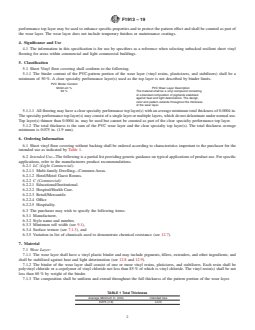
performance top layer may be used to enhance specific properties and to protect the pattern effect and shall be counted as part of
the wear layer. The wear layer does not include temporary finishes or maintenance coatings.
4. Significance and Use
4.1 The information in this specification is for use by specifiers as a reference when selecting unbacked resilient sheet vinyl
flooring for areas within commercial and light commercial buildings.
5. Classification
5.1 Sheet Vinyl floor covering shall conform to the following.
5.1.1 The binder content of the PVC-pattern portion of the wear layer (vinyl resins, plasticizers, and stabilizers) shall be a
minimum of 50 %. A clear specialty performance layer(s) used as the top layer is not described by binder limits.
PVC Binder Content
Minimum % PVC Wear Layer Description
50 % The material shall be a vinyl compound consisting
of a blended composition of pigments stabilized
against heat and light deterioration. The design,
color and pattern extends throughout the thickness
of the wear layer.
5.1.1.1 All flooring may have a clear specialty performance top layer(s) with an average minimum total thickness of 0.0004 in.
The specialty performance top layer(s) may consist of a single layer or multiple layers, which do not delaminate under normal use.
Top layer(s) thinner than 0.0004 in. may be used but cannot be counted as part of the clear specialty performance top layer.
5.1.2 The total thickness is the sum of the PVC wear layer and the clear specialty top layer(s). The total thickness average
minimum is 0.075 in. (1.9 mm).
6. Ordering Information
6.1 Sheet vinyl floor covering without backing shall be ordered according to characteristics important to the purchaser for the
intended use as indicated by Table 1.
6.2 Intended Use—The following is a partial list providing generic guidance on typical applications of product use. For specific
applications, refer to the manufacturers product recommendations.
6.2.1 LC (Light Commercial):
6.2.1.1 Multi-family Dwelling—Common Areas.
6.2.1.2 Hotel/Motel Guest Rooms.
6.2.2 C (Commercial):
6.2.2.1 Educational/Institutional.
6.2.2.2 Hospital/Health Care.
6.2.2.3 Retail/Mercantile.
6.2.2.4 Office
6.2.2.5 Hospitality.
6.3 The purchaser may wish to specify the following items:
6.3.1 Manufacturer,
6.3.2 Style name and number,
6.3.3 Minimum roll width (see 9.1),
6.3.4 Surface texture (see 7.1.3), and
6.3.5 Variation in list of chemicals used to demonstrate chemical resistance (see 12.7).
7. Material
7.1 Wear Layer:
7.1.1 The wear layer shall have a vinyl plastic binder and may include pigments, fillers, extenders, and other ingredients; and
shall be stabilized against heat and light deterioration (see 12.8 and 12.9).
7.1.2 The binder of the wear layer shall consist of one or more vinyl resins, platicizers, and stabilizers. Each resin shall be
polyvinyl chloride or a copolymer of vinyl chloride not less than 85 % of which is vinyl chloride. The vinyl resin(s) shall be not
less than 60 % by weight of the binder.
7.1.3 The composition shall be uniform and extend throughout the full thickness of the pattern portion of the wear layer.
TABLE 1 Total Thickness
Average Minimum in. (mm) Intended Use
0.075 (1.9) LC/C
F1913 − 19
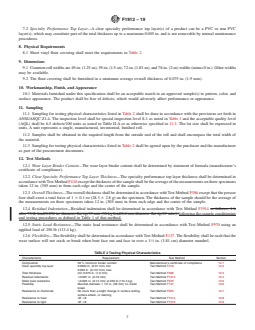
7.2 Specialty Performance Top Layer—A clear specialty performance top layer(s) of a product can be a PVC or non PVC
layer(s), which may constitute part of the total thickness up to a maximum 0.005 in. and is not removable by normal maintenance
procedures.
8. Physical Requirements
8.1 Sheet vinyl floor covering shall meet the requirements in Table 2.
9. Dimensions
9.1 Common roll widths are 49-in. (1.25-m), 59-in. (1.5-m), 72-in. (1.83-m), and 78-in. (2-m) widths (minus 0 in.). Other widths
may be available.
9.2 The floor covering shall be furnished in a minimum average overall thickness of 0.075 in. (1.9 mm).
10. Workmanship, Finish, and Appearance
10.1 Materials furnished under this specification shall be an acceptable match to an approved sample(s) in pattern, color, and
surface appearance. The product shall be free of defects, which would adversely affect performance or appearance.
11. Sampling
11.1 Sampling for testing physical characteristics listed in Table 2 shall be done in accordance with the provisions set forth in
ANSI/ASQC Z1.4. The inspection level shall be special inspection level S-1 as noted in Table 1 and the acceptable quality level
(AQL) shall be 6.5 defects/100 units as noted in
...