

ASTM A956/A956M-22
(Test Method)Standard Test Method for Leeb Hardness Testing of Steel Products
General Information
- Abstract
SIGNIFICANCE AND USE
5.1 Hardness of a material is a poorly defined term that may have many meanings depending on the type of test performed and the expectations of the person involved. The Leeb hardness test is of the dynamic or rebound type, which primarily depends both on the plastic and on the elastic properties of the material being tested. The results obtained are indicative of the strength and dependent on the heat treatment of the material tested.
5.2 The Leeb hardness test is a superficial determination only measuring the condition of the surface contacted. The results generated at that location do not represent the part at any other surface location and yield no information about the material at subsurface locations.
SCOPE
1.1 This test method covers the determination of the Leeb hardness of steel, cast steel, and cast iron (Part A), including the methods for the verification of Leeb hardness testing instruments (Part B), and the calibration of standardized test blocks (Part C).
Note 1: The original title of this standard was “Standard Test Method for Equotip Hardness Testing of Steel Products.”1
1.2 The values stated in either SI units or inch-pound units are to be regarded separately as standard. The values stated in each system are not necessarily exact equivalents; therefore, to ensure conformance with the standard, each system shall be used independently of the other, and values from the two systems shall not be combined.
1.3 This standard does not purport to address all of the safety concerns, if any, associated with its use. It is the responsibility of the user of this standard to establish appropriate safety, health, and environmental practices and determine the applicability of regulatory limitations prior to use.
1.4 This international standard was developed in accordance with internationally recognized principles on standardization established in the Decision on Principles for the Development of International Standards, Guides and Recommendations issued by the World Trade Organization Technical Barriers to Trade (TBT) Committee.
- Status
- Published
- Publication Date
- 31-Aug-2022
- Technical Committee
- A01 - Steel, Stainless Steel and Related Alloys
Overview
ASTM A956/A956M-22 is the Standard Test Method for Leeb Hardness Testing of Steel Products. Developed by ASTM International, this standard specifies a dynamic or rebound testing method, known as the Leeb hardness test, for determining the surface hardness of steel, cast steel, and cast iron products. The standard offers guidance for the correct use of Leeb hardness instruments, procedures for verifying their performance, and calibration of standardized hardness test blocks. This method is widely respected for its speed and non-destructive nature, making it highly suitable for both production environments and quality assurance processes.
The Leeb hardness test primarily reflects both plastic and elastic properties of the tested material, serving as an indicator of material strength, and is sensitive to the heat treatment status of steel products. It is important to note that the Leeb method only measures the surface condition at the tested location and does not provide information about subsurface or other areas of the component.
Key Topics
- Test Method Scope: Determination of Leeb hardness numbers for steel, cast steel, and cast iron. Includes device verification and test block calibration.
- Instrumentation: Utilizes an impact device with spherically tipped indenters and a digital display to record rebound measurements.
- Units and Measurements: Uses separate SI and inch-pound units. Results must not combine values from different systems.
- Procedure: Impact body is propelled onto the test piece surface, and the rebound velocity is measured. The Leeb hardness value is calculated as the ratio of rebound to impact velocity, multiplied by 1000.
- Surface Preparation: Surface finish and preparation are critical for reliable results; paint, scale, or coatings must be removed to avoid result distortion.
- Test Piece Requirements: Sufficient thickness, weight, and rigid support are necessary for accurate readings, especially on lightweight or thin sections.
- Verification and Calibration: Procedures for routine instrument verification and calibration using standardized hardness test blocks are prescribed.
- Direction Compensation: Test direction (vertical, horizontal, etc.) can affect results, and compensation may be required depending on instrument capabilities.
- Repeatability and Reproducibility: Provides statistical guidelines for assessing the consistency and reliability of the test results.
Applications
The Leeb hardness testing method, as described in ASTM A956/A956M-22, finds significant use in industrial and quality control processes, offering several practical advantages:
- On-Site Hardness Testing: Portability and quick results make it ideal for large, heavy, or installed steel and cast iron components where conventional destructive testing is impractical.
- Production Quality Assurance: Used for routine checks on forged, rolled, or heat-treated components to verify compliance with hardness specifications.
- Weld and Surface Inspection: Efficiently evaluates welded joints, cast surfaces, and heat-affected zones without damaging the material.
- Maintenance and In-Service Inspection: Supports maintenance programs by facilitating in-situ monitoring of mechanical properties for equipment such as pressure vessels, pipelines, and heavy machinery.
- Supplier Audits: Offers a non-destructive means to verify material properties during material receipt and supplier evaluations.
Related Standards
For organizations and professionals seeking comprehensive hardness evaluation practices, ASTM A956/A956M-22 integrates with several other key standards:
- ASTM E140: Standard Hardness Conversion Tables for Metals, providing relationships among Leeb, Brinell, Vickers, Rockwell, and other hardness scales.
- ASTM E177: Practice for Use of the Terms Precision and Bias in ASTM Test Methods, relevant to understanding accuracy in test results.
- ASTM E691: Practice for Conducting an Interlaboratory Study to Determine the Precision of a Test Method.
Adhering to ASTM A956/A956M-22 ensures robust, consistent, and internationally recognized procedures for dynamic hardness testing of steel products, supporting quality, safety, and regulatory compliance in various industrial settings.
Keywords: Leeb hardness, rebound hardness test, dynamic hardness testing, ASTM A956, steel hardness, non-destructive testing, quality control, hardness calibration, surface hardness test.
Relations
- Effective Date
- 01-May-2014
- Effective Date
- 01-May-2013
- Effective Date
- 01-May-2013
- Effective Date
- 01-Nov-2011
- Effective Date
- 01-Oct-2010
- Effective Date
- 01-Oct-2008
- Effective Date
- 01-Oct-2008
- Refers
ASTM E177-06b - Standard Practice for Use of the Terms Precision and Bias in ASTM Test Methods - Effective Date
- 15-Nov-2006
- Refers
ASTM E177-06a - Standard Practice for Use of the Terms Precision and Bias in ASTM Test Methods - Effective Date
- 01-Nov-2006
- Effective Date
- 01-Nov-2005
- Effective Date
- 01-Apr-2005
- Effective Date
- 01-Apr-2005
- Refers
ASTM E177-04e1 - Standard Practice for Use of the Terms Precision and Bias in ASTM Test Methods - Effective Date
- 01-Nov-2004
- Effective Date
- 01-Nov-2004
- Effective Date
- 01-Nov-2004
Get Certified
Connect with accredited certification bodies for this standard

Element Materials Technology
Materials testing and product certification.

Inštitut za kovinske materiale in tehnologije
Institute of Metals and Technology. Materials testing, metallurgical analysis, NDT.
Sponsored listings
Frequently Asked Questions
ASTM A956/A956M-22 is a standard published by ASTM International. Its full title is "Standard Test Method for Leeb Hardness Testing of Steel Products". This standard covers: SIGNIFICANCE AND USE 5.1 Hardness of a material is a poorly defined term that may have many meanings depending on the type of test performed and the expectations of the person involved. The Leeb hardness test is of the dynamic or rebound type, which primarily depends both on the plastic and on the elastic properties of the material being tested. The results obtained are indicative of the strength and dependent on the heat treatment of the material tested. 5.2 The Leeb hardness test is a superficial determination only measuring the condition of the surface contacted. The results generated at that location do not represent the part at any other surface location and yield no information about the material at subsurface locations. SCOPE 1.1 This test method covers the determination of the Leeb hardness of steel, cast steel, and cast iron (Part A), including the methods for the verification of Leeb hardness testing instruments (Part B), and the calibration of standardized test blocks (Part C). Note 1: The original title of this standard was “Standard Test Method for Equotip Hardness Testing of Steel Products.”1 1.2 The values stated in either SI units or inch-pound units are to be regarded separately as standard. The values stated in each system are not necessarily exact equivalents; therefore, to ensure conformance with the standard, each system shall be used independently of the other, and values from the two systems shall not be combined. 1.3 This standard does not purport to address all of the safety concerns, if any, associated with its use. It is the responsibility of the user of this standard to establish appropriate safety, health, and environmental practices and determine the applicability of regulatory limitations prior to use. 1.4 This international standard was developed in accordance with internationally recognized principles on standardization established in the Decision on Principles for the Development of International Standards, Guides and Recommendations issued by the World Trade Organization Technical Barriers to Trade (TBT) Committee.
SIGNIFICANCE AND USE 5.1 Hardness of a material is a poorly defined term that may have many meanings depending on the type of test performed and the expectations of the person involved. The Leeb hardness test is of the dynamic or rebound type, which primarily depends both on the plastic and on the elastic properties of the material being tested. The results obtained are indicative of the strength and dependent on the heat treatment of the material tested. 5.2 The Leeb hardness test is a superficial determination only measuring the condition of the surface contacted. The results generated at that location do not represent the part at any other surface location and yield no information about the material at subsurface locations. SCOPE 1.1 This test method covers the determination of the Leeb hardness of steel, cast steel, and cast iron (Part A), including the methods for the verification of Leeb hardness testing instruments (Part B), and the calibration of standardized test blocks (Part C). Note 1: The original title of this standard was “Standard Test Method for Equotip Hardness Testing of Steel Products.”1 1.2 The values stated in either SI units or inch-pound units are to be regarded separately as standard. The values stated in each system are not necessarily exact equivalents; therefore, to ensure conformance with the standard, each system shall be used independently of the other, and values from the two systems shall not be combined. 1.3 This standard does not purport to address all of the safety concerns, if any, associated with its use. It is the responsibility of the user of this standard to establish appropriate safety, health, and environmental practices and determine the applicability of regulatory limitations prior to use. 1.4 This international standard was developed in accordance with internationally recognized principles on standardization established in the Decision on Principles for the Development of International Standards, Guides and Recommendations issued by the World Trade Organization Technical Barriers to Trade (TBT) Committee.
ASTM A956/A956M-22 is classified under the following ICS (International Classification for Standards) categories: 77.040.10 - Mechanical testing of metals. The ICS classification helps identify the subject area and facilitates finding related standards.
ASTM A956/A956M-22 has the following relationships with other standards: It is inter standard links to ASTM E177-14, ASTM E691-13, ASTM E177-13, ASTM E691-11, ASTM E177-10, ASTM E691-08, ASTM E177-08, ASTM E177-06b, ASTM E177-06a, ASTM E691-05, ASTM E140-05, ASTM E140-05e1, ASTM E177-04e1, ASTM E177-04, ASTM E177-06. Understanding these relationships helps ensure you are using the most current and applicable version of the standard.
ASTM A956/A956M-22 is available in PDF format for immediate download after purchase. The document can be added to your cart and obtained through the secure checkout process. Digital delivery ensures instant access to the complete standard document.
Standards Content (Sample)
This international standard was developed in accordance with internationally recognized principles on standardization established in the Decision on Principles for the
Development of International Standards, Guides and Recommendations issued by the World Trade Organization Technical Barriers to Trade (TBT) Committee.
Designation:A956/A956M −22
Standard Test Method for
Leeb Hardness Testing of Steel Products
This standard is issued under the fixed designationA956/A956M; the number immediately following the designation indicates the year
of original adoption or, in the case of revision, the year of last revision.Anumber in parentheses indicates the year of last reapproval.
A superscript epsilon (´) indicates an editorial change since the last revision or reapproval.
1. Scope* E177Practice for Use of the Terms Precision and Bias in
ASTM Test Methods
1.1 This test method covers the determination of the Leeb
E691Practice for Conducting an Interlaboratory Study to
hardness of steel, cast steel, and cast iron (Part A), including
Determine the Precision of a Test Method
the methods for the verification of Leeb hardness testing
instruments (Part B), and the calibration of standardized test
3. Terminology
blocks (Part C).
3.1 Definitions:
NOTE 1—The original title of this standard was “Standard Test Method
3.1.1 calibration—determination of the values of the sig-
for Equotip Hardness Testing of Steel Products.”
nificant operating parameters of the instrument by comparison
1.2 The values stated in either SI units or inch-pound units
with values indicated by a reference instrument or by a set of
are to be regarded separately as standard. The values stated in
reference standards.
each system are not necessarily exact equivalents; therefore, to
3.1.2 Leeb hardness number—anumberequaltotheratioof
ensure conformance with the standard, each system shall be
the rebound velocity to the impact velocity of a 0.118 in.
used independently of the other, and values from the two
[3mm] or 0.197 in. [5 mm] (based on the type of impact
systems shall not be combined.
device) diameter spherically shaped tungsten carbide, silicon
1.3 This standard does not purport to address all of the
nitride, or diamond tipped impact body, multiplied by 1000.
safety concerns, if any, associated with its use. It is the
ReboundVelocity
responsibility of the user of this standard to establish appro-
L 5 31000
ImpactVelocity
priate safety, health, and environmental practices and deter-
mine the applicability of regulatory limitations prior to use.
The Leeb hardness number is followed by the symbol HL
1.4 This international standard was developed in accor-
with one or more suffix characters representing the type of
dance with internationally recognized principles on standard-
impact device.
ization established in the Decision on Principles for the
3.1.3 Leeb hardness test—a dynamic hardness test method
Development of International Standards, Guides and Recom-
using a calibrated instrument that impacts a spherically shaped
mendations issued by the World Trade Organization Technical
tungsten carbide, silicon nitride, or diamond tipped body with
Barriers to Trade (TBT) Committee.
a fixed velocity (generated by a spring force) onto a surface of
the material under test.The ratio of the rebound velocity to the
2. Referenced Documents
impactvelocityoftheimpactbodyisameasureofthehardness
2.1 ASTM Standards:
of the material under test.
E140Hardness Conversion Tables for Metals Relationship
3.1.4 surface finish—all references to surface finish in this
Among Brinell Hardness, Vickers Hardness, Rockwell
test method are defined as surface roughness (that is, Ra =
Hardness, Superficial Hardness, Knoop Hardness, Sclero-
average roughness value, AA = arithmetic average).
scope Hardness, and Leeb Hardness
3.1.5 verification—checking or testing the instrument to
ensure conformance with this test method.
This test method is under the jurisdiction of ASTM Committee A01 on Steel,
Stainless Steel and RelatedAlloys and is the direct responsibility of Subcommittee
4. Summary of Test Method
A01.13 on Mechanical and Chemical Testing and Processing Methods of Steel
Products and Processes.
4.1 During a hardness test, an impact body with a spheri-
Current edition approved Sept. 1, 2022. Published September 2022. Originally
cally shaped tungsten carbide, silicon nitride, or diamond tip
approved in 1996. Last previous edition approved in 2017 as A956/A956M–17A.
impacts, after being propelled to the specified velocity, the test
Leeb and Equotip are registered trademarks used with permission of Proceq SA.
DOI: 10.1520/A0956_A0956M-22.
surface from which it rebounds. The impact and rebound
For referenced ASTM standards, visit the ASTM website, www.astm.org, or
velocitiesaremeasuredwhentheimpactbodyisapproximately
contact ASTM Customer Service at service@astm.org. For Annual Book of ASTM
0.039in.[1mm]fromthetestsurface.Thisisaccomplishedby
Standards volume information, refer to the standard’s Document Summary pageon
the ASTM website. means of a permanent magnet mounted in the impact body
*A Summary of Changes section appears at the end of this standard
Copyright © ASTM International, 100 Barr Harbor Drive, PO Box C700, West Conshohocken, PA 19428-2959. United States
A956/A956M−22
which, during the test, moves through a coil in the impact 6.3 See8.1.1whenusingreplacementmachinecomponents.
device and induces an electric voltage on both the impact and
7. Test Piece
rebound movements. These induced voltages are proportional
7.1 Form—The Leeb hardness test is acceptable for steel,
to the respective impact and rebound velocities. The quotient
cast steel, and cast iron with varying shapes and sizes.
of these measured voltage values derived from the impact and
rebound velocities, multiplied by the factor 1000 produces a
7.2 Thickness and Weight—The thickness and weight of the
number which constitutes the Leeb hardness value.
testpieceshallbeconsideredwhenselectingtheimpactdevice
to be employed. The following guidelines are offered as
5. Significance and Use
minimum weights and sizes of test pieces for selecting the
5.1 Hardnessofamaterialisapoorlydefinedtermthatmay
proper test equipment. Test pieces of weights less than the
have many meanings depending on the type of test performed
minimum or pieces of any weight with sections less than the
andtheexpectationsofthepersoninvolved.TheLeebhardness
minimum thickness require rigid support and coupling to a
test is of the dynamic or rebound type, which primarily
thick, heavier non-yielding surface to resist the impact of the
depends both on the plastic and on the elastic properties of the
device. Failure to provide adequate support and coupling will
material being tested.The results obtained are indicative of the
produce test results lower than the true hardness value.
strength and dependent on the heat treatment of the material
Minimum Mass Minimum Mass Minimum Minimum
Impact
tested. without with Thickness Thickness
Device
Rigid Support Rigid Support (Uncoupled) (Coupled)
5.2 The Leeb hardness test is a superficial determination
D, DC, D+15, 0.984 in. 0.118 in.
only measuring the condition of the surface contacted. The
11.0 lb [5 kg] 4.4 lb [2 kg]
DL, S, E [25 mm] [3 mm]
results generated at that location do not represent the part at
2.756 in. 0.394 in.
G 33.1 lb [15 kg] 11.0 lb [5 kg]
any other surface location and yield no information about the
[70 mm] [10 mm]
0.394 in. 0.039 in.
material at subsurface locations.
C 3.3 lb [1.5 kg] 0.3 lb [0.5 kg]
[10 mm] [1 mm]
A. GENERAL DESCRIPTION OF INSTRUMENTS
7.3 Curvature—Test pieces with curved surfaces may be
AND TEST PROCEDURE FOR LEEB HARDNESS
tested on either the convex or concave surfaces providing that
TEST
this radius of curvature of the specimens is matched to the size
of the support ring and is not less than 1.969 in. [50 mm] for
6. Apparatus
the G impact device or 1.181 in. [30 mm] for other impact
6.1 The instrument used for Leeb hardness testing consists devices.
of (1) an impact device that is equipped with a spherically
7.4 Surface Finish/Preparation—The test surface shall be
shaped tungsten carbide, silicon nitride, or synthetic diamond
carefully prepared to avoid any alterations in hardness caused
tipped impact body, an induction coil velocity measuring
by heating during grinding or by work hardening during
assembly, and a support ring, and (2) an electronic digital
machining. Any paint, scale, pits, or other surface coatings
display hardness indicating device.
shallbecompletelyremoved.Thesurfacestobetestedshallbe
6.2 Impact Devices—There are eight types of impact de- smooth.Failuretoprovideadequatesurfacefinishwillproduce
vices used in Leeb hardness testing. These are the D, DC, questionable test results. Coarse finishes will tend to lower the
D+15, DL, G, C, S, and the E impact units. Brief descriptions measured value. It is recommended that the test surface be
of the types of devices and their common applications are machined or ground and polished to the following finishes.
given in Appendix X1. Table 1 provides the specifications for (The grinding wheel grit size shown for each finish is offered
the Leeb scales according to impact device type. for guidance in achieving the finish noted.)
TABLE 1 Specifications of Standard Leeb Hardness Testing Devices
Property Symbol Unit D/DC S E D+15 DL C G
A
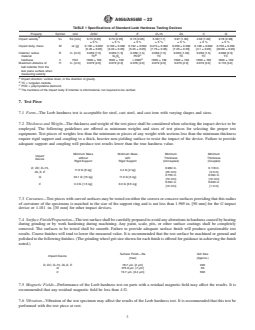
Impact velocity V ft/s [m/s] 6.73 [2.05] 6.73 [2.05] 6.73 [2.05] 5.58 [1.7] 5.97 [1.82] 4.56 [1.39] 9.78 [2.98]
A
±5% ±5% ±5% ±5% ±5% ±5% ±5%
Impact body, mass M oz [g] 0.192 ± 0.002 0.190 ± 0.002 0.192 ± 0.002 0.273 ± 0.002 0.256 ± 0.002 0.109 ± 0.002 0.705 ± 0.002
[5.45 ± 0.05] [5.40 ± 0.05] [5.45 ± 0.05] [7.75 ± 0.05] [7.25 ± 0.05] [3.1 ± 0.05] [20.00 ± 0.05]
Indenter, radius R in. [mm] 0.059 [1.5] 0.059 [1.5] 0.059 [1.5] 0.059 [1.5] 0.055 [1.39] 0.059 [1.5] 0.098 [2.5]
B C
material TC Si N PCD TC TC TC TC
3 4
D
hardness h HV2 1600 ± 100 1600 ± 100 $4500 1600 ± 100 1600 ± 100 1600 ± 100 1600 ± 100
Maximum distance of H in. [mm] 0.079 [2.0] 0.079 [2.0] 0.079 [2.0] 0.079 [2.0] 0.079 [2.0] 0.079 [2.0] 0.118 [3.0]
ball indenter from the
test piece surface when
measuring velocity
A
Impact direction: vertical down, in the direction of gravity.
B
TC = tungsten carbide.
C
PCD = polycrystaline diamond.
D
The hardness of the impact body E indenter is informational, not required to be verified.
A956/A956M−22
9.1.2 After placing the readied (loaded) impact device on
Surface Finish—Ra Grit Size
Impact Device
(max) (Approx.)
the test surface, trigger the impact by actuating the release
mechanism according to manufacturer’s instructions.
D, DC, D+15, DL, S, E 78.7 µin. [2 µm] 200
G 275.6 µin. [7 µm] 65 9.1.3 The Leeb hardness value is displayed or otherwise
C 15.7 µin. [0.4 µm] 500
used by a user interface device after the impact.
7.5 Magnetic Fields—Performance of the Leeb hardness
NOTE 2—The user interface device may take the form of a computer or
test on parts with a residual magnetic field may affect the
PLC that does not display the hardness value directly to the user. Such a
results. It is recommended that any residual magnetic field be
user interface device may use the hardness value to operate an automatic
less than 4 G.
sorting machine or simply log the value in a database.
7.6 Vibration—Vibrationofthetestspecimenmayaffectthe
9.2 Alignment—To prevent errors resulting from
results of the Leeb hardness test. It is recommended that this
misalignment, the base support ring of the impact device shall
test be performed with the test piece at rest.
be held snugly and perpendicular to the surface of the test
piece.
7.7 Temperature—The temperature of the test piece may
affect the results of the test. In addition, this effect may be
9.3 Impact Direction—The impact device is calibrated for
different for different materials. Testing to this procedure shall
the down vertical impact direction (perpendicular to a horizon-
be performed with the temperature of the test piece between
tal surface). For other impact directions such as 45° from the
39°F [4°C] and 100°F [38°C]. At temperatures outside this
horizontal plane or from underneath, the measured hardness
range, the user shall develop a temperature correction for the
values will require adjustment (see 10.2). Some newer models
specific material being tested.
automatically compensate for test direction.
8. Verification of Apparatus 9.4 Spacing Indentations—The distance between any two
impact points shall not be less than two diameters edge-to-
8.1 Verification Method—Priortoeachshift,workperiod,or
edge. The distance between the impact point and a specimen
use, and following a period of extended continuous use (1000
edge shall not be less than three diameters edge-to-edge. No
impacts),theinstrumentshallbeverifiedasspecifiedinPartB.
point shall be impacted more than once.
Any instrument not meeting the requirements of Part B shall
not be employed for the acceptance testing of product.
9.5 Reading the Leeb Instrument—Hardness values in Leeb
8.1.1 Cautionary note: When replacement parts are used in
units are read directly on the electronic display of the indicator
a Leeb hardness tester it is important that they be fully
device. The indicated value is automatically replaced with the
compatible with the original equipment, otherwise incorrect
next test impact result.
hardness readings may be obtained. Calibration using a single
9.6 Number of Impacts—Fiveimpactsinanareaofapproxi-
standard test block may indicate acceptable results, but addi-
2 2
mately 1 in. [645 mm ] shall constitute a test. If the material
tional calibration tests using blocks of differing hardness may
being tested is considered to be nonhomogeneous (for
yield unacceptable results. If replacement, non-original equip-
example, cast iron) ten impacts in an area shall be made to
ment parts are used, multiple block calibration verification is
constitute a test.
strongly advised. Specifically, one calibration block of a
hardness equal to or lower than the minimum expected
10. Calculation of Hardness Result
hardness of the material being tested, one calibration block of
a hardness equal to or greater than the maximum expected
10.1 The hardness test result shall be the arithmetic average
hardnessofthematerialbeingtested,andonecalibrationblock
of the five individual impact readings in the measuring area.
near the middle of the range should be used.
10.2 Compensation for Test Direction—When using a Leeb
instrument without automatic compensation for test direction,
9. Procedure
the compensation value for direction of test impact is to be
9.1 To perform a hardness test, the impact device is con-
subtracted from the average value determined for the measur-
nected to the user interface device and powered on.
ing area. This compensation value can be determined in
9.1.1 The impact device is readied for impact.
accordance with Tables 2-9.
9.1.1.1 Mechanically Charged Device—Some impact de-
vices are charged mechanically by pulling the impact body
11. Conversion to Other Hardness Scales or Tensile
against a spring or other mechanism that propels the impact
Strength Values
bodyattheprescribedvelocity.Theimpactdevice,whilenotin
contact with the test piece, is held firmly with one hand while 11.1 There is no direct correlation between the Leeb hard-
the charging mechanism is activated with the other hand. Once ness test principle and other hardness methods or a tensile
the impact body is in the charged position the charging strength test.All such conversions are, at best, approximations
mechanism is allowed to slowly return to its resting position. and therefore conversions should be avoided except for special
9.1.1.2 Otherwise Charged Device—Devices that are not caseswhereareliablebasisfortheapproximateconversionand
charged mechanically may use gravity or other force applica- the accuracy of the conversion has been obtained by compari-
tion method to propel the impact body at the prescribed sontesting.Noconversionsshallbeemployedwithoutspecific
velocity. Charging of these devices should be conducted agreement between the party specifying this test method and
according to manufacturer’s instructions. the party performing the hardness test.
A956/A956M−22
TABLE 2 Compensation Values for Other Impact Directions: TABLE 4 Compensation Values for Other Impact Directions:
Device D Device E
L L
D E
300 300
-6 -12 -20 -29 -5 -9 -18 -26
350 350
-6 -12 -19 -27 -4 -9 -17 -24
400 400
-5 -11 -18 -25 -4 -9 -16 -22
450 450
-5 -10 -17 -24 -4 -8 -15 -21
500 500
-5 -10 -16 -22 -4 -8 -14 -20
550 550
-4 -9 -15 -20 -4 -8 -13 -18
600 600
-4 -8 -14 -19 -3 -7 -12 -17
650 650
-4 -8 -13 -18 -3 -7 -12 -16
700 700
-3 -7 -12 -17 -3 -6 -11 -15
750 750
-3 -6 -11 -16 -3 -6 -10 -14
800 800
-3 -6 -10 -15 -3 -5 -9 -13
850 850
-2 -5 -9 -14 -2 -5 -8 -12
900 900
TABLE 3 Compensation Values for Other Impact Directions: TABLE 5 Compensation Values for Other Impact Directions:
DeviceD+15 Device C
L L
D+15 C
300 350
AA
-7 -14 -26 -38 -7 -15
350 400
-7 -13 -25 -36 -7 -14
400 450
-6 -12 -23 -34 -7 -13
450 500
-6 -12 -22 -32 -6 -13
500 550
-6 -11 -21 -30 -6 -12
550 600
-6 -11 -20 -28 -6 -11
600 650
-5 -10 -19 -27 -5 -10
650 700
-5 -10 -18 -25 -5 -10
700 750
-5 -9 -17 -24 -4 -9
750 800
-4 -9 -16 -22 -4 -8
800 850
-4 -8 -15 -21 -4 -7
850 900
-4 -8 -14 -20 -3 -6
900 950
A
Not permitted.
12. Report
12.1 Report the following information: 13. Precision and Bias
12.1.1 TheaverageLeebhardnessnumberforeachtestarea
13.1 The precision of this test method is based on an
withtheimpactdeviceindicated(forexample,xxxHLDorxxx
interlaboratory study of E140, Standard Hardness Conversion
HLD+15).
12.1.2 When hardness values converted from the Leeb
Supporting data have been filed atASTM International Headquarters and may
number are reported, the instrument used shall be reported in
beobtainedbyrequestingResearchReportRR:E28-1044.ContactASTMCustomer
parentheses, for example, HB (HLG). Service at service@astm.org.
A956/A956M−22
TABLE 6 Compensation Values for Other Impact Directions: TABLE 9 Compensation Values for Other Impact Directions:
Device G (Steel) Device S
L L
G S
300 400
... ... -12 -18 -4 -9 -16 -23
350 450
... ... -11 -17 -4 -8 -15 -22
400 500
... ... -11 -16 -4 -8 -14 -21
450 550
-2 -5 -10 -15 -4 -7 -13 -19
500 600
... ... -9 -14 -3 -7 -12 -18
550 650
... ... -9 -13 -3 -7 -12 -16
600 700
... ... -8 -12 -3 -6 -11 -15
650 750
... ... -8 -11 -3 -6 -10 -14
700 800
... ... -7 -10 -3 -5 -9 -12
750 850
-2 -5 -8 -11
-2 -5 -7 -10
TABLE 7 Compensation Values for Other Impact Directions:
Device G (Grey Cast Iron)
L
G
conductedin2006.Sixlaboratoriestestedfiveuniqueblocksat
varying hardness levels. Every “test result” represents an
... ... -11 -17
individual determination and nine replicate test results were
reported by each lab for each level. Practice E691 was
... ... -11 -16
followed for the design and analysis of the data; the details are
-2 -5 -10 -15
given in ASTM Research Report RR:E28-1044.
13.1.1 Repeatability (r)—The difference between repetitive
... ... -9 -14
results obtained by the same operator in a given laboratory
... ... -9 -13
applying the same test method with the same apparatus under
constant operating conditions on identical test material within
shortintervalsoftimewould,inthelongrun,inthenormaland
TABLE 8 Compensation Values for Other Impact Directions: correct operation of the test method, exceed the following
Device DL
values only in 1 case in 20.
L 13.1.1.1 Repeatability can be interpreted as maximum dif-
DL
ference between two results, obtained under repeatability
conditions, that is accepted as plausible due to random causes
under normal and correct operation of the test method.
-3 -6 -11 -16
13.1.1.2 Repeatability limits are listed in Table 10.
13.1.2 Reproducibility (R)—The difference between two
-3 -5 -9 -14
single and independent results obtained by different operators
-2 -5 -8 -13
applying the same test method in different laboratories using
different apparatus on identical test material would, in the long
-2 -4 -7 -11
run, in the normal and correct operation of the test method,
-2 -3 -6 -10
exceed the following values only in 1 case in 20.
13.1.2.1 Reproducibility can be interpreted as maximum
-1 -3 -5 -9
difference between two results, obtained under reproducibility
-1 -2 -4 -7
conditions, that is accepted as plausible due to random causes
under normal and correct operation of the test method.
-1 -2 -3 -6
13.1.2.2 Reproducibility limits are listed in Table 10.
13.1.3 The above terms (repeatability limit and reproduc-
ibility limit) are used as specified in Practice E177.
Tables for Metals Relationship Among Brinell Hardenss, 13.1.4 Any judgment in accordance with statements 13.1.1
Vickers Hardenss, Rockwell Hardness, Superficial Hardness, and 13.1.2 would have an approximate 95% probability of
Knoop Hardness, Scleroscope Hardness, and Leeb Hardness, being correct.
A956/A956M−22
TABLE 10 Hardness
Repeatability Reproducibility
A
Average Repeatability Limit Reproducibility Limit
Standard Deviation Standard Deviation
Material
S S rR
x¯ r R
Blocks 0521, 0520, and 0519 – 795.7 3.4 6.5 9.5 18.1
Level 1 hardness
Blocks 0518, 0517, and 0516 – 728.9 4.1 5.9 11.6 16.6
A
Level 2 hardness
Blocks 0515, 0514, and 0513 – 674.7 2.7 4.4 7.5 12.4
Level 3 hardness
Blocks 0512, 0511, and 0510 – 595.9 2.4 5.1 6.8 14.4
Level 4 hardness
Blocks 059, 058, and 057 – 512.8 3.0 8.0 8.5 22.5
A
Level 5 hardness
A
Data from only five laboratories used.
13.2 Bias—At the time of the study, there was no accepted calibrated surface. Any instrument not verified shall not be
referencematerialsuitablefordeterminingthebiasforthistest used for testing without repair and re-verification.
method, therefore no statement on bias is being made.
C. CALIBRATION OF STANDARDIZED HARDNESS
13.3 The precision statement was determined through sta-
TEST BLOCKS FOR LEEB HARDNESS
tistical examination of 252 results, from 6 laboratories, on
INSTRUMENTS
blocksrepresenting5levelsofhardness.Thesefivelevelshave
been described as the following:
17. Scope
Level 1: 800 HLD
17.1 Part C covers the calibration of standardized hardness
Level 2: 720 HLD
test blocks used for the verification of Leeb hardness instru-
Level 3: 670 HLD
ments.
Level 4: 600 HLD
Level 5: 520 HLD
18. Manufacture
13.3.1 To judge the equivalency of two test results, it is
recommended to choose the level closest in characteristics to
18.1 Each test block shall be made of steel with dimensions
the test level.
not less than 3.543in. [90 mm] in diameter by 2.126 in.
[54mm] thick for impact devices D, DC, D+15, DL, C, S, and
B. VERIFICATION OF LEEB HARDNESS
E and 4.724 in. [120 mm] in diameter by 2.756 in. [70 mm]
INSTRUMENTS
thickforimpactdevice G.Thetwooppositeendplanesurfaces
shall be parallel.
14. Scope
18.2 Each block shall be specifically prepared and heat
14.1 Part B covers the procedure for verification of L
...
This document is not an ASTM standard and is intended only to provide the user of an ASTM standard an indication of what changes have been made to the previous version. Because
it may not be technically possible to adequately depict all changes accurately, ASTM recommends that users consult prior editions as appropriate. In all cases only the current version
of the standard as published by ASTM is to be considered the official document.
Designation: A956/A956M − 17a A956/A956M − 22
Standard Test Method for
Leeb Hardness Testing of Steel Products
This standard is issued under the fixed designation A956/A956M; the number immediately following the designation indicates the year
of original adoption or, in the case of revision, the year of last revision. A number in parentheses indicates the year of last reapproval.
A superscript epsilon (´) indicates an editorial change since the last revision or reapproval.
1. Scope*
1.1 This test method covers the determination of the Leeb hardness of steel, cast steel, and cast iron (Part A), including the
methods for the verification of Leeb hardness testing instruments (Part B), and the calibration of standardized test blocks (Part C).
NOTE 1—The original title of this standard was “Standard Test Method for Equotip Hardness Testing of Steel Products.”
1.2 The values stated in either SI units or inch-pound units are to be regarded separately as standard. The values stated in each
system are not necessarily exact equivalents; therefore, to ensure conformance with the standard, each system shall be used
independently of the other, and values from the two systems shall not be combined.
1.3 This standard does not purport to address all of the safety concerns, if any, associated with its use. It is the responsibility
of the user of this standard to establish appropriate safety, health, and environmental practices and determine the applicability of
regulatory limitations prior to use.
1.4 This international standard was developed in accordance with internationally recognized principles on standardization
established in the Decision on Principles for the Development of International Standards, Guides and Recommendations issued
by the World Trade Organization Technical Barriers to Trade (TBT) Committee.
2. Referenced Documents
2.1 ASTM Standards:
E140 Hardness Conversion Tables for Metals Relationship Among Brinell Hardness, Vickers Hardness, Rockwell Hardness,
Superficial Hardness, Knoop Hardness, Scleroscope Hardness, and Leeb Hardness
E177 Practice for Use of the Terms Precision and Bias in ASTM Test Methods
E691 Practice for Conducting an Interlaboratory Study to Determine the Precision of a Test Method
3. Terminology
3.1 Definitions:
3.1.1 calibration—determination of the values of the significant operating parameters of the instrument by comparison with values
indicated by a reference instrument or by a set of reference standards.
This test method is under the jurisdiction of ASTM Committee A01 on Steel, Stainless Steel and Related Alloys and is the direct responsibility of Subcommittee A01.13
on Mechanical and Chemical Testing and Processing Methods of Steel Products and Processes.
Current edition approved Nov. 1, 2017Sept. 1, 2022. Published December 2017September 2022. Originally approved in 1996. Last previous edition approved in 2017 as
A956/A956M – 17.A956/A956M – 17A.
Leeb and Equotip are registered trademarks used with permission of Proceq SA. DOI: 10.1520/A0956_A0956M-17A.10.1520/A0956_A0956M-22.
For referenced ASTM standards, visit the ASTM website, www.astm.org, or contact ASTM Customer Service at service@astm.org. For Annual Book of ASTM Standards
volume information, refer to the standard’s Document Summary pageon the ASTM website.
*A Summary of Changes section appears at the end of this standard
Copyright © ASTM International, 100 Barr Harbor Drive, PO Box C700, West Conshohocken, PA 19428-2959. United States
A956/A956M − 22
3.1.2 Leeb hardness number—a number equal to the ratio of the rebound velocity to the impact velocity of a 0.118 in. [3 mm] or
0.197 in. [5 mm] (based on the type of impact device) diameter spherically shaped tungsten carbide, silicon nitride, or diamond
tipped impact body, multiplied by 1000.
Rebound Velocity
L 5 31000
Impact Velocity
The Leeb hardness number is followed by the symbol HL with one or more suffix characters representing the type of impact
device.
3.1.3 Leeb hardness test—a dynamic hardness test method using a calibrated instrument that impacts a spherically shaped tungsten
carbide, silicon nitride, or diamond tipped body with a fixed velocity (generated by a spring force) onto a surface of the material
under test. The ratio of the rebound velocity to the impact velocity of the impact body is a measure of the hardness of the material
under test.
3.1.4 surface finish—all references to surface finish in this test method are defined as surface roughness (that is, Ra = average
roughness value, AA = arithmetic average).
3.1.5 verification—checking or testing the instrument to ensure conformance with this test method.
4. Summary of Test Method
4.1 During a hardness test, an impact body with a spherically shaped tungsten carbide, silicon nitride, or diamond tip impacts, after
being propelled to the specified velocity, the test surface from which it rebounds. The impact and rebound velocities are measured
when the impact body is approximately 0.039 in. [1 mm] from the test surface. This is accomplished by means of a permanent
magnet mounted in the impact body which, during the test, moves through a coil in the impact device and induces an electric
voltage on both the impact and rebound movements. These induced voltages are proportional to the respective impact and rebound
velocities. The quotient of these measured voltage values derived from the impact and rebound velocities, multiplied by the factor
1000 produces a number which constitutes the Leeb hardness value.
5. Significance and Use
5.1 Hardness of a material is a poorly defined term that may have many meanings depending on the type of test performed and
the expectations of the person involved. The Leeb hardness test is of the dynamic or rebound type, which primarily depends both
on the plastic and on the elastic properties of the material being tested. The results obtained are indicative of the strength and
dependent on the heat treatment of the material tested.
5.2 The Leeb hardness test is a superficial determination only measuring the condition of the surface contacted. The results
generated at that location do not represent the part at any other surface location and yield no information about the material at
subsurface locations.
A. GENERAL DESCRIPTION OF INSTRUMENTS AND TEST PROCEDURE FOR LEEB HARDNESS TEST
6. Apparatus
6.1 The instrument used for Leeb hardness testing consists of (1) an impact device that is equipped with a spherically shaped
tungsten carbide, silicon nitride, or synthetic diamond tipped impact body, an induction coil velocity measuring assembly, and a
support ring, and (2) an electronic digital display hardness indicating device.
6.2 Impact Devices—There are eight types of impact devices used in Leeb hardness testing. These are the D, DC, D+15, DL,G,
C, S, and the E impact units. Brief descriptions of the types of devices and their common applications are given in Appendix X1.
Table 1 provides the specifications for the Leeb scales according to impact device type.
6.3 See 8.1.1 when using replacement machine components.
A956/A956M − 22
TABLE 1 Specifications of Standard Leeb Hardness Testing Devices
Property Symbol Unit D/DC S E D+15 DL C G
A
Impact velocity V ft/s [m/s] 6.73 [2.05] 6.73 [2.05] 6.73 [2.05] 5.58 [1.7] 5.97 [1.82] 4.56 [1.39] 9.78 [2.98]
A
± 5 % ± 5 % ± 5 % ± 5 % ± 5 % ± 5 % ± 5 %
Impact body, mass M oz [g] 0.192 ± 0.002 0.190 ± 0.002 0.192 ± 0.002 0.273 ± 0.002 0.256 ± 0.002 0.109 ± 0.002 0.705 ± 0.002
[5.45 ± 0.05] [5.40 ± 0.05] [5.45 ± 0.05] [7.75 ± 0.05] [7.25 ± 0.05] [3.1 ± 0.05] [20.00 ± 0.05]
Indenter, radius R in. [mm] 0.059 [1.5] 0.059 [1.5] 0.059 [1.5] 0.059 [1.5] 0.055 [1.39] 0.059 [1.5] 0.098 [2.5]
B C
material TC Si N PCD TC TC TC TC
3 4
D
hardness h HV2 1600 ± 100 1600 ± 100 $4500 1600 ± 100 1600 ± 100 1600 ± 100 1600 ± 100
Maximum distance of H in. [mm] 0.079 [2.0] 0.079 [2.0] 0.079 [2.0] 0.079 [2.0] 0.079 [2.0] 0.079 [2.0] 0.118 [3.0]
ball indenter from the
test piece surface when
measuring velocity
A
Impact direction: vertical down, in the direction of gravity.
B
TC = tungsten carbide.
C
PCD = polycrystaline diamond.
D
The hardness of the impact body E indenter is informational, not required to be verified.
7. Test Piece
7.1 Form—The Leeb hardness test is acceptable for steel, cast steel, and cast iron with varying shapes and sizes.
7.2 Thickness and Weight—The thickness and weight of the test piece shall be considered when selecting the impact device to be
employed. The following guidelines are offered as minimum weights and sizes of test pieces for selecting the proper test
equipment. Test pieces of weights less than the minimum or pieces of any weight with sections less than the minimum thickness
require rigid support and coupling to a thick, heavier non-yielding surface to resist the impact of the device. Failure to provide
adequate support and coupling will produce test results lower than the true hardness value.
Minimum Mass Minimum Mass Minimum Minimum
Impact
without with Thickness Thickness
Device
Rigid Support Rigid Support (Uncoupled) (Coupled)
D, DC, D+15, 0.984 in. 0.118 in.
11.0 lb [5 kg] 4.4 lb [2 kg]
DL,S, E [25 mm] [3 mm]
2.756 in. 0.394 in.
G 33.1 lb [15 kg] 11.0 lb [5 kg]
[70 mm] [10 mm]
0.394 in. 0.039 in.
C 3.3 lb [1.5 kg] 0.3 lb [0.5 kg]
[10 mm] [1 mm]
7.3 Curvature—Test pieces with curved surfaces may be tested on either the convex or concave surfaces providing that this radius
of curvature of the specimens is matched to the size of the support ring and is not less than 1.969 in. [50 mm] for the G impact
device or 1.181 in. [30 mm] for other impact devices.
7.4 Surface Finish/Preparation—The test surface shall be carefully prepared to avoid any alterations in hardness caused by heating
during grinding or by work hardening during machining. Any paint, scale, pits, or other surface coatings shall be completely
removed. The surfaces to be tested shall be smooth. Failure to provide adequate surface finish will produce questionable test
results. Coarse finishes will tend to lower the measured value. It is recommended that the test surface be machined or ground and
polished to the following finishes. (The grinding wheel grit size shown for each finish is offered for guidance in achieving the finish
noted.)
Surface Finish—Ra Grit Size
Impact Device
(max) (Approx.)
D, DC, D+15, DL,S, E 78.7 μin. [2 μm] 200
G 275.6 μin. [7 μm] 65
C 15.7 μin. [0.4 μm] 500
7.5 Magnetic Fields—Performance of the Leeb hardness test on parts with a residual magnetic field may affect the results. It is
recommended that any residual magnetic field be less than 4 G.
7.6 Vibration—Vibration of the test specimen may affect the results of the Leeb hardness test. It is recommended that this test be
performed with the test piece at rest.
A956/A956M − 22
7.7 Temperature—The temperature of the test piece may affect the results of the test. In addition, this effect may be different for
different materials. Testing to this procedure shall be performed with the temperature of the test piece between 39 °F [4 °C] and
100 °F [38 °C]. At temperatures outside this range, the user shall develop a temperature correction for the specific material being
tested.
8. Verification of Apparatus
8.1 Verification Method—Prior to each shift, work period, or use, and following a period of extended continuous use (1000
impacts), the instrument shall be verified as specified in Part B. Any instrument not meeting the requirements of Part B shall not
be employed for the acceptance testing of product.
8.1.1 Cautionary note: When replacement parts are used in a Leeb hardness tester it is important that they be fully compatible with
the original equipment, otherwise incorrect hardness readings may be obtained. Calibration using a single standard test block may
indicate acceptable results, but additional calibration tests using blocks of differing hardness may yield unacceptable results. If
replacement, non-original equipment parts are used, multiple block calibration verification is strongly advised. Specifically, one
calibration block of a hardness equal to or lower than the minimum expected hardness of the material being tested, one calibration
block of a hardness equal to or greater than the maximum expected hardness of the material being tested, and one calibration block
near the middle of the range should be used.
9. Procedure
9.1 To perform a hardness test, the impact device is connected to the user interface device and powered on.
9.1.1 The impact device is readied for impact.
9.1.1.1 Mechanically Charged Device—Some impact devices are charged mechanically by pulling the impact body against a
spring or other mechanism that propels the impact body at the prescribed velocity. The impact device, while not in contact with
the test piece, is held firmly with one hand while the charging mechanism is activated with the other hand. Once the impact body
is in the charged position the charging mechanism is allowed to slowly return to its resting position.
9.1.1.2 Otherwise Charged Device—Devices that are not charged mechanically may use gravity or other force application method
to propel the impact body at the prescribed velocity. Charging of these devices should be conducted according to manufacturer’s
instructions.
9.1.2 After placing the readied (loaded) impact device on the test surface, trigger the impact by actuating the release mechanism
according to manufacturer’s instructions.
9.1.3 The Leeb hardness value is displayed or otherwise used by a user interface device after the impact.
NOTE 2—The user interface device may take the form of a computer or PLC that does not display the hardness value directly to the user. Such a user
interface device may use the hardness value to operate an automatic sorting machine or simply log the value in a database.
9.2 Alignment—To prevent errors resulting from misalignment, the base support ring of the impact device shall be held snugly and
perpendicular to the surface of the test piece.
9.3 Impact Direction—The impact device is calibrated for the down vertical impact direction (perpendicular to a horizontal
surface). For other impact directions such as 45° from the horizontal plane or from underneath, the measured hardness values will
require adjustment (see 10.2). Some newer models automatically compensate for test direction.
9.4 Spacing Indentations—The distance between any two impact points shall not be less than two diameters edge-to-edge. The
distance between the impact point and a specimen edge shall not be less than three diameters edge-to-edge. No point shall be
impacted more than once.
9.5 Reading the Leeb Instrument—Hardness values in Leeb units are read directly on the electronic display of the indicator device.
The indicated value is automatically replaced with the next test impact result.
A956/A956M − 22
2 2
9.6 Number of Impacts—Five impacts in an area of approximately 1 in. [645 mm ] shall constitute a test. If the material being
tested is considered to be nonhomogeneous (for example, cast iron) ten impacts in an area shall be made to constitute a test.
10. Calculation of Hardness Result
10.1 The hardness test result shall be the arithmetic average of the five individual impact readings in the measuring area.
10.2 Compensation for Test Direction—When using a Leeb instrument without automatic compensation for test direction, the
compensation value for direction of test impact is to be subtracted from the average value determined for the measuring area. This
compensation value can be determined in accordance with Tables 2-9.
11. Conversion to Other Hardness Scales or Tensile Strength Values
11.1 There is no direct correlation between the Leeb hardness test principle and other hardness methods or a tensile strength test.
All such conversions are, at best, approximations and therefore conversions should be avoided except for special cases where a
reliable basis for the approximate conversion and the accuracy of the conversion has been obtained by comparison testing. No
conversions shall be employed without specific agreement between the party specifying this test method and the party performing
the hardness test.
12. Report
12.1 Report the following information:
12.1.1 The average Leeb hardness number for each test area with the impact device indicated (for example, xxx HLD or xxx
HLD+15).
12.1.2 When hardness values converted from the Leeb number are reported, the instrument used shall be reported in parentheses,
for example, HB (HLG).
TABLE 2 Compensation Values for Other Impact Directions:
Device D
L
D
-6 -12 -20 -29
-6 -12 -19 -27
-5 -11 -18 -25
-5 -10 -17 -24
-5 -10 -16 -22
-4 -9 -15 -20
-4 -8 -14 -19
-4 -8 -13 -18
-3 -7 -12 -17
-3 -6 -11 -16
-3 -6 -10 -15
-2 -5 -9 -14
A956/A956M − 22
TABLE 3 Compensation Values for Other Impact Directions:
Device D + 15
L
D + 15
-7 -14 -26 -38
-7 -13 -25 -36
-6 -12 -23 -34
-6 -12 -22 -32
-6 -11 -21 -30
-6 -11 -20 -28
-5 -10 -19 -27
-5 -10 -18 -25
-5 -9 -17 -24
-4 -9 -16 -22
-4 -8 -15 -21
-4 -8 -14 -20
TABLE 4 Compensation Values for Other Impact Directions:
Device E
L
E
-5 -9 -18 -26
-4 -9 -17 -24
-4 -9 -16 -22
-4 -8 -15 -21
-4 -8 -14 -20
-4 -8 -13 -18
-3 -7 -12 -17
-3 -7 -12 -16
-3 -6 -11 -15
-3 -6 -10 -14
-3 -5 -9 -13
-2 -5 -8 -12
13. Precision and Bias
13.1 The precision of this test method is based on an interlaboratory study of E140, Standard Hardness Conversion Tables for
Metals Relationship Among Brinell Hardenss, Vickers Hardenss, Rockwell Hardness, Superficial Hardness, Knoop Hardness,
Supporting data have been filed at ASTM International Headquarters and may be obtained by requesting Research Report RR:E28-1044. Contact ASTM Customer
Service at service@astm.org.
A956/A956M − 22
TABLE 5 Compensation Values for Other Impact Directions:
Device C
L
C
A A
-7 -15
-7 -14
-7 -13
-6 -13
-6 -12
-6 -11
-5 -10
-5 -10
-4 -9
-4 -8
-4 -7
-3 -6
A
Not permitted.
TABLE 6 Compensation Values for Other Impact Directions:
Device G (Steel)
L
G
. . . . . . -12 -18
. . . . . . -11 -17
. . . . . . -11 -16
-2 -5 -10 -15
. . . . . . -9 -14
. . . . . . -9 -13
. . . . . . -8 -12
. . . . . . -8 -11
. . . . . . -7 -10
Scleroscope Hardness, and Leeb Hardness, conducted in 2006. Six laboratories tested five unique blocks at varying hardness levels.
Every “test result” represents an individual determination and nine replicate test results were reported by each lab for each level.
Practice E691 was followed for the design and analysis of the data; the details are given in ASTM Research Report RR:E28-1044.
13.1.1 Repeatability (r)—The difference between repetitive results obtained by the same operator in a given laboratory applying
the same test method with the same apparatus under constant operating conditions on identical test material within short intervals
of time would, in the long run, in the normal and correct operation of the test method, exceed the following values only in 1 case
in 20.
13.1.1.1 Repeatability can be interpreted as maximum difference between two results, obtained under repeatability conditions, that
is accepted as plausible due to random causes under normal and correct operation of the test method.
A956/A956M − 22
TABLE 7 Compensation Values for Other Impact Directions:
Device G (Grey Cast Iron)
L
G
. . . . . . -11 -17
. . . . . . -11 -16
-2 -5 -10 -15
. . . . . . -9 -14
. . . . . . -9 -13
TABLE 8 Compensation Values for Other Impact Directions:
Device DL
L
DL
-3 -6 -11 -16
-3 -5 -9 -14
-2 -5 -8 -13
-2 -4 -7 -11
-2 -3 -6 -10
-1 -3 -5 -9
-1 -2 -4 -7
-1 -2 -3 -6
13.1.1.2 Repeatability limits are listed in Table 10.
13.1.2 Reproducibility (R)—The difference between two single and independent results obtained by different operators applying
the same test method in different laboratories using different apparatus on identical test material would, in the long run, in the
normal and correct operation of the test method, exceed the following values only in 1 case in 20.
13.1.2.1 Reproducibility can be interpreted as maximum difference between two results, obtained under reproducibility conditions,
that is accepted as plausible due to random causes under normal and correct operation of the test method.
13.1.2.2 Reproducibility limits are listed in Table 10.
13.1.3 The above terms (repeatability limit and reproducibility limit) are used as specified in Practice E177.
13.1.4 Any judgment in accordance with statements 13.1.1 and 13.1.2 would have an approximate 95 % probability of being
correct.
13.2 Bias—At the time of the study, there was no accepted reference material suitable for determining the bias for this test method,
therefore no statement on bias is being made.
13.3 The precision statement was determined through statistical examination of 252 results, from 6 laboratories, on blocks
representing 5 levels of hardness. These five levels have been described as the following:
Level 1: 800 HLD
A956/A956M − 22
TABLE 9 Compensation Values for Other Impact Directions:
Device S
L
S
-4 -9 -16 -23
-4 -8 -15 -22
-4 -8 -14 -21
-4 -7 -13 -19
-3 -7 -12 -18
-3 -7 -12 -16
-3 -6 -11 -15
-3 -6 -10 -14
-3 -5 -9 -12
-2 -5 -8 -11
-2 -5 -7 -10
Level 2: 720 HLD
Level 3: 670 HLD
Level 4: 600 HLD
Level 5: 520 HLD
13.3.1 To judge the equivalency of two test results, it is recommended to choose the level closest in characteristics to the test level.
B. VERIFICATION OF LEEB HARDNESS INSTRUMENTS
14. Scope
14.1 Part B covers the procedure for verification of Leeb hardness instruments by a standardized block method.
15. General Requirements
15.1 Before a Leeb hardness instrument is verified, the instrument shall be examined to ensure that:
15.1.1 The batteries in the indicating device are not discharged, and faulty batteries are replaced as required.
15.1.2 The impact device is clean, and the spherical tip of the impact body is free from all foreign matter (for example, dust, dirt,
grease, scale, etc.).
15.1.3 The tip of the impact body is free from cracks or deformed areas.
15.1.4 The test block is placed on a clean, level, firmly supported base.
16. Verification by Standardized Test Blocks
16.1 Check the Leeb hardness instrument by making two impacts on a five impacts uniformly distributed across a calibrated test
surface of a standardized test block.
16.2 The Leeb hardness instrument shall be considered verified if the individual arithmetic average of the five individual impact
A956/A956M − 22
TABLE 10 Hardness
Repeatability Reproducibility
A
Average Repeatability Limit Reproducibility Limit
Standard Deviation Standard Deviation
Material
S S r R
x¯ r R
Blocks 0521, 0520, and 0519 – 795.7 3.4 6.5 9.5 18.1
Level 1 hardness
Blocks 0518, 0517, and 0516 – 728.9 4.1 5.9 11.6 16.6
A
Level 2 hardness
Blocks 0515, 0514, and 0513 – 674.7 2.7 4.4 7.5 12.4
Level 3 hardness
Blocks 0512, 0511, and 0510 – 595.9 2.4 5.1 6.8 14.4
Level 4 hardness
Blocks 059, 058, and 057 – 512.8 3.0 8.0 8.5 22.5
A
Level 5 hardness
A
Data from only five laboratories used.
readings fall within 66 HL units of the reference value. value of the calibrated surface. Any instrument not verified shall not be
used for testing without repair and re-verification.
C. CALIBRATION OF STANDARDIZED HARDNESS TEST BLOCKS FOR LEEB HARDNESS INSTRUMENTS
17. Scope
17.1 Part C covers the calibration of standardized hardness test blocks used for the verification of Leeb hardness instruments.
18. Manufacture
18.1 Each test block shall be made of steel with dimensions not less than 3.543 in. [90 mm] in diameter by 2.126 in. [54 mm] thick
for impact devices D, DC, D+15, DL,C,S, and E and 4.724 in. [120 mm] in diameter by 2.756 in. [70 mm] thick for impact device
G. The two opposite end plane surfaces shall be parallel.
18.2 Each block shall be specifically prepared and heat treated to give a specific hardness and the necessary homogeneity and
stability of structure.
18.3 Each steel b
...