

ASTM A770/A770M-03(2018)
(Specification)Standard Specification for Through-Thickness Tension Testing of Steel Plates for Special Applications
General Information
- Abstract
ABSTRACT
This specification covers procedures and acceptance standards for the determination of reduction of area using steel plates as tension test specimen. The tension testing method shall provide a measure of the resistance of a steel plate to lamellar tearing. Alternative test specimen may be used in place of the standard test specimen. Several types of test specimen shall have specified values of plate thickness, diameter, minimum radius, and length of reduced section.
SCOPE
1.1 This specification2 covers the procedures and acceptance standards for the determination of reduction of area using a tension test specimen whose axis is perpendicular to the rolled surfaces of steel plates 1 in. [25 mm] and greater in thickness. The principal purpose of the testing is to provide a measure of the resistance of a steel plate to lamellar tearing. (See Appendix X1.)
1.2 The values stated in either inch-pound units or SI units are to be regarded as standard. Within the text, the SI units are shown in brackets. The values stated in each system are not exact equivalents; therefore, each system must be used independently of the other. Combining values from the two systems may result in nonconformance with the specification.
1.3 This specification is expressed in both inch-pound and SI units. However, unless the order specifies the applicable “M” specification designation (SI units), the material shall be furnished to inch-pound units.
1.4 This international standard was developed in accordance with internationally recognized principles on standardization established in the Decision on Principles for the Development of International Standards, Guides and Recommendations issued by the World Trade Organization Technical Barriers to Trade (TBT) Committee.
- Status
- Published
- Publication Date
- 31-Aug-2018
- Technical Committee
- A01 - Steel, Stainless Steel and Related Alloys
- Drafting Committee
- A01.11 - Steel Plates for Boilers and Pressure Vessels
Overview
ASTM A770/A770M-03(2018) is an internationally recognized standard specification developed by ASTM International for through-thickness tension testing of steel plates intended for special applications. The purpose of this standard is to outline procedures and acceptance criteria for measuring the reduction of area using a tension test specimen oriented perpendicular to the rolled surfaces of steel plates, specifically those 1 inch (25 mm) and greater in thickness. This testing provides essential insight into the steel plate’s resistance to lamellar tearing, a type of cracking caused mainly by strain through the plate thickness, particularly relevant in welded structures.
Key Topics
Through-Thickness Tension Testing:
The core focus of this standard is the method for testing steel plates by pulling a sample perpendicular to the plate’s surface to measure ductility and determine resistance to lamellar tearing.Test Specimen Types and Dimensions:
Several standard and alternative test specimen geometries are addressed, each with specific dimensions for diameter, length, and radius tailored to different plate thicknesses.Test Procedures and Acceptance Criteria:
- Plates must undergo two tension tests from each as-rolled or heat-treated plate, taken from the center areas at both ends.
- The minimum accepted reduction of area is set at 20%. If both tests fall below this limit, retesting is generally not permitted unless there’s a procedural “no-test.”
- Alternative specimens and additional tests can be specified by purchaser agreement.
Metric and Inch-Pound Units:
The standard supports both SI and inch-pound units. Materials default to inch-pound units unless otherwise specified.Identification of Compliant Plates:
Plates meeting through-thickness ductility requirements are marked “ZT” adjacent to standard product markings.
Applications
ASTM A770/A770M-03(2018) is invaluable for applications where steel plates are subjected to high restraint during fabrication, particularly welding, making them susceptible to lamellar tearing. Key application areas include:
Structural Steel for Critical Welded Constructions:
Ideal for bridges, offshore platforms, building components, and other heavy structures where through-thickness properties are crucial to structural integrity.Pressure Vessels and Boilers:
Used for monitoring and qualifying plates in industries governed by the ASME Boiler and Pressure Vessel Code, ensuring safety and long-term performance.Heavy Equipment and Machinery Bases:
Relevant wherever large steel plates are joined under high stress and reliability is critical.Infrastructure Projects:
Suited for large infrastructure elements where welding is a primary joining method and resistance to lamellar tearing improves service life and safety.
Related Standards
Several referenced and related documents support or complement ASTM A770/A770M-03(2018):
ASTM A370:
Standard Test Methods and Definitions for Mechanical Testing of Steel Products, cited for details on tension test specimen preparation and procedures.SA-770/SA-770M (ASME):
Adopted within Section II of the ASME Boiler and Pressure Vessel Code for equivalent applications.International Guidance:
Developed in accordance with principles recognized by the World Trade Organization Technical Barriers to Trade (TBT) Committee, ensuring harmonization with global best practices.
Practical Value
Implementing ASTM A770/A770M-03(2018) ensures:
- Enhanced quality control and risk mitigation against lamellar tearing in welded steel structures.
- Reliable material selection and qualification for engineers, manufacturers, and purchasers.
- Compliance with international trade requirements and codes, facilitating global project delivery and certification.
Keywords:
through-thickness tension testing, steel plate, lamellar tearing, structural steel testing, ASTM A770, welded structures, mechanical properties, reduction of area, special steelmaking processes.
Relations
- Effective Date
- 01-Mar-2024
- Effective Date
- 01-Jul-2019
- Refers
ASTM A370-17a - Standard Test Methods and Definitions for Mechanical Testing of Steel Products - Effective Date
- 15-Nov-2017
- Effective Date
- 01-Jan-2017
- Effective Date
- 01-Nov-2015
- Effective Date
- 15-May-2014
- Effective Date
- 15-Nov-2013
- Refers
ASTM A370-12a - Standard Test Methods and Definitions for Mechanical Testing of Steel Products - Effective Date
- 15-Oct-2012
- Effective Date
- 15-Mar-2012
- Refers
ASTM A370-11a - Standard Test Methods and Definitions for Mechanical Testing of Steel Products - Effective Date
- 15-Nov-2011
- Effective Date
- 15-Jun-2010
- Refers
ASTM A370-09a - Standard Test Methods and Definitions for Mechanical Testing of Steel Products - Effective Date
- 01-Jun-2009
- Refers
ASTM A370-09ae1 - Standard Test Methods and Definitions for Mechanical Testing of Steel Products - Effective Date
- 01-Jun-2009
- Effective Date
- 01-Jan-2009
- Refers
ASTM A370-08b - Standard Test Methods and Definitions for Mechanical Testing of Steel Products - Effective Date
- 15-Oct-2008
Get Certified
Connect with accredited certification bodies for this standard

Element Materials Technology
Materials testing and product certification.

Inštitut za kovinske materiale in tehnologije
Institute of Metals and Technology. Materials testing, metallurgical analysis, NDT.
Sponsored listings
Frequently Asked Questions
ASTM A770/A770M-03(2018) is a technical specification published by ASTM International. Its full title is "Standard Specification for Through-Thickness Tension Testing of Steel Plates for Special Applications". This standard covers: ABSTRACT This specification covers procedures and acceptance standards for the determination of reduction of area using steel plates as tension test specimen. The tension testing method shall provide a measure of the resistance of a steel plate to lamellar tearing. Alternative test specimen may be used in place of the standard test specimen. Several types of test specimen shall have specified values of plate thickness, diameter, minimum radius, and length of reduced section. SCOPE 1.1 This specification2 covers the procedures and acceptance standards for the determination of reduction of area using a tension test specimen whose axis is perpendicular to the rolled surfaces of steel plates 1 in. [25 mm] and greater in thickness. The principal purpose of the testing is to provide a measure of the resistance of a steel plate to lamellar tearing. (See Appendix X1.) 1.2 The values stated in either inch-pound units or SI units are to be regarded as standard. Within the text, the SI units are shown in brackets. The values stated in each system are not exact equivalents; therefore, each system must be used independently of the other. Combining values from the two systems may result in nonconformance with the specification. 1.3 This specification is expressed in both inch-pound and SI units. However, unless the order specifies the applicable “M” specification designation (SI units), the material shall be furnished to inch-pound units. 1.4 This international standard was developed in accordance with internationally recognized principles on standardization established in the Decision on Principles for the Development of International Standards, Guides and Recommendations issued by the World Trade Organization Technical Barriers to Trade (TBT) Committee.
ABSTRACT This specification covers procedures and acceptance standards for the determination of reduction of area using steel plates as tension test specimen. The tension testing method shall provide a measure of the resistance of a steel plate to lamellar tearing. Alternative test specimen may be used in place of the standard test specimen. Several types of test specimen shall have specified values of plate thickness, diameter, minimum radius, and length of reduced section. SCOPE 1.1 This specification2 covers the procedures and acceptance standards for the determination of reduction of area using a tension test specimen whose axis is perpendicular to the rolled surfaces of steel plates 1 in. [25 mm] and greater in thickness. The principal purpose of the testing is to provide a measure of the resistance of a steel plate to lamellar tearing. (See Appendix X1.) 1.2 The values stated in either inch-pound units or SI units are to be regarded as standard. Within the text, the SI units are shown in brackets. The values stated in each system are not exact equivalents; therefore, each system must be used independently of the other. Combining values from the two systems may result in nonconformance with the specification. 1.3 This specification is expressed in both inch-pound and SI units. However, unless the order specifies the applicable “M” specification designation (SI units), the material shall be furnished to inch-pound units. 1.4 This international standard was developed in accordance with internationally recognized principles on standardization established in the Decision on Principles for the Development of International Standards, Guides and Recommendations issued by the World Trade Organization Technical Barriers to Trade (TBT) Committee.
ASTM A770/A770M-03(2018) is classified under the following ICS (International Classification for Standards) categories: 77.040.10 - Mechanical testing of metals. The ICS classification helps identify the subject area and facilitates finding related standards.
ASTM A770/A770M-03(2018) has the following relationships with other standards: It is inter standard links to ASTM A370-24, ASTM A370-19, ASTM A370-17a, ASTM A370-17, ASTM A370-15, ASTM A370-14, ASTM A370-13, ASTM A370-12a, ASTM A370-12, ASTM A370-11a, ASTM A370-10, ASTM A370-09a, ASTM A370-09ae1, ASTM A370-09, ASTM A370-08b. Understanding these relationships helps ensure you are using the most current and applicable version of the standard.
ASTM A770/A770M-03(2018) is available in PDF format for immediate download after purchase. The document can be added to your cart and obtained through the secure checkout process. Digital delivery ensures instant access to the complete standard document.
Standards Content (Sample)
This international standard was developed in accordance with internationally recognized principles on standardization established in the Decision on Principles for the
Development of International Standards, Guides and Recommendations issued by the World Trade Organization Technical Barriers to Trade (TBT) Committee.
Designation: A770/A770M −03 (Reapproved 2018)
Standard Specification for
Through-Thickness Tension Testing of Steel Plates for
Special Applications
This standard is issued under the fixed designationA770/A770M; the number immediately following the designation indicates the year
of original adoption or, in the case of revision, the year of last revision. A number in parentheses indicates the year of last reapproval.
A superscript epsilon (´) indicates an editorial change since the last revision or reapproval.
This standard has been approved for use by agencies of the U.S. Department of Defense.
1. Scope 3. Ordering Information
1.1 This specification covers the procedures and accep- 3.1 The inquiry and order shall include the following, if
tancestandardsforthedeterminationofreductionofareausing required:
a tension test specimen whose axis is perpendicular to the 3.1.1 Supplementary requirements that are available to meet
rolled surfaces of steel plates 1 in. [25 mm] and greater in end use requirements (see S1 through S5).
thickness. The principal purpose of the testing is to provide a 3.1.2 Special requirements agreed upon between the manu-
measure of the resistance of a steel plate to lamellar tearing. facturer and the purchaser.
(See Appendix X1.)
4. Tension Tests
1.2 The values stated in either inch-pound units or SI units
4.1 Number of Tests:
are to be regarded as standard. Within the text, the SI units are
4.1.1 Two tests shall be required from each plate-as-rolled,
shown in brackets. The values stated in each system are not
except for plates subjected to heat treatment by quenching and
exact equivalents; therefore, each system must be used inde-
tempering. Two tests shall be required from each quenched-
pendentlyoftheother.Combiningvaluesfromthetwosystems
and-tempered plate. The tests shall be representative of the
may result in nonconformance with the specification.
plate in its final condition.
1.3 This specification is expressed in both inch-pound and
4.1.2 When plates are furnished by the manufacturer in an
SI units. However, unless the order specifies the applicable
unheat-treated condition and qualified by heat-treated speci-
“M” specification designation (SI units), the material shall be
mens (including normalized, normalized and tempered, and
furnished to inch-pound units.
quenched and tempered), two tests shall be required from each
1.4 This international standard was developed in accor-
plate-as-rolled.
dance with internationally recognized principles on standard-
NOTE 1—The term “plate-as-rolled” refers to the unit plate rolled from
ization established in the Decision on Principles for the
a slab or directly from an ingot. It does not refer to the condition of the
Development of International Standards, Guides and Recom-
plate.
mendations issued by the World Trade Organization Technical
4.2 LocationofTestCoupons—Take one test coupon at each
Barriers to Trade (TBT) Committee.
end of each plate as defined in 4.1. Take the test coupons from
the center of the plate width.
2. Referenced Documents
4.3 Orientation of Test Specimens—The longitudinal axis of
2.1 ASTM Standards:
thereducedsectionofthetestspecimensshallbeperpendicular
A370 Test Methods and Definitions for Mechanical Testing
to the rolled surface of the plate.
of Steel Products
4.4 Preparation of Test Specimens:
4.4.1 Welded Prolongations—When required, join welded
This specification is under the jurisdiction of ASTM Committee A01 on Steel,
prolongations to the surface(s) of the plate being tested. The
Stainless Steel and Related Alloys and is the direct responsibility of Subcommittee
A01.11 on Steel Plates for Boilers and Pressure Vessels.
joining method used shall be one which results in a minimal
Current edition approved Sept. 1, 2018. Published September 2018. Originally
heat-affected zone in the portion of the plate to be tested.
approved in 1980. Last previous edition approved in 2012 as A770/
ɛ1 Shielded metal arc, friction, stud, or electron-beam welding
A770M – 03 (2012) . DOI: 10.1520/A0770_A0770M-03R18.
methods have proven to be suitable.
For ASME Boiler and Pressure Vessel Code applications, see related Specifi-
cation SA-770/SA-770M in Section II of that Code.
4.4.2 Standard Test Specimens:
For referenced ASTM standards, visit the ASTM website, www.astm.org, or
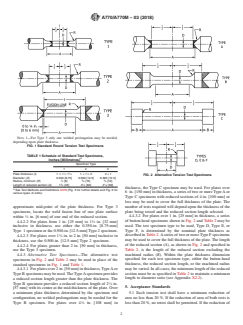
4.4.2.1 Threetypesofstandardroundtensiontestspecimens
contact ASTM Customer Service at service@astm.org. For Annual Book of ASTM
are shown in Fig. 1 and Table 1. For Types 1 and 2 specimens,
Standards volume information, refer to the standard’s Document Summary page on
the ASTM website. locate the center of the length of the reduced section at the
Copyright © ASTM International, 100 Barr Harbor Drive, PO Box C700, West Conshohocken, PA 19428-2959. United States
A770/A770M − 03 (2018)
NOTE 1—For Type 3 only one welded prolongation may be needed,
depending upon plate thickness.
FIG. 1 Standard Round Tension Test Specimens
TABLE 1 Schedule of Standard Test Specimens,
A
Inches [Millimetres]
Specimen Type
Plate thickness (t)1# t# 1 ⁄4 1< t#22< t
FIG. 2 Alternative Tension Test Specimens
Diameter (D) 0.350 [8.75] 0.500 [12.5] 0.500 [12.5]
1 3 3
Radius, minimum (R) ⁄4 [6] ⁄8 [10] ⁄8 [10]
3 1 1
Length of reduced section (A)1 ⁄4 [45] 2 ⁄4 [60] 2 ⁄4 [60]
thickness, the Type C specimen may be used. For plates over
A
See Test Methods and Definitions A370 (Fig. 5 for further details and Fig. 6 for
6 in. [150 mm] in thickness, a series of two or more TypeAor
various types of ends).
Type C specimens with reduced sections of 4 in. [100 mm] or
less may be used to cover the full thickness of the plate. The
number of tests required will depend upon the thickness of the
approximate mid-point of the plate thickness. For Type 3
plate being tested and the reduced section length selected.
specimens, locate the weld fusion line of one plate surface
4.4.3.2 For plates over 1 in. [25 mm] in thickness, a series
within ⁄4 in. [6 mm] of one end of the reduced section.
of button-head specimens shown in Fig. 2 and Table 2 may be
4.4.2.2 For plates from 1 in. [25 mm] to 1 ⁄4 in. [32 mm]
used. The test specimen type to be used, Type D, Type E, or
inclusive in thickness, use either the 0.350-in. [8.75-mm]
Type F, is determined by the nominal plate thickness as
Type 1 specimen or the 0.500-in. [12.5-mm]Type 2 specimen.
described in Table 2.Aseries of two or moreType F specimens
4.4.2.3 For plates over 1 ⁄4 in. to 2 in. [50 mm] inclusive in
may be used to cover the full thickness of the plate. The length
thickness, use the 0.500-in. [12.5-mm] Type 2 specimen.
of the reduced section (A), as shown in Fig. 2 and specified in
4.4.2.4 For plates greater than 2 in. [50 mm] in thickness,
Table 2, is the length of the reduced section excluding the
use the Type 3 specimen.
machined radius (R). Within the plate thickness dimension
4.4.3 Alternative Test Specimens—The alternative test
specified for each test specimen type, either the button-head
specimens in Fig. 2 and Table 2 may be used in place of the
thickness, the reduced section length, or the machined radius
standard specimens in Fig. 1 and Table 1.
may be varied. In all cases, the minimum length of the reduced
4.4.3.1 For plates over 2 in. [50 mm] in thickness,TypeAor
section must be as specified in Table 2 to maintain a minimum
TypeBspecimensmaybeused.TheTypeAspecimenprovides
length to diameter ratio (see Appendix X2.2).
a reduced section length greater than the plate thickness. The
Type B specimen provides a reduced section length of 2 ⁄4 in.
5. Acceptance Standards
[57 mm] with its center at the mid-thickness of the plate. Over
a minimum plate thickness determined by the specimen end 5.1 Each tension test shall have a minimum reduction of
configuration, no welded prolongations may be needed for the area no less than 20 %. If the reduction of area of both tests is
Type B specimen. For plates over 4 ⁄4 in. [108 mm] in less than 20 %, no retest shall be permitted. If the reduction of
A770/A770M − 03 (2018)
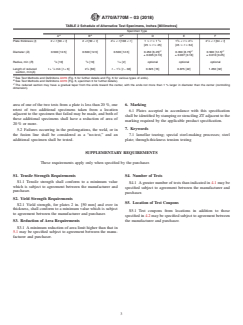
TABLE 2 Schedule of Alternative Test Specimens, Inches [Millimetres]
Specimen Type
A A B
A B C DE F
1 3 3 1 1
Plate thickness (t)2< t [50 < t]2
[25# t# 45] [45# t# 64]
C C C
Diameter (D) 0.500 [12.5] 0.500 [12.5] 0.500 [12.5] 0.250 [6.25] 0.350 [8.75] 0.500 [12.5]
± 0.005 [0.10] ± 0.007 [0.18] ± 0.010 [0.25]
3 3 1
Radius, min (R) ⁄8 [10] ⁄8 [10] ⁄16 [2] optional optional optional
1 1 1
Length of reduced t + ⁄4 min [t+6] 2 ⁄4 [60] t−1 ⁄2 [t − 38] 0.625 [16] 0.875 [22] 1.250 [32]
section, min(A)
A
See Test Methods and Definitions A370 (Fig. 5 for further details and Fig. 6 for various types of ends).
B
See Test Methods and Definitions A370 (Fig. 6, specimen 3 for further details).
C
The reduced section may have a gradual taper from the ends toward the center, with the ends not more than 1 % larger in diameter than the center (controlling
dimension).
area of one of the two tests from a plate is less than 20 %, one 6. Marking
retest of two additional specimens taken from a location
6.1 Plates accepted in accordance with this specification
adjacent to the specimen that failed may be made, and both of
shall be identified by stamping or stenciling ZT adjacent to the
these additional specimens shall have a reduction of area of
marking required by the applicable product specification.
20 % or more.
7. Keywords
5.2 Failures occurring in the prolongations, the weld, or in
the fusion line shall be considered as a “no-test,” and an 7.1 lamellar tearing; special steel-making processes; steel
additional spe
...